
Leica Q3 vs Fujifilm X100V: Compact Cameras Face Off
The Leica Q3 is here, and it brings bold performance. Its 40MP full-frame sensor promises incredible detail. Autofocus is faster than ever. Video capabilities include 4K recording. Every shot feels deliberate. Every feature supports hybrid shooting. Build quality is premium, and the design is classic Leica.
Meanwhile, the Fujifilm X100V remains impressively. Its APS-C sensor delivers sharp images with vibrant color science. Hybrid autofocus and tilting touchscreen add versatility. It records 4K video with high-quality profiles. The lens is fixed but optimized for street and portrait photography. The body is compact and weather-sealed.
Choosing between the Leica Q3 and Fujifilm X100V is not easy. Both cameras target enthusiasts and professionals who value image quality and reliability. Both excel in stills and video. Yet, subtle differences in sensor size, lens characteristics, autofocus, and hybrid performance matter. Understanding these differences is key before investing in either camera.
This comparison explores image quality, autofocus, video performance, build, and ergonomics. We break down the strengths and trade-offs of the Leica Q3 and Fujifilm X100V. By the end, you’ll know which compact camera fits your style, needs, and workflow.
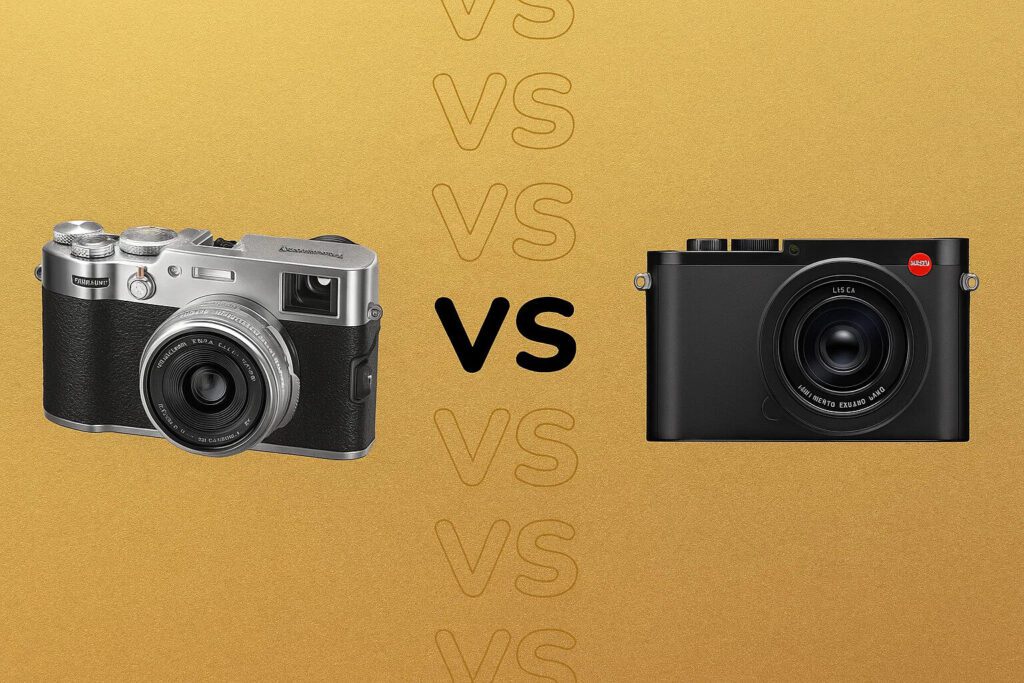
Leica Q3 vs Fujifilm X100V Specs & Features
The Leica Q3 and Fujifilm X100V are two of the most talked-about premium compact cameras. Both are designed for photographers who want portability without compromise. Both deliver excellent image quality, reliable autofocus, and hybrid shooting options. They target enthusiasts and professionals who value control and precision. Each camera has its own strengths, while some features overlap. In this comparison, we explore sensor performance, lenses, autofocus, video, and build. This helps you decide which camera fits your style and workflow.
Sensor and Image Quality
The Leica Q3 has a 40MP full-frame sensor. It delivers extraordinary detail in every shot. Dynamic range is wide. Shadows and highlights retain fine textures. Color reproduction is natural. Low-light performance is strong. The Fujifilm X100V uses a 26MP APS-C sensor. It produces sharp images with vibrant colors. Fujifilm’s color science is praised for lifelike skin tones. Noise is well-controlled even at higher ISO settings. Both cameras capture stunning images, but the Q3 edges ahead in resolution. The X100V shines in color rendition and tonal consistency. Photographers will notice subtle differences when printing large photos.
Lens and Optics
The Leica Q3 has a fixed 28mm f/1.7 lens. It is sharp across the frame and delivers smooth bokeh. Low-light shooting is excellent thanks to the wide aperture. The lens produces minimal distortion and handles flare well. The Fujifilm X100V features a fixed 23mm f/2 lens. Sharpness is excellent, especially in the center. Fujifilm’s lens produces pleasing color and contrast. Both lenses are compact, lightweight, and ideal for street, portrait, and landscape photography. The choice depends on preferred focal length. Leica Q3 gives a slightly wider perspective, while X100V has a classic field of view loved by many street photographers.
Autofocus System for Leica Q3 vs Fujifilm X100V
The autofocus system is a key area for comparison. The Leica Q3 uses a hybrid contrast/phase-detection AF. Eye and face detection work reliably. Low-light focus is fast and accurate. Tracking moving subjects is smooth but slightly slower in very dim conditions. The Fujifilm X100V has a hybrid AF system combining phase and contrast detection. Subject tracking is precise, and low-light performance is good. Both cameras offer focus peaking for manual focus enthusiasts. Overall, the Leica Q3 vs Fujifilm X100V autofocus debate favors personal preference. Some prefer the Q3’s simplicity, while others like X100V’s speed and customization.
Video Capabilities
Video performance is another important factor. The Leica Q3 records 4K up to 60fps with clean detail. It supports hybrid workflows and high-quality internal recording. Autofocus during video is reliable. External microphone support adds flexibility. The Fujifilm X100V records 4K at 30fps and Full HD at 120fps for slow motion. Color profiles include F-Log and standard options. Video stabilization is slightly stronger on the Q3. Both cameras are capable for casual video, but hybrid shooters may prefer the Leica Q3 for smoother 4K recording and higher frame rates.
Build, Design, and Handling
The Leica Q3 vs Fujifilm X100V both offer premium builds. The Q3 has a solid, weather-sealed body with magnesium alloy construction. It feels robust in hand. The X100V is compact, lightweight, and also weather-sealed with optional adapters. Dials and buttons on both cameras are tactile and easy to use. Handling is intuitive. The Q3 feels slightly larger, giving a more substantial grip for longer shoots. The X100V’s smaller footprint is convenient for travel and street photography. Ergonomics and design choices affect comfort, control, and shooting style.
High-Resolution Electronic Viewfinder
The Leica Q3 has a bright OLED EVF. The display is sharp, with excellent resolution and color accuracy. Refresh rates are high, making tracking fast-moving subjects smooth. The Fujifilm X100V features a hybrid OVF/EVF system. Users can switch between optical and electronic view easily. Both viewfinders provide precise framing in bright sunlight and low-light conditions. For photographers who rely heavily on composition, these viewfinders offer confidence and clarity.
Tilting Touchscreen LCD
The Q3 comes with a 3-inch tilting touchscreen. It allows shooting from high or low angles comfortably. Touch gestures control focus, menus, and image playback. The X100V has a 2.9-inch tilting LCD with responsive touch control. Both screens improve hybrid shooting workflows. They make reviewing and adjusting settings quick and intuitive. Tilting displays also enhance creativity, especially for video or unique angles.
Leica Q3 vs Fujifilm X100V Battery Life
Battery life is critical for long sessions. The Q3 delivers around 370 shots per charge. The X100V can manage approximately 420 shots. Power usage depends on EVF use, video recording, and settings. Both cameras support USB-C charging. Carrying spare batteries is recommended for extended hybrid shoots. Despite differences, both offer sufficient endurance for typical professional or enthusiast work.
Connectivity Options
Both cameras support Wi-Fi and Bluetooth. Remote shooting and wireless file transfer are straightforward. The Q3 adds USB-C tethering, which speeds up transfer and remote capture. The X100V relies on app-based control and wireless connectivity. These options help hybrid shooters integrate cameras into modern workflows. Sharing images, controlling the camera remotely, and managing files becomes simple and efficient.
Image Stabilization
The Leica Q3 includes in-body image stabilization (IBIS). It helps reduce shake during handheld photography and video. The X100V relies on lens-based stabilization. Both systems improve results in low-light conditions and dynamic scenarios. IBIS on the Q3 offers more flexibility and control. Stabilization is a critical feature for hybrid shooters who want crisp stills and smooth video without extra equipment.
Video Profiles and Recording Flexibility
The Q3 records 4K video at up to 60fps. Internal 10-bit recording supports professional workflows. The X100V records 4K at 30fps and Full HD at 120fps. Both cameras offer multiple color profiles for accurate post-processing. These features allow creators to match footage to different workflows. Flexibility in frame rates and color science impacts the final video quality. Hybrid shooters benefit from the versatility each camera offers.
Leica Q3 vs Fujifilm X100V Lens Performance
Both cameras have fixed prime lenses. The Q3’s 28mm f/1.7 lens delivers sharp detail and smooth background blur. The X100V’s 23mm f/2 lens produces Fujifilm’s signature vibrant colors. Lens speed and optical quality directly affect low-light performance and creative depth-of-field control. The Q3 gives a slightly wider perspective, while the X100V offers a classic street photography field of view. Photographers may choose based on preferred composition style.
Build Quality and Durability
The Q3 has a solid magnesium alloy body and is weather-sealed. It feels robust and premium. The X100V is compact but strong, with metal construction and weather resistance. Both cameras can handle demanding environments. Durability is important for travel, street, or outdoor photography. The Q3 provides a more substantial grip, while the X100V offers a pocket-friendly design. Handling and build quality affect comfort and confidence during long shoots.
Hybrid Shooting Flexibility
Both cameras allow smooth switching between stills and video. The Q3 slightly edges ahead thanks to faster frame rates and IBIS support. The X100V remains reliable for street, travel, and casual video. Hybrid shooting flexibility enables creators to cover multiple scenarios without changing cameras. Users can seamlessly switch from photography to video, making either camera suitable for versatile content creation.
Professional Workflow Support
The Q3 supports tethered capture and fast USB-C file transfer. Dual card slots allow separation of stills and video. The X100V supports wireless transfer and backup. Both integrate well into professional workflows. Efficient workflow support reduces downtime and improves productivity for hybrid creators. These features make post-processing and content delivery smoother, whether shooting in studio or on location.
Final Verdict
The Leica Q3 vs Fujifilm X100V comparison shows two outstanding compact cameras. Both cameras deliver impressive image quality, reliable autofocus, and hybrid shooting options. The Q3 offers a full-frame 40MP sensor, in-body stabilization, and faster 4K video at 60fps. Its 28mm f/1.7 lens captures sharp details and smooth bokeh. The X100V excels with Fujifilm’s color science, APS-C sensor performance, and a classic 23mm f/2 lens. It is compact, lightweight, and great for street photography.
Hybrid shooters may prefer the Q3 for video flexibility, higher resolution, and IBIS. Enthusiasts focused on color, portability, and everyday shooting might lean toward the X100V. Build quality is excellent on both cameras. The Q3 feels robust, while the X100V is pocket-friendly. Ergonomics, handling, and design affect comfort during extended use. Overall, the Leica Q3 vs Fujifilm X100V debate comes down to workflow, shooting style, and personal preference. Both cameras are capable, but each shines in its own way, making them worthy choices for serious photographers and hybrid creators.
Read More of Our Blogs
For more in-depth camera reviews and comparisons, explore our blog. Learn about the latest Leica, Fujifilm, Nikon, and Sony releases. Find guides on mirrorless innovations, full-frame breakthroughs, and hybrid camera performance. Discover articles on image quality, autofocus, video, lenses, and workflow tips. Stay updated on camera rumors, professional gear reviews, and practical shooting advice. Our blog helps photographers and creators make informed choices. Check out other camera comparisons to see how new models perform in real-world scenarios.