
Introduction
The Fujifilm X-M5 is officially released and available worldwide. This compact mirrorless camera launched in November 2024. It targets content creators, vloggers, and beginner photographers. Moreover, the camera suits travelers wanting lightweight gear. The X-M5 costs $799.95 body-only and $899.95 with kit lens. Additionally, it brings professional features to an affordable package.
This camera marks the return of Fujifilm’s M-series lineup. The last M-series model appeared in 2013 with the X-M1. Furthermore, the X-M5 represents modern content creation priorities. Fujifilm designed it specifically for social media creators. The company understands changing photography trends. Consequently, traditional features like viewfinders get sacrificed. Instead, the focus shifts to video and connectivity.
At just 355 grams, the X-M5 claims lightest X-series status. This weight includes battery and memory card. Therefore, it fits comfortably in jacket pockets. Users carry it everywhere without burden. The compact size doesn’t compromise build quality. Furthermore, the camera maintains premium aesthetics. Symmetrical dials create visual balance. Additionally, the retro design appeals to style-conscious creators.
Release Date and Market Position
Fujifilm announced the X-M5 on October 14, 2024. The silver version shipped in November 2024. Furthermore, a black variant arrived in April 2025. The camera targets the entry-level mirrorless segment. Specifically, it competes with vlogging-focused cameras.
Main competitors include Sony ZV-E10 and Canon EOS R50. Additionally, Nikon Z30 offers similar capabilities. However, the X-M5 provides unique Film Simulation features. Moreover, it includes more advanced video specifications. The 6.2K recording surpasses most competitors. Consequently, the camera occupies a distinctive market position.
The pricing strategy undercuts traditional mirrorless cameras. At $799.95, it costs less than Fujifilm’s X-T50. Furthermore, the kit lens bundle adds just $100. This aggressive pricing attracts budget-conscious creators. Additionally, students and beginners find it accessible. The camera democratizes advanced features. However, it maintains Fujifilm’s quality standards throughout.
Fujifilm X-M5 Specifications Table
| Feature | Details |
|---|---|
| Sensor Type | 26.1MP X-Trans CMOS 4, APS-C format (23.5 x 15.6mm), back-illuminated |
| Resolution | 26.1 Megapixels |
| Processor | X-Processor 5 |
| ISO Range | ISO 160-12800 (expandable to ISO 80-51200) |
| Autofocus System | Intelligent Hybrid AF (phase/contrast detection), AI subject detection (animals, birds, vehicles, insects, drones), face/eye detection |
| Stabilization | Digital Image Stabilization (video only), DIS Mode Boost |
| Video Recording | 6.2K 30fps (Open Gate), 4K DCI 60fps, 4K UHD 60fps, 1080p 240fps, F-Log/F-Log2, 4:2:2 10-bit internal |
| EVF | None (LCD-only composition) |
| LCD Screen | 3.0″ vari-angle touchscreen, 1.04 million dots, touch AF |
| Burst Shooting | 8fps mechanical, 20fps electronic (full frame), 30fps electronic (1.25x crop) |
| Battery | NP-W126S (440 shots ECO mode, 330 shots normal, 45-50 min video) |
| Storage | Single SD/SDHC/SDXC UHS-I slot |
| Connectivity | Wi-Fi, Bluetooth 5.2, USB-C (charging/data), micro HDMI, 3.5mm mic, 3.5mm headphone |
| Weight | 355g (12.5 oz) with battery and card |
| Dimensions | 111.9 x 66.6 x 38.0mm (4.4 x 2.6 x 1.5 inches) |
| Launch Price | $799.95 USD (body), $899.95 USD (with XC 15-45mm kit lens) |
Fujifilm X-M5 Sensor and Image Quality Performance
The Fujifilm X-M5 uses the 26.1-megapixel X-Trans CMOS 4 sensor. This APS-C sensor measures 23.5 x 15.6mm. Therefore, it provides a 1.5x crop factor. The back-illuminated design improves light gathering. Additionally, the sensor shares heritage with X-T4 and X100V.
The X-Trans color filter array eliminates optical low-pass filters. This design increases sharpness naturally. Furthermore, it reduces moiré without sacrificing detail. Images appear crisp straight from the camera. Consequently, less post-processing becomes necessary. The unique filter pattern differentiates Fujifilm from competitors.
Image quality impresses for the price point. Photos display excellent detail and clarity. Moreover, colors render vibrantly across lighting conditions. The 26-megapixel resolution suits most uses. Prints up to A3 size look exceptional. Additionally, cropping flexibility remains adequate. Social media and web use never tax the resolution.
Dynamic range reaches approximately 13 stops. This range handles most shooting scenarios. Furthermore, highlight recovery works effectively. Shadow detail preservation impresses in RAW files. JPEG files maintain good tonal gradation. However, extreme contrast scenes challenge the sensor. Bracketing helps in difficult lighting situations.
Low-light performance exceeds expectations. The sensor handles ISO 3200 confidently. Noise remains well-controlled up to ISO 6400. Furthermore, ISO 12800 stays usable for emergencies. The camera employs effective noise reduction algorithms. Consequently, high-ISO images retain detail. Night photography and indoor events work smoothly.
Color science represents Fujifilm’s signature strength. Film Simulations transform JPEG output instantly. Classic Chrome delivers muted, sophisticated tones. Eterna Bleach Bypass creates cinematic looks. Moreover, Nostalgic Neg. provides warm, nostalgic character. Photographers enjoy experimenting with different simulations. Additionally, all modes work in both photo and video.
The dedicated Film Simulation dial enhances usability. Users switch looks without entering menus. Eight popular simulations sit on the dial. Furthermore, three custom positions store favorites. This immediate access encourages creative exploration. Consequently, beginners discover personal styles faster.
Fujifilm X-M5 Autofocus Performance
The Fujifilm X-M5 employs intelligent hybrid autofocus. This system combines phase and contrast detection. Therefore, it covers most of the frame. The X-Processor 5 enables advanced AI features. Additionally, performance matches newer X-series models.
Subject detection recognizes multiple categories. The camera tracks animals, birds, and vehicles. Furthermore, it detects motorcycles, bicycles, and airplanes. Trains, insects, and drones complete the list. This versatility suits various photography genres. Consequently, users shoot confidently across scenarios.
Face and eye detection work reliably. The system locks onto subjects quickly. Moreover, it maintains focus during movement. Eye detection switches between eyes intelligently. Furthermore, it works with people wearing glasses. The performance suits portrait and street photography.
Tracking accuracy handles moderate speed well. Walking subjects stay in focus consistently. Moreover, running children remain sharp most times. However, very fast action proves challenging. Sports with rapid direction changes need anticipation. Nevertheless, most creators find performance adequate.
In video mode, autofocus performs smoothly. Focus transitions happen gradually and naturally. Furthermore, the system avoids hunting in most situations. Subject detection works while recording. Consequently, vloggers rely on autofocus confidently. However, busy backgrounds occasionally confuse the system.
The autofocus speed suits everyday shooting. It locks focus within fractions of seconds. Moreover, low-light focusing performs reasonably. Down to -4 EV, the system stays functional. Nevertheless, very dark scenes require assistance. AF illuminator helps in complete darkness.
Limitations exist compared to flagship models. The X-M5 lacks the latest phase-detection density. Furthermore, frame coverage doesn’t extend to edges. Deep learning updates arrive slower than flagship cameras. However, the system satisfies most users’ needs. Casual photographers won’t notice these limitations.
Fujifilm X-M5 Video Capabilities
Maximum video resolution reaches 6.2K at 30fps. This Open Gate format uses the full sensor. Therefore, it enables flexible aspect ratio cropping. 4K DCI records at up to 60fps. Additionally, 4K UHD offers identical frame rates. The camera oversamples from higher resolutions.
The 6.2K recording provides significant advantages. Content creators crop to different formats easily. Vertical 9:16 social media content works perfectly. Moreover, widescreen 21:9 cinematic ratios fit naturally. Furthermore, standard 16:9 and 4:3 remain available. Post-production flexibility increases dramatically.
Frame rate options cover standard video needs. The camera shoots 24, 25, and 30fps. Additionally, 60fps enables smooth motion footage. Slow motion reaches 240fps in 1080p. This 10x slow motion creates dramatic effects. Furthermore, the quality remains surprisingly good. Creative possibilities expand significantly.
Log profiles include F-Log and F-Log2. F-Log provides good dynamic range preservation. F-Log2 extends range to 13+ stops. Consequently, color grading flexibility increases substantially. Highlight and shadow recovery improves noticeably. Furthermore, the profiles work well in post-production.
Internal recording captures 4:2:2 10-bit footage. This specification surpasses most competitors. Color information increases significantly over 8-bit. Furthermore, banding virtually disappears. Smooth gradients render beautifully. Additionally, color grading tolerates more adjustments.
Video stabilization uses digital processing. The system combats basic camera shake effectively. Moreover, DIS Mode Boost increases stabilization strength. However, it applies slight crop. Walking footage becomes significantly smoother. Nevertheless, gimbal or tripod improves results further.
Audio capabilities impress for this class. Three built-in microphones capture directional sound. Users select surround, front, back, or front+back. Furthermore, steady-state noise reduction works effectively. Air conditioning and wind noise decrease noticeably. External microphones connect via 3.5mm jack. Additionally, headphone monitoring ensures proper levels.
The dedicated Vlog mode simplifies video creation. Touch controls adjust settings intuitively. Furthermore, product showcase mode works excellently. This feature refocuses from faces to products automatically. Social media creators benefit immensely. Additionally, Short Movie mode records 15, 30, or 60-second clips.
Vertical video recording works natively. The camera records 9:16 without rotation. On-screen timers show remaining recording time. Furthermore, the interface rotates for vertical shooting. TikTok and Instagram Reels creators love this feature. Consequently, social media workflow simplifies dramatically.
Frame.io Camera to Cloud integration enables instant uploads. Footage transfers wirelessly to cloud storage. Consequently, editors access files immediately. Remote teams collaborate efficiently. Furthermore, backup happens automatically during shooting. This feature alone justifies the camera for professionals.
Fujifilm X-M5 Design, Build Quality, and Handling
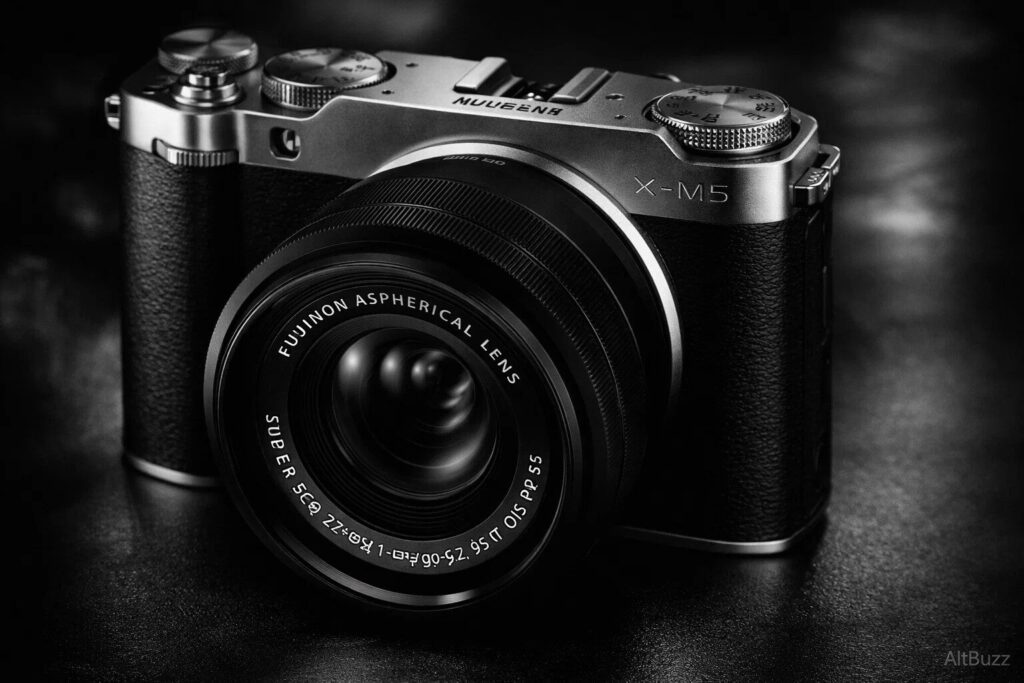
The body construction uses durable magnesium alloy. Build quality feels solid despite compact size. Furthermore, the finish resists fingerprints reasonably. Weather sealing doesn’t exist in this model. However, light moisture shouldn’t cause problems. Nevertheless, rain and dust require protection.
The grip design provides adequate purchase. One-handed operation stays possible. Moreover, the front control dial adds functionality. However, the dial feels somewhat mushy. Accidental adjustments happen occasionally. Nevertheless, most users adapt quickly.
Button layout maximizes limited space. Essential controls remain easily accessible. Moreover, customizable buttons increase efficiency. The joystick enables quick AF point selection. Furthermore, touchscreen gestures supplement physical controls. The hybrid approach works well overall.
The dedicated Film Simulation dial stands out. This left-side dial provides instant creative control. Users experiment with looks effortlessly. Moreover, the tactile feedback feels satisfying. Each position clicks distinctly. Consequently, settings never change accidentally.
The mode dial sits on the right side. It includes traditional PSAM modes. Additionally, Auto mode helps beginners. Four custom settings store preferred configurations. Moreover, separate Video and Vlog modes exist. Filter mode provides creative effects instantly.
Ergonomics suit the target audience. Content creators appreciate the flat-top design. Furthermore, vloggers hold the camera comfortably. The lightweight design prevents arm fatigue. Moreover, extended shooting sessions remain comfortable. However, large hands may feel cramped.
The absence of an electronic viewfinder divides opinion. Composition relies entirely on the LCD screen. Bright sunlight creates visibility challenges. Furthermore, traditional photographers miss eye-level shooting. However, target users rarely use viewfinders. Additionally, the omission reduces size and weight significantly.
The vari-angle LCD provides maximum flexibility. It flips out and rotates completely. Therefore, selfie vlogging works perfectly. High and low angles become effortless. Moreover, the touchscreen responds precisely. Menu navigation feels intuitive. Consequently, beginners master controls quickly.
Port placement considers practical use. The microphone jack sits on the top-left. A tethered rubber cover protects the connection. Furthermore, the headphone jack locates on the right. USB-C and micro-HDMI share a hinged door. This placement prevents cable interference.
The single SD card slot accepts UHS-I cards. This standard handles all recording formats. Moreover, card prices remain reasonable. However, professionals might prefer UHS-II speeds. Nevertheless, buffer clearing stays acceptable. Furthermore, reliability remains high with quality cards.
The battery compartment shares the card slot door. This design simplifies access. Moreover, the door feels sturdy. Latch mechanism provides confidence. Nevertheless, frequent opening may cause wear. Additionally, the compartment fits tightly.
Fujifilm X-M5 Battery Life and Connectivity
Battery performance uses the NP-W126S cell. This battery provides 8.7Wh capacity. Therefore, it delivers adequate runtime. CIPA rates 440 shots in ECO mode. Normal mode achieves approximately 330 shots. Furthermore, video recording lasts 45-50 minutes.
Real-world performance varies by usage. Heavy video shooting drains batteries faster. Moreover, LCD brightness affects runtime. Wireless connectivity also impacts battery life. Nevertheless, typical daily shooting completes easily. Serious shooters carry spare batteries. Additionally, USB-C charging enables portable power.
Power consumption remains impressively low. The X-Processor 5 operates efficiently. Furthermore, the camera doesn’t overheat. Extended recording sessions work reliably. Consequently, reliability exceeds expectations. The compact body dissipates heat adequately.
Charging options include USB-C power delivery. The camera charges while powered off. Moreover, it accepts standard USB-C chargers. Power banks extend field operation significantly. Additionally, car charging works during travel. This flexibility benefits travelers and adventurers.
Wireless connectivity includes Wi-Fi and Bluetooth 5.2. Bluetooth maintains constant connection with phones. Low energy consumption preserves battery life. Furthermore, the connection stays stable. Photos transfer to smartphones automatically. Additionally, remote control works reliably.
The Fujifilm XApp provides comprehensive control. Users preview and capture remotely. Moreover, settings adjust from smartphones. Image transfer happens wirelessly and quickly. Furthermore, geotag information embeds automatically. Social media sharing accelerates significantly.
Frame.io Camera to Cloud revolutionizes workflows. The camera uploads directly to cloud storage. Consequently, production teams access footage immediately. Remote collaboration becomes seamless. Moreover, automatic backup prevents data loss. Professional teams particularly appreciate this feature.
File transfer methods suit various needs. USB-C provides fastest wired transfer. Moreover, card readers work with any computer. Wi-Fi transfer suits quick social sharing. Additionally, cloud upload handles professional delivery. The camera accommodates diverse workflows.
The USB-C port supports data transfer. USB 3.2 Gen 1 speeds reach approximately 5Gbps. Therefore, large file transfers complete quickly. Moreover, the port charges the camera simultaneously. Multi-purpose functionality increases convenience. Consequently, fewer cables become necessary.
Fujifilm X-M5 Real-World Use Cases
Photography genres benefit from compact size. Street photography works exceptionally well. The small camera attracts less attention. Moreover, quick shooting suits spontaneous moments. Travel photography benefits from light weight. Additionally, everyday carry becomes practical.
Portrait photography produces beautiful results. The Film Simulations enhance skin tones naturally. Moreover, shallow depth of field remains achievable. Eye detection keeps subjects sharp consistently. Furthermore, the compact size relaxes subjects. Consequently, natural expressions emerge easily.
Landscape photography works with caveats. The camera handles tripod shooting well. Moreover, dynamic range suits most scenes. However, no viewfinder complicates bright conditions. Additionally, lack of IBIS requires sturdy support. Nevertheless, results justify the compromises.
Video use cases emphasize content creation. Vlogging works perfectly with the design. The flip-out screen enables self-monitoring. Moreover, lightweight construction prevents arm fatigue. Social media content creation thrives. Additionally, vertical video capabilities streamline workflows.
Product reviews and demonstrations excel. The three-microphone system captures clear audio. Furthermore, product showcase mode works brilliantly. Focus transitions happen naturally. Consequently, unboxing videos look professional. Additionally, tutorial creators produce polished content.
Travel vlogging suits the X-M5 perfectly. Compact size fits carry-on luggage easily. Moreover, image quality impresses viewers. Battery life handles daily shooting. Furthermore, weather resistance handles light conditions. The camera becomes the ideal travel companion.
Documentary work benefits from discreet size. Subjects ignore the small camera naturally. Moreover, AI tracking keeps moving subjects sharp. Audio quality captures clear dialogue. Furthermore, 6.2K resolution provides cropping flexibility. Consequently, single-camera productions stay feasible.
Event coverage handles moderate demands. The camera captures speeches and presentations. Moreover, low-light performance suits dim venues. However, fast action proves challenging. Additionally, no weather sealing limits outdoor events. Nevertheless, most occasions work successfully.
Family documentation appreciates ease of use. Auto mode helps non-photographer family members. Moreover, Film Simulations create appealing results. Kids tracking works reliably. Furthermore, lightweight design prevents reluctance. Consequently, memories capture beautifully.
Fujifilm X-M5 Pros and Cons
Pros
- Lightest current X-series camera at just 355 grams
- Exceptional image quality from proven 26MP sensor
- 20 Film Simulations with dedicated mode dial
- 6.2K Open Gate video recording capability
- 4K 60fps and 1080p 240fps frame rates
- Internal 4:2:2 10-bit video recording
- F-Log2 provides 13+ stops dynamic range
- Three built-in microphones with directional control
- Dedicated Vlog mode simplifies content creation
- Native vertical video recording (9:16)
- Frame.io Camera to Cloud integration
- AI subject detection for multiple categories
- Compact size fits jacket pockets easily
- Affordable pricing at $799.95 body-only
- USB-C charging supports power banks
- Excellent color science and JPEG output
- Vari-angle touchscreen for flexible composition
- Quick autofocus for everyday shooting
- Product showcase mode for reviewers
- Short Movie mode for social content
Cons
- No electronic viewfinder (EVF)
- No in-body image stabilization (IBIS)
- Digital stabilization only for video
- Single SD card slot (UHS-I only)
- Front control dial feels mushy
- Autofocus struggles with very fast action
- Battery life modest at 330-440 shots
- No weather sealing protection
- Micro-HDMI prone to damage
- Grip size small for large hands
- Limited buffer for continuous shooting
- Rolling shutter visible in fast pans
- Busy backgrounds confuse autofocus sometimes
- No headphone jack monitoring in photo mode
- LCD visibility poor in bright sunlight
- Limited frame coverage for AF points
- Overheating possible in extended 6.2K recording
- No support for CFexpress cards
- Plastic construction feels less premium
- Black version delayed until April 2025
Final Verdict
The Fujifilm X-M5 delivers exceptional value. Its compact design suits modern content creators perfectly. Moreover, video specifications exceed expectations. Image quality remains impressive throughout. Additionally, Film Simulations provide instant creative looks. The camera successfully targets its intended audience.
Value for money ranks highly. At $799.95, features surpass competitors. However, lens investments increase total cost. Furthermore, accessories add up quickly. Nevertheless, the entry price stays accessible. Kit lens bundle provides excellent starting point.
Who should buy this camera? Content creators prioritizing portability. Vloggers wanting professional video quality. Beginners transitioning from smartphones. Travel photographers seeking lightweight gear. Social media influencers creating daily content. Additionally, photographers wanting backup cameras. Students learning photography and videography. Parents documenting family life casually.
Who should avoid it? Professional photographers needing viewfinders. Sports photographers requiring fast autofocus. Wedding videographers needing IBIS. Landscape photographers wanting weather sealing. Event shooters needing dual card slots. Additionally, users with very large hands. Traditional photographers preferring manual controls. Studio photographers wanting tethered shooting. Wildlife photographers needing telephoto reach.
The Fujifilm X-M5 excels at intended purposes. It democratizes professional features effectively. Furthermore, it embraces modern content creation priorities. The camera sacrifices traditional features deliberately. Consequently, it serves specific users exceptionally well. Target audiences find tremendous value. However, traditional photographers seek alternatives. Ultimately, the X-M5 succeeds within its niche.
This camera represents Fujifilm’s future direction. Content creation drives camera design increasingly. Moreover, social media priorities influence features. The X-M5 embraces these changes fully. Consequently, it attracts younger users effectively. Additionally, it competes in growing markets. The camera signals industry evolution clearly.
Read More from AltBuzz
Read more from Altbuzz for camera reviews, detailed specs, and expert insights. AltBuzz delivers trusted and easy-to-understand photography content.
Subscribe AltBuzz YouTube Channel
Stay updated with camera reviews and comparisons. Subscribe to AltBuzz YouTube for hands-on camera content regularly.