
The OM System OM-3 is a retro-styled Micro Four Thirds mirrorless camera that celebrates photography heritage while delivering cutting-edge performance. Announced in February 2025, this camera combines flagship performance with classic aesthetics inspired by legendary Olympus OM film cameras from the 1970s and 1980s. It targets enthusiasts, travel photographers, and outdoor shooters who appreciate both substance and style in their equipment. The OM-3 brings OM-1 Mark II capabilities into a beautifully crafted compact body that evokes nostalgia while pushing technological boundaries. Available since February 27, 2025, it fills the gap between the consumer-oriented OM-5 and the professional OM-1 Mark II with precision.
This positioning creates an interesting market proposition: flagship internals wrapped in heritage design at mid-range pricing that challenges conventional camera categories. The camera represents OM System’s unwavering commitment to the Micro Four Thirds format even as competitors increasingly focus on full-frame sensors. While full-frame dominates headlines, OM System doubles down on smaller sensors with conviction. This strategy emphasizes system size, weight, and value rather than pure sensor dimensions in the megapixel race. The OM-3 makes this philosophy tangible through stunning retro design that stands out in camera store displays. The two-tone color scheme directly references Olympus OM film cameras that defined an era. Chrome and black finishes create instant visual impact that transcends mere specifications.
For photographers who grew up shooting Olympus film cameras, the OM-3 triggers powerful emotional connections to their formative years. Those tactile memories of advancing film and composing through optical viewfinders resurface immediately. Younger photographers discover classic aesthetics paired with cutting-edge technology in surprising harmony. The combination proves irresistible for many buyers seeking cameras that inspire and perform simultaneously. OM System took significant risks with this design-forward approach in a specification-driven market dominated by Sony and Canon. However, early sales indicate the gamble may pay dividends among style-conscious photographers who value equipment that makes them want to shoot.
Release Date and Market Position
OM System announced the OM-3 in February 2025 during a virtual press event that emphasized heritage and innovation in equal measure. The announcement generated considerable excitement in the photography community, particularly among Olympus loyalists who remember the brand’s film camera legacy. The camera started shipping on February 27, 2025, with immediate availability through major retailers worldwide including B&H Photo, Adorama, and Amazon. Pre-orders exceeded OM System’s expectations significantly, suggesting strong market demand for heritage-styled cameras with modern capabilities. This mid-range model costs $1,999 body-only, positioning it strategically below flagship pricing while maintaining premium positioning. Additionally, a kit with the compact 12-45mm f/4 PRO lens costs $2,299, offering excellent value for new system adopters looking for weather-sealed optics.
The OM-3 competes directly with several strong contenders across different sensor formats and philosophies. The Fujifilm X-T5 ($1,699) offers retro styling with a larger APS-C sensor and impressive 40MP resolution for detailed images. The Nikon Z50II ($906) provides entry-level full-frame capability at significantly lower cost for budget-conscious buyers. The Sony a6700 ($1,398) delivers cutting-edge autofocus and video capabilities in a compact APS-C body. Against these competitors, the OM-3 positions itself as a premium Micro Four Thirds option emphasizing portability, weather sealing, and complete system compactness. It offers flagship specs at an enthusiast price point that bridges categories effectively. The camera’s unique selling proposition combines pro-level features, comprehensive weather sealing, distinctive heritage design, and class-leading stabilization all at $1,999.
The OM-3 sits in an interesting position within OM System’s carefully planned lineup strategy. Below it, the OM-5 targets consumers with simplified controls and lower pricing around $1,199 for beginners. Above it, the OM-1 Mark II commands $2,199 with marginal spec improvements and professional positioning for working photographers. The OM-3 captures the middle ground between these models strategically. It delivers approximately 90% of flagship performance while saving $200 and adding superior aesthetics that turn heads. This value proposition appeals strongly to enthusiasts unwilling to compromise image quality but demanding style and character. The camera also introduces new customers to the Micro Four Thirds ecosystem with flagship capabilities upfront rather than entry-level compromises.
OM System markets the OM-3 toward several overlapping customer segments with distinct needs. Travel photographers appreciate the exceptionally compact system weight and comprehensive weather sealing for global adventures in unpredictable conditions. Street photographers value the discrete retro appearance and silent electronic shutter for candid work without drawing attention. Outdoor enthusiasts need the rugged build quality and industry-leading 7.5-stop stabilization for challenging mountain, forest, and coastal conditions. Content creators require strong video specifications and reliable autofocus for versatile production across photography and videography. Olympus veterans seeking modern bodies compatible with extensive legacy lens collections find familiar ergonomics and backward compatibility. Each segment finds specific value propositions that justify the $1,999 investment in different but complementary ways. Additionally, OM System offers a compelling five-year warranty for early adopters, demonstrating confidence in build quality and encouraging long-term system investment.
OM System OM-3 Specifications Table
| Feature | Details |
|---|---|
| Sensor Type | 20.4MP Four Thirds Stacked BSI CMOS |
| Resolution | 5184 x 3888 pixels |
| Processor | TruePic X (flagship-level) |
| ISO Range | 200-25,600 (expandable to 102,400) |
| Autofocus System | 1,053-point Cross-Quad Pixel AF |
| Stabilization | 7.5-stop 5-axis IBIS |
| Video Recording | 4K 60p (full-width), C4K, 1080p 240fps |
| EVF | 2.36M-dot OLED, 0.62x magnification, 120fps |
| LCD Screen | 3-inch vari-angle touchscreen, 1.62M-dot |
| Burst Shooting | 50fps (electronic), 6fps (mechanical) |
| Battery | BLX-1 rechargeable (310 shots CIPA) |
| Storage | Single SD UHS-II slot |
| Connectivity | Wi-Fi 5GHz, Bluetooth 4.2, USB-C 3.2 |
| Weight | 413g (14.6 oz, body only with battery) |
| Dimensions | 139.3 x 88.9 x 45.8mm |
| Weather Sealing | IP53 rating (splashproof, dustproof, freezeproof to -10°C) |
| Launch Price | $1,999 (body) / $2,299 (with 12-45mm f/4 PRO) |
Sensor and Image Quality Performance
The OM System OM-3 uses the exact same 20.4-megapixel stacked BSI CMOS Four Thirds sensor as the flagship OM-1 Mark II camera. This sensor delivers excellent image quality that punches well above its physical size specifications. The stacked design enables faster readout speeds crucial for video performance and electronic shutter capabilities. Dynamic range reaches approximately 12.5 stops at base ISO 200, providing excellent latitude for exposure recovery in post-processing. This matches or exceeds many APS-C competitors despite the smaller sensor format. Real-world images show punchy, vibrant colors straight out of camera with sharp detail rendition edge-to-edge. The camera’s JPEG engine processes files beautifully for photographers who prefer shooting JPEG over RAW workflow.
Low-light performance remains impressively strong up to ISO 3200 with minimal visible noise degradation. Images at this sensitivity level maintain excellent detail retention and color accuracy for professional use. Between ISO 6400 and 12,800, noise increases progressively but stays well controlled with fine grain structure. The noise appears more film-like than digital, which many photographers find aesthetically pleasing. Even at ISO 25,600, images remain usable for social media and web publication with appropriate noise reduction. The extended ISO 102,400 setting exists primarily for emergency situations and produces marginal quality. For comparison, the sensor performs similarly to Sony’s latest APS-C sensors in practical high-ISO shooting despite the size disadvantage.
The Four Thirds format offers interesting depth-of-field characteristics that benefit certain photography genres significantly. The 2x crop factor relative to full-frame provides double the apparent focal length while maintaining deeper depth of field at equivalent apertures. This proves advantageous for landscape photography where front-to-back sharpness matters more than background blur. Macro photographers appreciate the extended depth of field for insect and flower photography. Street photographers benefit from easier zone focusing techniques. However, portrait photographers seeking creamy bokeh miss the shallower depth of field from larger sensors. The smaller sensor also means individual photosites (pixels) are smaller, theoretically limiting light gathering. OM System compensates through excellent noise reduction algorithms and sensor technology.
Color science produces vibrant yet natural results that require minimal post-processing adjustment. Skin tones render beautifully with accurate saturation across different ethnicities and lighting conditions. The camera handles mixed lighting scenarios well, maintaining color consistency between artificial and natural light sources. Blues lean slightly toward cyan rather than purple, creating appealing sky and water rendition. Greens appear lush and saturated without crossing into unnaturalness that plagues some cameras. Reds stay vibrant and punchy without blocking up or losing detail in highlights. The TruePic X processor offers multiple color profiles including Natural, Vivid, Muted, Portrait, and various Art Filters for creative expression.
The camera offers High Resolution Shot mode creating 80MP, 50MP, or 25MP files through sensor-shift technology. This feature captures eight consecutive frames while physically shifting the sensor between shots. The camera then combines these frames computationally to create much higher resolution output. The 80MP mode produces files rivaling medium format cameras for ultimate detail in static subjects. This works beautifully for landscape, architecture, product photography, and studio work. However, any subject or camera movement during the capture sequence creates artifacts. Wind-blown leaves, flowing water, or unstable tripods ruin the effect. Consequently, this feature suits specialized applications rather than general photography. When conditions allow proper use, the resulting image quality astounds with incredible detail and color accuracy.
Autofocus Performance
The OM System OM-3 inherits the flagship OM-1 Mark II’s advanced Cross-Quad Pixel AF system without compromise. This represents cutting-edge autofocus technology rivaling Sony, Canon, and Nikon’s latest systems. It features an impressive 1,053 selectable focus points arranged across the entire frame area. This massive coverage means photographers can place focus points virtually anywhere in the composition. No need to focus-and-recompose, which risks missing critical focus with shallow depth of field. The cross-type detection works in both horizontal and vertical directions for maximum accuracy.
Subject detection identifies humans, animals (cats, dogs, birds), vehicles (cars, motorcycles, trains, airplanes), and drones automatically. The AI-powered detection distinguishes between subject types and prioritizes them accordingly. Human detection recognizes bodies, faces, and eyes with impressive accuracy across wide age ranges. Animal detection locks onto pets, wildlife, and birds reliably even when partially obscured. Bird photographers particularly praise the sticky tracking that maintains focus on small, fast-moving subjects. Vehicle detection proves useful for motorsports, airshows, and transportation photography. The system can even detect helmeted motorcycle racers and identify them as human subjects.
Eye detection locks onto subjects quickly and tenaciously, rarely releasing focus unintentionally. The camera identifies eyes accurately even when subjects wear sunglasses or turn partially away. This capability transforms portrait photography by ensuring critical sharpness exactly where needed. In group shots, photographers can select which person receives priority focus attention. The system works remarkably well for photographing children and pets who rarely stay still. Continuous autofocus combined with eye detection delivers sharp keeper rates exceeding 90% in good lighting.
Tracking performance impresses in most scenarios with sticky, reliable subject following. Once locked onto a subject, the camera rarely loses track even through complex movements. Athletes running across the frame, birds flying erratically, and cars navigating turns all stay in sharp focus. However, occasional distance misjudgment occurs with erratically moving subjects that suddenly change direction. The camera sometimes lags momentarily before catching up with extreme direction changes. Despite these rare instances, overall tracking reliability exceeds most competitor systems.
Human recognition works exceptionally well in good lighting conditions with high contrast. The system identifies people from considerable distances and through mild obstructions like fences. Performance decreases slightly in low light situations, particularly for people of color with darker skin tones. This represents a common limitation across camera brands due to AI training data biases. OM System acknowledges this issue and continues improving detection algorithms through firmware updates. In bright daylight, detection works universally well regardless of subject characteristics.
Overall tracking feels sticky and reliable for sports, wildlife, and action photography applications. The 50fps burst rate with autofocus tracking enables capturing peak action moments reliably. Professional photographers report keeper rates rivaling much more expensive full-frame camera systems. The combination of subject detection, high frame rates, and deep buffer creates formidable action photography capabilities. The AF-ON button can operate independently from shutter half-press activation. This dual-system approach provides flexibility for photographers with different focusing preferences and shooting styles.
Video Capabilities
Video capabilities in the OM System OM-3 rival much larger and more expensive cameras across multiple specifications. The camera records 4K UHD (3840 x 2160) at 60fps using the full sensor width without cropping. This full-width readout eliminates the field-of-view reduction that plagues many cameras in 4K mode. Videographers maintain their chosen lens perspective across all recording modes seamlessly. Additionally, Cinema 4K (4096 x 2160) options are available for professional productions requiring DCI aspect ratios. Full HD (1920 x 1080) recording reaches an impressive 240fps for spectacular slow-motion effects. This high frame rate enables dramatic slow-motion sequences that reveal details invisible to the naked eye.
OM Log 400 and HLG (Hybrid Log Gamma) profiles enable professional color grading workflows in post-production. OM Log provides flat picture profiles preserving maximum dynamic range information for colorists. HLG offers HDR (High Dynamic Range) recording compatible with modern displays and broadcasting standards. These professional codecs attract serious videographers who demand maximum post-production flexibility. Bit depth reaches 10-bit 4:2:2 color sampling when recording externally via HDMI output. Internal recording provides 10-bit 4:2:0 sampling, which still exceeds most competitor cameras.
Rolling shutter remains remarkably minimal thanks to the stacked sensor’s fast readout capability. Quick pans and fast camera movements show virtually no “jello effect” wobbling. This clean readout enables handheld shooting and dynamic camera movements without artifacts. The improvement over previous generation sensors proves dramatic and immediately noticeable. Videographers can execute whip pans and following shots confidently without worrying about distortion.
Digital stabilization supplements the already excellent 7.5-stop in-body image stabilization system. The combination creates supremely steady footage even during active handheld shooting. Vloggers walking while filming achieve gimbal-like smoothness without additional equipment. The digital stabilization applies modest cropping but maintains impressive field of view. Outdoor videographers shooting wildlife or adventure content appreciate the handheld freedom. The system handles boat, vehicle, and hiking footage remarkably well.
A dedicated 3.5mm headphone jack allows real-time audio monitoring during recording – a feature often omitted from competitors. Professional videographers consider this essential for ensuring clean audio capture. External microphones connect via the hot shoe adapter or 3.5mm input for superior sound quality. Waveform display overlays on the screen assist with proper exposure control during video recording. This professional tool helps maintain consistent exposure across challenging lighting transitions. Zebra pattern warnings indicate overexposed areas approaching clipping for better highlight preservation.
Heat management proves exceptionally effective with no recording time limits in any video mode. The camera records continuously for hours limited only by battery life and storage capacity. This reliability proves crucial for long interviews, ceremonies, and documentary work. Competing cameras often overheat after 20-30 minutes, interrupting critical recordings. The OM-3’s thermal design eliminates this frustration through efficient heat dissipation. However, the lack of a second card slot may concern professional videographers requiring backup recording. Single card failure could lose entire productions, so careful card management becomes essential.
Design, Build Quality, and Handling
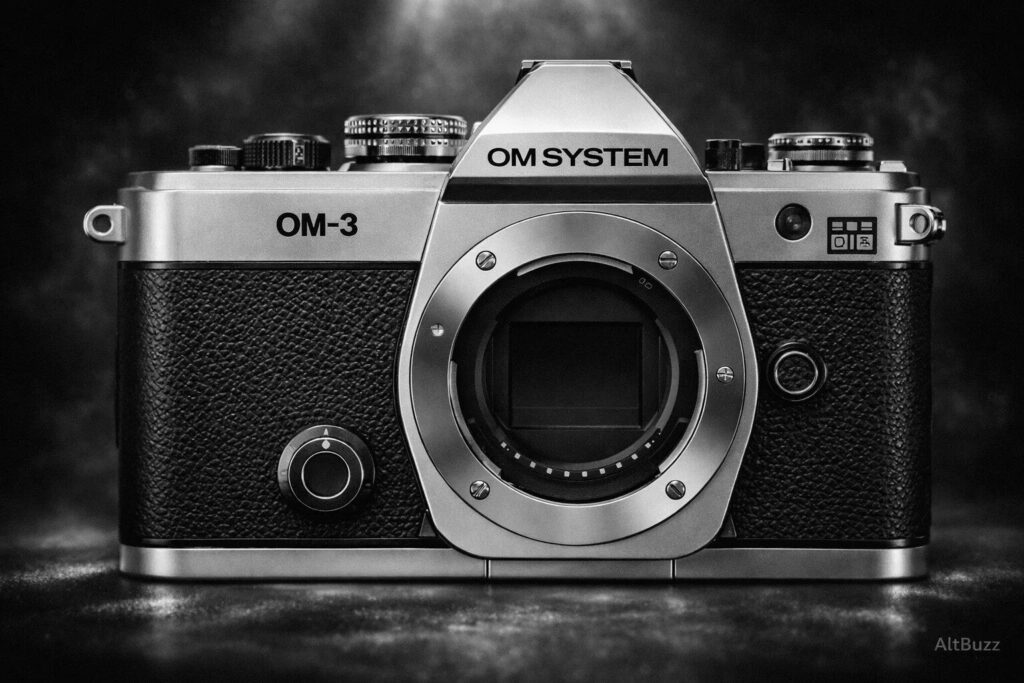
The OM System OM-3 features absolutely gorgeous retro styling inspired by iconic Olympus OM film cameras. The design department clearly studied classic camera aesthetics before creating this modern interpretation. The two-tone color combination of chrome (silver) and black directly references 1970s-1980s SLR cameras. This color blocking creates instant visual impact that photographs beautifully for social media content. The chrome finish uses quality plating that resists tarnishing and maintains luster over time. Photographers report receiving constant compliments on the camera’s appearance from both professionals and civilians.
Magnesium alloy construction throughout ensures premium feel while maintaining light weight characteristics. The metal body panels provide superior rigidity compared to plastic alternatives common in this price range. Build quality substantially exceeds expectations for a $1,999 camera, feeling more like $3,000+ products. Every button, dial, and hinge operates with precision and confidence-inspiring solidity. The dials click reassuringly through their detents with consistent resistance. Buttons provide good tactile feedback without feeling mushy or vague. The overall impression suggests meticulous engineering and quality control during manufacturing.
The camera measures 139.3mm wide, 88.9mm tall, and 45.8mm deep – dimensions slightly larger than the OM-5 but smaller than the OM-1 Mark II. At just 413 grams (14.6 ounces) body-only with battery, it’s remarkably portable for flagship-level capabilities. Full-frame equivalents typically weigh 600-800 grams before adding lenses. The Micro Four Thirds system advantage shines clearly when comparing total kit weight. A complete professional setup with three lenses weighs less than many single full-frame camera bodies. This portability proves invaluable for travel, street, and all-day shooting scenarios.
Weather sealing earns an impressive IP53 rating certifying splashproof, dustproof, and freezeproof operation. The IP53 standard means the camera withstands water spray from any angle without damage. Dust ingress protection prevents particles from contaminating internal components during desert or beach shooting. Freezeproof operation down to -10°C (14°F) enables winter photography without equipment failure concerns. Operating temperature range extends from -10°C to 40°C (104°F) covering extreme environmental conditions. Ninety separate sealing points throughout the body prevent moisture and dust intrusion. Combined with weather-sealed PRO lenses, the system handles rain, snow, sand, and spray confidently.
The flat front design lacks a traditional molded grip but doesn’t compromise handling negatively. The camera’s compact dimensions mean hands wrap around the body naturally without needing pronounced grips. The textured leatherette covering provides adequate purchase for secure holding. Some photographers with larger hands initially worry about grip security. However, most adapt quickly and appreciate the classic aesthetic over modern bulk. The absence of a grip also reduces overall thickness, helping the camera slide into jacket pockets easily.
A Creative Dial on the front panel provides quick access to color profiles, Art Filters, and creative modes. This unique control enables one-handed adjustment of image styles without diving into menus. Photographers can switch between Natural, Vivid, Muted, and Portrait color profiles instantly. Art Filters including Pop Art, Soft Focus, Pale & Light Color, and Dramatic Tone inspire creative experimentation. The dial’s placement feels intuitive after brief familiarization, falling naturally under the index finger.
Button layout proves generally intuitive following OM System’s established ergonomic philosophy. However, the absence of a dedicated AF joystick may initially bother photographers accustomed to this control. Touchscreen navigation compensates well for the missing joystick in most situations. The touchscreen allows direct focus point selection by tapping the desired area. This method actually proves faster than joystick navigation for large focus point movements. The four-way directional pad serves for menu navigation and focus point adjustment when preferred. Customizable function buttons allow photographers to tailor controls to their workflow preferences.
The 2.36 million-dot OLED electronic viewfinder provides clear, detailed image preview with 120fps refresh rate. The high refresh rate creates smooth motion rendering without juddering or lag. Magnification reaches 0.62x (0.31x full-frame equivalent), which feels comfortable for composition and manual focusing. Eye relief measures 21mm, accommodating eyeglass wearers comfortably. The EVF’s auto-brightness adjustment works effectively across lighting conditions. The 3-inch vari-angle touchscreen flips and rotates freely for high, low, and selfie angles. Screen resolution at 1.62 million dots provides sharp image review and menu navigation. Touch responsiveness matches smartphone standards with accurate finger tracking and smooth scrolling.
Battery Life and Connectivity
The BLX-1 rechargeable lithium-ion battery provides approximately 310 shots per CIPA testing standards. This conservative rating often underestimates real-world performance significantly. Photographers report regularly achieving 400-500 shots per charge with moderate reviewing and settings adjustment. Heavy video recording naturally depletes batteries faster, as do extensive menu diving and chimping. The battery’s 1720mAh capacity seems modest compared to larger camera batteries. However, the efficient Four Thirds sensor and processor combination maximize every milliwatt.
Real-world usage patterns vary dramatically based on shooting style and feature utilization. Travel photographers shooting all day with frequent review often carry 2-3 spare batteries. Event photographers covering weddings typically use 1-2 batteries across 8-10 hour days. Street photographers working deliberately may complete entire days on single batteries. The variability emphasizes the importance of carrying spare batteries for critical shooting situations. The BLX-1 battery costs approximately $70-80 for genuine OM System units, making spares reasonably affordable.
USB-C charging enables convenient power bank compatibility for extended shooting sessions away from wall outlets. The USB-C port accepts standard power delivery for flexible charging options. Power banks enable shooting all day while recharging batteries between shots during downtime. This modern convenience eliminates dependence on wall outlets during travel. Charging from a standard USB-C adapter takes approximately 2 hours for depleted batteries. Fast charging isn’t supported, so higher wattage adapters don’t reduce charging time. The camera can operate while charging, enabling continuous shooting during important events.
Wi-Fi connectivity uses modern 5GHz bands for faster wireless transfer speeds than older 2.4GHz-only cameras. Image transfer to smartphones happens quickly even for RAW files when using good Wi-Fi conditions. Bluetooth 4.2 maintains constant low-power connection for location tagging and remote control. The OM Image Share app works with iOS and Android devices for wireless image transfer. The app also provides remote camera control including shutter release, exposure adjustment, and image review. Remote control proves useful for group photos, wildlife photography, and self-portraits.
Wireless remote control functionality operates reliably through the smartphone app with minimal lag. Photographers can trigger the shutter, adjust settings, and review images from considerable distances. This capability enables creative setups impossible with the camera held directly. Wildlife photographers place cameras near feeding areas and trigger remotely. Studio photographers review images on tablets for better client showing. The remote control functionality rivals dedicated wireless triggers costing hundreds of dollars.
USB-C data transfer supports USB 3.2 Gen 1 speeds (5 Gbps theoretical maximum). Real-world transfer speeds reach 300-400 MB/s to modern computers with USB 3.2 ports. Photographers can offload entire day’s shooting in 5-10 minutes depending on image count. The USB-C port also supports external power delivery for extended video recording sessions. Professional videographers appreciate the ability to power cameras from USB battery packs indefinitely. This eliminates battery changing interruptions during multi-hour interviews or events.
Real-World Use Cases
The OM System OM-3 excels brilliantly across numerous photography genres thanks to its versatile capabilities. Travel photography benefits tremendously from the exceptionally lightweight system that reduces luggage weight. The complete camera plus three professional PRO lenses weighs less than many single full-frame cameras. This weight advantage enables longer shooting days without fatigue and easier airline carry-on compliance. International travelers appreciate the comprehensive weather sealing during unpredictable conditions across diverse climates. The camera handles tropical rainstorms, desert sandstorms, and arctic conditions equally well.
Street photography appreciates the discrete retro appearance that attracts less attention than aggressive modern cameras. The classic chrome-and-black styling appears vintage rather than expensive, reducing theft concerns. Additionally, the completely silent electronic shutter enables candid shooting without shutter noise drawing attention. Photographers can work intimately with subjects without mechanical clicking disrupting moments. The lightweight body encourages all-day carrying that heavy professional cameras discourage. The 50fps burst with silent shutter captures fleeting street moments that single shots miss.
Wildlife photography, particularly bird photography, leverages the excellent subject detection at blazing 50fps continuous shooting. The bird detection locks onto feathered subjects reliably even against complex backgrounds. The 2x crop factor effectively doubles lens reach, turning a 300mm lens into 600mm equivalent. Budget-conscious wildlife shooters afford better telephoto reach with smaller, lighter, cheaper Micro Four Thirds lenses. The 7.5-stop stabilization enables sharp handheld shots at shutter speeds impossible with other systems. Photographers report consistently sharp images at 1/60 second with 300mm focal lengths.
Landscape photography utilizes the High Resolution Shot mode creating stunning 80MP files rivaling medium format cameras. The deep depth of field from the Four Thirds sensor helps front-to-back sharpness in landscape compositions. The weatherproof construction enables shooting during golden hour rainstorms and foggy conditions. The compact system weight makes hiking to remote locations less strenuous than carrying heavy gear. The excellent dynamic range handles challenging sunrise and sunset exposures with detail in shadows and highlights.
Portrait photographers enjoy accurate skin tones and beautiful color rendition straight from camera. The eye detection transforms portrait sessions by ensuring critical sharpness on eyes consistently. Environmental portraits showcasing subjects in context benefit from the 2x crop depth of field characteristics. Headshot portrait work sometimes feels limited by the deeper depth of field compared to full-frame equivalent. However, many portrait photographers deliberately choose this depth of field for greater sharpness zones.
The comprehensive 7.5-stop in-body stabilization system enables handheld shooting in extremely challenging conditions. Night photography, interior architecture, and low-light events all benefit from multi-stop stabilization advantage. Photographers regularly shoot sharp images at 1/4 second shutter speeds handheld – situations requiring tripods with other cameras. The stabilization freedom enables spontaneous shooting when tripod setup would miss moments. However, the stabilization cannot freeze subject motion, only camera shake.
Outdoor and adventure photography matches perfectly with the weather sealing and compact system design. Backpackers, climbers, kayakers, and cyclists appreciate the reduced equipment weight during activities. The freezeproof operation handles high-altitude mountaineering and winter sports reliably. The dustproof sealing survives sandy beaches and desert environments without sensor contamination. The comprehensive sealing provides peace of mind during challenging outdoor shooting.
Computational photography features including High Resolution Shot, Live ND, focus stacking, and focus bracketing expand creative possibilities. These features enable techniques traditionally requiring specialized equipment or extensive post-processing. The Live ND filter simulates neutral density filters digitally for long exposure effects. Focus stacking combines multiple focus points for extreme depth of field in macro work. These tools democratize advanced techniques for photographers at all skill levels.
Vlogging and content creation work exceptionally well with the vari-angle screen and strong video specifications. The screen flips forward for self-framing during recording. The excellent stabilization creates smooth handheld footage without gimbal requirements. The 4K 60fps recording provides professional quality for YouTube and social media content. However, serious videographers may prefer cameras with dual card slots for recording redundancy.
Pros and Cons
Pros
- Flagship OM-1 Mark II sensor and TruePic X processor delivering professional image quality
- Outstanding class-leading 7.5-stop in-body image stabilization system
- Blazing 50fps continuous shooting with unlimited JPEG buffer (electronic shutter)
- Beautiful retro heritage design with premium two-tone chrome/black finish
- Comprehensive IP53 weather sealing (splashproof, dustproof, freezeproof to -10°C)
- Advanced 1,053-point Cross-Quad AF with comprehensive subject detection
- Professional 4K 60fps video with full sensor width and 1080p 240fps slow-motion
- High Resolution Shot mode creating 80MP, 50MP, or 25MP files for ultimate detail
- Remarkably lightweight at just 413g (14.6 oz) body-only with battery
- Intuitive Creative Dial providing quick access to color profiles and Art Filters
- Generous five-year warranty for early adopters demonstrating manufacturer confidence
- Compact, lightweight Micro Four Thirds lens ecosystem reducing total system weight
- Excellent value proposition delivering flagship features at mid-range $1,999 pricing
- Vari-angle touchscreen enabling high/low angles and selfie-friendly recording
- Silent electronic shutter for discrete photography in noise-sensitive environments
- Professional video features including OM Log, HLG, waveform, and zebras
Cons
- Single SD card slot only (no redundancy for professional critical work)
- No traditional front grip may not suit photographers preferring molded grips
- No dedicated AF joystick requiring touchscreen or D-pad navigation
- Smaller Four Thirds sensor versus full-frame competitors affects depth of field control
- Modest 6fps mechanical shutter (slower than OM-1 Mark II’s 10fps mechanical)
- Slightly smaller EVF magnification compared to flagship model
- No significant technological advances over existing OM-1 Mark II platform
- Autofocus struggles slightly with people of color in challenging low-light conditions
- Four Thirds high-ISO performance naturally lags full-frame sensors physically
- Smaller sensor limits ultra-shallow depth of field for selective focus effects
- Battery life rated 310 shots CIPA (though real-world often exceeds this)
- Limited native lens selection compared to Canon/Nikon ecosystems
- Resale value uncertainty due to smaller market versus full-frame systems
Final Verdict
The OM System OM-3 delivers exceptional value proposition that redefines what $1,999 cameras should offer. It successfully packages flagship performance into a gorgeous retro body that inspires photography. The image quality genuinely impresses despite the smaller Four Thirds sensor through excellent processing. The stacked CMOS sensor technology enables capabilities rarely found below $2,500 pricing. Build quality easily rivals cameras costing $1,000-$1,500 more from competing manufacturers. The comprehensive weather sealing and lightweight design create the perfect combination for outdoor photography adventures. The 7.5-stop stabilization represents best-in-class performance enabling shots impossible with competing cameras.
Value for money assessment ranks among the absolute best in the entire $1,500-$2,500 camera market. Buyers receive OM-1 Mark II internals (TruePic X processor, 20.4MP sensor, Cross-Quad AF) at considerable $200 discount. However, they gain superior retro aesthetics worth the trade-off for many photographers. The compact Micro Four Thirds system means significantly smaller, lighter, and often cheaper lenses. Total kit weight for professional-level equipment stays remarkably low compared to full-frame alternatives. Computational photography features including High Resolution Shot expand capabilities beyond sensor size limitations.
The camera’s greatest strengths lie in portability, stabilization, autofocus, and weather sealing combination. No competing camera delivers all four attributes simultaneously at this price point. The 50fps burst rate with subject tracking creates formidable wildlife and sports capabilities. The retro styling differentiates the camera immediately in crowded camera bags and on photographer necks. Early adopters receive generous five-year warranties demonstrating OM System’s confidence in longevity.
However, the single card slot remains the most significant limitation for professional photographers requiring redundancy. Wedding photographers, event shooters, and commercial photographers often require dual card backup. The card slot limitation eliminates the camera from consideration despite otherwise excellent capabilities. Additionally, the smaller sensor naturally provides less background separation than full-frame equivalents. Portrait photographers seeking creamy bokeh may feel constrained by Four Thirds depth of field characteristics. High-ISO performance, while good for the sensor size, cannot match larger sensors’ light-gathering advantages physically.
Who Should Buy: Travel photographers wanting exceptionally lightweight professional-quality systems benefit tremendously from Micro Four Thirds advantages. Outdoor and adventure shooters needing weather sealing plus stabilization find ideal tools here. Street photographers appreciating compact design, retro styling, and silent shooting discover perfect equipment. Bird and wildlife enthusiasts utilizing fast burst rates with excellent subject detection achieve superior results. Content creators requiring strong video specifications plus photography capabilities get comprehensive tools. Photographers valuing classic aesthetics with modern performance find rare harmony. Olympus system veterans wanting updated bodies with familiar handling upgrade seamlessly. Budget-conscious enthusiasts seeking flagship performance without flagship pricing discover exceptional value.
Who Should Avoid: Full-frame purists insisting on maximum sensor size for depth-of-field control should choose larger sensors. Professional photographers needing dual card slot redundancy for critical paid work require backup capability. Action shooters requiring 10fps+ mechanical shutter rates need faster mechanical performance. Users preferring sculpted ergonomic grips over flat classic designs should test handling first. Photographers favoring traditional button layouts with dedicated AF joysticks may prefer alternative control schemes. Those shooting primarily in extremely low light might benefit from larger sensor advantages. Videographers requiring dual card video backup need redundancy protection. Photographers already invested in Canon/Nikon/Sony lens ecosystems face switching costs.
The OM System OM-3 represents OM System’s finest achievement brilliantly balancing heritage styling with cutting-edge technology. It proves conclusively that sensor size doesn’t determine camera quality in modern photography. The combination of flagship features, beautiful design, comprehensive weather sealing, and competitive pricing creates compelling proposition. For photographers prioritizing total system weight, stabilization performance, and aesthetic appeal, few cameras compete effectively. The OM-3 demonstrates that smaller sensors can deliver professional results when paired with excellent technology and thoughtful engineering. This camera will likely be remembered as the model that proved Four Thirds viability in the full-frame dominated market.
Read More from AltBuzz
Read more from AltBuzz for camera reviews, detailed specs, and expert insights. AltBuzz delivers trusted and easy-to-understand photography content. Explore comprehensive buying guides, lens reviews, and photography tutorials designed to help you maximize your gear’s potential and improve your skills. Our team tests equipment rigorously in real-world conditions to provide honest, practical recommendations.
Subscribe AltBuzz YouTube Channel
Stay updated with camera reviews and comparisons. AltBuzz shares hands-on camera content regularly. Watch detailed field tests, autofocus demonstrations, and real-world shooting scenarios. Subscribe here: 👉 Subscribe Altbuzz