
Fujifilm X-H2 vs Panasonic Lumix GH6: Full Comparison Guide
Introduction
The Fujifilm X-H2 and Panasonic Lumix GH6 represent premium hybrid cameras for serious creators. Both models already hit the market and attracted professional attention immediately. This comparison dissects their capabilities for photography and videography comprehensively. Advanced users seeking maximum performance will benefit from this analysis tremendously.
Professional hybrid cameras serve demanding workflows equally. Photography and videography both demand excellence. These cameras refuse to compromise either discipline. Wedding photographers shoot ceremonies and receptions. Documentary filmmakers capture stills and motion. Content creators need versatile tools. These cameras address multiple needs simultaneously.
The pricing positions these cameras professionally. Neither targets casual users or beginners. Serious amateurs and working professionals form the target market. Features and specifications reflect professional requirements. The investment demands careful consideration and research.
Release Date Overview
Fujifilm X-H2 Release Date
Fujifilm announced the X-H2 in September 2022. Shipping began in November 2022 globally. The release completed Fujifilm’s professional X-H lineup. The X-H2S preceded this camera by months. Fujifilm offered resolution and speed options strategically.
Market reception praised the specifications immediately. The 40-megapixel resolution impressed photographers particularly. Professional reviewers highlighted value pricing. The camera sold steadily through launch period. Supply chain issues affected availability initially.
Panasonic Lumix GH6 Release Date
Panasonic revealed the Lumix GH6 in February 2022. Availability started in March 2022 worldwide. The launch ended years of speculation. GH5 users had waited since 2017 for successors. The announcement generated enormous anticipation.
The camera delivered long-awaited features finally. Unlimited recording time addressed previous criticisms. Internal ProRes recording excited professional videographers. The feature set justified premium pricing clearly. Professional video market embraced the camera immediately.
Specification Comparison Table
| Feature | Fujifilm X-H2 | Panasonic Lumix GH6 |
|---|---|---|
| Sensor Type | APS-C X-Trans CMOS 5 HR | Micro Four Thirds Live MOS |
| Resolution | 40.2 MP | 25.2 MP |
| Processor | X-Processor 5 | Venus Engine |
| ISO Range | 125-12800 (ext. 64-51200) | 100-25600 (ext. 50-25600) |
| Autofocus System | 425-point intelligent hybrid AF | 315-area DFD contrast AF |
| Stabilization | 5-axis IBIS (7.0 stops) | 5-axis IBIS (7.5 stops) |
| Video Recording | 8K 30p, 4K 120p | 5.7K 60p, 4K 120p |
| EVF | 5.76M-dot OLED | 3.68M-dot OLED |
| LCD Screen | 3.0″ three-way tilting touchscreen | 3.0″ fully articulating touchscreen |
| Burst Shooting | 15 fps mechanical, 20 fps electronic | 14 fps with AF-S, 8 fps with AF-C |
| Battery | NP-W235 (680 shots) | DMW-BLK22 (360 shots with EVF) |
| Storage | Dual CFexpress Type B / SD UHS-II | Dual SD UHS-II |
| Connectivity | Wi-Fi, Bluetooth, USB-C, optional Ethernet | Wi-Fi, Bluetooth, USB-C, HDMI 2.1 |
| Weight | 660g (body only) | 739g (body only) |
| Price at Launch | $1,999 (body only) | $2,199 (body only) |
Sensor Technology and Resolution: Fujifilm X-H2 vs Panasonic Lumix GH6
Here’s where philosophy diverges dramatically between manufacturers. Fujifilm packs 40.2 megapixels into an APS-C sensor. This resolution density crushes most full-frame cameras easily. Print size potential exceeds professional requirements substantially. Commercial photography benefits from massive resolution. Cropping flexibility increases creative options significantly.
The X-Trans color filter array eliminates moiré without optical low-pass filters. This design maximizes sharpness and detail rendering fundamentally. The non-Bayer pattern challenges some raw processors. Adobe Lightroom handles files well currently. Capture One provides excellent X-Trans support. The unique approach delivers distinctive image characteristics.
Panasonic employs a Micro Four Thirds sensor with 25.2 megapixels. Smaller sensor size affects depth of field and low-light performance inherently. However, the crop factor benefits video shooters with stabilization and reach. Image quality remains excellent within system limitations. The resolution satisfies most professional applications easily.
Sensor size differences impact multiple parameters simultaneously. APS-C sensors gather more light physically. Larger photosites improve dynamic range theoretically. Low-light performance advantages manifest clearly. Depth of field control increases with sensor size. These factors favor Fujifilm for pure photography.
Micro Four Thirds sensors provide distinct advantages too. Smaller sensor enables more effective stabilization. Telephoto reach doubles compared to full-frame effectively. System size and weight decrease substantially. Lens design becomes simpler and cheaper. These benefits matter for specific applications.
Resolution differences affect workflows significantly. Fujifilm’s 40-megapixel files demand more storage space. Processing power requirements increase proportionally. Backup strategies must account for larger files. However, the detail captured justifies these costs. Commercial work benefits from resolution overhead.
Panasonic’s resolution suits most video applications perfectly. 25 megapixels provides ample oversampling for 4K. File sizes remain manageable for typical workflows. Storage costs decrease compared to 40-megapixel systems. The practical balance serves video-focused users well.
Color science approaches differ fundamentally too. Fujifilm’s film simulations emulate legendary film stocks. Classic Chrome mimics documentary film beautifully. Velvia intensifies landscape colors dramatically. Provia delivers balanced general-purpose rendering. These presets inspire creative expression directly. Post-processing time decreases substantially for many photographers.
Panasonic emphasizes accurate neutral rendering. The colors appear true to life by default. This approach provides maximum editing flexibility. Colorists appreciate neutral starting points. Creative interpretation happens in post-production. The philosophy suits video production workflows particularly.
Autofocus Technology and Performance
Fujifilm upgraded to intelligent hybrid autofocus with subject detection. The 425-point system identifies people, animals, birds, cars, motorcycles, bicycles, airplanes, and trains automatically. Subject recognition works impressively across categories. Eye detection operates reliably across species consistently. Tracking maintains focus through challenging scenarios confidently.
Phase detection coverage spans the entire frame essentially. Focus point placement flexibility maximizes compositional freedom. Off-center subjects focus accurately without recomposing. The system operates quickly in various lighting conditions. Low-light performance reaches -7 EV impressively. Concert and event photography benefits tremendously.
Face and eye detection accuracy matters critically for portraits. Fujifilm detects eyes even when subjects turn away. The system handles multiple faces in the frame simultaneously. Priority selection happens automatically or manually. Wedding photographers trust the system completely. Fashion shooters capture sharp beauty details consistently.
Panasonic continues using contrast-detection DFD technology frustratingly. The 315-area system performs better than previous generations admittedly. Human face and body detection works adequately overall. However, tracking fast subjects challenges the system fundamentally. The contrast-detection limitation shows clearly in action.
Subject recognition remains limited compared to Fujifilm. Human detection works but animal recognition lags. The system lacks comprehensive subject categories. Photographers must assist the camera more. This requirement slows workflow unnecessarily. Professional action work suffers consequently.
Video autofocus performance separates these cameras significantly. Fujifilm tracks subjects smoothly during recording effectively. Face detection maintains focus on moving presenters reliably. The system avoids excessive hunting or snapping. Content creators trust the autofocus completely. Interview and documentary work benefits enormously.
Panasonic’s video AF works but shows more focus breathing. Walking interviews challenge the system noticeably. Manual focus becomes necessary for critical shots. Focus pullers appreciate manual control anyway. However, one-person productions struggle with limitations. The technological gap impacts production efficiency meaningfully.
Action photographers strongly prefer Fujifilm’s system definitively. Wildlife shooters benefit from comprehensive subject detection tremendously. Sports photography succeeds with higher keeper rates. Panasonic handles controlled situations fine adequately. Studio and tripod work shows minimal differences. The autofocus choice impacts genre suitability significantly.
Video Recording Capabilities and Professional Features
Both cameras target professional video production seriously. Feature sets reflect professional requirements comprehensively. However, approaches and priorities differ substantially between manufacturers. Understanding these differences helps appropriate selection.
Fujifilm records 8K at 30fps internally impressively. This massive resolution provides cropping flexibility in post-production. 4K capture reaches 120fps for smooth slow motion. The high frame rates enable creative expression. F-Log and F-Log 2 come included standardly. Professional color grading becomes possible immediately.
The 8K recording comes with limitations realistically. File sizes grow enormous very quickly. Storage costs increase substantially consequently. Processing power demands exceed typical workstations. Real-time editing becomes challenging or impossible. Proxy workflows become absolutely necessary.
However, future-proofing arguments favor 8K capability. Technology adoption trends toward higher resolutions. Content remains relevant longer with resolution overhead. Cropping and reframing flexibility benefits editors. The investment makes sense for some users.
Fujifilm’s 12-bit ProRes recording requires external recorders unfortunately. Internal recording maxes at 10-bit 4:2:2. This limitation disappoints some professional videographers. However, 10-bit internal recording satisfies most projects honestly. The color depth provides excellent grading latitude.
Panasonic maxes out at 5.7K 60fps or 4K 120fps internally. The resolution seems lower compared to 8K superficially. However, 5.7K provides ample oversampling for 4K delivery. Image quality impresses consistently in real production. The practical resolution serves professional needs excellently.
The camera records unlimited length without overheating concerns remarkably. This capability addresses previous Panasonic camera criticisms. Lectures, concerts, and ceremonies record without interruption. Documentary work benefits from worry-free recording. The reliability proves invaluable for critical productions.
V-Log comes standard for professional grading workflows. The flat profile preserves maximum dynamic range effectively. Professional colorists appreciate the grading latitude provided. The LOG curve matches Panasonic’s cinema cameras. Color matching simplifies multi-camera productions significantly.
Internal 10-bit 4:2:2 recording provides excellent flexibility standardly. Color information exceeds 8-bit substantially for grading. Professional productions achieve cinematic results internally. External recorders become optional rather than mandatory. Production costs decrease without sacrificing quality.
ProRes and ProRes HQ record internally to CFexpress cards. This capability requires firmware update currently. The professional codec integration elevates the camera substantially. Editing performance improves dramatically with ProRes. Broadcast standards compliance comes easily naturally.
HDMI 2.1 output enables high-resolution external recording comprehensively. Clean output supports various external recorders. Professional production workflows integrate seamlessly consequently. The connectivity supports demanding production requirements.
Recording format options differ substantially between cameras. Fujifilm emphasizes resolution primarily with 8K capability. Panasonic prioritizes professional codecs and unlimited recording. The philosophical difference reflects target markets somewhat. Both approaches serve professional needs validly.
Oversampling quality impresses from both cameras genuinely. Detail rendering exceeds typical 4K capture substantially. Sharpness and clarity satisfy professional standards easily. Clients cannot distinguish from more expensive equipment. The democratization of professional video continues.
Professional colorists appreciate each system’s LOG profiles highly. Fujifilm’s F-Log provides excellent grading latitude. Panasonic’s V-Log matches cinema camera output. Both profiles enable professional post-production workflows. Color science differences affect final look subtly.
Image Stabilization Systems
Both cameras include advanced 5-axis in-body stabilization. The technology enables previously impossible handheld shots. Slower shutter speeds succeed without tripods routinely. Video footage appears smooth and professional naturally. The feature proves invaluable across applications.
Panasonic claims 7.5 stops of compensation impressively. Fujifilm rates its system at 7.0 stops closely. Real-world testing confirms both claims reasonably. The half-stop difference rarely matters practically. Both systems perform excellently in actual use.
Video stabilization benefits particularly from IBIS technology. Handheld documentary work appears remarkably smooth. Walking shots show minimal bounce or shake. Production value increases without gimbal costs. One-person productions become more feasible.
Stabilization works with adapted lenses too. Manual focus vintage glass gains modern stabilization. The capability expands lens compatibility tremendously. Legacy glass becomes more usable practically. Lens collectors appreciate this flexibility greatly.
Electronic stabilization combines with IBIS for video. The dual system provides even smoother results. However, crop factors increase with electronic stabilization. Composition considerations affect wide-angle work. The trade-off seems worthwhile typically.
Telephoto photography benefits dramatically from IBIS. Wildlife shooters handhold longer lenses successfully. Sports photographers work without monopods frequently. The capability increases keeper rates substantially. Action photography becomes more accessible consequently.
Build Quality, Weather Sealing, and Ergonomics
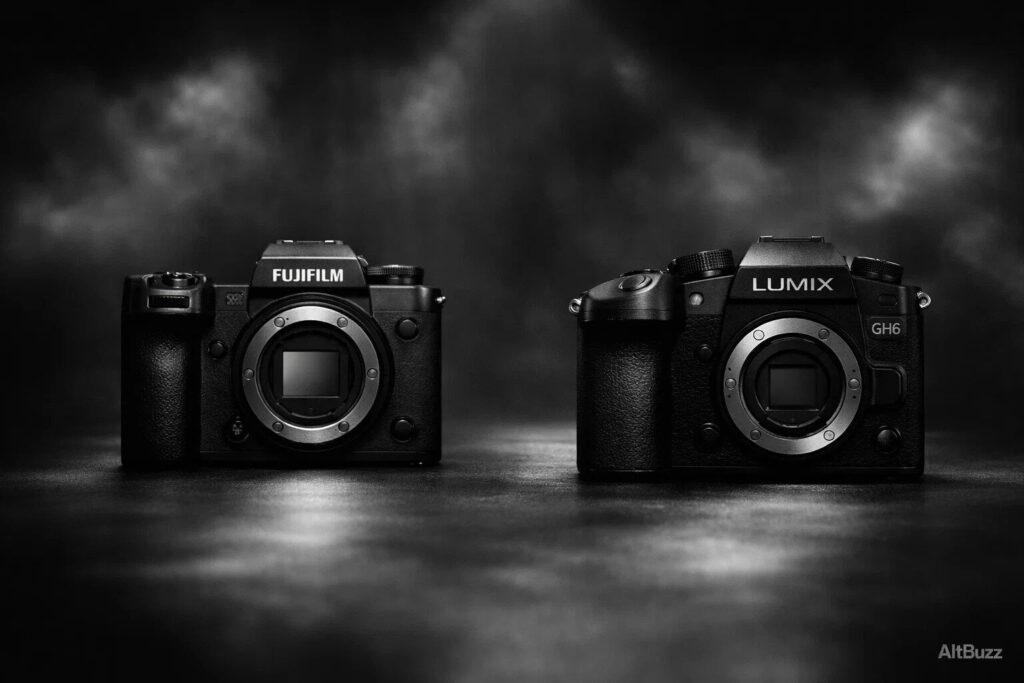
Professional cameras demand robust construction fundamentally. Both manufacturers deliver excellent build quality. However, approaches differ in details meaningfully.
Fujifilm designed the X-H2 for professional durability explicitly. Weather sealing protects against dust, moisture, and temperatures down to -10°C. Mountain photography becomes less stressful consequently. Beach shooting risks decrease substantially. Professional confidence increases with protection significantly.
The grip accommodates larger lenses comfortably naturally. Balance improves with telephoto glass attached. Long shooting sessions remain comfortable consistently. Mechanical shutter rated for 500,000 actuations impressively. This longevity exceeds typical camera lifespans substantially.
The three-way tilting screen offers flexibility without extending far from the body. High and low angles become accessible easily. However, vlogging and self-recording prove difficult. The screen doesn’t flip forward completely unfortunately. Content creators prefer fully articulating screens typically.
Panasonic built the GH6 to withstand harsh production environments explicitly. Magnesium alloy construction feels tank-like immediately. Weather sealing surpasses previous models significantly. Professional outdoor work proceeds confidently. The rugged build inspires long-term reliability trust.
The fully articulating screen serves vloggers and overhead shots perfectly. Self-recording becomes simple and intuitive. The mechanism provides maximum positioning flexibility. However, durability concerns exist with moving parts. Professional abuse testing shows limitations occasionally.
Button layouts cater to different workflows intentionally. Fujifilm maintains tactile dials for key settings prominently. ISO, shutter speed, and exposure compensation adjust mechanically. The physical controls provide tactile satisfaction. Settings change without menu diving constantly.
Panasonic offers extensive customization through menus comprehensively. Function buttons assign to numerous parameters. Workflows personalize completely to individual preferences. The flexibility suits diverse shooting styles. However, initial setup requires time investment.
Both cameras feature dual card slots for reliability critically. Professional work demands backup recording absolutely. Card failure protection prevents catastrophic data loss. The redundancy justifies professional use completely.
Viewfinder quality differs substantially between models. Fujifilm’s 5.76-million-dot EVF provides stunning clarity remarkably. Detail rendering exceeds most competitors easily. Manual focusing becomes easier with high resolution. The viewfinder experience delights consistently.
Panasonic’s 3.68-million-dot display shows very good detail. However, the resolution lags Fujifilm noticeably. Side-by-side comparison reveals the difference clearly. Professional photographers appreciate Fujifilm’s superiority here.
Battery Life and Power Management
Battery performance affects professional workflow significantly. All-day shooting requires adequate battery capacity. Both cameras provide reasonable longevity with caveats.
Fujifilm’s NP-W235 battery delivers approximately 680 shots per charge. This capacity satisfies most photography assignments easily. Wedding coverage becomes possible without excessive spares. However, video recording drains power faster predictably. Long recording sessions require backup power sources.
USB-C PD charging works during operation conveniently. This capability maintains power during studio shoots. Field charging with power banks extends time indefinitely. International travel simplifies without regional chargers. The modern standard benefits workflow significantly.
Battery grip options extend shooting time substantially. Vertical shooting ergonomics improve with grips simultaneously. The additional weight provides stability benefits. Professional photographers invest in grips routinely. The system integration works seamlessly naturally.
Panasonic’s DMW-BLK22 provides roughly 360 shots with EVF use. The capacity lags Fujifilm’s offering significantly unfortunately. All-day shooting requires multiple spare batteries definitely. Video production demands even more power reserves. The power-hungry features stress batteries considerably.
Professional videographers plan power management carefully. AC adapters provide continuous power for studio work. V-mount battery systems extend location recording substantially. The investment becomes necessary for serious production. However, these solutions add cost and complexity.
Battery standardization across Panasonic cameras helps somewhat. GH5 users already own multiple DMW-BLK22 batteries. System investment leverages across camera bodies. The compatibility reduces incremental costs partially.
Storage Solutions and Media Compatibility: Fujifilm X-H2 vs Panasonic Lumix GH6
Storage choices impact workflow speed and reliability substantially. Card slot configurations differ meaningfully between cameras. Understanding these differences prevents costly mistakes.
Fujifilm employs dual CFexpress Type B or SD UHS-II slots. CFexpress cards provide exceptional write speeds. 8K recording demands fast sustained writes. Buffer clearing happens almost instantly. Professional workflows benefit from performance dramatically.
However, CFexpress cards cost significantly more than SD cards. Budget constraints affect storage investment substantially. The faster speed justifies costs for demanding applications. Less intensive work manages fine with SD cards.
SD card compatibility maintains backward compatibility helpfully. Existing card collections remain usable immediately. The flexibility helps budget-conscious users particularly. Hybrid slot design maximizes versatility effectively.
Panasonic offers dual SD UHS-II slots exclusively. SD cards remain more affordable generally. Widespread availability simplifies replacement purchasing. However, write speeds limit some recording options. ProRes recording requires fast UHS-II cards specifically.
The dual SD configuration provides adequate performance overall. Most professional applications succeed without CFexpress speeds. Budget advantages make SD cards attractive. Existing SD card infrastructure leverages immediately.
Recording format file sizes affect storage requirements dramatically. 8K recording generates enormous files rapidly. A 256GB card fills in minutes potentially. Storage costs compound quickly with 8K workflows. Budget planning must account for storage investments.
5.7K and 4K recording generate more manageable file sizes. Storage costs remain reasonable for typical production. The practical balance serves most users better. Cost considerations favor moderate resolution recording.
Backup strategies require planning with either camera. Dual card slots enable simultaneous recording. Redundancy protects against card failure catastrophes. Professional standards demand backup recording absolutely. Neither camera compromises reliability here fortunately.
Connectivity and Professional Workflow Integration
Modern professional cameras demand comprehensive connectivity options. Both cameras provide extensive connectivity features. However, specific implementations differ meaningfully.
Both models offer Wi-Fi and Bluetooth connectivity standardly. Remote control functionality works reliably via apps. Smartphone integration enables various workflows conveniently. Image transfer speeds satisfy social media needs adequately.
USB-C connectivity enables various capabilities professionally. Tethered shooting works in major software packages. Capture One and Lightroom support both cameras fully. Real-time preview accelerates studio work substantially. Client approval happens immediately during shoots. The modern standard simplifies connections universally.
Fujifilm offers optional wired Ethernet for studio tethering. The connection provides maximum reliability and speed. Large file transfers complete quickly over Ethernet. Studio photographers appreciate the rock-solid connection. However, the adapter costs extra unfortunately.
Panasonic includes HDMI 2.1 for high-bandwidth video output. External recorders capture pristine signals cleanly. Monitor output helps focus pulling and framing. Production setups integrate seamlessly naturally. The professional connectivity justifies the camera’s positioning.
FTP transfer capabilities exist on both cameras helpfully. Event photographers upload while shooting continues. News photography demands rapid image delivery critically. Breaking events require immediate distribution. Both cameras enable professional workflows adequately.
Cloud integration continues evolving across manufacturers. Automatic backup protects against catastrophic loss. Client gallery sharing simplifies delivery substantially. However, subscription costs affect budget considerations. The convenience justifies costs for many professionals.
Lens Ecosystems and System Investment
Lens selection ultimately determines system satisfaction and capability. Both camera systems offer mature lens ecosystems. However, philosophies and implementations differ substantially.
Fujifilm’s X-mount system matured over many years successfully. The lens catalog includes over 40 native options comprehensively. Choices span ultra-wide to super-telephoto completely. Optical quality impresses across the lineup consistently. Third-party support from Sigma and Viltrox strengthens choices.
X-mount lenses generally remain reasonably compact. The APS-C sensor enables smaller lighter designs. Travel photographers appreciate reduced pack weight significantly. System portability exceeds full-frame alternatives noticeably. The practical advantages manifest daily.
Fujifilm offers unique focal lengths like 33mm f/1.4 distinctively. The equivalent 50mm full-frame perspective suits portraiture. However, the fast aperture provides depth control. These distinctive offerings differentiate the system meaningfully.
Professional zoom lenses cover essential ranges comprehensively. The 16-55mm f/2.8 delivers excellent performance. The 50-140mm f/2.8 serves events and portraits. The 100-400mm handles wildlife and sports. Professional needs find adequate coverage easily.
Panasonic participates in L-mount alliance beneficially. Sigma and Leica share the mount standard openly. Combined lens selection approaches competing systems. However, Micro Four Thirds creates confusion sometimes. The GH6 uses Micro Four Thirds specifically.
Native Micro Four Thirds lens selection remains extensive. Decades of development produced comprehensive coverage. Panasonic and Olympus both contributed lenses. Used market availability provides budget options. The mature ecosystem serves users well.
Micro Four Thirds lenses maximize the crop factor advantage. Telephoto reach doubles compared to full-frame effectively. A 300mm lens provides 600mm equivalent reach. Wildlife and sports photographers benefit tremendously. Lens size and weight decrease substantially simultaneously.
However, wide-angle options challenge Micro Four Thirds somewhat. Ultra-wide lenses prove difficult to design. Equivalent field of view requires extremely short focal lengths. Distortion correction becomes more critical. Full-frame and APS-C hold advantages here.
Price and Value Analysis
Professional camera pricing reflects capabilities and target markets. Both cameras position themselves professionally explicitly. Understanding value requires holistic assessment.
Fujifilm launched the X-H2 at $1,999 body-only competitively. Current pricing holds steady with occasional minor discounts. The resolution and specifications justify the cost easily. Comparable full-frame cameras cost significantly more. The value proposition strengthens relative to competition.
The X-H2 delivers 40-megapixel resolution at mid-tier pricing. Full-frame 45-megapixel cameras cost $3,000+ typically. The APS-C sensor enables this pricing advantage. Commercial photographers appreciate the value significantly. Stock photography benefits from resolution affordably.
Panasonic debuted the Lumix GH6 at $2,199 initially. Prices remain consistent in current markets currently. The video features justify premium pricing clearly. Professional video capabilities typically cost much more. Cinema cameras with similar features exceed $5,000 easily.
V-Log inclusion saves $200 compared to competitors. Internal ProRes recording eliminates external recorder costs. The integrated features reduce total production costs. Professional videographers recognize exceptional value here.
Value calculations split along photo-versus-video lines clearly. Photographers gain more from Fujifilm’s resolution and sensor size. The 40-megapixel APS-C sensor offers unique positioning. Commercial work benefits from resolution particularly.
Videographers appreciate Panasonic’s unlimited recording and codec options. Production reliability justifies investment completely. Professional features reduce external equipment costs. Commercial video work benefits economically.
Total system cost includes lenses obviously always. Fujifilm’s X-mount offers reasonable lens pricing. Excellent primes cost less than full-frame equivalents. The system remains accessible to aspiring professionals. Budget constraints favor Fujifilm somewhat.
Panasonic’s Micro Four Thirds lenses provide compact affordable options. The ecosystem maturity benefits professionals tremendously. Used equipment availability reduces costs substantially. System building happens gradually affordably.
Which Camera Should You Choose?
Fujifilm X-H2 excels for:
- Photographers prioritizing maximum resolution
- Wildlife and action shooters needing advanced AF
- Commercial work demanding detail capture
- Hybrid users who shoot more stills than video
- Those preferring larger sensor advantages
- Print photographers requiring resolution overhead
- 8K video for future-proof productions
- Stock photography requiring high resolution
- Fashion and beauty photography
- Landscape photography demanding detail
Panasonic Lumix GH6 excels for:
- Videographers requiring unlimited recording times
- Professionals needing internal ProRes recording
- Documentary and event videographers
- Compact system preferences for travel and gimbals
- Budget-conscious lens ecosystem building
- Proven reliability in demanding production environments
- Broadcast and commercial video production
- Wedding videography requiring reliability
- Multi-camera productions needing color matching
- Run-and-gun documentary work
Photography-heavy workflows favor the Fujifilm X-H2 decidedly. The resolution advantage proves meaningful commercially. Advanced autofocus enables action photography success. Stock photography benefits from massive resolution particularly.
Video-centric professionals lean toward the Panasonic Lumix GH6 strongly. Unlimited recording prevents missed moments critically. Internal ProRes recording simplifies professional workflows substantially. The proven reliability inspires production confidence.
True hybrid shooters find both cameras capable. The decision hinges on priority balance. Slight photography preference suggests Fujifilm. Video priority indicates Panasonic clearly. Budget and existing lens investments influence decisions significantly.
Professional applications differ meaningfully between genres. Wedding photographers split based on photo/video balance. Commercial shooters choose based on deliverable requirements. Documentary filmmakers strongly prefer Panasonic generally. Fashion photographers lean toward Fujifilm typically.
Try both cameras before purchasing ideally always. Rental houses stock both models typically. Real-world handling reveals personal preferences clearly. Ergonomics affect daily satisfaction substantially. The investment justifies thorough evaluation absolutely.
Read More from AltBuzz
Read more from AltBuzz for camera reviews, in-depth comparisons, and detailed specs. AltBuzz delivers clear and trusted camera insights. Professional photographers and videographers trust our thorough evaluations completely. Discover which gear matches your creative vision perfectly. Our testing methodology ensures comprehensive accuracy. Real-world experience informs every review substantially. Trust AltBuzz for reliable camera information consistently.
Subscribe AltBuzz YouTube Channel
Stay updated with camera comparisons and hands-on reviews. AltBuzz covers the latest photography gear. Subscribe here: 👉 Subscribe AltBuzz