
META TITLE (48 Characters): Nikon Z8 Full Review: Best Pro Mirrorless Camera
META DESCRIPTION (148 Characters): Read our full Nikon Z8 review. Discover its 45.7MP sensor, 8K video, blazing autofocus, pro build, and find out why it dominates the mirrorless camera market.
Nikon Z8 Review: The Most Complete Pro Mirrorless Camera in 2025
The Nikon Z8 changed the professional camera market. Nikon released it in May 2023. First, it brought flagship-level technology into a smaller form factor. Additionally, it packed nearly every feature from the Nikon Z9 into a lighter body. Furthermore, it targeted professional photographers who need power without bulk. Indeed, the photography world paid close attention at launch. Moreover, the Nikon Z8 quickly earned praise from reviewers and working professionals alike. Therefore, it now stands as one of the most complete mirrorless cameras ever made. Clearly, understanding this camera fully requires a deep and honest look at every aspect.
Background: Why Nikon Built the Z8
Nikon has a long history of building professional cameras. First, the company dominated the DSLR market for decades. Additionally, it successfully transitioned into the mirrorless era with the Z series. Furthermore, the Nikon Z9 launched in 2021 and impressed the entire industry. However, the Z9 had one significant limitation. Specifically, its large body and built-in vertical grip made it bulky for many shooters. Therefore, Nikon engineers went back to work. Consequently, they developed the Z8 as the answer to that problem. Above all, the goal was simple. Nikon wanted to give photographers Z9-level performance inside a traditional body shape. As a result, the Nikon Z8 was born, and it delivered on that promise completely.
Nikon Z8 Full Technical Specifications
Understanding the specs is the first step. Therefore, here is a complete breakdown of what the Nikon Z8 offers technically.
Sensor
- Type: Full-Frame Stacked BSI-CMOS Sensor
- Resolution: 45.7 Megapixels
- Pixel Size: 4.35 microns
- Sensor Dimensions: 35.9mm x 23.9mm
- Native ISO Range: 64 to 25600
- Extended ISO Range: 32 to 102400
- Color Depth: 14-bit RAW output
- Anti-Aliasing Filter: None (for maximum sharpness)
Processor
- Image Processor: EXPEED 7
- Processing Speed: Extremely fast dual-pipeline architecture
- Buffer Depth: Approximately 1000 JPEG frames or continuous RAW shooting
Autofocus System
- AF Type: Hybrid Phase Detection and Contrast Detection
- AF Points: 493 phase-detection points
- Coverage: Approximately 90% of the frame
- Subject Detection: Eyes, Faces, Bodies, Animals, Birds, Vehicles, Aircraft
- AF Sensitivity: Down to negative 10 EV in low light
- AF Tracking: Deep Learning subject recognition
Speed and Continuous Shooting
- Mechanical Shutter: Up to 8 fps
- Electronic Shutter: Up to 20 fps in full RAW
- High-Speed Crop Mode: Up to 120 fps in JPEG
- Blackout: Zero blackout with electronic shutter
- Pre-Release Capture: Up to 1 second pre-capture buffer
Video Specifications
- Maximum Resolution: 8K UHD at up to 60fps
- 4K Options: 4K at up to 120fps
- Internal Recording Formats: N-RAW 12-bit, ProRes RAW HLG, H.265, H.264
- Log Profile: N-Log 3, Flat, and standard picture profiles
- Maximum Bitrate: 1930 Mbps internal recording
- Recording Media: CFexpress Type B card
- RAW Output: 12-bit RAW over HDMI
Viewfinder
- Type: Electronic Viewfinder (EVF)
- Resolution: 3.69 million dots
- Magnification: 0.8x
- Refresh Rate: Up to 120fps display
- Coverage: 100%
Rear Screen
- Size: 3.2 inches
- Resolution: 2.1 million dots
- Type: Tilting Touchscreen LCD
- Tilt Direction: Vertical tilt (up and down)
- Touch Functions: Full touch control including focus selection
Storage
- Card Slot 1: CFexpress Type B
- Card Slot 2: SD UHS-II
- Simultaneous Recording: Yes
- Overflow Recording: Yes
- Backup Recording: Yes
Connectivity
- USB: USB-C 3.2 Gen 2
- USB Power Delivery: Yes (charging and power supply)
- HDMI: Full-Size HDMI Type A
- Wi-Fi: 802.11 a/b/g/n/ac (2.4GHz and 5GHz)
- Bluetooth: Version 5.0
- Wired LAN: Via optional accessory
- GPS: Via Bluetooth connected device
- Microphone Input: 3.5mm stereo jack
- Headphone Output: 3.5mm stereo jack
- Flash Sync: PC sync terminal and hotshoe
Body and Build
- Body Material: Magnesium Alloy
- Weather Sealing: Dust and moisture resistant
- Weight: 910 grams with battery and memory card
- Dimensions: 144 x 118.5 x 83mm
- Shutter Life: 400,000 actuations rated
Battery
- Battery Type: EN-EL15c Lithium-Ion
- Rated Life: Approximately 340 shots per charge (CIPA standard)
- USB Charging: Yes via USB-C
- USB Power Supply: Yes (shoot while connected to power)
- Grip Compatibility: MB-N12 vertical battery grip
The Sensor: A Deep Technical Look
The 45.7-megapixel stacked BSI-CMOS sensor is the heart of the Nikon Z8. First, the stacked architecture separates the sensor layers for faster readout. Additionally, this design eliminates rolling shutter distortion in video and fast action stills. Furthermore, the backside illumination design improves light gathering efficiency significantly. Therefore, the sensor performs exceptionally well in low light situations. Notably, Nikon removed the optical low-pass filter from this sensor. As a result, images display maximum sharpness and fine detail. Moreover, the 14-bit RAW output captures an enormous dynamic range. Consequently, photographers recover significant shadow and highlight detail in post-processing. In fact, the dynamic range measures approximately 14.5 stops at base ISO. This is outstanding for any camera at any price point.
Additionally, the native ISO 64 base sensitivity is lower than many competitors. Therefore, it produces cleaner base exposures with less noise in bright conditions. Furthermore, the stacked sensor architecture speeds up the analog-to-digital conversion dramatically. Consequently, the camera reads the entire sensor in approximately 1/270th of a second. As a result, rolling shutter distortion becomes almost invisible in most shooting scenarios. This technical achievement alone makes the Z8 stand apart from standard mirrorless sensors.
EXPEED 7 Processor: The Brain Behind the Power
The EXPEED 7 processor powers everything in the Nikon Z8. First, it handles the massive data throughput from the 45.7-megapixel sensor efficiently. Additionally, it processes the deep learning algorithms for subject detection autofocus. Furthermore, it manages the simultaneous video encoding at extremely high bitrates. Therefore, the camera never feels slow or sluggish during operation. Notably, the EXPEED 7 represents a massive generational leap over the EXPEED 6 in the Z6 II and Z7 II. In fact, it processes data approximately three times faster. Moreover, this speed directly enables features like 20fps RAW shooting and 8K video recording. Additionally, it handles noise reduction algorithms more intelligently than previous generations. Consequently, high-ISO images look cleaner and more detailed.
Furthermore, the EXPEED 7 powers the pre-capture buffer system. Therefore, the camera stores frames before the shutter button fully presses. Additionally, photographers can set this buffer to capture up to one second before the moment of pressing. Consequently, nobody misses a decisive moment due to slow reaction time. This feature alone transforms wildlife and sports photography workflows significantly.
Autofocus System: Precision at Every Frame
The Nikon Z8 autofocus system is one of the best in the industry. First, it uses 493 phase-detection points across the frame. Additionally, these points cover approximately 90% of the total image area. Furthermore, the system uses deep learning subject recognition algorithms. Therefore, it identifies and tracks subjects with remarkable consistency. Moreover, the subject detection covers an impressive range of categories.
Eye and Face Detection
The Z8 detects human eyes with outstanding accuracy. First, it locks onto the nearest eye by default. Additionally, photographers switch between left and right eye detection easily. Furthermore, it maintains eye tracking even during subject rotation and partial occlusion. Therefore, portrait photographers consistently achieve sharp eye focus without manual adjustment. Notably, it works reliably even in challenging lighting conditions. In fact, it maintains eye detection in light as low as negative 10 EV.
Animal and Bird Detection
Wildlife photographers benefit enormously from the Z8 autofocus. First, the camera detects dogs, cats, and birds automatically. Additionally, it specifically tracks bird eyes in flight. Furthermore, the tracking algorithm predicts subject movement between frames. Therefore, even fast-flying birds stay in sharp focus throughout a burst sequence. Moreover, Nikon regularly updates the subject detection through firmware updates. Consequently, the system continues improving without hardware changes.
Vehicle and Aircraft Detection
The Z8 also tracks vehicles and aircraft effectively. First, it recognizes cars, motorcycles, trains, and planes. Additionally, it tracks these subjects reliably at high speeds. Furthermore, this opens the camera to motorsport and aviation photography workflows. Therefore, action photographers find this feature extremely valuable in the field.
3D Tracking Mode
The 3D tracking mode follows subjects across the entire frame. First, the photographer places the initial focus point manually. Additionally, the camera takes over and maintains tracking automatically. Furthermore, it handles complex backgrounds and subject crossings efficiently. Therefore, tracking remains accurate even when other subjects briefly obstruct the view. Consequently, photographers focus on composition rather than constantly adjusting focus points.
Speed and Continuous Shooting Performance
The Nikon Z8 delivers exceptional speed in every mode. First, the mechanical shutter fires at up to 8 frames per second. Additionally, the electronic shutter reaches 20 frames per second with full RAW capture. Furthermore, a high-speed burst mode in JPEG delivers up to 120 frames per second. Therefore, photographers capture every possible version of a peak action moment. Moreover, the buffer depth in electronic shutter mode is effectively unlimited for JPEG files. Additionally, RAW shooting sustains approximately 1000 frames before slowing. Consequently, nobody runs out of buffer during extended bursts.
Pre-Release Capture Technology
The pre-release capture system deserves special attention. First, the camera continuously buffers images before shutter activation. Additionally, photographers choose between 0.3 and 1.0 seconds of pre-capture. Furthermore, this eliminates the human reaction time delay entirely. Therefore, the camera already recorded the decisive moment before the finger fully pressed. Notably, this technology previously appeared only in high-speed video cameras. In fact, it represents a significant leap in still photography capability. Consequently, bird takeoff shots, athletic jump peaks, and breaking action moments become much easier to capture.
Zero Blackout Electronic Viewfinder
The electronic viewfinder shows a live image with zero blackout during shooting. First, most traditional cameras black out the viewfinder with each shutter press. Additionally, this blackout causes photographers to lose visual tracking of the subject. Furthermore, the Z8 eliminates this problem entirely in electronic shutter mode. Therefore, photographers see continuous motion throughout any burst sequence. Consequently, tracking fast subjects becomes significantly more intuitive. Moreover, the EVF displays at up to 120fps refresh rate for smoothly rendered motion.
Video Capabilities: A Cinema-Grade Tool
The Nikon Z8 is one of the most capable video cameras at this price point. First, it records 8K UHD video internally at up to 60fps. Additionally, it shoots 4K video at up to 120fps for slow-motion footage. Furthermore, it captures video in multiple professional formats simultaneously. Therefore, filmmakers get incredible flexibility without external recorders.
8K Video Recording
The 8K video recording uses the full sensor width. First, this ensures no crop factor penalty. Additionally, the full-sensor 8K capture oversamples to produce extremely sharp 4K footage through downscaling. Furthermore, 8K RAW recording at 60fps is available in N-RAW format internally. Therefore, filmmakers get cinema-quality dynamic range with the flexibility of RAW color grading. Notably, the bitrate reaches 1930 Mbps for N-RAW recording. Consequently, editors work with maximum color information throughout post-production.
4K Video at 120fps
The 4K 120fps mode opens slow-motion possibilities at full resolution. First, the camera captures 4K footage at 5x slow motion at 24fps playback. Additionally, this mode uses a slight crop from the sensor. Furthermore, the quality remains excellent despite the crop factor. Therefore, videographers include visually impressive slow-motion sequences in any production. Moreover, the 4K 120fps uses 10-bit H.265 encoding for high-quality output.
N-RAW and ProRes RAW Recording
The Z8 records N-RAW 12-bit video internally to CFexpress cards. First, N-RAW captures all the sensor data before any processing. Additionally, this provides maximum latitude in color grading workflows. Furthermore, Nikon ProRes RAW HLG offers an alternative RAW option. Therefore, colorists using Final Cut Pro and DaVinci Resolve work with either format easily. Moreover, the N-Log 3 gamma profile provides a flat and wide dynamic range starting point. Consequently, color graders achieve film-like results with significant highlight and shadow recovery.
Waveforms, Zebras, and Monitoring Tools
The Z8 includes professional video monitoring tools built in. First, it displays real-time histogram overlays during video recording. Additionally, it shows zebra patterns for overexposure warning at custom threshold levels. Furthermore, it provides focus peaking in multiple colors for manual focus assistance. Therefore, videographers confirm correct exposure and focus without external monitors. Moreover, the HDMI output carries clean 12-bit RAW video for external recorder use. Consequently, productions requiring the highest quality get maximum signal from the camera.
Dual Native ISO for Video
The Z8 uses a dual native ISO architecture. First, it has optimized sensitivity at ISO 800 for video capture. Additionally, higher ISOs build from this native sensitivity point. Furthermore, this architecture keeps noise remarkably low in challenging lighting. Therefore, videographers shoot in mixed and available light with confidence. Notably, the camera transitions between native ISO points invisibly during recording. Consequently, indoor and outdoor scene transitions remain clean and usable.
Design, Ergonomics, and Build Quality
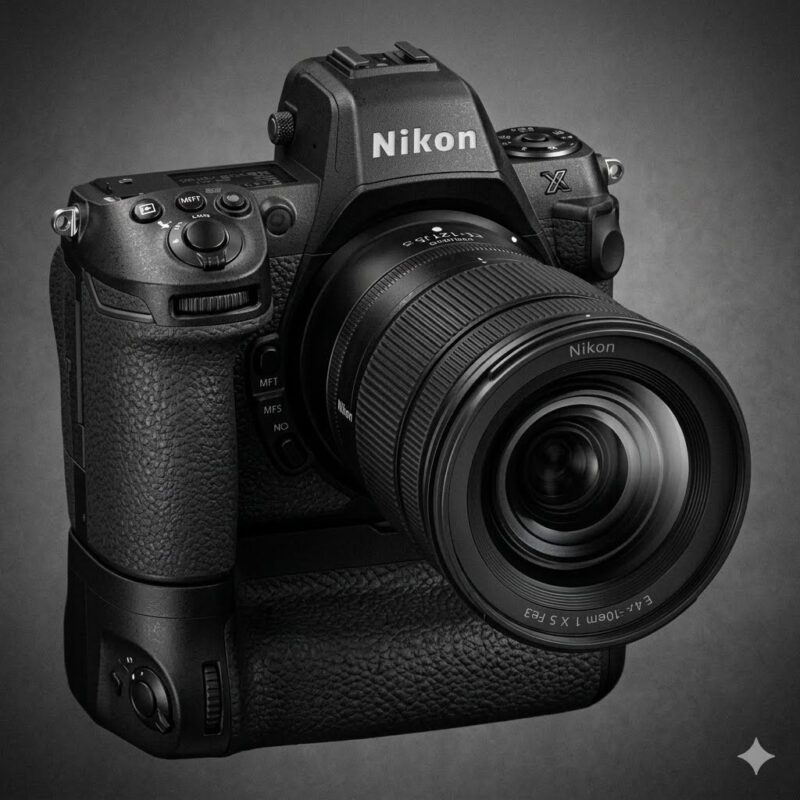
The Nikon Z8 body follows a traditional single-grip camera design. First, Nikon chose magnesium alloy for the entire body frame. Additionally, this material provides strength without significant weight penalty. Furthermore, the camera body receives dust and moisture sealing at every critical joint. Therefore, photographers shoot confidently in light rain and dusty environments. Notably, the sealing standard matches professional expectations for field use.
Grip and Handling
The grip on the Z8 is deep and comfortable. First, it accommodates large hands without strain during extended sessions. Additionally, the rubber texture provides secure grip in wet conditions. Furthermore, the grip depth allows a full four-finger hold. Therefore, the camera balances well with large telephoto lenses. Moreover, the button layout mirrors the Z9 closely. Consequently, photographers switching between both bodies experience minimal adjustment time.
Button Layout and Controls
The control layout reflects serious professional consideration. First, a dedicated video record button sits in an ergonomically logical position. Additionally, the camera features two separate command dials on the top and rear. Furthermore, a sub-selector joystick allows quick focus point movement. Therefore, photographers adjust focus areas without removing the eye from the viewfinder. Moreover, three customizable function buttons on the body allow personalized control mapping. Consequently, experienced photographers configure the camera exactly to their preferred workflow.
Additionally, the top LCD panel displays key settings at a glance. First, it shows shutter speed, aperture, ISO, and exposure compensation. Furthermore, it remains readable in direct sunlight. Therefore, photographers check settings without activating the rear screen. This is a small but important detail for professional usability.
Dual Card Slots
The dual card slot system adds significant professional reliability. First, Card Slot 1 accepts CFexpress Type B cards. Additionally, Card Slot 2 accepts SD UHS-II cards. Furthermore, photographers choose from several recording modes. Therefore, they use overflow, backup, or video/stills separation modes based on the workflow. Notably, N-RAW and ProRes RAW video requires the CFexpress slot for speed reasons. Consequently, professionals carry extra CFexpress cards for demanding video shoots.
Electronic Viewfinder: Seeing Clearly in Every Condition
The 3.69 million-dot electronic viewfinder delivers an impressive viewing experience. First, it displays the scene at 0.8x magnification. Additionally, the refresh rate reaches 120fps for smooth motion rendering. Furthermore, the coverage spans 100% of the actual image frame. Therefore, photographers compose with complete accuracy. Moreover, the EVF displays live histograms, shooting data, and horizon indicators. Consequently, the viewfinder becomes a comprehensive shooting dashboard.
Additionally, the EVF provides an exposure preview in real time. First, this shows the actual brightness of the final image before capture. Furthermore, it displays depth of field preview at any aperture. Therefore, photographers confirm correct exposure and focus depth before pressing the shutter. Notably, this real-time preview is a significant advantage over optical viewfinders. In fact, optical viewfinders cannot display this level of pre-capture information.
Rear Touchscreen: Flexibility for Every Angle
The 3.2-inch tilting touchscreen offers practical versatility. First, it tilts upward for low-angle shooting. Additionally, it tilts downward for overhead shooting perspectives. Furthermore, full touch control allows single-finger focus selection across the entire frame. Therefore, photographers move focus points quickly during live view shooting. Moreover, the touch interface navigates the menu system efficiently. Consequently, photographers find the desired settings faster than with buttons alone.
However, one limitation exists. The screen only tilts in a single vertical plane. Therefore, it does not fully articulate sideways for portrait orientation shooting. Consequently, photographers who frequently shoot vertical video may find this slightly limiting. Notably, Nikon made this design choice to maintain optimal weather sealing. Therefore, it represents a deliberate engineering tradeoff rather than an oversight.
Nikon Z8 Image Quality Analysis
The image quality from the Nikon Z8 is extraordinary. First, the 45.7-megapixel sensor captures enormous amounts of detail. Additionally, the absence of an anti-aliasing filter enhances microcontrast and fine texture. Furthermore, the 14-bit color depth preserves subtle tonal gradations throughout the image. Therefore, large prints at 40 inches and beyond look stunning.
Dynamic Range Performance
The dynamic range of the Z8 is among the best available. First, it measures approximately 14.5 stops at base ISO 64. Additionally, shadow recovery in RAW files is outstanding without significant color shift. Furthermore, highlight recovery pulls back slightly overexposed sky detail effectively. Therefore, photographers expose with confidence in high-contrast lighting situations. Moreover, the extra dynamic range reduces the need for HDR merging in many landscape scenarios. Consequently, single-frame exposures handle scenes that previously required bracketing.
High ISO Noise Performance
The Z8 performs excellently at elevated ISO settings. First, ISO 3200 produces clean and detailed images with minimal noise. Additionally, ISO 6400 remains very usable for professional publication. Furthermore, ISO 12800 shows manageable noise that responds well to modern noise reduction software. Therefore, photographers shoot confidently in dimly lit indoor and event scenarios. Moreover, the dual native ISO architecture in video mode extends clean performance further. Consequently, wedding and event photographers appreciate this real-world low-light capability.
Color Accuracy and Skin Tones
Nikon cameras historically produce excellent color rendering. The Z8 continues this tradition. First, it delivers accurate and pleasing color straight from the camera in JPEG mode. Additionally, the Picture Controls allow extensive customization of color and contrast. Furthermore, the RAW files respond beautifully to color grading in Lightroom and Capture NX-D. Therefore, portrait photographers achieve accurate and flattering skin tone rendition. Moreover, the white balance system performs intelligently in mixed lighting. Consequently, color correction requirements in post-processing stay minimal for most scenes.
Autofocus Performance in Real-World Conditions
Real-world autofocus performance defines a camera’s usability in the field. The Nikon Z8 excels consistently. First, it locks focus almost instantly in good light. Additionally, low-light autofocus performance stays reliable down to extremely dim conditions. Furthermore, the subject tracking maintains lock during complex subject motion. Therefore, sports photographers capture sharp images throughout full action sequences.
Portraits and Events
Portrait photographers love the eye detection system. First, it finds and locks to the nearest eye immediately upon activation. Additionally, it maintains eye contact even during moderate subject movement. Furthermore, it works reliably through semi-transparent veils and glasses. Therefore, wedding photographers capture candid moments with consistent sharpness. Moreover, the ability to select between human and animal detection prevents focus mistakes at outdoor events. Consequently, photographers covering pet-friendly events experience fewer missed focus situations.
Sports and Action
Sports photographers find the Z8 extremely capable. First, the 20fps electronic shutter captures sequences with massive buffer depth. Additionally, the predictive tracking algorithm anticipates subject motion between frames. Furthermore, the zero blackout EVF maintains visual subject tracking throughout any burst. Therefore, athletes in complex motion stay sharp across entire action sequences. Notably, the pre-release capture mode proves particularly valuable for peak moment capture. In fact, it makes previously difficult shots such as ball contact and jump peaks much more achievable.
Wildlife Photography
Wildlife photographers benefit from every autofocus feature simultaneously. First, bird detection and eye tracking work together for avian photography. Additionally, the 20fps burst captures wing positions throughout an entire flight sequence. Furthermore, the robust weather sealing protects the camera in field conditions. Therefore, wildlife photographers trust the Z8 in challenging outdoor environments. Moreover, the 45.7-megapixel sensor allows significant cropping while retaining print-worthy resolution. Consequently, photographers working with shorter telephoto lenses still achieve usable framing on distant subjects.
Nikon Z Mount Lens Ecosystem
The Nikon Z8 uses the Nikon Z mount system. First, the Z mount features a large 55mm inner diameter. Additionally, this wide diameter enables advanced optical designs previously impossible. Furthermore, Nikon has built an extensive lineup of Z-mount native lenses. Therefore, photographers find options for virtually every shooting scenario.
Native Z-Mount Lenses
Nikon offers an impressive range of native Z-mount lenses. First, the NIKKOR Z 24-70mm f/2.8 S covers the standard zoom range professionally. Additionally, the NIKKOR Z 70-200mm f/2.8 VR S delivers outstanding telephoto performance. Furthermore, the NIKKOR Z 400mm f/2.8 TC VR S includes a built-in 1.4x teleconverter. Therefore, wildlife and sports photographers cover extreme distances with native optical quality. Moreover, Nikon continues adding new lenses to the lineup regularly. Consequently, the Z-mount ecosystem grows more complete every year.
FTZ II Adapter for F-Mount Lenses
Nikon also offers the FTZ II adapter for legacy F-mount lenses. First, this adapter mounts all Nikon F-mount lenses optically perfectly. Additionally, it maintains full autofocus functionality with most AF-S and AF-P lenses. Furthermore, it passes electronic communication between lens and body completely. Therefore, photographers with existing Nikon F-mount lens collections protect their investment. Moreover, the adapter causes no exposure or image quality penalty. Consequently, transitioning from DSLR systems to the Z8 becomes significantly more affordable.
Connectivity and Wireless Features
The Nikon Z8 offers comprehensive connectivity options. First, it includes built-in Wi-Fi on both 2.4GHz and 5GHz bands. Additionally, Bluetooth 5.0 enables low-power persistent connections to smartphones. Furthermore, the USB-C port supports USB 3.2 Gen 2 data transfer speeds. Therefore, tethered shooting to a computer happens at high speed with minimal delay. Moreover, the full-size HDMI Type A port outputs clean video to external monitors and recorders. Consequently, video productions using external monitors work without adapters.
Nikon SnapBridge App Integration
The SnapBridge application connects the Z8 to smartphones wirelessly. First, it transfers images automatically to the phone after capture. Additionally, it allows remote shutter control from the smartphone. Furthermore, it adds GPS location data to image metadata via the phone’s GPS receiver. Therefore, photographers geotag images automatically without a separate GPS device. Moreover, firmware updates install wirelessly through the SnapBridge connection. Consequently, keeping the camera updated requires no computer connection.
NX MobileAir for Remote Control
The NX MobileAir application enables advanced remote shooting control. First, it displays a live view feed from the camera on the tablet or phone screen. Additionally, it controls all shooting parameters remotely. Furthermore, professionals use it for studio setups and remote camera positions. Therefore, photographers position the camera in difficult locations and control it from a safe distance. Moreover, it transfers full-resolution RAW files wirelessly during a shooting session. Consequently, photo editors begin selecting and editing images while the shoot continues.
Menu System and Usability
The Nikon Z8 uses the latest Nikon Z-series menu system. First, it organizes settings into logical categories with tabbed navigation. Additionally, the menu responds to touch inputs on the rear screen. Furthermore, a customizable My Menu section stores the most frequently used settings. Therefore, photographers access important functions with minimal button presses. Moreover, the i-button quick access menu provides rapid access to common shooting parameters. Consequently, experienced photographers change key settings without entering the full menu structure.
Custom Settings Bank
The Z8 includes a custom settings bank system. First, photographers store four complete camera configurations independently. Additionally, each bank saves shutter speed, aperture, ISO, autofocus mode, and drive mode simultaneously. Furthermore, switching between banks takes only seconds in the field. Therefore, photographers pre-configure the camera for different shooting scenarios before the shoot. Moreover, this proves extremely valuable during events that mix different shooting situations. Consequently, wedding photographers switch between ceremony, portrait, and reception configurations instantly.
Battery System and Power Management
The EN-EL15c battery powers the Nikon Z8 through demanding sessions. First, Nikon rates it at approximately 340 shots per charge under CIPA standard testing. Additionally, real-world shooting typically delivers more shots than the CIPA rating suggests. Furthermore, CIPA testing uses conservative and standardized conditions. Therefore, actual performance often exceeds the rated figure in typical shooting scenarios. However, heavy video recording reduces battery life significantly. Consequently, videographers carry multiple batteries for extended productions.
USB-C Power and Charging
The USB-C port adds significant flexibility to the power system. First, it charges the battery inside the camera from any USB-C power source. Additionally, it accepts power input while the camera operates actively. Furthermore, this allows continuous shooting from a USB-C power bank. Therefore, photographers eliminate battery anxiety during multi-hour outdoor sessions. Moreover, USB-C power delivery from a laptop maintains the camera during tethered studio sessions. Consequently, the power flexibility makes the Z8 extremely adaptable to various professional workflows.
MB-N12 Battery Grip
Nikon offers the MB-N12 vertical battery grip as an optional accessory. First, it attaches to the base of the Z8 body securely. Additionally, it holds two EN-EL15c batteries simultaneously. Furthermore, it adds a complete set of vertical shooting controls including a secondary shutter button. Therefore, portrait photographers shoot in vertical orientation without an awkward wrist position. Moreover, the dual battery configuration doubles the available shooting time significantly. Consequently, photographers cover full-day events without battery-related interruptions.
Nikon Z8 vs Competitors
Understanding how the Z8 compares to alternatives helps photographers make informed decisions.
Nikon Z8 vs Nikon Z9
The Z9 is the flagship camera above the Z8. First, both cameras share the same sensor and processor. Additionally, both deliver identical image quality in direct comparison. Furthermore, both share the same autofocus system and video specifications. Therefore, the practical difference between them is primarily physical. However, the Z9 includes a built-in vertical grip permanently. Additionally, the Z9 uses a larger dual EN-EL18d battery in that built-in grip. Consequently, the Z9 offers roughly double the battery life per charge. Moreover, the Z9 body is significantly larger and heavier. Therefore, sports photographers who shoot all day favor the Z9 for its endurance. In contrast, the Z8 wins for those who prioritize portability and cost savings.
Nikon Z8 vs Sony A7R V
The Sony A7R V is the primary competitor from Sony. First, the A7R V offers a 61-megapixel sensor with higher resolution. Additionally, it features a fully articulating rear screen for maximum angle flexibility. Furthermore, Sony has a more extensive native lens lineup currently. However, the Nikon Z8 delivers faster continuous shooting speeds. Additionally, the Z8 offers superior video capabilities including internal 8K RAW recording. Furthermore, the Z8 body is more weather-sealed according to most field reports. Therefore, the choice depends heavily on whether resolution or speed matters more. Notably, the A7R V lacks the pre-release capture buffer feature of the Z8. Consequently, action and wildlife photographers often prefer the Z8 for these technical reasons.
Nikon Z8 vs Canon EOS R5
The Canon EOS R5 is another direct competitor. First, the R5 uses a 45-megapixel sensor at a similar resolution. Additionally, it features a fully articulating touchscreen for flexible shooting angles. Furthermore, the Canon RF lens system offers exceptional optical quality. However, the Nikon Z8 significantly outperforms the R5 in video capability. Additionally, the Z8 offers internal 8K RAW recording while the original R5 faced overheating limitations. Furthermore, the Z8 provides faster continuous shooting at full resolution. Therefore, video-focused photographers strongly prefer the Z8. Moreover, the Z8 autofocus system rivals the Canon R5 closely in detection accuracy. Consequently, neither camera dominates the other completely across all categories.
Real-World Performance: What Photographers Actually Experience
Professional photographers who use the Nikon Z8 consistently report positive experiences. First, wildlife photographers praise the bird eye detection for its consistency. Additionally, wedding photographers appreciate the reliable low-light autofocus performance. Furthermore, videographers value the internal 8K RAW recording for high-end productions. Therefore, the Z8 serves diverse professional specializations effectively. Moreover, travel photographers note that the body size strikes an ideal balance between capability and portability. Consequently, it often replaces multiple specialized camera bodies in a travel kit.
In Sports Photography
Sports photographers find the Z8 extremely dependable. First, the 20fps burst rate captures every critical moment of action. Additionally, the pre-release buffer ensures that the frame before shutter press is never missing. Furthermore, the deep buffer allows extended burst sequences without slowing. Therefore, photographers capture entire play sequences from start to finish. Moreover, the zero-blackout EVF keeps the subject in visual frame throughout any burst. Consequently, tracking fast athletes and vehicles through the viewfinder feels natural and accurate.
In Landscape Photography
Landscape photographers leverage the full resolution advantage. First, the 45.7-megapixel sensor captures extraordinary levels of geographic detail. Additionally, the 14.5-stop dynamic range handles challenging high-contrast natural light. Furthermore, the base ISO 64 minimizes sensor noise in longer exposure scenarios. Therefore, landscape images print at enormous sizes without visible quality degradation. Moreover, the weather sealing protects the camera during outdoor exposure sessions in adverse conditions. Consequently, landscape photographers trust the Z8 in environments where other cameras might suffer damage.
In Studio Photography
Studio photographers also find real value in the Z8. First, the high resolution supports commercial retouching at the pixel level. Additionally, tethered shooting via USB-C integrates the camera into studio workflows. Furthermore, the 45-megapixel files satisfy even the most demanding advertising and editorial clients. Therefore, commercial photographers produce images ready for large-format print and billboard use. Moreover, the accurate color rendering simplifies color matching for product photography. Consequently, fewer post-production corrections are necessary in color-critical commercial work.
Firmware Updates: A Camera That Keeps Improving
Nikon actively updates the Z8 firmware. First, major updates have added new features since launch. Additionally, autofocus improvements have arrived in multiple updates. Furthermore, new video formats and recording options have expanded through firmware. Therefore, early buyers received a more capable camera over time without additional cost. Notably, Nikon added 8K 60fps recording through a firmware update after launch. Consequently, the investment in the Z8 continues delivering new value long after purchase. This ongoing development commitment reflects Nikon’s dedication to the Z8 platform.
Who Should Buy the Nikon Z8?
The Nikon Z8 suits a specific but wide range of photographers. First, professional wildlife photographers get the subject detection and speed they need. Additionally, wedding and event photographers get reliable autofocus and excellent high-ISO performance. Furthermore, sports photographers get the burst speed and buffer depth for demanding action. Therefore, working professionals across multiple specializations find strong justification for the purchase.
Moreover, hybrid photographers and videographers benefit enormously from the internal 8K RAW capability. Additionally, the N-Log 3 and ProRes RAW support integrate seamlessly into professional post-production pipelines. Furthermore, the audio recording system with professional microphone inputs serves documentary filmmakers well. Therefore, visual storytellers who work across still and video formats get a genuinely capable tool in a single body.
However, certain photographers may find the Z8 more than they need. First, casual photographers shooting family events and travel snapshots do not require this level of capability. Additionally, the price point places it clearly outside the beginner and enthusiast segment. Furthermore, photographers invested deeply in the Sony or Canon systems face significant switching costs. Therefore, the Z8 best suits working Nikon professionals and those intentionally building a Z-mount system.
Accessories Worth Considering With the Nikon Z8
Several accessories maximize the Nikon Z8 experience significantly.
CFexpress Type B Cards
High-speed CFexpress Type B cards are essential for maximum performance. First, they support the full data throughput for N-RAW and ProRes RAW video. Additionally, fast cards reduce buffer clearing time during rapid burst shooting. Furthermore, reputable brands like Nikon, ProGrade, and Sony offer reliable options. Therefore, investing in quality cards protects the camera’s full capability.
MB-N12 Battery Grip
The MB-N12 grip extends shooting endurance. First, it doubles battery capacity with two EN-EL15c batteries. Additionally, it adds vertical shooting controls for portrait orientation. Furthermore, it attaches and detaches quickly in the field. Therefore, it suits events and sports photographers who need extended runtime.
Nikon NIKKOR Z Lenses
Investing in native Z-mount lenses completes the system. First, native lenses deliver the highest optical and autofocus performance. Additionally, they fully support all electronic features of the body. Furthermore, Nikon’s S-Line lenses represent the best the system offers. Therefore, serious photographers prioritize native glass for maximum system performance.
SmallRig Z8 Cage
A SmallRig camera cage expands the Z8 for video productions. First, it adds multiple NATO rail and cold shoe mounting points. Additionally, it protects the body during demanding field productions. Furthermore, it allows mounting of monitors, microphones, and follow-focus systems. Therefore, video-focused operators configure a complete cinema rig around the Z8 body.
Common Questions About the Nikon Z8
Does the Nikon Z8 overheat during video recording? The Nikon Z8 manages heat well during video use. First, Nikon designed the thermal management system specifically for sustained recording. Additionally, 8K recording sessions run for extended periods without shutdown in normal temperature conditions. Furthermore, cooler ambient temperatures extend recording times further. Therefore, most videographers find the thermal performance acceptable for professional use.
Can the Nikon Z8 use older Nikon F-mount lenses? Yes, the Z8 accepts all Nikon F-mount lenses through the FTZ II adapter. First, the adapter maintains full electronic communication for most lenses. Additionally, autofocus functions normally with AF-S and AF-P lenses. Furthermore, older non-CPU lenses mount and function in manual mode. Therefore, photographers with existing Nikon DSLR lens collections transition with minimal additional investment.
Is the Nikon Z8 weather sealed? Yes, the Z8 features professional dust and moisture sealing. First, Nikon sealed every button, dial, port cover, and body joint. Additionally, the magnesium alloy body adds physical resilience. Furthermore, the weather sealing matches professional field expectations closely. Therefore, photographers shoot comfortably in light rain and dusty outdoor environments.
Does the Nikon Z8 have image stabilization? Yes, the Z8 includes in-body image stabilization (IBIS). First, the system provides up to 6 stops of shake compensation with compatible lenses. Additionally, it works in both still and video recording modes. Furthermore, it synchronizes with lens-based VR systems for maximum combined stabilization. Therefore, handheld shooting at slower shutter speeds produces sharp results.
What memory cards does the Nikon Z8 use? The Z8 uses two different card types. First, Card Slot 1 accepts CFexpress Type B cards for maximum speed. Additionally, Card Slot 2 accepts standard SD UHS-II cards. Furthermore, photographers use both simultaneously in various recording configurations. Therefore, redundant backup recording protects images and footage during critical shoots.
How does the Nikon Z8 autofocus compare to the Z9? The autofocus performance is essentially identical. First, both cameras share the same sensor and EXPEED 7 processor. Additionally, both use the same deep learning subject detection algorithms. Furthermore, Nikon applies the same firmware updates to both systems simultaneously. Therefore, no practical autofocus advantage exists between the two bodies.
Nikon Z8 Price and Value Assessment
The Nikon Z8 retails at approximately $3,999 USD for the body only. First, this positions it in the professional camera segment. Additionally, the price is significantly lower than the Nikon Z9 at launch. Furthermore, it competes directly with the Sony A7R V and Canon EOS R5 C on price. Therefore, buyers in this segment compare specifications carefully before committing. Moreover, the combination of 45.7-megapixel resolution, 20fps burst speed, and internal 8K RAW recording justifies the price against its competitors. Consequently, photographers frequently find the Z8 delivers the strongest technical specification package at this price point.
Additionally, Nikon occasionally bundles the Z8 with accessories or lens discounts. Furthermore, authorized retailers sometimes offer promotional pricing during holiday periods. Therefore, timing the purchase strategically can reduce the overall system cost. Moreover, the firmware update track record demonstrates that the value continues growing after purchase. Consequently, the long-term cost-per-feature calculation favors the Z8 strongly over its lifespan.
Final Verdict: Should You Buy the Nikon Z8?
The Nikon Z8 is an exceptional professional mirrorless camera. First, it delivers the sensor performance of a medium-resolution studio camera. Additionally, it shoots action at speeds comparable to dedicated sports cameras. Furthermore, it records cinema-quality video internally without external recorders. Therefore, it genuinely serves as a universal professional tool across multiple disciplines. Moreover, the compact professional body size makes it genuinely portable by flagship standards. Consequently, photographers carry it to locations where larger cameras create logistical problems.
Above all, the Nikon Z8 represents outstanding engineering achievement. First, Nikon managed to package Z9-level capability into a traditional body shape. Additionally, it added the pre-release capture buffer not available on the Z9 at launch. Furthermore, the autofocus system consistently performs at the very top of the industry. Therefore, professionals in every major photography genre find strong justification for ownership.
Indeed, the Z8 is not perfect. First, the tilting screen limits certain vertical video shooting scenarios. Additionally, the battery life is moderate and requires management during heavy video use. Furthermore, CFexpress cards add significant ongoing cost to the system. However, these limitations are minor relative to the overall capability package. Consequently, the Nikon Z8 earns the highest recommendation for professional photographers who demand the very best in a versatile and portable form.
Ultimately, the Nikon Z8 is not just a camera. First, it is a complete professional imaging system in a single body. Additionally, it evolves through firmware into an increasingly capable tool over time. Furthermore, it builds on one of the finest optical ecosystems in the industry. Therefore, investing in the Nikon Z8 is investing in a long-term professional platform. In 2025, it remains one of the most compelling and capable cameras available at any price. Professionals who choose it consistently confirm that it delivers exactly what it promises in the field every single day.
Read More from AltBuzz
Read more from Altbuzz for camera reviews, rumors, and detailed specs. AltBuzz delivers trusted and easy-to-understand photography content.
Subscribe to the AltBuzz YouTube Channel
Stay updated with camera reviews, rumors, and comparisons. AltBuzz shares regular camera content.
Subscribe Altbuzz and never miss a camera update.