
Sony VENICE 3: A Technical Look at What Comes After the Current Flagship
No credible source has reported a Sony VENICE 3 in development. Sony’s current flagship, the VENICE 2, launched in 2022 and remains firmly positioned at the top of the Cinema Line, still receiving active firmware support and appearing on major productions today. Searching through every current rumor tracker covering Sony’s cinema roadmap turns up no leaked specification sheet, no registered model number, and no insider report pointing toward an imminent successor.
This article takes a different approach than a typical rumor piece. Since no leak exists, we will build a technically grounded picture of what a Sony VENICE 3 would realistically need to include, based on three sources of real information. First, the actual sensor architecture, dynamic range, and codec depth of the current VENICE 2. Second, Sony’s own publicly stated Cinema Line strategy, which reveals a deliberate engineering progression across every model beneath it. Third, technology already proven in adjacent Sony cinema cameras like the BURANO and the rumored FX5, both of which offer real clues about where Sony’s sensor and processing development is headed. Consider this a technical projection rather than a rumor report.
Why No Genuine VENICE 3 Leak Currently Exists
Before speculating on specifications, it is worth understanding why this rumor has not materialized yet, and why that absence itself is meaningful.
VENICE 2 Remains Too Recent for a Successor Cycle
The VENICE 2 launched in 2022, and flagship cinema cameras at this level typically maintain a five to seven year product cycle before Sony introduces a genuine replacement. According to NoFilmSchool, industry speculation as recently as 2024 explicitly questioned whether it would even be too early for a VENICE 3, reflecting a general industry consensus that this camera remains several years away from a legitimate successor cycle.
Sony’s Cinema Line Follows a Deliberate Engineering Ladder
According to Y.M.Cinema Magazine, Sony’s entire Cinema Line now forms a visible, structured progression from the FX30 at the entry level through the FX3, FX6, BURANO, and finally VENICE 2 at the top. This structural clarity signals long-term engineering planning rather than opportunistic releases, and it suggests Sony treats VENICE 2’s position at the pinnacle of that ladder as something to protect deliberately rather than replace on an aggressive timeline.
Active Production Use Reduces Pressure for a Successor
The VENICE 2 continues seeing genuine production use on high-profile projects. Coverage from Y.M.Cinema Magazine’s reporting on the VENICE Rialto stereoscopic system confirms VENICE sensor technology remains central to major theatrical productions, including its role in Avatar 3’s stereoscopic capture system. A camera still actively serving flagship productions at this level faces considerably less commercial pressure for an imminent replacement compared to a consumer product nearing the end of its relevance.
Understanding the VENICE 2’s Current Technical Architecture
Any realistic projection of a VENICE 3 must start from a clear technical understanding of what the current flagship already delivers.
Sensor Architecture and Resolution
The VENICE 2 uses a full-frame 3:2 sensor architecture capable of 8.6K resolution, according to Y.M.Cinema Magazine’s Cinema Line breakdown. This resolution ceiling gives cinematographers substantial reframing flexibility in post-production, along with the ability to deliver native 8K masters for productions targeting that format. The original VENICE, by comparison, topped out at 6K resolution using its 36 x 24mm full-frame sensor, according to Sony’s own official specifications.
Dynamic Range and Dual Base ISO System
VENICE 2 delivers 16 stops of dynamic range, a meaningful increase over the original VENICE’s already impressive 15-stop rating. According to GearFocus, the original VENICE achieves this range through a dual base ISO system offering native sensitivity at ISO 500 and ISO 2500, allowing cinematographers to switch between standard lighting and low-light high dynamic range capture without introducing processing artifacts. This dual base ISO architecture has become a defining characteristic of Sony’s entire Cinema Line, appearing across the FX30, FX6, and BURANO as well.
Internal Codec Depth: X-OCN at 16-Bit
Codec architecture represents one of VENICE 2’s most significant technical advantages over the rest of Sony’s lineup. Y.M.Cinema Magazine’s coverage confirms VENICE 2 records internal 16-bit X-OCN in multiple variants, including XT, ST, and LT formats, alongside genlock support for multi-camera synchronization and full integration into large-scale digital film workflows. This codec depth alone establishes clear separation from lower-tier Cinema Line cameras, since internal X-OCN at this bit depth demands considerably more processing throughput and storage bandwidth than the ProRes or XAVC options found on cameras like the FX6.
Physical Design and Modular Extension System
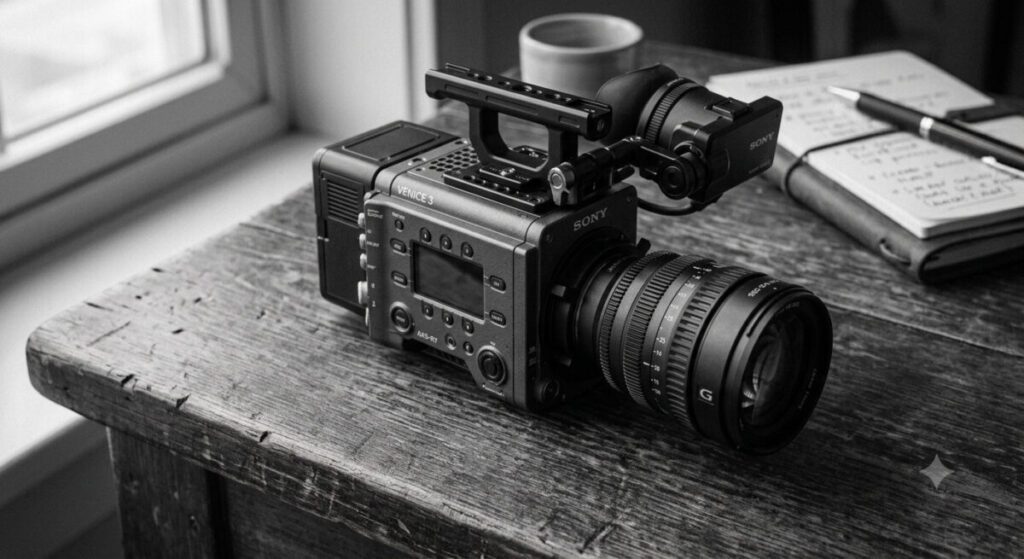
The original VENICE weighs approximately 3.9 kilograms excluding handle, viewfinder attachment, and bottom cover, built around a magnesium alloy, weather-sealed body according to GearFocus specifications. According to AbelCine, Sony’s Extension System allows the camera body to physically detach from the image sensor block, a modular architecture that supports specialized rigs like the Rialto extension unit used for tight spaces or stereoscopic 3D capture. This modularity represents genuine engineering differentiation that lower-tier Cinema Line cameras simply do not offer.
What Adjacent Sony Cinema Cameras Reveal About Future Sensor Direction
Since VENICE 2 sits at the top of Sony’s Cinema Line, technology trends visible in cameras beneath it often provide the clearest signal for where Sony’s broader sensor engineering is headed.
The Rumored FX5’s Sensor Architecture Debate
Currently circulating rumors about the FX5, a camera positioned well below VENICE 2 in the Cinema Line hierarchy, reveal an interesting engineering debate worth applying to any future VENICE successor. According to Sony Alpha Rumors, early FX5 leaks initially suggested a 16-megapixel global shutter sensor, before later correction revealed the camera instead uses a 16-megapixel fully stacked sensor optimized for fast readout rather than true global shutter operation.
Why Fast Stacked Sensors May Outperform Global Shutter for Cinema Work
This distinction carries real technical significance for any hypothetical VENICE 3 discussion. According to Y.M.Cinema Magazine’s FX5 analysis, global shutter sensors, while excellent at eliminating rolling shutter artifacts entirely, introduce genuine tradeoffs in dynamic range, noise performance, power consumption, and thermal management. A fast stacked sensor architecture can still dramatically reduce rolling shutter distortion while maintaining a more balanced overall image pipeline, a consideration that likely matters even more at VENICE’s flagship tier, where dynamic range and color science have always taken priority over pure specification headlines.
VENICE-Style Menu Systems Already Migrating Downward
Notably, the same FX5 leak coverage describes a menu structure borrowed directly from the VENICE lineup rather than Sony’s traditional Alpha-style interface, complete with a dedicated False Color button for exposure monitoring. This detail suggests Sony is already standardizing its professional cinema workflow interface across multiple tiers of the Cinema Line, a trend that would likely continue upward into any eventual VENICE 3 refinement rather than requiring an entirely new interface paradigm.
Technical Specifications a Sony VENICE 3 Would Likely Need
Building on VENICE 2’s existing architecture and the sensor trends visible in Sony’s broader Cinema Line, several technical upgrade paths seem genuinely plausible for an eventual successor.
Resolution Beyond 8.6K With Preserved Dynamic Range
Any VENICE 3 would need to advance meaningfully beyond VENICE 2’s current 8.6K ceiling without sacrificing the 16-stop dynamic range that defines the platform’s reputation among working cinematographers. Given how carefully Sony has balanced resolution against dynamic range across every VENICE generation so far, a jump to somewhere in the 10K to 12K range seems more technically plausible than an aggressive leap toward resolution figures competing purely on spec-sheet appeal.
Continued Dual Base ISO With Expanded Latitude
The dual base ISO architecture has proven itself across multiple camera generations and product tiers within Sony’s Cinema Line, making its continuation into a VENICE 3 almost certain. A meaningful upgrade path would likely involve expanding the total exposure latitude beyond the current 15 stops over to under 18 percent middle gray, or introducing a third base ISO tier specifically optimized for extreme low-light digital cinematography, an area where competing platforms have begun pushing harder in recent product cycles.
Faster Sensor Readout Without Full Global Shutter Compromise
Following the technical logic revealed in the FX5’s fast stacked sensor approach, a VENICE 3 would likely prioritize dramatically reduced rolling shutter through improved sensor readout speed rather than committing to a true global shutter design. This approach would preserve VENICE’s established color science and dynamic range reputation while still addressing rolling shutter concerns that occasionally arise during rapid camera movement or high-speed capture on large format productions.
Expanded Internal Codec Options
Given VENICE 2’s existing 16-bit X-OCN implementation across XT, ST, and LT variants, a successor would likely introduce either a higher bit-depth codec option or meaningfully improved compression efficiency at the same bit depth, reducing storage and data management burden on large-scale productions without compromising the grading flexibility that makes X-OCN valuable in the first place.
Continued Modular Extension System Compatibility
Given how central the Extension System and Rialto configuration have become to VENICE’s use in specialized productions, including the stereoscopic system used on Avatar 3, any VENICE 3 would almost certainly need to maintain backward compatibility with this modular ecosystem, or risk alienating productions that have invested heavily in existing Rialto and extension hardware.
Technical Implications for Post-Production Pipelines
A hypothetical resolution and codec increase on a VENICE 3 would ripple through post-production workflows in ways worth examining technically, since flagship cinema camera upgrades rarely stay contained to the camera body alone.
Storage and Data Rate Considerations
Moving beyond VENICE 2’s 8.6K resolution ceiling while maintaining 16-bit X-OCN codec depth would meaningfully increase data rates during capture. Productions already managing substantial storage infrastructure for VENICE 2’s XT variant would need to scale that infrastructure further, particularly for extended shooting days or multi-camera setups where storage costs compound quickly. This consideration alone often shapes how aggressively camera manufacturers push resolution increases at the flagship tier, since alienating productions with unmanageable data rates undermines the very professional trust that makes a camera like VENICE valuable in the first place.
Color Grading Pipeline Compatibility
VENICE’s ultra-wide color gamut and S-Log3 gamma encoding have become deeply embedded in established color grading workflows across the industry, according to Sony’s own official product materials. Any VENICE 3 would need to maintain fundamental compatibility with this established color pipeline, even while potentially expanding dynamic range or color depth further. Introducing an entirely new color science paradigm at the flagship tier would force productions and colorists to relearn established grading approaches, a genuine risk that Sony has consistently avoided across previous VENICE generations by prioritizing evolutionary rather than revolutionary color pipeline changes.
Virtual Production and LED Wall Compatibility
Sony has specifically marketed VENICE’s high-speed sensor readout as ideal for virtual production and LED wall synchronization, according to official Sony Cine materials. As virtual production continues expanding across the film and television industry, any VENICE 3 would need to maintain or improve this synchronization capability, since LED wall workflows demand extremely precise timing between camera sensor readout and wall refresh rates to avoid visible banding or moiré artifacts during capture.
Why Sony Would Approach a VENICE 3 Conservatively
Understanding Sony’s broader Cinema Line philosophy helps explain why a VENICE 3, whenever it eventually arrives, would likely prioritize refinement over dramatic reinvention.
Protecting an Established Production Standard
VENICE and VENICE 2 have collectively appeared on more than 500 theatrical, broadcast, cable, and streaming releases, according to Sony’s official Cine Line materials. This production track record represents enormous accumulated trust within the film industry, and Sony has strong incentive to preserve the specific color science, dynamic range characteristics, and workflow behavior that earned that trust rather than risk disrupting it with an aggressive redesign.
BURANO’s Role in Protecting VENICE’s Position
According to Y.M.Cinema Magazine’s Cinema Line analysis, the BURANO camera plays a specifically strategic role within Sony’s lineup, preventing ambitious cinematographers from needing to jump to competing brands as their projects scale up in ambition, while still preserving upward mobility toward VENICE for productions that eventually demand it. This structural positioning suggests Sony deliberately uses BURANO to absorb mid-tier demand, reducing pressure to rush VENICE 3 development purely to satisfy cinematographers who might otherwise feel locked out of Sony’s top-tier capabilities.
Technical Conservatism as a Feature, Not a Limitation
Unlike consumer camera lines that benefit from frequent, feature-driven refresh cycles, flagship cinema cameras succeed by demonstrating long-term reliability and predictable behavior across years of demanding production use. A VENICE 3 built with genuine technical conservatism, prioritizing proven dynamic range and color science over spec-sheet novelty, would likely serve working cinematographers better than a camera chasing resolution or frame rate records purely for marketing purposes.
Should Productions Wait for a Sony VENICE 3
Given the complete absence of any confirmed development timeline, this question carries real practical weight for productions currently planning camera packages.
The Case for Continuing With VENICE 2 Now
Productions with an immediate need for flagship-level cinema capability should not delay equipment decisions based on unconfirmed speculation. VENICE 2 remains genuinely capable, continues receiving active firmware support, and maintains proven compatibility with the extensive rental and post-production infrastructure built around it over the past several years.
The Case for Monitoring Sony’s Broader Roadmap
Productions planning multi-year equipment investments, or facilities considering a significant capital purchase rather than rental, may benefit from watching how Sony’s mid-tier Cinema Line technology, particularly the sensor and menu innovations appearing in the rumored FX5, eventually migrates upward. These technical trends often provide the earliest genuine signal of engineering direction well before Sony makes any official VENICE successor announcement.
Frequently Asked Questions About the Sony VENICE 3
Is the Sony VENICE 3 an officially confirmed camera?
No. There is currently no credible leak, registration filing, or insider report confirming a VENICE 3 exists in development. Everything in this article represents technically grounded speculation based on VENICE 2’s existing architecture and Sony’s broader Cinema Line strategy.
When did the current VENICE 2 launch?
The VENICE 2 launched in 2022 and remains Sony’s current flagship Cinema Line camera, continuing to receive active firmware support and seeing use on major theatrical and streaming productions.
What resolution does the VENICE 2 currently offer?
The VENICE 2 uses a full-frame 3:2 sensor architecture capable of 8.6K resolution, an increase over the original VENICE’s 6K maximum resolution.
Would a VENICE 3 use a global shutter sensor?
Based on sensor trends visible in Sony’s broader Cinema Line, including the rumored FX5’s fast stacked sensor approach, a true global shutter design seems less likely than a faster stacked sensor architecture that reduces rolling shutter without the dynamic range and thermal tradeoffs a global shutter typically introduces.
How does the BURANO relate to a potential VENICE 3?
The BURANO occupies a strategic middle tier within Sony’s Cinema Line, absorbing demand from cinematographers who want VENICE-level capability in a more portable form factor. This positioning likely reduces pressure on Sony to rush a VENICE 3 development timeline, since BURANO already serves much of that ambitious mid-tier demand.
Final Thoughts on the Sony VENICE 3
No confirmed rumor, leak, or insider report currently points toward a Sony VENICE 3 in active development. What does exist is a technically coherent picture built from VENICE 2’s proven architecture, Sony’s clearly stated Cinema Line engineering philosophy, and genuine sensor and interface trends already appearing in adjacent cameras like the rumored FX5. Based on this evidence, a future VENICE 3 would likely prioritize refined sensor readout speed, expanded codec options, and continued modular compatibility over dramatic reinvention, following the same conservative, trust-preserving approach that has defined every VENICE generation so far.
Whether Sony moves forward with this successor in the near term remains genuinely uncertain, and current industry consensus suggests it remains several years away at minimum. The engineering ladder Sony has built across its entire Cinema Line, from the FX30 through BURANO and up to VENICE 2, suggests any eventual VENICE 3 will emerge only once genuine technical justification exists, rather than as a reflexive response to competitive pressure or a routine product cycle. We will continue monitoring Sony’s Cinema Line roadmap for any genuine signal that this development has begun.
Read More from Altbuzz
For more cinema camera coverage, check our Sony FX5 rumor breakdown, our Sony BURANO versus VENICE 2 comparison, and our complete guide to Sony’s Cinema Line lineup for deeper context on this professional camera category.
Follow every Sony Cinema Line update and VENICE development at altbuzzmedia.com. For dedicated Sony cinema camera coverage, follow Y.M.Cinema Magazine at ymcinema.com.
Subscribe to Altbuzz YouTube Channel
Full technical breakdowns of the Sony VENICE 2, comparisons against BURANO and the rumored FX5, and ongoing coverage of Sony’s Cinema Line roadmap are live on the Altbuzz YouTube channel @AltBuzzMedia. Subscribe now for weekly cinema camera analysis and gear breakdowns through the rest of 2026.