
3 Pentax K-1 Mark II Alternatives
The Pentax K-1 Mark II is still one of the most distinctive full-frame DSLRs you can buy. However, at about eighteen hundred dollars new, it is a difficult purchase heading into 2027. Ricoh has also ended production of the current K-series, which makes the decision even harder. The good news is that you do not have to leave Pentax to spend less.
We found three Pentax K-1 Mark II alternatives. One keeps the full-frame experience. One is smaller and faster. One costs around five hundred dollars used. Each answers a different question about what you actually need from a Pentax.
At Altbuzz, we love cameras with a story. So we will walk through each option, show the trade-offs and explain who should buy what. Read on to find your best fit.
A quick note on prices. Every price in this article is a snapshot of U.S. listings. Stock for these cameras is thin, and used prices move with condition and availability. Treat each range as a guide, not a promise, and check current listings before you buy.
Why the Pentax K-1 Mark II Is Hard to Justify in 2027
Before we spend anyone’s money, we need to be fair to the camera that everything else is measured against. The K-1 Mark II is not a bad camera. It is a very good one. The real question is whether you need every part of the package you would pay for.
The Pentax K-1 Mark II at a Glance
Ricoh lists the K-1 Mark II in the United States at around $1,800, body only. For that money, you get a lot of unusual features.
- 36.4 megapixel full-frame CMOS sensor
- 5-axis sensor-shift stabilization
- Pixel Shift mode that pulls out extra detail when the camera sits still on a tripod
- Weather-resistant and dustproof body
- Optical viewfinder that shows nearly the whole frame
- Rear screen that flexes out on its own mount
- Built-in GPS with Astrotracer features for night sky photography
The flexible rear screen deserves a mention. Few cameras bother with a design like that.
What the K-1 Mark II Does Not Do
Now look at what is missing. First, speed. The camera shoots about 4.4 frames per second. Second, video. It stops at Full HD.
That is not a flaw so much as a statement. The K-1 Mark II earns its price through resolution, toughness and Pentax-only stills features. It does not chase sports or modern video. So the question was never whether it is a good camera. The question is whether you need every feature in the package.
Who the K-1 Mark II Really Fits
Think about who that package fits best.
- A landscape shooter who prints large and wants every last bit of detail
- Someone who shoots in rain and dust and does not want to baby the gear
- A photographer who loves the optical finder and has no interest in a screen between them and the scene
For those people, the price makes sense. For everyone else, part of it pays for features that never get used. Keep that split in mind, because the rest of this article builds on it.
The Ricoh Announcement Changes the Timing
The timing sharpens the question. On September 9, 2026, Ricoh announced that it will end production of the current K-series DSLRs. In the same announcement, Ricoh said it is developing a new series of digital SLR cameras. That series follows an entirely new concept, and it builds on the K-mount legacy.
Ricoh gave no model name. It gave no specifications, no price and no date. The company was also clear that the project will take time.
So Pentax is not walking away from the DSLR. It is closing one chapter. You have to decide how much to spend on that chapter.
What Pentax Buyers Actually Pay For
Pentax cameras sell on a different set of strengths than most rivals. Before we count down, it helps to separate the features that cost money from the features that deliver value. That split explains why a cheaper body can still feel like a true Pentax.
Shared Pentax Strengths
Several traits appear across the whole group. The cameras in this article offer sensor-shift stabilization, which works with any K-mount lens you attach. They also use sealed, weather-resistant bodies and optical viewfinders built around a pentaprism design. These traits define the Pentax experience, and they appear well beyond the flagship.
Full Frame Versus APS-C for Pentax Shooters
Sensor size is the biggest price driver. The K-1 Mark II and the original K-1 use a 36.4 megapixel full-frame sensor. The KF and the KP use APS-C sensors of about 24 megapixels. Full frame gives you more resolution and different depth of field behavior. APS-C gives you a smaller, lighter and cheaper camera.
So ask yourself an honest question. Do you print large, or do you share online and print small? Your answer tells you how much of the full-frame premium you will actually use.
Where the Money Goes
Think of the price as three layers. The first layer buys the Pentax basics, including sealing, stabilization and the optical finder. The second layer buys the larger sensor. The third layer buys refinements such as Dynamic Pixel Shift and autofocus tracking updates. The KF stops at the first layer. The original K-1 reaches the second layer. The Mark II adds the third.
3. Pentax KF
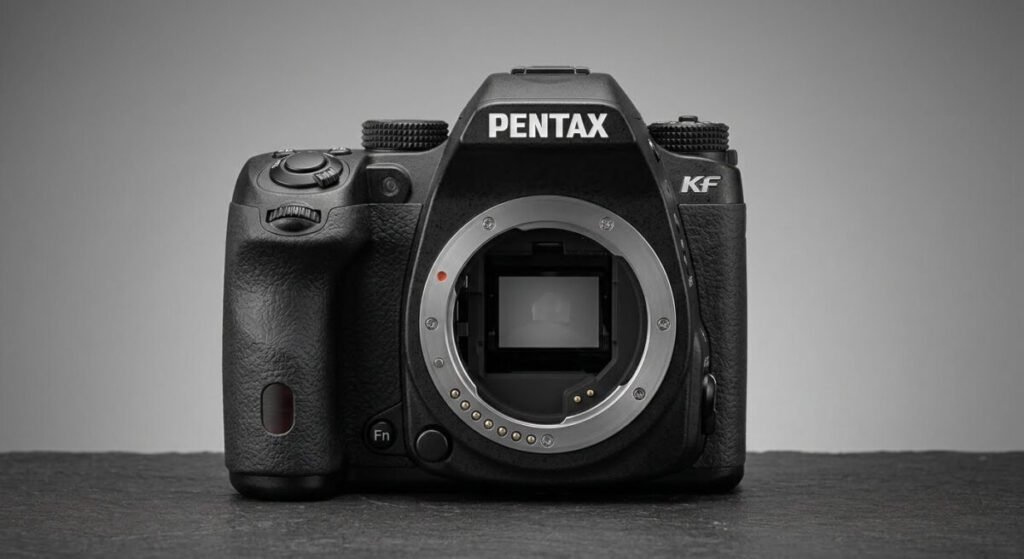
At number three, we have the Pentax KF. This is the camera that causes the sticker shock. A new KF lists at around $700. A used one has turned up for roughly $520. Stock is thin, and a used body is not the same deal as a new one. Still, set that price next to $1,800 and the conversation changes.
What Survives the Price Cut
More than you would expect. The KF keeps many features that make Pentax special.
- Pentaprism optical viewfinder with roughly 100% coverage
- Sensor-shift stabilization, rated by Ricoh at 4.5 shutter steps under its test conditions
- Dustproof and weather-resistant body with 100 sealing parts
- Vari-angle rear screen
- Burst shooting up to about 6 frames per second, a little faster than the K-1 Mark II
- Full compatibility with your K-mount lenses
What You Give Up
You give up the sensor. The KF uses a 24.24 megapixel APS-C sensor. Therefore, field of view and depth of field do not behave the way full frame does. The KF also will not match the K-1 Mark II for maximum landscape resolution.
That is a real trade. However, it matters less than you might think for many shooters.
Who Should Buy the KF
Think about a hiker caught in a rainstorm on a long trail. Picture a parent traveling with a family. For those buyers, a sealed, stabilized body with an optical finder may matter far more than extra megapixels.
There is a second kind of buyer too. Some photographers already own a few K-mount lenses and want a second body. Others want a way back into Pentax without a big commitment. A cheap, sealed body that accepts the lenses they already have is an easy yes. It also costs far less than a leap into new gear.
At around $500 used, the KF can save you more than $1,200 against a new K-1 Mark II. So start with one honest question. If full frame is not the reason you wanted the K-1 Mark II, does the KF already keep the Pentax features you care about?
An Honest Word on Cheaper Options
Cheaper same-brand options help only when nobody pretends that cheaper always means better. The KF is not a smaller K-1 Mark II. It is a different camera for a different buyer.
2. Pentax KP
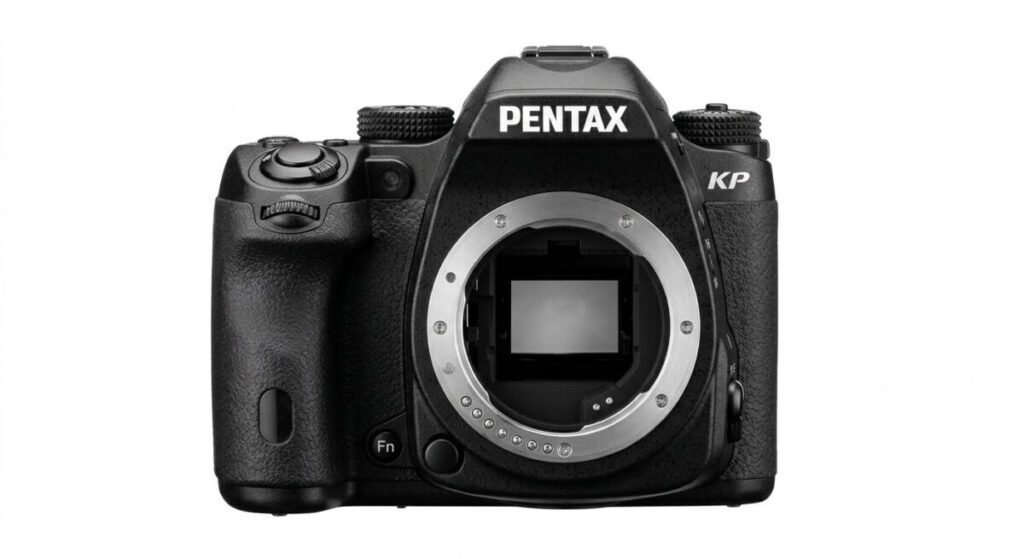
At number two, we have the Pentax KP. Here the argument stops being about price. It starts being about how a camera feels to carry. U.S. used listings have landed roughly between $719 and $859, again with thin inventory.
Key Specs
- 24.3 megapixel APS-C sensor
- 5-axis SR II stabilization
- Weather-resistant body with extensive sealing
- Pentaprism viewfinder covering nearly the whole frame
- Interchangeable grip system
- Burst shooting up to about 7 frames per second
On paper, the KP looks familiar. The unusual part is the grip system, which lets you change how the camera sits in your hand.
A Faster Burst, With a Warning
The KP beats the K-1 Mark II’s burst rate. However, do not stretch that into an action camera. Against newer high-end cameras, it is not built for that job.
The Pentax You Will Actually Carry
The KP is not an image-quality substitute for the K-1 Mark II. Instead, it suits someone who values portability, enthusiast controls and a smaller DSLR more than maximum sensor size. Think of a street or travel shooter who walks all day.
The K-1 Mark II is the better full-frame landscape flagship. The KP may be the Pentax you are actually willing to carry. The gap between the two cameras is easy to feel in the numbers and harder to feel in daily use.
A body you leave at home takes no pictures. A heavier camera that stays on the shelf is not the better camera, whatever the sensor says. That is the real case for the KP.
Hold One Before You Decide
Comfort is personal. So hold a KP if you can before you commit. Its age also matters. Check the condition carefully, and make sure batteries are easy to find.
1. Pentax K-1
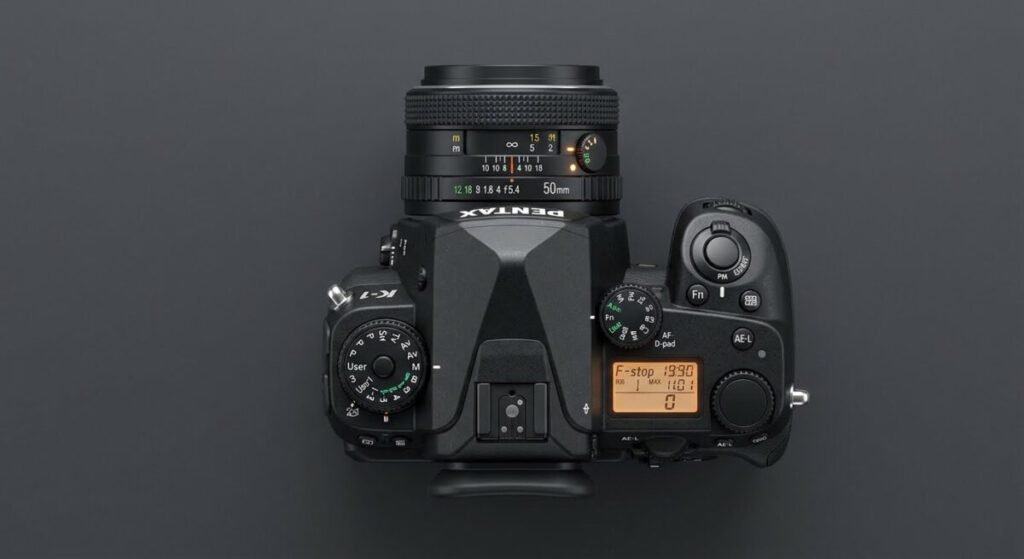
At number one, we have the original Pentax K-1. It is the only camera in this list that keeps the full-frame heart of the K-1 Mark II. Recent U.S. used snapshots run from roughly $989 to $1,229. Again, only a few bodies are listed.
Why the Sensor Makes It Interesting
The sensor makes the original K-1 interesting. Ricoh stated at the Mark II launch that the Mark II uses the same 36.4 megapixel full-frame sensor as the original. So the original K-1 already gives you a lot.
- The same 36.4 megapixel full-frame resolution
- 5-axis stabilization
- Dual SD card slots
- Rugged, weather-resistant body
- Pixel Shift mode
- Flexible rear screen
For the buyer who wants the K-1 Mark II concept but wants to keep several hundred dollars, this is the closest real answer. That concept means full-frame Pentax with high-resolution stills.
Why Dual Card Slots Matter
Those dual card slots matter more than they sound. High-resolution files add up fast on a long trip. A second slot gives a serious shooter room to work. The K-1 behaves like a serious tool, and that experience is what you really pay for.
What the Original Gives Up
The K-1 is not identical to the Mark II. The Mark II added an accelerator unit, higher sensitivity capability, Dynamic Pixel Shift and autofocus tracking refinements. Processing and high-ISO behavior differ between the two. The original gives up those refinements.
The Used Price Twist
Now the twist. Used Mark II prices can sit surprisingly close to the original. We found one retailer that listed used Mark IIs starting around $1,350. Next to an original K-1 at $1,229, that gap is small enough to make you stop. Next to an original near $1,000, it is a real discount.
So the original K-1 wins only when the price gap is meaningful. If a Mark II in similar condition costs just a little more, buy the Mark II and do not think twice.
Quick Comparison Table
| Camera | Sensor | Burst Speed | Snapshot Price | Best For |
|---|---|---|---|---|
| Pentax K-1 Mark II | 36.4 MP full frame | About 4.4 fps | About $1,800 new | Landscape detail and the most refined full-frame Pentax |
| Pentax KF | 24.24 MP APS-C | About 6 fps | About $700 new, about $520 used | Cheapest route to a sealed, stabilized K-mount DSLR |
| Pentax KP | 24.3 MP APS-C | About 7 fps | About $719 to $859 used | Portable enthusiast shooting |
| Pentax K-1 | 36.4 MP full frame | Check Ricoh’s spec sheet | About $989 to $1,229 used | Full-frame Pentax at a lower price |
Which Pentax Should You Buy?
Now let us turn all of this into a clear verdict. Your priorities decide the right answer.
Choose the KF If You Want the Cheapest Route
Pick the KF if you want a weather-resistant, stabilized K-mount DSLR at the lowest price. It also suits you if you do not need full frame.
Choose the KP If You Want a Smaller Body
Pick the KP if you want a smaller enthusiast Pentax with faster burst shooting. It rewards photographers who walk, travel and shoot all day.
Choose the Original K-1 If Full Frame Matters Most
Pick the original K-1 if full frame and the core K-1 experience matter most. This choice makes sense only when the used price gap is genuinely meaningful.
Choose the K-1 Mark II for the Most Refined Option
Pick the K-1 Mark II if you want the most refined outgoing full-frame Pentax DSLR. The price and condition must also make the premium reasonable.
Consider Waiting Only in One Case
Consider waiting only if your current camera already works and Ricoh’s future concept matters to you. Remember that Ricoh has announced no final specifications and no release date.
Real-World Scenarios: Which Pentax Fits Your Life?
Specs only tell part of the story. These short scenarios show how each camera fits real shooting habits.
The Weekend Landscape Photographer
You hike at dawn, shoot from a tripod and print your best work large. The K-1 Mark II fits you best. The original K-1 comes close if you find it at a meaningful discount. Pixel Shift and the 36.4 megapixel sensor reward your patience.
The Rainy-Day Traveler
You carry one camera, and the weather rarely cooperates. The KF fits you well. It offers a sealed body, stabilization and an optical finder at a low price. You also save money to spend on a good lens.
The All-Day Walker
You shoot street scenes and travel moments, and you cover many miles. The KP suits you. Its smaller body and interchangeable grip system make long days easier. A camera you enjoy carrying will capture more photos.
The Returning Pentax Owner
You already own K-mount lenses. A used KF or KP gives you a low-cost second body. The K-1 gives you a full-frame upgrade without paying Mark II prices, as long as the gap is real.
The Careful Waiter
Your current camera works well. You feel curious about Ricoh’s future DSLR concept. Keep shooting, and watch for official news. You lose nothing by waiting, because Ricoh has not announced a date.
How Much Can You Really Save?
Money drives most of these decisions, so let us put the numbers side by side. All figures come from the snapshots above.
Savings Against a New K-1 Mark II
A new K-1 Mark II lists at around $1,800. A used KF at around $520 saves you more than $1,200. A used KP between $719 and $859 saves you roughly $940 to $1,080. A used K-1 between $989 and $1,229 saves you about $570 to $810.
What Those Savings Can Buy
Those savings matter. A lower body price leaves room for a quality lens, a spare battery and fast memory cards. For many photographers, a good lens improves results more than a larger sensor does. Therefore, a cheaper body paired with better glass can beat a pricier body paired with a weak lens.
When the Savings Disappear
Remember the used Mark II twist. If a used Mark II sits only a little above a used K-1, the savings vanish. In that case, buy the Mark II and enjoy the added refinements.
Should You Wait for Ricoh’s New DSLR Series?
The new series makes waiting tempting. Still, waiting carries a real cost. Nobody knows what the cameras will offer or when they will arrive.
What We Know
Ricoh says a new series of digital SLR cameras is in development. The company says the concept is entirely new, and it builds on the K-mount legacy. Ricoh also says the project will take time.
What We Do Not Know
We do not know a model name. We do not know the specifications, the price or the release date. Any claim beyond Ricoh’s statement is speculation, so treat it that way.
A Practical Rule
If your current camera works, waiting costs you nothing. If you need a camera now, buy the Pentax that fits your work today. K-mount lenses should carry forward either way, since Ricoh says the new series builds on that legacy.
How to Buy a Used Pentax Safely
Thin inventory makes careful buying even more important. Use this short checklist before you pay.
Check the Body
- Inspect the weather seals, the grip and the corners for wear.
- Test the buttons, dials and card slots.
- Check the rear screen and its movement.
Check the Sensor and Viewfinder
- Look for dust, scratches or oil on the sensor.
- Confirm that the optical viewfinder looks clean and clear.
Check the Battery and Charger
Make sure batteries are easy to find for older bodies like the KP. Confirm that the charger works.
Choose a Trusted Seller
Prefer sellers with a clear grading standard, a return window or a warranty. You can browse inventory at MPB, B&H Photo and Adorama. You can also review official Pentax models on the Ricoh Imaging website.
Final Verdict: Is the K-1 Mark II Too Expensive?
The K-1 Mark II is not automatically too expensive. It is too expensive when the features that justify its premium are features you do not need.
If you want maximum landscape resolution, toughness and Pentax-only stills features, the Mark II still delivers. If you want the same sensor for less, the original K-1 deserves a look when the price gap is real. If full frame is not your reason for buying, the KF and the KP save you a lot of money. Each one keeps the sealed body, the stabilization and the optical finder that make Pentax special.
Now it is your turn. Would you take the KP over a full-frame K-1 for the same money? And if the used Mark II gap shrinks to almost nothing, does the original K-1 lose its argument? Tell us where you land in the comments.
Frequently Asked Questions About Pentax K-1 Mark II Alternatives
What is the best alternative to the Pentax K-1 Mark II?
It depends on what you value. The original K-1 is the closest alternative, because it keeps the full-frame sensor. The KF is the cheapest, and the KP is the smaller, faster option.
Is the Pentax K-1 Mark II being discontinued?
Ricoh announced on September 9, 2026 that it will end production of the current K-series DSLRs. The company also said it is developing a new series of digital SLR cameras.
Does the original Pentax K-1 use the same sensor as the Mark II?
Yes. Ricoh stated at the Mark II launch that the Mark II uses the same 36.4 megapixel full-frame sensor as the original. The Mark II adds processing and autofocus refinements.
Is the Pentax KF weather sealed?
Yes. The KF has a dustproof and weather-resistant body with 100 sealing parts. It also offers sensor-shift stabilization and a pentaprism optical viewfinder.
Will my K-mount lenses work on these cameras?
Yes. All three alternatives use the K-mount, so your existing K-mount lenses fit.
Read More from Altbuzz
Want more camera value, history and story-driven coverage? Explore the latest articles at altbuzzmedia.com.
Subscribe to Altbuzz YouTube Channel
If cameras with a story are your thing, subscribe to the Altbuzz channel on YouTube. We explain camera decisions by real shooting priorities instead of prestige or sensor size. Visit @AltBuzzMedia on YouTube and stay for the next one.
You can also support the channel through memberships and Super Thanks. Find everything else at altbuzzmedia.com.