
Pentax K-1 Review: Is This Full-Frame DSLR Still Worth Buying in 2027?
The original Pentax K-1 launched in 2016 with a bold promise. It offered a 36.4 megapixel full-frame sensor, a rugged weather-sealed body and a price well below most rivals. More than a decade later, that promise looks even more interesting. Ricoh has ended production of the current K-series DSLRs, and used K-1 bodies now sit in a strange and tempting price zone.
This Pentax K-1 review looks at the camera as a 2027 purchase. We cover design, image quality, Pixel Shift, autofocus, video, battery life and lens options. We also compare it with the K-1 Mark II, because that comparison decides most buying choices.
How we built this review. This article draws on Ricoh’s official specifications and on findings from independent reviews and lab tests of the K-1. It is not a hands-on lab report from Altbuzz. Used prices come from recent U.S. listing snapshots, and they move with condition and availability. Treat every price as a guide, not a promise.
Pentax K-1 Review: Quick Verdict
The K-1 is a stills camera first and a specialist tool second. It rewards photographers who value image quality, toughness and the optical viewfinder. It punishes anyone who expects fast tracking autofocus or modern video.
Why You Might Love It
- Excellent full-frame image quality with strong dynamic range
- Pixel Shift Resolution for extra detail on static scenes
- Sealed, rugged body with dual card slots
- Flexible rear screen and helpful built-in LED lights
- Very strong value on the used market
Why You Might Skip It
- Autofocus trails modern systems
- Video stops at Full HD
- Menus feel dated, and handling has a few quirks
- The DSLR era is closing, and Pentax lens choices are narrower than rival systems
Our Bottom Line
Buy the K-1 if you shoot landscapes, still life, architecture or studio work and want full-frame quality at a low price. Choose something else if you shoot sports, birds or video. We explain every point below.
Pentax K-1 at a Glance
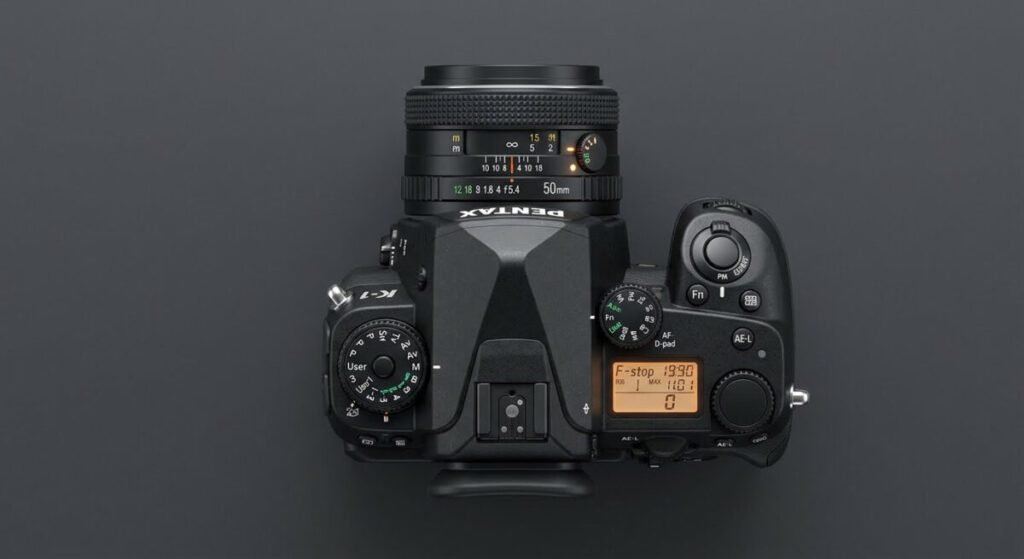
Here are the key specifications from Ricoh’s official specification page.
| Feature | Pentax K-1 |
|---|---|
| Sensor | 35.9 x 24.0 mm full-frame CMOS |
| Resolution | About 36.4 megapixels effective |
| Stabilization | 5-axis sensor-shift (SR II) |
| ISO range | 100 to 204,800 |
| Autofocus | 33 points, 25 cross-type, EV -3 to 18 |
| Burst rate | About 4.4 frames per second |
| Shutter speed | 1/8000 to 30 seconds, plus Bulb |
| Viewfinder | Pentaprism, about 100% coverage, 0.70x magnification |
| Rear screen | 3.2-inch flexible-tilt, about 1.04 million dots |
| Video | Full HD up to 60i and 30p, HD at 60p |
| Card slots | Dual SD (SD, SDHC, SDXC, UHS-I) |
| Battery life | About 760 shots (CIPA) |
| Weight | About 1,010 g with battery and card |
| Extras | Built-in GPS, electronic compass, Astrotracer, Pixel Shift |
You can confirm the details on the Ricoh Imaging specification page.
Why the Pentax K-1 Matters in 2027
Two events shape this camera’s story today. First, the K-1 became cheap for what it offers. Second, Pentax closed a chapter.
The Ricoh Announcement
On September 9, 2026, Ricoh announced the end of production for its K-series DSLR cameras. Ricoh said the move prepares for a transition to a new stage. The company also said it is developing a new series of digital SLR cameras built on an entirely new concept. That series will use K-mount lenses.
Ricoh gave no model name, no specifications, no price and no release date. It also said the project will take time. So Pentax is not abandoning the DSLR. It is pausing one generation and promising another.
What That Means for K-1 Buyers
The K-1 is no longer a current product. Stock is thin, and used examples drive the market. Even so, the K-mount remains alive. Ricoh points to its long history of K-mount lenses as the foundation for the future camera.
The Price Situation
Recent U.S. used snapshots ran from roughly $989 to $1,229, with only a few bodies listed. For comparison, Ricoh lists the K-1 Mark II at around $1,800 new. At launch in 2016, the original K-1 carried a suggested price of $1,799.95.
That means a used K-1 can cost hundreds less than a new Mark II. The saving is why this camera keeps appearing in value discussions.
Design and Build Quality
Pentax built the K-1 like a tool. The body uses magnesium alloy and carries Ricoh’s claim of 87 sealing parts. Ricoh describes it as dustproof, weather-resistant and cold-resistant.
A Body That Feels Solid
DPReview scored build quality 9.5 out of 10, one of the highest marks in its review. The reviewer described a solid body that avoids feeling heavy. The camera weighs about 1,010 grams with battery and card, so you still feel it in a bag. However, many full-frame DSLR users already expect that weight.
The Flexible Rear Screen
The K-1 has an unusual screen design. The 3.2-inch display flexes out on its own mount. You can angle it for low or high shots without tilting it in a fixed arc. Few cameras offer this design, and it helps with landscape and tripod work.
LED Lights That Actually Help
Pentax added small LED lights above the lens mount, behind the screen, at the card slot and at the cable switch terminal. These lights help you work in the dark. Night shooters and astrophotographers will appreciate them. Reviewers called the lights genuinely useful.
A Weak Spot Worth Checking
TechRadar’s reviewer noticed that the microphone port cover felt loose. A loose cover could weaken weather protection in theory. Therefore, check that cover when you inspect a used body. Make sure it sits firmly in place.
Handling and Viewfinder
The K-1 offers a classic DSLR experience. The pentaprism viewfinder covers about 100% of the frame. It also offers 0.70x magnification and about 20.6 mm of eye relief.
Grip and Controls
Reviewers praised the grip and the dial layout. DPReview called the multi-function dial a highlight. The camera feels comfortable in the hand during long sessions. Controls are logical for people who like physical dials.
Menus and Quirks
Not everything feels modern. DPReview criticized the nested menus and limited customization. It also noted that the live view is soft and that no single button zooms in to check focus. TechRadar called the menus dated looking. In addition, the autofocus points do not light up until focus locks.
None of these issues ruin the camera. However, they remind you that this design comes from 2016.
Who Will Enjoy the Handling
If you love optical viewfinders, you will enjoy the K-1. The view is large and clear, and no electronic screen sits between you and the scene. Photographers who prefer electronic viewfinders may miss exposure previews and focus aids.
Image Quality
Image quality is the K-1’s strongest argument. The 36.4 megapixel sensor does not use an anti-aliasing filter, so it captures extra fine detail. For scenes where moiré could appear, Pentax added an anti-aliasing filter simulator. That feature uses tiny sensor vibrations to reduce moiré.
Lab Test Results
DXOMark gave the K-1 sensor a score of 96. That result placed it near the top full-frame sensors of its time.
- Dynamic range: 14.6 EV at base ISO
- Color depth: 25.4 bits
- Low-light ISO score: 3,280
DXOMark rated the Nikon D810 at 97 and the Sony A7R II at 98. The K-1 landed very close to both. In low-light ISO score, the K-1 even edged out the D810, which scored 2,853.
What Reviewers Saw in Raw Files
DPReview found that K-1 Raw files rank among the best at this price. It compared the results to the Nikon D810 and the Sony A7R II. The reviewer also highlighted dynamic range as a standout strength. The sensor behaves close to ISO invariant. As a result, you can keep ISO low and lift shadows in editing with good results.
JPEG Quality Is Weaker
The in-camera JPEG engine received less praise. DPReview found light default sharpening and conservative noise reduction at high ISO. It also noted that greens and reds can look harsh. Therefore, Raw shooters get the most from this sensor.
Our Take on Image Quality
If you shoot Raw and edit your files, the K-1 delivers professional results. If you want finished JPEGs straight from the camera, tweak the settings or consider the Mark II, which improved the JPEG engine.
Pixel Shift Resolution
Pixel Shift is the K-1’s signature trick. The camera takes four images and shifts the sensor by one pixel between each. Then it combines them into one composite file.
What Pixel Shift Gives You
The result improves detail and reduces noise. DPReview estimated a benefit of roughly 1 to 2 EV. Colors also look more accurate, because each pixel location captures full color information. For landscape and still life photographers, that gain can be significant.
The Catch
Pixel Shift works best on static scenes. Movement can cause artifacts. Ricoh added a motion correction function for moving subjects, but DPReview found it helped only partly. A tripod still gives the best results.
Software Support
Early reviews found limited Raw support for Pixel Shift files. DPReview reported problems with Adobe Camera Raw and bugs in one Mac converter. Software support may have improved since then. Therefore, test your preferred editing software before you rely on this feature.
Our Take on Pixel Shift
Treat Pixel Shift as a tripod tool. It suits architecture, product work and landscapes. Skip it for anything that moves.
Autofocus and Performance
Here the K-1 shows its age. The camera uses 33 autofocus points, with 25 cross-type points in the center. Ricoh rates the system from EV -3 to 18 at ISO 100.
What Reviewers Found
Both major reviews flagged autofocus as the weak area. TechRadar called the system slow and told sports shooters to look elsewhere. DPReview tested continuous autofocus on a cyclist. Single-point tracking failed about half the time, and subject tracking failed far more often. The reviewer also found hesitant focus in single-shot mode and slower low-light acquisition than the Nikon D750 and Canon 6D.
DPReview saw the K-1 as a clear improvement over the older K-3 II. Still, it fell short of modern DSLR standards.
Burst Speed and Buffer
The K-1 shoots about 4.4 frames per second in full-frame mode. At that speed, Ricoh says the buffer holds about 70 JPEG frames or about 17 Raw frames. That performance suits deliberate shooting. It does not suit sports, birds in flight or motorsport.
Who Should Worry
Wildlife and sports photographers should skip this camera. A Nikon D500 or Canon 90D suits those jobs better. Landscape, architecture, studio and portrait shooters can live with the autofocus system. Those subjects stand still, and focus speed rarely matters.
Stabilization, GPS and Astrotracer
The K-1 includes 5-axis sensor-shift stabilization, which Pentax calls SR II. Because the system sits in the body, it works with any K-mount lens. That benefit adds value to older and cheaper lenses.
Built-In GPS and Compass
The camera also includes GPS, an electronic compass and logging features. It supports GPS, QZSS and SBAS satellites. Travel photographers can geotag their images without extra gear.
Astrotracer
Astrotracer uses the stabilization system and the GPS module to help with night sky photography. It lets you take longer exposures of stars without a tracking mount. Astrophotographers rarely find this feature in a camera at this price.
Video Quality
Video is not why anyone buys a K-1. The camera records Full HD at up to 60i and 30p, plus HD at 60p. Clips stop at 25 minutes or 4 GB. The camera includes a microphone input, a headphone terminal and HDMI output.
What Reviewers Found
DPReview scored video at 6.0 out of 10. The reviewer cited contrast-detect autofocus only, no clean HDMI output and limits on focus aids during recording. Footage looked soft. TechRadar noted that the camera can create 4K time-lapse sequences, but it does not record 4K video.
Our Take on Video
Treat the K-1 as a stills camera that can record clips. If video matters, look elsewhere.
Battery Life and Storage
The K-1 uses the D-LI90P battery. Ricoh rates it at about 760 shots under CIPA standards. DPReview noted that battery life trails most full-frame DSLRs, yet 760 shots still handles a full day of shooting for most people.
Dual SD Card Slots
The camera has two SD card slots that support UHS-I cards. Pixel Shift files and 36 megapixel images fill cards quickly. Dual slots give you backup options or extra capacity on long trips. Wedding and event shooters will value that safety net.
Lens Ecosystem
The K-1 uses the Pentax K-mount. That mount has a long history. Ricoh stresses lenses built over more than half a century. As a result, many used lenses work on this camera.
Strengths of the K-Mount
Because stabilization sits in the body, older lenses gain stabilization. Used lens prices also tend to stay low. That helps buyers who want to build a kit on a budget.
The Limits
DPReview pointed out that Pentax offers fewer modern full-frame lenses than Canon or Nikon. Therefore, check lens availability for your favorite focal lengths before you buy.
Good News for the Future
Ricoh says its upcoming DSLR concept will use K-mount lenses. That statement suggests your lenses should remain useful. Still, Ricoh has not shared dates or details.
Pentax K-1 vs K-1 Mark II
This comparison matters most. The Mark II looks similar, but it adds several refinements.
What the Mark II Adds
Ricoh stated at the Mark II launch that it uses the same 36.4 megapixel full-frame sensor as the original. The differences lie elsewhere.
- An accelerator unit that improves image processing
- Better high-ISO behavior and JPEG output
- Dynamic Pixel Shift for handheld use on static subjects
- Autofocus tracking refinements
- Faster single autofocus with many lenses
What Reviewers Said
PentaxForums called the Mark II upgrade incremental but real. Below ISO 6400, the differences are hard to spot. At medium and high ISO, the Mark II improves JPEG color and sharpness. The accelerator also affects battery life, and reviewers said that cost roughly offsets some benefits. They also noted that the original K-1 remains one of the best high-ISO cameras you can buy.
The Price Rule
Price decides this choice. One retailer listed used Mark II bodies from about $1,350. Next to a K-1 at $1,229, that gap is small. Next to a K-1 near $1,000, it is a real saving.
So follow this simple rule. If a Mark II in similar condition costs only a little more, buy the Mark II. If the K-1 saves several hundred dollars, buy the K-1.
Pentax K-1 vs Cheaper Pentax Options
You can also leave full frame behind and stay with Pentax.
Pentax KF
A new Pentax KF lists at around $700, and used examples have appeared near $520. It keeps the optical finder, stabilization and weather sealing. It uses a 24.24 megapixel APS-C sensor instead of full frame.
Pentax KP
Used Pentax KP bodies have landed between roughly $719 and $859. This smaller APS-C camera shoots up to about 7 frames per second and uses an interchangeable grip system.
Which One Fits You
Choose the K-1 if full-frame resolution drives your work. Choose the KF or KP if portability and price matter more.
Who Should Buy the Pentax K-1?
Match yourself to a buyer type.
Landscape and Architecture Photographers
You get high resolution, strong dynamic range and Pixel Shift. The K-1 suits your work well.
Photographers Who Shoot in Bad Weather
The sealed body and stabilization give you confidence in rain, dust and cold.
Astrophotographers
Astrotracer and GPS offer a rare feature set at this price.
Existing K-Mount Owners
You already own the lenses. A K-1 gives you a full-frame upgrade without a system change.
Who Should Skip the Pentax K-1?
Skip the K-1 in these cases.
Sports and Wildlife Shooters
Autofocus and burst speed will frustrate you.
Video Creators
The camera records Full HD only and offers limited video autofocus.
Beginners Who Want Modern Autofocus
Mirrorless cameras and newer DSLRs offer easier focus tracking and better live view.
How to Buy a Used Pentax K-1 Safely
Thin inventory makes careful buying important. Use this checklist.
Inspect the Camera Body
- Check the weather seals, the grip and the corners for wear.
- Check the microphone port cover and other port covers.
- Test the buttons, dials and both card slots.
- Test the flexible rear screen through its full movement.
Inspect the Sensor and Viewfinder
- Look for dust, scratches or oil on the sensor.
- Confirm that the viewfinder looks clean and clear.
Test Key Features
- Try Pixel Shift on a tripod.
- Test autofocus on a static target.
- Check the LED lights and the GPS feature.
Check the Battery and Charger
Make sure the battery holds a charge and the charger works.
Choose a Reliable Seller
Prefer sellers with a clear grading standard, a return window or a warranty. You can browse used inventory at MPB, B&H Photo and Adorama. Official Pentax information lives on the Ricoh Imaging website.
Pentax K-1 Pros and Cons
Pros
- Excellent Raw image quality and dynamic range
- Pixel Shift Resolution for static scenes
- Weather-sealed body with dual card slots
- Flexible rear screen and helpful LED lights
- Built-in GPS and Astrotracer
- Strong value on the used market
- Wide K-mount lens compatibility
Cons
- Autofocus lags behind modern cameras
- Video stops at Full HD
- Conservative JPEG output
- Nested menus and limited customization
- Pixel Shift needs static subjects
- Fewer modern full-frame lens choices
Final Verdict: A Specialist Full-Frame Bargain
The Pentax K-1 is not a camera for everyone. It cannot track a cyclist, and it will not impress video creators. Yet for the right photographer, it delivers remarkable value.
The sensor competes with the best full-frame chips of its generation. The body survives rain and dust. Pixel Shift squeezes out extra detail on a tripod. And the used price can sit hundreds of dollars below a new K-1 Mark II.
If you shoot landscapes, architecture, studio work or the night sky, the K-1 earns a strong recommendation. If a used Mark II costs only a little more, buy the Mark II instead. And if you shoot action or video, spend your money elsewhere.
Now we want to hear from you. Would you pick a used K-1 over a full-frame mirrorless camera at the same price? And does the Ricoh announcement make you more or less interested in Pentax? Tell us in the comments.
Frequently Asked Questions About the Pentax K-1
Is the Pentax K-1 still worth buying in 2027?
Yes, for stills photographers. The sensor and build quality still hold up. Autofocus and video are the main limits.
What is the difference between the Pentax K-1 and K-1 Mark II?
Both use the same 36.4 megapixel full-frame sensor. The Mark II adds an accelerator unit, better JPEG processing, Dynamic Pixel Shift and autofocus refinements.
Is the Pentax K-1 weather sealed?
Yes. Ricoh describes the body as dustproof, weather-resistant and cold-resistant, with 87 sealing parts. Check the port covers on a used body.
Does the Pentax K-1 shoot 4K video?
No. The camera records Full HD video. It can create 4K time-lapse sequences, but it does not record 4K video.
Is Pentax still making DSLRs?
Ricoh ended production of the current K-series DSLRs. The company says it is developing a new series of digital SLR cameras based on an entirely new concept. It has not announced a date or specifications.
Will my K-mount lenses work on future Pentax cameras?
Ricoh says the new DSLR concept will use K-mount lenses. Details remain unconfirmed.
Read More from Altbuzz
Want more camera reviews, rankings and value guides? Explore the latest articles at altbuzzmedia.com.
Subscribe to Altbuzz YouTube Channel
If cameras with a story are your thing, subscribe to the Altbuzz channel on YouTube. We explain camera decisions by real shooting priorities instead of prestige or sensor size. Visit @AltBuzzMedia on YouTube and stay for the next one.
You can also support the channel through memberships and Super Thanks. Find everything else at altbuzzmedia.com.