
Canon EOS R50 V Full Review: Specs, Performance & Verdict
The Canon EOS R50 V is officially released and available worldwide, and it is one of the most exciting creator-focused cameras to launch in 2025. Canon introduced this camera in March 2025, and it began shipping globally in April 2025. It is designed specifically for vloggers, content creators, and video enthusiasts who want a compact, cinema-capable mirrorless body without paying cinema prices.
This is not simply a camera update. Canon made a deliberate decision to create a separate video-focused variant of the R50 platform rather than a traditional Mark II upgrade. The result is a camera that brings 10-bit color recording, Canon Log 3, 4K oversampled from 6K, and a custom LUT workflow into a body that costs under $700. Those specifications would have been extraordinary at twice the price just three years ago.
Content creators have been asking for a camera like this for a long time. They need something small enough to carry everywhere, smart enough to handle solo shooting, and powerful enough to deliver broadcast-quality footage. The Canon EOS R50 V answers that call better than almost anything else in its class.
This review covers the Canon EOS R50 V in full detail. We examine the sensor performance, autofocus system, video capabilities, body design, battery life, connectivity options, and real-world use scenarios. By the end of this review, you will know exactly whether this camera belongs in your kit.
Release Date and Market Position of the Canon EOS R50 V
Canon officially announced the EOS R50 V on March 26, 2025. The camera became available for purchase globally in April 2025 at a launch price of $649.99 for the body only. A kit option pairing the body with the RF-S 14-30mm F4-6.3 IS STM PZ lens sells for $849.99. That lens is a power zoom designed specifically for vlogging, making it a natural companion for this body.
The Canon EOS R50 V occupies a carefully defined space in the APS-C mirrorless market. It sits above basic beginner cameras and below professional hybrid bodies like the Canon EOS R6 Mark II. Its primary competition comes from the Sony ZV-E10 II, the Fujifilm X-S20, and the original Canon EOS R50. However, none of those cameras matches the R50 V on a combination of cinema-grade color profiles, 10-bit recording, and a streamlined livestreaming toolkit.
Understanding what separates the R50 V from the standard R50 is important. Both cameras share the same 24.2-megapixel sensor and similar physical dimensions. The differences appear in how the camera processes and outputs footage. Canon upgraded the processor to DIGIC X in the R50 V, which unlocks 10-bit 4:2:2 recording, Canon Log 3 support, custom LUT ingestion, and significantly improved video stabilization. In photography terms, the two cameras are similar. In video terms, they are a generation apart.
For photographers who primarily shoot stills and use video occasionally, the standard EOS R50 offers better value. For creators whose primary output is video content for YouTube, Instagram, TikTok, or professional projects, the Canon EOS R50 V is the obvious and correct choice.
Canon EOS R50 V Full Specifications Table
| Feature | Details |
|---|---|
| Sensor Type | APS-C CMOS (Super 35mm cinema equivalent) |
| Resolution | 24.2 Megapixels |
| Processor | DIGIC X |
| ISO Range | 100 to 12,800 (expandable to 25,600) |
| Autofocus System | Dual Pixel CMOS AF II with 4,503 AF points |
| Stabilization | Movie Digital IS (electronic); no IBIS |
| Video Recording | 4K UHD 60p (crop), 4K 30p oversampled from 6K, 10-bit 4:2:2 YCbCr |
| EVF | None (video-optimized design) |
| LCD Screen | Fully articulating 1.04M-dot touchscreen, 3 inches |
| Burst Shooting | Up to 15 fps (electronic shutter) |
| Battery | LP-E17, approx. 310 shots CIPA, approx. 2 hours continuous video |
| Storage | Single SD card slot (UHS-II compatible) |
| Connectivity | Wi-Fi, Bluetooth, USB-C (UVC/UAC), HDMI micro, 3.5mm mic input |
| Weight | 370g with battery and card |
| Launch Price | $649.99 body only / $849.99 with RF-S 14-30mm PZ lens |
Sensor and Image Quality on the Canon EOS R50 V
Sensor Size, Type, and Design Purpose
The Canon EOS R50 V uses a 24.2-megapixel APS-C CMOS sensor that is physically equivalent to a Super 35mm cinema sensor. This comparison is significant because Super 35mm has been the standard for professional cinema production for decades. Canon’s marketing of the R50 V as a cinema-adjacent tool is not purely promotional language. The sensor dimensions genuinely align with what cinema cameras use, which has practical implications for field of view calculations and depth of field rendering.
Canon has used this sensor architecture across the EOS R10 and standard EOS R50. However, the R50 V pairs it with the much more powerful DIGIC X processor, which fundamentally changes what the sensor can deliver. Faster processing enables higher quality video output, more sophisticated noise reduction, and the computational headroom needed for cinema color profiles.
The 24.2-megapixel resolution is generous for a creator camera. Most vlogging and content creation work does not require high megapixel counts, but the additional resolution provides useful cropping flexibility in post-production, particularly when pulling 4K video from the 6K oversampled signal.
Real-World Still Image Quality
In real-world photography use, the Canon EOS R50 V produces clean, detailed, and color-accurate images. At base ISO, sharpness across the frame is strong when paired with quality RF-S lenses. Canon’s JPEG processing is among the best in the industry, and the R50 V continues that tradition. Out-of-camera JPEGs require minimal correction before sharing or delivering to clients.
Color reproduction is one of the strongest aspects of the R50 V’s still image output. Skin tones in particular look natural and flattering without excessive processing. This is valuable for portrait and lifestyle photographers who work quickly and cannot always dedicate time to extensive retouching. Green foliage, blue skies, and neutral grey tones all render accurately across the standard color profiles.
RAW file quality from the R50 V is also solid. Files respond well to editing in Adobe Lightroom, Capture One, and Canon’s own Digital Photo Professional software. There is good highlight recovery available, and shadow areas can be lifted reasonably without introducing heavy banding. For a 24MP APS-C sensor, the RAW files provide adequate latitude for most professional applications.
Dynamic Range in Practice
Dynamic range on the Canon EOS R50 V is appropriate for its sensor class. In controlled testing, the sensor delivers approximately 12 stops of usable dynamic range. This figure is competitive within the APS-C segment. In practice, photographers can expect good highlight retention in bright daylight and reasonable shadow recovery in post-production.
Notably, the R50 V performs better in video dynamic range than in stills, primarily because Canon Log 3 preserves highlight and shadow information that standard photo profiles clip. Shooting in Canon Log 3 and grading in post can yield a cinematic look with significantly more tonal depth than the camera’s standard colour profiles suggest in-camera. This workflow separates the R50 V from budget competitors that lack a proper log gamma option.
In challenging lighting situations, such as a subject backlit by a window or an outdoor scene with bright sky and shaded foreground, the R50 V handles the contrast adequately. However, users should not expect the kind of extreme dynamic range latitude found in full-frame sensors from Sony or Nikon. Managing exposure carefully in-camera remains important when working with this sensor.
Low-Light and High ISO Performance
Low-light performance from the Canon EOS R50 V is solid for its class. At ISO 800 and below, images are essentially noise-free and suitable for any professional application. ISO 1600 produces minimal noise that is easily managed in post-processing. ISO 3200 begins to show visible luminance noise, though color noise remains reasonably controlled.
Beyond ISO 3200, image quality drops more noticeably. ISO 6400 and above should be reserved for situations where obtaining a correctly exposed image is more important than pixel-level cleanliness. For social media content, which is typically viewed at relatively small sizes, ISO 6400 images from the R50 V remain usable.
The absence of in-body image stabilization means that low-light performance is also dependent on shutter speed. Without IBIS, photographers shooting stationary subjects in dim light must rely on wider apertures and higher ISOs rather than slower shutter speeds. Using a fast prime lens like the Canon RF 50mm f/1.8 STM is strongly recommended for indoor and low-light shooting with the R50 V.
Color Science and Picture Profiles
Canon’s color science is the defining competitive advantage of the R50 V. The camera supports an exceptionally wide range of color profiles for its price class. Options include Canon Log 3, HLG, HDR PQ, five creative picture style presets, and the ability to upload custom 33-point LUTs directly into the camera. In-camera LUT support at this price is genuinely remarkable. It allows creators to shoot with their final look applied in-camera, which simplifies monitoring and speeds up post-production workflows significantly.
Canon Log 3 provides approximately 1600 percent dynamic range, making it the recommended profile for all serious video work on the R50 V. Footage shot in Canon Log 3 takes color grading extremely well and translates cleanly to popular cinematic looks. This cinema-grade color pipeline, offered at an entry-level price, is arguably the single biggest reason to choose the Canon EOS R50 V over its competitors.
Autofocus Performance on the Canon EOS R50 V
Dual Pixel CMOS AF II System
The Canon EOS R50 V uses Dual Pixel CMOS AF II, Canon’s most capable phase-detection autofocus technology available in consumer cameras. With 4,503 selectable AF points covering nearly the full width and height of the frame, the system provides comprehensive subject detection across almost any composition. Canon first introduced Dual Pixel CMOS AF in 2013 and has refined it substantially over the following decade. The version in the R50 V benefits from all those years of algorithm development.
Dual Pixel AF works by using two photodiodes per pixel to compute phase information, enabling fast and accurate focus detection across the whole sensor rather than only in dedicated AF sensor zones. This approach produces particularly smooth and natural focus transitions in video, which is critical for content creators who rely on the camera to pull focus during filming without human intervention.
People Priority Registration Feature
One of the most useful and distinctive autofocus features in the Canon EOS R50 V is People Priority registration. This function allows users to register specific individuals so the camera actively prioritizes those registered faces when multiple people are in the frame. For creators who film themselves or regularly work with the same presenter or talent, this feature saves significant time and eliminates the frustration of the camera locking onto the wrong person in a crowded scene.
Setting up People Priority registration is simple. Users photograph the subject’s face and save it to the camera’s registered faces list. From that point, the camera will consistently prefer that individual’s face during autofocus operations. This feature is especially valuable for live event coverage, interview-style content, and any scenario where a specific subject must remain in sharp focus at all times.
Subject Detection Capability
Subject detection on the Canon EOS R50 V covers people, animals, and vehicles. For people detection, the system identifies faces and eyes reliably even in partially obscured or turned positions. Animal detection covers cats, dogs, and birds, making the R50 V suitable for pet photography and wildlife content creation. Vehicle detection enables tracking of cars and similar moving subjects for automotive content.
In real-world testing, face and eye detection perform consistently well. The system maintains focus on a subject even when they move toward or away from the camera, change their head angle, or briefly leave and re-enter the frame. For solo creators filming themselves without an assistant, this reliability is essential. The camera effectively functions as a hands-free focus operator.
Autofocus performance in low light is also improved compared to the standard R50. The R50 V’s DIGIC X processor enables the AF system to compute focus information more quickly from noisier data, which extends the effective AF range in dim environments. However, extremely dark scenes will still cause the system to hunt, which is normal for phase-detection AF at extreme light deficiency.
Video Autofocus and Focus Transition Control
For video, the Canon EOS R50 V offers extensive control over autofocus behavior. Users can adjust AF speed from very slow to very fast, enabling everything from instant snappy corrections to smooth, cinematic rack focus movements. AF sensitivity can also be tuned so the system either holds focus when subjects briefly leave the frame or immediately transfers to a new subject.
In practice, the video autofocus is among the best available at this price point. Focus transitions are smooth enough that they are often invisible to the viewer, which is the ideal standard for narrative and documentary video work. Subject tracking during panning shots is reliable, and the system handles camera movement without introducing focus pumping artifacts in most situations.
Video Capabilities of the Canon EOS R50 V
4K Recording with 6K Oversampling
The headline video capability of the Canon EOS R50 V is its ability to record 4K UHD footage at 30p oversampled from a 6K signal. Oversampling works by reading more pixels than the final video resolution requires and then downsampling that data to the target resolution. The result is sharper, more detailed 4K footage with better noise characteristics and less aliasing than cameras that simply read 4K pixels directly.
The practical benefit is visible when comparing R50 V footage with competitors that use pixel binning or line skipping to generate their 4K signal. Edges are cleaner, fine textures are preserved more accurately, and the overall image has a more film-like quality. For YouTube creators who want their content to stand out visually, this quality difference is meaningful.
4K 60p Mode and Frame Rate Options
At 60 frames per second, the Canon EOS R50 V records 4K video in a slightly cropped mode. The crop factor adds a small additional reach to lenses, which can be either an advantage or limitation depending on the subject. For action content, sports, or any fast-moving subject that benefits from a tighter focal length, the 4K 60p mode is a useful tool.
Full HD recording at 1080p extends up to 120fps, enabling slow-motion footage at 5x speed. This slow-motion capability is excellent for product videos, creative sequences, and any content where deliberate pacing adds visual impact. The 120fps full HD footage retains good image quality without excessive softness, making it a reliable option for slow-motion cutaways in edited productions.
10-Bit 4:2:2 Recording and Color Depth
The Canon EOS R50 V records 10-bit 4:2:2 video internally. This is an extraordinary specification for a camera at this price. An 8-bit video file contains 256 levels of color information per channel. A 10-bit file contains 1,024 levels per channel, providing over one billion possible colors. That additional color depth makes gradients smoother, color grading more flexible, and banding artifacts far less likely.
The 4:2:2 chroma subsampling specification means that full color resolution is preserved in the horizontal direction. Most consumer cameras use 4:2:0, which halves the color resolution. The step up to 4:2:2 in the R50 V is particularly beneficial for keying and compositing work, where clean color information at the edges of subjects is critical for separating them from backgrounds accurately.
Together, 10-bit and 4:2:2 recording give the Canon EOS R50 V a professional color pipeline that opens the door to broadcast-quality deliverables. Creators producing content for high-end platforms, commercial clients, or any application where color accuracy and grading latitude matter will find these specifications genuinely useful rather than merely impressive on paper.
Canon Log 3, HLG, and Custom LUT Support
Canon Log 3 is the recommended shooting profile for all serious video work on the R50 V. It preserves the maximum amount of tonal information across highlights and shadows, giving colorists the widest possible latitude in post-production. Canon Log footage is well-supported by professional software including DaVinci Resolve, Adobe Premiere Pro, and Final Cut Pro X.
HLG (Hybrid Log-Gamma) is available for creators who want HDR-capable output without extensive grading. HLG footage looks good on both standard dynamic range and HDR displays, making it a practical choice for creators who distribute to multiple platforms. HDR PQ mode provides true HDR output for premium delivery workflows.
Custom LUT support is perhaps the most impressive feature in this category. The R50 V accepts 33-point LUTs uploaded via a memory card or the Canon Camera Connect app. Once loaded, these LUTs can be applied to the in-camera preview and optionally baked into footage during recording. This enables creators to shoot with their exact final look visible through the screen, dramatically simplifying monitoring and communication with clients or directors.
Audio Recording Features
Audio is handled competently on the Canon EOS R50 V. The camera features a built-in three-channel microphone system that includes noise reduction designed to detect and suppress internal camera operating sounds, including lens focus motor noise. This filtering produces cleaner audio than the average built-in microphone system.
The 3.5mm microphone input supports external microphones for professional audio capture. A wide range of third-party microphones connect directly, including popular options from Rode, Deity, and Sennheiser. There is no headphone output on the R50 V, which is a notable limitation for video professionals who need to monitor audio in real time during shooting. For creators who prioritize audio quality, a directional shotgun microphone connected to the 3.5mm input significantly upgrades production value.
Livestreaming Capabilities
The Canon EOS R50 V supports four distinct livestreaming methods, which is an extraordinary feature for a camera at this price. First, UVC and UAC over USB-C allows the camera to function as a webcam-quality live video and audio source when connected to a computer. This works with all major streaming software including OBS, Streamlabs, and Zoom without any additional drivers.
Second, HDMI output to a capture card or live production switcher provides a high-quality, low-latency video signal for professional streaming setups. Third, the Canon Camera Connect app enables wireless streaming directly from the camera to a smartphone. Fourth, the Canon Live Switcher Mobile app supports multi-camera live production from a single smartphone interface, enabling smooth cuts between multiple connected Canon cameras.
These four options give the R50 V a streaming versatility that competing cameras at this price simply cannot match. For creators who make livestreaming a significant part of their content output, the R50 V is designed with their specific workflow in mind.
Video Stabilization
The Canon EOS R50 V relies on Movie Digital IS for stabilization. The digital IS system analyzes the camera’s motion data and applies a compensating crop and shift to the image in real time. The result is noticeably smoother handheld footage, particularly when walking.
The trade-off is a slight reduction in field of view due to the crop applied during digital stabilization. The degree of crop varies based on the stabilization setting selected. For creators who need the smoothest possible handheld footage, a gimbal remains the recommended solution. However, for casual vlogging, walking shots, and moderate handheld work, the digital IS produces entirely acceptable results without additional equipment.
Design, Build Quality, and Handling of the Canon EOS R50 V
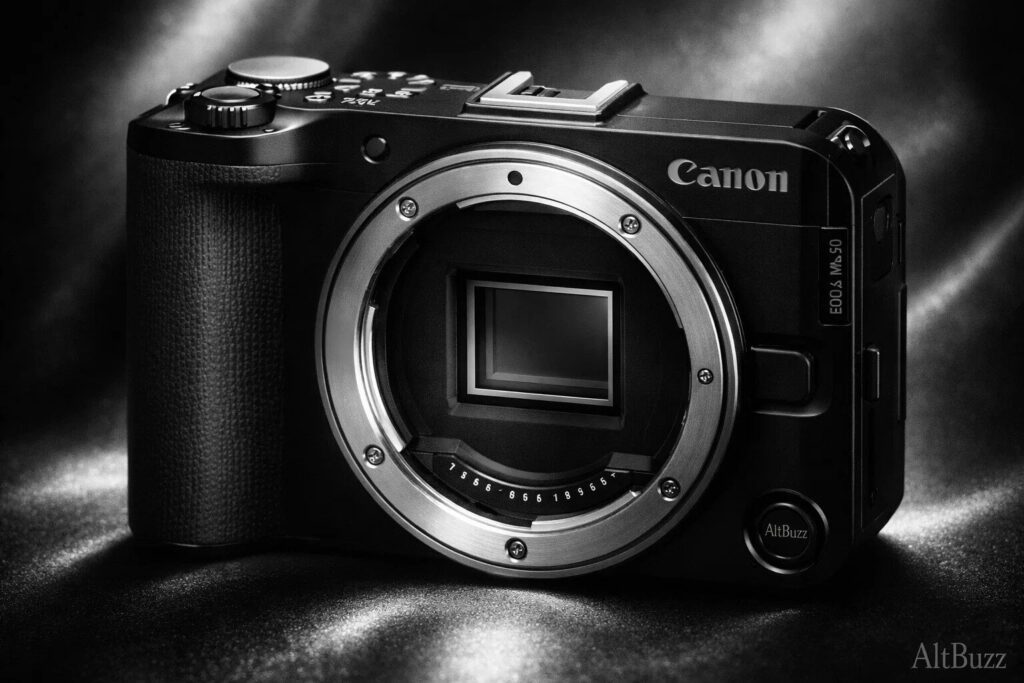
Body Construction and Form Factor
The Canon EOS R50 V uses a durable polycarbonate body construction. Despite being a plastic body, it feels solid and well-assembled. The compact dimensions make it easy to carry in a bag, mount on a gimbal, or hold in one hand for extended periods. The footprint is small enough to use discreetly in public spaces, which is genuinely valuable for street content creators and travel vloggers.
A distinctive design addition on the R50 V is the side-mounted tripod socket. Unlike standard bottom-mount tripod sockets, the side mount enables the camera to be attached to a tripod in portrait orientation. This directly supports vertical video content for platforms like TikTok, Instagram Reels, and YouTube Shorts. Canon has also added an automatic display rotation feature that flips shooting information when the camera is held vertically.
Screen and Viewfinder
The Canon EOS R50 V uses a 3-inch fully articulating 1.04-million-dot touchscreen. The articulating design allows the screen to be flipped outward for vlogging, tilted upward for low-angle shots, or tucked inward to protect the panel during storage or transport. This is the most practical screen configuration for solo content creators who regularly reframe their own shots.
There is no electronic viewfinder on the R50 V. This is a deliberate choice by Canon. Video creators overwhelmingly use the screen rather than a viewfinder, and removing the EVF allowed Canon to streamline the body design and reduce cost without impacting the target user’s workflow. However, photographers who prefer to compose through a viewfinder will find this absence frustrating.
Button Layout and Controls
The control layout on the R50 V is strongly video-centric. The mode dial features dedicated positions for video, vlogging mode, and automatic photo capture. A one-touch picture style button allows quick switching between color profiles without entering the menu system. A dedicated livestream button launches the camera’s livestreaming configuration rapidly.
Physical control count is limited compared to larger hybrid cameras. There is one control dial and a multi-controller directional pad. The touch screen covers functions that larger cameras handle with physical buttons. For users who prefer extensive physical controls, this arrangement will feel minimalist. For creators who primarily use the touch interface, it is intuitive and functional.
The menu system has been updated compared to earlier Canon mirrorless bodies and benefits from a cleaner organization. Video settings are grouped logically and accessible quickly. Canon’s touchscreen interface allows experienced users to configure the camera entirely through touch, which accelerates setup and adjustment during busy shooting situations.
Weather Sealing and Durability
The Canon EOS R50 V does not include weather sealing. This is consistent with its price class and intended use case. Most vloggers and content creators work in controlled environments, indoors, or in fair weather outdoor conditions where weather sealing is rarely needed. For users who regularly shoot in rain, dust, extreme humidity, or challenging outdoor conditions, this limitation is a real consideration.
A wide range of third-party rain covers compatible with compact mirrorless bodies are available at low cost. While the lack of weather sealing is a limitation, it does not make the camera fragile. The polycarbonate body withstands normal handling well, and the camera has been designed for daily creator use rather than expedition-level durability.
Battery Life and Connectivity on the Canon EOS R50 V
Battery Performance in Real-World Use
The Canon EOS R50 V uses the LP-E17 battery, rated at approximately 310 shots per charge under CIPA testing conditions. In real-world video shooting, users typically achieve around 2 hours of continuous recording on a single charge. That figure is adequate for most individual filming sessions, including YouTube uploads, event coverage segments, and short commercial shoots.
For longer shooting days, the LP-E17’s capacity becomes a constraint. Full-day event coverage or extended production work requires multiple charged batteries or a continuous power solution. The LP-E17 is widely available and reasonably priced, and it is compatible with many other Canon bodies including the EOS RP, EOS 250D, and EOS M50 Mark II.
USB-C Charging and Power Options
USB-C charging is supported on the Canon EOS R50 V, which is one of its most practically useful features. The camera charges from any USB-C power source, including laptop chargers, power banks, and car charging adapters. In-body USB charging means the camera itself is the charger, eliminating the need for a separate battery charging unit in a travel bag.
More importantly, the R50 V can be powered directly from a USB-C source while in use. This means a large-capacity power bank can extend shooting time indefinitely in a studio or fixed setup. For livestreamers who need continuous operation for several hours, this is a critical capability. A 20,000mAh power bank connected via USB-C can power the R50 V for an entire day of streaming without interruption.
Wireless Connectivity
Wi-Fi and Bluetooth connectivity are both present on the Canon EOS R50 V. The Canon Camera Connect app handles image transfer to smartphones, remote live view control, and location tagging. Bluetooth maintains a persistent, low-power connection to a paired device even when the camera is in standby, enabling automatic image transfer and GPS tagging without manually activating Wi-Fi each time.
Wireless transfer speeds are acceptable for photo files but become slow for large 4K video files. For transferring video footage from a day of shooting, connecting the camera directly to a computer via USB or using a card reader is significantly faster. Wireless connectivity is most useful for quick social media sharing, remote camera control from a smartphone, and instant preview of recent shots.
Storage and Card Compatibility
The R50 V uses a single SD card slot with UHS-II compatibility. UHS-II cards offer write speeds fast enough to handle the bitrate requirements of 4K 10-bit recording without buffer overflow issues. Using a quality UHS-II card is strongly recommended to ensure reliable recording at all quality settings.
A single card slot does mean there is no backup recording option. For professional productions where data loss is catastrophic, this is an important limitation. Creators should back up their cards immediately after each shoot. A portable SSD connected via USB-C provides adequate redundancy for most production workflows.
Real-World Use Cases for the Canon EOS R50 V
Vlogging and Solo Content Creation
Vlogging is the Canon EOS R50 V’s primary and strongest use case. Every design decision on this camera supports the solo creator workflow. The articulating screen swings forward for self-recording. People Priority AF keeps the creator in sharp focus even while moving. The compact body mounts easily on lightweight tripods, selfie sticks, and gimbals. Vertical shooting orientation support serves the short-form social media workflow.
For a solo YouTube creator, the R50 V represents a significant upgrade path from a smartphone or an entry-level camera without cinema color profiles. The 10-bit Canon Log 3 output combined with custom LUT support produces a quality of footage that looks substantially more professional on screen. Viewers can perceive the quality difference even without understanding the technical reasons for it.
Studio and Commercial Video Production
Beyond personal content creation, the Canon EOS R50 V has real applications in small-scale commercial video production. Product videos, talking head interviews, and social media campaigns for brands all fall within the camera’s capabilities. The 4K oversampled from 6K image quality is clean enough for professional commercial use when paired with appropriate lighting.
The custom LUT workflow is particularly valuable in commercial contexts. Agencies and brands often have specific look development requirements for their video content. The ability to load and preview a specific LUT in-camera means the camera operator can confirm the final look during production rather than discovering issues in post.
Events and Travel Photography and Video
The compact size and versatile autofocus make the R50 V a capable travel camera for creators who want one body that handles both photography and video. The lightweight design reduces fatigue during long walking days or intensive event coverage. The reliable face detection works across a wide range of social situations including concerts, conferences, sports events, and street scenarios.
For travel content on YouTube or Instagram, the R50 V’s combination of portability and video quality is a strong asset. Many travel creators use larger, heavier full-frame cameras and carry the weight as a trade-off for quality. The R50 V makes a compelling argument that the quality gap has narrowed significantly, and that portability has real value worth prioritizing.
Pros and Cons of the Canon EOS R50 V
Pros
- 10-bit 4:2:2 color recording at an entry-level price point of $649.99
- 4K video oversampled from 6K for exceptional sharpness and detail
- Canon Log 3 and HLG support for professional color grading workflows
- Custom 33-point LUT ingestion directly in-camera for in-field look monitoring
- Dual Pixel CMOS AF II with 4,503 points and People Priority registration
- Four distinct livestreaming methods including UVC/UAC over USB-C
- 2-hour continuous recording time for extended production sessions
- USB-C charging from any power bank for all-day operational flexibility
- Side-mounted tripod socket for native vertical content creation
- Compact 370g body ideal for gimbal use, travel, and solo shooting
- Dedicated 3-channel microphone with internal noise cancellation
- Full RF lens ecosystem compatibility for long-term lens investment value
Cons
- No in-body image stabilization, relies on digital IS only
- No electronic viewfinder, screen-only operation may frustrate stills photographers
- 4K 60p mode uses a crop factor, reducing effective field of view
- Battery life is moderate at 310 shots CIPA; multiple batteries needed for long days
- No weather sealing, limiting use in rain, dust, and extreme conditions
- Single card slot with no redundant backup recording option
- No headphone output for in-camera audio monitoring during recording
- Wireless file transfer speed is slow for large video files
Final Verdict on the Canon EOS R50 V
The Canon EOS R50 V is a carefully engineered and purpose-built tool for the modern content creator. Canon identified a clear gap in the market: creators who needed cinema-grade color tools in a compact, affordable body. The R50 V fills that gap with precision. Its 10-bit 4:2:2 recording, Canon Log 3 support, 4K oversampled from 6K, custom LUT ingestion, and four livestreaming methods combine to create a feature set that was not available anywhere near this price point before its launch.
The trade-offs are real but reasonable. The lack of IBIS, the absent EVF, the modest battery, and the single card slot are limitations that must be understood before purchasing. None of them are dealbreakers for the camera’s intended audience. Vloggers rarely use viewfinders, digital IS handles most walking shots adequately, and power banks solve the power concern at low cost.
For photographers who mainly shoot stills and occasionally produce video, the standard Canon EOS R50 offers better value. But for the growing population of video-first creators who want a credible, cinema-influenced workflow in a small body under $700, the Canon EOS R50 V is one of the best choices on the market today. It represents exceptional value for money and a genuine step forward in creator-focused camera technology.
Read More from AltBuzz
Read more from AltBuzz for camera reviews, detailed specs, and expert insights. AltBuzz delivers trusted and easy-to-understand photography content for creators at every level. Visit AltBuzz for in-depth gear coverage, comparison guides, and buying advice you can rely on.
Subscribe to the AltBuzz YouTube Channel
Stay updated with the latest camera reviews and head-to-head comparisons. AltBuzz publishes hands-on camera content regularly, covering new releases and in-depth testing across all major brands. Subscribe to AltBuzz and never miss a review.