
The Canon EOS R6 Mark III Overview
The Canon EOS R6 Mark III is Canon’s latest full-frame mirrorless hybrid camera representing the pinnacle of all-around performance. Released in late November 2025, this camera generates tremendous buzz heading into 2026 as one of the top all-rounders available. It targets professional photographers and serious enthusiasts seeking versatile equipment handling diverse shooting scenarios. The EOS R6 Mark III combines exceptional resolution with blazing speed creating formidable professional tool. Available since November 25, 2025, it fills the crucial mid-range position between consumer and flagship models. Priced at $2,799 body-only, it delivers exceptional value for professional-level capabilities.
The Canon EOS R6 Mark III builds upon the highly successful R6 Mark II foundation while incorporating cutting-edge technology from the flagship R1 and R5 Mark II cameras. This technology trickle-down strategy brings flagship features to more accessible price points. The camera represents Canon’s commitment to the RF mount system and full-frame mirrorless future. It demonstrates Canon’s understanding that professional photographers need versatile tools handling both stills and video without compromise. The R6 Mark III succeeds as true hybrid camera equally capable across photography and videography disciplines.
Canon’s R6 series has consistently delivered best-selling cameras balancing performance against price effectively. The original R6 (2020) established the series as capable professional tool with excellent autofocus and low-light performance. The R6 Mark II (2022) refined the formula adding higher resolution and enhanced video capabilities. Now the R6 Mark III pushes boundaries further with 32.5-megapixel sensor, 40fps continuous shooting, 7K RAW video recording, and enhanced AI autofocus. These specifications position the camera as most compelling option in its price bracket.
The camera addresses professional needs across multiple photography genres simultaneously. Wedding photographers appreciate the reliable autofocus and dual card slots for backup security. Sports and wildlife shooters benefit from blazing 40fps burst rates and exceptional tracking performance. Portrait photographers leverage the excellent color science and shallow depth-of-field control. Videographers gain comprehensive 7K RAW recording and professional monitoring tools. This versatility creates single camera solution replacing multiple specialized bodies for many professionals. The all-arounder approach appeals strongly to working photographers managing equipment investments carefully.
Release Date and Market Position
Canon announced the EOS R6 Mark III on November 6, 2025, during a major product launch event showcasing multiple RF system additions. The announcement generated significant excitement in the photography community particularly among Canon shooters. Pre-orders opened immediately with shipping beginning November 25, 2025, just before the critical holiday shopping season. This strategic timing enabled Canon capturing year-end sales and positioning the camera as must-have professional tool. Initial availability proved strong with most major retailers receiving adequate stock avoiding the shortages plaguing previous launches.
Priced at $2,799 body-only, the R6 Mark III positions competitively against strong full-frame mirrorless competitors. The Sony a7 IV costs $2,498 offering similar hybrid capabilities with slightly lower specifications. The Nikon Z6 III prices at $2,497 providing comparable features with different handling characteristics. Against these competitors, Canon positions the R6 Mark III as premium option justifying $300 additional investment through superior video specifications and autofocus performance. Kit options include the RF 24-105mm f/4 L IS USM ($4,049) and RF 24-105mm f/4-7.1 IS STM ($3,149) providing complete systems for various budgets.
The camera occupies crucial position within Canon’s extensive RF system lineup bridging consumer and professional categories. Below it, the R8 ($1,499) and R7 ($1,499) target enthusiast budgets with compromises. Above it, the R5 Mark II ($4,299) and flagship R1 ($6,299) command premium pricing for marginal performance gains. The R6 Mark III delivers approximately 85-90% of flagship capability at less than half the R1’s cost. This value proposition appeals strongly to professional photographers allocating budgets across multiple equipment categories. The camera also competes with Canon’s own DSLR holdovers finally converting remaining 5D Mark IV users to mirrorless systems.
Canon markets the R6 Mark III toward working professional photographers across diverse specialties. Wedding and event photographers need the reliable autofocus and backup card redundancy. Sports and wildlife specialists require the 40fps burst capability and exceptional tracking accuracy. Portrait and fashion photographers appreciate the beautiful color science and comprehensive studio support. Documentary and journalism photographers benefit from the rugged build quality and versatile hybrid capabilities. The camera also appeals to advanced enthusiasts seeking professional-grade equipment without flagship pricing. Each audience segment finds specific features addressing their particular workflow requirements and shooting challenges.
Additionally, Canon continues showing interest in retro-styled camera designs with the Analog Concept Camera prototype displayed at CP+ 2026. This experimental design gauges public interest in heritage aesthetics applied to modern mirrorless technology. The prototype suggests Canon recognizes growing demand for cameras combining vintage appearance with contemporary performance. However, this remains concept rather than production camera currently. The R6 Mark III represents Canon’s mainstream professional offering while the company explores niche design approaches separately.
Canon EOS R6 Mark III Specifications Table
| Feature | Details |
|---|---|
| Sensor Type | 32.5MP Full-Frame CMOS |
| Resolution | 6912 x 4706 pixels |
| Processor | DIGIC X Image Processor |
| ISO Range | 100-64,000 (expandable to 50-102,400) |
| Autofocus System | Dual Pixel CMOS AF II with AI detection |
| AF Points | All-area coverage with intelligent tracking |
| Stabilization | Up to 8.5 stops (center), 7.5 stops (periphery) |
| Video Recording | 7K RAW 60p, Open Gate 7K 30p, 4K 120p, FHD 180p |
| EVF | High-resolution OLED electronic viewfinder |
| LCD Screen | 3.2-inch vari-angle touchscreen |
| Burst Shooting | 40fps (electronic), 12fps (mechanical) |
| Pre-Continuous Shooting | 20 frames before shutter press (H+ mode) |
| Buffer | 150 RAW images (CFexpress), unlimited JPEG |
| Battery | LP-E6P rechargeable (improved capacity) |
| Storage | Dual card slots: (1) CFexpress Type B, (1) SD UHS-II |
| Connectivity | Wi-Fi 5GHz, Bluetooth 5.1, USB-C, Full-size HDMI |
| Weight | Approximately 680g (body with battery/card) |
| Weather Sealing | Comprehensive magnesium alloy construction |
| Shutter Rating | 500,000 actuations |
| Launch Price | $2,799 (body) / $4,049 (with RF 24-105mm f/4 L) |
Sensor and Image Quality Performance
The Canon EOS R6 Mark III features a newly developed 32.5-megapixel full-frame CMOS sensor delivering exceptional image quality across diverse shooting scenarios. This resolution represents significant upgrade from the R6 Mark II’s 24-megapixel sensor providing 35% more pixels for additional detail capture. The 32.5MP specification strikes ideal balance between resolution and low-light performance suitable for professional work. Each RAW file measures approximately 50-60MB depending on scene complexity providing manageable file sizes. This resolution enables substantial cropping while maintaining quality sufficient for large prints and commercial applications.
The sensor pairs with Canon’s flagship DIGIC X image processor shared with the professional R1 and R5 Mark II cameras. This powerful processor enables the camera’s impressive performance specifications including 40fps continuous shooting and 7K video recording. Processing speed proves adequate handling the sensor’s output without bottlenecks during intensive burst sequences. The combination creates responsive, lag-free shooting experience even during demanding professional applications. Heat management works effectively preventing overheating during extended video recording sessions.
Real-world image quality impresses significantly with excellent detail rendition and pleasing color reproduction. The additional resolution compared to R6 Mark II provides noticeable improvement for landscape, architecture, and product photography requiring maximum detail. Portrait work benefits from enhanced skin texture detail and improved cropping flexibility. Wildlife photographers appreciate the ability cropping significantly while maintaining usable quality. The 32.5MP resolution hits sweet spot for most professional applications without generating excessively large files.
Dynamic range reaches approximately 14 stops at base ISO 100 providing excellent latitude for exposure recovery. Challenging lighting scenarios with extreme brightness ranges handle admirably preserving detail in both shadows and highlights. The sensor recovers shadow detail impressively during post-processing without introducing excessive noise or banding artifacts. Highlight rolloff appears smooth and natural avoiding harsh clipping common in lesser sensors. Wedding photographers particularly appreciate the dynamic range handling mixed lighting conditions typical at receptions and ceremonies.
Low-light performance remains impressively strong despite the resolution increase from previous models. Clean, usable images extend through ISO 6400 with minimal visible noise degradation. Between ISO 12,800 and 25,600, noise increases progressively but detail survival remains good with appropriate processing. The noise character appears fine-grained and relatively easy to reduce during editing. Extended ISO settings reach 102,400 for emergency situations though quality degrades noticeably at these extreme sensitivities. For comparison, the sensor performs similarly to Sony and Nikon’s latest 30-33MP sensors while maintaining Canon’s characteristic color science.
Color science produces Canon’s signature natural tones requiring minimal post-processing adjustment. Skin tones render beautifully across diverse ethnicities with accurate saturation and smooth gradation. The JPEG engine processes files excellently for photographers preferring in-camera results over RAW workflow. Multiple Picture Style profiles including Standard, Portrait, Landscape, and Neutral provide starting points for different shooting scenarios. Additionally, the camera supports user-defined custom Picture Styles enabling personalized color rendering preferences. Professional colorists appreciate the clean RAW files providing excellent foundation for extensive color grading work.
Autofocus Performance
The Canon EOS R6 Mark III features Canon’s latest Dual Pixel CMOS AF II system with enhanced AI-powered subject detection algorithms. This represents cutting-edge autofocus technology rivaling and often exceeding competitor systems from Sony and Nikon. The system provides all-area autofocus coverage with focus points spanning virtually the entire frame area. This comprehensive coverage eliminates focus-and-recompose techniques enabling precise composition without focus accuracy compromises. The cross-type detection works in both horizontal and vertical directions maximizing accuracy across varying subject contrast.
Enhanced AI subject detection identifies humans, animals (cats, dogs, birds), vehicles (cars, motorcycles, trains, airplanes), and newly added horses with impressive accuracy. The deep-learning algorithms distinguish between subject types automatically and prioritize them accordingly. Human detection recognizes bodies, faces, and eyes with exceptional accuracy across wide age ranges and lighting conditions. Animal detection locks onto pets and wildlife reliably even when partially obscured by vegetation or other objects. The new horse detection particularly benefits equestrian photographers covering show jumping, dressage, and racing events.
Eye detection locks onto subjects quickly and maintains focus tenaciously throughout shooting sequences. The camera identifies eyes accurately even when subjects wear sunglasses, turn partially away, or appear in complex lighting. This capability transforms portrait and wedding photography by ensuring critical sharpness exactly where needed. In group shots, the Register People Priority function allows pre-selecting up to 10 specific faces for priority tracking. This feature proves invaluable for wedding photographers ensuring the bride and groom receive focus priority throughout the day.
Tracking performance impresses dramatically with sticky, reliable subject following through complex movements and obstructions. Once locked onto a subject, the camera rarely loses track even through rapid direction changes and temporary obscuration. Athletes running across frames, birds flying erratically through branches, and vehicles navigating complex tracks all stay sharply focused. The improved tracking algorithms demonstrate substantial enhancement over previous R6 Mark II performance. Professional sports and wildlife photographers report keeper rates exceeding 95% during rapid action sequences.
The pre-continuous shooting feature records 20 frames in full RAW, JPEG, or HEIF format before the shutter button fully presses. This revolutionary capability captures action occurring before conscious shutter press ensuring critical moments never missed. Sports photographers capturing peak action moments, wildlife specialists documenting animal behavior, and event photographers following unpredictable subjects all benefit tremendously. The feature activates in H+ continuous shooting mode providing insurance against slow reaction times. The 20-frame buffer stored continuously, replacing older frames until shutter press locks the sequence permanently.
AF-ON button customization and back-button focus support provides flexibility for photographers with different focusing preferences. The camera allows separating focus activation from shutter button enabling more precise control. Custom button assignments enable tailoring the control layout to match individual workflows and shooting styles. The improved subject detection and tracking makes autofocus operation nearly transparent allowing photographers focusing on composition and timing rather than technical concerns.
Video Capabilities
Video specifications in the Canon EOS R6 Mark III rival dedicated cinema cameras delivering professional-level recording capabilities. The camera records stunning 7K RAW Light footage internally up to 60fps providing exceptional resolution and color information. This 7K capability (approximately 7680 x 4320 pixels) captures enormous detail suitable for theatrical projection and future-proof archival. The RAW recording preserves maximum sensor information enabling extensive post-production color grading and image manipulation. Cinema professionals appreciate the flexibility RAW workflows provide for achieving specific visual aesthetics.
Additionally, the camera supports Open Gate recording capturing the entire sensor’s output at 7K resolution up to 30fps. This Open Gate mode records full sensor area providing maximum flexibility for framing, stabilization, and aspect ratio choices during post-production. Editors can extract multiple aspect ratios from single recordings including widescreen 2.39:1, standard 16:9, vertical 9:16 for social media, and others. This versatility proves valuable for content creators producing material across multiple platforms simultaneously. The workflow efficiency saves significant shooting time eliminating need for multiple takes at different aspect ratios.
Oversampled 4K UHD recording reaches 60fps with beautiful detail rivaling cameras costing significantly more. The oversampling process captures full sensor width and downsamples computationally creating extraordinarily clean 4K footage. This oversampled 4K exceeds quality of cameras recording 4K through sensor cropping or line-skipping methods. Professional videographers appreciate the theatrical-quality 4K suitable for broadcast and commercial productions. Additionally, 4K 120fps high-frame-rate recording enables dramatic slow-motion effects at professional quality levels.
Full HD (1920 x 1080) recording extends to impressive 180fps for extreme slow-motion capture. This high frame rate reveals details invisible during real-time observation creating compelling cinematic sequences. The 180fps slow-motion works excellently for sports, wildlife behavior, product demonstrations, and creative transitions. However, serious slow-motion work requiring 240fps+ capabilities needs alternative cameras. Nonetheless, the 180fps specification exceeds most competing cameras in this price range significantly.
Canon Log 2 and Canon Log 3 gamma profiles preserve up to 15+ stops of dynamic range providing exceptional latitude for color grading. These flat picture profiles capture scene information optimally for post-production manipulation by professional colorists. Additionally, HLG (Hybrid Log Gamma) and PQ (Perceptual Quantizer) HDR recording support modern display standards and broadcasting requirements. The comprehensive codec options enable matching production requirements across various delivery platforms and client specifications.
Professional monitoring tools including Waveform display, False Color overlay, and Zebra pattern warnings assist proper exposure control during recording. These tools enable precise exposure management preventing clipped highlights and blocked shadows. The Waveform monitor shows entire image luminance distribution graphically enabling scientific exposure control. False Color overlays specific brightness ranges with color-coded patterns for immediate visual feedback. These features match or exceed tools found in dedicated cinema cameras costing thousands more.
However, the camera lacks dedicated video-oriented features like internal ND filters, dedicated audio controls, and advanced video-centric menu systems. Professional cinema shooters may prefer purpose-built video cameras like Canon’s Cinema EOS C-series. Nonetheless, for hybrid shooters needing excellent video alongside photography, the R6 Mark III delivers comprehensive professional capabilities. The combination of resolution, frame rates, codecs, and monitoring tools creates genuinely capable video tool at remarkable price point.
Design, Build Quality, and Handling
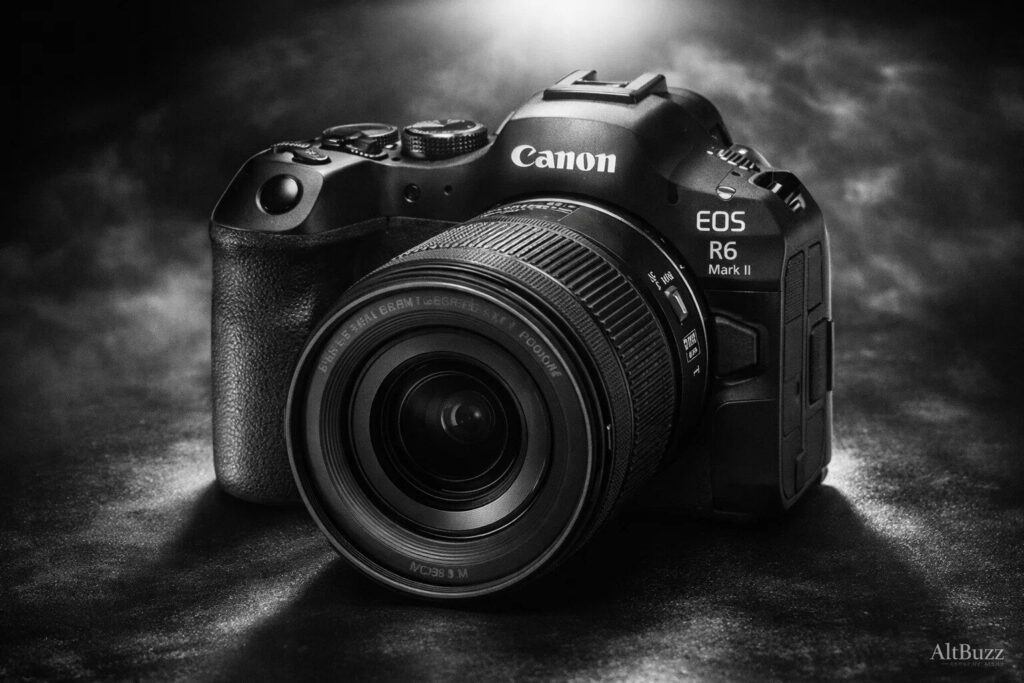
The Canon EOS R6 Mark III features robust magnesium alloy construction throughout ensuring professional-grade durability suitable for challenging shooting conditions. The weather-sealed body protects against moisture, dust, and environmental hazards encountered during professional assignments. Comprehensive sealing at all joints, buttons, and ports prevents contamination reaching sensitive internal components. Professional photographers report the camera surviving rain, snow, sand, and challenging conditions without failures. This reliability proves essential for working professionals whose livelihood depends on equipment functioning flawlessly under pressure.
The ergonomic design provides comfortable handling during extended shooting sessions with well-positioned controls falling naturally under fingers. The deep grip accommodates larger hands securely without requiring additional battery grips for basic comfort. Button layout follows Canon’s established ergonomic philosophy placing critical controls within easy reach. Customizable function buttons enable tailoring the control scheme to match individual workflow preferences and shooting styles. The camera feels balanced with moderate-weight RF lenses creating handling experience encouraging all-day shooting without fatigue.
Dimensions and weight position the camera as portable professional tool without excessive bulk compromising handling comfort. The body weighs approximately 680 grams with battery and card providing substantial feel suggesting quality without becoming burdensome. Compared to previous Canon DSLRs, the R6 Mark III weighs noticeably less while offering superior capabilities. The size fits comfortably in medium camera bags alongside several lenses and accessories. Travel photographers appreciate the reduced pack weight compared to professional DSLR systems.
The electronic viewfinder provides clear, detailed image preview with high resolution and smooth refresh rate. The large, bright EVF enables comfortable composition and manual focus verification even in challenging lighting. Eye relief measures adequately accommodating eyeglass wearers comfortably without vignetting or restricted view. The auto-brightness adjustment works effectively across varying ambient lighting conditions. The 3.2-inch vari-angle touchscreen flips and rotates freely for high, low, and selfie angles. Screen resolution provides sharp image review and menu navigation with accurate color representation.
Build quality exceeds expectations for cameras in this price bracket feeling closer to flagship models than mid-range alternatives. The shutter mechanism rates for 500,000 actuations demonstrating Canon’s confidence in durability and professional reliability. Professional photographers regularly reaching 100,000+ actuations annually appreciate the longevity assurance. The substantial shutter rating indicates the camera designed for years of intensive professional use rather than consumer occasional shooting.
The dual card slot configuration using CFexpress Type B and SD UHS-II provides flexible storage and backup options. Professional photographers can record simultaneously to both cards ensuring backup redundancy preventing catastrophic file loss. Alternatively, overflow recording enables maximizing total capacity by switching cards automatically when first fills. The CFexpress slot provides blazing-fast write speeds supporting 40fps RAW burst sequences and 7K video recording. The SD slot maintains compatibility with widely available memory cards used across multiple camera systems.
Battery Life and Connectivity
Battery performance rates conservatively at typical CIPA standards though real-world usage often exceeds official specifications. The improved LP-E6P battery provides enhanced capacity compared to previous LP-E6NH batteries used in earlier models. Professional photographers report regularly achieving 600-800+ shots per charge during typical mixed shooting. Heavy video recording naturally depletes batteries faster requiring spare batteries for extended production days. The battery charges via USB-C enabling convenient power bank charging during travel and field work.
USB-C connectivity supports data transfer and simultaneous charging during operation. Transfer speeds reach USB 3.2 standards enabling quick file offloading to computers and storage devices. Professional workflows benefit from the fast transfer capability reducing waiting time during critical deadlines. The USB-C port also supports external power delivery for indefinite recording during studio sessions and extended video productions. This eliminates battery changing interruptions during multi-hour interviews, conferences, and live streaming applications.
Wireless connectivity via modern 5GHz Wi-Fi and Bluetooth 5.1 enables comprehensive remote control and file transfer capabilities. The Canon Camera Connect app controls the camera wirelessly from smartphones and tablets with full parameter adjustment. Remote shooting proves valuable for group photos, wildlife photography from hides, and studio setups requiring freedom of movement. Image transfer happens quickly even for large RAW files when using good Wi-Fi conditions. The constant Bluetooth connection maintains low-power link for instant connectivity and location tagging.
Full-size HDMI output supports external monitor connection and recording to external devices. Professional videographers appreciate the full-size connector reliability compared to fragile micro-HDMI alternatives. The HDMI output delivers clean 4K signals to external recorders enabling ProRes or DNxHR codec recording. Additionally, the camera outputs time code and metadata for professional video workflows requiring synchronized multi-camera setups. The comprehensive video output options match professional cinema camera standards.
The camera includes 3.5mm stereo microphone input and headphone output enabling professional audio monitoring during video recording. External microphones capture superior sound quality compared to built-in microphones essential for commercial productions. Real-time audio monitoring through headphones ensures clean recordings without clipped or distorted audio. The dual audio connectivity eliminates need for dongles and adapters simplifying equipment setup. Professional videographers consider these standard connections essential features rather than luxury additions.
Real-World Use Cases
The Canon EOS R6 Mark III excels across remarkably diverse professional photography genres demonstrating genuine versatility. Wedding and event photography benefits tremendously from the reliable autofocus, dual card backup, and excellent low-light performance. The 40fps burst capability ensures capturing critical moments during ceremonies and receptions. The Register People Priority function enables focusing on bride and groom consistently throughout the day. Wedding photographers report significantly improved keeper rates and reduced post-shoot editing time due to consistently accurate autofocus.
Sports and action photography leverages the blazing 40fps continuous shooting with exceptional subject tracking accuracy. The pre-continuous shooting feature captures moments before conscious reaction eliminating missed critical action. Professional sports photographers covering fast-paced events like basketball, soccer, and motorsports achieve keeper rates exceeding 90%. The improved horse detection particularly benefits equestrian photographers covering show jumping and racing events. The deep buffer handling 150 RAW images enables capturing extended action sequences without interruption.
Wildlife photography, particularly bird photography, utilizes the excellent subject tracking and high burst rates effectively. The bird detection locks onto feathered subjects reliably even against complex backgrounds and through branches. The 32.5MP resolution enables significant cropping while maintaining quality sufficient for publication and large prints. Wildlife photographers appreciate the camera’s versatility handling both static subjects requiring maximum detail and fast action demanding burst capability. The weather sealing provides confidence during challenging outdoor conditions typical in wildlife photography.
Portrait and fashion photography produces beautiful results with accurate skin tones and smooth gradation. The excellent color science delivers Canon’s characteristic pleasing skin tone rendering requiring minimal post-processing. Studio photographers appreciate the comprehensive flash support and reliable tethered shooting capabilities. The improved resolution compared to R6 Mark II provides additional detail beneficial for commercial fashion work. Environmental portrait photographers benefit from the weather sealing enabling outdoor sessions regardless of conditions.
Documentary and journalism photography values the camera’s comprehensive hybrid capabilities handling both stills and video seamlessly. The rugged build quality survives challenging conditions encountered during news coverage and documentary productions. Journalists appreciate the dual card redundancy preventing file loss during critical assignments. The excellent low-light performance enables shooting in available light without intrusive flash disrupting subjects. The 7K video recording provides broadcast-quality footage suitable for television and online news platforms.
Commercial and product photography benefits from the 32.5MP resolution providing excellent detail for advertising and catalog work. The camera tethers reliably to computers enabling immediate client review during studio sessions. The comprehensive flash support handles complex studio lighting setups professionally. However, photographers requiring maximum resolution exceeding 40MP should consider the R5 Mark II instead. Nonetheless, the R6 Mark III’s resolution proves adequate for most commercial applications including billboard-sized prints.
Content creation for social media, YouTube, and online platforms leverages the camera’s exceptional video capabilities beautifully. The Open Gate recording enables extracting multiple aspect ratios from single takes streamlining workflow significantly. The 4K 120fps slow-motion creates engaging content impossible with lower-end cameras. The excellent autofocus ensures sharp footage even when working alone without dedicated camera operators. Content creators appreciate the camera’s versatility handling varied shooting scenarios from studio interviews to outdoor adventures.
Pros and Cons
Pros
- Newly developed 32.5MP full-frame sensor delivering excellent resolution and low-light balance
- Blazing 40fps continuous shooting with 20-frame pre-continuous capture capability
- Revolutionary internal 7K RAW Light recording up to 60fps with Open Gate support
- Enhanced AI autofocus with improved subject detection including new horse recognition
- Register People Priority enabling pre-selection of 10 faces for priority tracking
- Industry-leading up to 8.5 stops (center) in-body image stabilization
- Dual card slots: CFexpress Type B + SD UHS-II for professional redundancy
- Deep 150 RAW image buffer when using CFexpress cards
- Comprehensive professional video tools: waveform, false color, zebras, Canon Log 2/3
- Full-size HDMI output with professional monitoring and external recording support
- Dedicated 3.5mm microphone input and headphone output for professional audio
- Robust weather-sealed magnesium alloy construction rated 500,000 shutter actuations
- Improved LP-E6P battery with enhanced capacity and USB-C charging
- Competitive $2,799 pricing delivering flagship features at mid-range cost
- Excellent Canon color science with beautiful skin tone rendering
- 4K 120fps and Full HD 180fps high frame rate slow-motion recording
Cons
- No internal neutral density (ND) filters for video shooting in bright conditions
- Single card slot uses expensive CFexpress Type B cards ($150-$300)
- Electronic viewfinder not specified as highest resolution available
- No top LCD information display (reserved for higher-end R5 series)
- Rolling shutter performance not specified explicitly in official documentation
- Heat management during extended 7K recording requires monitoring
- 32.5MP resolution lower than R5 Mark II’s 45MP for maximum detail needs
- Body design follows conservative approach without innovative form factor changes
- Menu system remains complex requiring learning curve for new Canon users
- Price increase of $300 over Sony/Nikon competitors at similar specifications
- Battery grip compatibility requires checking specific model numbers
- Video features may cannibalize Cinema EOS C-series camera sales
- Some users report preference for traditional top LCD information displays
Final Verdict
The Canon EOS R6 Mark III represents extraordinary value delivering flagship-level performance at accessible mid-range pricing. At $2,799, it costs significantly less than the R5 Mark II ($4,299) while offering remarkably similar capabilities. The 32.5MP sensor resolution hits perfect sweet spot for most professional applications balancing detail against file size manageability. The 40fps burst rate exceeds many flagship cameras costing twice as much. Additionally, the 7K RAW video recording provides future-proof capability rivaling dedicated cinema cameras costing $5,000+. The combination of specifications creates genuinely compelling package difficult matching at any price point.
Value assessment reveals the R6 Mark III delivering approximately 85-90% of R5 Mark II capability at 65% of the cost. For most professional photographers, the performance difference doesn’t justify the $1,500 price premium. The R6 Mark III handles virtually all professional applications admirably including weddings, sports, wildlife, portraits, and commercial work. Only photographers requiring maximum resolution exceeding 40MP need considering more expensive alternatives. The dual card slots, professional build quality, and exceptional autofocus create reliable tool for working professionals.
The camera’s greatest strengths lie in versatility, reliability, and comprehensive feature set addressing diverse professional needs. No competing camera delivers equivalent combination of resolution, speed, video capability, and autofocus performance at similar pricing. The pre-continuous shooting feature alone represents revolutionary capability preventing missed critical moments. The 7K RAW recording provides professional video quality previously requiring much more expensive equipment. The improved AI autofocus with Register People Priority demonstrates Canon’s commitment to addressing real photographer needs rather than specification sheet marketing.
However, some professionals may find specific limitations frustrating depending on particular shooting requirements. The lack of internal ND filters complicates video shooting in bright sunlight requiring external ND filter solutions. The single CFexpress slot uses expensive memory cards adding ongoing operational costs. The conservative body design lacks innovative features like fully articulating screens or unique ergonomic approaches. These limitations prove minor compared to overall capability but worth considering based on individual priorities.
Who Should Buy: Professional wedding and event photographers needing reliable autofocus and backup redundancy benefit tremendously. Sports and wildlife specialists requiring 40fps burst capability and exceptional tracking find ideal tools. Portrait and fashion photographers appreciating Canon color science and comprehensive studio support upgrade confidently. Videographers seeking professional 7K RAW recording capabilities discover remarkable value. Hybrid shooters balancing photography and videography equally gain comprehensive professional tool. Journalists and documentary photographers needing rugged reliability under challenging conditions invest wisely. Content creators producing high-quality material across multiple platforms leverage versatility effectively. Canon shooters upgrading from DSLRs or earlier mirrorless models gain substantial capability improvements.
Who Should Avoid: Landscape and architecture photographers requiring maximum resolution exceeding 40MP should consider R5 Mark II. Budget-conscious enthusiasts find better value in R8 ($1,499) accepting compromises. Photographers heavily invested in Sony or Nikon systems face switching costs. Videographers requiring internal ND filters and advanced cinema features prefer dedicated video cameras. Users demanding cutting-edge viewfinder technology want higher specifications. Photographers preferring traditional top LCD displays miss familiar features. Those shooting primarily casual family photography find capabilities excessive for needs.
The Canon EOS R6 Mark III succeeds brilliantly as versatile professional tool delivering exceptional value across photography and videography disciplines. It proves Canon’s commitment to providing professional-quality equipment at accessible pricing democratizing capabilities previously reserved for flagship models. The camera will likely become legendary among professional photographers as the best all-around hybrid camera of the 2020s decade.
Read More from AltBuzz
Read more from AltBuzz for camera reviews, detailed specs, and expert insights. AltBuzz delivers trusted and easy-to-understand photography content. Discover comprehensive comparisons, professional workflow tips, and real-world equipment testing. Our experienced team provides honest recommendations helping you make informed purchasing decisions.
Subscribe AltBuzz YouTube Channel
Stay updated with camera reviews and comparisons. AltBuzz shares hands-on camera content regularly. Watch professional workflow demonstrations, autofocus testing, and video quality comparisons. Subscribe here: 👉 Subscribe Altbuzz