
Canon EOS R8 vs Nikon Z5: Full Comparison Guide
Introduction
Budget-conscious photographers face a tough decision between the Canon EOS R8 and Nikon Z5. Both cameras have launched already and target entry-level full-frame buyers. This comparison examines strengths and compromises in each model. First-time full-frame users will find this breakdown particularly helpful.
Entry-level full-frame cameras democratize professional image quality. Previously, full-frame meant spending $3,000+ on body alone. These cameras bring that sensor size to wider audiences. Aspiring professionals build portfolios affordably. Enthusiasts upgrade from crop sensors without financial stress.
The choice between Canon and Nikon involves more than specifications. System commitment affects future lens purchases. Ecosystem maturity influences accessory availability. Brand loyalty plays psychological roles for many photographers. This comparison provides objective analysis beyond marketing claims.
Release Date Overview
Canon EOS R8 Release Date
Canon released the EOS R8 in February 2023. Availability started in March 2023. The announcement surprised many industry observers. Canon positioned this camera below the R6 series. Aggressive pricing aimed to capture market share. Initial supplies sold out quickly worldwide.
The R8 represents Canon’s newest technology. Dual Pixel CMOS AF II brings cutting-edge autofocus. The processor enables advanced computational features. Canon clearly targeted content creators with this release. Marketing emphasized video capabilities heavily.
Nikon Z5 Release Date
Nikon launched the Z5 in July 2020. The camera entered stores in August 2020. This release completed Nikon’s Z-mount entry lineup. The Z50 covered APS-C while Z5 addressed full-frame. Nikon priced the camera aggressively against Sony. Market reception exceeded company expectations initially.
Three years separate these camera releases. Technology advancement shows in specifications. However, Nikon’s lower current pricing offsets age. The used market offers additional savings. This timing difference affects value calculations significantly.
Specification Comparison Table
| Feature | Canon EOS R8 | Nikon Z5 |
|---|---|---|
| Sensor Type | Full-frame CMOS | Full-frame BSI CMOS |
| Resolution | 24.2 MP | 24.3 MP |
| Processor | DIGIC X | EXPEED 6 |
| ISO Range | 100-102400 (ext. 50-204800) | 100-51200 |
| Autofocus System | Dual Pixel CMOS AF II (4,897 positions) | 273-point hybrid AF |
| Stabilization | No IBIS | 5-axis IBIS (5 stops) |
| Video Recording | 4K 60p (6K oversampled) | 4K 30p (full-frame) |
| EVF | 2.36M-dot OLED | 3.69M-dot OLED |
| LCD Screen | 3.0″ fully articulating touchscreen | 3.2″ tilting touchscreen |
| Burst Shooting | 40 fps electronic, 6 fps mechanical | 4.5 fps |
| Battery | LP-E17 (220-370 shots) | EN-EL15c (390 shots) |
| Storage | Single SD UHS-II | Dual SD UHS-II |
| Connectivity | Wi-Fi, Bluetooth, USB-C | Wi-Fi, Bluetooth, USB-C |
| Weight | 461g (body only) | 590g (body only) |
| Price at Launch | $1,499 (body only) | $1,399 (body only) |
Sensor Technology and Image Quality
Megapixel count sits virtually identical at around 24 megapixels. This resolution suits most photography applications perfectly. Large prints up to 20×30 inches look excellent. Commercial work rarely demands more resolution. Crop sensors previously limited print sizes. Full-frame sensors eliminate these restrictions completely.
Canon uses a standard CMOS sensor design. The sensor originates from the R6 Mark II. Proven technology ensures reliability and performance. Back-illumination would improve light gathering theoretically. However, real-world differences remain minimal. Image quality satisfies professional standards easily.
Nikon employs back-illuminated technology for improved light gathering. The BSI design provides slight advantages in shadows. High-ISO performance benefits marginally from this construction. The sensor technology dates back several years. However, image quality remains excellent by modern standards.
Color science philosophies differ between manufacturers. Canon’s color science produces vibrant, pleasing tones straight from camera. Skin tones appear warm and flattering naturally. Marketing materials look ready without processing. Clients appreciate the immediate output quality. Wedding photographers particularly value Canon’s colors.
Nikon delivers more neutral rendering that suits extensive editing. Colors appear accurate but less punchy initially. This approach provides maximum editing flexibility. Professional retouchers prefer neutral starting points. The latitude for creative interpretation increases. Portrait retouchers appreciate this foundation.
Dynamic range performs well on both systems. Canon achieves approximately 13+ stops of latitude. Nikon delivers slightly more at 14+ stops. Shadow detail recovery impresses from both cameras. Highlight rolloff appears smooth and gradual. HDR photography benefits from this capability. Landscape photographers work confidently in challenging light.
Low-light performance reveals meaningful differences. Canon’s DIGIC X processor handles noise reduction effectively. Clean images emerge up to ISO 6400 easily. Usable results extend to ISO 25600. Beyond that, noise becomes objectionable for most uses. Nikon’s older EXPEED 6 shows more noise at extreme ISOs. Practical shooting rarely pushes either camera to limits. Both satisfy general photography needs. Event photography in dim venues works well on both.
File format options include RAW and JPEG on both. Canon produces 14-bit RAW files with good detail. Nikon matches this specification exactly. File sizes reach approximately 25-30MB per image. JPEG quality impresses from both manufacturers. Social media posting works directly from camera. Professional work demands RAW processing typically.
Autofocus Systems: Canon EOS R8 vs Nikon Z5
Canon’s Dual Pixel CMOS AF II technology crushes the competition. Coverage spans 100% of the frame area. Every pixel serves dual purpose for imaging and focusing. This design enables remarkable AF density. Subject detection works for humans, animals, and even vehicles. Eye detection operates flawlessly across species. Subject tracking maintains focus through complex movements.
The 4,897 selectable AF positions provide incredible precision. Photographers place focus exactly where needed. Off-center compositions benefit tremendously. The system recognizes subjects automatically. Face and eye priority works without manual selection. Wedding photographers capture sharp bridal details consistently. Pet photographers lock onto animal eyes perfectly.
Tracking performance impresses across scenarios. Fast-moving subjects remain in focus confidently. Erratic motion doesn’t confuse the algorithm. The camera predicts subject paths effectively. Sports photography becomes accessible to more photographers. Wildlife shots succeed with higher keeper rates. Action photography transforms with this technology.
Video autofocus performs exceptionally smooth. Focus transitions happen naturally and gradually. The camera avoids sudden snapping or hunting. Face tracking works even with subject movement. Content creators trust Canon’s video AF completely. YouTube production becomes more reliable. Vloggers work without focus assistants.
Nikon’s 273-point hybrid system functions reliably but lacks modern speed. Eye detection works for people only. The feature originated several years ago. Animal eye detection remains absent completely. Tracking performance falls behind contemporary standards. The system shows its age in demanding situations.
Static subjects present no problems for Nikon. Portrait photography works perfectly fine. Studio work shows minimal AF differences. Landscape photography doesn’t stress autofocus. Tripod-mounted work eliminates AF concerns. However, any fast-moving subject tests Nikon’s system. Children’s sports prove challenging. Wildlife photography frustrates with missed focus.
Low-light autofocus capabilities differ substantially. Canon’s system works down to -6.5 EV. This sensitivity enables focusing in near darkness. Concert photography benefits enormously. Nikon reaches -4.5 EV sensitivity. Performance suffers in very dim conditions. Event photographers notice these limitations.
AF customization options vary between cameras. Canon provides extensive AF menu settings. Users fine-tune tracking sensitivity parameters. Subject switching behavior adjusts to style. Nikon offers fewer customization options. The simpler approach suits beginners better. Advanced users miss granular control.
Photographers shooting action prefer Canon decisively. The technological advantage proves overwhelming. Wildlife and sports benefit from superior tracking. The Nikon Z5 handles landscapes and portraits adequately. Studio and tripod work shows fewer differences. Event photography splits depending on lighting conditions.
Video Recording Capabilities
Canon pushes ahead significantly in video specifications. The EOS R8 captures 4K 60fps with 6K oversampling. This oversampling delivers exceptional sharpness and detail. Image quality appears crisp and professional. Color information exceeds standard 4K capture. The technological advantage shows clearly in footage.
Canon Log 3 enables professional color grading. The flat profile preserves maximum dynamic range. Colorists appreciate the grading latitude provided. Professional productions benefit from this capability. The LOG profile costs nothing extra. This inclusion represents significant value.
Electronic stabilization helps handheld shooting considerably. Walking shots appear smoother than unassisted footage. However, IBIS absence shows compared to competitors. Gimbal use becomes more necessary overall. Action camera-style stabilization doesn’t exist. Production value requires additional equipment.
Recording limits exist but rarely impact typical use. The camera records approximately 2 hours continuously. Overheating concerns appear in warm environments. Summer outdoor shoots require monitoring. Breaks between takes prevent thermal shutdown. Event videographers plan accordingly.
Nikon records 4K 30fps maximum from the full sensor. Image quality looks good but not exceptional. The camera lacks oversampling benefits. Sharpness appears adequate for most applications. No flat picture profiles come included. This omission disappoints video-focused buyers. Professional color grading becomes impossible.
Limited frame rate options restrict creative flexibility. Slow motion maxes out at 120fps Full HD. Creative options pale compared to Canon. The technology gap spans three years clearly. Video feels like an afterthought in design. The Z5 serves basic video needs only.
Video autofocus performance separates these cameras dramatically. Canon’s smooth tracking enables professional results. Nikon’s contrast detection shows visible hunting frequently. Critical focus pulls require manual operation. This difference impacts production efficiency significantly. Time wasted on retakes costs money.
Audio capabilities remain basic on both cameras. 3.5mm microphone inputs accept external mics. Headphone monitoring requires adapters unfortunately. Audio levels adjust in-camera adequately. However, professional audio demands external recorders. Serious videographers invest in dedicated solutions. The cameras provide acceptable starting points.
Content creators choose Canon without hesitation. The EOS R8 delivers near-professional video features. Production value increases without huge investment. Nikon users treat video as a secondary feature. The Z5 captures family memories adequately. Professional video work demands different cameras. The gap between these cameras for video is enormous.
In-Body Image Stabilization Absence vs. Presence
In-body stabilization represents the Nikon Z5’s biggest advantage. The 5-axis IBIS compensates for 5 stops. Slower shutter speeds become possible handheld. Telephoto lenses benefit tremendously from stabilization. Landscape photographers shoot without tripods more often. Travel weight decreases without support equipment.
IBIS works with any attached lens. Adapted vintage glass gains modern stabilization. Manual focus lenses become more usable. The flexibility benefits lens collectors particularly. Third-party lenses work just as well. System advantages extend beyond native glass.
Canon eliminated IBIS to reduce costs and weight. The decision prioritizes portability over features. Street photographers appreciate the reduced size. However, stabilized lenses become mandatory for low-light work. The lens ecosystem must provide stabilization. Canon’s RF lenses generally include IS though.
Stabilized lenses cost more typically. The system investment increases to match Nikon’s capability. Budget builds suffer from this requirement. However, lens-based IS often outperforms IBIS. Telephoto stabilization works better in lenses. The engineering allows more specialized tuning.
Video stabilization shows clear differences. Nikon’s IBIS provides smoother handheld footage. Electronic stabilization combines with IBIS effectively. Walking shots appear professional quality. Canon relies solely on electronic stabilization. The crop factor impacts composition negatively. Gimbal use becomes more necessary.
Low-light handheld photography favors Nikon strongly. Wedding photographers work in dim churches confidently. Concert photography becomes more feasible. Shutter speeds drop 3-5 stops safely. Image sharpness improves dramatically. The feature enables previously impossible shots.
Landscape photography benefits from IBIS significantly. Golden hour shooting extends into blue hour. Waterfall photography needs less neutral density filtration. Tripod setups decrease in frequency. Spontaneous compositions become possible. The creative flexibility increases substantially.
Design, Build Quality, and Ergonomics
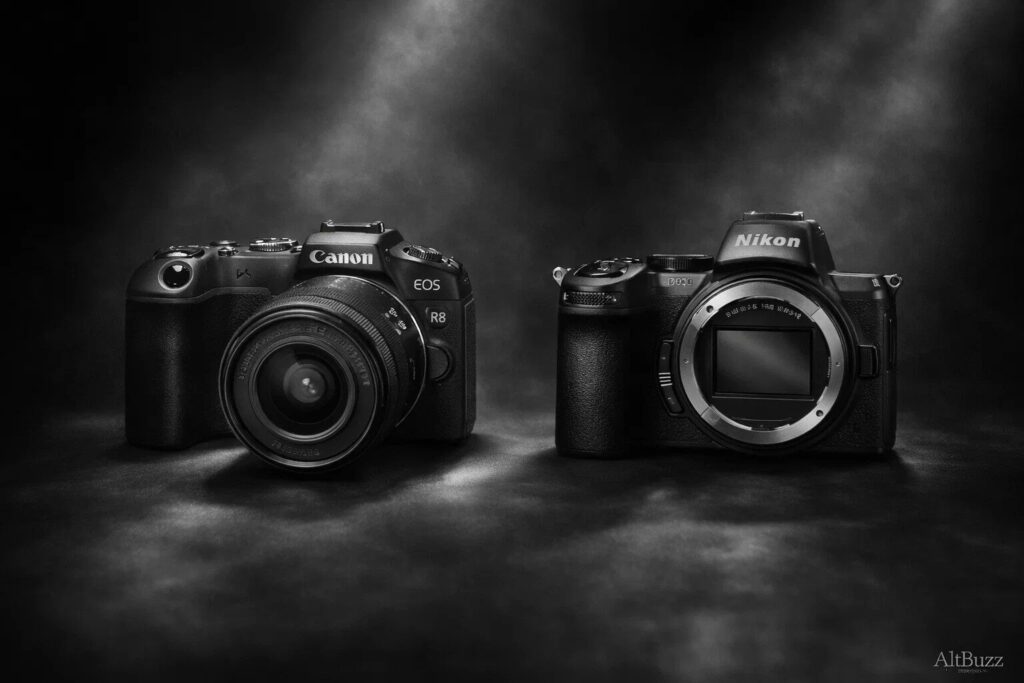
Canon stripped down the EOS R8 to minimize size and weight. The camera weighs just 461 grams without accessories. Compact dimensions suit travel photography perfectly. Airline carry-on restrictions matter less. Day-long shooting causes less fatigue initially. However, the small grip doesn’t suit all hands. Larger lenses create front-heavy imbalance. Telephoto shooting requires careful technique.
No weather sealing exists at this price point. Rain and dust pose serious risks. Professional outdoor work requires protective measures. The camera targets fair-weather photography primarily. Budget constraints necessitated these compromises clearly. Users accept limitations or pay more.
The fully articulating screen helps vloggers and creative angles. Self-recording becomes possible without guesswork. The mechanism extends from the body side. Low and high angle shooting improves dramatically. However, the hinge mechanism represents failure point. Durability concerns exist over time.
Build quality feels adequate but not premium. Polycarbonate construction reduces weight successfully. The camera feels somewhat plasticky honestly. Professional photographers notice the economy clearly. However, the structure withstands normal use fine. Enthusiast photography demands match construction quality.
Nikon built the Z5 with more traditional proportions. The larger grip provides comfortable handling for extended sessions. All-day wedding coverage remains comfortable. Button layout follows familiar Nikon patterns. DSLR users transition seamlessly. The learning curve remains gentle.
Weather sealing protects against dust and moisture. Mountain photography becomes less stressful. Beach shooting risks decrease significantly. Professional confidence increases with protection. The sealed body justifies higher weight partially.
The tilting screen works for most situations but limits vlogging use. Overhead and eye-level shooting works perfectly. Ground-level perspectives remain accessible. However, self-recording proves difficult. The screen doesn’t flip forward completely. Content creators prefer articulating screens strongly.
Build quality feels robust and professional. Magnesium alloy components reinforce the structure. The camera inspires long-term reliability confidence. Professional photographers trust Nikon’s construction. The weight penalty seems worthwhile overall. Serious shooters value this substance.
Button and dial placement differs significantly. Canon clusters controls on the camera rear. The top plate remains relatively clean. Mode dial operation requires two hands sometimes. The ergonomics suit smaller hands better. Nikon distributes controls more traditionally. DSLR-style layout feels immediately familiar. The conventional approach suits larger hands particularly.
Viewfinder quality favors Nikon significantly. The 3.69-million-dot EVF provides stunning clarity. Details appear sharp and crisp always. The larger magnification helps manual focusing. Canon’s 2.36-million-dot display shows adequate detail. However, the difference becomes obvious comparing directly. Professional photographers appreciate Nikon’s superiority here.
Battery Life and Storage Solutions
Battery performance differences prove dramatic in practice. Nikon’s EN-EL15c delivers approximately 390 shots per charge. All-day wedding coverage becomes possible. Travel photography simplifies with fewer spare batteries. The proven battery appears across Nikon cameras. System users already own multiple copies typically.
Canon’s LP-E17 manages only 220-370 shots depending on usage. This limitation frustrates serious shooters immediately. Multiple spare batteries become mandatory equipment. Wedding photographers carry 4-5 batteries routinely. The small battery size limits capacity physically. Chemistry and size conspire against longevity.
Video recording drains Canon’s battery alarmingly fast. Extended recording sessions require external power. USB-C power delivery helps during static shoots. However, mobile shooting demands many spares. The cost and weight add up quickly. Budget calculations must include batteries.
Both cameras charge via USB-C conveniently. Power bank charging extends field time indefinitely. International travel simplifies without separate chargers. The modern standard benefits both systems. Wall adapters become nearly obsolete. Portable power solutions cost less too.
Third-party battery availability affects costs. Canon LP-E17 clones cost $15-30 typically. Quality varies dramatically across brands. Some batteries trigger warnings in-camera. Nikon EN-EL15c alternatives also exist plentifully. The established battery enjoys better third-party support.
Storage solutions separate these cameras fundamentally. Nikon’s dual card slots provide essential backup capability. Simultaneous recording protects against card failure. Wedding photography demands this redundancy absolutely. Card failure means complete catastrophic loss otherwise. Professional standards require dual slots typically.
Overflow recording extends capacity seamlessly. Shooters start with one card then continue automatically. Large events benefit from extended capacity. RAW to one card and JPEG to another works. The flexibility supports various workflows effectively.
Canon’s single slot creates anxiety for important shoots. Card failure risk remains constant and real. Backup strategies become absolutely essential. Immediate backup after shooting protects data. Cloud upload provides insurance against loss. However, the single slot remains significant weakness.
Both cameras support UHS-II SD card speeds. Write performance satisfies burst shooting needs. Buffer clearing happens quickly with fast cards. Video recording benefits from sustained write speeds. Card cost decreases as technology matures. The SD format remains accessible worldwide.
Connectivity Features and Wireless Capabilities
Modern cameras demand comprehensive connectivity options. Both models provide Wi-Fi and Bluetooth. Remote control functionality works reliably via apps. Smartphone integration enables various workflows. Image transfer speeds satisfy social media needs. Professional delivery requires faster solutions though.
Canon’s Camera Connect app provides straightforward operation. Live view remote shooting works well. Exposure and focus adjust from smartphones. Interval timer programming happens remotely. The interface could improve but functions adequately. Firmware updates install over Wi-Fi.
Nikon’s SnapBridge app offers similar functionality. Automatic image transfer works in background. Selected images upload continuously. The convenience suits casual sharing well. However, professional workflows demand more speed. Large RAW files transfer slowly.
USB-C connectivity enables various capabilities. Tethered shooting works in major software packages. Capture One and Lightroom support both cameras. Real-time preview accelerates studio work. Client approval happens immediately during shoots. The modern standard simplifies connections.
FTP transfer capabilities exist on both cameras. Event photographers upload while shooting continues. News photography demands rapid image delivery. Breaking events require immediate distribution. Both cameras enable professional workflows. Configuration requires some technical knowledge though.
HDMI output serves video production needs. External recorders capture clean HDMI signals. Recording codecs and resolutions improve dramatically. Professional video work benefits from external recording. Monitor output helps focus pulling and framing. Both cameras provide standard HDMI connections.
Lens Ecosystem and System Investment: Canon EOS R8 vs Nikon Z5
Lens selection ultimately determines system satisfaction. Canon’s RF mount launched in 2018. Native lens selection grows rapidly. The lineup covers essential focal lengths comprehensively now. Professional options include fast primes and zooms. Budget choices remain limited compared to EF mount.
Canon’s lens roadmap promises continued expansion. The company demonstrates clear RF commitment. Innovation appears in many new designs. However, RF lenses generally cost more than equivalents. The mount prioritizes optical quality over affordability. Budget-conscious buyers face challenges.
RF lens quality generally impresses reviewers. Sharpness and contrast exceed EF predecessors. Modern optical designs maximize mirrorless advantages. The short flange distance enables new possibilities. However, innovation costs money consistently.
Canon EF lens compatibility via adapter helps. The extensive EF catalog remains accessible. Used EF lenses cost far less than RF options. The adapter functions flawlessly with most lenses. Budget system building becomes possible this way. However, native RF lenses perform better typically.
Nikon’s Z-mount launched identically in 2018. Native lens selection covers essentials comprehensively. The lineup addresses most photography needs. Professional and consumer options both exist. However, some focal length gaps remain.
Nikon F-mount compatibility via FTZ adapter shines. Decades of F-mount lenses remain usable. The adapter maintains excellent compatibility. Autofocus works with AF-S and newer lenses. This backwards compatibility provides huge advantages. Existing Nikon users leverage previous investments.
Third-party lens support differs between systems. Sigma produces excellent RF and Z mount lenses. Tamron focuses more on RF mount currently. Viltrox and Samyang offer budget alternatives. The market develops rapidly for both systems. Competition benefits consumers ultimately.
Lens pricing affects total system cost dramatically. Canon’s RF 24-105mm f/4L IS costs approximately $1,300. Nikon’s Z 24-120mm f/4 S runs about $1,100. Budget zooms cost $300-600 on both systems. Third-party options reduce costs further typically. The investment compounds over time significantly.
Prime lens selection varies between systems. Canon offers popular focal lengths like 35mm, 50mm, 85mm. Nikon provides similar coverage with excellent optics. Both companies produce budget and premium versions. Third-party primes expand options affordably. Manual focus vintage glass adapts to both systems.
Telephoto options serve wildlife and sports photographers. Canon’s RF lineup includes several excellent telephoto zooms. Nikon provides competitive alternatives with similar quality. Both systems serve professional telephoto needs adequately. However, these lenses cost thousands regardless of mount.
Target Audience and Use Case Analysis
Canon EOS R8 targets tech-forward content creators primarily. YouTube producers need cutting-edge autofocus and video. The camera delivers exactly these priorities. Social media influencers value the fully articulating screen. Vlogging capabilities match or exceed competition. The compact size suits mobile production styles.
Photographers prioritizing autofocus choose Canon confidently. Wildlife shooters benefit from subject detection capabilities. Sports photographers track action reliably. Pet photographers capture sharp animal portraits. The AF advantage justifies compromises elsewhere. Action photography transforms with this technology.
Budget-conscious photographers upgrading from crop sensors benefit. Full-frame becomes accessible under $1,500. Image quality improvements prove substantial. Low-light capability increases dramatically. Depth of field control expands creative options. The R8 democratizes full-frame accessibility.
Nikon Z5 targets traditional photographers valuing reliability. Wedding photographers need dual card slots absolutely. The backup capability prevents career-ending disasters. IBIS enables work in dim venues. The weather sealing provides professional confidence. Conservative buyers choose proven technology over latest features.
Landscape photographers appreciate IBIS tremendously. Handheld shooting becomes viable in more situations. Tripod requirements decrease significantly. Travel weight reduces without sacrificing capability. The stabilization enables creative freedom. Golden hour shooting extends into blue hour.
Studio photographers find adequate performance from both. Controlled lighting eliminates many variable factors. Tethered shooting works perfectly on both systems. Image quality satisfies commercial requirements. Neither camera demonstrates clear advantages here. Personal preference and ecosystem determine choice.
Event photographers split based on priorities. Those valuing autofocus choose Canon. Those requiring dual slots choose Nikon. Battery life considerations favor Nikon strongly. Video needs favor Canon substantially. The decision depends on event type ultimately.
Long-Term Value and Future-Proofing
Technology advancement pace affects value retention. Canon’s newer release date provides advantage here. The R8 incorporates 2023 technology standards. The camera remains current for longer theoretically. However, Canon’s frequent releases decrease older model values.
Nikon’s three-year age shows in specifications. However, current discounted pricing offsets age partially. The camera serves needs adequately despite older tech. Image quality doesn’t depreciate with time. Professional photographers use older equipment successfully.
Firmware update frequency varies by manufacturer. Canon updates cameras regularly with new features. The company demonstrates good long-term support. Nikon similarly supports products well. Both manufacturers maintain cameras beyond release. User confidence benefits from this support.
Used market considerations affect future resale. Canon cameras typically maintain value reasonably. However, newer releases devalue predecessors quickly. Nikon cameras depreciate faster initially. However, prices stabilize at reasonable levels. Both cameras serve used market needs differently.
System investment exceeds body cost always. Lenses represent larger financial commitment. Accessories and support gear add costs. Learning curve investments matter too. Platform switching costs time and money. Initial choice ripples forward for years.
Which Camera Should You Choose?
Canon EOS R8 wins for:
- Cutting-edge autofocus performance
- Superior video recording capabilities
- Compact size for travel and street photography
- High-speed burst shooting needs
- Content creation and vlogging
- Latest technology and features
- Smooth video autofocus tracking
Nikon Z5 wins for:
- In-body image stabilization
- Dual card slots for backup security
- Better battery life for extended shooting
- Weather sealing and robust build
- Lower current market price
- Superior viewfinder quality
- Proven reliability and durability
- Better value for landscape photography
Action and video shooters choose Canon. The autofocus and video capabilities prove decisive. Content creators benefit from modern features. Budget constraints favor the discounted Nikon Z5. Landscape and portrait photographers prefer Nikon. Traditional photographers value reliability and durability. Technology enthusiasts appreciate Canon’s modern systems.
Consider your primary photography genre carefully. Autofocus requirements drive many decisions. Video needs determine feature priorities. Budget affects immediate and long-term costs. System commitment matters more than body choice. Try both cameras in stores if possible. Rent before buying to confirm preferences.
Read More from AltBuzz
Read more from AltBuzz for camera reviews, in-depth comparisons, and detailed specs. AltBuzz delivers clear and trusted camera insights. Find honest evaluations that cut through marketing hype. Make informed decisions with our expert guidance. Professional photographers contribute real-world experience. Our testing methodology ensures accuracy. Trust AltBuzz for reliable camera information.
Subscribe AltBuzz YouTube Channel
Stay updated with camera comparisons and hands-on reviews. AltBuzz covers the latest photography gear. Subscribe here: 👉 Subscribe AltBuzz