
Some cameras announce themselves loudly. The Fujifilm XF10 does the opposite. It slips quietly into a jacket pocket. It sits on a table without demanding attention. It fits in the hand with the settled confidence of something that understands exactly what it exists for.
Released in August 2018, the XF10 pairs a 24.3MP APS-C X-Trans sensor with a 28mm equivalent f/2.8 lens and Fujifilm’s acclaimed Film Simulation system inside a body weighing 279 grams. For street photographers, deliberate travel shooters, and hobbyists who want genuine sensor quality in a truly pocketable format, this camera built a devoted following that persists well beyond its launch year.
This review examines the XF10 in complete technical depth, explaining what each specification means in practical shooting situations and where the camera asks its owner to accept real, honest compromises.
The Philosophy Behind the Fujifilm XF10
Before examining specifications, understanding the XF10’s design philosophy makes every technical decision more legible. Fujifilm built the XF10 for photographers who prioritize image quality and creative expression over autofocus speed, video performance, or operational flexibility.
The camera assumes the photographer makes deliberate decisions. It provides precise tools to execute those decisions with both technical accuracy and a visual character that generic cameras cannot replicate. This philosophy explains why Fujifilm chose a fixed 28mm lens over a zoom. It explains the Film Simulation system. It explains Snap Focus. Every element serves a photographer who shoots with intention rather than convenience.
Fujifilm XF10: Complete Specifications
| Feature | Specification |
|---|---|
| Sensor Type | APS-C X-Trans CMOS III, 24.3MP |
| Processor | EXR Processor IV |
| Lens | Fujinon 18.5mm f/2.8 (28mm equivalent, fixed) |
| ISO Range | ISO 200 to 12,800 (expandable ISO 100 to 51,200) |
| Autofocus System | Contrast-detect AF, 77 selectable zones |
| Stabilization | None |
| Video Recording | 4K UHD 15fps, 1080p 60fps |
| Viewfinder | None |
| LCD Screen | 3.0-inch fixed touchscreen, 1.04M dots |
| Burst Shooting | 6fps at full resolution |
| Battery | NP-95, approx. 330 shots per charge |
| Storage | Single SD/SDHC/SDXC slot, UHS-I |
| Connectivity | Wi-Fi, Bluetooth |
| Dimensions | 112.5 x 64.4 x 40.0mm |
| Weight | 279g with battery and card |
| Launch Price | Approx. $499 USD |
The 28mm Perspective: A Creative and Historical Choice
Why 28mm for Street Photography
The choice of 28mm equivalent focal length is the XF10’s first and most significant creative statement. This is not the 24mm of vlogging cameras or the classic 35mm of traditional street photography. It sits deliberately between the two, occupying a perspective that photographers have used for documentary and photojournalistic work for decades.
At typical street shooting distances of two to three meters, a 28mm lens renders a subject with natural proportions while keeping the surrounding environment visible and contextually significant. The viewer sees both the person and the place simultaneously. Neither element dominates or overwhelms the other. The 28mm perspective invites the surrounding world into the frame rather than isolating subjects against compressed backgrounds.
Optical Design of the Fujinon Lens
The Fujinon 18.5mm f/2.8 is a true optical design, not a computational focal length or electronic zoom approximation. Nine elements in seven groups, including two aspherical elements, control barrel distortion and chromatic aberration across the frame with careful precision. Corner sharpness is strong across most of the aperture range. Distortion is well-controlled for a wide-angle lens design. The rendering of out-of-focus areas at f/2.8 distances is smooth and gradual without appearing artificially blurred or nervously busy.
Depth of Field Advantage Over Smaller Sensors
At f/2.8 on an APS-C sensor, depth of field is meaningfully shallower than f/2.8 on a 1-inch or 1/2.3-inch sensor. A 1/2.3-inch sensor at f/2.8 produces near-infinite depth of field at standard shooting distances, making subject-background separation essentially impossible. The XF10’s APS-C sensor at f/2.8 produces visible foreground-to-background separation at portrait distances, with subjects appearing sharply focused against backgrounds that soften into recognizable context.
Additionally, the low-light performance advantage of APS-C over smaller sensors at equivalent ISO settings is consistent, measurable, and visible in real shooting comparisons. This technical advantage is one of the primary reasons photographers accept the XF10’s other compromises in exchange for its sensor quality.
Fujifilm XF10 Sensor: The X-Trans CMOS III in Detail
What X-Trans Architecture Means Technically
Standard Bayer sensors use a 2×2 repeating grid of red, green, and blue photosites. Fujifilm’s X-Trans design uses a 6×6 pseudo-random color filter array with a higher proportion of green photosites arranged in a non-repeating pattern. This irregular arrangement reduces moiré patterning on fine regular textures including woven fabrics, architectural grillwork, window screens, and building facades without requiring the anti-aliasing filter that most Bayer sensors use.
Anti-aliasing filters reduce moiré by optically blurring the incoming image slightly before it reaches the sensor. This blur reduces moiré but also softens overall resolution. By addressing moiré through color array design rather than optical filtration, X-Trans preserves full optical sharpness from the lens. The result is images with noticeably sharper fine detail than equivalent-resolution Bayer sensors with anti-aliasing filters typically produce.
Rendering Character and Film-Like Quality
The practical rendering result is images with a quality that Fujifilm photographers describe consistently as organic and film-like. Fine detail retains texture without appearing over-sharpened or artificially clarified. Tonal transitions between focused and defocused areas feel gradual and natural rather than abrupt. Colors, particularly greens, blues, and skin tones, exhibit complexity and subtlety that simpler sensor designs sometimes reduce to flat, undifferentiated uniformity.
This rendering character is difficult to quantify in specifications but immediately apparent when comparing processed files side by side. It is a significant part of why photographers choose Fujifilm cameras specifically rather than alternatives with technically similar megapixel counts.
X-Trans RAW Processing Considerations
X-Trans sensor files require specific RAW processing treatment. The 6×6 color array pattern requires a more complex de-mosaicing algorithm than standard Bayer patterns, and different RAW processors handle this differently. Capture One and Iridient X-Transformer are generally considered to produce the sharpest and most accurate results from XF10 RAW files. Adobe Lightroom historically applied a smoothing effect to fine detail in X-Trans files, though this improved substantially in more recent versions. Photographers who prioritize the highest possible detail extraction from RAW files should evaluate their preferred processing software against X-Trans files specifically before committing.
Dynamic Range and DR Expansion System
At base ISO 200, the XF10 delivers approximately 12.5 stops of dynamic range. Fujifilm’s Dynamic Range expansion modes extend effective JPEG dynamic range through a combination of sensor exposure adjustment and tone curve modification at the point of capture.
DR200 underexposes the sensor by one stop and applies a modified tone curve that recovers highlight detail while maintaining midtone brightness. DR400 repeats this process twice, recovering approximately two additional stops of highlight detail compared to standard DR100. In high-contrast lighting situations, including direct sunlight with deep shadow areas, sun-backlit subjects, and interiors with bright windows, DR400 reduces blown highlight areas substantially in JPEG output.
RAW shooters can apply equivalent adjustments in post-processing with complete control. For JPEG shooters who want well-exposed images in challenging contrast situations without editing, the DR expansion system provides tangible improvement that makes the XF10 more capable in real conditions than base dynamic range figures alone suggest.
Low-Light ISO Performance
ISO 800 produces clean, detailed images with minimal visible noise across the frame. ISO 1600 introduces noise that remains fine-grained and controlled rather than blotchy or smeared across tonal areas. ISO 3200 is usable for prints up to A4 size and comfortable for screen and social media display. Beyond ISO 3200, noise reduction processing begins softening fine detail in hair strands, fabric weaves, and distant foliage textures.
The ISO 51,200 expansion ceiling serves emergency situations only. Images at maximum expansion show obvious noise alongside processing artifacts that render fine detail beyond meaningful recovery. For available-light street photography in urban evening environments, ISO 3200 to 6400 covers most practical situations acceptably. This performance advantage over smaller-sensor cameras at equivalent ISO settings is consistent and meaningful in daily street and travel shooting.
Fujifilm Film Simulations: The XF10’s Defining Creative System
What Film Simulations Actually Are
Film Simulations are in-camera JPEG processing profiles that replicate the color, contrast, and tonal characteristics of specific Fujifilm photographic film stocks from the analog era. These are not artistic Instagram-style filters applied digitally without underlying logic. They are meticulously engineered color science profiles built on decades of Fujifilm’s analog film manufacturing knowledge and calibrated against the physical characteristics of film stocks that professional photographers trusted for documentary and fine art work for decades.
The distinction matters because it explains both the quality and the character of the results. Film Simulations produce aesthetics that reference real photographic history rather than invented digital looks. Photographers who grew up with or admire the visual language of film photography immediately recognize and appreciate the references.
Provia and Standard Rendering
Provia/Standard is Fujifilm’s general-purpose simulation. It delivers accurate color reproduction, moderate contrast, and clean natural rendering across all subject types. Provia suits portraits, travel, events, architecture, and everyday photography without specialized aesthetic requirements. It functions as a reliable baseline from which other simulations depart in specific creative directions.
Velvia for Landscape and Nature
Velvia/Vivid is based on Fujifilm Velvia reversal film, historically a favorite among landscape and nature photographers for its intense color saturation and strong contrast. Greens intensify dramatically in Velvia. Blues deepen to deep saturated tones. Reds and yellows gain energy and presence in the frame. Portraits in Velvia appear oversaturated and unflattering in most conditions. Landscapes, architecture in strong directional light, and botanical subjects look genuinely spectacular. The simulation rewards appropriate subject selection with results that look bold and visually powerful straight from the camera.
Astia for Portrait Work
Astia/Soft uses gentle contrast curves, soft color rendering, and particularly flattering skin tone reproduction calibrated for portrait photography. Outdoors in natural daylight, Astia produces portrait JPEG results that look professionally processed without any editing. Skin appears smooth and warm without artificial orange shifts. Shadows lift slightly compared to other simulations, reducing harsh under-eye shadows in outdoor midday light.
Classic Chrome for Documentary and Street
Classic Chrome is arguably the most popular Film Simulation among Fujifilm users and represents the simulation most closely associated with documentary, street, and travel photography aesthetics. Classic Chrome produces desaturated color, a slightly cool white balance bias, and strong shadow rendering that adds weight, depth, and visual gravity to compositions. Images in Classic Chrome reference the visual language of mid-twentieth century documentary photography and color magazine work from the 1960s and 1970s. The aesthetic looks simultaneously timeless and modern, which explains its enormous popularity across professional and enthusiast Fujifilm photographers worldwide.
PRO Neg Simulations for Controlled Portrait Work
PRO Neg. Hi and PRO Neg. Std are designed specifically for portrait and studio photography. Both deliver accurate, controlled color with reduced contrast and precisely calibrated skin tone rendering. PRO Neg. Hi carries slightly more saturation and contrast than Std. Both simulations produce professional-grade portrait JPEG output that requires minimal retouching under controlled lighting. Studio photographers and portrait shooters who work under predictable light find these simulations particularly valuable for consistent client-ready output.
Acros: The Black-and-White Standard
Acros is Fujifilm’s dedicated black-and-white simulation, based on Fujifilm Acros 100 black-and-white film. It delivers significantly finer grain structure than the standard Monochrome simulation, with superior shadow gradation and micro-contrast that creates a three-dimensional appearance in faces and textured surfaces. Acros is available with Yellow, Red, and Green filter effects for tonal control. The Red filter deepens sky tones dramatically and brightens skin tones in black-and-white conversion. The Yellow filter provides subtle sky separation. The Green filter increases foliage contrast and detail.
Acros is widely regarded as the most capable in-camera black-and-white processing available from any manufacturer. Black-and-white photographers who convert digital color files in post-processing consistently produce results less refined than Acros output directly from the camera in side-by-side comparisons.
How Film Simulations Transform the Shooting Experience
Film Simulations display in live view before the shutter fires. The photographer composes and exposes while seeing the final processed look on screen in real time, not a neutral technical preview that requires imagination to translate into finished output. Switching from Provia to Classic Chrome changes the entire emotional character of the live scene as framed. Switching to Acros with a Red filter deepens the sky and shifts tonal balance in the black-and-white preview, visible before any capture decision.
This live preview capability means Film Simulations actively inform composition and exposure decisions rather than simply applying after the fact. A photographer who selects Classic Chrome before shooting a market scene will compose and meter differently than one shooting in Provia. The simulation becomes part of the creative process rather than a retrospective adjustment. For hobbyists and enthusiasts who want expressive photography without extended post-processing workflows, this system provides a uniquely valuable and genuinely creative tool.
Fujifilm XF10 Autofocus System
Contrast-Detect Behavior and Speed
The XF10 uses contrast-detect autofocus with 77 selectable zones. Contrast-detect AF maximizes contrast values within the selected focus zone by moving the lens element until contrast peaks, then confirming focus at that position. In good light with stationary or slow-moving subjects, this process completes quickly and accurately. The XF10 achieves focus in approximately 0.16 seconds under favorable conditions, which is acceptable for street photography, deliberate travel shooting, and casual portrait work.
In lower light or with low-contrast subjects, focus hunting occurs. The lens racks through the focus range searching for sufficient contrast before confirming, which introduces a delay that increases with decreasing light levels and subject contrast. For static subjects in challenging light, patience and reframing resolve this practically. For fast-moving subjects in dim conditions, missed focus becomes a consistent frustration rather than an occasional inconvenience.
Snap Focus: Bypassing AF Entirely
Snap Focus is the XF10’s most distinctive and practically important focusing feature for street photography. It bypasses autofocus completely and sets a fixed focus distance representing a pre-calculated zone-focused depth of field at the chosen aperture.
At f/8 and two meters, depth of field extends from approximately one meter to beyond five meters. Everything at typical street photography shooting distances appears acceptably sharp without any autofocus operation whatsoever. The photographer pre-selects the snap distance, raises the camera, and fires immediately on instinct. No focus delay. No hunting. No missed decisive moments while the camera searches for contrast in the scene.
Zone focus technique has been central to street photography since the film camera era. Cartier-Bresson, Winogrand, and Friedlander all used zone focus approaches to enable split-second capture. The XF10 implements this technique digitally with preset distances of one, 1.5, two, and five meters. Understanding which distance suits which typical shooting scenario allows rapid and confident capture in any lighting condition without autofocus involvement.
Manual Focus Implementation
Manual focus is available through a screen-based touch-drag interface. The XF10 does not have a physical focus ring on the lens. Instead, dragging a finger across the touchscreen moves focus through the range. A focus peaking display highlights in-focus edges in a selected color for visual confirmation.
Manual focus on the XF10 is slower and less tactile than physical ring-based manual focus. For static subjects where time allows careful focus placement, it works adequately. For situations requiring rapid precise focus adjustment, the interface feels cumbersome compared to a traditional focus ring.
Touch AF Practicality
The touchscreen supports touch AF for instant focus zone relocation by tapping any point on screen. For stationary subjects in moderate light, touch AF relocates and confirms focus quickly without directional button navigation. This is faster and more intuitive than button-based zone selection for non-critical shooting situations where the AF system has enough contrast and light to confirm quickly.
Fujifilm XF10 Video Capabilities: Complete Honesty Required
4K at 15fps: The Honest Assessment
The XF10 records 4K UHD at 15fps. At this frame rate, any camera movement or subject motion produces visibly stuttering, choppy footage during standard playback. Standard video viewing at 24fps, 25fps, or 30fps reveals the 15fps frame rate as immediately unnatural and distracting. For conventional filmmaking, vlogging, social media content, or any video where smooth motion is expected, 4K at 15fps on the XF10 is not a usable recording option.
Fujifilm chose this frame rate as a deliberate market differentiation decision at the time of the XF10’s launch in 2018. The camera’s imaging pipeline was technically capable of higher frame rates, but delivering full 4K video capability at 30fps would have reduced differentiation between the XF10 and Fujifilm’s more expensive X-series bodies at the time. For buyers in 2024, this limitation is simply a real and unavoidable constraint.
1080p as the Practical Video Mode
Full sensor readout at 1080p produces smooth footage at 60fps with good detail and accurate color rendering. For occasional video clips, travel documentation, personal memory recording, and social media content, 1080p 60fps from the XF10 looks entirely usable and appropriately detailed. Film Simulations apply to video recording just as they do to stills, meaning Classic Chrome, Acros, Velvia, and all other profiles produce their characteristic visual character in video clips as well.
For photographers who occasionally record video rather than dedicated videographers, 1080p 60fps provides entirely sufficient quality for most purposes. The Film Simulation integration in video is genuinely useful, producing a consistent aesthetic identity across both still and video output without requiring separate color grading.
Audio and Recording Limitations
No microphone input exists on the XF10. The single built-in microphone records basic reference audio that is adequate for personal documentation but insufficient for any professional or semi-professional content application. Recording clips in any mode are subject to standard file size limitations. For video-focused buyers, these constraints represent significant limitations that alternative cameras handle considerably better.
Fujifilm XF10 Design, Controls, and Build Quality
Physical Materials and Construction
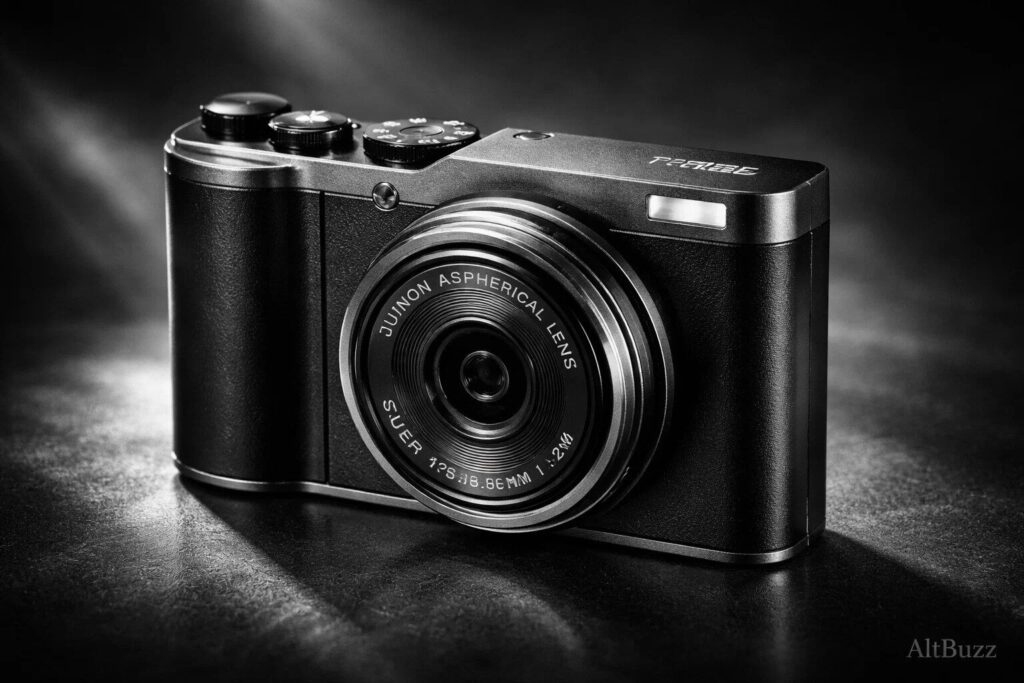
The XF10 body combines polycarbonate panels with an aluminum top plate. Build quality feels noticeably more premium than cameras at a similar price that use entirely plastic construction. The top plate finish has a tactile quality that feels confident and solid in hand. At 279 grams, the camera is genuinely compact while maintaining the kind of physical presence that communicates quality rather than fragility.
The wide, flat body profile, 112.5mm wide by 40mm deep, creates a camera that sits comfortably in a jacket pocket in landscape orientation. The lens does not extend or telescope on power-up. The physical profile remains constant whether the camera is powered on or off, which makes pocket carry and quick deployment completely practical in everyday use.
No weather sealing is present on the XF10. Light rain and dusty environments require caution and ideally a protective cover during active shooting.
Control Layout for Deliberate Photography
The XF10’s control layout reflects its intended deliberate shooting style explicitly. A rear control dial handles aperture in aperture-priority mode and exposure compensation with a press. A dedicated AF/MF switch on the front of the body allows instant transition between autofocus and manual focus without any menu navigation. A customizable Fn button on the top plate accesses a rapid shooting menu covering ISO, white balance, Film Simulation, dynamic range, and noise reduction in a single screen.
Physical controls directly access the parameters that deliberate photographers adjust most frequently during a session. The layout rewards photographers who understand their preferred settings and want fast access to change them. It does not suit photographers who rely on fully automatic operation or who prefer guided menu interfaces.
The Fixed Non-Tilting Screen
The 3.0-inch LCD does not tilt or articulate in any direction. This is the XF10’s most limiting ergonomic constraint for contemporary shooting workflows. Overhead shooting requires raising the camera above eye level and estimating composition by memory or instinct. Low-angle shooting requires crouching to screen level. Self-filming is impractical because the screen faces away from the subject during any attempt at arm-length self-directed capture.
For dedicated street photographers who compose primarily at eye level or slightly above, the fixed screen creates minimal practical inconvenience during a typical shooting session. For travel photographers, lifestyle shooters, and anyone who uses low and high compositional angles regularly, the fixed screen creates genuine daily frustration that a tilting mechanism would entirely resolve.
Silent Electronic Shutter
The XF10 includes a silent electronic shutter mode that produces completely inaudible captures. For street photographers who want to shoot candidly without drawing attention from a shutter click, or for quiet environments like museums, ceremonies, and performances where mechanical shutter sound is inappropriate, the electronic shutter is a practically valuable feature. Combined with the compact and unobtrusive body design, the silent shutter makes the XF10 a genuinely discreet street photography tool.
Fujifilm XF10 Battery Life and Connectivity
Battery Endurance
The NP-95 battery delivers approximately 330 shots per charge. A full day of moderate street photography typically completes on a single battery charge under normal usage patterns. Heavier burst shooting, extensive playback review, and active Wi-Fi transfer reduce endurance noticeably below the rated figure. Additionally, cold weather reduces battery performance meaningfully, which matters for photographers who shoot in winter conditions.
Carrying one spare battery provides a comfortable buffer for most full-day shooting situations. The NP-95 is reasonably compact and affordable, making two or three spare cells a practical solution for intensive shooting days or multi-day travel.
USB Charging Via Micro-USB
USB charging is supported through the Micro-USB port, enabling charging from power banks, laptop USB ports, and standard USB wall adapters. The Micro-USB standard rather than USB-C reflects the camera’s 2018 design date and represents a dated connector choice by current standards. Functionally, the charging flexibility remains useful for travel despite the older connector format. Micro-USB cables remain widely available, which mitigates the inconvenience somewhat.
Wireless Connectivity
Fujifilm Camera Remote app connectivity via Wi-Fi and Bluetooth enables remote shutter control, live view monitoring, image transfer, and GPS location tagging from smartphone location data. Bluetooth allows persistent low-energy pairing for automatic camera-phone connection on power-up.
Transfer speeds suit JPEG files at an adequate pace. Large RAF RAW file transfers proceed slowly enough that wired transfer via Micro-USB is considerably faster for bulk sessions. Photographers who regularly transfer complete RAW shooting sessions wirelessly will find the process time-consuming and will likely prefer cable connection for practical bulk transfer.
Fujifilm XF10 Real-World Use Cases
Street Photography
This is the XF10’s strongest and most natural application. The 28mm perspective, compact body, silent electronic shutter, Snap Focus capability, and Classic Chrome Film Simulation combine into a comprehensive street photography tool that experienced photographers in this genre find deeply satisfying. The combination rewards deliberate and instinctive shooting simultaneously.
Photographers committed to street work will extract more from the XF10 than from cameras with more technically advanced specifications but less inherent character. The camera encourages a shooting approach that matches what street photography demands: quick, decisive, visually aware.
Travel Photography with Commitment
The compact dimensions and APS-C image quality create a strong travel photography tool for photographers who commit to working within a single fixed focal length. One camera, one perspective, and a discipline to work with that constraint produces travel photography with a distinctive visual consistency that zoom-lens results often lack.
Travel photographers who need zoom flexibility will find the fixed lens limiting in practical destination shooting. Those who embrace the constraint will find their compositional instincts improve over time as the 28mm perspective becomes deeply familiar.
Personal Photo Journaling
Selecting a Film Simulation and committing to it across a project or trip produces a visually coherent body of work. Classic Chrome through a week in a city. Acros across a family event. Velvia for a coastal landscape trip. This kind of intentional approach produces results that feel unified and considered rather than technically inconsistent. The XF10 actively rewards this working method through its live simulation preview and quick simulation switching through the function menu.
Available Light Indoor Photography
APS-C low-light performance exceeds smaller sensor alternatives at equivalent ISO settings by a consistent and measurable margin. For indoor events, home photography, museum visits, and low-light documentary situations, the XF10 handles conditions that genuinely challenge 1-inch and 1/2.3-inch sensor cameras. The f/2.8 aperture, while not the fastest available, provides a meaningful advantage over slower kit zoom lenses in indoor ambient light.
Large Print and Archival Photography
At 24.3MP, the XF10 produces files capable of sharp prints at A2 and beyond when processed carefully. Photographers who display work on walls, enter print competitions, or shoot for editorial publications benefit from this resolution capability more than those creating exclusively for screen delivery. The X-Trans sensor’s resolution advantage over Bayer sensors with anti-aliasing filters becomes most visible in large prints where fine texture detail is examined closely.
Fujifilm XF10 Pros and Cons
Strengths Worth Knowing
The 24.3MP APS-C X-Trans sensor delivers image quality identical to Fujifilm cameras costing significantly more at launch, providing a level of performance rarely available in a body this compact and affordable. Film Simulations including Classic Chrome, Acros with filter options, Velvia, and Astia provide a genuinely unique and historically grounded creative system that no competing manufacturer replicates with equivalent depth. The 28mm focal length carries documentary and photojournalistic tradition behind it, making it a natural and well-supported choice for street and travel work.
The silent electronic shutter enables completely discreet shooting in sensitive environments. JPEG output from the Film Simulation system delivers organic and film-like rendering quality that stands apart from the generic processed look of most digital camera output. USB charging from standard power banks and adapters works conveniently through the Micro-USB port. The premium aluminum top plate construction gives the camera a physical quality that feels appropriate for its intended use and photographic heritage.
Snap Focus provides an AF-independent rapid-capture solution with deep historical roots in street photography technique. For photographers who learn and apply zone focus technique, the XF10 becomes one of the most responsive cameras available in any light condition at any price.
Weaknesses That Matter
4K video is limited to 15fps, making it essentially unusable for conventional video content of any kind. Contrast-detect AF only means the camera struggles with fast movement and subjects in low light in ways that modern hybrid phase-detect systems handle comfortably. The fixed non-tilting screen prevents low-angle, overhead, and self-filming composition entirely without physical workarounds.
No weather sealing or dust resistance of any kind limits shooting confidence in light rain, mist, and outdoor dusty conditions. No optical or in-body image stabilization makes the camera entirely dependent on high shutter speeds or high ISO to combat camera shake in lower light. The absence of a microphone input prevents external audio connection for video work entirely. The Micro-USB charging port rather than USB-C reflects the camera’s 2018 origins and feels dated compared to current USB-C standard connectivity on competing cameras.
Who Should Buy the Fujifilm XF10?
The XF10 suits a photographer who values image quality and creative color control in a compact fixed-lens body above video performance, autofocus speed, or operational flexibility. It is the right camera for a street photographer who wants genuine APS-C sensor performance in a pocket-sized body that disappears into daily life. It is the right camera for a hobbyist who loves Fujifilm’s Film Simulations and wants access to them in the most compact and affordable Fujifilm body available.
It is not the right camera for a vlogger, a parent photographing fast and unpredictably moving children at indoor events, a travel photographer who films video as a core part of their workflow, or anyone who considers quality 4K video an essential purchase requirement. The XF10 asks its owner to accept real limitations in exchange for a specific, historically grounded photographic experience that very few cameras in its size and price category can approach.
Final Thoughts on the Fujifilm XF10
The Fujifilm XF10 was a deliberate camera at launch in 2018 and it remains a deliberate camera today. Its specifications serve a clearly understood purpose. Its design reflects deep awareness of the photographer it was built for. That photographer wants APS-C image quality, Fujifilm’s Film Simulation creative system, a 28mm documentary perspective, and a body that integrates into daily life without demanding special attention or careful handling.
The video specification has aged substantially since 2018. The contrast-detect autofocus system trails modern hybrid implementations by a clear and consistent margin. The fixed non-tilting screen limits compositional flexibility in ways that feel increasingly anachronistic as articulating screens become standard across the industry.
For still photography in its intended applications, however, the XF10 remains genuinely excellent. It produces images with a quality and character that cameras costing more but carrying less photographic identity cannot replicate. At current street prices below the original launch figure, the XF10 represents outstanding value for the photographer who understands what they are buying and commits fully to its perspective, its simulations, and its deliberate approach to the act of photography.
Read More from AltBuzz
For camera reviews that go beyond spec sheets and explain what cameras actually feel like to use in the real world, visit AltBuzz. AltBuzz covers photography gear with technical depth and practical honesty for photographers at every level.
Subscribe to the AltBuzz YouTube Channel
Stay updated with the latest camera reviews and comparisons. AltBuzz breaks down every major camera with real-world context, technical clarity, and genuine depth. Subscribe to AltBuzz on YouTube for photography content that genuinely improves your gear decisions and shooting skills.