
Nikon Z4 Rumors: Expected Specs, Features and Release
The Nikon Z4 has emerged as one of the most intriguing subjects in professional photography discourse this year. The camera does not officially exist. Nikon has made no statement confirming its development. Yet the accumulation of credible leaks, patent analysis, and coherent market logic has elevated the Nikon Z4 from a casual forum rumor to a subject of serious industry conversation.
The proposition being discussed is compelling. A full-frame mirrorless camera positioned between the entry-level Z5 II and the professional hybrid Z6 III. Higher resolution than the Z6 III. More accessible pricing than the Z7 III. Built for photographers who need more than an entry camera can offer but who cannot justify flagship expenditure.
This editorial examines all available evidence and considers what the Nikon Z4 might mean for professional and advanced amateur photographers navigating the current full-frame mirrorless market.
Expected Release Date and Market Position of the Nikon Z4
Nikon’s Z-mount strategy has followed a deliberate and methodical progression since 2018. Each new body has addressed a specific segment with focused intent. The Z5 anchored affordability. The Z6 series served hybrid professionals. The Z7 series served resolution-hungry landscape and studio photographers. The Z8 and Z9 addressed speed and professional durability. The Nikon Z4 appears designed to occupy the resolution middle ground that currently sits vacant between the Z6 III and Z7 III.
From a competitive standpoint, this positioning makes considerable strategic sense. Sony’s A7 IV has proven that a 33-megapixel full-frame hybrid camera at approximately 2500 dollars finds a substantial and willing audience. Canon’s EOS R6 Mark III is expected to respond competitively in the same bracket. Nikon’s response, if the Nikon Z4 rumors hold, would enter that conversation with a sensor resolution advantage and the substantial AF capabilities developed through the Z8 and Z9 program.
Industry sources point toward a potential announcement window in the first half of 2026. CP+ in February or a dedicated Nikon online reveal event in spring are the most commonly cited scenarios. A body-only price in the 2099 to 2599 dollar range would position the Nikon Z4 aggressively against Sony and Canon equivalents while maintaining adequate separation from the Z6 III below and the Z7 III above.
Nikon Z4 Rumored Specifications Table
| Feature | Rumored Details |
|---|---|
| Sensor Type | Full-frame BSI-CMOS, stacked architecture debated |
| Resolution | Approximately 36 megapixels |
| Processor | EXPEED 7 or next-generation variant |
| ISO Range | 64 to 51200, expandable to 204800 |
| Autofocus System | Full subject detection with 3D tracking across frame |
| Stabilization | 5-axis IBIS rated to 6.5 stops |
| Video Recording | 4K 60fps uncropped, 4K 120fps speculated |
| EVF | 5.76 million dot OLED EVF |
| LCD Screen | 3.2-inch fully articulating touchscreen |
| Burst Shooting | 20 fps electronic shutter, 11 fps mechanical |
| Battery | EN-EL15d or vertical grip compatible variant |
| Storage | Dual slots: one CFexpress Type B and one SD |
| Connectivity | Wi-Fi 6, Bluetooth 5.2, USB-C 3.2 Gen 2 |
| Weight | Approximately 730 grams |
| Expected Price | 2099 to 2599 USD |
Rumored Sensor and Image Quality of the Nikon Z4
The sensor specification of the Nikon Z4 sits at the center of all meaningful discussion about this camera. The resolution figure of approximately 36 megapixels occupies a deliberate and commercially intelligent position. It offers a meaningful step above the Z6 III’s 24.5 megapixels for photographers who require larger prints or more aggressive cropping latitude. At the same time, it preserves clear resolution distance from the Z7 III’s 45.7 megapixels, protecting the logic of that camera’s continued existence in the lineup.
Whether the Nikon Z4 employs a stacked sensor architecture is the most consequential unresolved question. Stacked CMOS technology, as implemented in the Z9 and Z8, enables dramatically faster sensor readout. This effectively eliminates rolling shutter distortion and enables the pre-capture buffer performance that professional sports photographers have embraced. However, stacked sensors carry meaningful manufacturing cost premiums. Delivering a stacked 36-megapixel sensor at or below 2600 dollars would be an impressive engineering and commercial achievement.
The more conservative scenario involves a conventional BSI-CMOS architecture without stacking. This would still represent a significant improvement over the Z5 II’s sensor. Dynamic range at base ISO is expected to approach or exceed 14 stops regardless of whether stacking is employed. The distinction between stacked and non-stacked would manifest primarily in maximum burst speed, rolling shutter characteristics, and pre-capture capability rather than in baseline image quality metrics.
Nikon’s color rendering at 36 megapixels has the potential to deliver exceptional tonal transitions in portrait and landscape work. The additional pixel density compared to the Z6 III translates to finer detail resolution in high-frequency subjects like fabric texture, foliage, and architectural elements. For photographers who shoot for commercial clients requiring large-format reproduction, this resolution increase carries genuine practical value.
Rumored Autofocus System in the Nikon Z4
The autofocus system expected in the Nikon Z4 draws directly from the technological foundation established through Nikon’s EXPEED 7 development program. Based on available leaks, the Z4 would receive comprehensive subject detection spanning human subjects at the granular level of face and eye recognition, animals covering both domesticated and wild species, and motorized vehicles.
The implementation of 3D tracking at 36 megapixels introduces specific engineering considerations. Higher resolution sensors generate substantially more data per frame. Processing this data stream while maintaining continuous subject tracking at high frame rates requires EXPEED 7’s computational resources operating near capacity. This may be part of why some sources suggest the Nikon Z4 could introduce a next-generation EXPEED variant rather than the existing EXPEED 7 found in the Z8 and Z9.
Pre-capture buffer functionality, which allows the camera to retain frames recorded before the shutter release is fully depressed, would be a highly valued feature for professional event and sports photographers using the Nikon Z4. Its inclusion would partially offset any burst rate limitations imposed by the higher-resolution sensor.
For wildlife and sports photographers in particular, the credible combination of reach via compatible Nikkor telephoto lenses, reliable subject detection at 36 megapixels, and a price point below the Z7 III would make the Nikon Z4 an immediately compelling proposition.
Expected Video Capabilities of the Nikon Z4
The Nikon Z4’s video specifications, if the prevailing rumors hold, would establish it as one of the more capable hybrid cameras in the professional market at its rumored price point.
4K video at 60 frames per second with a full sensor read and no crop is the baseline expectation derived from multiple independent sources. The Z6 III introduced this capability to the mid-range Z series. The Nikon Z4, with its higher resolution sensor, would need to deliver equivalent or superior output to justify its premium over the Z6 III in the video domain.
The most aggressive and least confirmed rumor suggests 4K at 120 frames per second internally. This capability, if real, would place the Nikon Z4 in a category occupied by only a small number of cameras globally. High-frame-rate 4K enables ultra-smooth slow-motion sequences without the resolution sacrifice that comes with recording at 1080p. For commercial videographers and documentary cinematographers, this specification would be transformational at this price point.
N-Log 3 or an equivalent advanced logarithmic gamma profile is expected. The importance of this for professional users cannot be understated. Log gamma enables significantly wider dynamic range capture that can be graded in post-production, aligning the Nikon Z4 with professional color pipelines used in broadcast and streaming production. ProRes RAW output via compatible recorders is also speculated, which would extend the camera’s utility in high-end production environments.
Design and Build Expectations for the Nikon Z4
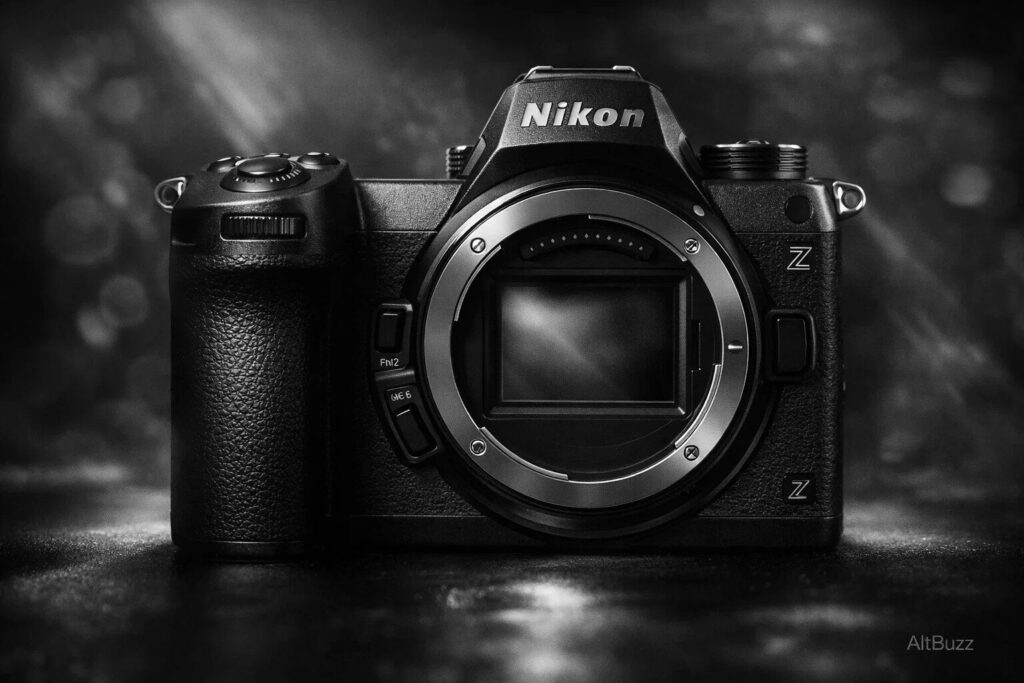
The build quality expected of the Nikon Z4 reflects its professional market ambitions directly. A magnesium alloy body with comprehensive weather sealing against dust and moisture is widely anticipated and would be essentially non-negotiable for working photographers operating in unpredictable conditions.
Ergonomically, the Nikon Z4 is expected to position itself above the Z6 III’s form factor. A deeper grip, a more pronounced thumb rest, and improved single-handed handling balance are all speculated based on feedback patterns from Z6 series users. The button layout is expected to offer more customization options, with additional function buttons accessible without menu navigation.
A top-plate LCD panel for quick settings confirmation without activating the main screen is expected. This detail distinguishes professional-grade cameras from consumer bodies and its inclusion on the Nikon Z4 would signal Nikon’s clear intention to target working photographers as the primary audience.
Joystick navigation for autofocus point selection remains a standard professional expectation. The dual card slot configuration with one CFexpress Type B and one SD card slot addresses the redundancy requirements of photographers working in professional contexts where file loss is not an acceptable outcome.
Battery and Connectivity Rumors for the Nikon Z4
The Nikon Z4’s power architecture is expected to build on the EN-EL15 battery family that has been central to Nikon’s professional and enthusiast lineup. An EN-EL15d variant with improved energy density is speculated. Compatibility with existing EN-EL15 batteries in the user’s kit while the newer variant delivers extended performance would be the ideal commercial scenario.
USB-C 3.2 Gen 2 connectivity would enable both high-speed tethered shooting for studio workflows and in-camera charging for location photographers. Gigabit Ethernet via USB-C adapter or a dedicated port is speculated for broadcast and studio integration. This level of connectivity aligns with the professional positioning that the Nikon Z4’s rumored specifications consistently suggest.
Wi-Fi 6 for rapid multi-file transfer in studio environments and Bluetooth 5.2 for persistent smartphone pairing and remote control are both expected. The combination of these connectivity features would make the Nikon Z4 a well-integrated tool in both studio production and field photography workflows.
Potential Real-World Use Cases for the Nikon Z4
The Nikon Z4’s rumored specification set suggests a camera of deliberate and extensive versatility across professional photography and videography disciplines.
Wedding and event photographers represent perhaps the most commercially significant target audience. The combination of 36 megapixels for large-print delivery, subject detection for reliable candid capture, dual card slots for file redundancy, and weather sealing for variable outdoor conditions addresses every primary requirement of a working wedding photographer in one body.
Commercial portrait and advertising photographers would value the resolution for retouching flexibility and the high-quality tethering capability for studio workflows. Dynamic range expected from the 36-megapixel sensor would also support the complex lighting scenarios common in commercial portraiture.
Documentary photographers and photojournalists who require files suitable for full-bleed editorial spreads at large circulation publications would find the balance of resolution and frame rate competitive with dedicated high-resolution alternatives at significantly higher price points.
Wildlife and nature photographers using the Nikon Z4 would benefit from the combination of improved tracking AF, 36 megapixels for cropping flexibility in post-production, and weather sealing for field conditions. The Z4 is not a dedicated wildlife camera but its balance of features serves that genre well.
Possible Pros and Cons Based on Rumors
Expected Advantages
- 36 megapixel resolution provides significant detail advantage over Z6 III for large-print and heavy-crop workflows
- Comprehensive subject detection AF system expected to match Z8 performance levels
- Professional build quality with magnesium alloy and weather sealing anticipated
- 4K 60fps uncropped rumored as baseline video output with 4K 120fps speculated
- Dual card slot configuration with CFexpress Type B and SD expected for professional redundancy
- N-Log advanced gamma profile and potential ProRes RAW output anticipated
- Top-plate LCD and professional button layout expected for enhanced on-set usability
- Positioned below Z7 III pricing while offering competitive resolution and feature set
Possible Limitations
- Stacked sensor architecture remains unconfirmed and may be absent at this price point
- 36 megapixel files generate substantially larger storage and post-production infrastructure demands
- 4K 120fps internal remains among the most speculative and unverified of the current rumors
- Final camera designation as Nikon Z4 is not confirmed and may change before announcement
- Rolling shutter characteristics without stacked sensor may disappoint action and video specialists
- All specifications are currently based on rumors and patent analysis without official confirmation
Final Thoughts on the Nikon Z4
The Nikon Z4, as constructed from available leaks and informed industry analysis, represents a strategically coherent and commercially ambitious addition to Nikon’s Z-mount professional lineup. It addresses a resolution tier that Sony has proven to be commercially receptive. It brings the AF intelligence developed through the Z8 and Z9 program to a price point accessible to a much wider professional audience. And its anticipated video capabilities would make it the most capable hybrid camera in its price bracket if the more aggressive rumors prove accurate.
The critical qualification throughout this analysis must be restated clearly. Nothing is confirmed. Nikon has not acknowledged the Nikon Z4’s existence. Every specification discussed here is derived from leaks, patent examination, and considered market logic. The final product, should it arrive, may differ significantly from what current rumors describe.
For professionals currently evaluating whether to upgrade or invest in a new system, the Nikon Z4 warrants patient and attentive monitoring. If it delivers on even the majority of what is currently being speculated, it will represent one of the more significant full-frame mirrorless value propositions in several years.
Read more from AltBuzz for camera rumors, leaked specs, and expert insights. AltBuzz delivers trusted and easy-to-understand photography content. Altbuzz
Stay updated with camera rumors and comparisons. AltBuzz shares latest camera content regularly. Subscribe Altbuzz