
Nikon Z5 II Rumors: Expected Specs, Features and Release
The Nikon Z5 II has not been officially announced yet. Nikon has confirmed nothing. No press release exists. No product page has gone live. However, the photography world is already paying very close attention to what is coming.
Leaks are surfacing. Patent filings are pointing in a clear direction. And Nikon’s own product history makes the Nikon Z5 II feel almost inevitable at this point. The evidence is building steadily, and the picture it paints is genuinely exciting for anyone shopping in the affordable full-frame mirrorless segment.
The original Nikon Z5 launched in 2020 and quickly became one of the most recommended entry points into the full-frame mirrorless world. It offered excellent image quality, a compact body, and a price that made full-frame accessible to a much wider audience. However, it also carried real limitations. The 4K video mode was heavily cropped. The autofocus system lacked the subject detection intelligence found in Nikon’s higher-end cameras. The processor was showing its age. Burst speeds were modest. Battery life was average.
The Nikon Z5 II is expected to address every single one of those weaknesses. Furthermore, it is expected to add new capabilities that the original Z5 never offered at all. If the rumors hold true, this will not feel like a minor refresh. It will feel like a genuinely new camera built on a stronger foundation.
So let us go through everything currently rumored about the Nikon Z5 II, section by section, in full detail.
Expected Release Date and Market Position
Where the Nikon Z5 II Fits in Nikon’s Lineup
Nikon has been working through a very deliberate and methodical refresh of its Z-series lineup over the past few years. The Z9 anchors the professional flagship position. The Z8 brought flagship-level performance into a smaller and more accessible body. The Z6 III introduced a partially stacked sensor at the mid-range professional level. The Z7 III serves resolution-hungry landscape and studio photographers.
The entry-level full-frame segment, however, has been waiting. The original Z5 has served that role for several years now. It has done so admirably. But the competitive landscape has shifted considerably since 2020. Sony launched the A7C II. Canon released the EOS R8 and continued developing the R6 Mark III. Both of those brands pushed affordable full-frame performance forward significantly. Nikon needs the Nikon Z5 II to respond with equal force.
When the Nikon Z5 II Could Arrive
Based on Nikon’s recent product launch cadence, most rumor sources point toward a possible announcement in late 2025 or the first quarter of 2026. Nikon has recently favored direct online reveal events for mid-range camera launches, sometimes paired with CP+ in February or other regional photography events.
Following a standard six to eight week pre-order and delivery window after announcement, the Nikon Z5 II could realistically reach customers by spring or early summer of 2026. That timeline makes strategic sense for Nikon. It would give the camera maximum visibility during the peak spring purchasing season.
Who the Nikon Z5 II Is Built For
The target audience for the Nikon Z5 II is straightforward and well-defined. Nikon is building this camera for photographers who want full-frame image quality without spending Z6 III money. That buyer typically comes from one of two places. Either they are stepping up from a crop-sensor camera and want full-frame for the first time. Or they are an existing Z5 user who is ready to upgrade and wants meaningful improvement over what they already own.
Additionally, the Nikon Z5 II targets hybrid shooters who want solid video alongside their photography. The original Z5 disappointed video users with its cropped 4K output. The Z5 II appears designed to win those users back with a significantly improved video feature set.
In terms of price, the Nikon Z5 II is expected to land between 1499 and 1799 dollars for the body only. That positioning would sit directly between the Canon EOS R8 and the Sony A7C II. It is a competitive bracket, but Nikon has the Z-mount lens ecosystem and the brand loyalty to compete effectively there.
Nikon Z5 II Rumored Specifications Table
| Feature | Rumored Details |
|---|---|
| Sensor Type | Full-frame BSI-CMOS |
| Resolution | Approximately 24.5 megapixels |
| Processor | EXPEED 7 |
| ISO Range | 100 to 51200, expandable to 204800 |
| Autofocus System | Subject detection AF with 3D tracking |
| Stabilization | 5-axis IBIS up to 6.0 stops |
| Video Recording | 4K 30fps uncropped and 1080p 120fps |
| EVF | 3.69 million dot OLED EVF |
| LCD Screen | 3.2-inch fully articulating touchscreen |
| Burst Shooting | Up to 14 fps with electronic shutter |
| Battery | EN-EL15c or compatible variant |
| Storage | Dual UHS-II SD card slots |
| Connectivity | Wi-Fi, Bluetooth, USB-C with charging |
| Weight | Approximately 675 grams |
| Expected Price | 1499 to 1799 USD |
Rumored Sensor and Image Quality of the Nikon Z5 II
The BSI-CMOS Upgrade and Why It Matters
The sensor upgrade in the Nikon Z5 II is one of the most talked-about elements in the entire rumor discussion. The original Z5 used a solid full-frame CMOS sensor, but it did not use back-side illuminated technology. That distinction matters more than many casual photographers realize.
BSI sensors place the light-collecting elements on the back side of the silicon wafer rather than the front. This design removes obstructions between the incoming light and the photodiodes. More photons reach the sensor. Less light gets wasted. The result is improved sensitivity, cleaner images at higher ISO values, and better overall tonal quality across the entire frame.
The Nikon Z5 II reportedly uses a full-frame BSI-CMOS sensor. That single change would already make it a meaningfully better imaging tool than the original Z5 in practical shooting conditions.
Resolution: Why 24.5 Megapixels Still Makes Sense
Resolution is rumored to sit at approximately 24.5 megapixels. At first glance, some photographers might want a higher number. However, 24.5 megapixels is an extremely well-balanced choice for this camera’s target market.
Files stay manageable in size. Storage demands remain reasonable. Editing performance stays smooth even on mid-range computers. At the same time, 24.5 megapixels produces excellent detail for large prints, tight crops, and high-resolution social media content. For portrait, travel, family, and street photography, this resolution hits the sweet spot cleanly.
Additionally, higher resolution sensors demand more from lenses to show their advantage. At 24.5 megapixels, even more affordable Z-mount lenses perform beautifully. That matters a great deal for entry-level buyers who are building their first full-frame kit on a budget.
Dynamic Range and Color Accuracy
Dynamic range from the Nikon Z5 II’s BSI sensor is expected to approach 14 stops at base ISO. That is competitive with every camera in its class. In practice, 14 stops of dynamic range means you can recover significantly more detail from both shadows and highlights during editing. High-contrast scenes like bright outdoor portraits or backlit landscapes become much more manageable to process.
Nikon’s color science has consistently produced natural, accurate, and pleasing results across its full-frame lineup. Skin tones come out warm and realistic. Landscape colors feel true to the scene rather than artificially boosted. The Nikon Z5 II is expected to carry this tradition forward without any compromise. In fact, the BSI sensor combined with the EXPEED 7 processor is expected to deliver even smoother color transitions and more refined tonal gradation than the original Z5 managed.
The EXPEED 7 Processor Changes Everything
Perhaps the single most impactful rumored specification for the Nikon Z5 II is the inclusion of the EXPEED 7 processor. This processor already powers the Z8 and Z9. It is Nikon’s most capable image processing engine. Bringing it down to the Z5 level would be a landmark development.
EXPEED 7 handles noise reduction more intelligently than EXPEED 6. It processes data from the sensor faster, enables the subject detection autofocus algorithms that have made the Z8 and Z9 so impressive. And it supports higher burst rates and faster buffer clearing. And it handles 4K video processing with significantly less strain, which is directly related to the improved video output expected from the Nikon Z5 II.
In short, EXPEED 7 transforms the Nikon Z5 II from a straightforward entry camera into a genuinely capable photographic tool that punches well above its price class.
Rumored Autofocus System in the Nikon Z5 II
The Original Z5’s Autofocus Limitation
The original Nikon Z5 used a competent phase-detect autofocus system. It focused reliably on stationary and slow-moving subjects. However, it lacked the subject detection intelligence that Nikon had already introduced in higher-end cameras. Eye AF was not available. Animal detection did not exist. Tracking fast-moving subjects at the edges of the frame was unreliable.
For photographers shooting active subjects, whether children, pets, birds, or athletes, the original Z5’s autofocus required more manual intervention than competing cameras at the time. That gap has only grown as Sony and Canon pushed subject detection performance forward aggressively.
Subject Detection: What the Nikon Z5 II Reportedly Brings
The Nikon Z5 II reportedly addresses this gap head-on by including full subject detection autofocus powered by EXPEED 7. This system automatically identifies and tracks human subjects with face and eye-level specificity. It also detects and tracks animals, covering both domestic pets and wildlife. Vehicle detection for cars and aircraft is also expected.
This capability changes the practical shooting experience dramatically. Instead of manually selecting an autofocus point and hoping it stays on your subject, the camera does the intelligent work automatically. You compose the frame. The camera handles focus. You concentrate entirely on timing and expression.
Eye AF and What It Does for Portrait Photographers
Eye AF is one of the most valuable autofocus features for portrait, family, and event photographers. When Eye AF is active, the camera searches for a human subject’s eye and locks focus onto it precisely. Even when a subject turns their head slightly or moves toward or away from the camera, Eye AF maintains focus on the eye rather than drifting to the nose, ear, or background.
The Nikon Z5 II is expected to support Eye AF in both photo mode and video mode. That dual-mode capability matters especially for hybrid shooters who move between photo and video capture throughout a session.
3D Tracking Across the Full Frame
3D tracking is another major expected upgrade over the original Z5. The Nikon Z5 II’s 3D tracking system reportedly operates across the full sensor width and height. This means the camera actively tracks a subject as it moves anywhere within the frame, not just within a central zone.
For sports sideline shooting, playground family sessions, and bird photography, full-frame 3D tracking is a practical game changer. Subjects that previously fell out of focus as they moved toward the frame edges now stay locked and sharp throughout their movement.
Burst Speed and AF Performance During Continuous Shooting
The Nikon Z5 II is expected to support burst shooting at up to 14 frames per second using the electronic shutter. At that speed, the camera needs to maintain accurate subject tracking frame after frame without losing lock or introducing motion blur from slow readout.
EXPEED 7’s processing speed makes this possible. The processor reads sensor data fast enough to update tracking calculations between every frame at 14fps. The result is a camera that keeps subjects sharp during fast action sequences in a way that the original Z5 simply could not manage.
Expected Video Capabilities of the Nikon Z5 II
The Biggest Problem with the Original Z5’s Video
Video was genuinely the weakest area of the original Nikon Z5. The camera could record 4K video but applied a significant crop when doing so. That crop narrowed the field of view noticeably compared to what the lens was designed to deliver. Wide-angle lenses suddenly behaved like standard lenses. Standard lenses felt like short telephoto lenses. For videographers used to full-frame coverage, this was deeply frustrating.
Furthermore, the cropped 4K output came with image quality limitations that reflected the processing constraints of EXPEED 6. Detail was acceptable but not exceptional. Noise at higher ISO values was more visible in video mode than in still images. The overall video experience left many users disappointed.
Uncropped 4K: The Most Important Video Upgrade
The Nikon Z5 II reportedly fixes the crop problem entirely. Uncropped 4K recording at 30 frames per second is widely rumored across multiple independent sources. This means the camera reads from the full width of the sensor when recording 4K video.
The practical consequences are significant. Your wide-angle lens delivers the wide perspective it was designed to provide. Your standard zoom covers its full focal length range. Depth of field renders naturally at full-frame proportions. The video output looks and feels like it came from a full-frame camera rather than a cropped approximation of one.
This single upgrade transforms the Nikon Z5 II’s appeal to videographers and hybrid shooters dramatically.
1080p Slow Motion at 120 Frames Per Second
Beyond uncropped 4K, the Nikon Z5 II reportedly adds 1080p recording at 120 frames per second. Slow-motion video at this frame rate opens up creative possibilities that the original Z5 never offered.
At 120fps captured and played back at 24fps, footage slows to one fifth of real-time speed. At playback at 30fps, the slow down factor is four times. Both settings deliver smooth, cinematic slow motion without the stuttering or judder that lower frame rates produce. Think about shooting a child blowing out birthday candles. A pet leaping through the air. A surfer riding a wave. All of these subjects benefit enormously from clean, smooth slow-motion capture.
For YouTube creators, wedding videographers, and short film makers working with a modest budget, 1080p 120fps is a highly practical and frequently used creative tool. The Nikon Z5 II is rumored to deliver it reliably.
N-Log and Flat Color Profiles for Video Creators
One of the most requested features for the Z5 was a log or flat color profile for video recording. The original Z5 offered limited flat profile options that gave video creators some post-processing latitude but fell short of what professional workflows demanded.
The Nikon Z5 II reportedly includes N-Log or an improved flat gamma profile for video. N-Log captures a wider dynamic range during recording by compressing the tonal information from the sensor into the video file. The footage looks flat and low-contrast directly out of the camera. However, during color grading in post-production, the editor can pull that compressed information back out and create rich, cinematic-looking results that standard color profiles simply cannot match.
For video content creators who take their work seriously, this capability is genuinely transformational at this price point.
Improved Heat Management for Longer Recording
Heat management is a practical concern that many reviews of the original Z5 overlooked at launch. Extended 4K recording sessions generated heat that limited continuous recording times. Users encountered time limits before the camera needed to cool down.
The Nikon Z5 II reportedly addresses this with improved internal thermal management. Better heat dissipation allows longer uninterrupted recording sessions. For event videographers, interview shooters, and documentary-style content creators who cannot afford to stop recording at inconvenient moments, this improvement carries real practical value.
HDMI Output and External Recording
Clean HDMI output for external recording is expected on the Nikon Z5 II. This allows users to connect an external recorder like an Atomos Ninja and capture higher-quality video files than the camera stores internally. For more serious video work, external recording extends the color depth and data rate of captured footage significantly.
Additionally, the HDMI connection enables live streaming directly from the camera to a computer or streaming device. Content creators who run live streams or deliver live event coverage can use the Nikon Z5 II as a dedicated streaming camera source without any additional software workaround.
Design and Build Expectations for the Nikon Z5 II
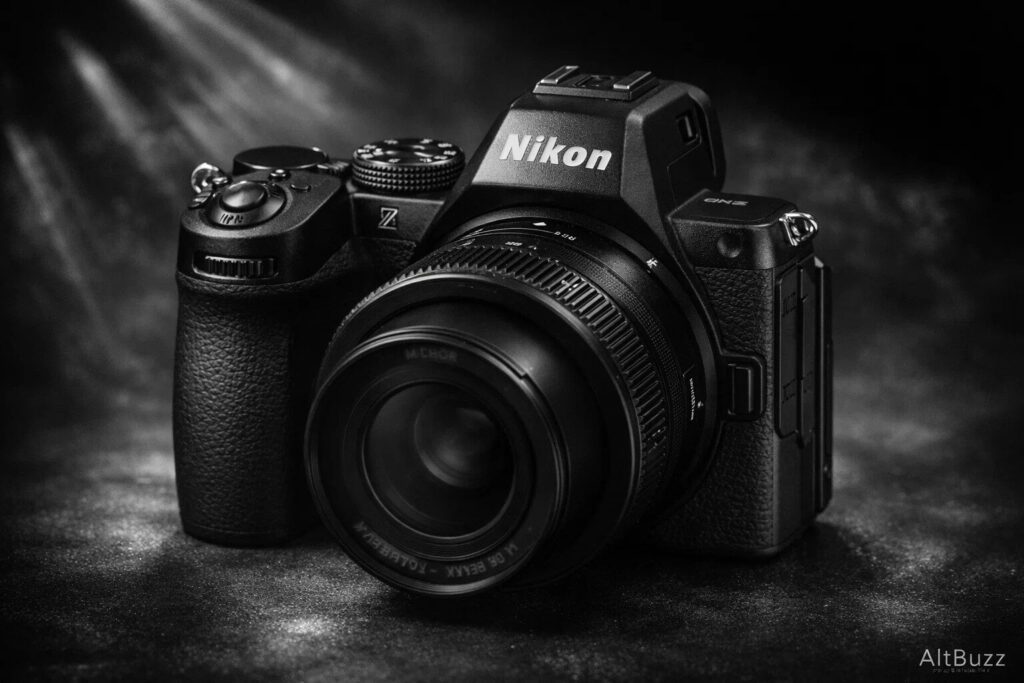
The Core Design Language Stays Familiar
The Nikon Z5 II is expected to maintain the clean, understated design language that defines the current Z-series lineup. Nikon has established a consistent visual identity across the Z5, Z6, and Z7 families. The Z5 II will almost certainly stay within that aesthetic rather than introducing a radical redesign.
That consistency is actually a selling point rather than a limitation. Existing Nikon DSLR users transitioning to mirrorless immediately feel comfortable with the control layout, the grip depth, and the button positioning. The learning curve stays low. Photographers spend less time searching for buttons and more time shooting.
Compact Body Size Retained
The original Z5 was notably compact for a full-frame mirrorless camera. That compactness made it practical for everyday carry, travel, and long shooting sessions where a heavier camera becomes physically tiring.
The Nikon Z5 II is expected to retain a similarly compact footprint. Weight is estimated at approximately 675 grams with battery and card. That figure positions it well below larger professional bodies while remaining substantial enough to balance comfortably with a range of Z-mount lenses. For photographers who prioritize mobility alongside image quality, this size and weight combination is genuinely appealing.
The Fully Articulating Screen Upgrade
The original Nikon Z5 used a tilting screen that flipped up and down on a single axis. It was practical for vertical angle adjustments but could not rotate outward for front-facing use. That limitation frustrated vloggers, solo content creators, and photographers who needed to see themselves in frame while shooting.
The Nikon Z5 II is rumored to feature a fully articulating touchscreen. This design allows the screen to swing out sideways and rotate fully forward. The result is that the screen works for overhead shots looking down, low-angle shots looking up, eye-level shooting in portrait orientation, and front-facing self-recording for video content.
For content creators who shoot alone regularly, this upgrade alone justifies serious interest in the Nikon Z5 II over the original.
Weather Sealing Stays In
Weather sealing was one of the original Z5’s strongest selling points relative to competitors at its launch price. The camera offered dust and moisture resistance that many rival cameras at similar prices did not provide.
The Nikon Z5 II is widely expected to retain comprehensive weather sealing. Photographers who shoot outdoors in variable conditions, attend events in unpredictable weather, or simply want a camera that handles real-world use without stress will find this reassuring. Weather sealing does not mean the camera is waterproof, but it does mean light rain, dust, and splashes from outdoor environments will not cause damage.
Button Layout and Control Refinements
Beyond the major design elements, the Nikon Z5 II is expected to introduce small but meaningful control refinements based on years of Z5 user feedback. Improved button tactile feedback, better differentiation between closely positioned buttons, and additional customizable function buttons are all anticipated.
A more accessible video record button placement is also speculated. The original Z5’s video button position required some users to shift their grip slightly to reach it comfortably. Moving it to a more natural position would improve the shooting experience for hybrid users who switch between photo and video frequently throughout a session.
Connectivity Rumors for the Nikon Z5 II
Battery Life and the EN-EL15 Family
Battery performance is a practical concern for photographers who shoot all day without reliable access to power outlets. The Nikon Z5 II is expected to use an EN-EL15c battery or a closely compatible variant. This is excellent news for existing Nikon users who have already accumulated EN-EL15 batteries from previous cameras. Those batteries will work in the Z5 II, extending shooting time without any additional investment.
Battery life from the EN-EL15c in the Z5 II is rumored at approximately 360 shots per charge under standard shooting conditions. That figure represents a meaningful improvement over the original Z5. Additionally, the improvement comes despite the Z5 II’s more powerful processor and higher-resolution sensor, both of which demand more energy per frame. Nikon’s power management engineering is apparently efficient enough to deliver better battery life even with more capable hardware running underneath.
USB-C Charging: A Long-Overdue Addition
USB-C charging is expected to arrive with the Nikon Z5 II. This feature has been conspicuously absent from some Nikon bodies and its inclusion here would bring the camera in line with what photographers now expect as standard.
USB-C charging means you can top up the battery from a laptop, a standard USB-C power adapter, or a portable power bank. During a long travel day, you can charge the camera in an airport lounge using the same cable you use for your phone. On an outdoor shoot, a compact power bank in your bag can extend shooting time significantly. These are small but genuinely useful quality-of-life improvements.
Wi-Fi, Bluetooth, and the SnapBridge Experience
The Nikon Z5 II is expected to include both Wi-Fi and Bluetooth connectivity. Together, these two technologies power Nikon’s SnapBridge application, which runs on iOS and Android devices and connects your smartphone to the camera wirelessly.
Through SnapBridge, you can transfer images from the camera to your phone automatically in the background as you shoot. You can share photos to social media directly from the field without needing a computer. You can remotely control the camera from your phone, setting exposure, triggering the shutter, and composing from a distance using the phone as a live view screen.
Bluetooth maintains a persistent low-power connection between the camera and phone even when Wi-Fi is not active. This allows the camera to sync its internal clock with the phone automatically and to receive GPS location data from the phone for geotagging images without requiring a dedicated GPS chip in the camera body.
Dual Card Slots for Reliability
The Nikon Z5 II is expected to include dual UHS-II SD card slots. This is a significant practical advantage over single-slot cameras. Using dual slots, you can configure the camera in several useful ways.
You can set the second slot as an automatic backup, with every image written simultaneously to both cards. This gives you redundancy against card failure, which matters most for wedding photographers and event shooters where missing critical moments is not an option. Alternatively, you can use the second slot for overflow storage, switching automatically when the first card fills. Or you can use the slots to separate RAW files and JPEG files, sending each format to its own dedicated card for easier organization later.
Dual card slots also mean you can carry twice the total storage capacity without needing to pause and swap cards during a session.
Potential Real-World Use Cases for the Nikon Z5 II
Portrait and Family Photography
Portrait and family photography represent perhaps the strongest natural fit for the Nikon Z5 II. The full-frame BSI sensor delivers the natural background separation that makes portrait photography visually compelling. Subject faces stay sharp and detailed. Backgrounds render as smooth, creamy blur that directs attention to the subject effectively.
Subject detection AF with Eye AF makes capturing sharp portraits of moving children dramatically more reliable than it was with the original Z5. Children run, turn, laugh, and jump constantly. The Nikon Z5 II’s tracking system follows them throughout all of that movement and keeps eyes sharp. More keeper images per session. Less frustration. More creative confidence.
Travel Photography
Travel photography demands versatility above almost everything else. You encounter landscapes, architecture, street scenes, food, and people all within the same afternoon. You need a camera that handles all of those subjects well without requiring you to carry excessive equipment.
The Nikon Z5 II fits this role naturally. Its compact body stays comfortable during long days of walking. The full-frame sensor handles the dramatic lighting changes between indoor and outdoor shooting without constant manual intervention. The weather sealing provides confidence in unpredictable conditions. The Wi-Fi connectivity lets you share images quickly when internet access is available.
Paired with a versatile zoom like the Nikkor Z 24-120mm f4 or the compact Nikkor Z 28-75mm f2.8, the Nikon Z5 II becomes an extremely capable and relatively light travel kit.
Wedding and Event Photography
Wedding photographers have demanding requirements. They need reliable autofocus in low-light church interiors, dynamic range to handle bright outdoor receptions without blowing highlights. Also they need dual card slots for file redundancy on irreplaceable moments. And they need good battery life across a twelve-hour shooting day.
The Nikon Z5 II reportedly addresses every one of those needs. Subject detection keeps faces sharp during first looks, processionals, and candid receptions without requiring constant manual AF adjustment. Dynamic range from the BSI sensor handles the harsh mixed lighting typical of reception venues. Dual card slots provide redundancy. USB-C charging lets photographers top up between ceremony and reception using a portable charger.
For second shooters or photographers building their first professional kit on a budget, the Nikon Z5 II appears to be an excellent entry into working wedding photography.
Content Creation and Vlogging
Content creators who produce YouTube videos, Instagram Reels, or short-form social content will find the Nikon Z5 II’s video upgrades genuinely useful. The fully articulating screen solves the front-facing monitoring problem that the original Z5 could not address. The uncropped 4K output delivers full-frame video quality that looks cinematic and professional.
N-Log gives creators who take their color grading seriously much more flexibility in post-production. 1080p 120fps adds slow-motion capability for visual variety. USB-C charging keeps the camera powered through marathon recording sessions. And the camera’s compact size means it pairs well with compact gimbals and lightweight travel tripods without adding unmanageable weight to a portable content creation kit.
Wildlife and Nature Photography
Wildlife photographers on a budget will also find the Nikon Z5 II interesting. Subject detection for animals is expected to cover both pets and wild species. 3D tracking across the full frame keeps birds and mammals in focus as they move unpredictably through the environment. 14fps burst shooting captures multiple frames through fast action sequences to maximize the chance of getting the decisive moment.
Weather sealing matters significantly for outdoor wildlife work. Shooting in rain, mist, or dusty conditions is a routine part of wildlife photography. The Z5 II’s sealing provides meaningful protection without adding the weight and bulk of a dedicated professional wildlife body.
Possible Pros and Cons Based on Rumors
Expected Advantages of the Nikon Z5 II
- Full-frame BSI-CMOS sensor reportedly delivers significantly improved low-light performance over the original Z5
- EXPEED 7 processor rumored to bring flagship-level processing power to an entry-level price point
- Subject detection AF with Eye AF and 3D tracking speculated to cover people, animals, and vehicles across the full frame
- Uncropped 4K 30fps reportedly fixes the most significant limitation of the original Z5’s video output
- 1080p 120fps slow-motion recording rumored for cinematic creative flexibility
- N-Log or flat color profile expected for serious video color grading workflows
- Fully articulating touchscreen rumored, replacing the original Z5’s more limited tilting screen
- Dual UHS-II SD card slots expected for professional redundancy and flexible storage management
- USB-C charging anticipated for practical travel and field use
- Weather sealing expected to be retained from the original Z5
- EN-EL15 battery compatibility likely maintained, benefiting existing Nikon users
- Compact body size anticipated for comfortable everyday carry and travel
Possible Limitations of the Nikon Z5 II
- No CFexpress Type B slot expected, which limits future-proofing compared to higher-tier Z-series bodies
- 14fps burst speed with electronic shutter is solid but does not match the Z6 III’s higher performance ceiling
- No ProRes or Cinema RAW video recording expected at this price point
- Video overheating limits may be improved but perhaps not entirely eliminated
- 24.5 megapixels satisfies most users but may disappoint photographers who specifically want higher resolution for large-format printing or heavy cropping
- All specifications remain unconfirmed and are based entirely on leaks and industry speculation until Nikon makes an official announcement
Final Thoughts on the Nikon Z5 II
The Nikon Z5 II, based on everything currently rumored, looks like a very significant step forward from the original Z5. It does not try to compete with the Z6 III on every specification. Instead, it focuses clearly on delivering the improvements that matter most to its target audience. Better autofocus, better video, sensor technology and better connectivity. A more versatile screen. All wrapped in the same compact, weather-sealed body that made the original Z5 so appealing.
For photographers currently using the original Z5, the rumored upgrades make a compelling case for upgrading. The AF system alone would change the practical shooting experience meaningfully. Combined with the video improvements, the case becomes very strong.
For first-time full-frame buyers, the Nikon Z5 II appears to sit right at the intersection of capability and value. You get EXPEED 7 intelligence, full-frame image quality, uncropped 4K video, and a camera that handles real-world conditions reliably. All at a price that does not require a professional budget to justify.
As always, patience is the smart strategy right now. Nikon has not confirmed a single detail about the Nikon Z5 II officially. Every specification discussed here comes from leaks, patent analysis, and informed industry speculation. The final camera may differ from what rumors currently describe.
However, the direction is clear. And it points toward something genuinely worth waiting for.
Read more from AltBuzz for camera rumors, leaked specs, and expert insights. AltBuzz delivers trusted and easy-to-understand photography content. Altbuzz
Stay updated with camera rumors and comparisons. AltBuzz shares latest camera content regularly. Subscribe Altbuzz