
Nikon Z90 Full Rumor Preview: Specs, Release Date, and Everything You Need to Know
The Nikon Z90 has become one of the most discussed camera rumors in the mirrorless photography community over the past several months. Rumored to be Nikon’s most ambitious APS-C mirrorless body ever produced, the Nikon Z90 is expected to challenge Sony, Canon, and Fujifilm simultaneously in the premium crop-sensor camera segment.
Nikon has not officially confirmed the Nikon Z90 exists. No release date has been scheduled publicly. No official specifications have been shared. Everything in this article is drawn from leaks, patent filings, retailer movements, and careful industry analysis that experienced camera watchers use to anticipate upcoming releases.
That said, the consistency, detail, and frequency of available leaks suggest Nikon is actively developing a camera that closely matches the description circulating in rumor communities. Here is a comprehensive breakdown of everything worth knowing about the Nikon Z90 based on what credible sources have revealed so far.
Why the Nikon Z90 Matters to the Photography World
The Gap Nikon Needs to Fill
The APS-C mirrorless market has been dominated by Sony and Fujifilm for several years. Sony’s a6700 sets the benchmark for autofocus and video capability in the crop-sensor segment. Fujifilm’s X-T5 leads on resolution and image quality. Canon’s EOS R7 delivers fast burst speeds with reliable weather sealing at a competitive price.
Nikon has been largely absent from this conversation at the enthusiast and semi-professional level. The Z50 II and Z30 serve entry-level buyers well, but neither camera competes seriously with the a6700 or X-T5 for demanding photographers who want the best possible performance from an APS-C system.
What the Nikon Z90 Could Change
The Nikon Z90 is expected to change this situation directly. Based on rumors, Nikon is not building a modest update. The company appears to be developing a genuine flagship APS-C body that takes direct aim at the best the competition currently offers.
For Nikon shooters who have been waiting for a compelling reason to stay in the ecosystem rather than switching to Sony or Fujifilm, the Nikon Z90 could be exactly that reason. Beyond Nikon users, the Nikon Z90 matters to the broader camera market because a strong new entrant at the top of the APS-C segment forces all competitors to respond. Photographers of all brands ultimately benefit when competition drives innovation.
Nikon Z90 Rumored Release Date and Launch Strategy
When Is the Nikon Z90 Expected to Arrive
The most commonly cited timeline for the Nikon Z90 points to a 2025 announcement. Some sources are more specific, suggesting a first-half 2025 reveal, potentially at CP+ in February or during a targeted Nikon media briefing ahead of the summer season.
Nikon has been executing an aggressive product release schedule since the Z9 launched in late 2021. The Z8 arrived in 2023 as a more compact and accessible version of the Z9’s capabilities. The Z6 III followed with a partially stacked sensor design that improved readout speed over its predecessor. The Z50 II updated Nikon’s entry-level APS-C offering. The Nikon Z90 would represent the natural next step in this progression, filling the significant gap between the enthusiast Z50 II and the professional full-frame Z8.
Signs That a Launch Is Coming
Retailer activity in certain markets has reportedly shown signs consistent with preparation for a new camera announcement in the APS-C segment. Specific accessories compatible with rumored Nikon Z90 specifications have been referenced in supplier documentation seen by rumor communities. None of this constitutes official confirmation, but the pattern is consistent with a real product nearing announcement.
The timing also aligns strategically with the competitive landscape. Sony’s a6700 has been on sale since mid-2023. By the time the Nikon Z90 potentially launches in mid-2025, the a6700 will be approaching two years old. Nikon would be launching a next-generation product against a camera that is aging relative to new technology, which improves the competitive positioning considerably.
How the Nikon Z90 Positions in Nikon’s Lineup and Against Rivals
Where It Sits Inside Nikon’s Own Range
The Nikon Z90 is expected to sit clearly above the Z50 II in Nikon’s APS-C lineup. The Z50 II serves enthusiast photographers who want solid image quality in a compact body. The Nikon Z90 is rumored to target a significantly more demanding audience with professional-grade specifications.
Within Nikon’s full lineup, the Nikon Z90 would position below the Z8 in terms of full-frame versus APS-C sensor size but potentially match or approach it on burst speed, autofocus capability, and video features. For photographers who primarily use longer telephoto lenses and appreciate the additional reach that the APS-C crop factor provides, the Nikon Z90 could actually be preferable to the Z8 for specific use cases like wildlife and sports.
How It Compares to External Rivals
Against external rivals, the competitive picture is more nuanced. The Sony a6700 leads on autofocus confidence and has a proven two-year track record in the market. The Nikon Z90 needs to match this benchmark to be taken seriously. The Fujifilm X-T5 leads on resolution at 40 MP, but the Nikon Z90 at a rumored 45 MP would surpass it. The Canon EOS R7 offers strong burst speed and weather sealing at a lower price point, but the Nikon Z90 is expected to exceed it on resolution, video capability, and autofocus depth.
Nikon Z90 Rumored Specifications Table
| Feature | Expected Details |
|---|---|
| Sensor Type | APS-C BSI Stacked CMOS — Rumored |
| Resolution | Approx. 45 MP — Rumored |
| Processor | EXPEED 7 or next-generation variant — Expected |
| ISO Range | 100 to 64000 expandable — Rumored |
| Autofocus System | Multi-subject AI detection with deep learning — Expected |
| Stabilization | 6-axis in-body VR — Rumored |
| Video Recording | 4K 120fps with N-RAW internal — Rumored |
| EVF | 5.76M-dot OLED at 0.8x magnification — Rumored |
| LCD Screen | 3.2-inch fully articulating at 2.1M-dot — Expected |
| Burst Shooting | Up to 30 fps electronic — Rumored |
| Battery | EN-EL15c — Expected |
| Storage | Dual CFexpress Type B plus SD — Rumored |
| Connectivity | USB-C 3.2, HDMI 2.1, Wi-Fi 6, Bluetooth 5.3 — Expected |
| Weight | Approx. 660g — Estimated |
| Expected Price | $2,500 to $3,000 USD — Estimated |
All specifications listed above are based entirely on rumors and leaks. Nikon has not confirmed any of these details. Actual specifications may differ when the Nikon Z90 is officially announced.
Nikon Z90 Autofocus: Closing the Gap with Sony Once and For All
The History of Nikon AF in the Mirrorless Era
Autofocus capability has been the most frequently cited reason photographers chose Sony over Nikon in the mirrorless era. The Z9 began to change this narrative with its deep-learning subject detection system. The Z8 brought similar AF performance to a smaller and more affordable body. The Nikon Z90 is expected to bring this same level of AF capability to the APS-C segment for the very first time.
What the Rumored AI System Can Do
The rumored AF system for the Nikon Z90 is based on the same deep-learning architecture that powers Nikon’s current flagship cameras. Subject recognition covering humans, animals, birds, insects, vehicles, and aircraft is widely expected. The breadth of subject types matters for wildlife and sports photographers who encounter unpredictable scenes where multiple subject categories may appear simultaneously.
For wildlife photographers specifically, bird AF is one of the most demanding tests of any autofocus system. Birds in flight change direction rapidly, disappear behind foliage, and vary enormously in size and coloring. A system that can track birds reliably is generally capable of handling nearly any other fast-moving subject effectively. Nikon’s bird AF improvements in recent cameras have been significant, and the Nikon Z90 is expected to push this even further.
Low-Light AF and Subject Switching Intelligence
Low-light autofocus performance deserves separate attention. The rumored stacked sensor architecture in the Nikon Z90 provides faster sensor readout, which directly supports AF tracking in low-contrast and low-light conditions. Faster readout means the AF system receives updated data more frequently, allowing it to calculate subject position changes with greater accuracy.
The Nikon Z90 is also expected to inherit Nikon’s subject switching intelligence from the Z9 generation. When multiple subjects are present in a frame, the camera can intelligently prioritize based on contextual cues rather than simply tracking the nearest or largest subject. This contextual AF decision-making is particularly valuable for sports and event photography where scenes are complex and subject priority changes rapidly.
Burst Speed and High-Speed Performance: The Nikon Z90 in Action
Understanding What 30fps Really Means
A rumored 30 fps electronic burst rate would place the Nikon Z90 among the fastest APS-C cameras ever built. For comparison, the Sony a6700 tops out at 11 fps with mechanical shutter and 22 fps in electronic shutter mode. The Canon EOS R7 reaches 30 fps electronic but with a much lower resolution sensor. The Nikon Z90 at 30 fps with a rumored 45 MP sensor would offer the highest combination of resolution and burst speed in the entire APS-C segment.
Pre-Capture Technology and What It Means for Photographers
Pre-capture buffer functionality, similar to Nikon’s implementation in the Z9, is also rumored for the Nikon Z90. Pre-capture begins recording frames to a buffer before the shutter button is fully pressed. When the photographer completes the press, the camera saves frames from both before and after the trigger point. This effectively eliminates the reaction time delay between seeing an action and capturing it.
For wildlife photographers waiting for a precise moment like a predator striking or a bird landing, pre-capture is genuinely transformative technology. It changes the relationship between the photographer and the unpredictable subject in a fundamental way.
Storage and Buffer Depth Considerations
The data demands of 30 fps at 45 MP are substantial. Each full-resolution RAW file at 45 MP is estimated at around 90 to 100 megabytes. At 30 fps, that generates approximately 2.7 to 3 gigabytes of data per second during sustained burst shooting. The rumored dual CFexpress Type B card slots address this challenge directly. CFexpress Type B is currently the fastest commercially available camera card standard, with write speeds exceeding 1600 MB/s in current card generations.
Buffer depth at maximum burst rate will be an important real-world metric once the Nikon Z90 is officially tested. A camera that sustains 30 fps for only two seconds before slowing is far less useful than one that maintains it for eight to ten seconds. Nikon’s processor efficiency in this area will be closely scrutinized when the Nikon Z90 reaches reviewers.
Video Capabilities: The Nikon Z90 as a Serious Production Tool
Internal N-RAW at 4K 120fps: Why It Matters
The Nikon Z90 video rumors represent a potentially landmark moment for APS-C video capabilities. Internal N-RAW recording at 4K 120fps would be genuinely exceptional. No current mainstream APS-C camera offers internal RAW video recording at this frame rate. The Nikon Z90 could establish a new standard for what is achievable in the crop-sensor video segment.
N-RAW is Nikon’s proprietary compressed RAW video format. It was introduced with the Z9 and has been praised by colorists for offering high image quality with more manageable file sizes compared to uncompressed RAW formats. N-RAW files carry far more tonal information than conventional compressed video formats, giving editors significantly more latitude during color correction and grading.
N-Log, Dynamic Range, and Color Science
N-Log color profile support is expected across all major recording modes on the Nikon Z90. N-Log is Nikon’s log gamma profile designed to maximize dynamic range captured in video footage. When shooting in N-Log, footage appears flat and desaturated but contains approximately 12 stops of dynamic range. Colorists can then apply a LUT or perform custom grading to extract a finished look that retains detail across the full tonal range of the scene.
The combination of N-RAW and N-Log on the Nikon Z90 would make it a camera that documentary filmmakers, commercial directors, and serious hybrid shooters could consider as a primary production tool. This repositioning is significant for Nikon and represents a clear statement of intent about where the company sees the Nikon Z90 sitting in professional workflows.
Slow Motion and Practical Applications
4K at 120fps specifically enables slow-motion capture that retains full 4K resolution. Wildlife videographers capturing fast animal movement benefit from the ability to analyze and present footage at reduced speed without the resolution penalty of 1080p alternatives. Sports videographers creating broadcast-quality slow-motion replays need the combination of resolution and frame rate that 4K 120fps provides. Commercial directors shooting high-speed product footage rely on this capability for visual impact.
Overheating: The Unanswered Question
Overheating management at sustained high frame rates remains one of the most important and least addressed questions in current Nikon Z90 rumors. Stacked sensor cameras generally generate more heat during operation because of the additional circuit layers involved in their construction. How Nikon engineers thermal management on the Nikon Z90 will be critical, particularly for video professionals who need to record for extended periods at maximum settings. This will be one of the first things reviewers test when hands-on access becomes available.
Resolution and Image Quality: What 45 Megapixels on APS-C Really Means
The Resolution Advantage in Real Shooting Scenarios
Forty-five megapixels on an APS-C sensor would be the highest resolution ever achieved in a mainstream crop-sensor mirrorless camera. The practical implications of this resolution advantage are significant and vary considerably depending on photographic discipline.
Landscape photographers working with wide-angle lenses would gain exceptional fine-detail rendering. When photographing mountain ranges, coastal scenes, or architectural subjects where minute texture and sharpness across the entire frame matter, 45 MP provides a meaningful advantage over current 26 or 33 MP alternatives. Large format printing becomes viable at sizes where lower-resolution cameras begin to show softness.
What High Resolution Means for Wildlife Photographers
Wildlife photographers who regularly crop their images for framing improvements would find 45 MP enormously liberating. Photographing a bird at 400mm on an APS-C body already provides a full-frame equivalent field of view of approximately 600mm. Cropping to 50 percent of frame area still leaves over 22 MP of resolution, enough for publication-quality prints and digital presentation at any size. This cropping flexibility effectively extends the telephoto reach of existing lenses without any optical investment.
Sensor Architecture and Dynamic Range
The stacked BSI CMOS architecture rumored for the Nikon Z90 adds an important dimension beyond raw pixel count. Stacked sensor designs read out data faster than conventional BSI CMOS sensors because the image capture layer is electronically bonded to a separate DRAM buffer layer. This faster readout reduces rolling shutter distortion when shooting moving subjects in electronic shutter mode.
Dynamic range at base ISO is expected to be competitive with the best APS-C sensors currently available. The BSI stacked architecture should allow the Nikon Z90 to capture around 14 stops of dynamic range at low ISO settings. This performance matters for landscape photographers shooting high-contrast scenes and for any photographer who needs maximum shadow and highlight recovery flexibility during post-processing.
Low-Light Performance Expectations
Low-light performance will not match full-frame cameras at equivalent pixel sizes, but meaningful improvements over current Nikon APS-C bodies are widely anticipated. The rumored ISO range extending to 64000 with expansion options suggests Nikon has invested heavily in noise management for the Nikon Z90 sensor and processor combination. Indoor event photographers, astrophotographers, and documentary shooters working in available light conditions will find this particularly relevant.
Build Quality, Weather Sealing, and Design of the Nikon Z90
Body Construction and Professional Durability
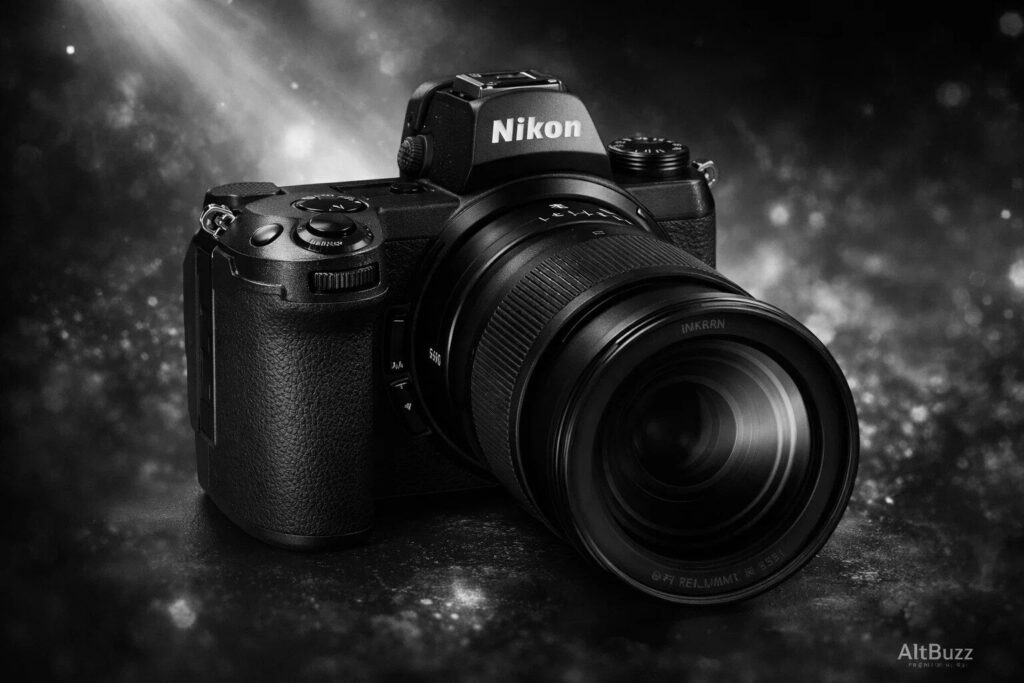
The Nikon Z90 is consistently described in rumor sources as a significantly more professional body than any current Nikon APS-C camera. The Z30 and Z50 series use primarily plastic construction with limited environmental sealing. The Nikon Z90 is expected to feature magnesium alloy construction with comprehensive dust and moisture resistance.
Weather sealing is not just about rain protection. It covers dust infiltration in dry sandy environments, condensation management when moving between temperature extremes, and resistance to the physical rigors of professional field use. Wildlife photographers who wade through wetlands, sports photographers covering outdoor events in rain, and travel photographers working in desert or tropical environments all depend on genuine weather sealing to protect equipment representing significant financial investment.
The EVF: A Class-Leading Viewfinder
The rumored EVF specification for the Nikon Z90 deserves particular attention. A 5.76-million-dot OLED viewfinder at 0.8x magnification would rank among the best optical viewfinder experiences available in any camera at any price point. For photographers who prefer eye-level shooting, a high-resolution EVF with accurate color rendering and fast refresh rate is not a luxury. It is a fundamental tool for precise framing, critical focus assessment, and natural shooting ergonomics.
High magnification matters specifically for manual focus users and photographers who need to judge fine detail like eye sharpness in portrait work or feather detail in bird photography. The 0.8x magnification rumored for the Nikon Z90 would make the viewfinder experience noticeably more immersive and precise than the smaller viewfinders found in most APS-C cameras.
The Articulating Screen and Its Creative Benefits
The fully articulating rear screen expected on the Nikon Z90 expands shooting flexibility across multiple photography genres. Ground-level wildlife photography becomes more practical when the screen rotates to face upward from a low camera position. Overhead content creation benefits from the ability to see what the camera sees from above without guesswork. Traditional eye-level shooting works naturally with the screen folded flat against the body.
The combination of a world-class EVF and a fully articulating screen on the Nikon Z90 would give photographers complete flexibility regardless of shooting position or style. Very few cameras at any price point offer both a top-tier EVF and a fully articulating screen simultaneously. If the Nikon Z90 delivers on both rumored specifications, it fills a gap that currently forces photographers to choose between these two important features.
Size, Weight, and the Trade-Off Discussion
Body dimensions have not been definitively confirmed in rumors, but the estimated 660g weight suggests a body notably larger and heavier than APS-C competitors like the Sony a6700 at around 493g or the Canon EOS R7 at 530g. The additional weight likely reflects the more robust build quality, larger battery, and dual card slot infrastructure.
Whether this trade-off is acceptable depends entirely on individual shooting priorities. A wildlife photographer who values durability, battery life, and card redundancy will accept the additional weight readily. A travel photographer prioritizing portability above all else may find the weight challenging. The Nikon Z90 is clearly not designed to be the lightest option in its class. It is designed to be the most capable.
Battery Life and Connectivity: Professional Grade Performance
EN-EL15c: The Right Battery Choice
The EN-EL15c is one of the most capable batteries in Nikon’s lineup. It powers the Z8, Z6 III, and Z7 III and has established a strong reputation for reliable capacity across extended shooting sessions. Choosing this battery for the Nikon Z90 makes sense both technically and commercially, as it allows existing Nikon users to leverage batteries they already own.
Battery life expectations for the Nikon Z90 are closely tied to how heavily its most demanding features are used. Continuous 30 fps burst shooting with active subject tracking and the high-resolution EVF active simultaneously will drain the battery significantly faster than casual shooting in single-frame mode. Real-world battery life figures will be an important benchmark once reviewers have hands-on access to the Nikon Z90.
Wireless and Wired Connectivity Breakdown
Wi-Fi 6 provides faster file transfer speeds and more reliable connections in crowded wireless environments compared to older Wi-Fi standards. Photography studios, sports arenas, and event venues often have congested wireless networks. Wi-Fi 6’s improved channel management handles these environments more effectively, which matters for photographers who rely on wireless tethering or FTP file transfer during professional assignments.
Bluetooth 5.3 improves pairing stability and reduces latency for accessories like wireless remote controls and mobile device connections. The practical benefit is more reliable remote triggering during wildlife photography from a hide and smoother mobile app control during studio work.
Professional Output Ports and Tethered Shooting
HDMI 2.1 output on the Nikon Z90 supports external recording at high bandwidth. Professional videographers who use external recorders like the Atomos Ninja or Blackmagic Video Assist rely on clean, high-bandwidth HDMI output for the best possible recorded quality. HDMI 2.1 ensures the Nikon Z90 can feed full-resolution, high-frame-rate signals to these devices without bottlenecking the output.
USB-C 3.2 enables tethered shooting at speeds fast enough for a comfortable studio photography workflow. Sending 45 MP RAW files to a tethered computer in real time requires substantial bandwidth, and USB-C 3.2 delivers this reliably. The same port handles power delivery for charging during extended sessions, reducing the logistical complexity of power management on location.
Who Is the Nikon Z90 Actually Built For
Wildlife and Bird Photographers
Wildlife and bird photographers represent the most natural primary audience for the Nikon Z90. The combination of 30 fps burst speed, pre-capture buffer, AI subject detection including dedicated bird recognition, 45 MP resolution for maximum crop flexibility, and APS-C crop factor for additional telephoto reach creates a specification that is almost ideally suited to this genre.
A wildlife photographer with a 500mm lens on the Nikon Z90 effectively commands the equivalent of 750mm full-frame reach combined with the best burst speed and autofocus available in the crop-sensor segment. This pairing is genuinely compelling and difficult to match at a comparable price point.
Sports and Action Photographers
Sports photographers covering outdoor events, school athletics, and action sports would find the Nikon Z90 highly relevant. The expected weather sealing handles outdoor conditions reliably. The 30 fps burst captures peak action without depending on perfect timing. The AI tracking AF manages complex multi-athlete scenes across different lighting conditions. The 45 MP resolution provides editorial crop flexibility when precise framing in the moment is not always possible.
Serious Enthusiasts and Hybrid Shooters
Serious enthusiast photographers who want professional-grade capabilities without the cost and weight of a full-frame system represent another important segment. The Nikon Z90 at an estimated $2,500 to $3,000 is considerably less expensive than a Z8. For photographers who primarily shoot in conditions where APS-C size is not a limiting factor, the Nikon Z90 could represent exceptional value against the capabilities on offer.
Hybrid photographers who balance still photography with serious video work would find the expected Nikon Z90 video capabilities compelling as a complement to their still shooting. The combination of 45 MP stills and 4K 120fps N-RAW video in a single body reduces the need for a separate dedicated video camera, which simplifies kit and reduces overall investment.
Nikon Z90 Pros and Cons Based on Rumors
Expected Advantages
- 45 MP resolution with stacked sensor sets a new APS-C benchmark that no current rival matches
- 30 fps burst with pre-capture expected to lead the entire crop-sensor performance segment
- 4K 120fps with internal N-RAW recording is genuinely exceptional for any APS-C camera
- 6-axis in-body VR expected to stabilize both high-resolution stills and demanding video recording
- Class-leading 5.76M-dot OLED EVF expected based on current leaks
- EN-EL15c battery is compatible with existing Nikon Z-series gear, reducing additional investment for current users
- Dual CFexpress Type B plus SD provides professional-grade storage flexibility and backup recording capability
- Rumored weather-sealed magnesium alloy build suits demanding professional field use
- Wi-Fi 6 and Bluetooth 5.3 support modern professional wireless workflows
Expected Disadvantages
- Estimated $2,500 to $3,000 price point is high for an APS-C camera and may limit audience
- 660g estimated weight exceeds most APS-C competitors and may discourage travel-focused photographers
- Nikon’s APS-C native lens selection remains thinner than Sony’s E-mount ecosystem
- Overheating performance at sustained 4K 120fps is an unresolved and important question
- Full-frame adapters add size and weight, partially undermining the APS-C compact advantage
- All specifications remain entirely unconfirmed as of writing and may change before official announcement
Final Expectation Verdict: Is the Nikon Z90 a Game-Changer
The Strengths of the Rumored Package
Based on the totality of available rumors and the context of the current camera market, the Nikon Z90 has genuine potential to be a landmark camera for Nikon and for the APS-C segment as a whole. The combination of 45 MP resolution, 30 fps burst, 4K 120fps N-RAW video, and AI autofocus inherited from Nikon’s flagship Z series represents a complete and coherent professional specification.
Nikon has demonstrated with the Z9 and Z8 that it can execute on ambitious camera designs. The engineering and sensor technology that made those cameras competitive is now available to be adapted for the APS-C format. The Nikon Z90 stands to be the direct beneficiary of this accumulated capability.
Concerns Worth Watching
The price, weight, and lens ecosystem concerns are real and should not be dismissed. Photographers who need portability above all else or who are deeply invested in a competing lens system will have legitimate reasons to consider alternatives. The overheating question at high frame rate video also requires a satisfactory answer before the Nikon Z90 can be confidently recommended for demanding video production use.
The Final Word
For Nikon shooters and open-minded buyers who prioritize performance over ecosystem loyalty, the Nikon Z90 based on current rumors looks like a very compelling proposition. Watch for official Nikon announcements closely throughout 2025. When the Nikon Z90 is officially revealed, compare the final specifications carefully against the rumors outlined here. The degree to which the final product matches these expectations will tell photographers a great deal about how seriously Nikon has committed to leading the APS-C professional segment.
Read More from AltBuzz
Discover in-depth camera reviews, buying guides, and expert photography tips at AltBuzz. AltBuzz delivers straightforward and reliable photography content trusted by enthusiasts and professionals worldwide.
Subscribe to the AltBuzz YouTube Channel
Never miss a camera review, hands-on test, or gear comparison. Subscribe AltBuzz and stay ahead of the latest releases with real-world coverage posted regularly.