
Panasonic G100 II: Everything We Know So Far About Specs, Features and Release
The Panasonic G100 II has not been officially announced. However, the creator camera community is buzzing. Panasonic launched the original G100 in 2020 as a dedicated vlogging and content creation camera. It had some truly great ideas. Yet, it also had real weaknesses that held it back from becoming a clear market leader. Now, rumors suggest a follow-up is coming. And this time, Panasonic might fix everything that went wrong.
Everything in this article is based on speculation, community rumors, and historical patterns. Panasonic has not confirmed the G100 II. Treat all information here as unverified until an official announcement is made.
The original G100 was a genuinely interesting camera. It brought a sophisticated 3-capsule directional microphone system to a compact Micro Four Thirds body. It targeted YouTubers, travel vloggers, and social media creators. It was lightweight and affordable. However, the autofocus was unreliable. The battery was small. The screen could not fully articulate. Those weaknesses hurt its reception among the very audience it was built for.
The Panasonic G100 II has a clear mission. Fix those problems. Then build meaningfully on what worked.
Who Is This Camera For?
The G100 II targets content creators, vloggers, and beginners stepping up from smartphones. These are people who need easy-to-use controls, great video quality, and good audio without immediately buying external equipment. They want a camera that is light enough to carry all day. They also want something they can grow with as their skills and ambitions improve over time.
Expected Release Date and Market Position
The original G100 launched in July 2020. A 2025 release for the G100 II would follow a five-year gap. That is a long cycle. However, Panasonic has been heavily focused on its higher-end S-series full-frame cameras in recent years. A return to the entry-level creator market makes strong commercial sense given how much this segment has grown.
Possible announcement venues include CP+ Japan 2025. Panasonic has historically used this show for consumer-focused camera reveals. A standalone online reveal event is also entirely possible.
The Panasonic G100 II would compete against the Sony ZV-E10 II, Canon EOS M50 Mark II, and Fujifilm X-S20. All of those are strong rivals with established audiences. Panasonic will need to bring meaningful, specific improvements to stand out convincingly in this crowded space.
Rumored Specifications
Here is a complete breakdown of the expected specs for the Panasonic G100 II.
| Feature | Rumored Details |
|---|---|
| Sensor Type | Micro Four Thirds Live MOS |
| Resolution | 20 to 22 MP |
| Processor | Venus Engine (Updated) |
| ISO Range | 100 to 25,600 |
| Autofocus | Hybrid PDAF plus AI Subject Recognition |
| Stabilization | 5-axis E-IS plus Dual IS with compatible lenses |
| Video | 4K 60fps, FHD 240fps, 10-bit internal, V-Log L |
| EVF | 2.36M dot OLED (tilting) |
| LCD | 3.0 inch fully articulating touchscreen |
| Burst Speed | 15fps electronic, 6fps mechanical |
| Battery | DMW-BLG10 (upgraded from BLH7) |
| Storage | Single SD UHS-I or UHS-II |
| Connectivity | Wi-Fi 5, Bluetooth 5.0, USB-C, 3.5mm mic jack |
| Microphone | Upgraded 3-capsule directional mic |
| Weight | 300 to 330g |
| Expected Price | USD 749 to 899 |
Panasonic G100 II Sensor and Image Quality
The original G100 used a 20.3 MP Live MOS sensor. It was solid at base ISO. However, it struggled noticeably in low light. High ISO performance above 3,200 became visibly noisy. That was a real problem for creators shooting indoors, at events, or in any dim environment.
The Panasonic G100 II is expected to use a refined version of this sensor. The resolution may stay in a similar range. However, improved per-pixel performance and better noise handling are widely expected. That would make a meaningful, practical difference for indoor and evening shooting.
In addition to low-light improvements, color rendering is expected to benefit from Panasonic’s updated processing pipeline. Better auto white balance in mixed lighting, improved metering in backlit situations, and richer JPEG output are all areas where the G100 II should improve noticeably over its predecessor.
High ISO Performance
For content creators, high ISO performance matters enormously. Studio creators can control their lighting. However, vloggers shooting on the go rarely have that luxury. A camera that performs confidently at ISO 3,200 and ISO 6,400 dramatically expands where and when you can shoot without worrying about noise.
The G100 II’s updated sensor and Venus Engine combination should push clean performance to at least ISO 3,200 and ideally ISO 6,400. That would match or exceed most competitors in this price range and make the camera far more flexible for real-world creator use.
Still Photography Quality
The G100 II is primarily a video-focused camera. However, many creators also shoot still photos with it. Better scene recognition, improved dynamic range in raw files, and stronger JPEG processing would all benefit still shooters alongside video creators. The MFT system provides plenty of lens options for portraits, travel shots, and everyday photography.
Panasonic G100 II Autofocus System
This is the most critical area for the G100 II. The original G100’s autofocus was its biggest problem. The contrast-detect DFD system frequently hunted in low light during video. It sometimes lost track of faces during movement. For a camera aimed at vloggers, unreliable autofocus was a serious and recurring limitation.
Thankfully, rumors strongly point to a genuine PDAF upgrade in the Panasonic G100 II. Panasonic already proved it can deliver excellent phase-detect autofocus in the G9 II and S5 IIX. Bringing that technology down to a sub-USD 900 camera would be a transformative step forward.
AI-powered face and eye tracking is also expected. For selfie vlogging and sit-down content creation, reliable face tracking is not a luxury. It is a basic requirement in 2025. If the G100 II delivers consistent and confident face tracking, it immediately becomes one of the strongest options in its price range.
Tracking During Video
Real-time subject tracking during video recording is where the G100 II needs to impress most. Vloggers move. They walk and talk. They look away from the camera and back again. They change positions during recording. A reliable tracking system that keeps the subject sharp through all of these movements would be a game changer for this camera’s audience.
Low-Light Autofocus
Low-light autofocus is another key improvement area. The original G100 would hunt visibly when light dropped. Improved PDAF with better low-contrast performance should handle dimly lit rooms, evening outdoor shooting, and indoor event recording far more confidently.
Autofocus in Selfie Mode
Many G100 users shoot in selfie mode with the screen flipped forward. Reliable face tracking from the front is essential for this use case. The G100 II’s AI subject recognition should make selfie-angle autofocus far more dependable than the original G100 ever managed.
Panasonic G100 II Video Capabilities
Video is the G100 II’s reason for existing. Therefore, this section matters most.
The original G100 topped out at 4K 30fps. That is simply not competitive in 2025. The Panasonic G100 II is widely expected to push to 4K 60fps. This brings it in line with the Sony ZV-E10 II and other modern vlogging cameras. Smooth, high-frame-rate 4K is now a baseline expectation for any serious creator camera.
4K 60fps Recording
4K 60fps opens up possibilities that 4K 30fps does not. You can slow down 4K 60fps footage to 50 percent in a 30fps timeline for smooth slow-motion. That is very useful for dramatic B-roll, walking shots, and product showcases. Additionally, 4K 60fps simply looks smoother and more cinematic during motion. It is a meaningful upgrade that creators will feel immediately.
Full HD 240fps Slow-Motion
Full HD at 240fps is another expected upgrade. Slow-motion B-roll is a staple of modern YouTube videos. Having 240fps at full HD gives creators beautiful slow-motion for reactions, product demos, and cinematic inserts. This feature alone would significantly improve the G100 II’s appeal for professional-style content.
10-Bit Internal Recording
10-bit internal recording is one of the most exciting rumored additions to the G100 II. The original G100 was limited to 8-bit. Moving to 10-bit gives creators far more flexibility in color grading. Skin tones hold up better. Shadows have more detail. Highlights recover more cleanly. Overall, 10-bit footage just looks better when you push it in post-production.
For a camera in this price range, 10-bit internal recording would be genuinely impressive. It is a feature that many creators at this level currently have to spend significantly more to access.
V-Log L Recording
V-Log L is also expected to return. Combined with 10-bit recording, this gives the G100 II a color grading workflow that punches well above its price class. V-Log L expands the dynamic range captured by flattening the in-camera picture profile. This gives editors more latitude to make creative color decisions in post-production.
For creators who want their footage to look cinematic, V-Log L is a valuable tool. For those who prefer a quicker workflow, the standard picture profiles will still produce pleasing results directly.
Anamorphic Video Mode
Based on trends across Panasonic’s other cameras, an anamorphic de-squeeze mode is possible in the G100 II. This would appeal to creators who want a cinematic widescreen look when using anamorphic lens adapters. It is a niche feature. However, it would reinforce the G100 II’s credentials as a serious creative tool at an accessible price.
The Directional Microphone System
The original G100’s built-in 3-capsule directional microphone was genuinely clever. It allowed users to switch between front-facing, front-and-back, and omnidirectional audio pickup patterns. For solo creators without an external microphone setup, this was extremely useful.
The Panasonic G100 II is expected to improve on this system in several ways. Better directional isolation means cleaner capture of the subject’s voice while rejecting ambient noise from the sides. Improved wind noise reduction would help outdoor creators who shoot in breezy conditions. Cleaner audio at higher gain levels would benefit indoor creators shooting in naturally quiet environments.
This microphone system remains one of the most unique features in this camera class. No major competitor at this price point offers anything comparable. Panasonic should and likely will make it a headline feature of the G100 II.
External Microphone Support
The 3.5mm microphone jack from the original G100 is expected to return. This allows creators to connect external microphones like the Rode VideoMicro or Deity V.Lav for even higher audio quality. Combined with the improved built-in microphone, the G100 II would offer best-in-class audio flexibility for its price range.
Some community members have asked for a headphone output for real-time audio monitoring. Whether Panasonic includes this in the G100 II remains unclear. However, its inclusion would be a significant bonus for creators who care about audio quality on location.
Panasonic G100 II Design and Build
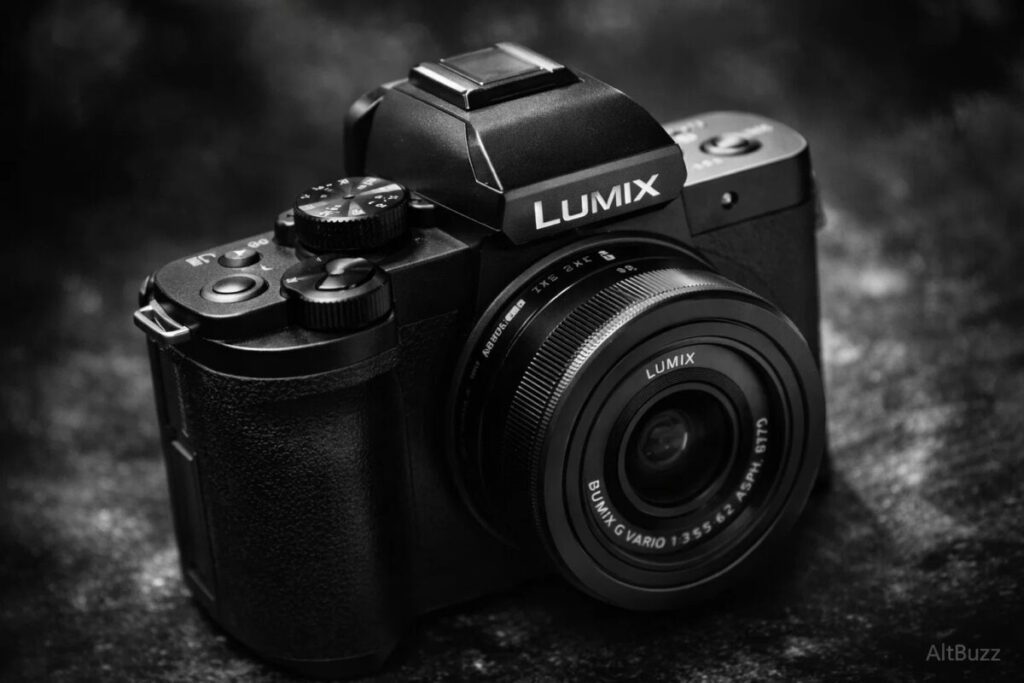
The original G100 was notably compact and lightweight. That was intentional. Vloggers and daily shooters do not want to carry heavy cameras all day. The G100 II is expected to maintain this lightweight character. Based on rumors, the body should weigh between 300 and 330 grams.
Fully Articulating Screen
The most significant design upgrade is the fully articulating screen. The original G100 had only a simple tilting display. That was a genuine limitation for selfie-angle vlogging and low-angle shooting. A fully articulating touchscreen flips all the way around to face forward. This makes the G100 II dramatically more practical for solo content creators who need to see themselves while recording.
Additionally, a fully articulating screen is better for overhead shooting, ground-level angles, and waist-level photography. It is a versatile addition that improves the camera for every shooting style.
Grip and Ergonomics
A slightly deeper grip and improved thumb rest ergonomics are also possible based on user feedback. The original G100 had a shallow grip that some users found uncomfortable during extended shooting sessions. A more confident grip shape would improve handling without adding significant bulk.
Button layout refinements are also expected. Better spacing between control buttons, a more accessible record button position, and improved touch response on the screen are all plausible improvements.
Overall Build Quality
The G100 II should continue the original’s tradition of solid build quality for its price. A mix of polycarbonate and metal construction gives the right balance of lightweight and durable. Weather sealing is not expected at this price point. However, basic splash resistance might be considered given that competing cameras at similar prices are beginning to offer it.
Panasonic G100 II Battery and Connectivity
Battery life was one of the most criticized aspects of the original G100. The small DMW-BLH7 battery offered around 300 shots or less than 60 minutes of continuous 4K video. For a full day of content creation, that required carrying multiple spare batteries. That is genuinely inconvenient.
The Panasonic G100 II is rumored to switch to the larger DMW-BLG10 battery. This change alone would provide a meaningful runtime improvement. The BLG10 offers approximately 60 percent more capacity than the BLH7. That difference is very noticeable in real-world use.
USB-C Charging
USB-C charging is expected and essential for a modern creator camera. Being able to charge from a power bank mid-shoot is a feature that creators depend on. USB-C also supports faster data transfer speeds for getting footage off the camera quickly. Panasonic would be making a significant mistake not to include it in the G100 II.
Wireless Connectivity
Wi-Fi for wireless image transfer and Bluetooth for pairing with smartphones are expected to continue. The Lumix Sync app allows remote control of the camera from a smartphone. That is useful for solo creators who need to adjust settings without touching the camera. Future improvements to the app itself are also possible.
Panasonic G100 II vs Competitors
Panasonic G100 II vs Sony ZV-E10 II
The Sony ZV-E10 II uses an APS-C sensor. That gives it a slight advantage in low-light performance and bokeh potential. Sony’s autofocus is also excellent. However, the G100 II’s directional microphone system is genuinely unique. Sony cannot match it with the ZV-E10 II’s standard stereo microphone. The G100 II also has access to the full range of Micro Four Thirds lenses, which is extensive. Both cameras target the same audience. The G100 II wins on audio. The ZV-E10 II wins on sensor size and autofocus brand reputation.
Panasonic G100 II vs Canon EOS M50 Mark II
The Canon EOS M50 Mark II is a well-established choice in this space. However, Canon’s EF-M lens ecosystem is limited and appears to be discontinued in favor of the RF system. The G100 II’s MFT lens ecosystem is far more active and extensive. The G100 II’s rumored 4K 60fps and 10-bit recording would also surpass the M50 Mark II’s video capabilities significantly.
Panasonic G100 II vs Fujifilm X-S20
The Fujifilm X-S20 is a strong competitor. It offers an APS-C sensor, excellent film simulations, and good video features at a higher price point. The G100 II targets a slightly lower budget. However, if Panasonic delivers 10-bit recording and 4K 60fps at under USD 900, it would offer impressive value compared to the X-S20’s higher asking price. Fujifilm’s color science and film simulations remain a unique selling point that the G100 II cannot directly replicate.
Real-World Use Cases for the Panasonic G100 II
YouTube and Social Media Content Creation
This is the G100 II’s primary use case. A flip screen, improved directional microphone, 4K 60fps, AI face tracking, and lightweight body check every major box for a solo YouTube creator. The directional microphone system in particular gives it an audio advantage that no rival at this price currently matches.
Creators who film sit-down talking head videos, product reviews, tutorials, and travel vlogs would all find the G100 II highly capable. The 10-bit V-Log L recording gives the footage a polished, professional look that stands out on platforms like YouTube.
Travel Vlogging
Compact size and lightweight build make the G100 II a natural travel partner. Paired with a small MFT kit lens or a compact prime, it fits easily in any bag. USB-C charging from a power bank keeps it running through long travel days. The improved battery life means fewer interruptions during shooting. 4K 60fps handles everything from city walks to landscape shots with smooth, professional-looking motion.
Beginner and Enthusiast Photography
MFT offers one of the widest ranges of affordable lenses available. Beginners entering the interchangeable-lens world can start with a kit lens and grow their collection over time without spending a fortune. The G100 II’s touch-friendly interface, AI subject recognition, and clear physical controls make it accessible to newcomers without feeling limiting as skills develop.
Podcast and Talking Head Video
The G100 II’s directional microphone system makes it ideal for studio-style talking head content. A creator sitting in front of the camera can use the front-focused pickup pattern to capture their voice cleanly while rejecting room noise from behind and to the sides. Combined with reliable face tracking, the G100 II becomes a turnkey talking-head video setup that requires minimal additional equipment.
Event and Street Photography
With improved high-ISO performance and faster autofocus, the G100 II would handle events, street scenes, and candid photography far better than the original G100. The compact body is unobtrusive. The improved burst speed of 15fps electronic would help capture decisive moments. The G100 II is primarily a video camera. However, it would be a capable everyday photo camera as well.
Pros and Cons Based on Rumors
Expected Strengths
- Compact and very lightweight body
- Upgraded 3-capsule directional microphone
- 4K 60fps video recording
- Full HD 240fps slow-motion
- Hybrid PDAF autofocus
- Fully articulating touchscreen
- 10-bit V-Log L recording
- Affordable expected price under USD 900
- USB-C charging expected
- Improved high-ISO performance
- Larger battery than original
Potential Weaknesses
- MFT sensor is physically smaller than APS-C
- Battery life may still fall short of all-day shooting
- No weather sealing expected
- Price may rise slightly above the original G100
- Competing against strong Sony and Canon rivals
- Nothing officially confirmed by Panasonic yet
What Would Make the G100 II an Essential Buy?
The G100 II does not need to be the best camera in every area. It needs to be the best camera for its specific audience. If Panasonic delivers reliable PDAF, 4K 60fps, 10-bit V-Log L, a fully articulating screen, and an improved directional microphone at under USD 900, the G100 II becomes very hard to argue against.
The directional microphone system is the G100 II’s strongest unique feature. No competitor at this price offers anything like it. If Panasonic improves it meaningfully, that alone justifies the camera for a large portion of its target audience.
Better battery life and reliable autofocus would remove the two biggest frustrations from the original G100 experience. If both are delivered, the G100 II transforms from a camera with potential into a camera with purpose.
Final Thoughts on the Panasonic G100 II
The Panasonic G100 II has a real opportunity ahead of it. The content creation market continues to grow. More people are starting YouTube channels, social media pages, and online businesses than ever before. These creators need cameras that work reliably, sound good, and produce quality video without requiring expensive additional equipment.
The original G100 had the right idea. It just needed better execution in key areas. If Panasonic delivers PDAF, 4K 60fps, 10-bit recording, a fully articulating screen, and an improved directional microphone at under USD 900, the G100 II would not just be a good beginner vlogging camera. It would be one of the best cameras in its class, full stop.
It would have a clear identity. It would serve its audience better than any rival. And it would remind the market why Panasonic’s video-focused cameras deserve serious attention.
AltBuzz will cover every new leak and official announcement for the Panasonic G100 II as this camera gets closer to launch. Watch this space closely.
Read more from AltBuzz for camera reviews, rumors, and detailed specs. AltBuzz delivers trusted and easy-to-understand photography content.
Stay updated with camera reviews, rumors, and comparisons. AltBuzz shares regular camera content on YouTube. Subscribe AltBuzz