
Sony A7C vs Panasonic Lumix S5: Full Comparison Guide
Introduction
Choosing between the Sony A7C and Panasonic Lumix S5 challenges many hybrid shooters. Both cameras arrived on the market already and continue selling well today. This guide breaks down key differences for photographers and videographers. Compact full-frame seekers will gain valuable insights here.
Full-frame cameras traditionally meant large, heavy bodies. These two models challenge that assumption completely. Sony pioneered the compact full-frame concept. Panasonic followed with video-centric features. Both manufacturers target creators who refuse to compromise.
The compact form factor appeals to multiple user groups. Travel photographers appreciate reduced pack weight. Street shooters value discretion and portability. Wedding photographers need lightweight backup bodies. Content creators demand video capabilities without bulk. These cameras serve diverse needs effectively.
Release Date Overview
Sony A7C Release Date
Sony unveiled the A7C in September 2020. Market availability began in October 2020. The “C” designation means “Compact” in Sony’s naming scheme. Initial reception mixed among photographers. Some praised portability while others criticized ergonomics. Sales exceeded Sony’s conservative projections.
The A7C represents Sony’s attempt to attract vloggers. Marketing emphasized content creation capabilities. The fully articulating screen specifically targets this audience. Sony positioned the camera between enthusiast and professional tiers. Pricing reflected this strategic positioning.
Panasonic Lumix S5 Release Date
Panasonic announced the Lumix S5 in September 2020. The camera shipped to customers by late September 2020. This timing directly competed with Sony’s launch. Industry observers noted the simultaneous releases. Both companies targeted the same market segment clearly.
The Lumix S5 completed Panasonic’s L-mount lineup. Higher-priced S1 and S1H served professionals. The S5 brought L-mount technology to broader audiences. Panasonic emphasized video features heavily in marketing. The company leveraged its video heritage strategically.
Specification Comparison Table
| Feature | Sony A7C | Panasonic Lumix S5 |
|---|---|---|
| Sensor Type | Full-frame BSI CMOS | Full-frame CMOS |
| Resolution | 24.2 MP | 24.2 MP |
| Processor | BIONZ X | Venus Engine |
| ISO Range | 100-51200 (ext. 50-204800) | 100-51200 (ext. 50-204800) |
| Autofocus System | 693-point phase detection | 225-area DFD contrast AF |
| Stabilization | 5-axis IBIS (5.5 stops) | 5-axis IBIS (6.5 stops) |
| Video Recording | 4K 30p (full-frame), 4K 60p (APS-C crop) | 4K 60p (full-frame) |
| EVF | 2.36M-dot OLED | 2.36M-dot OLED |
| LCD Screen | 3.0″ vari-angle touchscreen | 3.0″ free-angle touchscreen |
| Burst Shooting | 10 fps | 7 fps mechanical, 9 fps electronic |
| Battery | NP-FZ100 (680-740 shots) | DMW-BLK22 (470 shots) |
| Storage | Single SD UHS-II | Dual SD UHS-II |
| Connectivity | Wi-Fi, Bluetooth, USB-C | Wi-Fi, Bluetooth, USB-C |
| Weight | 509g (body only) | 630g (body only) |
| Price at Launch | $1,799 (body only) | $1,997 (body only) |
Sensor and Image Quality: Sony A7C vs Panasonic Lumix S5
Resolution matches perfectly at 24.2 megapixels on both systems. Sony employs a back-illuminated sensor design. This technology improves light gathering efficiency. Low-light performance benefits from BSI construction. Panasonic uses a standard full-frame CMOS sensor. The design emphasizes video optimization over stills. Image quality differences remain subtle in most conditions.
Pixel size measures approximately 5.94 microns on both sensors. This dimension influences dynamic range and noise characteristics. Larger pixels generally capture more light. Both cameras maximize sensor potential effectively. Professional image quality emerges from both systems.
Sony’s color science leans toward neutral and accurate reproduction. Skin tones render naturally without adjustment. Landscape colors appear realistic and balanced. This approach provides editing flexibility. Panasonic delivers slightly warmer tones straight from camera. The look pleases many shooters immediately. Post-processing adjusts colors easily when needed.
Dynamic range performs excellently on both models. Sony achieves approximately 14+ stops of latitude. Panasonic delivers similar performance in testing. Shadow detail recovery impresses from both cameras. Highlight rolloff appears smooth and gradual. HDR photography benefits from this capability. Wedding photographers appreciate the exposure latitude.
Raw file quality satisfies professional requirements. Sony produces 14-bit uncompressed raw files. File sizes reach approximately 50MB per image. Panasonic offers similar bit depth and flexibility. Both systems integrate with major editing software. Lightroom and Capture One support files fully.
JPEG processing differs between manufacturers. Sony emphasizes accuracy over punch. Images may appear flat initially. This approach prevents clipping and maintains detail. Panasonic delivers more contrast and saturation. Social media posting works without adjustments. Personal preference determines better output style.
Low-light capabilities shine equally on both cameras. Extended ISO ranges reach ISO 204800 on each system. Practical usability tops out around ISO 12800 for clean results. Noise reduction algorithms work effectively at high ISOs. The Sony A7C edges slightly ahead in noise control at extreme sensitivities. Real-world differences rarely impact typical shooting. Event photographers work confidently in dim venues.
Autofocus Performance Comparison
Sony’s autofocus system dominates this category decisively. The 693-point phase-detection system covers 93% of the frame. Eye autofocus works brilliantly for humans and animals. Tracking performance handles fast-moving subjects confidently. Sports photographers trust Sony’s AF reliability. Video autofocus operates smoothly and reliably. Content creators appreciate the consistency.
Real-time tracking identifies subjects automatically. The camera maintains focus through occlusions. Subject recognition includes humans, animals, and birds. The algorithm predicts motion patterns effectively. Action photography becomes easier with superior AF. Wildlife shooters capture sharp images consistently.
Panasonic relies on contrast-detection DFD (Depth from Defocus) technology. The 225-area system performs adequately in good light. Low-light focusing struggles compared to Sony. AF sensitivity reaches -6 EV on paper. Real-world performance disappoints in dim conditions. Subject tracking lacks the precision of phase-detection systems. Video shooters notice hunting in challenging situations.
Face and body detection works on Panasonic cameras. Human recognition operates reliably for stationary subjects. Moving subjects challenge the system’s capabilities. Animal detection exists but lags Sony significantly. The contrast-detection limitation shows clearly here.
AF customization options differ between systems. Sony provides extensive AF menu settings. Users fine-tune sensitivity and tracking parameters. Custom AF areas help specific shooting scenarios. Panasonic offers similar customization depth. However, fundamental technology limits ultimate performance.
Video autofocus separates these cameras dramatically. Sony maintains smooth focus transitions naturally. The system avoids sudden snapping or hunting. Face tracking works even with subject movement. Panasonic’s DFD struggles with continuous focus. Manual focus becomes necessary for critical shots. Professional videographers notice this limitation immediately.
Real-world scenarios strongly favor Sony’s system. Sports and wildlife photographers benefit from superior tracking. Portrait shooters appreciate reliable eye detection. The Panasonic Lumix S5 handles static subjects well. Moving subjects require more attention from the photographer. Landscape and studio work shows less difference.
Video Capabilities and Recording Features
Panasonic excels dramatically in video features. The Lumix S5 records 4K 60fps using the full sensor width. No crop factor diminishes field of view. This capability benefits wide-angle shooting significantly. V-Log comes included for professional color grading. The flat profile preserves maximum dynamic range. 10-bit 4:2:0 internal recording provides flexibility. Color grading latitude exceeds 8-bit significantly.
Unlimited recording time suits long-form content. Lectures, concerts, and ceremonies record without interruption. Overheating remains absent even in warm environments. Thermal management impresses during extended shoots. Professional video work demands this reliability.
Sony A7C records 4K 30fps full-frame or 4K 60fps with APS-C crop. The crop factor limits wide-angle shooting at higher frame rates. Field of view reduction frustrates interior videographers. S-Log profiles require purchasing separately. The additional cost disappoints budget-conscious creators. 8-bit 4:2:0 internal recording restricts grading latitude. Professional work demands external recorders.
Recording limits exist depending on settings. Overheating occurs during extended 4K recording. Summer outdoor shoots prove problematic. The compact body struggles with heat dissipation. Workarounds include external recorders and breaks. These limitations frustrate event videographers.
Frame rate options differ between cameras. Panasonic offers 4K at 60p, 30p, and 24p. Full HD reaches 180fps for slow motion. Creative options expand with higher frame rates. Sony provides 4K 60p (cropped) and full HD 120fps. Slow-motion capabilities satisfy most needs. Professional work benefits from Panasonic’s flexibility.
Video autofocus performance separates these cameras. Sony’s phase detection tracks smoothly and reliably. Panasonic’s contrast detection shows visible hunting. Critical focus pulls require manual operation. This difference impacts production efficiency significantly.
Audio capabilities matter for video production. Both cameras feature 3.5mm microphone inputs. External recorders improve audio quality substantially. Headphone monitoring requires adapters on both models. The Sony includes a digital audio interface. Professional audio demands external equipment regardless. Serious videographers invest in dedicated recorders.
Content creators overwhelmingly prefer the Panasonic Lumix S5. Professional video work demands the included features. Hybrid shooters appreciate the recording flexibility. Sony serves photographers who occasionally shoot video. The gap in video capability is substantial. YouTube creators and filmmakers choose Panasonic consistently.
In-Body Image Stabilization Performance
Both cameras include 5-axis in-body stabilization. Panasonic claims 6.5 stops of compensation. Sony rates its system at 5.5 stops. Real-world testing confirms Panasonic’s advantage. The extra stop matters for handheld telephoto work. Landscape photographers shoot at slower shutter speeds confidently.
IBIS benefits multiple photography genres. Wildlife shooters stabilize long telephoto lenses. Wedding photographers work in dim churches. Travel photographers shoot without tripods. The technology enables previously impossible shots. Lighter camera bags result from eliminating tripods.
Video stabilization differs from stills. Both cameras provide electronic stabilization for video. This digital processing adds to IBIS benefits. Handheld video appears smooth and professional. Walking shots show minimal bounce. Gimbal requirements decrease with good IBIS.
Lens compatibility affects stabilization performance. Native lenses communicate with camera bodies. The system optimizes stabilization accordingly. Adapted lenses lose coordination benefits. Manual stabilization settings help adapted glass. Both systems handle adapted lenses adequately.
Stabilization limitations exist despite technology. Very slow shutter speeds still require support. The 1/focal length rule still provides guidance. IBIS extends safe handheld speeds significantly. Technique matters alongside technology. Proper shooting form maximizes stabilization benefits.
Design and Handling: Sony A7C vs Panasonic Lumix S5
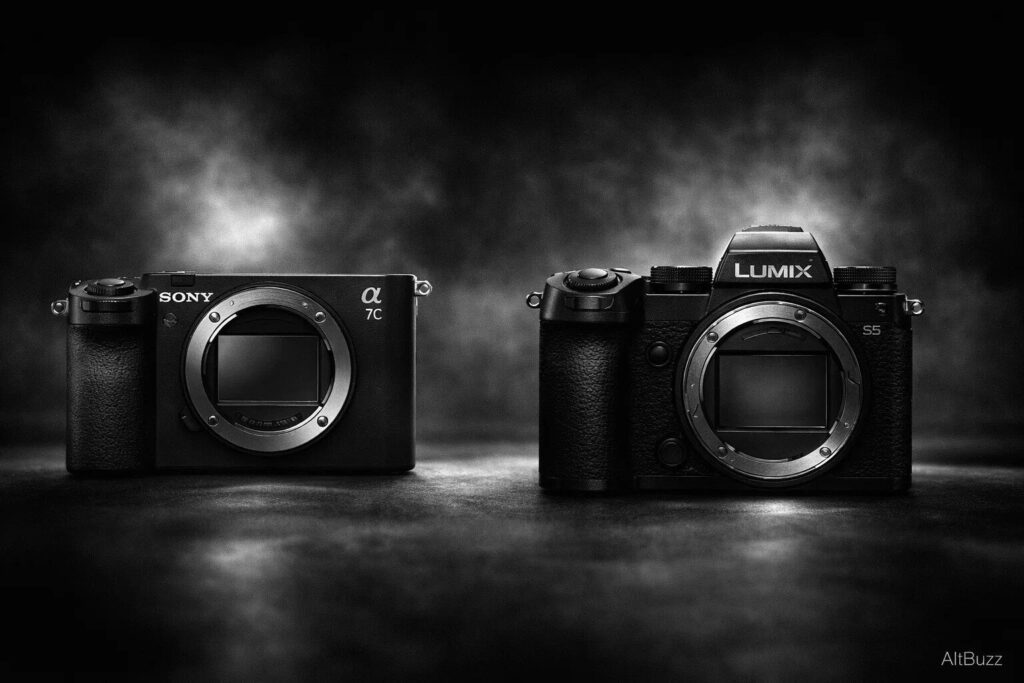
Sony prioritizes compact size above all else. The A7C measures significantly smaller than traditional full-frame cameras. Dimensions approach APS-C camera territory. Rangefinder-style design appeals to street photographers. The small grip challenges users with larger lenses. Telephoto lens handling requires careful balance. Weather sealing provides protection in harsh conditions. Dust and moisture resistance enables outdoor confidence.
Build quality feels solid despite compact size. Magnesium alloy construction ensures durability. The camera withstands professional use demands. However, the small size compromises handling. Larger hands find the grip cramped. Extended shooting sessions cause hand fatigue. Some photographers add grip extensions.
Button layout adapts to compact dimensions. Controls cluster on the camera rear. The top plate remains relatively clean. ISO and exposure compensation dials sit prominently. Custom button assignment helps workflow efficiency. Sony veterans adapt quickly to the layout.
Panasonic maintains a more traditional DSLR-inspired body. The grip accommodates larger hands comfortably. Button placement follows conventional layouts. DSLR users transition easily to this system. Weather sealing matches Sony’s protection level. The slightly larger size improves handling with telephoto lenses.
The Lumix S5 body feels substantial and professional. Build quality inspires confidence immediately. Weight distribution balances well with most lenses. Long shooting sessions remain comfortable. The camera disappears during use. Photographers focus on subjects rather than equipment.
Screen mechanisms differ between cameras. Sony uses a side-hinged vari-angle screen. This design suits vlogging perfectly. The screen flips for self-recording easily. Landscape orientation remains possible. Traditional shooting benefits from flexible positioning. Panasonic employs a fully articulating free-angle screen. This mechanism provides maximum flexibility. Overhead and ground-level shooting works perfectly.
Viewfinder specifications appear identical on paper. Both displays show 2.36 million dots. Refresh rates reach 60fps for smooth tracking. However, viewfinder placement differs significantly. Sony positions the EVF in the corner. This placement feels strange initially. Rangefinder styling dictates the choice. Panasonic centers the viewfinder traditionally. This position feels natural to most photographers.
Eye sensor behavior affects usability. Both cameras switch between EVF and LCD automatically. Sensor sensitivity adjusts in menus. False triggers frustrate some users. Manual switching provides complete control. Personal preference determines better implementation.
Battery Life and Power Management
Sony’s NP-FZ100 battery delivers exceptional longevity. Expect 680-740 shots per charge depending on settings. This capacity exceeds most mirrorless cameras. All-day shooting becomes possible without spares. The battery charges via USB-C for convenience. Power banks extend field time indefinitely. Longer video sessions drain power faster. Still photography maximizes battery life.
Battery availability and cost matter long-term. Third-party NP-FZ100 batteries cost significantly less. Quality varies across manufacturers. OEM batteries guarantee compatibility and safety. Many photographers mix genuine and third-party. The investment grows with multiple spares.
Panasonic’s DMW-BLK22 battery provides approximately 470 shots. The capacity lags Sony’s offering significantly. All-day shooting requires spare batteries. USB-C charging works during operation. This capability helps maintain power levels. Battery grip options extend shooting time. Vertical shooting ergonomics improve with grips.
Power consumption varies by usage patterns. EVF use drains power faster than LCD. Continuous shooting consumes more power. Video recording stresses batteries most. Cold weather reduces capacity on both cameras. Photographers plan battery needs accordingly.
In-camera charging provides convenience. Both cameras charge via USB-C connections. Power banks eliminate downtime completely. International travel simplifies without separate chargers. The compact charging solution saves bag space.
Dual card slots give Panasonic a workflow advantage. Backup recording protects critical shoots. Wedding and event photography demands redundancy. Overflow recording extends capacity seamlessly. RAW to one card and JPEG to another works. Sony’s single slot creates risk for professionals. Card failure means complete data loss. Backup strategies become essential.
Card slot specifications differ meaningfully. Sony provides single SD UHS-II slot. Write speeds satisfy continuous shooting needs. Panasonic offers dual SD UHS-II slots. Both slots perform at full speed. Buffer clearing happens faster overall. Professional workflows benefit from dual slots.
Both cameras offer Wi-Fi and Bluetooth connectivity. Remote control functionality works reliably. Image transfer speeds satisfy social media needs. Tethering capabilities help studio work. FTP transfer enables immediate delivery. Professional workflows integrate both cameras.
Lens Ecosystem Considerations
Sony’s E-mount system dominates market share. Native lens selection exceeds 70 options. Choices span ultra-wide to super-telephoto. Professional G Master lenses deliver exceptional performance. Budget options exist for most focal lengths. Third-party support remains strongest in industry.
Sigma produces excellent Art series E-mount lenses. Contemporary line offers lightweight alternatives. Tamron brings innovative designs to market. Viltrox and Samyang provide budget options. The variety satisfies diverse needs and budgets. Used market availability exceeds other systems.
Panasonic participates in L-mount alliance. Sigma and Leica share the mount standard. Combined lens selection approaches Sony’s breadth. Leica lenses deliver legendary optical quality. Premium pricing limits accessibility for many. Sigma provides performance at lower costs.
Native Panasonic lenses cover essential focal lengths. The S-series lineup grows steadily. Professional options include fast primes and zooms. Compact lenses balance size with performance. System weight remains reasonable overall. Third-party options expand choices further.
Lens pricing affects system cost significantly. Sony’s popular 24-70mm f/2.8 GM costs approximately $2,200. Panasonic’s equivalent S Pro lens runs similar pricing. Budget conscious photographers seek alternatives. Third-party zooms cost $800-1,200 typically. These options deliver excellent value.
Specialty lenses differentiate systems slightly. Sony offers unique focal lengths like 20mm f/1.8. Macro options exist across focal lengths. Panasonic provides comprehensive coverage too. Wildlife photographers find 100-400mm options. Both systems serve professional needs adequately.
Adapted lenses expand possibilities significantly. Sony accepts nearly any lens via adapters. Canon EF, Nikon F, and others adapt. Autofocus adapters exist for some mounts. Panasonic adapts Nikon F lenses effectively. Sigma’s MC-21 adapter handles Canon EF. Legacy glass gains new life affordably.
Price and Value Analysis
Sony launched the A7C at $1,799 body-only. Current pricing fluctuates between $1,600-$1,800. Kit bundles include the 28-60mm compact zoom. This lens suits the compact form factor. Used market activity increases gradually. Early adopters upgrade to newer models.
Bundle deals appear around holiday seasons. Retailers discount to move inventory. Patient shoppers save hundreds of dollars. Refurbished units offer additional savings. Sony’s warranty coverage provides peace of mind.
Panasonic debuted the Lumix S5 at $1,997. Prices now range from $1,500-$1,800 depending on sales. Aggressive promotions appeared post-launch. The company built market share through value. Kit options include 20-60mm versatile zoom. This lens delivers excellent image quality.
The L-mount alliance expands lens choices. Sigma and Leica lenses integrate seamlessly. Value proposition strengthens with video features included. V-Log inclusion saves $200 over Sony. Dual card slots add professional value. These factors improve overall value proposition.
Dollar-for-dollar value depends on priorities. Photographers favor Sony’s autofocus and battery life. The extensive lens ecosystem provides flexibility. Market leadership ensures long-term support. Videographers prefer Panasonic’s feature set and dual slots. Included professional video features save money. The decision hinges on primary use case.
Total system cost includes lenses obviously. Sony’s mature ecosystem offers more used options. Budget builds become possible with patience. Panasonic requires more upfront investment typically. However, video features reduce external recorder costs. The calculation varies by individual needs.
Resale value considerations affect long-term cost. Sony cameras maintain value better historically. Higher market share drives demand. Panasonic cameras depreciate faster initially. However, video features appeal to specific buyers. Both cameras serve secondary market needs.
Connectivity and Workflow Integration
Professional workflows demand reliable connectivity. Both cameras integrate with major software. Tethered shooting works in Capture One and Lightroom. Real-time preview speeds studio work. Client approval happens immediately.
Wi-Fi transfer speeds satisfy mobile publishing. Social media posting happens from smartphones. Image quality remains excellent despite compression. Instant sharing meets modern expectations. Marketing departments appreciate rapid delivery.
Remote control capabilities enhance creativity. Smartphone apps control both cameras. Interval timer programming works remotely. Wildlife hides benefit from silent triggering. Self-portraits become easier with remote control.
Cloud integration continues evolving. Both manufacturers offer cloud services. Automatic backup protects against loss. Sharing galleries with clients simplifies delivery. Subscription costs vary by storage needs.
FTP transfer enables professional delivery. Event photographers upload while shooting. Clients access images immediately. Breaking news photography depends on speed. Both cameras enable rapid distribution.
Real-World Performance Scenarios
Wedding photography demands reliability above all. Autofocus performance favors Sony decisively. Battery life advantages compound over long events. Single card slot creates anxiety though. Panasonic’s dual slots provide essential backup. Video features help capture ceremony details. Both cameras serve as capable secondary bodies.
Portrait photography emphasizes image quality and eye AF. Sony’s eye detection works flawlessly. Tracking maintains focus as subjects move. Panasonic requires more manual intervention. Static studio work shows less difference. Natural light portraiture benefits from IBIS. Both cameras deliver professional results.
Landscape photography prioritizes resolution and dynamic range. Both 24-megapixel sensors satisfy most needs. Large prints require attention to technique. IBIS enables handheld shooting in low light. Panasonic’s superior stabilization shows advantage. Tripods remain essential for maximum quality. Weather sealing protects gear in mountains.
Street photography values discretion and speed. Sony’s compact size reduces intimidation. Quick autofocus captures decisive moments. Panasonic’s larger size attracts more attention. Silent shooting modes help both cameras. Electronic shutters eliminate shutter sound. Candid photography becomes easier.
Travel photography prioritizes size and versatility. Sony wins in pure portability terms. The compact form factor suits carry-on bags. Panasonic offers better ergonomics for all-day shooting. Lens size affects total kit weight. Both systems enable creative travel documentation.
Video production separates these cameras dramatically. Panasonic delivers professional features standard. Unlimited recording suits documentary work. V-Log inclusion enables professional color grading. Sony requires accessories for similar capability. The cost difference grows with accessories. Commercial video work favors Panasonic heavily.
Which Camera Should You Choose?
Sony A7C strengths:
- Superior autofocus system for stills and video
- Exceptional battery life for extended shooting
- Compact body ideal for travel and street photography
- Larger selection of native E-mount lenses
- Stronger position in used lens market
- Better high-ISO noise control
- Rangefinder styling appeals aesthetically
Panasonic Lumix S5 strengths:
- Professional video features included standard
- Dual card slots for backup and overflow
- Better in-body stabilization performance
- Superior ergonomics for all-day handling
- 4K 60fps full-frame recording
- Unlimited recording time prevents interruptions
- V-Log included without additional cost
Photography-focused users benefit from the Sony A7C. The autofocus advantage proves decisive for action. Battery life enables all-day shooting confidence. Video-centric creators should choose the Panasonic Lumix S5. Professional features justify the investment. Hybrid shooters leaning toward video gain more from Panasonic. Hybrid shooters prioritizing stills prefer Sony.
Consider your primary use case carefully. Autofocus requirements drive many decisions. Video needs determine feature priorities. System commitment outweighs body choice. Lenses represent larger investment long-term. Try both cameras before purchasing ideally.
Read More from AltBuzz
Read more from AltBuzz for camera reviews, in-depth comparisons, and detailed specs. AltBuzz delivers clear and trusted camera insights. Our comprehensive evaluations help photographers and videographers make confident choices. Stay informed with expert analysis. Professional photographers contribute to our content. Real-world testing informs every review. Trust AltBuzz for honest assessments.
Subscribe AltBuzz YouTube Channel
Stay updated with camera comparisons and hands-on reviews. AltBuzz covers the latest photography gear. Subscribe here: 👉 Subscribe AltBuzz