
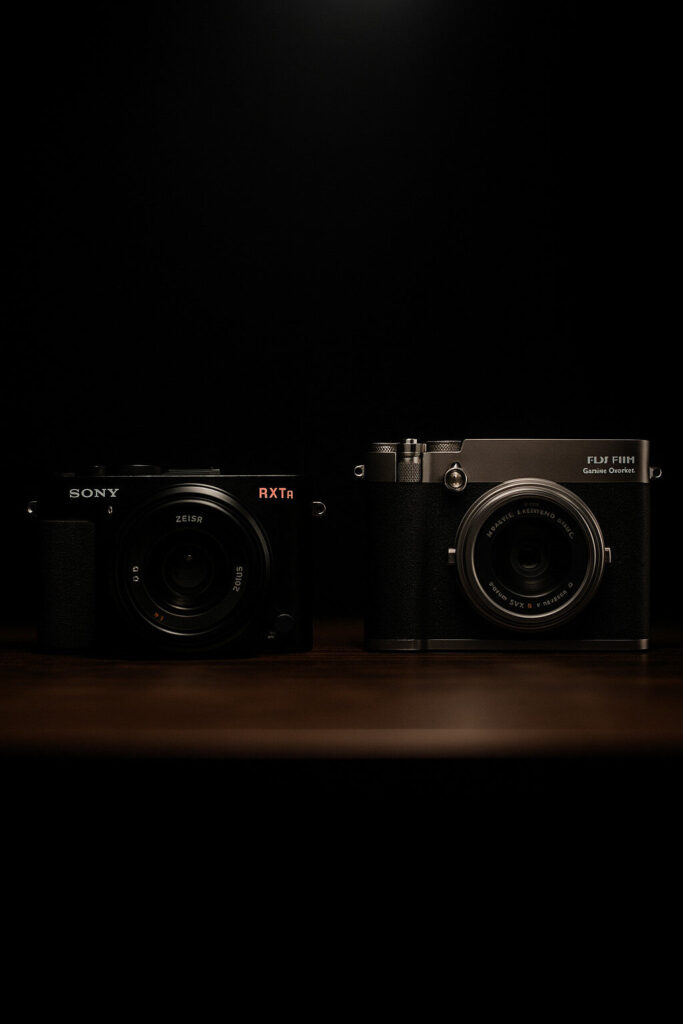
The camera world is full of battles. But few fights feel as dramatic as the one between the Sony RX1R III and the Fujifilm GFX100RF. Both cameras are loved. Both cameras are powerful. Yet they are built for very different photographers.
From the very first glance, you can see the difference. The Sony RX1R III is small and light. It slips into your bag and almost disappears. On the other hand, the Fujifilm GFX100RF is larger and heavier. It looks serious, and it feels like a tool made for big work.
The Sony RX1R III comes with a 61 MP full-frame sensor and a bright f/2 lens. This makes it fast, sharp, and perfect for travel or street shots. Meanwhile, the Fujifilm GFX100RF has a giant 102 MP medium-format sensor and a slower f/4 lens. It is not as quick, but it gives detail that no full-frame camera can match.
This means you are not just choosing between two cameras. You are choosing between speed and detail. Additionally, you are choosing between a pocket-friendly tool and a studio powerhouse. And you are choosing between freedom and perfection.
So which one is right for you? In this blog, we compare them step by step. We explain the size, the lens, the files, the flash, and the focus. By the end, you will know which camera truly wins for your style of photography.
Features and Performance
The features and performance of a camera decide how it will feel in real life. Both the Sony RX1R III and the Fujifilm GFX100RF are powerful, but they shine in very different ways. Therefore, it is important to look at each part step by step. From autofocus to lenses, video, and flash, these cameras have unique strengths. By understanding these, you can see which camera suits your style best.
Autofocus
Autofocus is key for capturing sharp images. The Sony RX1R III is fast and reacts quickly. As a result, it works perfectly for street, travel, and moving subjects. On the other hand, the Fujifilm GFX100RF is slower but extremely accurate. This makes it ideal for studio work or carefully planned shots.
Video Quality
Video is another area to consider. Sony can record smooth and stable footage. Therefore, it is good for casual videos or vlogs. Meanwhile, the Fujifilm captures high-quality, detailed video. However, it is heavier and harder to handle for long recordings. Both cameras can produce great results, but the choice depends on speed versus detail.
Sensor & Detail
The sensor determines how much detail a camera can capture. Sony has a 61 MP full-frame sensor. It produces crisp images with vivid colors. In contrast, Fujifilm has a massive 102 MP medium-format sensor. Because of this, it creates extremely detailed shots perfect for large prints or fine art photography.
Lens & Aperture
The lens affects light and focus in images. The Sony comes with a 35 mm f/2 lens. It lets in more light and creates soft backgrounds. Meanwhile, Fujifilm has a 35 mm f/4 lens. It is slower but extremely sharp. Therefore, it excels in controlled environments and professional shoots.
Flash & Shutter
The shutter type affects flash and studio use. Sony uses a normal shutter. As a result, it cannot sync with flash at very high speeds. On the other hand, Fujifilm has a leaf shutter. This allows flash at high shutter speeds. Therefore, it is better for studio work or creative lighting setups.
Image Quality
Image quality is the heart of any camera. The Sony RX1R III delivers crisp and vibrant photos. Therefore, it works well for everyday shooting, travel, and street photography. In contrast, the Fujifilm GFX100RF captures incredible detail. Its 102 MP sensor creates images that are sharp even when printed very large.
Detail & Sharpness
Sony provides excellent detail for most uses. You can crop your photos and still keep clarity. Meanwhile, Fujifilm takes it further. Every leaf, texture, and small element appears sharp. Because of this, it is ideal for studio, landscapes, or professional prints.
Low Light Performance
The Sony RX1R III performs well in low light. Its f/2 lens lets in more light, reducing blur. On the other hand, Fujifilm’s f/4 lens is slower in low light. However, its medium-format sensor handles noise very well. Therefore, it still produces clean images in darker settings.
Dynamic Range
Dynamic range decides how well a camera captures highlights and shadows. Sony has good dynamic range for most scenes. Meanwhile, Fujifilm excels in this area. Its sensor captures subtle tones and shadow details that many cameras miss.
Color & Tonality
Sony images have rich and natural colors. They look vibrant and realistic. The Fujifilm goes a step further. Colors are deep, smooth, and almost painterly. Therefore, it is perfect for portraits, landscapes, and fine art photography.
Portability & Handling
The size and weight of a camera affect how you use it every day. The Sony RX1R III is small, light, and easy to carry anywhere. Therefore, it is perfect for street photography, travel, or casual shooting. On the other hand, the Fujifilm GFX100RF is larger and heavier. Yet, it feels solid and professional in hand. Because of this, you can hold it steady for long periods. Both cameras have a strong grip, but your choice depends on whether you prioritize mobility or stability.
Controls & Ergonomics
Handling and controls are important for fast shooting. Sony keeps things simple with fewer buttons. This makes it quick to adjust settings while shooting. Meanwhile, Fujifilm has more buttons and dials. Therefore, you can fine-tune every setting. However, it may take time to get used to it. For beginners, Sony is easier. For professionals, Fujifilm offers more control.
File Size & Storage
File size and storage are a big deal for photographers. The Sony RX1R III produces large files, but they are manageable. This means you can edit, transfer, and share your photos without needing an extremely powerful computer. Therefore, it is convenient for travel, street photography, or casual shooting. In addition, storing files on external drives or cloud services is easier because the file sizes are not extreme.
In contrast, the Fujifilm GFX100RF creates massive files due to its 102 MP medium-format sensor. These files capture extraordinary detail, making them perfect for professional prints, studio work, and large landscapes. However, such large files require more storage space and a faster computer to handle editing smoothly. If you plan to shoot in RAW or do heavy post-processing, the Fujifilm setup demands planning.
Despite the extra effort, these huge files offer unmatched flexibility. You can crop heavily, zoom into tiny details, or print massive images without losing quality. Therefore, the Fujifilm GFX100RF excels when ultimate image quality is the goal. On the other hand, the Sony RX1R III provides a practical balance, giving high-quality images that are easier to handle.
Ultimately, your choice depends on how you use your files. If convenience, portability, and quick editing are priorities, the Sony wins. If you prioritize detail, precision, and professional flexibility, the Fujifilm takes the lead.
Battery Life & Practical Use
Battery life and practical use also matter. The Sony RX1R III lasts long and is quick to charge. You can shoot for hours without worry. Meanwhile, Fujifilm uses more power because of its large sensor and high-resolution files. As a result, it may need extra batteries for long sessions. Despite this, Fujifilm offers features that make the extra effort worthwhile. Choosing between them means deciding what matters most: convenience or ultimate performance.
Price
Price is a big factor when choosing a camera. The Sony RX1R III is priced at approximately $5,099.99 USD. It’s a compact full-frame camera with a 61MP sensor and a Zeiss 35mm f/2 lens. Therefore, you’re paying for portability and high quality in a small package.
On the other hand, the Fujifilm GFX100RF is priced at around $5,599.95 USD. It offers a massive 102MP medium-format sensor and a built-in 35mm f/4 lens. As a result, you’re investing in exceptional detail and image quality.
Both cameras are premium options with distinct advantages. Sony offers convenience and portability. The Fujifilm provides unmatched detail and dynamic range. Your choice depends on what you value more: size and speed or ultimate image quality.
| Feature | Sony RX1R III | Fujifilm GFX100RF |
|---|---|---|
| Sensor | 61 MP full-frame | 102 MP medium-format |
| Lens | 35mm f/2 (built-in) | 35mm f/4 (built-in) |
| Autofocus | Fast, great for moving subjects | Slower, very accurate |
| Video | Smooth and easy | High-quality, very detailed |
| Low Light | Performs well, bright lens | Handles noise well, slower lens |
| Dynamic Range | Good | Excellent, captures subtle tones |
| Flash & Shutter | Normal shutter, limited flash speed | Leaf shutter, high-speed flash sync |
| Size & Weight | Small, light, pocketable | Larger, heavier, professional feel |
| Portability | Excellent | Less portable, more stable |
| Price | $5,099.99 USD | $5,599.95 USD |
Conclusion
Choosing between the Sony RX1R III and the Fujifilm GFX100RF is not easy. Both cameras are amazing, but they serve different needs. The Sony is small, fast, and perfect for travel, street, and everyday shots. Meanwhile, the Fujifilm is huge, detailed, and ideal for studio, landscapes, and large prints. Your choice depends on what matters most: portability and speed, or ultimate image quality and control. Both cameras are investments, and either can create stunning photos if used well.
Read More of Our Blogs
Explore more camera comparisons, reviews, and tips to find the perfect gear for your photography adventures. Stay updated with our latest guides and insights!