
Introduction
In 2025, cinema cameras are evolving fast. Nikon ZR and Canon EOS C50 are two of the most talked-about cameras this year. Both are full-frame and offer professional video performance and are compact, yet powerful. If you are a filmmaker, content creator, or videographer, you want cameras that deliver RAW, high dynamic range, high frame rate, and reliable autofocus. Nikon ZR uses a 24.5 MP full-frame CMOS sensor. It supports RED R3D NE 12-bit RAW. Video can go up to 6K at 59.94 fps. Canon EOS C50 has a 32 MP full-frame sensor.
It records 7K Cinema RAW Light at 60 fps. Both cameras have dual base ISO, giving 15+ stops of dynamic range. Both offer high-quality audio recording. Nikon ZR has 32-bit float audio built in. Canon C50 has 4-channel 24-bit audio. Both cameras support Log profiles for wide exposure latitude. Nikon uses REDWideGamutRGB and Log3G10. Canon uses Canon Log 2 and 3. Both cameras allow high-speed recording. Nikon ZR shoots 4K at 119 fps. Canon C50 shoots 4K at 120 fps. Both cameras have stabilization. Nikon ZR has 5-axis in-body stabilization.
Canon C50 relies on lens stabilization and rig support. Both are compact for handheld and run-and-gun shooting. Both support professional lenses. Nikon uses Z-mount lenses. Canon uses RF-mount and cinema lenses.
Both cameras have connectivity options. HDMI, USB-C, timecode, and Wi-Fi are supported. Both have flexible recording formats. ProRes, RAW, N-RAW, XF-AVC, XF-HEVC. Both are designed for fast workflow are ready for post-production. Also, Both cameras compete in video quality, dynamic range, portability, and pro features. The choice depends on your workflow, project type, and personal preference. Nikon ZR leans toward lightweight, high-speed, and cinematic portability. Canon EOS C50 leans toward high resolution, open-gate flexibility, and advanced rigging. In this blog, we compare Nikon ZR vs Canon EOS C50 in specs, video quality, dynamic range, features, and usability. We will help you decide which compact cinema camera is the better choice for 2025.
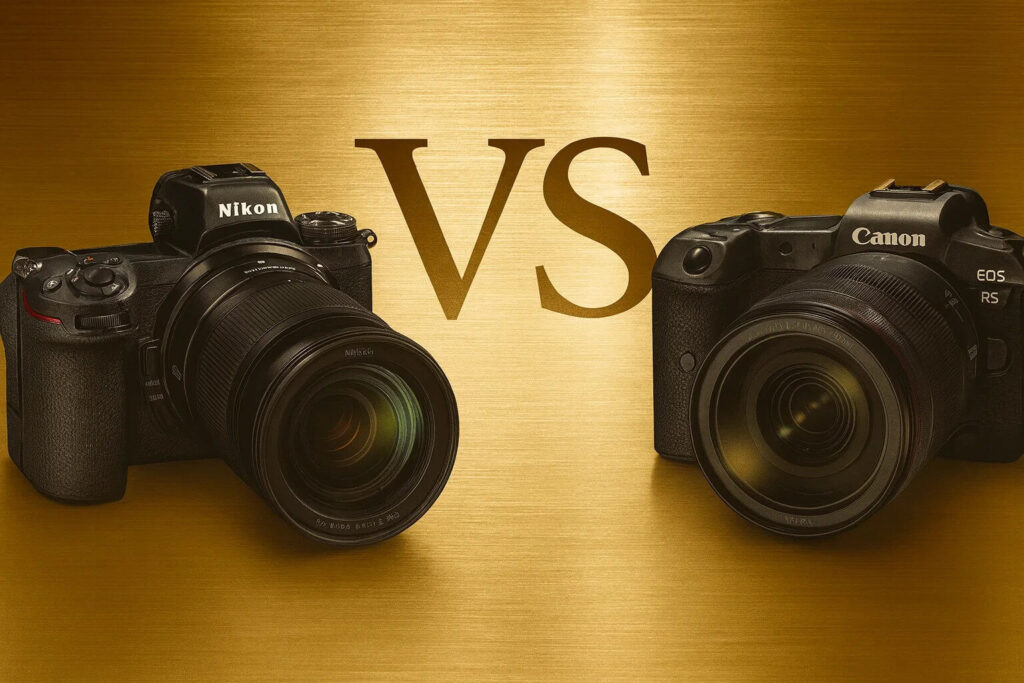
Nikon ZR vs Canon EOS C50: Specs and Features Comparison
When comparing the Nikon ZR and Canon EOS C50, both cameras target professional filmmakers and content creators who need compact cinema cameras with high video performance. Both offer full-frame sensors, RAW recording, dual base ISO, and pro-level connectivity. While Nikon ZR focuses on portability, RED-based RAW workflow, and built-in audio, Canon EOS C50 emphasizes higher resolution, open-gate flexibility, and robust rigging options. In this section, we will break down their autofocus, image quality, stabilization, video formats, audio, and usability so you can see exactly how they compare.
Autofocus
Autofocus is a critical feature for professional video and filmmaking. When comparing Nikon ZR vs Canon EOS C50, autofocus performance is a key factor for many creators. Nikon ZR uses AI-based subject recognition, which can detect people, vehicles, and moving objects with high precision. The tracking is reliable even during handheld shooting, run-and-gun scenarios, and fast-moving subjects. ZR works seamlessly with Z-mount lenses, allowing smooth focus transitions and consistent subject tracking.
Canon EOS C50, on the other hand, uses Dual Pixel CMOS AF II with advanced subject detection for faces, animals, and vehicles. Its autofocus is fast, accurate, and effective even in complex environments with multiple subjects. Both cameras offer excellent autofocus, but the approach is slightly different. Nikon ZR excels in compact, fast shooting environments, making it ideal for solo filmmakers. Canon EOS C50 provides more advanced detection and smoother transitions, making it suitable for professional cinema setups where precision is critical. When comparing Nikon ZR vs Canon EOS C50, autofocus capability is one of the strongest points for both cameras, but each shines in different shooting conditions.
Image Quality
Image quality is determined by sensor performance, color science, dynamic range, and ISO handling. In the comparison of Nikon ZR vs Canon EOS C50, both cameras deliver cinematic image quality suitable for professional video production. Nikon ZR features a 24.5 MP full-frame CMOS sensor with REDWideGamutRGB and Log3G10 color science. It has dual base ISO at 800 and 6400, offering 15+ stops of dynamic range for high-quality footage even in challenging lighting conditions. Canon EOS C50 comes with a 32 MP full-frame CMOS sensor, providing higher resolution for post-production flexibility. It supports Canon Log 2 and 3 profiles with dual base ISO also at 800 and 6400.
Its dynamic range exceeds 15 stops, giving filmmakers wide exposure latitude for creative grading. Both cameras are capable of producing cinematic images, but Nikon ZR leans toward a RAW workflow with RED-based color science, while Canon EOS C50 focuses on higher resolution, open-gate flexibility, and enhanced post-production options. For creators comparing Nikon ZR vs Canon EOS C50, image quality is a major deciding factor based on whether priority is RAW workflow or sensor resolution.
Video Formats and Recording Options
Video formats and recording options define how versatile a camera is in production. Comparing Nikon ZR vs Canon EOS C50, both cameras offer multiple professional-grade formats. Nikon ZR records 12-bit RAW internally, with maximum resolution up to 6K at 59.94 fps. It also supports N-RAW and ProRes RAW HQ for efficient high-quality recording. For slow-motion projects, it can record 4K at 119 fps and Full HD at 239.76 fps. Canon EOS C50 records 7K Cinema RAW Light at 60 fps internally, while also supporting XF-AVC and XF-HEVC 10-bit 4:2:2 formats.
It offers high frame rates such as 4K up to 120 fps and 2K up to 180 fps. Canon’s open-gate 3:2 mode uses the full sensor area for maximum flexibility. Nikon ZR favors uncompressed RAW recording for color grading freedom, while Canon EOS C50 focuses on higher resolution and flexible recording formats for structured workflows. For anyone comparing Nikon ZR vs Canon EOS C50, video format and recording flexibility is a key consideration for professional projects, especially in post-production.
Stabilization
Stabilization is essential for handheld, run-and-gun, or mobile filming. In the Nikon ZR vs Canon EOS C50 comparison, stabilization is approached differently by each camera. Nikon ZR features 5-axis in-body image stabilization (IBIS), which reduces shake and ensures smooth footage even in fast-paced or handheld scenarios. Its compact and lightweight body improves stabilization performance, making it ideal for solo operators or mobile shooting setups. Canon EOS C50 relies primarily on lens stabilization combined with external rigs for smooth results. While it can achieve stable footage, additional support is often needed for handheld shooting. Nikon ZR’s IBIS provides more convenience and mobility for creators, whereas Canon EOS C50 excels in structured setups with multiple accessories and rigging. When comparing Nikon ZR vs Canon EOS C50, stabilization plays a vital role in determining which camera is better suited for fast, solo shooting versus controlled professional setups.
Audio
Audio recording is critical for professional video production. Both cameras offer high-quality audio solutions, but in different ways. Nikon ZR provides built-in 32-bit float audio, which allows clean, detailed, and dynamic sound without the need for an external recorder in many situations. It also supports external microphones via standard jacks for more flexibility. Canon EOS C50 offers 4-channel 24-bit audio recording with XLR connections available via its detachable handle. This allows professional multi-channel audio setups for films, interviews, and commercial projects. For creators comparing Nikon ZR vs Canon EOS C50, ZR is more convenient for solo, lightweight filming, while C50 is ideal for complex productions with multiple audio sources. Both cameras provide pro-level sound, but each is optimized for different workflows and user needs.
Dynamic Range
Dynamic range is crucial for capturing details in both highlights and shadows. When comparing Nikon ZR vs Canon EOS C50, both cameras offer impressive dynamic range for professional video. Nikon ZR has dual base ISO at 800 and 6400, which allows filmmakers to maintain 15+ stops of dynamic range even in difficult lighting conditions. Its Log3G10 profile and REDWideGamutRGB color space help retain color accuracy and highlight details for grading. Canon EOS C50 also offers dual base ISO at 800 and 6400, with over 15 stops of dynamic range.
It uses Canon Log 2 and 3 for wide latitude and cinematic grading flexibility. Both cameras allow filmmakers to capture high-contrast scenes with excellent detail. Nikon ZR leans toward RAW-based workflows for ultimate flexibility, while Canon C50 excels when full-frame resolution and open-gate shooting are prioritized. For creators deciding between Nikon ZR vs Canon EOS C50, dynamic range is a major factor for low-light and high-contrast shooting.
Nikon ZR vs Canon EOS C50: Lens Compatibility
Lens options are essential for creativity and professional results. Nikon ZR supports Z-mount lenses, giving access to high-quality optics for cinema and photography. It works well with both Nikon’s prime and zoom lenses, offering versatility for filmmakers. Canon EOS C50 uses RF-mount and Canon cinema lenses, which provide professional-grade optics optimized for full-frame video. Cine lenses with advanced optics, focus gears, and anamorphic options are fully compatible. When comparing Nikon ZR vs Canon EOS C50, ZR offers more compact lens solutions for run-and-gun shooting. C50 offers high-end cinema lenses for precision control, wide apertures, and specialized effects. Both systems allow filmmakers to choose lenses based on style, workflow, and project needs. Lens flexibility is a key difference between the two cameras for professional production.
Workflow and Post-Production
Efficient workflow is important for professional creators. Nikon ZR records 12-bit RAW and ProRes formats. Its RED-based files integrate easily with major NLE software like DaVinci Resolve, Premiere Pro, and Final Cut Pro. RAW workflow allows maximum control over color grading and exposure adjustments. Canon EOS C50 records 7K Cinema RAW Light, XF-AVC, and XF-HEVC formats. Its open-gate mode and high-resolution RAW give flexibility for reframing, cropping, or stabilizing footage in post. Both cameras support dual media slots for recording and backup. When comparing Nikon ZR vs Canon EOS C50, ZR is ideal for fast-paced production and lightweight editing pipelines. C50 is better for high-resolution cinematic workflows where post-production flexibility is critical.
Nikon ZR vs Canon EOS C50: Connectivity and Ports
Connectivity is important for modern filming environments. Nikon ZR offers HDMI output, USB-C, timecode support, and Wi-Fi. It allows direct monitoring, file transfer, and cloud-based imaging recipes. Canon EOS C50 offers HDMI, USB-C, timecode, Ethernet, and Wi-Fi with adapters. It supports multi-camera setups and networked workflows. Both cameras provide professional connections for audio, monitoring, and external recorders. When comparing Nikon ZR vs Canon EOS C50, ZR is more portable for simple setups, while C50 is better for multi-camera productions and studio workflows requiring advanced connectivity.
Usability and Ergonomics
Ergonomics affect comfort and shooting efficiency. Nikon ZR is compact and lightweight at around 540 grams. It has a weather-sealed, fan-less magnesium alloy body. A bright 4″ articulating LCD makes monitoring easy in all lighting conditions. Canon EOS C50 is slightly larger but offers flexible rigging options. Its detachable handle includes XLR ports and additional control buttons. Both cameras have intuitive menus, customizable buttons, and touchscreen interfaces. When comparing Nikon ZR vs Canon EOS C50, ZR is ideal for solo creators and handheld work, while C50 is optimized for structured shoots with full rigs, external monitors, and professional setups. Both prioritize usability but cater to slightly different production styles.
High Frame Rate & Slow Motion: Nikon ZR vs Canon EOS C50
High frame rate recording is important for cinematic slow-motion effects. Nikon ZR can shoot 4K at 119.88 fps and Full HD up to 239.76 fps. It records 12-bit RAW internally, allowing high-quality slow-motion footage with excellent detail. Canon EOS C50 can shoot 4K at 120 fps and 2K up to 180 fps. Open-gate 7K recording can be used for reframing or cropping without losing resolution. Both cameras allow filmmakers to slow down action smoothly for cinematic effects. When comparing Nikon ZR vs Canon EOS C50, ZR is ideal for lightweight, fast-moving projects. C50 is better for projects requiring maximum post-production flexibility and high-resolution slow-motion.
RAW & Color Science
RAW recording and color science define creative control in video. Nikon ZR supports RED R3D NE and ProRes RAW HQ. It uses REDWideGamutRGB and Log3G10 profiles. This provides cinematic colors, wide dynamic range, and smooth gradients. Canon EOS C50 records 7K Cinema RAW Light and supports Canon Log 2/3. It preserves color details and allows wide grading latitude in post-production. Both cameras deliver high-end cinematic color. When comparing Nikon ZR vs Canon EOS C50, ZR favors RAW workflow for indie filmmakers. C50 favors high-resolution cinematic projects with more post-production options.
Build Quality & Durability: Nikon ZR vs Canon EOS C50
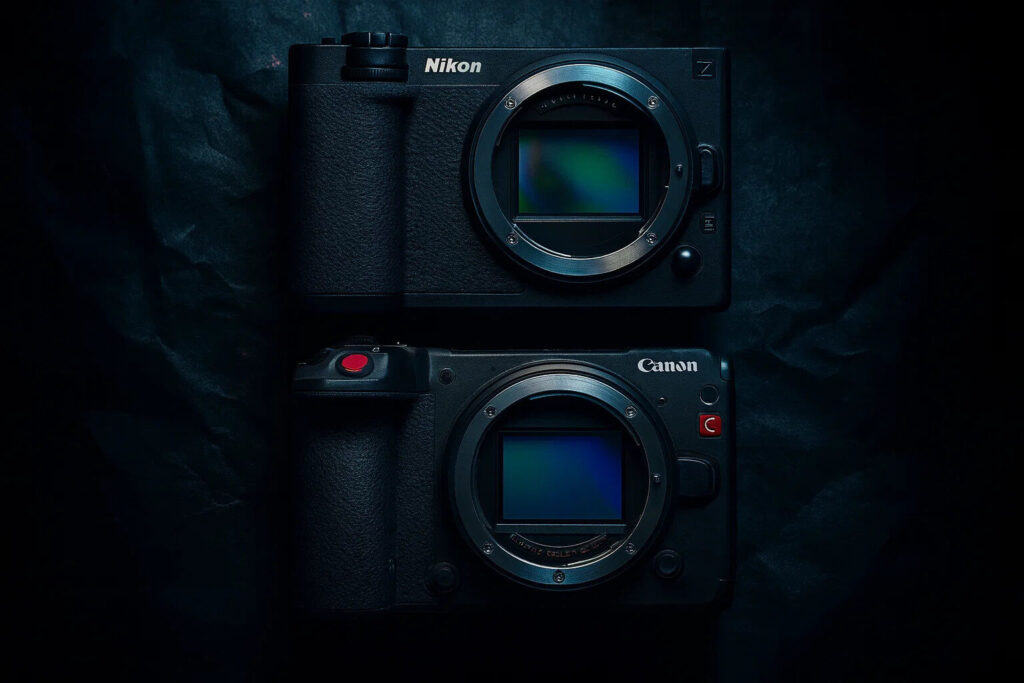
Build quality affects reliability in professional shooting. Nikon ZR has a weather-sealed, fan-less magnesium alloy body. It is compact, lightweight, and durable for outdoor and mobile shooting. Canon EOS C50 has a robust design with a detachable handle and XLR audio support. It is slightly larger but built for studio and on-set professional use. Both cameras are rugged and reliable. When comparing Nikon ZR vs Canon EOS C50, ZR is better for portable and handheld shooting. C50 is ideal for structured shoots where full rigs and accessories are required.
Media & Storage
Media options are critical for recording long and high-resolution projects. Nikon ZR supports CFexpress Type B and microSD cards. It allows high-speed recording for RAW and ProRes formats. Canon EOS C50 supports dual media slots with CFexpress Type B and SD UHS-II cards. This allows backup recording, proxy workflows, and extended shooting times. Both cameras handle professional media management efficiently. When comparing Nikon ZR vs Canon EOS C50, ZR is more compact and convenient for short shoots. C50 provides flexibility for high-resolution long projects and studio environments.
Monitoring & Display
Monitoring is important for framing, focus, and exposure. Nikon ZR has a 4″ articulating LCD with 1000 cd/m² brightness. It provides clear visuals even in bright sunlight. Canon EOS C50 has a similar bright display and supports external monitors via HDMI. Both cameras have touchscreen controls for quick adjustments. ZR is convenient for handheld or solo shooting. C50 works well with rigs and external monitoring systems. When comparing Nikon ZR vs Canon EOS C50, display and monitoring options support both lightweight and professional production workflows efficiently.
Final Verdict: Nikon ZR vs Canon EOS C50
When comparing Nikon ZR vs Canon EOS C50, both cameras are excellent for professional filmmaking and content creation. Nikon ZR is compact, lightweight, and ideal for run-and-gun shooting. It offers 12-bit RAW, high frame rates, 5-axis stabilization, and AI-based autofocus. Canon EOS C50 is slightly larger but provides higher resolution, open-gate 7K recording, advanced Dual Pixel CMOS AF II, and multi-channel audio. ZR is perfect for solo creators, indie filmmakers, and fast-paced shooting. C50 is better for structured productions, cinematic setups, and projects needing maximum post-production flexibility. Both cameras offer superb image quality, dynamic range, and professional features. Choosing between Nikon ZR vs Canon EOS C50 depends on your workflow, shooting style, and project requirements. For lightweight portability and fast shooting, Nikon ZR wins. For high-resolution cinema projects with full post-production control, Canon C50 is the better choice.
Read More of Our Blogs
- Latest Camera Rumors 2025 – Get the inside scoop on upcoming cameras and gear before they launch.
- New Camera Reviews – Detailed reviews of the latest cameras, lenses, and accessories.
- Camera Comparisons – Compare features, specs, and performance of popular cameras.
- Photography and Video Gear Updates – Stay informed about new releases and tech in the camera world.
- Top Cameras for Filmmakers – Guides and recommendations for cinema and content creation cameras.