
Introduction
The Pixii Max and Nikon Coolpix P1100 represent dramatically different philosophies in digital photography. Both cameras are already released and shipping to customers worldwide. This detailed comparison helps photographers decide which camera aligns with their shooting style and requirements. The Pixii Max caters to rangefinder enthusiasts who value premium build quality and full-frame image fidelity. Conversely, the Nikon Coolpix P1100 targets wildlife and travel photographers seeking extreme telephoto reach without carrying heavy telephoto lenses.
Release Date Overview
Pixii Max Release Date
French camera manufacturer Pixii announced the Max in July 2024. Pre-orders opened on July 5th with pricing starting at €3,999. Shipping began shortly after the announcement period. This full-frame rangefinder became the company’s flagship model. Photographers received their units throughout summer and fall 2024. The camera remains available through authorized dealers globally.
Nikon Coolpix P1100 Release Date
Nikon unveiled the Coolpix P1100 in February 2025. The camera arrived in stores during spring 2025. This superzoom bridge camera succeeded the popular P1000 model. The P1100 replaced the P1000 that was discontinued in 2024. Distribution expanded worldwide within weeks. Availability has remained strong across major retailers.
Specification Comparison Table
| Feature | Pixii Max | Nikon Coolpix P1100 |
|---|---|---|
| Sensor Type | Full-Frame BSI CMOS | 1/2.3″ BSI-CMOS |
| Resolution | 24.5MP | 16MP |
| Processor | 64-bit processor | EXPEED |
| ISO Range | 100-25600 (exp. to 80-51200) | 100-6400 |
| Autofocus System | Manual Focus (Rangefinder) | Contrast-detect AF |
| Stabilization | In-lens (lens dependent) | Dual Detect Optical VR (4 stops) |
| Video Recording | No video capability | 4K UHD 30p, FHD 60p |
| EVF | Optical rangefinder (0.67x) | 2.36M-dot OLED EVF |
| LCD Screen | Rear touchscreen | 3.2″ vari-angle (non-touch) |
| Burst Shooting | 1.0 fps | Up to 7 fps |
| Battery | Rechargeable Li-ion | EN-EL20a |
| Storage | 32GB or 128GB internal | SD/SDHC/SDXC card |
| Connectivity | Wi-Fi, Bluetooth, USB-C | Wi-Fi, Bluetooth 5.2, USB-C |
| Weight | 480g (body only) | 1,410g (with lens) |
| Price at Launch | $4,325 / €3,999 | $1,099.95 |
Sensor and Image Quality Comparison
The Pixii Max features a high-performance 24.5MP full-frame sensor with 5.94 μm photodiodes. This large 36 x 24mm sensor delivers exceptional imaging capabilities across diverse shooting conditions. DxOMark testing showed the sensor achieves 25.2 bits of color depth, 13.6 stops of dynamic range, and a low-light score of 3,108. The full-frame format provides beautiful depth of field control and superior bokeh rendering. Low-light performance stands out dramatically with clean images even at higher ISO settings. Dynamic range allows photographers to recover highlights and shadows effectively in post-processing.
In stark contrast, the Nikon Coolpix P1100 uses a 16MP backside-illuminated CMOS sensor measuring just 1/2.3 inches. This sensor has approximately 1/30th the imaging area of a full-frame sensor. The compact sensor enables the camera’s extraordinary 125x zoom lens design. However, image quality suffers in dim conditions, with noticeable noise and detail loss even at ISO 800. Dynamic range proves limited compared to larger sensors. Color accuracy remains good in optimal lighting conditions. The f/8 maximum aperture at telephoto ranges combined with the limited ISO ceiling restricts low-light shooting.
The Pixii Max dominates for pure image quality metrics. Its full-frame sensor captures significantly more detail, handles challenging lighting better, and offers professional-grade output. Nevertheless, the Nikon P1100 delivers acceptable results for its intended wildlife and travel photography applications when shooting in good light.
Autofocus Performance Comparison
The Pixii Max employs a traditional rangefinder focusing system requiring complete manual operation. The rangefinder uses images from two viewfinder windows that collapse into a single image linked to the camera’s distance setting. This analog approach produces accurate results, especially at shorter focal lengths and in challenging lighting. Speed and accuracy depend entirely on the photographer’s skill level. Some users find the rangefinder patch quality disappointing for a camera at this price point. The learning curve proves steep for photographers accustomed to autofocus systems. This method rewards patience and deliberate composition.
The Nikon Coolpix P1100 features contrast-detection autofocus. The system includes subject tracking capabilities across the frame. If subjects move reasonably predictably, the autofocus system can maintain focus adequately. However, the system struggles with fast-moving subjects and can be slow to acquire focus. The camera lacks animal subject detection, which limits its performance for wildlife video. The Bird Watching mode optimizes settings for avian photography. Real-world usability proves straightforward for beginners.
For ease of use, the Nikon P1100 wins decisively with its automated focusing system. Conversely, the Pixii Max appeals exclusively to photographers who embrace manual focusing techniques and have rangefinder experience.
Video Capabilities Comparison
The Pixii Max offers absolutely no video recording functionality. This camera focuses purely on still photography without compromise. Pixii designed the Max exclusively for photographers who prioritize image-making over multimedia content creation. Video shooters must eliminate this option entirely from consideration.
The Nikon Coolpix P1100 records 4K UHD video at 30fps and Full HD at 60fps. Additional frame rate options include 720p at higher speeds. The Dual Detect Optical VR provides four stops of stabilization to keep videos steady during handheld shooting. However, the camera lacks advanced features like log profiles for color grading. Video autofocus struggles without animal subject detection, making it slow to track wildlife. The vari-angle screen assists with creative shooting angles. Overall video quality suits casual recording rather than professional production.
For content creators requiring both stills and video, the Nikon P1100 provides clear advantages. Meanwhile, pure photographers may appreciate the Pixii’s singular focus on still image excellence.
Design and Handling Comparison
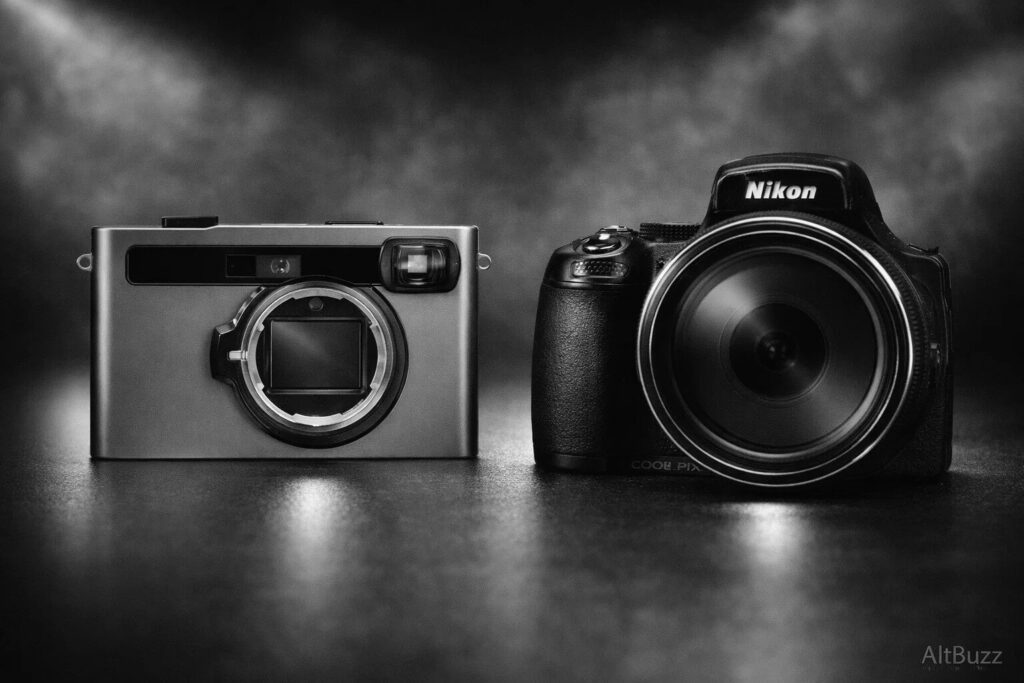
The Pixii Max features a machined-aluminum body weighing just 480 grams. This compact rangefinder design prioritizes portability and discrete shooting. The camera lacks a rear screen, with settings displayed on a top OLED panel. Button layout follows minimalist rangefinder conventions with essential controls only. The new wide-angle optical viewfinder features high-quality optics with advanced coatings for enhanced clarity. Weather sealing protects the camera body against environmental elements. The grip remains modest, favoring compactness over extended comfort. Build quality reflects premium craftsmanship throughout.
The Nikon Coolpix P1100 weighs 1,410 grams and measures 181mm in length when extended. The bridge camera design incorporates a substantial grip for secure handling during long sessions. Ergonomics prove excellent, with camera controls fitting naturally into photographers’ hands. A control ring on the lens barrel allows adjustments for focus, exposure, white balance, and ISO. Multiple zoom controls provide flexibility including a snap-back button for quick subject reacquisition. The 3.2-inch vari-angle LCD complements the 2.36M-dot OLED electronic viewfinder. Unfortunately, the camera lacks weather resistance, requiring protection during unpredictable conditions.
Both cameras excel in their respective design philosophies. The Pixii Max delivers compact precision for deliberate photography. On the other hand, the Nikon P1100 offers comfortable all-day handling for extended wildlife observation sessions.
Battery Life and Connectivity
The Pixii Max delivers approximately 250 shots per charge. The rechargeable lithium-ion battery supports USB-C charging for convenient power management. Wi-Fi and Bluetooth connectivity enable wireless image transfer and remote camera control. The modern connectivity suite supports smartphone integration and cloud workflows. Battery performance varies based on shooting intensity and environmental conditions. Carrying spare batteries proves advisable for extended shooting sessions.
The Nikon Coolpix P1100 runs on the EN-EL20a battery, rated for approximately 260 shots per CIPA standards. Battery life typically covers a full day of moderate shooting. USB-C charging allows power bank compatibility during travel. Wireless connectivity operates via WPA3-SAE Wi-Fi and Bluetooth 5.2. SnapBridge technology facilitates seamless photo sharing to mobile devices. Remote control options include the optional ML-L7 wireless remote for ISO, zoom, and aperture adjustments.
Both cameras provide modern connectivity features suitable for contemporary workflows. The Nikon P1100 edges ahead slightly with newer Bluetooth standards and more extensive remote control options.
Lens and Zoom Capabilities
The Pixii Max accepts Leica M-mount lenses exclusively. This mount compatibility provides access to state-of-the-art imaging with time-honored analog shooting processes. Photographers can choose from extensive M-mount lens collections spanning vintage classics to modern optical designs. Lens investment costs range from hundreds to thousands of dollars per optic. The interchangeable lens system offers maximum creative flexibility. Wide-angle, normal, and moderate telephoto focal lengths work best with the rangefinder focusing system.
The Nikon Coolpix P1100 features a built-in 125x optical zoom lens covering 24-3000mm in full-frame equivalent. The NIKKOR lens construction includes 17 elements in 12 groups with one Super ED and five ED lens elements. Dynamic Fine digital zoom extends reach to an equivalent 6000mm. This all-in-one design eliminates lens changing entirely. However, the lens extension mechanism operates slowly, potentially missing fleeting wildlife moments. At 2000-3000mm, images maintain reasonable detail despite the extreme focal length.
The comparison highlights fundamentally different approaches. The Pixii Max offers lens flexibility with significant additional investment. Conversely, the Nikon P1100 provides unprecedented zoom range in a single, affordable package.
Price and Value Comparison
The Pixii Max launched at €3,999 (approximately $4,325) for the 32GB model and €4,249 for the 128GB version. These prices cover the body only without lenses. Quality M-mount lenses add thousands of dollars to the total investment. Current market prices remain near launch levels due to limited production. Value proposition centers on premium build quality, full-frame sensor performance, and unique rangefinder experience. Target users include professional photographers, serious enthusiasts, and rangefinder devotees willing to invest significantly. Pixii offers upgrade paths for existing camera owners, preserving their investment.
The Nikon Coolpix P1100 debuted at $1,099.95 as a complete, ready-to-shoot system. This single purchase includes the camera body and extraordinary zoom lens. Modest retailer discounts occasionally appear for this model. While expensive for a compact camera, the value becomes reasonable considering the included capabilities. Target users include wildlife photographers, birders, travelers, and hobbyists wanting extensive reach without interchangeable lens complexity. The P1100 offers capabilities most consumer cameras and smartphones cannot match at any price.
For sheer value per dollar, the Nikon P1100 delivers phenomenal zoom capability at a fraction of the Pixii’s investment. However, the Pixii Max provides full-frame excellence and premium craftsmanship for discerning photographers with appropriate budgets.
Which Camera Should You Choose?
The Pixii Max excels in image quality, sensor performance, build craftsmanship, and photographic purity. Its sensor performance rivals even top-tier full-frame cameras in dynamic range and color reproduction. It suits experienced photographers who embrace manual focus and appreciate rangefinder shooting methodology. Full-frame image quality remains unmatched in this comparison. Additionally, compatibility with extensive M-mount lens ecosystems provides remarkable creative possibilities. The camera rewards deliberate, thoughtful photography over rapid-fire shooting.
The Nikon Coolpix P1100 shines in versatility, accessibility, and unprecedented telephoto reach. The 125x optical zoom makes it possible to capture subjects barely visible to the naked eye. It serves wildlife photographers, bird watchers, travel shooters, and anyone needing extreme zoom capability without heavy gear. Video functionality adds significant practical value for multimedia creators. Furthermore, the all-in-one design eliminates lens investment decisions entirely. For amateur photographers passionate about wildlife and the moon, this camera delivers images most other cameras cannot achieve.
Choose the Pixii Max if you prioritize ultimate image quality, appreciate rangefinder methodology, and have budget for premium equipment plus lens investments. Select the Nikon Coolpix P1100 if you need massive telephoto reach, video capability, autofocus convenience, and an all-in-one solution at accessible pricing. Your photography style, subject matter, and budget determine the optimal choice between these fundamentally different cameras.
Read More from AltBuzz
Read more from AltBuzz for camera reviews, in-depth comparisons, and detailed specs. AltBuzz delivers clear and trusted camera insights.
Subscribe AltBuzz YouTube Channel
Stay updated with camera comparisons and hands-on reviews. AltBuzz covers the latest photography gear. Subscribe AltBuzz for the latest updates.