
Nikon Z8 Full Review: Specs, Performance & Verdict
The Nikon Z8 is officially released and has been widely available since May 2023. It is one of the most significant professional camera releases in recent memory, and its impact on the mirrorless market has been substantial. Nikon took the core specifications of its flagship Nikon Z9, which launched at approximately $5,500, and delivered them in a smaller, lighter, and more affordable body priced at $3,999. The photography and videography community responded immediately: the Nikon Z8 sold out at launch and remained backordered for months in multiple markets.
Understanding why the Z8 caused this response requires knowing what it actually offers. A 45.7-megapixel fully stacked CMOS sensor. The same EXPEED 7 processor as the Z9. 8K RAW internal video. Completely silent and blackout-free electronic shooting. Twenty frames per second full-frame continuous capture. 120fps pre-release buffer shooting in DX crop. Deep learning subject detection covering humans, animals, vehicles, and aircraft. These are flagship specifications by any reasonable standard.
The Nikon Z8 is designed for professional photographers and serious enthusiasts who need maximum image quality, maximum reliability, and maximum flexibility across both photography and video. It does not make significant compromises compared to the Z9. The primary difference is the absence of the integrated vertical grip, which reduces the body size and weight by approximately 30 percent and lowers the price by approximately $1,500.
This review covers the Nikon Z8 in complete detail. We examine its sensor performance, autofocus capabilities, video specifications, body design and handling, battery life, connectivity features, and real-world performance across multiple photographic disciplines. By the end, you will have a thorough understanding of what the Nikon Z8 delivers and whether it is the right professional tool for your specific needs.
Release Date and Market Position of the Nikon Z8
Nikon announced the Z8 on May 10, 2023, and began shipping it globally immediately following the announcement at a body-only launch price of $3,999. The speed from announcement to availability was unusually fast and reflected Nikon’s confidence in the product’s readiness for immediate delivery.
The Z8 occupies a carefully defined position in both Nikon’s lineup and the broader professional mirrorless market. Within Nikon’s Z-system, it sits one tier below the Z9 and one tier above the Z6 III in terms of capability and price. Against competitors, its primary rivals at launch were the Sony a7R V, Canon EOS R5, and systems targeting the resolution-demanding professional segment. The Z8 competed favorably against all of them in most practical specifications and exceeded them in several key areas, particularly video capabilities and electronic shutter performance.
Since its May 2023 launch, the Nikon Z8 has received numerous substantial firmware updates. These updates added 8K 30fps RAW with ProRes RAW HQ, expanded pre-release capture to 1 second at 120fps, added new autofocus modes including a sophisticated auto-capture trigger system, improved stabilization algorithms, added new video recording formats, and extended compatibility with accessories. Nikon’s post-launch firmware support for the Z8 has been exceptional and demonstrates a long-term commitment to the product that significantly extends its competitive lifespan.
The Z8’s target audience includes professional sports and wildlife photographers who need speed and reliability, commercial photographers who demand high resolution, wedding photographers who want both image quality and operational confidence, and video professionals who need broadcast-quality footage from a camera that also handles stills. It is a generalist professional tool executed at the highest level.
Nikon Z8 Full Specifications Table
| Feature | Details |
|---|---|
| Sensor Type | 45.7MP Full-Frame Fully Stacked CMOS (identical to Nikon Z9) |
| Resolution | 45.7 Megapixels |
| Processor | EXPEED 7 |
| ISO Range | 64 to 25,600 (expandable to 32 to 102,400) |
| Autofocus System | 493-point hybrid phase-detection and contrast AF with deep learning multi-subject detection |
| Stabilization | 5-axis IBIS, up to 6 stops; enhanced performance via firmware |
| Video Recording | 8K 30p RAW internal, 4K 120p (crop), 4K 60p oversampled, ProRes RAW HQ, N-RAW 12-bit |
| EVF | Quad-VGA OLED 3.69M-dot, 120fps refresh, 0.8x magnification |
| LCD Screen | 3.2-inch fully articulating 2.1M-dot touchscreen |
| Burst Shooting | 20 fps full-frame with full AF and AE, 120fps pre-release in DX crop |
| Battery | EN-EL15c, approx. 340 shots CIPA; continuous USB-C power supported |
| Storage | CFexpress Type B plus SD UHS-II dual card slots |
| Connectivity | Wi-Fi, Bluetooth, USB 3.2 Gen 2 Type-C, full-size HDMI Type A, 3.5mm mic and headphone |
| Weight | 883g with battery and card |
| Launch Price | $3,999 USD body only |
Sensor and Image Quality on the Nikon Z8
The 45.7MP Fully Stacked CMOS Sensor
The Nikon Z8 uses a 45.7-megapixel fully stacked CMOS sensor that is physically and electronically identical to the sensor found in the Nikon Z9. Fully stacked architecture places dedicated memory chips directly beneath the imaging sensor in a complete stacked arrangement. This configuration enables the fastest possible data readout speeds, essentially eliminating the time gap between capturing a frame and transmitting its data to the image processor.
The consequences of this fast readout are transformative for certain aspects of camera performance. Rolling shutter distortion is reduced to such a minimal level that it is essentially invisible in practical shooting scenarios. The camera’s electronic shutter, at up to 20fps, produces images with no visible distortion even when photographing fast lateral movement, rotating objects, or subjects illuminated by high-frequency artificial light sources.
The 45.7-megapixel resolution provides images with exceptional detail. Each image contains approximately 8,688 x 5,792 pixels, enabling enormous print sizes, aggressive cropping without quality loss, and the kind of fine detail rendering that professional commercial, advertising, and fine art clients expect.
Real-World Image Quality at 45 Megapixels
At 45.7 megapixels, the Nikon Z8 produces images with a level of detail that is immediately distinguishable from lower-resolution cameras when viewed at full size or in large-format prints. Fine textures such as fabric weave, feather barbs, skin pores, and architectural detail are rendered with a precision that rewards high-quality optics and careful shooting technique.
Portrait photography benefits significantly from the high resolution. Close-up portraits reveal a level of micro-texture in skin and eyes that gives images a three-dimensional, sculptural quality. Fashion and beauty photographers who deliver to campaigns requiring extreme retouching latitude will find the Z8’s files respond exceptionally well to high-magnification editing.
Landscape photographers benefit equally. Mountain ranges, forest canopies, urban skylines, and seascape scenes captured at base ISO contain enough pixel information to create photomural prints at exhibition scale. In-camera JPEG and HEIF processing from the EXPEED 7 is outstanding. Even at the full 45.7-megapixel resolution, the processor delivers clean, well-detailed, and color-accurate JPEGs that require minimal adjustment before publishing.
Dynamic Range and RAW File Quality
The Nikon Z8 provides approximately 14 or more stops of dynamic range in optimal shooting conditions. This figure places it among the best performing full-frame sensors available from any manufacturer. Highlight retention is exceptional, preserving detail in bright areas that less capable sensors would clip to pure white. Shadow lifting in post-processing reveals clean, detailed information several stops below the midtone exposure.
RAW files from the Z8 respond outstandingly well to editing in all major professional software packages. Lightroom, Capture One, DXO PhotoLab, and Nikon’s own NX Studio all handle the files with excellent detail retention, color accuracy, and tonal control. A notable advantage of the high-resolution sensor is that pixel-level noise, when present, is significantly less visible at normal output sizes. A noisy 45MP image downsampled to 24MP for delivery has effectively undergone noise averaging, producing a cleaner output file than a natively noisy 24MP image.
Color Rendering and Nikon Color Science
Nikon’s color science on the Z8 delivers neutral, accurate, and highly professional color rendering. Nikon’s approach prioritizes accuracy and editing latitude over in-camera punch or stylization. This philosophy suits professional photographers who process their own images and require a reliable, consistent starting point that responds predictably to their established editing workflows.
Skin tone rendering is particularly strong. The Z8 captures a nuanced range of skin tones across diverse complexions with natural transitions between highlights and shadows. Video color science extends the same philosophy to the moving image. N-Log and Z-Log profiles provide comprehensive latitude for professional color grading. Nikon’s Imaging Recipes, downloadable through Nikon Imaging Cloud, enable specific cinematic looks to be applied consistently across all cameras on a multi-camera production.
Autofocus Performance on the Nikon Z8
493-Point Deep Learning AF Architecture
The Nikon Z8’s autofocus system uses 493 phase-detection AF points distributed across the frame, combined with AI-driven deep learning subject classification and tracking. This is identical to the AF system in the Nikon Z9, Nikon’s top professional camera used by the world’s leading sports and wildlife photographers. Receiving Z9-identical AF in a $3,999 body represents extraordinary value for photographers who depend on autofocus reliability for their professional income.
The deep learning algorithms running on the EXPEED 7 processor analyze each frame in real time to identify and classify subjects. Human subjects are detected at the most granular level, with full-body detection, face detection, and bilateral eye detection all available simultaneously. The system selects the most appropriate detection level based on subject distance and framing automatically, removing the need for manual switching between AF modes as conditions change.
Multi-Subject Detection Across Categories
Subject detection on the Z8 covers humans, animals, vehicles, and aircraft. Within each category, the detection operates at a level of specificity that surpasses most competitors. Animal detection covers specific animal types, with dedicated recognition models for dogs, cats, and birds. Bird recognition handles subjects in flight at distance, in low contrast conditions, and during fast directional changes with reliability that rivals dedicated wildlife tracking cameras.
Vehicle detection covers cars, motorcycles, bicycles, and trains. Aircraft detection handles both fixed-wing and rotary aircraft, making the Z8 genuinely useful for aviation photography and airshow coverage. The breadth of subject category support means that the Z8 handles virtually any subject type a working professional photographer encounters.
Pre-Release Capture and Buffer Performance
Pre-release capture is one of the most operationally powerful features in the Nikon Z8 and represents a genuinely new approach to capturing decisive moments. When enabled, the camera continuously buffers up to 1 second of images before the shutter release is fully pressed. In DX crop mode at 120fps, this means the camera stores 120 frames of recent history, any of which can be included in the captured sequence.
The practical impact of this feature on hit rates for sports, wildlife, and event photography is transformative. Moments that were previously missed because the photographer’s finger was a fraction of a second late are now routinely captured. Timing-dependent shots such as a bird catching a fish, an athlete clearing a bar, or a precise peak-action moment in a dance performance can now be captured with a consistency that previously required perfect anticipation or significant luck.
Buffer depth at 20fps in full RAW is generous, enabling sustained burst sequences long enough to cover most peak-action windows before requiring a writing pause. CFexpress Type B storage speeds further minimize the actual write time, keeping the buffer cleared rapidly for the next burst sequence.
AF Performance in Low Light and Challenging Conditions
The Z8’s autofocus maintains strong performance in low-light environments. The combination of phase-detection AF across the full frame and the EXPEED 7 processor’s real-time deep learning analysis enables reliable focus acquisition and maintenance at light levels where many competing systems resort to slow contrast-detection hunting. Shooting at indoor concerts, low-light events, and dawn and dusk wildlife sessions is supported with confidence.
In challenging conditions such as strong backlight, fast lateral movement, subjects against complex backgrounds, and multiple overlapping subjects in the frame, the Z8’s AF demonstrates the robustness expected of a system derived from professional sports photography equipment.
Video Capabilities of the Nikon Z8
8K RAW Internal Video Recording
The Nikon Z8 records 8K RAW video internally at up to 30fps. At launch, this was one of the most ambitious video specifications available in any camera regardless of price. The ability to capture 8K at full 12-bit RAW quality to CFexpress Type B cards internally, without needing an external recorder, places the Z8 in a production tier previously reserved for dedicated cinema cameras.
8K RAW footage provides extraordinary post-production flexibility. Colorists working with Z8 footage have access to the full sensor data, uncompressed and unprocessed, giving them the maximum possible latitude for color grading, noise reduction, and output optimization. The 8K resolution also enables 4K delivery from heavily cropped regions of the frame, effectively providing additional focal length options in post-production without any loss of final output quality.
Storage requirements for 8K RAW recording are substantial. A one-hour sequence in 8K N-RAW fills a 256GB CFexpress card, so productions working in 8K RAW need to budget for significant storage capacity. For standard YouTube and social media production, the lower-resolution modes provide equivalent or better practical value.
4K Video Modes and Oversampling Quality
For 4K delivery, the Z8 offers exceptional quality through full-sensor 8K oversampling. At 4K 30p and 24p, the camera reads the complete 8K sensor and downsamples to the 4K output, producing arguably the finest 4K image quality achievable from any hybrid camera. The oversampled 4K from the Z8’s stacked sensor rivals dedicated cinema camera output in terms of sharpness, detail, noise performance, and color fidelity.
At 4K 60p, the camera applies a modest crop to the sensor readout to enable the higher frame rate. Even with this crop, the image quality at 4K 60p is outstanding compared to most competing cameras. The 4K 120fps mode in DX crop provides professional-quality high frame rate footage for slow-motion applications. At 5x or greater slow motion speeds, the preserved image quality and natural motion rendering competes with cameras specifically engineered for high frame rate applications.
ProRes RAW, N-RAW, and Log Video Profiles
The Z8’s video recording format options cover every major professional post-production pipeline. N-RAW 12-bit internal recording stores the full sensor data in Nikon’s native RAW video format, supported natively by DaVinci Resolve and compatible with most professional NLEs. ProRes RAW HQ recording targets Final Cut Pro X workflows, delivering RAW quality with ProRes decode efficiency.
ProRes 422 HQ provides a high-quality compressed recording option for productions that do not require RAW flexibility. This format is universally compatible with professional editing software and produces smaller files than RAW formats while maintaining excellent image quality for most delivery standards. N-Log and Z-Log profiles deliver flat, grading-ready footage in the non-RAW recording modes and are well-supported by comprehensive LUT packages available from Nikon and third parties.
IBIS, Focus Point VR, and Stabilization in Video
The Nikon Z8’s 5-axis IBIS provides essential stabilization support for handheld and mobile video production. In conjunction with electronic VR, the combined stabilization enables smooth handheld footage in walking, panning, and stationary shooting scenarios. The effectiveness for narrative and documentary handheld shooting is sufficient to produce usable footage in many situations without a gimbal.
Focus Point VR applies stabilization compensation relative to the active AF point rather than the frame center, producing more natural-looking results during tracking shots compared to frame-center electronic stabilization. This innovation is particularly noticeable during panning sequences where a subject is tracked across the frame. The stabilization keeps the subject stable rather than the background, which is the perceptually correct behavior for a tracking shot and significantly improves the professional appearance of handheld tracking footage.
Heat Management and Recording Duration
The Z8’s stacked sensor generates significant heat during extended 8K and 4K recording sessions. Nikon has engineered the body with internal heat management pathways. In 4K modes, the Z8 records for 2 or more hours continuously in moderate ambient temperatures. In 8K RAW mode, recording durations are typically 30 to 40 minutes in standard conditions before thermal management intervenes.
Firmware updates since launch have progressively improved thermal management algorithms, extending maximum continuous recording times beyond launch specifications. For productions requiring extended continuous 8K recording, careful interval management between recording sessions is recommended.
Design, Build Quality, and Handling of the Nikon Z8
Magnesium Alloy Build and Professional Weather Sealing
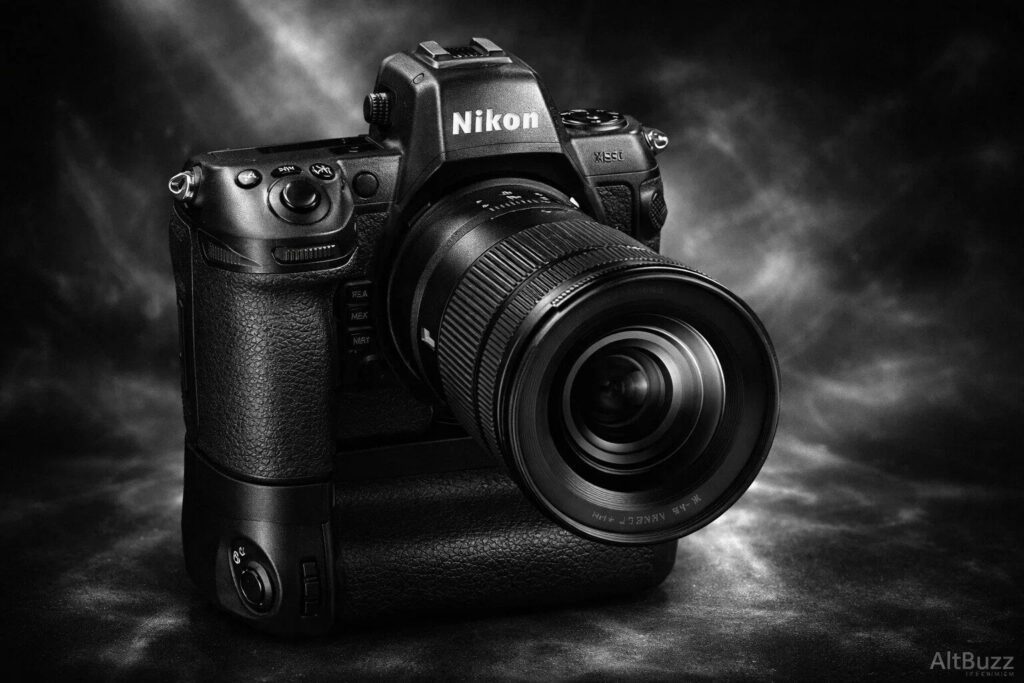
The Nikon Z8 is constructed from a high-rigidity magnesium alloy throughout the main body structure. Professional-grade weather sealing is applied comprehensively to all body seams, port covers, dial surrounds, and button housings. The sealing quality matches or exceeds what Nikon provides in the Z9 flagship and is field-tested for reliable operation in rain, dust, humidity, and temperature extremes representative of professional outdoor shooting conditions.
The physical robustness of the Z8 gives working professionals the confidence to use it without excessive concern in demanding environments. Wildlife photographers shooting in rainforest humidity, sports photographers working through a rain-soaked stadium, and documentary filmmakers operating in dusty or coastal environments can all rely on the Z8’s protection.
Silent Shooting and the Electronic Shutter Advantage
The Nikon Z8 uses an exclusively electronic shutter system. There is no mechanical shutter in this camera. This design choice is enabled by the fully stacked sensor’s ultra-fast readout, which eliminates the rolling shutter distortion that makes electronic shutters impractical in conventional BSI sensors for fast subjects.
Complete silence during shooting is a significant practical advantage in many professional contexts. Concert and performance photographers who must not disrupt musicians can shoot continuously without any audible mechanical shutter operation. Wedding ceremony photographers can capture intimate moments without the distraction of shutter sounds. Wildlife photographers can approach sensitive animals without audible camera operation triggering behavioral changes.
The absence of mechanical shutter also eliminates shutter wear as a service interval concern. Conventional cameras specify rated shutter actuation counts that determine service intervals, typically in the 300,000 to 500,000 range for professional bodies. The Z8’s electronic shutter has no mechanical wear cycle, theoretically extending the camera’s operational life beyond comparable mechanical shutter limits.
Viewfinder and LCD System
The Z8 features a quad-VGA OLED electronic viewfinder at 3.69 million dots with a 120fps refresh rate. The 0.8x magnification provides a comfortable viewing scale for the range of hand sizes and shooting styles encountered in professional use. The fully articulating 3.2-inch 2.1-million-dot touchscreen provides flexible positioning for the diverse shooting orientations required in professional work. Low-angle wildlife photography benefits from tilting the screen upward for ground-level composition. The vlogging position, with the screen facing forward, enables self-recording for documentary and behind-the-scenes content.
Operational Controls and Customization Depth
The Z8’s control layout is designed for professional operational efficiency. Multiple programmable function buttons, dual control dials, a multi-selector joystick, a sub-selector, and the primary AF point joystick provide complete control access without taking the eye from the viewfinder. The i-button provides rapid access to a configurable set of frequently used settings through a single button press.
Customization depth in the Z8 is comprehensive. Virtually every button on the body can be assigned to a custom function from an extensive list. Custom banks for both photography and video allow instant switching between pre-configured complete settings profiles, enabling a photographer to move between completely different shooting configurations in seconds.
Battery Life and Connectivity on the Nikon Z8
Battery Life in Professional Use
The Nikon Z8 uses the EN-EL15c battery, rated at approximately 340 shots per charge under CIPA testing conditions. In real-world professional use, typical field performance ranges from 350 to 550 shots per charge depending on shooting style. For video recording, battery consumption is higher than in stills mode. At 4K resolution, the Z8 provides approximately 60 to 90 minutes of continuous recording per battery charge.
For sustained video productions, the USB-C power delivery input enables continuous operation from an AC adapter or large-capacity power bank. Professional photographers working full shooting days should carry a minimum of three charged batteries to ensure uninterrupted coverage. The optional MB-N12 battery grip accessory accepts two EN-EL15c batteries simultaneously, effectively doubling capacity and improving vertical shooting ergonomics.
USB-C Power Delivery and Field Operations
USB 3.2 Gen 2 connectivity via USB-C provides both high-speed data transfer and power delivery simultaneously. The USB power delivery input enables the camera to operate continuously from external power without relying on the battery, which is valuable for time-lapse sequences, fixed installation shots, livestreaming, and studio portrait or product photography sessions where the camera remains stationary.
The high-speed USB 3.2 Gen 2 connection enables tethered shooting directly to a computer running compatible software. Tethered capture with the Nikon Z8 delivers RAW files to editing software in near real time, enabling immediate client review of images during studio sessions.
Dual Card Slot Professional Configuration
The Z8’s dual card slot configuration pairs CFexpress Type B and SD UHS-II. For 8K RAW and high-bitrate video recording, the CFexpress slot provides the write speed performance essential for reliable operation. The SD slot serves backup recording, overflow management, or JPEG destination functions.
Simultaneous backup recording writes each image to both cards at the time of capture, providing real-time data redundancy that is a professional requirement for assignment and commercial photography. Card failure during an uncoverable event such as a wedding ceremony is a career-damaging scenario that dual-card backup recording comprehensively mitigates.
Full-Size HDMI and External Recording
The full-size HDMI Type A output on the Nikon Z8 provides a clean, uncompressed video signal to external recorders, field monitors, and live production equipment. Connecting the Z8 to an Atomos Sumo or a Blackmagic Video Assist extends the camera’s recording capabilities for productions that require monitoring on a larger display or recording to an external drive. For live broadcast applications, the HDMI output feeds directly to a production switcher, enabling the Z8 to serve as a live camera in multi-camera studio or field productions.
Real-World Use Cases for the Nikon Z8
Professional Sports and Action Photography
Sports and action photography represents the most demanding use case for any camera system’s autofocus, speed, and reliability capabilities. The Nikon Z8 handles this use case at the highest level. The 20fps continuous shooting with Z9-derived deep learning subject tracking maintains lock on the most challenging subjects: sprinters in mid-stride, football players in contact, cyclists in a pack, and tennis players at ball impact. The 120fps pre-release capture in DX crop mode adds a critical timing safety net for peak-action moments that traditional burst shooting cannot guarantee.
The completely silent electronic shutter enables unobtrusive shooting from courtside, trackside, and any access position where audible mechanical shutter operation might attract unwanted attention or distract athletes. The weather sealing ensures reliable operation in the outdoor conditions typical of professional sports venues, including rain-soaked football stadiums, dusty athletics tracks, and high-humidity swimming pools.
Wildlife and Nature Photography
Wildlife photography demands a unique combination of AF reliability across diverse subject types, high-resolution capture for distant subjects, weather sealing for field conditions, and silent operation for sensitive animals. The Nikon Z8 addresses every one of these requirements at the professional level. The Z9-derived subject detection handles birds, mammals, reptiles, and insects with a depth of recognition capability that is not available in any competitor at this price point.
The 45.7MP resolution provides critical cropping latitude for wildlife photography, where obtaining a tight composition in-camera is frequently impossible due to subject behavior and access limitations. A wildlife image captured at 45MP and cropped to 24MP equivalent maintains excellent output quality for editorial and gallery use. This cropping flexibility effectively extends the useful focal length range of every lens in the system.
Commercial, Advertising, and High-End Portrait Photography
Commercial and advertising photographers who deliver to clients requiring maximum technical quality find the Z8’s 45.7MP resolution and excellent RAW file quality ideal for their workflow. Beauty retouching, product detail photography, architectural interiors, and fashion campaigns all benefit from the additional pixel information the Z8 provides. The tethered shooting capability via USB-C enables real-time client review that is standard practice in commercial studio work.
Wedding photographers who want a single body to handle the entire event workflow benefit from the Z8’s breadth of capability. Silent shooting during the ceremony, reliable face detection during the first dance, dual card backup for all critical moments, and strong high-ISO performance in dimly lit venues combine to make the Z8 one of the most complete wedding photography tools available.
Professional Video and Film Production
For video professionals, the Z8 functions as a serious production camera. 8K RAW internal recording places it in a quality tier that genuinely competes with dedicated cinema cameras from Sony, Canon, and Blackmagic at a fraction of their price. A documentary filmmaker who needs a weather-sealed, autofocus-capable camera that also delivers broadcast-quality footage benefits uniquely from the Z8’s hybrid design.
The combination of IBIS, reliable continuous AF tracking, dual card backup, headphone monitoring, and full-size HDMI output creates a self-contained professional video production system. Independent filmmakers, commercial directors, and content producers who require maximum creative flexibility from a single camera body will find the Z8’s specification breadth genuinely enables productions that would otherwise require multiple specialized cameras.
Pros and Cons of the Nikon Z8
Pros
- 45.7MP fully stacked CMOS sensor delivering identical performance to the flagship Nikon Z9
- 8K 30p RAW internal video recording with ProRes RAW HQ and ProRes 422 HQ
- Completely silent electronic shutter with effectively zero rolling shutter distortion
- Deep learning subject detection covering people, animals, birds, vehicles, and aircraft
- 20fps full-frame continuous shooting with Z9-class AF and AE tracking
- Pre-release capture buffer at up to 120fps for 1 second prior to shutter press
- 5-axis IBIS with Focus Point VR for natural-looking video stabilization
- Professional weather sealing in magnesium alloy construction
- Dual CFexpress Type B plus SD UHS-II card slots with simultaneous backup recording
- 3.5mm headphone output for professional real-time audio monitoring
- USB-C power delivery for continuous operation without battery limitations
- Significant ongoing firmware support substantially expanding capabilities post-launch
Cons
- No integrated vertical grip unlike the Nikon Z9, requiring the optional MB-N12 accessory for best vertical shooting ergonomics
- EN-EL15c battery modest at 340 shots CIPA, requiring multiple batteries for full-day professional use
- Body weight of 883g is substantial compared to lighter mirrorless alternatives
- CFexpress Type B cards required for maximum video quality represent a significant storage investment
- 8K recording thermal limits constrain continuous recording duration at maximum resolution
- Launch price of $3,999 places it at the premium end of the mirrorless market
- Z-mount native lens ecosystem smaller than Sony E-mount in total lens count
- No built-in pop-up flash for simple situations requiring basic fill flash
Final Verdict on the Nikon Z8
The Nikon Z8 is among the finest professional cameras ever produced. Nikon achieved something remarkable with its design and execution: the full performance, sensor quality, and video capability of their flagship Z9 in a smaller, lighter, and more accessible package. The stacked CMOS sensor’s silent electronic shutter, the deep learning subject detection AF system, the 8K RAW video recording, and the 20fps pre-release burst capability together represent a combination of professional tools that define the current state of the art in hybrid mirrorless photography.
Several years after its launch, the Z8 remains fully competitive with newer cameras from all major manufacturers. Nikon’s comprehensive firmware update program has continued to add features and improve existing performance, demonstrating a long-term product commitment that adds genuine long-term value to the purchase. The Z8 bought today is a better camera than the Z8 that shipped in May 2023.
The Nikon Z8 is the right camera for professional photographers who need maximum resolution, maximum speed, maximum video quality, and maximum reliability from a single body. Sports photographers, wildlife photographers, commercial photographers, wedding professionals, and video producers all find specific and substantial advantages in the Z8’s specifications. Users who are primarily budget-constrained or whose work does not require the full professional specification set may find the Nikon Z6 III a more appropriate choice. But for professionals who demand the best and use every capability their camera offers, the Nikon Z8 is one of the most complete professional tools ever made available at this price.
Read More from AltBuzz
Read more from AltBuzz for camera reviews, detailed specs, and expert insights. AltBuzz delivers trusted and easy-to-understand photography content for professionals and enthusiasts at every level. Visit AltBuzz for in-depth gear coverage, comparison guides, and photography buying advice you can trust.
Subscribe to the AltBuzz YouTube Channel
Stay updated with the latest camera reviews and in-depth comparisons from AltBuzz. AltBuzz publishes hands-on camera and gear content regularly, covering major new releases and detailed testing across all major brands and formats. Subscribe to AltBuzz and never miss an update.