
Nikon D850 vs Canon R5 Mark II: Can a 9-Year-Old DSLR Still Win?
On paper, the Nikon D850 vs Canon R5 Mark II comparison should end before it starts. Nikon announced the D850 in 2017, so the camera is now nine years old. Canon launched the R5 Mark II in 2024. The Canon shoots more than four times faster. It tracks eyes and animals across the frame. It stabilizes the sensor. It also records 8K RAW video.
Yet both cameras still produce roughly 45-megapixel full-frame images. And the Nikon now costs a fraction of the Canon’s price. That fact makes the real question much harder. How much better does newer technology actually need to be?
This guide answers that question in plain terms. We compare price, sensors, autofocus, speed, stabilization, viewfinders, battery life, weight and video. We also warn you about the biggest trap in this decision, which is the cost of switching systems. By the end, you will know which camera fits your kind of photography.
Nikon D850 vs Canon R5 Mark II: The Quick Answer
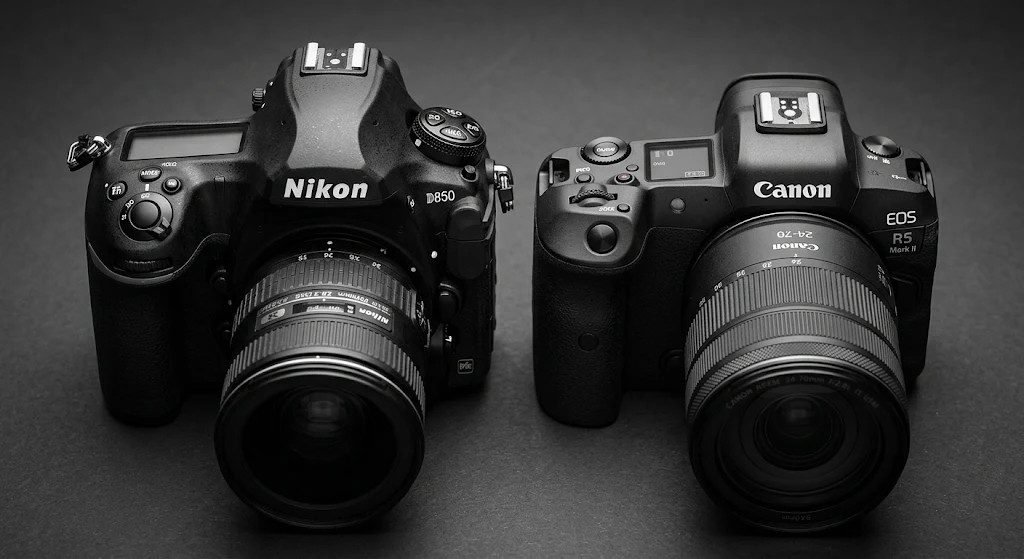
The Canon R5 Mark II is clearly the more capable camera. The Nikon D850 can still win, depending on who holds it and what they shoot.
| Your Priority | Better Choice |
|---|---|
| Landscape and studio stills | Nikon D850 |
| Maximum stills value for the money | Nikon D850 (used) |
| Battery endurance | Nikon D850 |
| Wildlife, birds and sports | Canon R5 Mark II |
| Weddings and events | Canon R5 Mark II (leans Canon) |
| Video and hybrid work | Canon R5 Mark II (decisively) |
| Starting from zero with a big budget | Canon R5 Mark II |
Prices, specifications and listings change often. Check the manufacturer’s page and a major retailer before you buy. You can start with Nikon’s official D850 page and Canon’s official R5 Mark II page.
How We Compared These Two Cameras
We compared the cameras on what newer technology really changes. We did not count spec-sheet wins. A bigger number only matters if it solves a problem in your photography.
So we asked three questions for every category:
- Does the difference show in the final image?
- Does it change how easy the shot is to get?
- Does it justify the cost, including the cost of switching systems?
These questions keep the comparison honest. A camera can win a category and still be the wrong purchase.
The Price Problem: New Flagship vs Proven Used Body
Start with the money, because the money is why this question exists at all.
What the Canon R5 Mark II Costs
Canon lists the R5 Mark II body at $4,299. Instant rebates have cut that figure. Canon USA ran a $300 rebate that dropped the price to $3,999 at retailers such as B&H Photo and Adorama. So a new R5 Mark II sits around $4,000, depending on the retailer and whatever rebate is running.
What the Nikon D850 Costs
The Nikon is a different kind of purchase. Nikon no longer sells the D850 as a current product, so you will buy used. Used D850 listings on MPB have recently run from roughly $879 to $1,749, depending on condition. Check MPB for today’s numbers, because used prices shift week by week.
Why This Is Not a Fair Fight
This is not a new-versus-new contest, and it would be dishonest to pretend otherwise. It is a proven used body against a current flagship. The gap is big enough to pay for serious glass. A buyer who saves more than $2,000 can spend that money on a professional lens. A great lens often improves pictures more than a new body does.
Are You Buying a Camera or Rebuilding a Kit?
That gap hides something important. A camera body is rarely just a camera body. If you shoot Nikon F-mount, you probably own lenses, flashes, batteries, chargers and remotes. Moving to Canon means replacing a working system, not swapping a box.
The reverse also holds. If you already shoot Canon RF, nobody should tell you to buy into F-mount because a used Nikon looks cheap. So the question under the price is simple. Are you buying a camera, or are you rebuilding a kit?
Sensors: 45 Megapixels, Two Eras
Now comes the first surprise. Look past the age gap and compare the sensors.
The Resolution Tie
The Nikon D850 packs 45.7 megapixels onto a full-frame back-side-illuminated CMOS sensor. The Canon R5 Mark II offers 45 megapixels on a stacked back-side-illuminated sensor. For this comparison, that is a tie. Both cameras deliver more detail than most prints and screens will ever demand.
The Nikon’s Quiet Advantage: ISO 64
The Nikon keeps one quiet advantage. Its native base ISO is 64, while the Canon starts at ISO 100. For a tripod landscape, an architectural frame or a controlled studio setup, that lower starting point is genuinely useful. It lets you use slower shutter speeds or wider apertures in bright light without adding filters.
We will not claim the Nikon makes better images. Lenses, exposure and processing matter more than either spec sheet. The honest conclusion is that both cameras produce excellent files.
What the Stacked Sensor Really Means
The Canon’s stacked sensor does more than add resolution. Its design supports faster readout and modern performance features. That hint matters. The newer camera solves a different set of problems entirely. So if the final image looks excellent from both, how much should everything around the image influence an upgrade?
The next sections answer that question one category at a time.
Autofocus: Where the Nine Years Show
This is where the age gap stops being theoretical.
How the Nikon D850 Focuses
The Nikon uses 153 autofocus points. Ninety-nine of those points are cross-type. The camera also offers 3D tracking from the DSLR era. It was a professional system when Nikon launched it, and it still performs well for someone who knows how to drive it.
Notice that phrase: drive it. The Nikon often asks the photographer to manage focus placement actively. You steer the point across the frame and keep it on your subject.
How the Canon R5 Mark II Focuses
The Canon works another way. Its Dual Pixel autofocus covers most of the frame. It recognizes people, eyes, animals and other subjects, and then follows them. You choose the subject, and the camera does much of the tracking.
Real-World Autofocus Scenarios
Think about these hard subjects:
- A bird against messy branches
- A child sprinting across a lawn
- A wedding guest slipping through a crowd
- An athlete changing direction without warning
The Nikon can follow those subjects if you are good. The Canon takes much of that workload off you. That shift in workload is the strongest reason a wildlife, action or event photographer should look hard at the newer body.
The Takeaway on Autofocus
The Canon wins autofocus clearly. However, the Nikon is not a bad performer. A skilled shooter who works on predictable subjects can still get excellent results from the D850.
Burst Speed: Seven Frames vs Thirty
Speed widens the gap even more.
Nikon D850 Burst Rate
The Nikon shoots about 7 frames per second with the body alone. It can reach 9 frames per second, but only with the specified battery grip and battery setup. So 9 fps is not the everyday number.
Canon R5 Mark II Burst Rate
The Canon shoots up to 12 frames per second with its mechanical shutter. It reaches up to 30 frames per second with its electronic shutter. That is more than four times the Nikon’s body-only rate. It is not a small step. It changes how you catch a moment, like a bird leaving a branch or a bride’s expression changing.
The Fine Print on Electronic Shutters
Remember the lesson from our camera buying mistakes guide. A headline frame rate always comes with conditions. Electronic shutters can show rolling shutter on fast-moving subjects. Some artificial lights can cause banding. Flash may not work in the fastest modes. Check the exact conditions before you build a workflow around 30 fps.
Who Needs the Speed?
Speed matters only when timing matters. A landscape or studio photographer gets almost nothing from 30 frames per second. A sports or wildlife shooter gets a lot.
Stabilization: IBIS Changes Handheld Shooting
Stabilization follows the same logic as speed.
Nikon D850: No In-Body Stabilization
The Nikon has no in-body stabilization. You get stabilization only when you use a lens with Nikon’s VR system. Many F-mount telephoto lenses offer VR, but many prime lenses do not.
Canon R5 Mark II: In-Body Stabilization
The Canon adds in-body image stabilization, or IBIS. Canon rates it at up to 8.5 stops when you pair it with a lens that has its own stabilization. IBIS helps most with handheld static subjects, travel, interiors and lenses without their own stabilization.
A Caution About IBIS
IBIS has limits. It fixes blur from your own hand movement. It does not freeze a moving subject. Shutter speed still does that. If your dancer or bird looks soft, a faster shutter will help more than extra stabilization.
The Optical Finder Strikes Back
Now the Nikon fights back, and not with nostalgia.
The Nikon’s Optical Viewfinder
The D850’s optical viewfinder gives you a direct view of the scene. It has no rendering and no display lag. You see light bounce through the lens and into your eye. Many photographers love that honesty. The view also stays clear in very bright sun and does not use battery power to display.
The Canon’s Electronic Viewfinder
The Canon’s 5.76-million-dot OLED electronic viewfinder works differently. It offers exposure preview, overlays, playback, focus aids and visible subject tracking. You see what the frame will become before you press the shutter. That preview helps beginners and experts alike.
Which Viewfinder Wins?
Which is better is partly personal. Some photographers want the honesty of looking through the lens. Others want to see the final picture before they shoot. Neither view is wrong. Try both in a camera store if you can.
Battery Life: The Nikon’s Biggest Practical Win
Battery life is hard to argue with.
The Numbers
Nikon rates the D850 at about 1,840 shots per charge under CIPA testing. Canon rates the R5 Mark II at about 340 shots with the viewfinder and about 630 shots with the rear screen. That means the Nikon’s rating is more than five times higher in viewfinder use.
Real-World Use
Real use varies, and neither number is a hard limit. Cold weather, video and heavy review use all drain batteries faster. Even so, endurance counts on a long wedding day or a remote trip. The Nikon can run through a full day on one battery. The Canon usually needs spares, and wise Canon shooters carry them.
Weight and Size
Weight pushes the other way.
Comparing Body Weights
Canon lists the R5 Mark II at about 670 grams for the body alone. Nikon lists the D850 at about 915 grams for the body alone. Both figures leave out the battery and memory card. So the Canon is roughly 245 grams lighter.
Add a battery and card to each, and both cameras gain more weight. The gap stays similar. The Nikon also has a larger body overall, which shows up in a bag.
Why the Difference Matters
Those 245 grams add up over a long day. They help with travel, hiking and two-body kits. Lighter is not automatically better, because a heavier camera can balance better with big lenses. Still, it is a real difference.
Video: Where the Contest Ends
Video is where the comparison stops being close, so we will not manufacture suspense.
Nikon D850 Video
The Nikon records full-frame 4K at up to 30 frames per second. That feature belonged to a much older video workflow. It also offers 1080p slow motion. For simple clips, it works fine. For modern video work, it feels dated.
Canon R5 Mark II Video
The Canon records 8K raw video internally. It also records 4K at up to 120 frames per second. It adds modern autofocus and a far deeper hybrid toolset. Check Canon’s page for the exact frame rates available in each recording format, because they vary by mode.
If serious video matters to your work, the Canon wins decisively.
The Qualification for Stills Shooters
Here comes the honest qualification. A stills-first landscape or studio photographer should not hear that 8K raw alone justifies changing systems. It is a remarkable capability for someone who will use it. It is an expensive extra for someone who will not.
Remember the storage cost as well. High-end raw video produces huge files, and you need fast cards and big drives. Our camera buying mistakes guide explains that hidden cost in detail.
The Switching Trap
So the Canon wins autofocus, speed, stabilization and video. Case closed?
Why a Better Camera Can Still Be the Wrong Purchase
Not quite. A modern body can win every technical category and still be the wrong purchase if the system change solves no real problem.
Nikon owners should price the Canon RF lenses needed to rebuild their current kit before they call this an upgrade. Add flashes, batteries, chargers, remotes and the rest of the workflow. The true cost can dwarf the body-price difference.
The Opposite Temptation for Canon Owners
Canon owners face the opposite temptation. A cheap Nikon body does not fit the system they already built. A low price alone is not a reason to start a second system.
What This Comparison Really Shows
This guide compares philosophies, not brand loyalty. Nobody should switch systems for minor gains. Switch only when a limit in your current kit keeps costing you shots, jobs or creative freedom.
Nikon D850 vs Canon R5 Mark II: Full Comparison Table
| Feature | Nikon D850 | Canon R5 Mark II |
|---|---|---|
| Announced | 2017 | July 2024 |
| Sensor | 45.7MP full-frame BSI CMOS | 45MP full-frame stacked BSI CMOS |
| Base ISO | 64 | 100 |
| Autofocus | 153 points, 99 cross-type, 3D tracking | Dual Pixel AF with eye, people and animal detection |
| Burst speed | About 7 fps (9 fps with grip) | Up to 12 fps mechanical, 30 fps electronic |
| Stabilization | None in body (lens VR only) | IBIS, up to 8.5 stops with a stabilized lens |
| Viewfinder | Optical | 5.76M-dot OLED electronic |
| Video | Full-frame 4K up to 30p | 8K raw internal, 4K up to 120p |
| Battery rating (CIPA) | About 1,840 shots | About 340 (EVF) or 630 (LCD) shots |
| Body weight | About 915 g | About 670 g |
| Typical price | About $879 to $1,749 used | About $4,000 to $4,299 new |
Which Camera Should You Buy?
The right answer depends on what you shoot. Use these profiles to decide.
Choose the Nikon D850 for Landscape and Studio Work
The D850 remains extremely compelling for landscape, studio and deliberate high-detail stills. It suits Nikon owners who value ISO 64 and do not need modern subject tracking. It also offers a bright optical finder and long battery life.
Choose the Canon R5 Mark II for Wildlife, Birds and Sports
The Canon’s autofocus, burst speed and subject recognition make a far stronger case here. Birds in flight, running athletes and fast family moments all favor the newer camera. The D850 can capture them, but it demands far more skill from you.
Choose the Canon for Weddings and Events (With a Caveat)
Weddings and events lean Canon, because it is the stronger modern tool. Eye tracking and silent shooting help in churches and crowded rooms. The Nikon still offers endurance, familiar controls and a proven workflow for people who already own one. If you shoot weddings with a D850 today and it works, keep shooting.
Choose the Canon for Video and Hybrid Work
It is Canon, decisively. The video gap is the widest gap in this comparison.
If You Are a Nikon Owner With No Major Limitation
Keeping the D850 is a valid result. Spend your money on a better lens instead.
If You Are Starting From Zero With a Large Budget
The Canon is the more modern long-term platform. However, total RF system cost matters. Price the lenses you want before you decide.
If You Want Maximum Stills Value
A healthy used D850 is difficult to dismiss. Few cameras at any price deliver this much resolution for so little money.
Final Verdict: Nikon D850 vs Canon R5 Mark II
The Canon R5 Mark II wins nearly every technical category. Autofocus, speed, stabilization and video all favor the newer camera, and the gap is large. If you shoot fast subjects or video, the Canon is the clear choice.
Even so, the Nikon D850 refuses to disappear. It matches the Canon’s resolution. It beats the Canon on base ISO and battery life. It costs a fraction of the price. For deliberate, high-detail stills, it remains a superb tool, and a used body offers remarkable value.
So the answer to our title question is yes, with conditions. A nine-year-old DSLR can still win for the right photographer. That photographer shoots landscapes, studio work or other planned subjects. They already own Nikon glass, and they want to spend less. For everyone else, the Canon is the better camera.
Frequently Asked Questions
Is the Nikon D850 still worth buying in 2026?
Yes, for the right buyer. The D850 still delivers 45.7 megapixels, excellent image quality and long battery life. It suits landscape, studio and deliberate stills work. It does not suit fast action or serious video as well as newer cameras.
Is the Canon R5 Mark II worth the extra money?
It is worth it if you shoot fast subjects, video or hybrid work. The autofocus, burst speed and stabilization offer real advantages. It is less worthwhile for landscape or studio shooters who gain little from those features.
Does the Nikon D850 have the same megapixels as the Canon R5 Mark II?
They are almost the same. The Nikon D850 has 45.7 megapixels, and the Canon R5 Mark II has 45 megapixels. Both cameras produce very detailed full-frame images.
Which camera has better autofocus?
The Canon R5 Mark II has far better autofocus. It recognizes people, eyes and animals and tracks them across most of the frame. The Nikon D850 asks the photographer to steer the focus point more actively.
Does the Nikon D850 have in-body image stabilization?
No. The D850 has no in-body stabilization. You only get stabilization from lenses that include Nikon’s VR system.
Which camera has better battery life?
The Nikon D850 wins easily. Nikon rates it at about 1,840 shots per charge. Canon rates the R5 Mark II at about 340 shots with the viewfinder and about 630 with the rear screen.
Can the Nikon D850 shoot 8K video?
No. The D850 records full-frame 4K at up to 30 frames per second. The Canon R5 Mark II records 8K raw video internally.
Should I switch from Nikon to Canon for the R5 Mark II?
Only if a limit in your current kit keeps costing you shots or jobs. Price the Canon RF lenses and accessories first. The true cost of switching often exceeds the price of the body.
Read More from Altbuzz
Want more comparisons that explain what newer technology really changes? Explore these Altbuzz guides.
- 10 Camera Buying Mistakes to Avoid in 2027
- Leica Q3 43 Review: Sharp, Pricey and Special
- Best Leica Cameras in 2027: Which One Wins?
- All Altbuzz Camera Reviews
Subscribe to the Altbuzz YouTube Channel
Prefer watching to reading? Our video version walks through every category with extra context. Subscribe to Altbuzz on YouTube for camera comparisons, rankings and rumor coverage. You can also find more at altbuzzmedia.com.
Say the price gap went into lenses instead of a new body. Would you take a used Nikon D850 with the glass you have been missing, or the Canon alone? Tell us in the comments, and tell us which feature made your choice.