
Sony Alpha A7R VI Rumors: Expected Specs, Features and Release Date
The Sony A7R VI is the most talked-about high-resolution camera of 2026. Multiple credible leaks have emerged from respected sources. Sony has not officially confirmed it yet. However, the specifications coming from the rumor community are now highly consistent and increasingly specific.
The A7R series carries one clear identity: maximum resolution. Every generation has pushed the boundaries of full-frame detail capture. The A7R IV reached 61MP in 2019. The A7R V retained that same sensor in 2022. Seven years of sensor continuity is a very long time in this industry.
All information in this article is based on community leaks, informed analysis, and realistic industry speculation. Sony has not confirmed any of these details. Read this as a rumor-based examination only.
Expected Release Date and Market Position
When Will the Sony A7R VI Launch?
Multiple independent sources now point to an April to June 2026 announcement window. Some reports suggest shipping could begin as early as May 2026. Moreover, the specificity of the leaked specs suggests a camera deep in final testing rather than early development.
How Credible Are These Leaks?
Photo Rumors published detailed leaked specifications in April 2026 from multiple independent contributors. Daily Camera News and Camera Lookout have corroborated key details across several reports. Furthermore, the consistent 80MP figure across different sources adds significant credibility.
Market Position and Pricing
The Sony A7R VI is expected to sit above the A7 V and alongside the A1 II in the Alpha lineup. Expected pricing falls between $3,999 and $4,499 at launch. This positions it as a premium tool for serious professionals without reaching the A1 II’s most extreme tier.
Target Audience
The primary audience includes landscape photographers, studio and commercial photographers, and fine art creators. Additionally, wildlife photographers who crop heavily and architectural shooters for demanding professional clients are key target users. Hybrid creators who want both maximum resolution stills and impressive video also fit this camera perfectly.
Rumored Specifications Table
| Feature | Rumored Details |
|---|---|
| Sensor Type | Full-frame fully stacked CMOS |
| Resolution | 80MP effective pixels |
| Processor | BIONZ XR2 with dedicated AI chip |
| ISO Range | 100 to 51200 (expandable) |
| Autofocus System | AI Phase Detection, 60fps AE/AF tracking at full resolution |
| Stabilization | 8.5-stop 5-axis IBIS |
| Video Recording | Full-frame 10.9K oversampled 8K/30p, APS-C 7.1K 4K/60p, 5.5K binned 4K/120p |
| EVF | High-resolution OLED with improved brightness |
| LCD Screen | 3-inch articulating touchscreen, higher resolution than A7 V, 50% brighter than A1 II |
| Burst Shooting | 30fps electronic, 14-bit RAW |
| Composite Modes | 16-frame high-res composite, 32-frame noise-reduction composite |
| Battery | NP-FZ100 with improved efficiency |
| Storage | Dual CFexpress Type A and SD UHS-II |
| Connectivity | USB-C 3.2 Gen 2, Wi-Fi 6E, Bluetooth 5.3, full-size HDMI |
| Weight | Approximately 720g |
| Expected Price | $3,999 to $4,499 |
Sensor and Image Quality (Rumored)
The 80MP Fully Stacked Sensor
The headline specification for the Sony A7R VI is an 80MP fully stacked CMOS sensor. This jumps nearly 20 megapixels above the A7R V’s 61MP. Moreover, the fully stacked architecture itself is a more significant advance than the resolution number alone suggests.
What Does Fully Stacked Mean?
A conventional BSI sensor has two main layers. The imaging layer faces the lens and the readout circuit layer sits behind it. A fully stacked sensor adds a dedicated memory layer between them. This separation dramatically accelerates how quickly data moves from the sensor to the processor.
Why Stacking Matters at 80MP
Reading 80 million pixels fast enough for 30fps burst shooting and 8K video requires exceptional readout speed. The fully stacked architecture makes this physically possible. Furthermore, faster readout reduces rolling shutter in electronic shutter mode compared to the A7R V.
Dynamic Range Expectations
Most credible sources estimate 16 or more stops of dynamic range in mechanical shutter mode. Even more remarkably, some leaks suggest the electronic shutter mode of the A7R VI will exceed the A7R V’s mechanical shutter dynamic range. This is a genuinely significant advancement.
Dual-Layer Transistor Pixels
Some sources also mention dual-layer transistor pixel technology in the 80MP sensor. This improves signal separation at the individual pixel level. As a result, both shadow detail and highlight accuracy improve across the full tonal range.
Pixel-Shift Composite Modes
Two composite modes are expected. First, a 16-frame pixel-shift composite mode produces files with resolution well beyond the native 80MP. Additionally, a 32-frame composite mode reduces noise for low-light studio work. Together, these modes extend the sensor’s effective capability far beyond its native specifications.
Autofocus System (Rumored)
60fps AE/AF Tracking at Full 80MP
The Sony A7R VI is rumored to deliver 60fps AE and AF tracking at full 80MP resolution. This is technically demanding. It requires both fast sensor readout and sufficient processor throughput to run 80 million pixels and autofocus calculations simultaneously.
The Dedicated AI Chip
Sony’s dedicated AI recognition chip runs scene analysis as a fully separate process. It does not share resources with the main BIONZ XR2 imaging pipeline. Consequently, autofocus speed, accuracy, and subject classification all stay consistent under heavy processing loads.
Subject Recognition
Expected subject tracking covers humans with eye and face priority. Full-body tracking activates when the face is not visible. Additionally, animal, bird, and vehicle recognition are all part of the expected AI tracking suite, reflecting the diverse professional audiences this camera serves.
What Does 30fps Burst Mean for Wildlife Photographers?
At 30fps with 80MP files, one second of burst shooting produces 30 individual images. Each of those images supports substantial cropping down to approximately 20MP. Therefore, wildlife and sports photographers can shoot across a key action moment and select the best frame in post.
Electronic Shutter Speed Context
The electronic shutter speed in the A7R VI is faster than the A7 V but remains about one-third the speed of the A1 II. This still means rolling shutter is a consideration for very fast lateral subject movement. However, for the majority of A7R VI use cases, this level of performance is entirely sufficient.
Video Capabilities (Expected)
Full-Frame 8K at 30fps
The primary video headline is full-frame 8K/30p with 10.9K oversampling. The camera reads a 10.9K resolution area from the full sensor and downsamples to 8K. As a result, the footage has exceptional sharpness and detail that native 8K capture cannot match.
APS-C 4K at 60fps
APS-C crop mode should deliver 4K at 60fps with 7.1K oversampling. This mode also provides additional reach, which benefits wildlife and sports shooters. Furthermore, the 7.1K oversampling still produces high-quality footage despite using only part of the sensor area.
4K at 120fps Slow Motion
A pixel-binned 5.5K to 4K mode is expected to reach 120fps. Pixel-binning combines neighboring pixel data rather than true oversampling. Consequently, the footage is slightly softer than the fully oversampled modes. However, it still delivers genuine 4K slow-motion capability at a very useful frame rate.
Important Video Limitations
The Sony A7R VI is primarily a stills camera. It will not offer open gate recording or internal RAW video output. Additionally, 6K HEVC recording is not expected. These features remain exclusive to Sony’s Cinema Line FX bodies as a deliberate product differentiation strategy.
10-Bit Internal Recording
10-bit 4:2:2 internal recording in XAVC HS format is expected. S-Log3 and HLG support are standard expectations. Together, these features make the A7R VI capable for professional hybrid video workflows, even without the more advanced cinema-specific codecs.
Design and Build (Expected)
Redesigned Grip
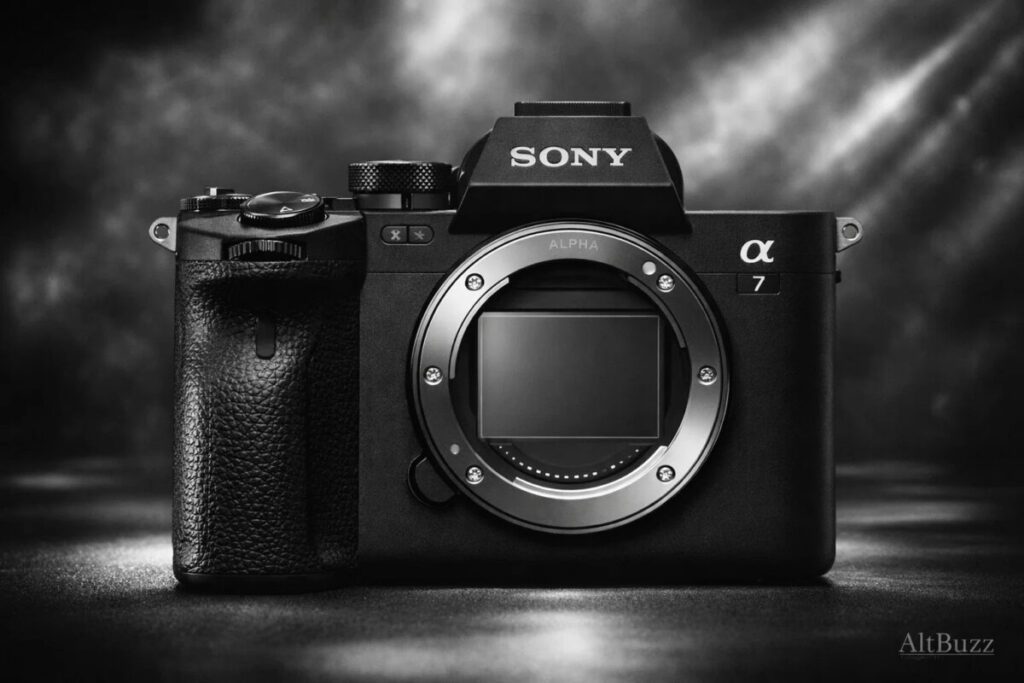
The A7R VI is expected to adopt the deeper and more contoured grip profile first seen on the A1 II. This grip provides more hand contact area and improves shooting security. For long landscape, commercial, and wildlife sessions, improved grip comfort reduces fatigue and produces better results.
50% Brighter LCD Screen
Sources report the A7R VI’s rear LCD will be 50% brighter than the A1 II’s already impressive display. This is a very significant brightness improvement. Outdoor photographers working in direct sun or high-altitude conditions will notice an immediate and practical difference.
Higher Resolution Screen
The screen resolution is also expected to increase beyond the A7 V’s panel. This produces finer pixel density for more precise image review. Additionally, sharper display output helps with accurate focus peaking visualization in live view and playback.
Body Dimensions and Build
Overall body dimensions are expected to remain consistent with the A7R V. Magnesium alloy construction and comprehensive weather sealing are standard professional expectations that Sony will certainly meet. Furthermore, the familiar control layout should help existing A7R users transition immediately.
Battery and Connectivity (Rumored)
NP-FZ100 Continues
The NP-FZ100 battery remains the expected power source. This maintains compatibility across Sony’s entire professional Alpha ecosystem. Additionally, BIONZ XR2 power management should deliver better efficiency than the A7R V, despite the higher processing demands of 80MP.
Storage Planning for 80MP
80MP RAW files are substantially larger than 61MP files from the A7R V. High-bitrate 8K video compounds this demand further. Therefore, CFexpress Type A cards are essential for the highest performance modes, while the SD UHS-II slot handles more accessible storage needs.
Lossy and Lossless RAW Options
Sony should continue supporting both lossless compressed and lossy compressed RAW formats. Lossy compressed RAW at 80MP still contains more total image data than lossless RAW from many competing cameras. Moreover, it reduces storage requirements significantly for everyday professional shooting.
Wi-Fi 6E and USB-C
Wi-Fi 6E provides faster transfer speeds and better range in interference-heavy environments. USB-C 3.2 Gen 2 handles fast wired data transfer, tethered studio shooting, and USB-C charging. Additionally, Bluetooth 5.3 enables reliable low-power device pairing through Sony’s Creators App.
Real-World Use Cases
Landscape Photography
Landscape photographers need files that deliver gallery-quality prints at very large sizes. A single 80MP RAW file from the A7R VI supports a print roughly 40 by 27 inches at 300dpi with no upscaling. Furthermore, 16-stop dynamic range captures both bright sky and deeply shadowed foreground detail in a single exposure.
Commercial and Advertising Photography
Commercial clients regularly request images for full-page spreads, billboards, and multi-format digital use. An 80MP source file gives art directors extraordinary cropping flexibility. As a result, a 50% crop of an 80MP file still produces a 20MP image suitable for most digital publication standards.
Wildlife Photography
The combination of 80MP resolution and 30fps burst shooting transforms wildlife photography workflows. Photographers can fire a burst during fast action sequences and then select and crop the best frame in post-production. The cropped result still carries enough resolution for professional publication, even after significant cropping.
Architectural Photography
Real estate and architectural clients demand maximum detail and accurate tonal rendering. The 80MP resolution captures fine surface textures and building details at a level that satisfies even the most demanding agency briefs. Additionally, the expected dynamic range handles difficult mixed-light interior and exterior scenarios confidently.
Scientific and Academic Photography
Researchers documenting specimens, artifacts, or materials at high magnification need maximum resolution and accurate color. The Sony A7R VI suits botany, archaeology, and materials science applications well. Furthermore, the pixel-shift composite modes extend effective resolution even further in controlled multi-exposure situations.
Pros and Cons (Based on Rumors)
Expected Pros
The 80MP fully stacked CMOS sensor is the most significant advance in the A7R series since the A7R IV. Fully stacked architecture enables 30fps electronic burst at full 80MP resolution, which is remarkable at any price tier. Oversampled 8K/30p from a full-frame 10.9K readout delivers footage quality that outperforms native 8K capture. 16-stop dynamic range in mechanical shutter mode handles demanding high-contrast scenes confidently. Additionally, pixel-shift composite modes extend effective resolution and noise performance well beyond the native sensor specifications. The redesigned deeper grip improves handling for extended professional sessions. Furthermore, the rear LCD expected to be 50% brighter than the A1 II makes outdoor monitoring genuinely practical in direct sunlight.
Expected Cons
The absence of open gate recording and internal RAW video limits the camera’s appeal for dedicated cinema workflows. Electronic shutter speed is still approximately one-third the speed of the A1 II, which means rolling shutter remains relevant in fast-motion electronic shutter scenarios. The 30fps burst has a reported frame count limit before the buffer clears. Additionally, 80MP file sizes demand fast cards, high-capacity storage, and capable editing computers. Furthermore, the expected $3,999 to $4,499 price range places the camera well beyond the reach of enthusiast photographers. Finally, all specifications here remain entirely unconfirmed by Sony.
Final Thoughts
The Sony A7R VI is shaping up to be one of the most consequential camera releases of the year. An 80MP fully stacked sensor is not an incremental improvement. It represents a genuine architectural shift for the A7R series.
The consistent and increasingly detailed leaks from multiple independent sources now paint a credible portrait of what is coming. For photographers who have waited since the A7R V for a true generational leap, the wait appears to be nearly over.
When Sony makes the official announcement, the Sony A7R VI will very likely exceed even the high expectations the rumor community has built around it. Keep following AltBuzz for every update as that moment gets closer.
Read More from AltBuzz
Read more from Altbuzz for camera reviews, rumors, and detailed specs. AltBuzz delivers trusted and easy-to-understand photography content.
Subscribe AltBuzz YouTube Channel
Stay updated with camera reviews, rumors, and comparisons. AltBuzz shares regular camera content.