
Introduction
The Blackmagic URSA Cine Immersive 100G changes everything about live immersive production. This camera is not a concept or a prototype. Blackmagic Design officially announced it at NAB 2026 in April 2026, and it is now available for order worldwide.
This is the world’s first immersive cinema camera built specifically for live production with Apple Immersive Video. It targets broadcast professionals, live event producers, sports broadcasters, and anyone serious about capturing stereoscopic 3D content in real time.
Before this camera existed, live immersive video simply was not possible at the cinema quality level. On-demand productions had the URSA Cine Immersive. But live? That was an unsolved problem. The bandwidth demands of dual 8K video, the latency requirements of live broadcast, and the complexity of stereoscopic output all made real-time immersive content feel out of reach. The URSA Cine Immersive 100G solves every one of those problems in a single body.
In this review, we break down every aspect of the Blackmagic URSA Cine Immersive 100G. We cover the sensors, the optics, the video workflow, the connectivity, the real-world use cases, and who this camera is really built for. This guide leaves nothing out.
Release Date and Market Position
Blackmagic Design unveiled the Blackmagic URSA Cine Immersive 100G on April 13, 2026, just ahead of NAB Show 2026. It was publicly demonstrated at Blackmagic’s booth N2502 at the event. Industry professionals got their first hands-on look at the camera during the show.
It ships in Q3 2026 and is available for order now at US$26,495, excluding local duties and taxes.
This model builds directly on the original Blackmagic URSA Cine Immersive. That original model was the first-ever commercial camera system designed to capture Apple Immersive Video for the Apple Vision Pro. It set the standard for immersive cinema. The 100G variant takes everything that made the original powerful and adds one transformative upgrade: live immersive production capability via 100G Ethernet output.
The pricing difference between the two models is relatively modest given what the 100G adds. The original URSA Cine Immersive is available at US$24,995. For an additional $1,500, the 100G version opens up the entire live broadcast market. For any production house already invested in immersive content, that upgrade cost is easy to justify.
The camera has already proven itself in demanding real-world conditions. It was used for Spectrum Front Row, a series of live NBA Lakers games broadcast in Apple Immersive Video during the 2025-2026 season. Those games are available on demand via the Spectrum SportsNet and NBA apps on Apple Vision Pro. That is not a demo reel. That is live professional sports delivered in stereoscopic 8K to paying subscribers.
Live immersive production is no longer theoretical. It is happening right now, and the URSA Cine Immersive 100G is the camera making it possible.
Blackmagic URSA Cine Immersive 100G: Full Specifications
| Feature | Details |
|---|---|
| Sensor Type | Dual RGBW custom sensors (stereoscopic 3D) |
| Sensor Resolution | Dual 8K x 8K per eye |
| Dynamic Range | 16 stops |
| Color Science | Generation 6, DaVinci Wide Gamut film curve |
| Frame Rates | 23.98, 24, 25, 29.97, 30, 50, 59.94, 60, 90 fps |
| Max Stereoscopic Frame Rate | 90 fps at 8K x 8K (both eyes simultaneously) |
| Lens System | Fixed focal length, custom stereo lens pair, 180+ degree field of view |
| ND Filters | Built-in IR ND: Clear, 2-stop, 4-stop, 6-stop, 8-stop (button activated) |
| Iris | Fixed iris |
| Recording Format | Blackmagic RAW (single stereo file) or ProRes SMPTE-2110-22 stream |
| Internal Storage | Blackmagic Media Module 8TB (included) |
| Live Output | 100G Ethernet (SMPTE-2110-22 IP video) |
| Data Rate | Under 50 Gb/s per camera |
| Connectivity | 100G Ethernet, 10G Ethernet, High-Speed Wi-Fi, 5G Mobile (USB-C), 4G Mobile (USB-C), Blackmagic Cloud |
| LCD Monitor | Capacitive touchscreen with Left Eye, Right Eye, Punch In, and Side-by-Side view options |
| Metadata | Discrete left and right eye optical calibration metadata |
| Color Processing | Dual 3D LUT processors; independent LUT for SMPTE-2110 output |
| Software Included | DaVinci Resolve Studio |
| Companion Module | Blackmagic URSA Cine Live Encoder (sold separately) |
| Price | US$26,495 |
| Availability | Q3 2026 |
Sensor and Image Quality
The Blackmagic URSA Cine Immersive 100G uses two custom-designed RGBW sensors. Each sensor captures 8K x 8K resolution simultaneously. Together, they produce a true stereoscopic 3D image that is purpose-built for immersive content delivery on Apple Vision Pro.
Why RGBW Matters
The RGBW sensor design is a key differentiator over traditional camera sensors. Standard broadcast and cinema cameras use RGB pixel arrays. RGBW adds a fourth type of pixel: a white-sensitive, unfiltered pixel. This white pixel captures all wavelengths of light without the filtering losses that RGB pixels experience.
The result is more light reaching the sensor overall. This translates directly into better performance in low-light environments, less noise in shadow regions, and a wider effective dynamic range. For live events like concerts and indoor sports arenas, where lighting is challenging and constantly changing, RGBW gives operators a significant advantage over conventional cameras.
Dynamic Range
With 16 stops of dynamic range, this camera captures the full scene from the deepest shadows to the brightest highlights in a single exposure. That level of latitude is historically reserved for high-end cinema cameras on controlled film sets. The URSA Cine Immersive 100G brings it to live broadcast environments.
Consider a live basketball game. The court is brightly lit. The crowd in the upper stands is much darker. A standard broadcast camera struggles to expose for both at once. The URSA Cine Immersive 100G handles that challenge comfortably. You get a clean image from the lit court surface all the way into the shadows of the upper arena without any compromises.
Generation 6 Color Science
The Generation 6 Color Science represents Blackmagic’s most advanced color processing to date. It pairs with a new DaVinci Wide Gamut film curve developed specifically for this generation of cameras.
The DaVinci Wide Gamut color space is significantly larger than Rec. 709 or even Rec. 2020. Recording in this wide gamut gives colorists far more flexibility during post-production. Colors can be pushed, pulled, and transformed without degrading. Skin tones stay natural. Gradients remain smooth. The image holds up under heavy grading.
For live broadcast, Blackmagic has designed the color pipeline so that the camera outputs a calibrated, color-accurate signal in real time. You do not need to grade the live feed extensively. The camera delivers broadcast-ready color straight out of the 100G port.
Single Stereo RAW File
Each sensor records to a single Blackmagic RAW stereo file. Both the left-eye and right-eye footage are packaged together in one container. This is a major workflow improvement over traditional 3D production methods, where left and right cameras record to separate media and require syncing in post.
With the URSA Cine Immersive 100G, the stereo pair is already synchronized at the hardware level. There is no drift, no sync offset, and no manual alignment required. Editors open one file and get both perspectives immediately.
Blackmagic RAW is also a lossless or near-lossless format depending on the compression setting chosen. It retains the full 16 stops of dynamic range and the full color information from the sensor. Post-production teams have complete flexibility to grade, reframe, and deliver in any format.
Optical System and Lens Design
The Blackmagic URSA Cine Immersive 100G uses a fixed lens system. There is no interchangeable lens mount. The dual custom lens pair is engineered exclusively for immersive stereoscopic capture and cannot be swapped out for a different optic.
Why Fixed Lenses Make Sense Here
At first glance, a fixed lens system might seem like a limitation. In practice, it is the right engineering decision for this type of camera. Immersive stereoscopic video requires both lenses to share identical optical characteristics: the same focal length, the same distortion profile, the same chromatic aberration behavior, and the same focus plane. Any variation between the two lenses would create a mismatch in the stereo pair, which causes viewer discomfort.
By manufacturing both lenses as a matched, integrated pair in a single housing, Blackmagic eliminates that risk entirely. Every unit that ships has calibrated, matched optics. The stereo geometry is consistent from the factory.
Field of View
The lenses deliver a consistent 180-degree-plus field of view across both eyes. That ultra-wide perspective is what creates the sensation of being physically present inside a scene. When a Vision Pro user watches NBA coverage shot with this camera, they are not looking at a flat image of the court. They are placed inside the arena, surrounded by the environment.
This is a fundamentally different viewing experience from traditional video. The 180-degree FOV means there is content in the viewer’s full peripheral vision. The scene feels real because the visual information matches what a human would actually see standing at that location.
Built-In ND Filters
The camera includes a built-in IR ND filter system. Five settings are available: Clear, 2-stop, 4-stop, 6-stop, and 8-stop. These are activated by a physical button, which is important during live production. Operators can change exposure quickly without touching any software settings.
The ND filters are infrared-cut design. This prevents the color shift that standard ND filters often introduce in bright outdoor conditions. IR cut maintains accurate color even when heavy filtration is in use. The iris is fixed, keeping the optical relationship between both lenses perfectly consistent at all times.
Optical Calibration Metadata
The camera records discrete left and right eye optical calibration metadata embedded directly into every Blackmagic RAW file. This metadata describes the precise optical characteristics of each lens at the time of capture. Post-production tools, including DaVinci Resolve Studio, read this metadata and apply corrections automatically. Convergence, alignment, and distortion compensation all happen without manual adjustment.
Video Capabilities
The Blackmagic URSA Cine Immersive 100G is engineered around one primary purpose: delivering live immersive video at broadcast quality. It achieves this through several interconnected systems that work together as a complete solution.
Live Immersive Output via 100G Ethernet
The defining feature of this camera is its 100G Ethernet port. This single addition is what separates the 100G from the original URSA Cine Immersive and what makes live immersive production possible for the first time.
The bandwidth requirements of dual 8K stereo video at high frame rates are enormous. Standard 10G Ethernet connections used in conventional broadcast cannot carry that data load in real time. 100G Ethernet provides ten times the bandwidth, which is exactly what is needed to transport both eye streams simultaneously without compression artifacts or latency issues.
Each camera produces a data stream under 50 Gb/s. Because that number is below 50 Gb/s, two cameras can share a single 100G Ethernet fiber connection. Production teams can run a stereo rig with two cameras on a single fiber run. That simplifies infrastructure, reduces cabling, and cuts costs at large venues where fiber runs are expensive.
SMPTE-2110 IP Video Output
Output is delivered as SMPTE-2110-22 IP video. SMPTE-2110 is the broadcast industry’s standard for IP-based production. It carries uncompressed or lightly compressed video over standard IP networks rather than traditional coaxial SDI cables.
Modern broadcast facilities, OB trucks, and live production centers are rapidly adopting SMPTE-2110 infrastructure. The URSA Cine Immersive 100G integrates directly into these environments. No SDI routing is required. The camera connects to IP switches and routers used throughout the production chain.
This compatibility matters enormously for adoption. Broadcasters do not have to build a separate immersive infrastructure. They use the same 100G IP backbone they are already deploying for conventional live production and add immersive cameras to it.
Blackmagic URSA Cine Live Encoder
The Blackmagic URSA Cine Live Encoder is the companion module designed specifically for the 100G model. It is a live processor module that compresses the stereo, high-frame-rate dual-sensor stream into Apple ProRes in real time. The encoded output leaves the camera as a SMPTE-2110-22 IP video stream on the 100G port.
This is significant because it eliminates external compression hardware from the OB truck. Previously, encoding stereoscopic video from two 8K sensors in real time would require a dedicated compute server. The Live Encoder handles that task at the camera level. The IP network receives a compressed, ready-to-route ProRes stream rather than raw uncompressed video.
The Live Encoder is sold separately and was not yet shipping at the time of announcement. Its planned availability is later in 2026.
Blackmagic RAW for On-Demand Production
For productions that do not require live output, the camera records directly to the internal 8TB Media Module as a single Blackmagic RAW stereo file. Both sensors write to this module simultaneously. Each sensor supports 90 fps at 8K x 8K, meaning both left and right eyes record smooth, high-frame-rate footage.
At 90 fps, immersive footage has a level of motion smoothness that standard 24 or 30 fps content cannot match. Fast action, such as a fastbreak in basketball or a sprint finish in athletics, renders with complete clarity and no motion blur. This frame rate makes immersive sports content feel dramatically more lifelike.
Color Output and LUT Pipeline
The dual 3D LUT pipeline gives operators full control over color output. Two 3D LUT processors handle different output paths simultaneously. A third dedicated processor applies a separate LUT to the SMPTE-2110 live output path independently.
This means you can simultaneously output a calibrated Rec. 709 signal for conventional broadcast, a PQ HDR signal for premium delivery, and a log-format recording to internal storage. Each path has its own color treatment. Primary color corrections based on DaVinci Resolve lift, gamma, and gain controls are available directly in the camera for all channels.
Output color spaces include Rec. 709, Rec. 2020, and PQ for HDR. The operator selects the appropriate color space for each output destination independently.
Supported Frame Rates
The camera supports a comprehensive range of project frame rates: 23.98, 24, 25, 29.97, 30, 50, 59.94, 60, and 90 fps. This covers every major broadcast standard globally, from 24p cinema to 50Hz PAL broadcast to 60Hz NTSC and the full 90 fps maximum for immersive sports.
Design and Handling
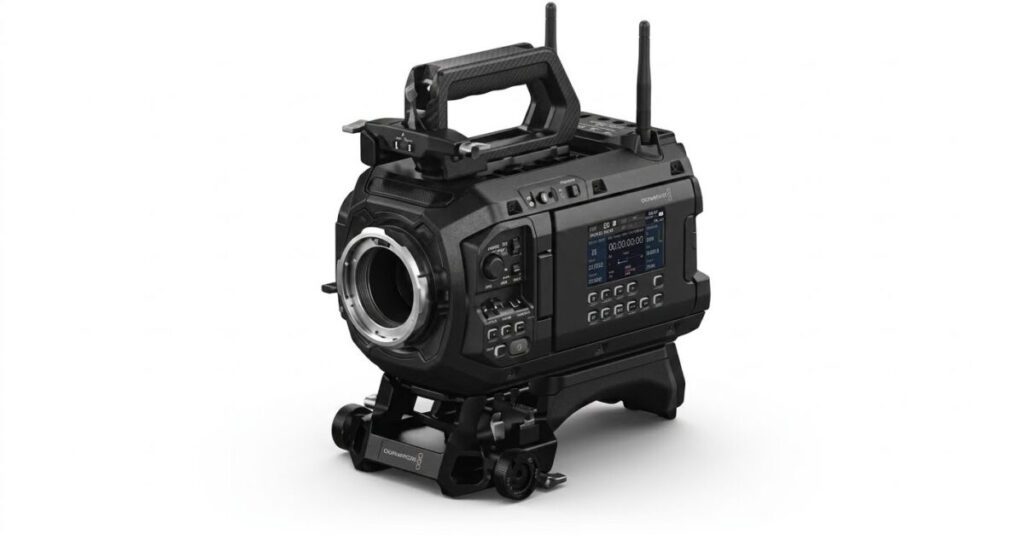
The Blackmagic URSA Cine Immersive 100G has a robust, purpose-built body. It follows the URSA Cine design language that Blackmagic has developed across their cinema camera lineup: practical, clean, professional, and built for demanding production environments.
Physical Build
The dual-lens housing is the most visually distinctive element of the design. Both lenses sit side by side in a single integrated housing at the front of the body. They are factory-calibrated, pre-aligned, and locked permanently. Operators do not adjust or modify the lens geometry. The stereo pair ships ready to shoot.
The body is described by Blackmagic as lightweight and robust. For a dual-sensor stereoscopic system with this level of capability, keeping the weight manageable is a genuine engineering achievement. Camera operators handling the unit on tripods, jibs, or fixed broadcast mounts will appreciate the balance and portability.
Industry-standard connections are used throughout the body. Power, data, and control inputs follow established cinema camera conventions, which makes integration with existing rigging systems straightforward.
LCD Touchscreen Monitoring
The capacitive LCD touchscreen provides full monitoring control for the camera operator. Four monitoring modes are available. Left Eye shows only the left sensor feed. Right Eye shows only the right sensor feed. Punch In allows the operator to zoom into a specific area for focus checking or alignment verification. Side-by-Side shows both eye feeds simultaneously on a split screen.
The Side-by-Side mode is especially practical during setup. Operators can verify that both sensors are correctly aligned and that the stereo geometry looks correct before a live broadcast begins. If there is any drift or misalignment, it becomes visible immediately in this mode.
Workflow Integration
The camera includes DaVinci Resolve Studio. This is Blackmagic’s professional post-production software and one of the most widely used color grading and editing platforms in the industry. Having it bundled with the camera means buyers get a complete production-to-post pipeline from day one.
DaVinci Resolve Studio reads Blackmagic RAW stereo files natively. It automatically applies the embedded optical calibration metadata. Colorists and editors have a fully calibrated stereo timeline ready as soon as they import the media. There is no third-party plugin or format conversion required.
For live workflows, Resolve works alongside the URSA Cine Live Encoder and the SMPTE-2110 infrastructure to enable real-time monitoring, grading, and output management during a broadcast.
Battery and Connectivity
The Blackmagic URSA Cine Immersive 100G offers a comprehensive range of connectivity options. Regardless of the venue, the infrastructure, or the production scale, this camera has a connection path that works.
100G Ethernet
The primary connection is the 100G Ethernet port for SMPTE-2110 live video output. This port carries the full dual 8K stereo stream in real time. It connects directly to 100G IP network switches and routers used in modern broadcast infrastructure. At large venues with dedicated fiber backbones, the camera slots directly into the existing network.
10G Ethernet
10G Ethernet provides a secondary IP connection. This is not used for live video output due to insufficient bandwidth for stereoscopic 8K. Instead, it handles file transfers, cloud synchronization, remote configuration, and network media management. When a production wraps and the team needs to move large Blackmagic RAW stereo files off the media module and onto storage servers, the 10G connection handles that transfer efficiently.
High-Speed Wi-Fi
Built-in high-speed Wi-Fi keeps the camera connected wirelessly to local networks. This is useful during setup for accessing camera settings remotely, pushing firmware updates, and managing Blackmagic Cloud sync without requiring a physical cable connection. In a crowded venue during a live event, Wi-Fi gives the production team wireless access to camera management tools.
5G and 4G Mobile via USB-C
5G and 4G mobile connectivity via USB-C is one of the most practical features for location production. Many live event venues do not have dedicated broadcast fiber infrastructure. Outdoor festivals, temporary sports venues, and emerging markets may have cellular coverage but no fixed network.
With a mobile data connection through the USB-C port, the camera can transmit to Blackmagic Cloud and participate in remote production workflows even without fixed infrastructure. It also provides a backup connection path at venues where the primary fiber network experiences issues during a live broadcast.
Blackmagic Cloud
Blackmagic Cloud integration ties the entire ecosystem together. Camera operators, producers, and post-production teams can access media remotely from anywhere in the world. Footage recorded to the 8TB Media Module can be synced to Blackmagic Cloud during or after production. DaVinci Resolve Studio connects directly to Blackmagic Cloud, allowing editors to begin cutting before the camera team even returns from the venue.
For global productions where post teams are in different countries from the camera crew, Blackmagic Cloud eliminates the delays and logistics of shipping physical media drives.
Internal Storage
The 8TB Media Module is a high-performance removable storage unit included with the camera. It is rated for the sustained write speeds needed to record dual 8K RAW at up to 90 fps continuously. The module is hot-swappable in supported configurations, meaning productions can swap media without powering down between sessions. That is critical for long live events like full-day sporting events or multi-set concerts.
Real-World Use Cases
Live Sports Broadcasting
The Blackmagic URSA Cine Immersive 100G already demonstrated its capabilities in professional sports. It captured NBA Lakers games live for Apple Immersive Video during the 2025-2026 season under the Spectrum Front Row brand. The result was a viewing experience that placed Vision Pro users courtside in real time during a live professional game.
Sports broadcasting is one of the biggest growth areas for immersive content. The combination of intense action, large crowds, and high production values translates powerfully in 180-degree stereoscopic video. The energy of a live game transfers to the viewer in a way that flat video simply cannot match.
Future applications in sports include football, tennis, Formula 1, Olympic events, and combat sports. Each of these involves dynamic action that benefits from the depth and presence of stereoscopic immersive capture.
Live Music and Concert Production
Concert productions gain enormously from immersive video. With the URSA Cine Immersive 100G, audiences watching from home on an Apple Vision Pro experience a front-row perspective at a live performance. They see the performers up close, hear the audio mixed for spatial presentation, and feel surrounded by the crowd atmosphere.
The camera’s wide dynamic range handles the challenging lighting of concert environments. Stage lights can vary from very dark to intensely bright within the same frame. The 16-stop latitude of this camera holds detail across those extremes without clipping highlights or crushing shadows. The RGBW sensor performs well even when practical light sources appear in the frame directly.
Major touring artists and festival organizers are already exploring immersive broadcasting as a premium product offering for fans who cannot attend in person. This camera enables that product at broadcast quality.
Documentary and Cinema Production
The original URSA Cine Immersive established strong credentials in documentary filmmaking before the 100G model arrived. High-profile productions using the camera include MotoGP: Tour De Force, Debut at the BBC Proms, an upcoming Real Madrid documentary, and the NASA Artemis II documentary coverage.
These productions demonstrate the original camera’s capability in demanding real-world conditions. The 100G model carries all of those same capabilities forward. For documentary productions that involve live events as part of their production plan, the 100G adds the flexibility to capture both scripted and live segments with a single camera system.
Corporate Events and Branded Content
Large-scale corporate events, keynote presentations, product launches, and brand experiences are beginning to explore immersive content as a premium format. Companies can deliver live immersive streams from their events to Vision Pro users globally. Attendees who could not be present physically get an experience that is far more engaging than a traditional livestream.
The URSA Cine Immersive 100G enables this type of production at the quality level brands expect. Combined with a modest live production infrastructure, a single camera unit can anchor an entire immersive broadcast from a corporate venue.
Broadcast and OB Truck Integration
With full SMPTE-2110 compliance and 100G output, this camera integrates directly into modern broadcast OB truck setups. Broadcasters operating IP-based production facilities can add the URSA Cine Immersive 100G to their camera fleet without building a separate infrastructure layer.
The data efficiency is also important for OB use. At under 50 Gb/s per camera, two units share a single 100G fiber run from the venue floor to the OB truck. That means a two-camera immersive setup adds only one additional fiber connection to the existing broadcast plant. The technical overhead is manageable for any facility already operating on 100G IP infrastructure.
Live Theater and Performing Arts
Theater and performing arts organizations are beginning to explore immersive capture as a preservation and distribution format. A live performance captured with this camera can be experienced by audiences worldwide long after the show closes. The 180-degree field of view places the viewer inside the theater. The spatial audio integration available through Apple Vision Pro completes the experience.
For ballet companies, opera houses, and theatrical productions, immersive capture offers a way to extend the reach of live performances to global audiences who would otherwise never see them.
Blackmagic URSA Cine Immersive 100G vs Original URSA Cine Immersive
Many buyers will want to understand the practical differences between this camera and the original URSA Cine Immersive that preceded it.
The original model focuses entirely on on-demand production. It records Blackmagic RAW to internal storage and produces immersive cinema content for post-production delivery. It is a powerful and proven camera for scripted and documentary content.
The 100G model adds live output capability. That single addition fundamentally changes what the camera can do. Live sports, live concerts, live broadcasts, and any production that requires real-time delivery to viewers becomes possible. The 100G model is not a replacement for the original. It is an extension of the platform into a completely new production category.
For productions that only work with on-demand content and never need live output, the original model at US$24,995 remains the right choice. For anyone building a live immersive production capability, the 100G at US$26,495 is the correct investment.
Who Should Buy the Blackmagic URSA Cine Immersive 100G
This camera is not designed for every filmmaker. It serves a specific and growing segment of the market. Here is a clear breakdown of who benefits most.
Broadcast networks and streaming services building Apple Immersive Video live programming should consider this camera as the backbone of their immersive production setup. The SMPTE-2110 output and 100G connectivity align with enterprise broadcast infrastructure.
Live sports production companies covering events where courtside or pitch-side immersive capture adds value for premium subscribers on Apple Vision Pro will find this camera to be the only professional-grade tool available for that purpose.
OB truck operators working with broadcasters exploring immersive formats can add this camera to their existing 100G IP infrastructure with minimal modification. The camera integrates like any other SMPTE-2110 source.
Concert and festival producers working with major artists interested in delivering premium immersive experiences to fans via Apple Vision Pro can use this camera to build a compelling product offering.
High-end documentary producers working on prestige projects that involve live events as part of their production will benefit from the flexibility to switch between RAW on-demand recording and live output within a single shoot.
Smaller independent productions, narrative filmmakers, and photographers will find this camera’s price point and specialized feature set difficult to justify. For those users, Blackmagic’s broader URSA Cine lineup offers more appropriate options.
Pros and Cons
Pros
- World’s first live immersive cinema camera with 100G Ethernet output
- Dual 8K x 8K RGBW sensors with 16 stops of dynamic range
- 100G Ethernet delivers real-time stereoscopic live output
- Two cameras share one 100G fiber connection at under 50 Gb/s each
- Generation 6 Color Science with DaVinci Wide Gamut film curve
- Records single Blackmagic RAW stereo file for streamlined post-production
- Five-stop built-in IR ND filter system for fast exposure control
- Comprehensive connectivity covering 100G, 10G, Wi-Fi, 5G, 4G, and Blackmagic Cloud
- DaVinci Resolve Studio included at no extra cost
- 8TB Media Module included
- Proven in live professional sports production before general release
- Integrates directly into SMPTE-2110 IP broadcast infrastructure
- Optical calibration metadata simplifies stereo post-production
Cons
- Fixed lens system with no interchangeable mounts limits optical flexibility
- High price point of US$26,495 limits access for independent and smaller productions
- Requires URSA Cine Live Encoder for full live workflow, sold separately
- Live Encoder was not yet shipping at the time of announcement
- Physical availability begins Q3 2026
- Very specialized use case focused on immersive content for Apple Vision Pro
- Apple Vision Pro’s current audience size limits the immediate scale of distribution
- Full live immersive pipeline requires significant supporting infrastructure investment
Final Verdict
The Blackmagic URSA Cine Immersive 100G is a landmark product in the history of broadcast technology. It is not a camera for general use. It is a precision instrument engineered to solve a specific and previously unsolvable problem: delivering live stereoscopic 8K immersive video at broadcast quality.
No other camera on the market currently does what this one does. The combination of dual 8K x 8K RGBW sensors, 16 stops of dynamic range, Generation 6 Color Science, and 100G Ethernet live output is entirely unique at this time. The fact that this camera was deployed for real NBA live broadcasts before its general release to the public is extraordinary validation of its capabilities.
The price is significant. The workflow requirements are real. Supporting infrastructure including 100G Ethernet networks, the URSA Cine Live Encoder, and SMPTE-2110 routing adds cost beyond the camera body. For productions without an existing broadcast IP infrastructure, getting up and running with a complete live immersive setup requires meaningful investment.
However, for the organizations this camera targets, that investment is justified by the product it enables. Live immersive sports, concerts, and events on Apple Vision Pro represent a genuinely new category of premium content. Early movers in this space have the opportunity to build an audience and establish a format before competition arrives.
The Blackmagic URSA Cine Immersive 100G does not compromise on quality to achieve live output. It delivers the same cinematic image quality that made the original URSA Cine Immersive the standard for immersive cinema, and it delivers that image live. That is a significant technical achievement.
Live immersive production has arrived. The Blackmagic URSA Cine Immersive 100G is the camera at the center of it.
Read More from AltBuzz
Read more from Altbuzz for camera reviews, rumors, and detailed specs. AltBuzz delivers trusted and easy-to-understand photography content.
Subscribe to the AltBuzz YouTube Channel
Stay updated with camera reviews, rumors, and comparisons. AltBuzz shares regular camera content.
Subscribe Altbuzz and never miss a camera update.
Published May 2026 | AltBuzz Media