
Sony A9 III Review: The World’s First Full-Frame Global Shutter Camera in 2025
The Sony A9 III made history. Sony announced it in November 2023 and shipped it in early 2024. First, it became the world’s first full-frame camera with a global shutter sensor. Additionally, this single innovation changed professional photography fundamentally. Furthermore, it eliminated rolling shutter distortion from full-frame mirrorless cameras entirely. Therefore, action photographers, sports shooters, and studio professionals took immediate notice. Moreover, the A9 III also pushed continuous shooting speeds to 120 frames per second. Consequently, it set new performance benchmarks across the entire camera industry. Indeed, understanding the Sony A9 III requires a thorough examination of every technical aspect it introduces.
Background: Why Sony Built the A9 III
Sony has led the mirrorless camera revolution for over a decade. First, the original A9 launched in 2017 and shocked the industry with 20fps blackout-free shooting. Additionally, the A9 II improved on that foundation with better ergonomics and connectivity. Furthermore, Sony engineers identified a persistent limitation across all digital cameras. Specifically, every CMOS sensor on the market used a rolling shutter readout mechanism. Therefore, fast motion caused image distortion during high-speed shooting. Moreover, flash synchronization remained limited to slower shutter speeds due to this rolling shutter. Consequently, Sony invested years into developing a solution at the full-frame level.
The result was the stacked global shutter sensor inside the A9 III. First, this sensor reads every pixel simultaneously rather than line by line. Additionally, it achieves this at speeds previously impossible in a full-frame format. Furthermore, it opens creative and technical possibilities that photographers never had access to before. Therefore, the A9 III represents not just a camera upgrade but a genuine technological breakthrough. Above all, it arrives with a complete professional feature set that makes it immediately usable for demanding professional work.
Sony A9 III Full Technical Specifications
Here is a complete technical breakdown of the Sony A9 III specifications.
Sensor
- Type: Full-Frame Stacked CMOS Global Shutter Sensor
- Resolution: 24.6 Megapixels
- Effective Pixels: 24.6 megapixels
- Sensor Size: 35.6mm x 23.8mm (Full Frame)
- Pixel Size: 5.56 microns
- Native ISO Range: 250 to 25600
- Extended ISO Range: ISO 100 to 51200
- Color Depth: 14-bit RAW output
- Anti-Aliasing Filter: None
- Global Shutter: Yes, full-frame global simultaneous pixel readout
Processor
- Image Processor: BIONZ XR
- AI Accelerator: Dedicated AI Processing Unit
- Processing Pipeline: Dual-pipeline architecture for speed and quality
- Buffer Depth: Continuous shooting without buffer limitation in JPEG, approximately 239 compressed RAW frames
Autofocus System
- AF Type: Fast Hybrid AF with Phase Detection
- AF Points: 759 phase-detection points
- Frame Coverage: Approximately 92% horizontal and 90% vertical
- Subject Recognition: Human eyes, faces, bodies, animals, birds, insects, cars, trains, aircraft
- AI Processing: Real-time recognition via dedicated AI chip
- AF Sensitivity: Down to negative 4 EV in low light
- AF Speed: 0.03 seconds acquisition time
Speed and Continuous Shooting
- Maximum Frame Rate: 120 fps with full AF and AE tracking
- RAW Burst Speed: 120 fps in compressed RAW
- Electronic Shutter Speed Range: 1/80,000s to 30s
- Mechanical Shutter Speed Range: 1/8000s to 30s (also available)
- Flash Sync Speed: Any shutter speed up to 1/80,000s
- Pre-Capture: Yes, up to 1 second before shutter press
- Blackout: Zero blackout during continuous shooting
Video Specifications
- Maximum Resolution: 4K at up to 120fps
- Slow Motion: Up to 4x slow motion at 4K 120fps
- Full-Frame 4K: Yes, from full sensor width
- Log Profiles: S-Log3, S-Log2, S-Cinetone
- Internal Recording Formats: XAVC HS 10-bit 4:2:2, XAVC S 10-bit 4:2:2, XAVC S-I
- Maximum Internal Bitrate: 600 Mbps
- RAW Video Output: 16-bit RAW over HDMI to Atomos Ninja V+
- Rolling Shutter: Zero rolling shutter due to global shutter sensor
Viewfinder
- Type: Electronic Viewfinder (Quad-VGA OLED)
- Resolution: 9.44 million dots
- Magnification: 0.90x
- Refresh Rate: Up to 240fps
- Coverage: 100%
- Blackout-Free: Yes
Rear Screen
- Size: 3.0 inches
- Resolution: 1.44 million dots
- Type: Fully Articulating Touchscreen LCD
- Articulation: Multi-angle fully articulating (flips sideways and forward)
- Touch Functions: Full touch control including AF point selection
Storage
- Card Slot 1: CFexpress Type A or SD UHS-II
- Card Slot 2: CFexpress Type A or SD UHS-II
- Simultaneous Recording: Yes
- Relay and Backup: Yes
Connectivity
- USB: USB-C 3.2 Gen 2 (10Gbps)
- USB Power Delivery: Yes
- HDMI: Full-Size HDMI Type A
- Wi-Fi: Wi-Fi 6 (802.11 ax), 2.4GHz and 5GHz
- Bluetooth: Version 5.1
- Wired LAN: Via USB-C adapter
- Microphone Input: 3.5mm stereo jack
- Headphone Output: 3.5mm stereo jack
- PC Sync Terminal: Yes (for studio flash at any shutter speed)
- Multi-Interface Shoe: Yes (with digital audio support)
Body and Build
- Body Material: Magnesium Alloy
- Weather Sealing: Dust and moisture resistant
- Weight: 585 grams body only
- Dimensions: 136.1 x 96.9 x 82.9mm
- Shutter Life: 500,000 actuations rated (mechanical)
Battery
- Battery Type: NP-FZ100 Lithium-Ion
- Rated Life: Approximately 530 shots per charge (CIPA standard)
- USB Charging: Yes via USB-C
- USB Power Supply: Yes during shooting
- Grip Compatibility: VG-C5 vertical battery grip
The Global Shutter Sensor: The Most Important Innovation in Years
The global shutter sensor is the defining feature of the Sony A9 III. First, understanding it requires understanding how traditional sensors work. Additionally, this context explains why the global shutter matters so profoundly. Therefore, a brief technical explanation is valuable here.
How Traditional Rolling Shutter Works
Traditional CMOS sensors read image data line by line from top to bottom. First, the top row of pixels captures the image at a slightly earlier moment. Additionally, each successive row captures the scene a fraction of a millisecond later. Furthermore, this time difference across the frame causes distortion in fast-moving subjects. Therefore, fast-spinning propellers appear bent in photographs. Moreover, rapidly moving athletes show slightly skewed body proportions. Consequently, photographers using traditional sensors always managed this limitation carefully.
Additionally, flash synchronization suffered the same limitation. First, the rolling shutter means the sensor is never fully exposed simultaneously. Therefore, using a flash requires shutter speeds slow enough for the sensor to read fully before the flash fires. Consequently, most cameras limit flash sync to 1/200s or 1/250s maximum. This forces photographers to sacrifice creative control in bright outdoor flash scenarios.
How the Global Shutter Solves Everything
The Sony A9 III global shutter reads every pixel across the entire sensor simultaneously. First, every pixel captures the scene at exactly the same instant. Additionally, this simultaneous capture eliminates all time-based distortion. Furthermore, it makes rolling shutter distortion physically impossible regardless of subject speed. Therefore, helicopter blades, spinning wheels, fast pitches, and every other fast-moving subject render geometrically accurate. Moreover, the simultaneous sensor readout allows flash synchronization at any shutter speed.
Consequently, photographers sync studio strobes and speedlights at 1/80,000s. First, this opens enormous creative possibilities in outdoor portrait photography. Additionally, photographers use a fast shutter speed to reduce ambient light to zero. Furthermore, the strobe then adds precisely controlled light to the subject. Therefore, shooting in harsh midday sun becomes as controllable as a studio environment. This capability alone transforms the A9 III into a uniquely versatile tool for portrait and fashion photographers.
The Technical Cost of the Global Shutter
The global shutter sensor does carry one significant technical tradeoff. First, storing pixel data simultaneously requires capacitors built into each pixel. Additionally, these capacitors add complexity to the pixel structure. Furthermore, this complexity increases the noise floor slightly compared to equivalent rolling shutter sensors. Therefore, the native ISO starts at 250 rather than 100 or 64 as found on competing cameras. Consequently, the A9 III shows slightly more noise at very low ISO settings compared to the best high-resolution sensors. However, Sony engineered the noise performance to remain excellent across the usable ISO range. Moreover, the advantages of the global shutter far outweigh this limitation for the camera’s intended audience.
The BIONZ XR Processor and AI Processing Unit
The Sony A9 III uses the BIONZ XR processor alongside a dedicated AI Processing Unit. First, the BIONZ XR handles standard image processing tasks at high speed. Additionally, the separate AI chip handles subject recognition and real-time tracking independently. Furthermore, this dual-chip architecture prevents processing conflicts between image handling and autofocus computation. Therefore, the camera maintains 120fps with full autofocus and autoexposure at all times. Moreover, the AI unit processes subject detection algorithms without borrowing resources from the main processor. Consequently, autofocus performance stays consistent regardless of shooting speed or image complexity.
Additionally, the AI Processing Unit enables expanded subject recognition categories. First, it identifies insects as a dedicated tracking category for macro and nature photographers. Additionally, it tracks cars, trains, airplanes, and other vehicles reliably. Furthermore, it detects and tracks human bodies even without visible face or eye data. Therefore, tracking subjects from behind or in profile stays reliable. Moreover, Sony updates the AI recognition algorithms through firmware. Consequently, the subject detection capability continues expanding after purchase without hardware replacement.
Autofocus System: Intelligent Tracking at 120 Frames Per Second
The Sony A9 III autofocus system is among the finest ever built. First, it uses 759 phase-detection points across the frame. Additionally, these points cover 92% of the horizontal frame width. Furthermore, the AI Processing Unit drives intelligent subject recognition in real time. Therefore, the camera identifies and tracks subjects faster than human reaction allows. Moreover, the autofocus recalculates tracking data for every single frame at 120fps. Consequently, even at maximum burst speed, every frame benefits from fresh autofocus calculation.
Real-Time Eye Autofocus
The real-time eye autofocus performs with exceptional reliability. First, it detects human eyes from a significant distance even at smaller apertures. Additionally, it prioritizes the eye nearest to the camera by default. Furthermore, photographers switch between left and right eye priority instantly. Moreover, the system tracks eyes through partial obstruction and dramatic lighting changes. Therefore, portrait and event photographers achieve sharp eye focus in candid and unpredictable situations. Notably, the eye tracking works in video recording mode simultaneously with stills functionality. Consequently, hybrid photographers get reliable eye tracking across both media types.
Animal and Bird Recognition
Wildlife photographers benefit enormously from the expanded recognition system. First, the AI unit detects dogs, cats, and birds automatically. Additionally, it specifically recognizes and tracks bird eyes in flight. Furthermore, the dedicated insect recognition category serves macro photographers uniquely. Therefore, butterfly, dragonfly, and beetle photographers track subjects that other cameras lose. Moreover, the 120fps burst captures every wing beat of a bird in flight with remarkable completeness. Consequently, wildlife photographers return from sessions with significantly higher keeper rates than with previous generation cameras.
Sports and Vehicle Tracking
Sports autofocus performance reaches new heights with the A9 III. First, the 120fps tracking calculates subject position 120 times per second. Additionally, the predictive algorithm anticipates trajectory between frames mathematically. Furthermore, vehicle recognition tracks motorsport subjects across the full frame reliably. Therefore, racing photographers capture sharp images of fast-moving cars throughout entire race sequences. Moreover, the zero-blackout electronic viewfinder allows continuous visual tracking without interruption. Consequently, photographers maintain visual contact with subjects throughout any burst regardless of length.
Low-Light Autofocus Performance
The A9 III autofocus operates reliably down to negative 4 EV. First, this allows tracking in nearly complete darkness. Additionally, the AF illuminator assist light activates in extreme low light conditions. Furthermore, the AI subject recognition maintains detection in challenging illumination. Therefore, event and wedding photographers achieve reliable autofocus during dimly lit reception moments. However, the negative 4 EV limit is slightly less impressive than some competitors. Consequently, photographers requiring autofocus in extreme darkness consider this specification carefully.
120fps Continuous Shooting: Redefining Speed
The 120 frames per second continuous shooting of the Sony A9 III is extraordinary. First, this speed is six times faster than the original A9’s already impressive 20fps. Additionally, it captures 120 full-resolution compressed RAW files every single second. Furthermore, full autofocus and autoexposure tracking operate at every single frame. Therefore, photographers never choose between speed and focusing accuracy. Moreover, the buffer handles approximately 239 compressed RAW frames before slowing. Consequently, photographers shoot extended bursts covering entire athletic plays and sequences.
Pre-Capture Buffer
The pre-capture system stores images before the shutter button fully activates. First, the camera continuously buffers up to one second of frames before capture. Additionally, this means up to 120 frames exist before the intentional press. Furthermore, this completely eliminates reaction time as a limiting factor. Therefore, peak moments that happen before a photographer reacts are safely captured. Notably, this feature proves particularly valuable for sports moments. In fact, diving catches, peak jump heights, and moment-of-impact images become reliably reproducible. Consequently, photographers working in fast and unpredictable sports scenarios gain a decisive technical advantage.
Zero Blackout Viewfinder at 120fps
The electronic viewfinder delivers zero blackout during 120fps shooting. First, it refreshes at up to 240fps during burst capture. Additionally, this means the photographer sees a live feed smoother than continuous motion. Furthermore, subject tracking through the viewfinder stays visually smooth even at maximum speed. Therefore, panning shots and fast subject tracking feel natural rather than disorienting. Moreover, Sony designed the EVF to display at 9.44 million dots resolution. Consequently, the live view image quality itself is extremely high even during maximum-speed bursts.
Flash Synchronization: A Complete Creative Revolution
The global shutter enables flash synchronization at any shutter speed. This is one of the most significant practical advantages of the Sony A9 III. First, traditional cameras limit flash sync to approximately 1/200s or 1/250s. Additionally, this limitation forces outdoor flash photographers to use neutral density filters. Furthermore, high-speed sync modes on speedlights reduce maximum flash power significantly. Therefore, outdoor portrait photographers historically struggled to balance ambient and flash exposure.
Flash at 1/80,000s
The A9 III solves this problem completely. First, photographers sync studio monolights, pack systems, and speedlights at any shutter speed. Additionally, choosing 1/8000s in direct sunlight drops the ambient exposure to near zero. Furthermore, the strobe then lights the subject with full power and precision. Therefore, outdoor fashion shoots and portrait sessions in direct midday sun achieve studio-quality control. Moreover, speedlights maintain full power output at 1/80,000s instead of reducing power for high-speed sync. Consequently, photographers use smaller, lighter flash systems to achieve the same results previously requiring powerful generators.
Studio Photography Transformation
Studio photographers experience an equally significant benefit. First, they sync strobes at any shutter speed without limitation. Additionally, this allows complete freezing of subject motion using strobe duration alone. Furthermore, it separates ambient light control and strobe exposure independently. Therefore, creative lighting ratios and effects become more controllable than ever before. Moreover, photographers using older studio flash systems gain new capabilities from the camera side without replacing flash equipment. Consequently, the A9 III extends the creative life of existing studio flash investments.
Video Capabilities: Professional Quality Without Rolling Shutter
The Sony A9 III delivers impressive video performance alongside its stills capabilities. First, it records 4K video at up to 120fps internally. Additionally, the global shutter completely eliminates rolling shutter distortion in video recording. Furthermore, this makes it uniquely suitable for filming fast action and handheld footage. Therefore, video content of sports, dance, and rapid camera moves renders cleanly.
4K 120fps Recording
The 4K 120fps mode enables stunning slow-motion footage. First, at 24fps playback, this produces 5x slow motion at full 4K resolution. Additionally, the full-sensor readout preserves the full-frame field of view. Furthermore, 10-bit 4:2:2 color sampling preserves maximum color detail. Therefore, colorists work with rich color information throughout post-production. Moreover, the XAVC HS codec uses efficient H.265 compression for manageable file sizes. Consequently, storage costs remain reasonable even during heavy 4K 120fps recording sessions.
4K Full-Frame Coverage
The A9 III records 4K from the full sensor width. First, this produces no crop factor penalty compared to a full-frame still image. Additionally, wide-angle lenses retain their full wide perspective in video mode. Furthermore, full-sensor coverage maintains the same lens character that photographers expect. Therefore, videographers choose lenses based on their optical qualities rather than adjusting for crop factors. Moreover, the oversampled 4K from the full sensor produces sharper and more detailed footage than basic 4K recording methods.
S-Log3 and Color Science
Sony’s S-Log3 gamma profile captures maximum dynamic range in video. First, it flattens the image to preserve highlight and shadow detail simultaneously. Additionally, it provides approximately 15 stops of dynamic range in video mode. Furthermore, S-Cinetone delivers a film-inspired color rendering for documentary and narrative work. Therefore, colorists work from a rich starting point in any grading software. Moreover, Sony Color Science is widely respected throughout the video production industry. Consequently, footage integrates naturally into productions that combine footage from multiple Sony cameras.
16-bit RAW HDMI Output
The A9 III outputs 16-bit RAW video over HDMI to compatible recorders. First, the Atomos Ninja V+ accepts and records this RAW output. Additionally, 16-bit RAW captures more color depth than any internal recording format. Furthermore, this option suits high-end commercial and narrative productions requiring maximum post-production flexibility. Therefore, productions with extensive color grading pipelines benefit from the RAW output. Notably, this feature adds external recorder cost to the overall production budget. Consequently, productions weigh internal 10-bit recording against external 16-bit RAW based on their specific requirements.
Zero Rolling Shutter in Video
The global shutter eliminates rolling shutter distortion entirely in video. First, fast lateral camera pans render without the characteristic wobble of rolling shutter sensors. Additionally, filming fast vehicles, rotating objects, and propeller aircraft produces geometrically accurate results. Furthermore, handheld shooting with rapid camera movements stays clean and usable. Therefore, run-and-gun documentary filmmakers gain freedom they never had with traditional sensors. Moreover, drone footage using the A9 III shows none of the propeller distortion common with rolling shutter sensors. Consequently, aerial videographers achieve cleaner and more professional-looking results.
Design, Ergonomics, and Build Quality
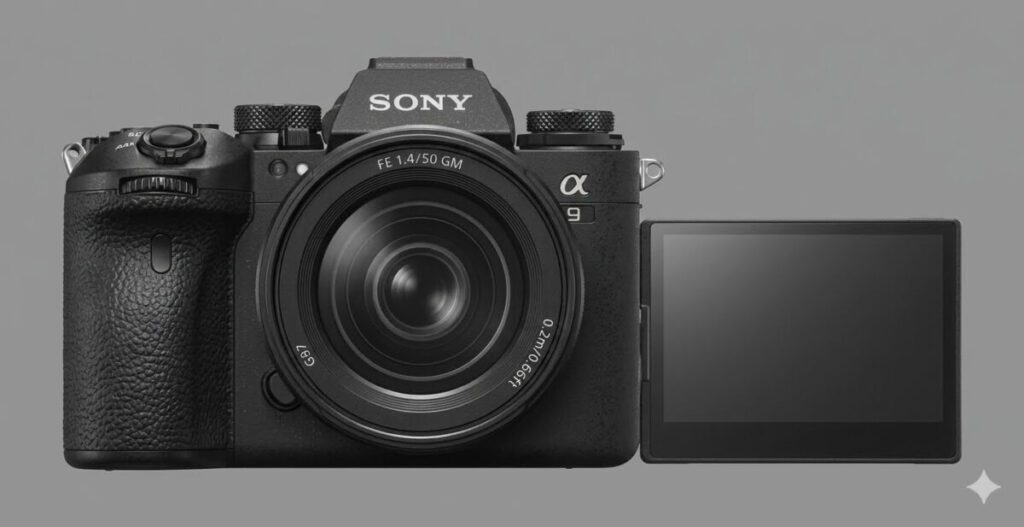
The Sony A9 III occupies a traditional professional body design. First, Sony constructed the body from magnesium alloy throughout. Additionally, the camera receives comprehensive dust and moisture sealing at every joint and control. Furthermore, the compact dimensions make it smaller than many competitors in its class. Therefore, it handles comfortably during long shooting sessions without fatigue. Notably, the body weighs just 585 grams without lens attached. Consequently, it is one of the lightest professional full-frame cameras currently available.
Grip and Control Layout
The grip depth provides secure handling for extended sessions. First, the textured rubber surface prevents slipping in wet conditions. Additionally, the grip accommodates four fingers comfortably without cramping. Furthermore, the control layout reflects Sony’s refined understanding of professional workflows. Therefore, every key control reaches without repositioning the grip hand. Moreover, a dedicated still/video/S&Q mode switch on the top plate changes operating mode instantly. Consequently, photographers transition between stills and video workflows without entering menus.
Multi-Function Buttons and Customization
The A9 III provides extensive button customization. First, it offers 12 customizable buttons assignable to various functions. Additionally, the My Menu feature stores frequently used settings for quick access. Furthermore, three custom shooting modes on the mode dial store complete camera configurations. Therefore, photographers pre-configure the camera for different scenarios before shooting begins. Moreover, the front dial, rear dial, and top control dial provide three independent exposure control inputs. Consequently, photographers adjust aperture, shutter speed, and ISO simultaneously with minimal effort.
Fully Articulating Touchscreen
The 3.0-inch fully articulating touchscreen offers maximum flexibility. First, it swings out sideways and rotates to face forward. Additionally, this allows shooting at any angle including directly overhead and at ground level. Furthermore, vloggers and solo video creators use the forward-facing position for self-monitoring. Therefore, the articulating screen suits both traditional photography and modern content creation workflows. Moreover, full touch control covers AF point selection, menu navigation, and image playback. Consequently, photographers operate the camera efficiently with minimal button interaction.
Electronic Viewfinder Quality
The 9.44 million-dot OLED electronic viewfinder delivers a stunning view. First, 9.44 million dots provides extraordinary detail in the viewfinder image. Additionally, the 0.90x magnification offers a large and immersive viewing experience. Furthermore, the 240fps refresh rate produces completely smooth motion rendering during fast tracking. Therefore, sports and wildlife photographers see subjects in full smooth motion during burst shooting. Moreover, the high-resolution OLED panel displays accurate colors for critical exposure decisions. Consequently, photographers make informed creative decisions through the viewfinder alone.
Image Quality: What 24.6 Megapixels Delivers
The Sony A9 III uses a 24.6-megapixel sensor. First, this resolution suits most professional publishing requirements comfortably. Additionally, files print beautifully at sizes up to 24 x 36 inches at standard print resolution. Furthermore, the 14-bit RAW files carry sufficient tonal information for demanding post-processing. Therefore, action and sports photographers work with files that meet client and agency specifications without compromise.
Dynamic Range Performance
The dynamic range performance of the A9 III is very good for an action-oriented camera. First, it delivers approximately 13.5 stops at native ISO 250. Additionally, shadow recovery from properly exposed RAW files is clean and detailed. Furthermore, highlight recovery manages slightly overexposed sky and window light effectively. Therefore, photographers capture high-contrast scenes with good confidence. However, the dynamic range is slightly below the best landscape-optimized sensors from Sony and Nikon. Consequently, photographers requiring extreme dynamic range for landscape or studio work sometimes prefer higher-resolution alternatives.
High ISO Noise Performance
High ISO performance is impressive despite the global shutter complexity. First, ISO 3200 produces clean and detailed images with minimal visible noise. Additionally, ISO 6400 remains fully usable for professional publication in most contexts. Furthermore, ISO 12800 shows manageable noise patterns that respond well to noise reduction software. Therefore, indoor sports and event photographers shoot confidently in challenging arena lighting. Moreover, the extended ISO reaches 51200 for extreme emergency situations. Consequently, photographers cover a wide range of lighting scenarios with a single camera body.
Color Science and Rendering
Sony color science continues evolving with the A9 III. First, it delivers accurate and pleasing colors in JPEG straight from the camera. Additionally, Creative Look profiles offer distinct rendering styles directly in-camera. Furthermore, the RAW files respond excellently to color grading in Lightroom, Capture One, and DaVinci Resolve. Therefore, photographers and colorists achieve their desired looks with predictable efficiency. Moreover, skin tone rendering is accurate and flattering in both stills and video modes. Consequently, portrait and fashion photographers trust the A9 III for color-critical commercial work.
Battery Life and Power System
The NP-FZ100 battery powers the Sony A9 III through demanding shooting sessions. First, Sony rates it at approximately 530 shots per charge under CIPA standard conditions. Additionally, real-world performance often exceeds this figure in typical shooting scenarios. Furthermore, the 530-shot rating is significantly better than the Nikon Z8 under equivalent conditions. Therefore, photographers cover more ground before needing a battery change. Moreover, the USB-C port supports power delivery during active shooting. Consequently, connecting a large USB-C power bank enables essentially unlimited shooting duration.
VG-C5 Vertical Battery Grip
The VG-C5 grip adds a second battery and vertical shooting controls. First, it doubles the available battery capacity for extended sessions. Additionally, it adds a vertical shutter button, AF joystick, and control dials. Furthermore, it communicates the battery status of both cells independently on the camera display. Therefore, photographers track remaining power for each battery individually. Moreover, the grip maintains the same weather sealing standard as the body itself. Consequently, adding the grip does not compromise environmental protection.
Storage System: Dual CFexpress Type A and SD UHS-II
The Sony A9 III accepts CFexpress Type A cards in both card slots. First, CFexpress Type A cards offer very high read and write speeds. Additionally, both slots also accept standard SD UHS-II cards as an alternative. Furthermore, this dual-format compatibility gives photographers maximum flexibility. Therefore, photographers choose between speed-optimized CFexpress and cost-effective SD cards based on their needs. Moreover, both slots operate simultaneously in overflow, backup, and separate media type configurations. Consequently, recording video to one slot while capturing stills to the other becomes possible.
CFexpress Type A Advantage
CFexpress Type A cards provide the speed the A9 III demands at 120fps. First, they sustain write speeds exceeding 700 MB/s. Additionally, this throughput handles continuous 120fps compressed RAW without buffer saturation. Furthermore, the smaller physical size of Type A cards is more compact than Type B cards. Therefore, Sony chose this format to maintain the body size and dual-slot design. Moreover, CFexpress Type A cards also function in compatible Sony readers and other devices. Consequently, the card investment transfers across a compatible equipment ecosystem.
Connectivity and Professional Workflow Integration
The Sony A9 III provides comprehensive connectivity for professional workflows. First, it includes Wi-Fi 6 on 2.4GHz and 5GHz bands for fast wireless transfer. Additionally, Bluetooth 5.1 maintains persistent low-power connections to smartphones. Furthermore, the USB-C 3.2 Gen 2 port transfers data at 10Gbps for fast tethered shooting. Therefore, sports wire photographers transfer images to editorial networks with minimum delay. Moreover, the full-size HDMI Type A port connects monitors and recorders without adapters. Consequently, video productions integrate the A9 III into existing monitor setups immediately.
FTP Transfer and Network Integration
The A9 III supports direct FTP transfer over Wi-Fi and wired networks. First, it connects to FTP servers directly without a tethering computer. Additionally, it transfers images automatically as they capture during live sports events. Furthermore, photographers configure up to nine different FTP server profiles. Therefore, photographers covering different clients or venues switch server destinations instantly. Moreover, background FTP transfer continues while the photographer keeps shooting actively. Consequently, wire service photographers deliver images to editorial desks without pausing the shoot.
Creators App Integration
The Sony Creators app connects the A9 III to smartphones wirelessly. First, it transfers selected images to the phone for immediate social media sharing. Additionally, it provides remote shutter control and live view monitoring. Furthermore, it allows remote adjustment of key camera settings from the phone screen. Therefore, photographers set up remote camera positions and control them from a distance. Moreover, it transfers GPS location data from the phone to image metadata automatically. Consequently, images receive accurate geotag data without a dedicated GPS unit.
Menu System and Usability
Sony completely redesigned the menu system in recent camera generations. First, the new menu organizes settings into logical categories with clear labeling. Additionally, the search function finds any setting by keyword quickly. Furthermore, the My Menu customization stores up to 30 frequently used settings. Therefore, photographers access every important function within two or three button presses. Moreover, the touch-enabled menu navigation on the rear screen accelerates setting selection. Consequently, new users learn the menu structure faster than with older Sony camera designs.
Shooting Mode Memory
The A9 III stores up to three custom shooting configurations in MR mode. First, photographers save a complete camera state including every relevant setting. Additionally, recalling a stored mode takes a single dial turn. Furthermore, the custom modes cover stills, video, and specialized scenario configurations. Therefore, photographers pre-configure the camera for sports, portraits, and video before arriving at a location. Moreover, some settings update dynamically within a recalled mode without overwriting it. Consequently, photographers make small adjustments without permanently altering their carefully built configurations.
Sony A9 III vs Competitors
Sony A9 III vs Nikon Z8
The A9 III and Z8 serve different priorities. First, the Z8 offers 45.7 megapixels versus the A9 III’s 24.6 megapixels. Additionally, the Z8 records 8K RAW video internally while the A9 III tops out at 4K. Furthermore, the Z8 reaches 20fps while the A9 III shoots at 120fps. Therefore, each camera excels in different professional scenarios. Moreover, the Z8 starts at approximately $3,999 while the A9 III costs around $5,999. Consequently, the Z8 offers better value for photographers who prioritize resolution and video quality. In contrast, the A9 III delivers unmatched speed and the global shutter advantage for action specialists.
Sony A9 III vs Canon EOS R3
The Canon EOS R3 is the closest competitor from Canon. First, the R3 uses a stacked BSI-CMOS sensor with a rolling shutter design. Additionally, the R3 features eye-controlled AF using the photographer’s own eye position. Furthermore, the R3 shoots at 30fps with mechanical and 195fps with electronic shutter in specific crop modes. However, the A9 III’s global shutter eliminates distortion that the R3 cannot avoid. Additionally, the A9 III offers 120fps full-frame RAW at full resolution. Therefore, for photographers where rolling shutter matters, the A9 III wins decisively. Moreover, the R3 includes a built-in vertical grip while the A9 III requires a separate purchase. Consequently, wildlife photographers who shoot vertically frequently may prefer the R3 ergonomics.
Sony A9 III vs Sony A1
The Sony A1 is Sony’s own flagship above the A9 III. First, the A1 offers 50.1 megapixels versus the A9 III’s 24.6 megapixels. Additionally, the A1 records 8K video internally while the A9 III does not. Furthermore, the A1 shoots at 30fps with a rolling shutter sensor. However, the A9 III shoots at 120fps with zero rolling shutter. Therefore, the choice depends entirely on whether resolution or speed is the priority. Moreover, the A1 costs less than the A9 III in some markets. Consequently, photographers who need resolution and video quality sometimes find the A1 a better investment than the A9 III.
Sony A9 III vs Fujifilm X-H2S
The Fujifilm X-H2S is a cropped-sensor competitor worth considering. First, the X-H2S uses an APS-C stacked sensor for 40fps shooting. Additionally, it offers competitive autofocus performance at a significantly lower price. Furthermore, the APS-C sensor provides a 1.5x crop factor that extends telephoto reach. However, the full-frame global shutter of the A9 III provides superior image quality and zero distortion. Additionally, the A9 III handles low-light scenes with more native sensitivity headroom. Therefore, professionals requiring full-frame image quality choose the A9 III. Moreover, enthusiasts and budget-conscious professionals find the X-H2S a compelling alternative.
Real-World Performance Across Shooting Disciplines
Professional Sports Photography
Sports photographers experience the A9 III as a transformative tool. First, 120fps captures every phase of athletic movement in complete detail. Additionally, the zero blackout EVF maintains visual contact with subjects throughout any burst. Furthermore, the pre-capture buffer saves decisive moments that happen before the shutter press. Therefore, peak action moments of catches, impacts, and expressions appear with unprecedented reliability. Moreover, flash synchronization at any shutter speed allows outdoor action photography with controlled strobe lighting. Consequently, sports portrait sessions in outdoor environments become fully controllable regardless of ambient intensity.
Wedding Photography
Wedding photographers find unique value in the A9 III. First, the 120fps burst covers ceremony moments with complete sequence capture. Additionally, the excellent high-ISO performance handles dimly lit reception venues. Furthermore, the reliable eye autofocus tracks faces through crowds and challenging angles. Therefore, wedding photographers deliver sharper and more complete coverage to clients. Moreover, the flash sync advantage works beautifully for outdoor couple portraits in harsh sunlight. Consequently, wedding photographers expand their creative range without sacrificing technical quality.
Wildlife and Nature Photography
Wildlife photographers access remarkable capability with the A9 III. First, the 120fps burst captures every wing beat of birds in flight. Additionally, animal and bird eye tracking locks and maintains focus during rapid directional changes. Furthermore, the insect detection category opens macro nature photography to AI tracking. Therefore, butterfly and dragonfly photographers track subjects that previously required significant manual focus skill. Moreover, the pre-capture buffer stores the critical moment of takeoff or strike before conscious reaction. Consequently, nature photographers achieve images previously considered largely luck-dependent.
Commercial Studio Photography
Studio photographers discover new creative possibilities with the A9 III. First, flash synchronization at 1/80,000s enables complete ambient light elimination outdoors. Additionally, full studio strobe power at any shutter speed gives lighting designers maximum creative control. Furthermore, the 24.6-megapixel resolution satisfies most advertising and editorial publication requirements. Therefore, commercial photographers produce client-ready images with maximum lighting flexibility. Moreover, the tethered USB-C connection to Capture One and Lightroom integrates smoothly into studio workflows. Consequently, art directors and photographers review full-resolution images instantly during studio sessions.
Journalism and Photojournalism
Photojournalists value the A9 III for its speed and connectivity. First, 120fps covers fast news events with complete sequence capture. Additionally, direct FTP transfer sends images to editorial desks without a computer intermediary. Furthermore, the compact body size allows discrete shooting in sensitive news environments. Therefore, photojournalists work faster and more efficiently with the A9 III as their primary tool. Moreover, the reliable autofocus in unpredictable lighting handles news environments effectively. Consequently, agencies receive sharper and more timely coverage from photographers using this system.
In-Body Image Stabilization: 8 Stops of Protection
The Sony A9 III includes a highly effective in-body image stabilization system. First, it provides up to 8 stops of shake compensation with compatible lenses. Additionally, it works cooperatively with Sony OSS lens-based stabilization. Furthermore, the IBIS functions in both still and video recording modes. Therefore, handheld video footage shows dramatically reduced camera shake. Moreover, the Active Stabilization mode increases video stabilization at a small crop penalty. Consequently, handheld videographers achieve nearly gimbal-quality smooth footage in many scenarios.
Stabilization During 120fps Bursts
The IBIS operates during 120fps continuous shooting. First, it stabilizes each individual frame throughout the burst sequence. Additionally, this maintains image sharpness even during handheld panning shots. Furthermore, telephoto lens shooting benefits significantly from this stabilization at high burst speeds. Therefore, photographers using long lenses handheld achieve higher keeper rates throughout burst sequences. Notably, the combination of 120fps speed and 8-stop stabilization represents a uniquely powerful pairing. Consequently, action photographers handhold lenses that previously required monopod or tripod support.
Sony A9 III Firmware Updates and Ongoing Development
Sony actively develops and updates A9 III firmware. First, the camera launched with a strong feature set. Additionally, Sony committed to ongoing improvements through software updates. Furthermore, Sony has a strong track record of significant post-launch firmware additions on professional bodies. Therefore, early A9 III buyers can reasonably expect new capabilities over time. Moreover, AI subject recognition categories often expand through firmware updates. Consequently, the investment in the A9 III continues delivering growing value beyond the purchase date.
Sony G Master and Third-Party Lens Ecosystem
The Sony E-mount lens ecosystem is one of the largest in mirrorless photography. First, Sony offers an extensive lineup of native E-mount lenses. Additionally, third-party manufacturers including Sigma, Tamron, and Zeiss produce high-quality E-mount options. Furthermore, this competition keeps prices competitive across multiple quality tiers. Therefore, photographers build complete systems at various budget levels within the Sony ecosystem.
Sony G Master Lenses
Sony G Master lenses represent the top optical tier in the system. First, the Sony FE 24-70mm f/2.8 GM II is one of the finest standard zoom lenses available. Additionally, the Sony FE 70-200mm f/2.8 GM OSS II delivers outstanding telephoto performance. Furthermore, the Sony FE 400mm f/2.8 GM OSS covers demanding wildlife and sports distances. Therefore, professional photographers access premium optical quality across all focal lengths. Moreover, G Master lenses include OSS image stabilization that combines with the IBIS cooperatively. Consequently, the stabilization system delivers maximum performance with native Sony lenses.
Sigma and Tamron E-Mount Options
Third-party lenses expand the system affordably. First, Sigma’s Art line delivers exceptional optical quality at competitive prices. Additionally, Tamron offers excellent zoom lenses with macro capability at accessible price points. Furthermore, both brands maintain full electronic communication with the A9 III body. Therefore, photographers build capable systems without exclusively choosing Sony-branded glass. Moreover, Sigma regularly updates firmware for their E-mount lenses. Consequently, compatibility with new camera features stays current without replacing lenses.
Accessories That Maximize the Sony A9 III Experience
VG-C5 Vertical Battery Grip
The VG-C5 grip is the primary recommended accessory. First, it doubles battery capacity for extended shooting sessions. Additionally, it adds complete vertical orientation shooting controls. Furthermore, the grip integrates seamlessly with the body aesthetically. Therefore, portrait and vertical-format photographers use it as a permanent addition. Moreover, it maintains full weather sealing when attached. Consequently, environmental protection remains intact regardless of the grip’s presence.
CFexpress Type A Cards
High-quality CFexpress Type A cards are essential for full performance. First, Sony Tough CFexpress Type A cards offer excellent speed and reliability. Additionally, ProGrade Digital cards deliver strong performance at slightly lower pricing. Furthermore, fast cards reduce buffer clearing time between burst sequences. Therefore, photographers maintain faster readiness between shooting opportunities. Moreover, the dual-slot design allows one slot for speed-critical RAW and one for backup SD cards. Consequently, storage flexibility matches the shooting scenario without compromising reliability.
Atomos Ninja V+ External Recorder
The Atomos Ninja V+ records the 16-bit RAW HDMI output from the A9 III. First, it stores ProRes RAW or Apple ProRes directly to fast SSD media. Additionally, it adds a large calibrated monitoring display to the rig. Furthermore, the combination creates a genuinely cinema-grade shooting package. Therefore, commercial video productions gain maximum quality from the A9 III sensor. Moreover, the recorder powers from its own battery independently. Consequently, the camera battery serves stills and electronic functions while the recorder handles storage independently.
Sony Multi-Interface Shoe Accessories
The Multi-Interface Shoe accepts Sony’s digital audio accessories. First, the ECM-B10 microphone connects digitally without an audio cable. Additionally, the XLR-K3M adapter accepts professional balanced XLR microphone inputs. Furthermore, the digital connection delivers higher audio quality than analog alternatives. Therefore, video-focused photographers capture professional audio quality without an audio recorder. Moreover, the Multi-Interface Shoe also accepts Sony video lights. Consequently, photographers build compact documentary rigs with clean audio and lighting from a single hotshoe connection.
Frequently Asked Questions About the Sony A9 III
What makes the global shutter different from a regular shutter? A global shutter reads all pixels simultaneously. First, traditional shutters scan from top to bottom creating time differences. Additionally, this time difference distorts fast-moving subjects in the frame. Furthermore, the A9 III reads every pixel at the exact same moment. Therefore, no distortion occurs regardless of subject or camera speed. Consequently, images and video always render geometrically accurate.
Does the Sony A9 III shoot 8K video? No, the Sony A9 III does not shoot 8K video internally. First, its maximum internal recording resolution is 4K. Additionally, 4K at 120fps is the highest available option. Furthermore, 16-bit RAW output over HDMI requires an external recorder. Therefore, filmmakers requiring 8K recording should consider the Sony A1 instead. Consequently, the A9 III targets speed-focused shooters more than resolution-focused videographers.
Why does the A9 III start at ISO 250 instead of ISO 100? The global shutter architecture requires additional circuitry at each pixel. First, this circuitry slightly raises the minimum readable signal. Additionally, Sony optimized the sensor for the ISO 250 to 25600 range primarily. Furthermore, the extended range reaches ISO 100 for specific scenarios. Therefore, photographers in very bright conditions or requiring ultimate shadow performance sometimes note this starting point. Notably, practical impact in normal shooting scenarios is minimal. Consequently, most photographers never notice this limitation in real-world use.
Is the Sony A9 III worth its price? The A9 III delivers unique capabilities at its price point. First, no other full-frame camera offers a global shutter. Additionally, 120fps full-frame RAW shooting is exclusive to this camera. Furthermore, flash sync at any shutter speed opens creative possibilities unavailable elsewhere. Therefore, photographers who specifically need these features find the price fully justified. Moreover, specialists in sports, action, and studio flash work see clear professional return on the investment. Consequently, the price makes sense for the right professional application.
Can the Sony A9 III use older Sony A-mount lenses? Yes, with the Sony LA-EA5 adapter. First, this adapter mounts A-mount lenses on E-mount bodies. Additionally, it passes electronic communication for autofocus functionality. Furthermore, it includes a built-in phase-detection AF system for older screw-drive lenses. Therefore, photographers with Sony A-mount glass transition to the A9 III without losing their lens investment. Moreover, the adapter maintains full aperture control and EXIF data communication. Consequently, transitioning from older Sony DSLR systems involves minimal additional cost.
How does the Sony A9 III handle overheating during video? Sony designed the A9 III with improved thermal management. First, the body dissipates heat more effectively than previous generations. Additionally, 4K recording sessions run for extended periods without shutdown in normal temperature conditions. Furthermore, using a smaller recording resolution or lower frame rate extends recording duration further. Therefore, most video productions complete without thermal interruption. However, extended 4K 120fps recording in warm environments may trigger temperature warnings. Consequently, videographers covering long events monitor temperature indicators and take occasional breaks during intense recording sessions.
Sony A9 III Price and Market Position
The Sony A9 III retails at approximately $5,999 USD body only. First, this positions it above most professional mirrorless cameras currently available. Additionally, it is the most expensive camera in the Sony Alpha lineup below the A1. Furthermore, the price reflects the unprecedented technology inside the global shutter sensor. Therefore, the cost comparison with standard cameras does not apply fairly. Moreover, photographers evaluate the A9 III against what it uniquely enables rather than against standard feature comparisons. Consequently, professional sports, news, and studio photographers justify the investment based on specific workflow advantages.
Additionally, the total system cost requires consideration. First, CFexpress Type A cards add to the initial investment. Additionally, the VG-C5 grip and G Master lenses significantly increase the total outlay. Furthermore, the Atomos recorder for 16-bit RAW video adds further cost. Therefore, prospective buyers calculate total system cost rather than body price alone. Moreover, Sony occasionally offers promotional bundles with lens or accessory discounts. Consequently, purchasing timing affects the overall value of the investment.
Who Should Buy the Sony A9 III?
The Sony A9 III suits a specific but enthusiastic professional audience. First, professional sports photographers benefit most from 120fps and global shutter combined. Additionally, photojournalists who cover fast-moving news events gain decisive speed advantages. Furthermore, wildlife photographers working with birds and fast-moving animals benefit enormously. Therefore, these specializations represent the core audience for this camera. Moreover, commercial photographers using strobe lighting gain unprecedented creative control through any-speed flash sync. Consequently, both field-based action photographers and controlled studio professionals find compelling reasons to invest.
However, certain photographers do not need the A9 III’s specific strengths. First, landscape photographers who prioritize maximum resolution and dynamic range find the 24.6-megapixel sensor limiting. Additionally, filmmakers requiring 8K video production find the 4K limitation significant. Furthermore, photographers on tighter budgets find excellent alternatives in the Nikon Z8 and Sony A7R V. Therefore, the A9 III is for photographers whose work specifically demands what only a global shutter camera delivers. Above all, it suits professionals who can translate its unique technical advantages into direct commercial or creative value.
Final Verdict: A Milestone Camera for Specific Professionals
The Sony A9 III is a genuinely historic camera. First, it introduced the world’s first full-frame global shutter sensor. Additionally, it delivers 120fps continuous RAW shooting with full autofocus tracking. Furthermore, it enables flash synchronization at every shutter speed without limitation. Therefore, it provides capabilities that no other camera on the market matches in a single package. Moreover, the build quality, weather sealing, and ergonomics meet the highest professional standards. Consequently, it delivers both technological innovation and practical usability simultaneously.
However, the A9 III is not for everyone. First, the relatively modest 24.6-megapixel resolution limits its appeal for resolution-critical work. Additionally, the absence of 8K video limits its attractiveness to filmmakers. Furthermore, the premium price demands a clear professional justification. Therefore, photographers should evaluate it honestly against their specific needs. Notably, for sports, action, news, wildlife, and studio flash specialists, the A9 III is simply the best tool available anywhere at any price. Moreover, the ongoing firmware development ensures the camera continues improving over its useful life.
Ultimately, the Sony A9 III marks a turning point in camera history. First, the global shutter will eventually become standard across the industry. Additionally, the A9 III proves the technology is ready for demanding professional use today. Furthermore, Sony executed this technological leap without sacrificing the reliability professionals demand. Therefore, buying the A9 III means owning the first chapter of what becomes the new standard for professional photography. Above all, it is a landmark achievement that deserves its premium position in the camera market. In 2025, no other camera delivers what the Sony A9 III offers to the photographers who need it most.
Read More from AltBuzz
Read more from Altbuzz for camera reviews, rumors, and detailed specs. AltBuzz delivers trusted and easy-to-understand photography content.
Subscribe to the AltBuzz YouTube Channel
Stay updated with camera reviews, rumors, and comparisons. AltBuzz shares regular camera content.
Subscribe Altbuzz and never miss a camera update.