
Sony RX0 Mark III: What an Industrial-Grade Action Pod Could Look Like
The Sony RX0 Mark III does not exist in any confirmed leak, patent filing, or insider report right now. Search through every major rumor tracker covering Sony in 2026, and you will not find a single credible source discussing this camera. What you will find instead is years of forum threads, comment sections, and wishlist articles from photographers who keep asking the same question. Why has Sony abandoned the most interesting rugged camera concept it ever built?
This article takes a different approach than a typical rumor roundup. Since no leak exists, we will build a realistic picture of what a Sony RX0 Mark III could include based on three things. First, the actual specs and shortcomings of the original RX0 II. Second, how the broader action camera market has evolved since Sony last touched this product line. Third, what photographers and videographers have been requesting in forums and community discussions for years. Think of this as an informed wishlist rather than a rumor breakdown, built from real market signals instead of an unconfirmed leak.
Why the Sony RX0 Mark III Conversation Refuses to Die
Sony released the original RX0 in 2018, followed by the RX0 II in March 2019. Since then, silence. No successor, no official statement, and no clear signal about whether Sony still considers this product line active.
A Cult Following Built Around a Genuinely Unique Camera
Despite its commercial struggles, the RX0 II earned a small but devoted following among photographers who valued its unusual combination of features. According to Digital Camera World, the RX0 II packed a 1-inch Exmor RS stacked sensor into a genuinely tiny, rugged body, a combination that no other action camera manufacturer had matched at the time of its release. That same coverage argues Sony should have pushed harder into this space rather than letting the concept quietly fade away.
Forum Discussions That Never Really Stopped
Photography forums have kept the RX0 Mark III conversation alive for years. A DPReview forum thread captures this pattern well, with users directly asking whether anyone has heard rumors about a third-generation RX0, while acknowledging Sony seems to have quietly discontinued the line entirely. The most common requests in threads like this center on two specific upgrades: continuous autofocus and proper in-body stabilization, both of which the RX0 II handled poorly compared to modern expectations.
A Camera That Never Quite Fit Its Own Category
Part of the RX0’s ongoing appeal comes from how awkwardly it fit into existing camera categories. Coverage from RedShark News describes the RX0 models as not strictly action cameras in the traditional sense, largely due to their narrower field of view compared to typical helmet cameras. This in-between identity, part professional b-roll tool and part rugged compact, is exactly what made it interesting to a specific niche of photographers and filmmakers, even as it confused Sony’s own marketing efforts.
What Made the Original Sony RX0 Line Special
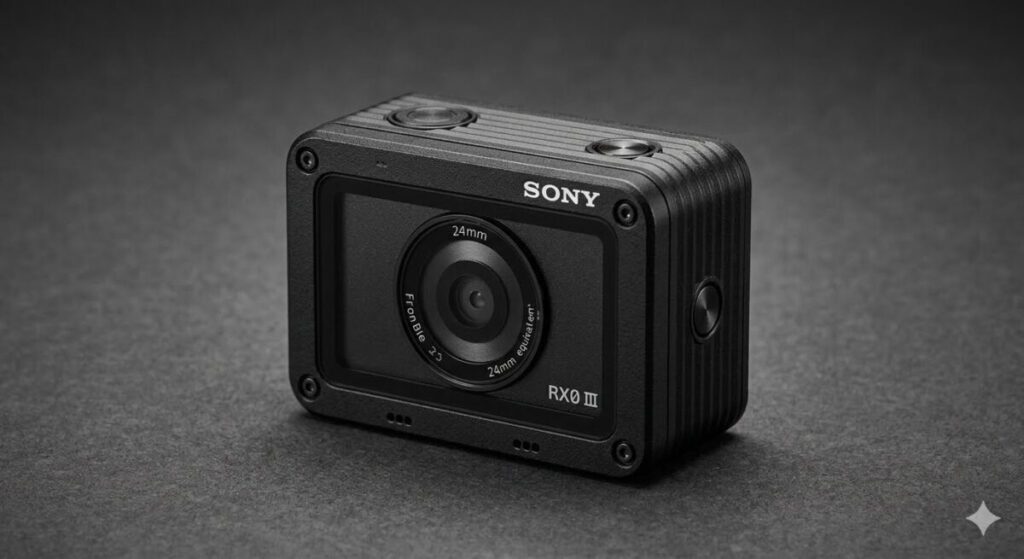
Before speculating about a Mark III, it helps to understand exactly what the RX0 II already delivered, since any successor would need to build on this foundation.
A Genuinely Large Sensor in a Genuinely Tiny Body
The RX0 II measured just 59 by 40.5 by 35 millimeters and weighed only 132 grams, according to specifications listed by B&H Photo. Despite this tiny footprint, it housed a 15.3-megapixel 1-inch stacked sensor, a size that dwarfed the sensors found in most competing action cameras at the time. This sensor size advantage remains the single biggest reason enthusiasts still talk about the RX0 line years after its release.
Genuine Ruggedness Without an External Case
Unlike most action cameras that require a separate waterproof housing, the RX0 II was waterproof to 10 meters, shockproof to 2 meters, and crushproof up to 200 kilograms of force right out of the box. This built-in durability meant photographers could drop the camera into rough conditions without fumbling with a bulky external case, a genuine convenience advantage that added to its appeal for documentary and adventure work.
A Fixed Lens That Limited Its Versatility
The RX0 II shipped with a fixed ZEISS Tessar 24mm equivalent f/4 lens, a choice that kept the body impossibly compact but also limited creative flexibility. Photographers who wanted a tighter framing or a wider field of view had no option beyond digital cropping, a real limitation compared to competitors that eventually began offering interchangeable lens options or wider native fields of view.
What Fans Actually Want From a Sony RX0 Mark III
Based on years of community discussion and the RX0 II’s documented shortcomings, a clear wishlist has emerged among photographers who still hope Sony revisits this concept.
Variable Optical Zoom Instead of a Fixed Lens
The single most requested upgrade centers on lens flexibility. A fixed 24mm lens made sense for an ultra-compact form factor in 2019, but competitors have since demonstrated that a compact zoom lens can coexist with a rugged, pocketable body. A variable optical zoom, even a modest range like 24 to 70mm equivalent, would address one of the RX0 II’s most consistent criticisms without abandoning the tiny footprint that made it special in the first place.
Continuous Autofocus That Actually Works
Autofocus performance stands out as the second most requested improvement across nearly every RX0 discussion thread. The original RX0 and RX0 II relied on contrast-detect autofocus, a system that struggled with moving subjects compared to the phase-detection systems Sony had already perfected across its Alpha mirrorless lineup by 2019. A true RX0 Mark III would need reliable continuous autofocus to remain relevant against modern competitors that have made subject tracking a core selling point.
Real In-Body Image Stabilization
Video stabilization on the RX0 II relied heavily on electronic correction processed through Sony’s companion smartphone app rather than genuine in-body mechanical stabilization. Competitors like DJI have since made mechanical gimbal stabilization a standard feature even in small form factor devices. A meaningful RX0 successor would likely need to close this gap directly, whether through improved electronic stabilization or a compact mechanical solution built into the body itself.
Longer Battery Life for Extended Shoots
Battery life has remained a consistent frustration among RX0 II owners, with the camera rated at roughly 35 minutes of continuous use in some configurations. Photographers using multiple RX0 units for multi-camera setups, a genuinely popular use case for documentary and event coverage, often found themselves swapping batteries far more frequently than competing action cameras required.
The Action Camera Market Has Changed Dramatically Since 2019
Understanding what a Sony RX0 Mark III would need to compete against requires looking at how much the broader action camera landscape has shifted since Sony last touched this product line.
GoPro’s Aggressive Pivot Toward Larger Sensors
GoPro has spent recent years fighting to stay relevant against Chinese competitors, and its response has been aggressive. According to Digital Camera World, GoPro’s new Mission series launched in 2026 with a 50-megapixel 1-inch sensor across the entire lineup, directly matching the sensor size advantage that once belonged almost exclusively to Sony’s RX0 line. One version, the Mission 1 Pro ILS, even adopted an interchangeable Micro Four Thirds mount, a move covered by GSM Gotech that represents the most dramatic format shift the action camera market has seen in years.
DJI and Insta360 Closing the Sensor Gap
DJI and Insta360 have both pushed toward larger sensors as well, though neither has fully matched a true 1-inch sensor across their mainstream lineup yet. Coverage from Amateur Photographer shows both brands now compete heavily on stabilization quality, low light performance, and AI-assisted editing features rather than pure sensor size alone, suggesting that a modern RX0 Mark III would need to match not just sensor performance but also software sophistication to remain competitive.
Sony’s Own Silence Speaks Volumes
Perhaps the most telling detail is Sony’s own apparent retreat from this space. According to a recent TS2 Tech analysis, Sony has not released a new traditional action camera in years, with its once-popular AS series already discontinued entirely alongside the aging RX0 line. This silence makes an RX0 Mark III feel less like an imminent product and more like a genuine open question about whether Sony still sees strategic value in this category at all.
Why an Industrial-Grade Framing Makes Sense
If Sony ever does revisit this concept, positioning it as an industrial or professional tool rather than a consumer action camera would align well with where the RX0 line always found its actual audience.
Multi-Camera Rigs and Professional B-Roll Work
The RX0 II found genuine traction among professionals building multi-camera arrays for events, documentaries, and film production rather than typical extreme sports users. Sony’s own marketing around the original RX0 II leaned into this use case, supporting configurations of up to 100 synchronized cameras controlled remotely. A true industrial-grade successor could lean further into this professional niche, adding features like more robust wireless synchronization and even tougher build materials rather than chasing GoPro’s mainstream consumer audience directly.
Standing Apart From the Consumer Action Camera Race
Rather than competing head-on with GoPro, DJI, and Insta360 on price and mainstream features, a genuinely industrial-focused RX0 Mark III could target inspection work, scientific documentation, and controlled production environments where reliability and image quality matter more than social media friendly features. This kind of focused positioning would also explain why Sony has felt no urgency to rush a successor, since the professional niche the RX0 originally served does not move nearly as fast as the consumer action camera market.
Imagining Real World Use Cases for an Industrial RX0 Mark III
Thinking through practical scenarios helps clarify why photographers keep asking for this camera, even without any confirmed development behind it.
Documentary and Multi-Angle Event Coverage
Wedding and documentary videographers have long used the RX0 II as a discreet secondary angle camera, placed on a table, mounted to a rig, or hidden within a scene to capture perspectives a primary camera cannot reach. A variable zoom lens on a Mark III would meaningfully expand this use case, letting videographers adjust framing without physically repositioning a hidden camera mid-event, something the fixed 24mm lens on the current model simply cannot do.
Industrial Inspection and Scientific Documentation
Beyond creative applications, a genuinely rugged, high quality compact camera serves real value in industrial inspection work, where documenting equipment conditions in tight or hazardous spaces demands both durability and image quality that smartphone cameras cannot match. Scientific field researchers documenting specimens or environmental conditions in remote locations face similar demands, needing a camera that survives rough handling without sacrificing the detail needed for later analysis.
Automotive and Motorsport Applications
The original RX0 found a genuine niche among motorsport teams and automotive content creators who needed a camera small enough to mount inside a vehicle cabin or engine bay without disrupting airflow or safety systems. An improved autofocus system paired with better stabilization would make this use case considerably more viable, since the current RX0 II’s contrast-detect autofocus often struggles to keep pace with the vibration and rapid movement common in this environment.
Underwater and Marine Photography
Given its built-in waterproofing, the RX0 line has also attracted underwater photographers who prefer avoiding bulky external housings for casual snorkeling or shallow dive documentation. A Mark III with improved low light performance, an area where 1-inch sensors generally struggle compared to their larger full-frame counterparts, would extend this appeal further into genuinely challenging underwater lighting conditions.
Realistic Pricing If Sony Ever Brings This Camera Back
Even in the absence of a leak, Sony’s own pricing history offers useful clues about where a hypothetical RX0 Mark III might land.
Learning From the RX0 II’s Price Position
The RX0 II launched with a retail price around 700 dollars, later settling closer to 998 dollars according to recent pricing comparisons from Digital Camera World. That positioning placed it well above typical consumer action cameras but still below professional cinema tools. A Mark III, especially one framed around industrial or professional use cases, would likely land somewhere in a similar range, possibly higher if Sony adds a variable zoom lens and improved stabilization hardware, both of which increase manufacturing complexity considerably.
Comparing Against GoPro’s New Mission Series
GoPro’s Mission 1 Pro currently retails at 699 dollars, while the interchangeable lens Mission 1 Pro ILS variant commands a premium for its Micro Four Thirds mount flexibility. If Sony wanted to reclaim its position as the premium sensor size leader, it would likely need to price any RX0 successor competitively against these GoPro Mission models rather than significantly above them, given how much ground GoPro has closed on sensor size alone.
The Professional Multi-Camera Rig Consideration
Buyers who purchase RX0 units in bulk for multi-camera rigs represent a genuinely important consideration for pricing strategy. Professionals building arrays of five, ten, or more synchronized cameras care deeply about per-unit cost, meaning Sony would need to balance ambitious new features against a price point that still makes sense for photographers buying multiple units at once for a single production.
Frequently Asked Questions About the Sony RX0 Mark III
Is the Sony RX0 Mark III a confirmed Sony product?
No. There is currently no credible leak, patent filing, or insider report confirming this camera exists in development. Everything in this article represents informed speculation based on community wishlist discussions and market trends rather than a sourced rumor.
Why did Sony stop making RX0 cameras?
Sony has never officially explained why it stopped developing the RX0 line after the RX0 II in 2019. Industry observers generally point toward limited commercial success and a shrinking market for premium action cameras during that period as likely factors.
What made the original Sony RX0 line different from GoPro?
The RX0 and RX0 II both used a considerably larger 1-inch sensor compared to GoPro’s smaller sensors at the time, giving Sony’s cameras a meaningful image quality advantage, particularly in low light. This advantage has narrowed significantly since GoPro introduced its own 1-inch sensor in the 2026 Mission series.
What upgrades would fans want most in an RX0 Mark III?
Based on years of community discussion, the most requested upgrades include a variable optical zoom lens, reliable continuous autofocus, genuine in-body image stabilization, and longer battery life for extended multi-camera shoots.
Should I buy a Sony RX0 II now or wait for a Mark III?
Given the complete absence of any confirmed development, waiting specifically for a Mark III is not a reliable strategy. Photographers needing a rugged, large sensor camera today have strong alternatives already available, including GoPro’s new Mission series.
Should You Wait for a Sony RX0 Mark III
Given the complete absence of any credible leak or insider report, waiting for a Sony RX0 Mark III carries real risk for anyone who needs a rugged, high quality camera right now. Sony has given no indication that this product line remains active, and years of silence suggest a revival, if it happens at all, could still be a long way off.
Photographers who need this kind of tool today have genuinely strong alternatives already available. The GoPro Mission series now matches the RX0’s signature 1-inch sensor advantage, while DJI and Insta360 continue to push stabilization and low light performance further with each release cycle. Anyone drawn to the original RX0 concept specifically for its sensor size no longer needs to wait for Sony, since that advantage has already arrived elsewhere in the market.
Final Thoughts on the Sony RX0 Mark III
The Sony RX0 Mark III remains, for now, a camera that exists only in the collective imagination of photographers who loved what made the original RX0 line special. No leak, no patent filing, and no insider report currently points toward an actual product in development. What does exist is a clear, well documented wishlist built from years of community frustration with the RX0 II’s autofocus, stabilization, and battery limitations, combined with a rapidly evolving action camera market that has already closed much of Sony’s original sensor size advantage.
Whether Sony ever revisits this concept remains genuinely uncertain. Sony has shown throughout 2026 that it remains willing to invest heavily in other corners of its camera lineup, from cinema bodies to compact full-frame cameras, which makes its continued silence on the RX0 line feel more like a deliberate choice than simple oversight. Perhaps the company has concluded this niche no longer justifies dedicated development, or perhaps a genuinely new concept is still taking shape behind closed doors. Either way, we will continue watching for any real signal that this product line might return, though nothing currently suggests an announcement is imminent.
Read More from Altbuzz
For more action camera and compact camera coverage, check our GoPro Mission 1 Pro review, our best action cameras of 2026 buying guide, and our Sony RX100 series comparison for related gear in Sony’s compact camera lineup.
Follow every action camera update and Sony rumor at altbuzzmedia.com. For dedicated Sony rumor tracking, follow Sony Alpha Rumors at sonyalpharumors.com.
Subscribe to Altbuzz YouTube Channel
Full comparisons between the Sony RX0 II, GoPro Mission series, DJI Osmo Action, and Insta360 Ace Pro, along with ongoing coverage of any future Sony action camera news, are live on the Altbuzz YouTube channel @AltBuzzMedia. Subscribe now for weekly camera comparisons and gear breakdowns through the rest of 2026.