
Fujifilm GFX 180: Inside the Rumors Behind a Potential 180-Megapixel Monster
The Fujifilm GFX 180 has quietly become one of the most talked about names in medium format photography, even though Fujifilm has confirmed nothing officially. Multiple trusted sources reporting to Fuji Rumors claim the company is developing a camera built around a staggering 180-megapixel sensor, a resolution figure that would push medium format photography into territory previously reserved for cameras costing tens of thousands of dollars.
This article breaks down everything currently known about the Fujifilm GFX 180. We will cover the sensor speculation, the lens questions this resolution raises, and how this rumored camera fits into Fujifilm’s broader GFX roadmap. We will also compare it against Phase One and Hasselblad, the two brands that currently define the ultra high resolution medium format space. By the end, you will understand exactly why this rumor has generated such strong reactions across the photography community.
What Is the Fujifilm GFX 180 and Where the Rumor Started
The Fujifilm GFX 180 name comes directly from rumor coverage rather than any official Fujifilm announcement. According to reporting from Fuji Rumors, multiple trusted sources have confirmed that Fujifilm is developing a 180-megapixel GFX camera, though the site has been careful to note that no launch date currently exists. This kind of cautious framing matters, since medium format development cycles typically stretch across several years rather than months.
A Resolution Jump That Surprised Even Longtime Fujifilm Watchers
Fujifilm’s current flagship, the GFX100 II, already delivers 102 megapixels, a figure that already surpasses Hasselblad’s own 100-megapixel sensor. Jumping to 180 megapixels represents nearly double that resolution, a leap significant enough that even dedicated Fujifilm forums reacted with genuine surprise. Discussion threads on DPReview quickly turned toward identifying the likely sensor source, with several posters pointing toward a cropped version of Sony’s 247-megapixel IMX811 sensor as the probable foundation for this rumored chip.
No Confirmed Timeline Yet
Every source covering this story agrees on one key point. Fujifilm has given no indication of when this camera might actually launch. Notebookcheck reported that FujiRumors learned this development is happening from several independent sources, but confirmed that it will still take considerable time before any camera using this sensor reaches the market. Anyone hoping for an imminent announcement should adjust expectations accordingly.
Why 180 Megapixels Matters for Medium Format Photography
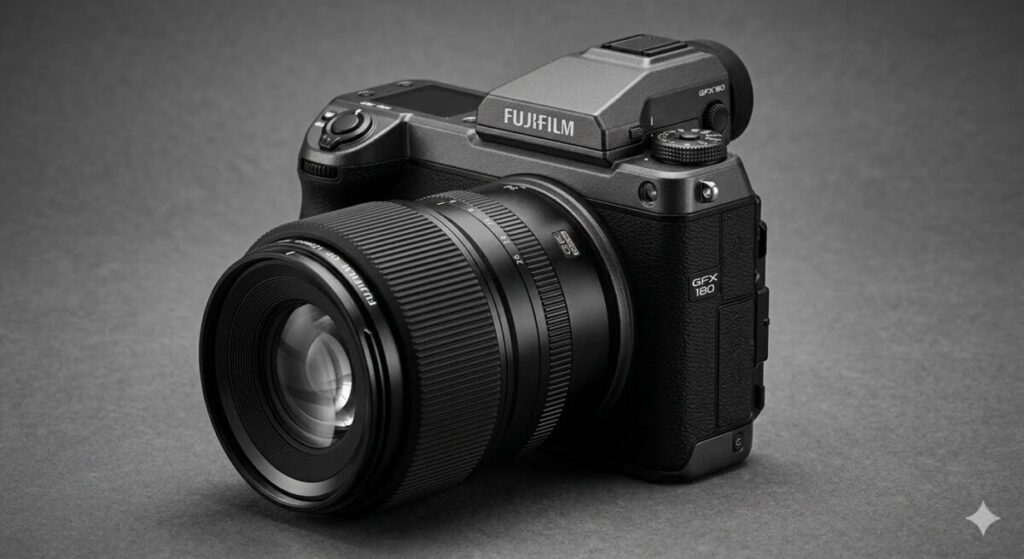
Understanding why this resolution jump matters requires looking at how Fujifilm’s current lineup compares against the rest of the high resolution medium format market.
Surpassing Phase One’s Flagship Sensor
Phase One’s XF IQ4 currently holds the crown among photography focused medium format sensors at 150 megapixels, though that camera carries a price tag well above 50,000 dollars. If Fujifilm successfully launches the GFX 180, it would surpass Phase One’s resolution while likely remaining dramatically more affordable, following the same pricing philosophy that has defined the entire GFX lineup since its 2017 debut.
A Smaller Sensor Punching Above Its Class
An important technical detail separates Fujifilm’s approach from Phase One’s. The GFX system uses a medium format sensor measuring 43.8 by 32.9 millimeters, roughly 49 percent smaller than the sensor found inside Phase One’s IQ4. According to Notebookcheck, this size difference partly explains why Fujifilm could realistically offer higher resolution at a fraction of Phase One’s price, even while working with a physically smaller sensor.
Beyond the Megapixel Race: Real Use Cases
A 180-megapixel sensor is not really built for everyday photography. Coverage from The Phoblographer suggests this kind of resolution would serve museum grade archival work, ultra large format prints, and cultural heritage documentation far more than typical portrait or landscape photography. Commercial photographers producing massive billboard prints or gallery scale exhibitions represent another realistic audience for a camera built around this much raw detail.
The Big Question: Can Fujinon GF Lenses Handle 180 Megapixels
Perhaps the most debated aspect of this entire rumor centers on whether Fujifilm’s existing lens lineup can actually resolve this much detail.
A Familiar Concern From the GFX100 Launch
This is not the first time photographers have questioned whether GF lenses could keep pace with a resolution increase. Fuji Rumors notes that Fujifilm faced the exact same skepticism when it launched the original GFX100 at 100 megapixels, and the company addressed those concerns directly at the time by demonstrating that its lens lineup could resolve well beyond that figure. That history suggests Fujifilm likely began planning for higher resolution sensors long before any rumor of the GFX 180 ever surfaced.
Optical Limitations at Extreme Resolution
Not every lens in the GF lineup will necessarily perform equally well at 180 megapixels. Coverage from The Phoblographer raises a fair point here, noting that medium format lenses are inherently large and heavy, which makes both autofocus speed and edge to edge sharpness harder to optimize simultaneously. Older or adapted lenses may struggle to fully resolve this level of detail, meaning photographers chasing maximum sharpness might need to lean toward Fujifilm’s newest and most optically refined GF glass rather than older lenses already sitting in their bag.
Why Fujifilm Would Still Move Forward Anyway
Despite these optical challenges, industry logic still favors Fujifilm pushing ahead with higher resolution. Sony currently supplies the sensor technology behind most medium format cameras on the market, and if Sony eventually shifts production away from its current 100-megapixel generation, Fujifilm may have little choice but to adopt whatever next generation sensor becomes available. Securing early access to a higher resolution chip protects Fujifilm’s competitive position within the GFX lineup regardless of how quickly the lens ecosystem catches up.
How the Fujifilm GFX 180 Fits the Broader GFX Roadmap
This rumored camera does not exist in isolation. It connects directly to a wider set of expectations building around Fujifilm’s 2026 product plans.
A Roadmap Already Packed With Speculation
Fujifilm’s 2026 rumor cycle has been unusually active across both its X series and GFX lineup. According to a detailed roundup from Daily Camera News, rumors already point toward refreshed flagship bodies and new form factors across the GFX system, with some speculation suggesting the eventual GFX 180 sensor could influence resolution decisions across Fujifilm’s entire APS-C lineup as well. If the rumor holds true, cameras like the X-T6, X-Pro4, and X100VII could all eventually adopt a 46-megapixel APS-C sensor derived from lessons learned during 180-megapixel sensor development.
The GFX100RF as a Preview of What Comes Next
Fujifilm already announced the GFX100RF in 2025, a fixed lens medium format camera that combined a 102-megapixel sensor with a genuinely compact body. Some analysts view this release as an early signal of Fujifilm’s broader direction, hinting that future GFX cameras, including a potential GFX 180, might continue exploring new form factors rather than simply repeating the traditional interchangeable lens body style that has defined the lineup since 2017.
Fujifilm’s Deliberate, Slow Moving Philosophy
Unlike full-frame competitors that refresh their lineups on tight annual cycles, GFX development moves at a noticeably slower pace. A recent Daily Camera News system guide describes this approach as intentional stability, prioritizing backward lens compatibility and long-term investment protection over chasing rapid spec increases. This philosophy actually supports the idea that a project as ambitious as the GFX 180 would take years to develop properly rather than rushing to market.
Fujifilm GFX 180 vs Phase One and Hasselblad
Positioning within the ultra high resolution medium format space requires understanding exactly who Fujifilm would be competing against.
Phase One’s Premium, Professional Pricing
Phase One has long targeted an extremely narrow, well funded professional audience with its XF IQ4 system, a camera whose price alone puts it out of reach for the vast majority of working photographers. If the Fujifilm GFX 180 launches anywhere close to Fujifilm’s typical pricing philosophy, it would undercut Phase One dramatically, potentially opening 180-megapixel capture to commercial and fine art photographers who could never justify Phase One’s five figure investment.
Hasselblad’s Shared Sensor Format
Since Hasselblad and Fujifilm both build cameras around the same medium format sensor size, speculation naturally extends toward Hasselblad’s own roadmap as well. If a 180-megapixel sensor genuinely becomes available at this size class, it seems plausible that Hasselblad could eventually adopt a similar chip for a future X3D model, following the same pattern where both brands have historically shared comparable sensor generations from Sony.
Fujifilm’s Consistent Value Advantage
Across its entire GFX history, Fujifilm has consistently priced its cameras below comparable Hasselblad offerings. The current GFX100S II retails around 5,800 dollars, notably cheaper than Hasselblad’s X2D II 100C at roughly 7,300 dollars. If that value gap continues with the GFX 180, Fujifilm could once again offer the highest resolution option in its class while still undercutting its closest rival on price.
Who Would Actually Need a 180-Megapixel Camera
This question sits at the center of ongoing debate within the photography community, and reasonable people land on different answers.
Genuine Professional Use Cases
Museum digitization projects, large scale fine art reproduction, and cultural heritage archival work all benefit from maximum possible resolution, since these projects often require capturing artwork or historical documents with enough detail to survive decades of future use. Commercial photographers producing massive prints for retail displays or architectural installations represent another realistic audience where 180 megapixels genuinely solves a practical problem rather than existing purely as a marketing number.
Why Many Photographers Will Skip This Camera
For the vast majority of working photographers, current resolution options already exceed practical needs. The existing 100-megapixel GFX100 II already provides more detail than most clients will ever require, and forum discussions among longtime GFX shooters reflect genuine skepticism about whether doubling that figure adds meaningful value for typical professional work. Storage requirements, file handling speed, and computer processing demands all increase substantially at this resolution level, creating real workflow costs that many photographers would rather avoid entirely.
What Owning a 180-Megapixel Camera Would Actually Involve
Beyond the sensor itself, a resolution jump this dramatic changes nearly every part of a photographer’s workflow, from the memory card in the camera to the computer sitting on the editing desk.
Storage and File Management Challenges
A single uncompressed raw file from a 180-megapixel sensor would likely exceed 300 megabytes, dwarfing even the already substantial files produced by the current GFX100 II. Photographers working on extended shoots would need significantly more memory card capacity and external storage than they currently budget for, along with faster card write speeds to avoid buffer delays during continuous shooting. A full day of shooting could easily consume terabytes of storage once raw files, backups, and edited exports all get accounted for.
Computer Hardware Demands
Editing software already strains under the weight of 100-megapixel files, and doubling that resolution would push hardware requirements even further. Photographers would likely need faster processors, more system memory, and quicker storage drives just to keep editing software responsive during routine retouching work. This hidden cost rarely gets discussed alongside camera pricing, yet it represents a real financial consideration for anyone seriously considering this level of resolution for professional use.
Autofocus Speed Tradeoffs at Extreme Resolution
Higher resolution sensors typically process data more slowly than their lower resolution counterparts, a tradeoff that could affect autofocus speed and continuous shooting rates on the rumored GFX 180. Medium format cameras have never competed with full-frame mirrorless systems on pure speed, and a resolution jump this significant would likely widen that gap further rather than closing it, reinforcing that this camera targets deliberate, considered photography rather than fast paced action work.
How the Photography Community Has Reacted to the Rumor
Few camera rumors generate as much genuine debate as this one, and the reaction across forums and photography publications reveals a community split on whether this development actually matters.
Skepticism From Working Photographers
Many working photographers have responded to the GFX 180 rumor with open skepticism rather than excitement. Coverage from The Phoblographer captured this sentiment directly, noting that recent years have shown megapixel count matters far less than autofocus speed, feature set, or overall system reliability. Experienced GFX shooters posting on forums like DPReview echoed similar reservations, with several longtime 100-megapixel users explicitly stating that their current resolution already exceeds what any client realistically demands.
Enthusiasm From Specialists and Technical Photographers
A different segment of the photography world has responded with genuine enthusiasm instead. Technical photographers working in archival digitization, fine art reproduction, and large format commercial printing see real value in extreme resolution, since these fields directly benefit from every additional pixel a sensor can capture. For this smaller but dedicated audience, the GFX 180 represents a meaningful tool rather than an unnecessary spec war entry.
What This Divide Says About the Camera’s Real Audience
This split reaction actually reinforces exactly what Fujifilm appears to be building toward. Rather than trying to appeal to every GFX owner, a camera like the GFX 180 seems designed for a narrower, more specialized audience willing to accept larger files and slower shooting speeds in exchange for maximum possible detail. Understanding this target audience helps explain why general skepticism from casual medium format shooters does not necessarily signal that Fujifilm made a wrong strategic decision.
Medium Format vs Full Frame: Where the GFX 180 Would Sit
Positioning a camera this specialized requires stepping back to look at the wider mirrorless market as a whole.
A Different Philosophy Than Full Frame Competition
Full-frame systems from Sony, Canon, and Nikon compete heavily on autofocus speed, video capability, and overall versatility. The GFX system, and the rumored GFX 180 in particular, follows a completely different philosophy centered entirely on image quality and tonal depth rather than speed or hybrid functionality. Photographers drawn to this camera are not comparing frame rates or subject tracking accuracy. They are comparing dynamic range, color depth, and the sheer amount of recoverable detail sitting inside a single file.
A Growing Niche Rather Than a Mass Market Play
Medium format will likely never compete with full-frame systems on raw sales volume, and Fujifilm appears to understand this reality clearly. Rather than chasing broad market share, the GFX 180 would reinforce Fujifilm’s position as a specialized option for photographers who prioritize absolute image quality above nearly every other consideration. This kind of deliberate niche positioning has served the GFX lineup well since its 2017 launch, and a resolution flagship like the GFX 180 would extend that same strategy even further.
What a Fujifilm GFX 180 Release Might Look Like
Since Fujifilm has confirmed nothing officially, any discussion of release timing or pricing remains firmly speculative.
Realistic Timeline Expectations
Every credible source covering this rumor agrees that a launch remains distant. Given how slowly the GFX lineup typically evolves, and the genuine technical challenges involved in validating lens performance at this resolution, a realistic release window likely sits well beyond 2026, possibly extending into 2027 or later before Fujifilm feels confident bringing this sensor to market.
Pricing Expectations Based on GFX History
Fujifilm has consistently positioned its flagship GFX bodies below 10,000 dollars, a pattern that has held steady across the GFX100, GFX100 II, and GFX100S II. If that pricing philosophy continues, a GFX 180 could plausibly launch somewhere in the 8,000 to 12,000 dollar range, still dramatically cheaper than Phase One’s offerings while commanding a premium over Fujifilm’s current flagship lineup.
Frequently Asked Questions About the Fujifilm GFX 180
Is the Fujifilm GFX 180 an official Fujifilm product?
No. Fujifilm has not confirmed this camera. Every detail discussed here comes from rumor sites and industry sources rather than an official announcement.
What sensor would the Fujifilm GFX 180 use?
Speculation points toward a cropped version of Sony’s 247-megapixel IMX811 sensor, resized to fit the GFX system’s medium format dimensions and yielding roughly 180 megapixels.
Would existing GF lenses work with the GFX 180?
Most current GF lenses should work, though older or adapted lenses may struggle to fully resolve this level of detail. Fujifilm’s newest optically refined GF glass would likely perform best.
When will the Fujifilm GFX 180 launch?
No official timeline exists. Sources agree that development is genuinely underway, but a realistic release likely sits well beyond 2026 given how slowly medium format cameras typically move from rumor to retail.
How much will the Fujifilm GFX 180 cost?
Pricing remains speculative, though Fujifilm’s history suggests a figure somewhere between 8,000 and 12,000 dollars, still far below Phase One’s ultra premium pricing for comparable resolution.
Final Thoughts on the Fujifilm GFX 180
The Fujifilm GFX 180 represents one of the most ambitious rumors currently circulating in the medium format world. A jump to 180 megapixels would firmly establish Fujifilm as the resolution leader within accessible medium format photography, surpassing even Phase One’s flagship sensor while likely remaining far more affordable. Real questions remain about lens performance, practical use cases, and exactly when this camera might actually arrive, but the underlying sensor development appears to be genuinely underway according to multiple independent sources.
Nothing here is official yet, and Fujifilm has given no indication of a launch timeline. We will continue tracking every update on this story as new details emerge throughout 2026 and beyond.
Read More from Altbuzz
For more medium format coverage, check our Fujifilm GFX100 II review, our Hasselblad X2D II versus GFX100S II comparison, and our complete guide to medium format lenses for deeper context on this growing category.
Follow every Fujifilm GFX 180 leak and medium format update at altbuzzmedia.com. For dedicated Fujifilm rumor tracking, follow Fuji Rumors at fujirumors.com.
Subscribe to Altbuzz YouTube Channel
Full breakdowns of every Fujifilm GFX 180 leak, comparisons against Phase One and Hasselblad, and ongoing medium format coverage are live on the Altbuzz YouTube channel @AltBuzzMedia. Subscribe now for weekly camera rumor breakdowns and hands-on reviews through the rest of 2026.