
I Bought 4 Canon Cameras in 2026: Here’s the One I’d Keep
Canon gives buyers plenty of ways to spend more money in 2026, but that does not mean every step up the lineup earns its price. I bought four of the models most Canon shoppers consider today, the EOS R50, the EOS R10, the EOS R6 Mark III, and the EOS R5 Mark II, and I set out to find where real improvements begin and where they stop mattering. By the end of the experiment, one camera stood out as a clear winner, and it was not the model I expected to keep.
This article breaks down what each camera delivers, where it struggles, and which one ultimately earned the top spot in this head-to-head test. If you are deciding between these four cameras, the sections below walk through the reasoning step by step, starting with the least expensive option in the lineup. Stick with it, because the final verdict at the end may not be the camera you expect.
Why I Bought Four Canon Cameras Instead of Trusting Spec Sheets
Spec sheets tell you what a camera can do on paper. They rarely tell you where the money actually goes to work. I wanted to know, in practical terms, when an upgrade changes how a photographer shoots and when it just adds a bigger number to a marketing page.
That question matters more in 2026 than it did a few years ago. Canon’s RF mount now spans a huge price range, from budget-friendly APS-C bodies to full-frame cameras built for working professionals. Buyers often assume the improvements scale evenly with price. They do not. Some jumps change everything. Others barely register once you put two photos side by side.
Canon EOS R50: The Camera That Surprised Me Most
The EOS R50 sits at the bottom of this experiment, which means every other camera has to justify itself against it. That is not a small job. Canon built the Canon EOS R50 around a 24.2MP APS-C sensor on the RF mount, so it shares a lens system with cameras that cost several times more.
What the R50 Gets Right
The R50 does not just take a decent photo. It takes a genuinely good one, and it delivers that quality earlier in Canon’s lineup than most buyers expect. Place a well-lit portrait from the R50 next to one from the most expensive camera in this test, and the gap does not scale the way the price difference suggests it should. That single fact makes the rest of this comparison uncomfortable for every camera that costs more.
Where the R50 Falls Short
The limitations show up somewhere else entirely. The body skips in-body image stabilization, so a shaky hand stays shaky. The grip stays small, the controls stay simplified, and the chassis was never built to survive a demanding professional workflow. None of that hurts image quality directly. It just makes the camera harder to push past its comfort zone.
For family photography, travel, everyday shooting, or a first interchangeable-lens camera, the R50 answers the question before a buyer finishes asking it. If you shoot mainly in those situations, this whole experiment starts to feel unnecessary for anything pricier.
That leaves one real question: what happens when you spend more but stay inside the same sensor class?
Canon EOS R10: Better Handling, Harder to Justify
The Canon EOS R10 uses the same 24.2MP APS-C sensor as the R50. Same resolution, different camera entirely. Canon built this body for a more enthusiast-focused shooter, with real dials, a deeper grip, and a faster burst rate for photographers who want to operate their camera rather than let it operate them.
Handling Over Raw Image Quality
The upgrade from the R50 to the R10 is not primarily about better files. It is about becoming a more deliberate photographer. Shooters who chase action, adjust exposure constantly, or want a camera that grows alongside their skills get real value from the R10’s handling. Photographers who mostly shoot on automatic settings were already well served by the cheaper camera.
Where the R10 Gets Squeezed
This positioning creates a tough spot for the R10, and it is not the camera’s fault. Buyers who want small and inexpensive already have that in the R50. Buyers willing to spend meaningfully more for a completely different kind of capability find that the next camera in this lineup changes the conversation far more dramatically than the R10 does. That leaves the R10 clearly better than the R50, but the kind of better that is easy to talk yourself out of once you know what comes next.
The first two cameras answered how much better an APS-C body becomes with a modest price increase. The next camera answers a much bigger question: what happens when the entire class of camera changes underneath you?
Canon EOS R6 Mark III: The Camera That Made the Extra Money Make Sense
The Canon EOS R6 Mark III moves to a 32.5MP full-frame sensor and pairs it with CFexpress Type B and UHS-II SD card slots, the kind of dual-storage setup Canon usually reserves for cameras built to be depended on. DPReview scored the camera 91%, and praised the combination of a 32-megapixel sensor, in-body stabilization, 40fps burst shooting with pre-capture, 7K RAW video, and an unusually wide range of real-world versatility.
Full-Frame Sensor and Professional-Grade Storage
Here is what changed the moment I picked up the camera. With the first upgrade, I had to explain why the improvement mattered. With the Canon EOS R6 Mark III, I stopped needing to. The sensor moves to full frame. Stabilization lives in the body instead of depending on a stabilized lens. The card slots support a real professional workflow. Burst speed and pre-capture change what action photography even looks like, and the video toolset steps into serious hybrid territory. None of these improvements arrived alone. They arrived together, in the same camera.
Sensor and Autofocus
The 32.5-megapixel sensor gives images meaningfully more detail than either APS-C camera in this test, while staying easy to handle for editing and storage. Canon paired the sensor with Dual Pixel CMOS AF II, which tracks moving subjects with more confidence than the earlier bodies manage.
Storage and Build
CFexpress Type B and UHS-II SD card slots give working photographers a workflow that survives long shoots and tight deadlines. That dual-slot setup rarely shows up on cameras below this price point, and it signals that Canon built the R6 Mark III for people who cannot afford a dropped file.
Why the Canon EOS R6 Mark III Works for Almost Every Photographer
This combination explains why the Canon EOS R6 Mark III suits an unusually wide range of photographers. Weddings, events, portraits, wildlife, sports, family action, travel, and professional hybrid work all fit comfortably within what this camera handles well. It is difficult to name a normal photographic situation where the R6 Mark III becomes the limiting factor.
What DPReview and Other Reviewers Found
DPReview reached a similar conclusion in its review of the camera, noting that unless a photographer works professionally with especially demanding needs, it becomes hard to argue for meaningfully more camera than this for most stills and video work. That kind of praise matters, because DPReview does not hand out high scores lightly, and the review specifically called out the balance the R6 Mark III strikes across stills and video.
Canon EOS R5 Mark II: The Best Camera I Didn’t Need
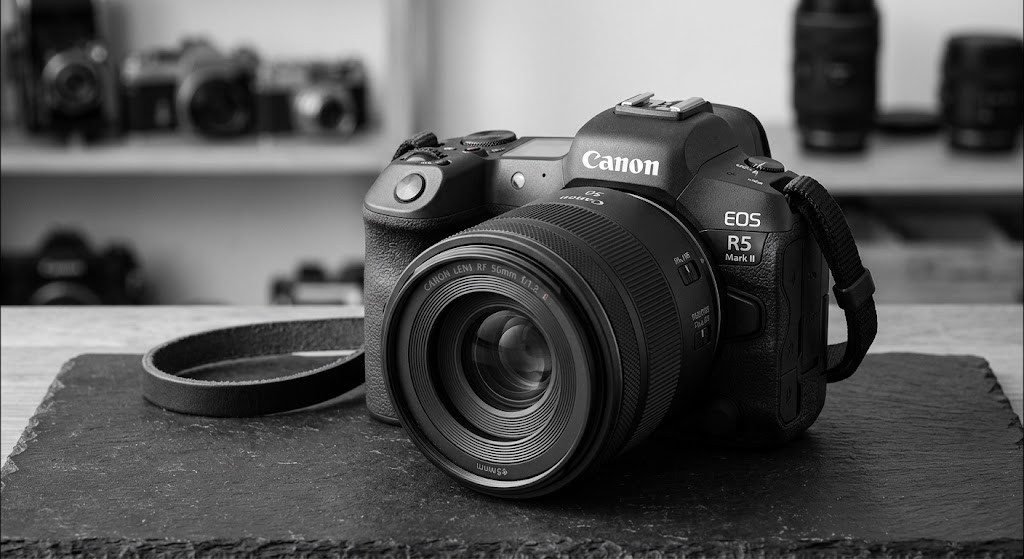
The Canon EOS R5 Mark II carries a 45MP stacked full-frame sensor, and the numbers around it are hard to ignore: 30fps blackout-free electronic shooting, Eye Control AF, advanced subject recognition, and 8K RAW video recording up to 60p. DPReview scored this camera 93%, the highest of anything in this lineup.
The Case for 45 Megapixels
It is easy to understand why a photographer would want this camera. 45 megapixels means far more room to crop without apology. The stacked sensor reads out faster than a standard sensor, which matters enormously the moment an electronic shutter meets fast motion. Rolling shutter distortion shrinks, and demanding action photography becomes far more convincing. Eye Control AF and the subject recognition system push autofocus into territory the R6 Mark III does not reach.
For commercial photographers, landscape and studio work, high-resolution portraiture, wildlife shooters who crop aggressively, and hybrid professionals who need the highest video ceiling, this camera earns every part of its reputation.
The Hidden Cost of More Resolution
Owning the R6 Mark III first changes the question a buyer asks about the R5 Mark II. It stops being “is this camera better.” It obviously is. The real question becomes: after everything the R6 Mark III already delivers, does the R5 Mark II’s extra capability justify its extra cost for your specific work?
The larger files come with a cost that never shows up on a spec sheet. Bigger memory cards, heavier backup systems, slower edits, and more demanding computers all follow a jump to 45 megapixels. High resolution is not free once you own it.
The RF Mount Advantage Across This Whole Lineup
One detail ties all four cameras together and makes this comparison more useful than a typical spec-sheet showdown. Every camera in this test, from the entry-level R50 up through the R5 Mark II, uses Canon’s RF mount. A photographer who starts on the R50 and later upgrades to the R6 Mark III does not need to rebuild a lens collection from scratch. Full-frame RF lenses mount directly on the full-frame bodies, and RF-S lenses built for the APS-C cameras still work through the crop-mode adjustment that Canon builds into every RF body.
That shared mount changes how a buyer should think about this decision. The choice between these four cameras is not just about which sensor or burst rate fits your budget today. It is also about which body fits the lens investment you plan to make over the next few years. Someone planning to build a serious full-frame kit gains more from starting on the R6 Mark III, even at a higher upfront cost, because every full-frame RF lens purchased later works at its full potential immediately. Someone who expects to stay in the APS-C ecosystem for the foreseeable future loses nothing by starting with the R50 or R10 and saving the difference for lenses instead.
Autofocus and Subject Tracking Compared
Autofocus performance separates these four cameras almost as clearly as sensor size does. The R50 and R10 share Canon’s Dual Pixel CMOS AF II system, and it performs well for the price, locking onto faces and eyes reliably in good light and tracking moderate motion without much fuss. Neither camera pushes much further than that, and neither needs to for the audience it targets.
The Canon EOS R6 Mark III raises the bar noticeably. Improved tracking algorithms hold onto moving subjects with more confidence, and a Register People Priority style function lets a photographer pre-select specific faces for the camera to favor during a shoot, a genuinely useful tool at weddings and events where the same handful of people matter more than everyone else in the frame. Pre-continuous shooting adds another layer of security, capturing frames before the shutter button gets pressed so a photographer never fully misses a moment that happens a half-second too fast.
The R5 Mark II pushes autofocus further still. Eye Control AF lets a photographer simply look at a subject through the viewfinder to shift focus, and the expanded subject recognition system reaches into territory the R6 Mark III does not cover. For photographers shooting fast, unpredictable wildlife or sports where every fraction of a second counts, that extra autofocus depth genuinely changes outcomes. For most other photography, the R6 Mark III’s autofocus system already removes missed focus as a meaningful concern.
Video Capabilities Compared
Video tells a similar story to stills, with each step up the lineup unlocking a real jump in capability rather than a marginal one.
The R50 and R10 both handle 4K video competently for social content, vlogging, and casual hybrid work, but neither camera was built with serious video production in mind. Recording windows stay limited, and neither body offers the kind of professional codec options that a video-first creator eventually outgrows.
The Canon EOS R6 Mark III changes that conversation entirely. 7K RAW recording at up to 60p, oversampled 4K at 60p, and high-speed 1080p slow motion give hybrid creators a genuinely professional toolkit in a body that still handles stills duty just as well. Open Gate recording adds flexibility for creators repurposing the same footage across vertical and horizontal platforms, a workflow that matters more every year as content spreads across more formats.
The R5 Mark II extends the ceiling further with 8K RAW recording up to 60p, a capability aimed squarely at productions that need maximum resolution for cropping and reframing in post. That capability comes with the same tradeoff that applies to its stills files: larger recordings demand faster storage, more robust backup systems, and more powerful editing hardware.
Canon EOS R6 Mark III vs Canon EOS R5 Mark II: The Real Finale
Resolution: How Much Do You Actually Need
Resolution offers the easiest place to start this comparison. 32.5 megapixels already covers weddings, events, portraits, travel, and most professional output, with room to crop moderately. 45 megapixels earns its keep in large commercial output, landscapes, studio work, architecture, and aggressive wildlife cropping. If your output already fits inside 32 megapixels, more resolution becomes desirable rather than necessary, and that distinction matters more than it sounds like it should.
Stacked Sensor Speed: Where the R5 Mark II Pulls Ahead
The stacked sensor is where the R5 Mark II buys something real. Faster readout genuinely changes how an electronic shutter behaves under fast motion, and that headroom matters to photographers whose work regularly pushes against it. The more expensive camera does not merely win on paper here. Speed numbers alone, 40fps against 30fps, undersell what actually happens, because raw burst speed does not fully describe how a sensor performs once a photographer depends on it.
So here is where the comparison lands, in terms of raw capability: the R5 Mark II wins on capability, full stop. But capability was never the only question in this experiment, and which camera actually earns the win comes down to something else entirely. More on that at the end.
Quick Verdict: Which Canon Camera Should You Buy
Canon EOS R50
Choose the R50 for excellent everyday photography at the lowest cost and the smallest system size.
Canon EOS R10
Choose the R10 if stronger handling and dedicated APS-C performance matter specifically to your shooting style.
Canon EOS R6 Mark III
Choose the R6 Mark III because it covers almost everything a serious Canon system needs to cover.
Canon EOS R5 Mark II
Choose the R5 Mark II when higher resolution, stacked-sensor readout, and specialized professional capability genuinely apply to your work, not simply because it costs more.
Side-by-Side Comparison
| Camera | Sensor | Burst Speed | Video | Best For |
|---|---|---|---|---|
| Canon EOS R50 | 24.2MP APS-C | Up to 15fps electronic | 4K 30p oversampled | Everyday photography, first camera, travel |
| Canon EOS R10 | 24.2MP APS-C | Faster burst, deeper grip | 4K 30p oversampled | Action shooters who want more manual control |
| Canon EOS R6 Mark III | 32.5MP full frame | Up to 40fps with pre-capture | 7K RAW up to 60p | Weddings, events, sports, hybrid professional work |
| Canon EOS R5 Mark II | 45MP stacked full frame | Up to 30fps blackout-free | 8K RAW up to 60p | Commercial, studio, aggressive cropping, elite autofocus needs |
Who Should Actually Buy Each Camera
Buying the right camera comes down to matching a body to how you actually shoot, not to which camera scores highest on a spec sheet. A few practical scenarios make the decision easier.
A parent documenting a growing family, a traveler who wants sharp photos without hauling a heavy bag, or a student picking up their first interchangeable-lens camera gets everything they need from the R50. The camera answers the assignment without asking the buyer to pay for capability they will not use.
A hobbyist who shoots youth sports on weekends, wants a deeper grip and real dials, or plans to grow into more deliberate shooting habits over the next few years fits the R10 well. The step up in handling makes a genuine difference for anyone who adjusts settings shot to shot rather than leaning on full auto.
A working photographer covering weddings, events, portraits, or hybrid video work, or a serious enthusiast who wants a body that will not become a limiting factor as their skills improve, lands squarely in Canon EOS R6 Mark III territory. It remains the camera in this lineup built to disappear into the background of a shoot and simply perform.
A commercial photographer who prints large output, a landscape or studio shooter who crops aggressively, or a wildlife or sports specialist who depends on the fastest possible autofocus and sensor readout justifies the price of the R5 Mark II. Everyone else pays for specialized capability they may rarely use.
Frequently Asked Questions
Is the Canon EOS R6 Mark III worth it over the Canon EOS R5 Mark II?
It depends on what your work actually demands. The Canon EOS R6 Mark III delivers full-frame image quality, fast burst shooting, strong autofocus, and professional dual-card storage at a lower cost and with smaller file sizes. The R5 Mark II pulls ahead when a photographer specifically needs 45 megapixels or stacked-sensor speed for demanding action and commercial work. See the final verdict at the end of this article for how that tradeoff played out in this test.
Is the Canon EOS R50 good enough for beginners?
The R50 handles everyday photography, travel, and family shooting well, and its image quality holds up surprisingly close to far more expensive cameras in good light. Buyers who want faster handling, more physical controls, or room to grow into more advanced shooting should look at the R10 instead.
What makes the Canon EOS R6 Mark III different from the R6 Mark II?
The Canon EOS R6 Mark III moves to a new 32.5-megapixel full-frame sensor, adds CFexpress Type B storage alongside UHS-II SD, and pushes burst shooting up to 40fps with pre-continuous capture. It also expands video capability with 7K RAW recording, giving hybrid shooters far more flexibility than the previous generation offered.
Does the Canon EOS R5 Mark II make sense for hobbyists?
It can, but the extra resolution and stacked-sensor speed mostly benefit photographers who crop aggressively, print large commercial work, or shoot fast-moving action under an electronic shutter. Hobbyists who mainly share photos online or print at moderate sizes rarely need to push past what the R6 Mark III already delivers.
Can I use the same lenses across all four cameras?
Full-frame RF lenses work on every camera in this lineup, since Canon builds the R50, R10, R6 Mark III, and R5 Mark II around the same RF mount. RF-S lenses designed for the APS-C bodies also mount on the full-frame cameras, though they trigger an automatic crop. That shared mount makes it easy to upgrade bodies later without replacing an entire lens collection.
Is the Canon EOS R10 worth the upgrade over the R50?
It depends on how deliberately you shoot. The R10 shares the same sensor as the R50, so image quality stays similar. The real upgrade shows up in handling, with a deeper grip, more physical controls, and a faster burst rate that rewards photographers who adjust settings actively rather than relying on automatic modes.
Which Canon camera in this lineup handles low light best?
The full-frame sensors in the Canon EOS R6 Mark III and the R5 Mark II both outperform the APS-C sensors in the R50 and R10 once light gets scarce, thanks to larger individual pixels gathering more light. Between the two full-frame cameras, the R6 Mark III’s larger pixel pitch at 32.5 megapixels gives it a slight edge in high-ISO cleanliness over the higher-resolution 45-megapixel sensor in the R5 Mark II.
The Keeper: The Camera I Actually Kept
After spending real time behind all four cameras, the R5 Mark II wins on paper. It is not close. Higher resolution, a stacked sensor, faster readout, and more advanced autofocus all sit on its side of the ledger.
But paper was never the whole test, and the camera I actually kept is the Canon EOS R6 Mark III.
Not because it is the cheapest camera in this lineup. Not because it technically beats the R5 Mark II, because it clearly does not. The Canon EOS R6 Mark III wins because it sits at the exact point where Canon hands a serious photographer nearly everything they realistically need. Full-frame image quality, dependable autofocus, fast action performance, in-body stabilization, professional controls, a dual-card workflow, and genuinely strong video all arrive in one body, right before the spending starts buying increasingly specialized advantages instead of universally useful ones.
Canon gives buyers a lot of ways to spend more money, but the improvements do not scale evenly with the price. There is a point where extra spending stops fixing anything a photographer actually needed fixed. For this experiment, that point landed at the Canon EOS R6 Mark III. That point will not sit in the same place for every photographer, and the right camera ultimately depends on what your work actually demands from it.
Read More from Altbuzz
Best Canon Cameras for Wedding Photography This Year
Canon RF Lens Roadmap 2026: What’s Coming Next for R-Series Shooters
Full-Frame vs APS-C in 2026: Which Sensor Size Actually Fits Your Work
Subscribe to Altbuzz YouTube Channel
Enjoyed this comparison? Alt Buzz publishes hands-on buying experiments like this one every week. Subscribe to the Altbuzz YouTube channel so you never miss a review, and check out the Core and Elite memberships linked in the channel description to support future gear tests directly.