
Canon PowerShot S5 IS Full Review: Specs, Performance & Verdict
The Canon PowerShot S5 IS is a bridge camera that bridges the gap between compact cameras and DSLRs. Released in 2007, this camera targets enthusiasts wanting extensive zoom and manual controls. It features an 8-megapixel sensor, 12x optical zoom with image stabilization, and a vari-angle LCD screen. However, it lacks RAW shooting capability and weather sealing.
Release Date and Market Position
Canon announced the Canon PowerShot S5 IS in May 2007. The camera reached retailers in June 2007. It succeeded the PowerShot S3 IS, which launched in April 2006. Competitors included the Panasonic Lumix FZ18 and Olympus SP-570 UZ. The S5 IS positioned itself as a prosumer bridge camera offering DSLR-like handling.
Canon PowerShot S5 IS Specifications Table
| Feature | Details |
|---|---|
| Sensor Type | 1/2.5-inch CCD |
| Resolution | 8.0 megapixels |
| Processor | DIGIC III |
| ISO Range | 80-1600 (Auto High ISO mode available) |
| Autofocus System | 9-point AiAF with Face Detection |
| Stabilization | Optical Image Stabilizer (lens-shift type) |
| Video Recording | VGA (640 x 480) at 30/15 fps |
| EVF | 115,000 pixels electronic viewfinder |
| LCD Screen | 2.5-inch, 207,000 pixels, vari-angle |
| Burst Shooting | 2.5 fps continuous |
| Battery | NB-3L rechargeable lithium-ion (approximately 400 shots) |
| Storage | SD/SDHC/MMC |
| Connectivity | USB 2.0, A/V output, TTL hot shoe |
| Weight | 574 grams (with battery and card) |
| Launch Price | Approximately $400-450 USD |
Sensor and Image Quality Performance
CCD Sensor and DIGIC III Processing
The Canon PowerShot S5 IS employs an 8.0-megapixel 1/2.5-inch CCD sensor. This sensor size was common for bridge cameras during 2007. CCD technology produces smooth color gradations and low noise at base ISO. The sensor measures approximately 5.76 x 4.29mm physically.
The DIGIC III processor handles image processing with improved speed over DIGIC II. Processing time decreased by approximately 30% compared to predecessors. This affects shooting responsiveness and buffer clearing. The processor also manages noise reduction and color reproduction.
Maximum resolution reaches 3264 x 2448 pixels at full size. This provides sufficient detail for prints up to 11×14 inches comfortably. Smaller sizes like 8×10 look excellent. The 8-megapixel count meets most consumer needs from this era.
Daylight Image Quality Assessment
Real-world image quality delivers sharp results in good lighting. Detail reproduction satisfies most users for typical applications. Center sharpness impresses across the zoom range. Edge sharpness remains acceptable with slight softness.
Colors appear vibrant and natural with Canon’s characteristic rendering. Skin tones show pleasing warmth without oversaturation. Foliage renders with good green tones. Blue skies maintain saturation without clipping.
The iSAPS technology uses a scene database automatically. This system optimizes settings based on recognized scenarios. Over 1,000 shooting situations are programmed. The technology improves automatic shooting results.
Sharpness levels appear appropriate straight from camera. Canon applies moderate sharpening to JPEGs. Results avoid over-sharpening halos. Images require minimal post-processing for sharing.
Dynamic Range Performance
Dynamic range is limited by the small sensor size naturally. Shadows can block up quickly in high-contrast scenes. Highlight recovery provides minimal headroom. Careful exposure management maximizes usable range.
The camera handles typical outdoor contrast adequately. Overcast days and even lighting produce best results. Bright sunny days with deep shadows challenge the sensor. Exposure compensation helps manage difficult situations.
JPEG files show limited shadow and highlight recovery. Post-processing cannot retrieve blocked shadows significantly. Blown highlights show no detail recovery. Proper exposure at capture becomes critical.
Unfortunately, the Canon PowerShot S5 IS lacks RAW capability entirely. Photographers cannot access raw sensor data. This restricts post-processing flexibility significantly. Advanced users may find this limiting.
Low-Light and High-ISO Quality
Low-light performance shows expected limitations for the sensor size. Image quality remains acceptable up to ISO 400 reasonably. Noise starts becoming visible at ISO 200. However, detail remains well-preserved at lower ISOs.
Noise becomes increasingly visible at ISO 800 significantly. The camera applies aggressive noise reduction at higher ISOs. This softens fine details progressively. Color accuracy begins diminishing above ISO 400.
By ISO 1600, noise significantly degrades image quality. Fine textures blur together from noise reduction. Color noise appears alongside luminance noise. Maximum usable ISO realistically ends at ISO 800.
The Auto High ISO mode extends sensitivity automatically. However, image quality at maximum settings proves marginal. Emergency situations may justify high ISOs. Otherwise, photographers should avoid extreme sensitivities.
Chromatic noise shows better control than some competitors. Luminance noise dominates the noise pattern. Canon’s noise reduction algorithms balance detail and smoothness. Results remain usable within the camera’s ISO limits.
12x Optical Zoom Lens Performance
The 12x optical zoom lens covers 36-432mm equivalent focal length. This extensive range handles diverse photographic situations. Wide-angle suits landscapes and interiors. Telephoto brings distant subjects closer dramatically.
Optical quality is reasonable across the zoom range overall. Center sharpness remains good throughout focal lengths. Corner performance varies with zoom position. Wide-angle shows better corner sharpness than telephoto.
The maximum aperture ranges from f/2.7 to f/3.5. This compares favorably to many travel zoom lenses. However, the aperture still limits low-light capability. Background blur potential remains modest overall.
Sharpness decreases slightly at telephoto extremes as expected. The 432mm equivalent shows more softness than mid-range. However, results remain acceptable for typical use. Stopping down improves sharpness slightly.
Chromatic aberration appears occasionally in high-contrast edges. Purple fringing shows in backlit tree branches sometimes. However, the issue rarely interferes severely. The lens performs well for its class.
Close-focusing capability enables macro photography effectively. The lens focuses down to 0cm at wide-angle. This extremely close focus suits flower and insect photography. Macro performance represents a significant strength.
Autofocus Performance
9-Point AiAF System Mechanics
The Canon PowerShot S5 IS uses a 9-point AiAF system. The camera automatically selects focus points based on subject detection. This artificial intelligence analyzes the scene continuously. The system prioritizes closer subjects and central positioning.
Alternatively, users can manually select a single focus point. This override provides precise control when needed. The center point often provides fastest acquisition. Manual selection works well for off-center compositions.
Focus point display appears on the LCD screen clearly. Active points highlight in green when locked. This visual confirmation helps verify proper focus. The display updates in real-time during composition.
Focus Speed and Accuracy
Autofocus speed is respectable but not exceptional overall. The Ultrasonic Motor (USM) in the lens provides relatively quiet operation. This motor technology improves speed over traditional motors. However, performance lags behind contemporary DSLRs.
Well-lit scenes yield quick focus acquisition times. The system locks almost instantly in bright conditions. Outdoor daylight photography presents no speed issues. Indoor lighting slows performance moderately.
Focus accuracy meets expectations for general photography. Stationary subjects achieve sharp focus reliably. The system performs consistently across the zoom range. Both wide-angle and telephoto focusing work well.
However, tracking fast-moving subjects challenges the system significantly. Sports and action photography may result in missed shots. The camera lacks predictive autofocus capabilities. Burst shooting with continuous AF helps somewhat.
Face Detection and Portrait AF
Face Detection AF/AE represents a significant feature upgrade. The system detects up to nine faces in the frame simultaneously. This multi-face recognition works remarkably well. Faces at various distances are detected effectively.
Focus, exposure, and flash adjust automatically for detected faces. The camera prioritizes the largest or closest face typically. Face Detection dramatically improves portrait photography success rates. Group photos maintain better overall sharpness.
However, profile shots may not trigger face detection reliably. The system requires visible facial features frontally. Turned heads often go unrecognized. Full-face orientation provides best detection results.
Face Detection works in both still photography and video modes. This consistency helps when switching between formats. The feature genuinely enhances user experience. It represents advanced technology for 2007.
Macro Focusing Capabilities
The camera includes impressive macro focusing capabilities. Close-up photography works exceptionally well for the class. The lens focuses extremely close at wide-angle settings. This enables dramatic macro perspectives.
Focus accuracy in macro mode is reliable and consistent. The camera achieves sharp focus on tiny subjects. Flowers, insects, and small objects photograph beautifully. Macro represents one of the S5 IS’s strengths.
However, depth of field becomes extremely shallow in macro. Only a thin plane achieves sharp focus. Stopping down the aperture increases depth moderately. Tripods help maintain critical focus positioning.
Manual focus assistance would improve macro shooting. However, this feature is absent on the S5 IS. Autofocus works adequately in most macro situations. Critical focusing sometimes requires multiple attempts.
Video Capabilities
VGA Video Recording Specifications
Video recording on the Canon PowerShot S5 IS reaches VGA resolution only. This measures 640 x 480 pixels exactly. Frame rates include 30 fps and 15 fps options. Recording format is Motion JPEG throughout.
This format creates large file sizes unfortunately. However, it ensures broad compatibility across platforms. Most computers and software handle Motion JPEG natively. No special codecs are required for playback.
Maximum clip size increased to 4GB from 1GB predecessors. This allows longer continuous recording sessions. At 30 fps, approximately 12 minutes records continuously. The 15 fps mode extends recording time further.
Video quality suffices for casual recording and sharing. However, VGA resolution looks dated by modern standards. HD video was emerging in 2007 from competitors. The S5 IS represents transitional technology.
Optical Zoom and Focus During Recording
One standout feature is optical zoom during recording. Users can zoom in and out while filming freely. The Ultrasonic Motor operates relatively quietly for this. Motor noise remains minimized compared to conventional motors.
However, some zoom sound remains audible in recordings. Headphones reveal this limitation clearly. External microphones would help but aren’t supported. The zoom capability outweighs this minor limitation.
The zoom range provides significant creative flexibility. Starting wide and zooming to telephoto adds production value. Travel videos benefit from this capability dramatically. Few compact cameras offered this in 2007.
Video AF and Stabilization Features
Face Detection AF/AE works during video capture uniquely. Focus and exposure continuously adjust for moving subjects. This represents advanced capability for the era. Face priority ensures people remain in focus.
Continuous autofocus sometimes hunts during recording noticeably. This creates distracting focus shifts in footage. Manual focus lock before recording helps prevent hunting. However, manual focus during video isn’t available.
Optical Image Stabilization operates during video recording. This reduces camera shake considerably in footage. Videos appear much smoother than unstabilized alternatives. However, walking motion still appears in handheld shots.
The combination of zoom, AF, and IS during video stands out. These features together provide genuine utility. Casual videographers appreciate the capabilities. Professional work requires better equipment regardless.
Stereo Audio Recording
Stereo audio recording sets the Canon PowerShot S5 IS apart significantly. Built-in stereo microphones capture directional sound. This creates more immersive audio compared to mono. Spatial positioning enhances the viewing experience.
Audio quality exceeds many compact cameras from this era. Dialogue captures clearly at moderate distances. Environmental sounds add atmosphere to videos. However, professional audio still requires external equipment.
No external microphone input exists unfortunately. Serious videographers cannot connect professional microphones. Wind noise can interfere with outdoor recordings. The built-in microphones lack wind reduction features.
Audio recording levels are fixed automatically. Manual level adjustment isn’t available to users. This automatic operation works adequately usually. However, some situations benefit from manual control.
Design, Build Quality, and Handling
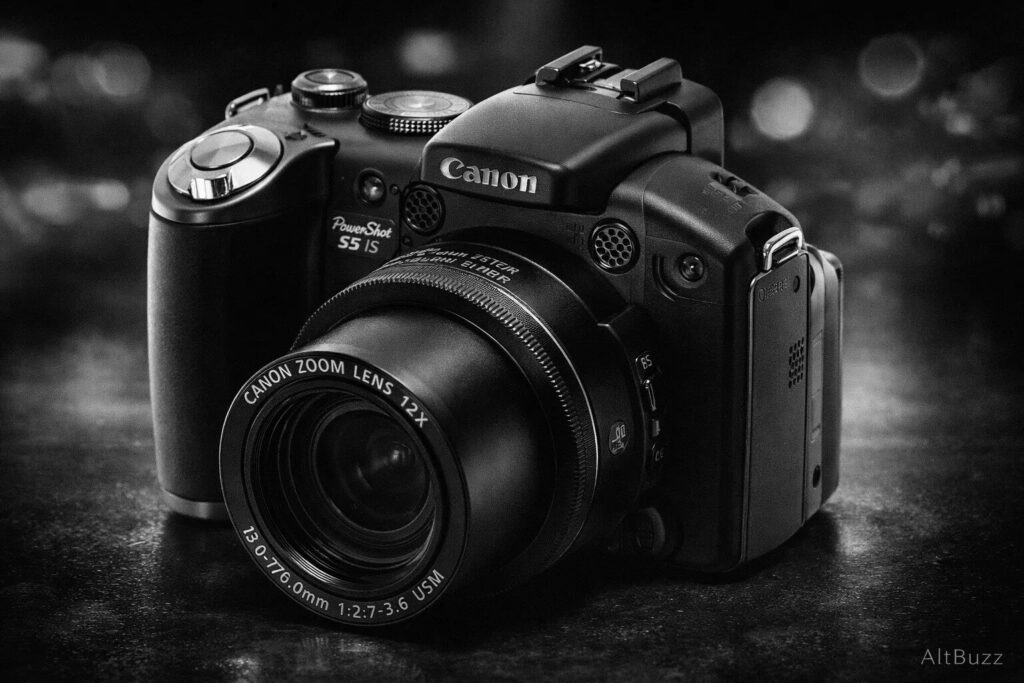
DSLR-Inspired Design Philosophy
The Canon PowerShot S5 IS features DSLR-inspired design deliberately. The form factor mimics interchangeable lens cameras intentionally. This familiar design appeals to upgrading consumers. The styling suggests professional capability.
The camera measures 117 x 80 x 77.7mm dimensionally. These measurements create substantial presence. The camera doesn’t feel like typical compacts. However, it remains smaller than actual DSLRs.
Weight reaches 574 grams with battery and card included. This substantial weight provides shooting stability. The mass helps steady telephoto shots. However, all-day carrying causes some fatigue.
Build quality feels solid with plastic body construction. The materials withstand normal usage well. However, the plastic doesn’t match metal construction durability. Weather sealing is completely absent unfortunately.
Superior Grip and Handling
Grip design provides exceptionally secure handling. The deep grip accommodates most hand sizes comfortably. Larger hands appreciate the ergonomic shaping. The grip texture prevents slipping effectively.
Ample space exists between grip and lens barrel. Fingers don’t crowd when holding the camera. This spacing improves comfort during extended shooting. The design clearly prioritized ergonomics successfully.
This ergonomic design helps steady telephoto shots significantly. Handholding at 432mm equivalent becomes feasible. The grip anchors the camera firmly. Combined with IS, sharp handheld telephoto succeeds.
Weight distribution balances front-to-back reasonably. The camera doesn’t feel excessively front-heavy. However, the lens extends significantly when zoomed. Extended zoom affects balance moderately.
Control Layout and Accessibility
Button layout offers excellent accessibility throughout. Most controls fall easily under fingers naturally. The Power/Mode Lever uniquely combines power and mode switching. This innovation saves space and simplifies operation.
External controls minimize menu diving for common adjustments. ISO, white balance, and exposure compensation adjust quickly. Dedicated buttons provide direct access efficiently. This speeds up shooting workflow considerably.
The mode dial includes full P/A/S/M manual modes. Aperture Priority enables depth of field control creatively. Shutter Priority freezes or blurs motion selectively. Manual mode provides complete creative control.
However, some buttons feel small for larger fingers potentially. Button spacing is adequate but not generous. Most users adapt quickly regardless. The control density maximizes functionality efficiently.
Vari-Angle LCD Advantages
The 2.5-inch vari-angle LCD flips out and rotates freely. This allows shooting from high and low angles comfortably. Overhead shots become easy without strain. Ground-level perspectives require no lying down.
Users can flip the screen against the body for protection. This safeguards the LCD during transport effectively. Closing the screen automatically switches to electronic viewfinder. This automatic switching proves convenient practically.
Screen resolution reaches 207,000 pixels adequately. Image preview and review appear reasonably sharp. However, modern screens exceed this resolution significantly. The screen represents 2007 technology standards.
The articulation mechanism feels solid and durable. Hinges move smoothly without excessive looseness. The design withstood years of use generally. However, mechanisms eventually wear with heavy usage.
Electronic Viewfinder Performance
The 115,000-pixel EVF provides an alternative to LCD shooting. Viewfinder usage conserves battery power significantly. Bright conditions favor EVF over LCD viewing. Eye-level shooting feels more natural for some.
Viewfinder quality is acceptable for composition purposes. However, resolution limitations become apparent quickly. Fine details appear soft and pixelated. Critical focusing challenges the EVF’s capabilities.
Eye sensor automatically switches between LCD and EVF. Bringing the camera to eye activates the viewfinder. Lowering it reactivates the LCD screen. This automation works reliably and helpfully.
Diopter adjustment accommodates eyeglass wearers effectively. The range suits most vision corrections. This personalization improves viewfinder usability. However, the EVF lags far behind modern standards.
Battery Life and Connectivity
Excellent Battery Performance
Battery performance delivers approximately 400 shots per CIPA standards. This rating exceeds many compact cameras significantly. The NP-3L rechargeable lithium-ion battery provides good endurance. Real-world usage often exceeds the official rating.
Battery capacity measures 1100mAh at 3.7V nominally. This provides adequate energy for extended shooting. Conservative shooting extends shot count considerably. Reviewing images frequently reduces total capacity.
Cold weather impacts battery performance moderately. However, the NP-3L handles cold better than some. Keeping the battery warm helps in freezing conditions. Spare batteries remain affordable and available.
Battery availability in used markets remains good currently. Replacement batteries cost reasonably still. Third-party options provide budget alternatives. Original Canon batteries ensure best compatibility.
Charging and Power Options
Battery charging requires the dedicated charger included. In-camera charging is not supported unfortunately. This necessitates packing the charger when traveling. The charger is compact but occupies luggage space.
Charging time takes several hours for complete recharge. Overnight charging prevents shooting interruptions effectively. The charger accepts worldwide voltage automatically. Only plug adapters are needed internationally.
The camera can operate on AC power optionally. The ACK-DC20 AC adapter kit enables continuous operation. Studio work benefits from unlimited power. However, this accessory costs extra.
Battery indicators display remaining capacity accurately. Four-level indication provides adequate monitoring. Users can gauge remaining shooting time. This helps prevent unexpected battery depletion.
Connectivity and Expansion Options
Connectivity includes USB 2.0 for file transfer standard. The proprietary USB cable connects to computers. File transfer speeds are adequate but not exceptional. Importing large quantities takes considerable time.
A/V output allows viewing on televisions easily. Composite video connects to standard TV inputs. This enables comfortable image review on large screens. Sharing photos with groups becomes more enjoyable.
The Canon PowerShot S5 IS features a TTL hot shoe uniquely. This accepts Canon Speedlite EX-series flashes. E-TTL metering provides automatic flash control. Flash exposure compensation allows creative adjustments.
High-speed sync enables flash with fast shutter speeds. This overcomes normal flash sync limitations. Fill-flash in bright conditions becomes possible. The hot shoe dramatically expands creative lighting.
Storage and Memory Cards
The camera accepts SD, SDHC, and MMC cards. Maximum capacity support extends to 4GB cards. Larger SDXC cards were not available in 2007. Modern high-capacity cards exceed camera specifications.
Card compatibility is excellent across brands generally. Both name-brand and budget cards work reliably. However, faster cards improve buffer clearing. Class 4 or higher speeds are recommended.
Buffer capacity limits continuous shooting somewhat. The camera stores images to card progressively. Fast cards reduce clearing time between bursts. Slower cards create longer delays noticeably.
Real-World Use Cases
Wildlife and Nature Photography
Wildlife photography benefits from the 12x optical zoom considerably. The 432mm equivalent telephoto reach captures distant subjects. Birds and animals become accessible from safe distances. Image stabilization helps maintain sharpness when handholding.
However, autofocus limitations affect fast-moving animals significantly. Birds in flight challenge the AF system substantially. Stationary wildlife photographs much more successfully. Slow-moving subjects work adequately overall.
The camera’s size may spook wildlife less than DSLRs. Quieter operation compared to DSLR mirror slap helps. However, serious wildlife photography ultimately requires better equipment. The S5 IS serves casual wildlife shooting.
Nature macro photography represents a significant strength. The excellent close-focusing capability suits flowers and insects. Macro detail reproduction impresses for the camera class. Depth of field control helps isolate subjects.
Travel and Vacation Photography
Travel photography suits the Canon PowerShot S5 IS well overall. The zoom range covers wide landscapes to distant details. One camera handles diverse travel situations effectively. However, size and weight exceed truly compact cameras.
The vari-angle LCD aids unique perspective photography. High and low angles become comfortable to shoot. Tourist attractions photograph from creative angles. Crowd-free overhead shots work particularly well.
Hot shoe capability enables better flash photography. Museums and indoor attractions benefit from Speedlites. Better lighting improves interior photography dramatically. This capability differentiates the S5 IS significantly.
Battery life supports full-day sightseeing comfortably. Carrying one spare battery provides ample capacity. The excellent endurance prevents shooting interruptions. Travelers can shoot confidently without anxiety.
Event and Indoor Photography
Event photography works adequately with external flash added. The hot shoe allows professional lighting solutions effectively. Speedlite 430EX or 580EX transform indoor capability. E-TTL metering simplifies flash operation considerably.
Face detection helps capture good people shots consistently. Group photos maintain better overall sharpness. The system optimizes exposure for faces automatically. This improves event photography success rates.
However, burst shooting limitations may frustrate action moments. The 2.5 fps continuous rate seems slow. Capturing peak action requires timing and luck. Sports events challenge the camera’s capabilities.
Indoor performance without flash shows sensor limitations. High ISO quality degrades quickly above ISO 400. Flash becomes necessary for acceptable quality. The hot shoe makes this practical fortunately.
Casual Video Recording
Casual video recording serves family events adequately. Stereo audio and optical zoom add significant value. The combination creates more engaging videos. Family viewing appreciates these features greatly.
However, VGA resolution looks dated compared to HD. Modern expectations exceed 640×480 substantially. Footage appears soft on large modern displays. The camera represents transitional video technology.
Face Detection during video helps maintain focus. Family videos keep people sharp automatically. This automation improves casual videography success. Users needn’t worry about manual focusing.
The camera size provides stable handheld shooting. Better grip aids video steadiness considerably. Combined with optical stabilization, results improve. However, walking videos still show movement.
Pros and Cons
Pros
- Versatile 12x optical zoom (36-432mm equivalent)
- Optical Image Stabilizer with up to 3 stops compensation
- TTL hot shoe for external Speedlite flashes
- Face Detection AF/AE/FE technology
- Vari-angle 2.5-inch LCD screen
- Full manual controls (P, A, S, M modes)
- Stereo audio recording in video mode
- USM lens provides quiet zoom operation
- Good battery life (approximately 400 shots)
- Electronic viewfinder available
Cons
- No RAW format support
- Small 1/2.5-inch sensor limits image quality
- VGA video resolution only
- No weather sealing
- Slow continuous shooting (2.5 fps)
- Autofocus struggles with fast action
- Relatively large and heavy for a compact
- High ISO performance poor above ISO 400
- Limited to JPEG shooting only
- Dated by current standards
Final Verdict
The Canon PowerShot S5 IS delivers solid performance for a 2007 bridge camera. Manual controls satisfy enthusiast photographers. The 12x zoom range handles diverse shooting situations. Image stabilization enables handheld telephoto photography.
Value for money was competitive at launch around $400-450. Today, the S5 IS appears only in the used market. Its capabilities are dated compared to modern cameras. However, it still functions adequately for casual photography.
Who should buy this camera? Budget-conscious beginners wanting manual controls might consider used S5 IS models. Casual photographers seeking zoom versatility without interchangeable lenses could find value. Those learning photography basics may appreciate the comprehensive feature set.
Who should avoid it? Serious photographers need current technology and RAW capability. Low-light photographers require better high-ISO performance. Videographers wanting HD recording should look elsewhere. Action photographers need faster autofocus systems. Anyone seeking compact portability should choose smaller cameras.
The Canon PowerShot S5 IS served its purpose well during its era. It provided an accessible entry point to advanced photography features. However, technology has advanced significantly since 2007. Modern smartphones often match or exceed its capabilities.
For those interested in photographic history or budget equipment, the S5 IS represents capable technology from its time. Otherwise, contemporary cameras offer superior performance in every aspect.
Read More from AltBuzz
Read more from AltBuzz for camera reviews, detailed specs, and expert insights. AltBuzz delivers trusted and easy-to-understand photography content. Explore comprehensive guides covering cameras from vintage classics to modern innovations. Get reliable information to make informed photography decisions.
Subscribe AltBuzz YouTube Channel
Stay updated with camera reviews and comparisons. AltBuzz shares hands-on camera content regularly. Watch detailed video reviews featuring real-world testing and practical demonstrations. Subscribe here to access valuable photography content and stay informed about camera gear.Share