
The Fujifilm X-70 is a compact camera that packs an APS-C sensor into a pocketable body. Released in February 2016, this camera targets street photographers and enthusiasts seeking high image quality without bulk. It features a fixed 28mm equivalent lens, tilting touchscreen, and classic design. However, it lacks a viewfinder and versatile zoom capabilities.
Release Date and Market Position
Fujifilm announced the X-70 in January 2016. The camera hit shelves on February 18, 2016. It positioned itself as a premium compact in the large-sensor category. Competitors included the Ricoh GR II and Sony RX100 series. The X-70 offered an alternative to interchangeable lens systems for minimal shooting.
Fujifilm X-70 Specifications Table
| Feature | Details |
|---|---|
| Sensor Type | APS-C X-Trans CMOS II |
| Resolution | 16.3 megapixels |
| Processor | EXR Processor II |
| ISO Range | 200-6400 (expandable to 100-51200) |
| Autofocus System | Intelligent Hybrid AF (49-point Single Point, 77-point Wide/Tracking) |
| Stabilization | None (in-body) |
| Video Recording | 1080p at 60/50/30/25/24 fps |
| EVF | None (optional VF-X21 optical viewfinder available) |
| LCD Screen | 3.0-inch, 1.04 million dots, tilting touchscreen (180° upward) |
| Burst Shooting | 8 fps (approximately 10 frames) |
| Battery | NP-95 (330 shots per charge) |
| Storage | SD/SDHC/SDXC |
| Connectivity | Wi-Fi 802.11b/g/n |
| Weight | 340g (with battery) |
| Launch Price | Approximately $700 USD |
Sensor and Image Quality Performance
APS-C X-Trans CMOS II Sensor Technology
The Fujifilm X-70 uses a 16.3-megapixel APS-C X-Trans CMOS II sensor. This sensor eliminates the need for an optical low-pass filter. Consequently, images show exceptional sharpness and detail. The X-Trans color filter array reduces moiré and false color.
The sensor size measures approximately 23.6 x 15.6mm. This substantially exceeds the sensors in most compact cameras. Larger sensor area collects more light per pixel. Better light gathering capability improves overall image quality.
Real-World Image Sharpness and Detail
Real-world image quality impresses across various conditions. Colors appear natural with pleasing skin tones. Edge-to-edge sharpness remains consistent throughout the frame. Fine textures render with impressive clarity.
The absence of an optical low-pass filter maximizes resolution. Files contain remarkable detail when viewed at 100%. Photographers can crop significantly while maintaining image quality. This flexibility proves valuable for reframing and enlargement.
Dynamic Range Capabilities
Dynamic range performs well for a sensor from this era. Highlight recovery provides reasonable headroom in post-processing. Shadow detail retrieval works adequately in RAW files. JPEG files show more limited recovery potential.
The camera handles high-contrast scenes reasonably. However, extreme lighting situations still challenge the sensor. Exposure bracketing helps in particularly difficult conditions. HDR techniques work well with the X-70’s files.
Low-Light and High-ISO Performance
Low-light performance extends to ISO 6400 with acceptable noise levels. Images at ISO 1600 show minimal noise and retain good detail. ISO 3200 remains usable for most applications. Beyond ISO 3200, noise becomes more visible but remains manageable.
The expandable ISO range extends to 51200. However, these extreme settings produce marginal results. Color accuracy diminishes at very high ISOs. Noise reduction becomes aggressive, sacrificing detail.
Chromatic noise appears relatively well-controlled. Luminance noise dominates at higher ISOs. This noise pattern maintains a film-like quality. Many photographers find this preferable to color noise.
Film Simulation Modes for Creative Expression
The camera includes 11 Film Simulation modes. These modes replicate classic Fujifilm film stocks digitally. Each simulation produces distinctive color and tonal characteristics.
Classic Chrome delivers muted tones and deep colors. This mode excels for documentary and street photography. Shadows render rich without blocking. Highlights maintain subtle gradations.
Velvia produces saturated, vibrant results. Landscape photographers appreciate the intensified colors. Blues become deeper, greens more vivid. However, skin tones can appear oversaturated in this mode.
Provia offers balanced, natural tones for everyday shooting. This mode provides accurate color reproduction. It serves as an excellent starting point for versatile photography.
Additional modes include Astia, Pro Neg Hi, Pro Neg Std, Monochrome, Sepia, and more. Each mode offers unique creative possibilities straight from the camera. These options reduce post-processing time significantly.
Autofocus Performance
Intelligent Hybrid AF System Explained
The Fujifilm X-70 employs Intelligent Hybrid AF technology. This system combines phase detection and contrast detection autofocus. Phase detection covers the center of the frame with fast acquisition speeds. The hybrid approach balances speed and accuracy effectively.
Phase detection pixels are embedded within the sensor. This on-sensor implementation enables quick focus acquisition. The system switches to contrast detection for fine-tuning. This two-stage process delivers both speed and precision.
AF Point Coverage and Selection
In Single Point mode, the camera offers 49 selectable AF points. These points provide good coverage across the frame. Users can position focus points precisely for composition. Manual selection works intuitively through the touchscreen.
Wide/Tracking mode expands coverage to 77 points. This broader array improves subject tracking capability. The camera automatically selects multiple points for moving subjects. Coverage extends well beyond the central area.
Focus Speed and Accuracy in Various Conditions
Autofocus speeds reach as fast as 0.06 seconds in optimal conditions. Bright daylight produces the quickest acquisition times. Good contrast subjects lock focus almost instantaneously. The system performs confidently in typical shooting scenarios.
Lower light conditions slow autofocus performance. The camera hunts more frequently in dim environments. Adding AF-assist illumination helps in darkness. However, the illuminator has limited range.
Focus accuracy remains consistent across the frame. Corner focus points maintain reliability. Repeated focus tests show good consistency. Photographers can trust the system for critical work.
Subject Tracking and Face Detection
Subject tracking works adequately for moderately moving subjects. Slowly walking people track reliably. Children and pets present more challenges. The system occasionally loses fast or erratically moving subjects.
Face detection helps with portrait shooting. The system detects up to nine faces and adjusts focus accordingly. Face priority ensures people remain sharp in group shots. Eye detection is not available on this model.
However, the Fujifilm X-70 lacks the sophisticated tracking found in newer cameras. Advanced subject recognition features are absent. Fast-moving subjects can challenge the autofocus system. Sports and action photography exceed the camera’s optimal use cases.
Video Capabilities
Video Recording Formats and Resolution
Video recording maxes out at Full HD 1080p resolution. Frame rate options include 60, 50, 30, 25, and 24 fps. The camera records in MPEG-4 and H.264 formats. File sizes remain manageable with H.264 compression.
Maximum bit rate reaches 36 Mbps at highest quality settings. This produces clean footage with minimal compression artifacts. The Fujifilm X-70 offers three quality levels for file size flexibility. Video quality suits casual recording and vlogging applications.
Video Quality and Film Simulation Support
Film Simulation modes work during video recording. This allows consistent color grading between photos and videos. Classic Chrome produces cinematic tones in footage. Velvia adds punch to nature videos.
Video quality shows good detail and sharpness. The APS-C sensor provides nice depth of field control. Background blur appears naturally with the f/2.8 lens. This creates a more professional look than small-sensor cameras.
Color reproduction in video matches the photo quality. Skin tones render pleasantly across different simulations. White balance performs reliably in most conditions. Overall video image quality exceeds typical compact cameras.
Video Autofocus and Manual Focus Options
Continuous autofocus operates during video recording. However, focus hunting occurs occasionally. The system sometimes struggles with tracking moving subjects. Face detection helps maintain focus on people.
Manual focus during recording provides better control. Focus peaking assists with precise focusing. However, the manual focus mechanism is fly-by-wire. This makes smooth focus pulls challenging.
Video Stabilization and Audio Recording
Unfortunately, the Fujifilm X-70 lacks log profiles for advanced color grading. No flat picture profile exists for maximum dynamic range. Videographers cannot apply LUTs professionally. This limits the camera’s appeal for serious video work.
Video stabilization is absent entirely. The camera has no in-body stabilization system. Lens-based stabilization is also unavailable. Consequently, footage requires steady hands or external support.
Tripods and gimbals become necessary for smooth results. Handheld video shows noticeable camera shake. This limitation significantly impacts video usability. Stabilization represents a major missing feature.
Audio recording uses the built-in microphone only. No external microphone input exists. Audio quality suits basic needs but lacks professional capability. Wind noise can interfere with outdoor recordings.
The microphone captures monaural audio. Stereo recording would enhance the video experience. Background noise appears prominently without directional capture. Serious videographers need external recording solutions.
Vlogging Features and Screen Functionality
The tilting touchscreen aids video framing significantly. Flip it 180 degrees for selfie videos and vlogs. Touch focus during recording provides some creative control. Seeing yourself while recording helps frame shots properly.
However, the screen doesn’t articulate sideways. This limits positioning options compared to fully articulating screens. The straight-forward flip works specifically for front-facing recording.
Overall, video capabilities remain basic compared to modern standards. The camera was designed primarily for photography. Video functions serve supplementary roles. Dedicated video cameras offer superior features.
Design, Build Quality, and Handling
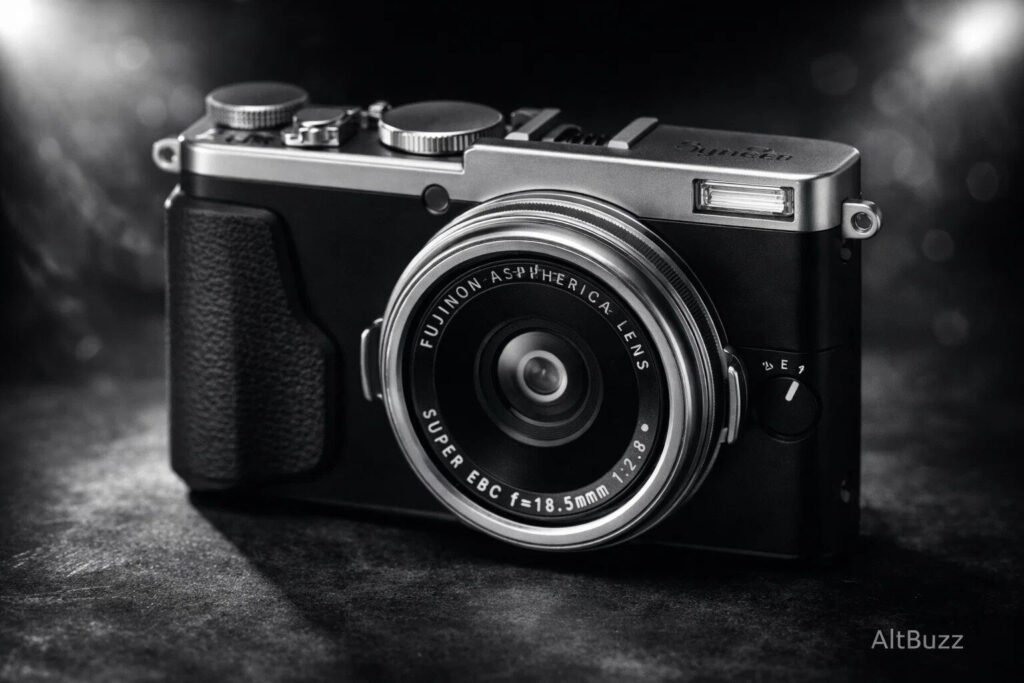
Body Construction and Materials
The Fujifilm X-70 features a metal chassis with classic styling. The top and bottom plates use aluminum construction. This metal build provides structural rigidity and premium feel. Build quality feels solid despite the compact size.
The camera measures 113 x 64 x 44mm. These compact dimensions allow true pocket portability. Weighing 340 grams with battery, it carries easily all day. The size rivals many point-and-shoot cameras.
However, weather sealing is absent. No gaskets protect against dust or moisture. Users must protect the camera from rain and humidity. This limits outdoor shooting in adverse conditions.
Ergonomics and Grip Design
The grip is minimal but functional for one-handed shooting. A textured thumb rest appears on the rear panel. Front grip area provides adequate purchase. However, larger hands may find it cramped during extended use.
The compact size means limited real estate for controls. Fingers can accidentally bump buttons. Some users may prefer larger camera bodies. Despite this, the ergonomics work well for its size class.
Weight distribution feels balanced. The camera doesn’t feel front-heavy despite the lens. Single-handed operation remains comfortable for brief periods. Two-handed shooting provides the most stability.
Control Layout and Customization
Button layout follows Fujifilm’s traditional approach. Dedicated dials control aperture and shutter speed. These physical controls provide direct parameter access. Manual shooting becomes intuitive and quick.
Eight function buttons offer extensive customization options. Users can assign frequently used features to buttons. The touchscreen also serves as a control interface. This dual control system accommodates different preferences.
The Auto Mode Switch lever provides quick access to automated shooting. Toggle it for instant full-auto operation. This proves useful when handing the camera to others. Quick switches between manual and auto enhance versatility.
Menu navigation follows Fujifilm’s established system. The Q menu provides quick access to common settings. This reduces diving into the main menu structure. Experienced Fujifilm users feel immediately comfortable.
LCD Screen Features and Functionality
The 3.0-inch tilting touchscreen is a standout feature. It flips 180 degrees upward for selfies. Tilt it down approximately 45 degrees for overhead shooting. This versatility enhances creative shooting angles.
Screen resolution reaches 1.04 million dots. This provides sharp image preview and review. Colors display accurately for composition judgment. Outdoor visibility performs adequately in most conditions.
Touch functionality allows quick focus point selection. Tap anywhere on screen to focus instantly. Touch Shot captures the image immediately after focusing. These features speed up shooting workflow significantly.
The screen doesn’t fully articulate sideways. This limits positioning compared to fully articulating designs. However, the tilting mechanism saves space. It maintains the camera’s compact profile.
Lens Characteristics and Fixed Focal Length
The built-in 18.5mm f/2.8 lens equals 28mm in full-frame terms. This moderately wide angle suits environmental photography. Street scenes and architecture benefit from the perspective. The focal length encourages getting closer to subjects.
The f/2.8 maximum aperture provides decent low-light capability. It also enables some background blur at close distances. However, extensive bokeh requires very close focusing. The depth of field remains relatively deep overall.
A nine-blade aperture diaphragm creates pleasing bokeh. Out-of-focus areas render smoothly. Specular highlights show attractive circular shapes. This contributes to the overall image quality.
The fixed lens eliminates zoom capability. This limitation requires physical movement for reframing. Some photographers find this restrictive. Others appreciate the simplicity and optical quality advantages.
Battery Life and Connectivity
Battery Performance and Real-World Usage
Battery performance delivers approximately 330 shots per charge. This rating follows CIPA standards with specific test conditions. Real-world usage varies based on shooting style and feature usage. Heavy LCD use drains the battery faster than viewfinder shooting.
The Fujifilm X-70 lacks a viewfinder entirely. All composition happens through the LCD screen. Screen-on time directly impacts battery consumption. Frequent image review further reduces shot count.
Cold weather significantly affects battery performance. Lithium-ion batteries lose capacity in freezing temperatures. Keep spare batteries warm in pockets. Swap batteries as needed in cold conditions.
Power-saving features help extend battery life. Auto power-off settings conserve energy between shots. Reducing LCD brightness decreases consumption. Disabling Wi-Fi when not needed also helps.
Charging Options and Battery Management
The NP-95 battery charges via the included charger. In-camera charging is not available on this model. This requires carrying the dedicated charger when traveling. Some photographers prefer in-camera USB charging for simplicity.
Charging time takes approximately 2 hours for full recharge. The charger accepts worldwide voltage (100-240V). This eliminates the need for voltage converters internationally. Simply pack the appropriate plug adapter.
Photographers should carry spare batteries for extended sessions. NP-95 batteries remain reasonably priced. Third-party options provide budget alternatives. Always verify compatibility before purchasing third-party batteries.
Battery capacity holds 1800mAh at 3.7V nominal voltage. This provides decent capacity for the camera size. However, modern cameras often exceed this capacity. Battery technology has improved since 2016.
Wireless Connectivity and File Transfer
Wi-Fi connectivity enables wireless image transfer. The Fujifilm X-70 supports 802.11b/g/n standards. Connection range reaches adequate distances for typical usage. Walls and interference can affect performance.
The Fujifilm Camera Remote app allows smartphone control. Available for iOS and Android devices, it provides remote shooting capability. Users can adjust settings, trigger the shutter, and transfer files remotely. This proves useful for group photos and self-portraits.
Connection setup is straightforward through the menu system. The camera can function as an access point. Alternatively, it connects to existing Wi-Fi networks. Initial pairing takes a few moments.
Image transfer speeds depend on file size and Wi-Fi conditions. JPEG files transfer relatively quickly. RAW files take considerably longer. Patience is required for large batches.
Physical Connectivity Options
The Fujifilm X-70 includes micro-USB connectivity. This port handles data transfer to computers. USB 2.0 speeds are adequate but not exceptional. Modern USB 3.0 would provide faster transfers.
Micro-HDMI output enables viewing on televisions. Connect the camera directly to displays. This allows comfortable image review on large screens. Presentation of photos becomes more enjoyable.
No headphone jack exists for audio monitoring. This limitation affects video recording workflow. External audio recorders become necessary for serious work. The absence reflects the camera’s photo-first design.
The camera accepts SD, SDHC, and SDXC cards. UHS-I cards provide optimal performance. Faster cards improve buffer clearing times. Budget cards work adequately for single shots.
Real-World Use Cases
Street Photography Applications
Street photography represents the Fujifilm X-70’s strongest application. The compact size encourages discreet shooting without intimidating subjects. People respond more naturally to smaller cameras. This inconspicuous appearance captures authentic moments.
The 28mm equivalent lens suits environmental portraits and urban scenes. It provides context while remaining versatile. Street photographers appreciate the moderately wide perspective. The focal length has become a street photography standard.
Film Simulation modes add creative character to street captures. Classic Chrome produces documentary-style tones. The muted colors and rich shadows suit urban environments. Images possess a timeless quality straight from camera.
Silent electronic shutter mode enables truly silent shooting. No mechanical clap alerts subjects to photography. This discretion proves invaluable in quiet environments. Libraries, churches, and performances become accessible.
Quick operation from pocket to shot takes seconds. No lens extends when powering on. The camera remains ready almost instantly. This responsiveness captures fleeting moments effectively.
Travel Photography Scenarios
Travel photography benefits enormously from the Fujifilm X-70’s portability. It slips easily into bags or pockets without bulk. Unlike interchangeable lens systems, no lens changes are necessary. One camera handles diverse situations simply.
Image quality rivals larger cameras for web and social media. Even moderate prints show impressive detail. The APS-C sensor delivers travel-worthy results. Photographers needn’t sacrifice quality for portability.
The wide-angle lens captures landscapes and architecture effectively. Sweeping vistas fit within the frame. Interior spaces appear spacious and open. Street scenes gain environmental context.
However, distant subjects challenge the fixed focal length. Wildlife and far architecture remain small in frame. Cropping helps but reduces resolution. Supplementing with a smartphone zoom sometimes helps.
Battery life suffices for typical daily sightseeing. Charge overnight at accommodations. Carrying one spare battery provides security. The compact charger packs easily in luggage.
Documentary and Personal Projects
Documentary photographers appreciate the authentic rendering. Film Simulations provide consistent aesthetics across projects. The camera becomes an extension of vision. Technical operation fades into the background.
RAW capability enables significant post-processing flexibility. Files hold substantial data for adjustments. Exposure recovery works well within reasonable limits. Color grading achieves professional results.
The compact form factor reduces photographer fatigue. Extended shooting sessions remain comfortable. Subjects forget about the camera’s presence. More natural, candid moments emerge.
Quick access controls speed up shooting workflow. Aperture and shutter dials provide tactile feedback. ISO adjustment requires button press but remains quick. Manual exposure becomes second nature.
Casual Family and Event Photography
Family events suit the Fujifilm X-70 well enough. Good indoor performance with reasonable ISOs captures gatherings. Face detection helps ensure sharp family portraits. The tilting screen aids group photo composition.
However, limitations appear with active children. Fast autofocus struggles with running kids. Burst shooting rate falls short for action moments. Dedicated family photographers might prefer faster cameras.
The camera excels at environmental family portraits. The 28mm lens includes surroundings meaningfully. Context adds storytelling elements to images. Memories capture both people and places.
Selfie capability through the flip screen delights. Families can compose group selfies easily. Touch shutter makes operation simple. Everyone appears sharp and properly exposed.
Creative and Experimental Photography
The Fujifilm X-70 encourages experimental approaches. Digital filter effects expand creative possibilities. Multiple exposure mode creates layered compositions. In-camera creativity reduces post-processing time.
Macro capability reaches down to 10cm minimum focus. Close-up photography of flowers and details succeeds. The f/2.8 aperture provides some background separation. However, dedicated macro cameras offer closer focusing.
Long exposure capability extends to 30 seconds. Night photography and light trails become possible. A tripod becomes essential for stability. External remote shutter reducers vibration further.
The square format crop mode appeals to some photographers. Instagram and social media favor square compositions. In-camera cropping previews the final result. This matches shooting intention to output format.
Pros and Cons
Pros
- Excellent image quality from APS-C sensor
- Compact, pocketable design with metal build
- Tilting touchscreen with 180-degree flip
- Film Simulation modes for creative looks
- Fast autofocus in good lighting
- Manual controls appeal to enthusiasts
- Wi-Fi connectivity for easy sharing
Cons
- No built-in viewfinder (optional accessory required)
- Lacks weather sealing
- Fixed 28mm lens limits versatility
- No in-body image stabilization
- Basic video features without log profiles
- Average battery life (330 shots)
- Discontinued with limited accessory support
Final Verdict
The Fujifilm X-70 delivers outstanding image quality in a truly compact package. Its APS-C sensor outperforms smaller-sensor competitors. Street and travel photographers will appreciate the portable form factor. Film Simulation modes provide creative flexibility without post-processing.
Value for money depends on finding it used. Originally priced around $700, the X-70 now appears in the used market. Its image quality justifies the investment for those prioritizing portability and sensor size.
Who should buy this camera? Enthusiasts seeking a pocketable APS-C camera should consider the X-70. Street photographers wanting discrete shooting will appreciate its size. Users who prefer prime lenses over zooms will enjoy the fixed 28mm focal length.
Who should avoid it? Photographers needing zoom versatility should look elsewhere. Videographers require more advanced features. Users who depend on viewfinders may find the optional accessory expensive. Those shooting in harsh conditions need weather-sealed alternatives.
The Fujifilm X-70 remains a capable, compact camera that punches above its weight class. Despite being discontinued, it continues to serve photographers who value quality over convenience.
Read More from AltBuzz
Read more from AltBuzz for camera reviews, detailed specs, and expert insights. AltBuzz delivers trusted and easy-to-understand photography content. Whether you’re researching new gear or improving your skills, AltBuzz provides reliable information for photographers at every level.
Subscribe AltBuzz YouTube Channel
Stay updated with camera reviews and comparisons. AltBuzz shares hands-on camera content regularly. Get practical insights and real-world testing from experienced photographers. Subscribe here to join the community and never miss new camera coverage.