
Fujifilm X-T40 Rumors: Expected Specs, Features and Release
The Fujifilm X-T40 has not been officially announced. Fujifilm has released no confirmation. No specification sheet exists anywhere on the internet with Fujifilm’s name attached to it.
However, the Fujifilm community is already tracking every leak. Every patent filing. Every credible rumor. And the picture forming around the Fujifilm X-T40 is genuinely exciting.
The X-T series is one of the most respected camera lines in the enthusiast photography world. Each generation has carried Fujifilm’s exceptional design philosophy, analog-inspired controls, and outstanding image quality into an accessible and affordable package. The X-T10 started the compact entry tradition strongly. The X-T20 improved on it meaningfully. The X-T30 took another clear step forward. The X-T30 II refined the X-T30 but offered only modest changes.
Now the photography community is ready for something substantially more ambitious. The Fujifilm X-T40 is expected to deliver exactly that.
Based on leaks, Fujifilm’s current technology across the broader X series lineup, and the clear direction of the brand’s development program, the X-T40 looks like the most significant compact X-T upgrade in the line’s history. Better sensor. Smarter autofocus. Improved video. More versatile screen. All in the same compact, lightweight body that made the X-T30 so widely loved.
Everything in this blog is based on rumors, leaks, and informed speculation. No detail here has received official Fujifilm confirmation. Nevertheless, the picture forming around the Fujifilm X-T40 deserves careful examination.
Expected Release Date and Market Position
The X-T Series Structure and Where the Fujifilm X-T40 Belongs
Understanding the Fujifilm X-T40’s likely position starts with understanding how Fujifilm structures the X-T line. Fujifilm operates two parallel development tracks within the X-T series. The main X-T line, currently at the X-T5, targets serious enthusiasts and semi-professional users. It uses the highest-specification sensors, comprehensive weather sealing, and the most advanced feature sets available in the X-series lineup.
The compact entry X-T line runs alongside it. The X-T10, X-T20, X-T30, and X-T30 II form this secondary line. These cameras deliver the genuine X-T aesthetic and core X-T shooting experience in a smaller, lighter, and more affordable package. They sacrifice weather sealing, a smaller number of physical controls, and some professional-tier features to achieve their more accessible price point.
The Fujifilm X-T40 continues this tradition in what looks like the most ambitious generation yet. It would deliver Fujifilm’s most current sensor and processing technology inside the compact entry format that has attracted so many first-time Fujifilm buyers and travel-focused photographers over the years.
Fujifilm’s History of Technology Democratization
Fujifilm has a consistent and admirable history of bringing flagship technology down to more accessible price points. The X-Trans CMOS 4 sensor first appeared in the X-T4 before arriving in the X-T30. The X-Processor 4 followed a similar path. Each generation sees the technology from the main X-T line eventually reach the compact entry model.
The Fujifilm X-T40 appears set to follow this exact same pattern. The X-Trans CMOS 5 HR sensor that currently distinguishes the flagship X-T5 is widely rumored to arrive in the X-T40. The X-Processor 5 that powers subject detection AF across the current flagship lineup is expected to come with it. This technology democratization is one of the most valuable aspects of the Fujifilm brand’s product philosophy.
When the Fujifilm X-T40 Could Launch
Fujifilm updates the compact X-T line approximately every two years. The X-T30 II arrived in 2021 as a relatively minor refinement. A significant generational change with the X-T40 designation is therefore overdue and widely anticipated. Multiple industry sources point toward a possible announcement in late 2025.
A late 2025 reveal with early 2026 availability aligns well with Fujifilm’s typical announcement-to-shipping timeline of eight to twelve weeks. Fujifilm has also been hinting at broader X-series updates across multiple product lines. The X-T40 fits naturally into that planned refresh cycle. Its announcement alongside other X-series updates is a plausible scenario based on how Fujifilm has organized previous multi-product launch windows.
Who the Fujifilm X-T40 Targets and Why They Matter
The Fujifilm X-T40 targets a broad but clearly defined audience. First-time Fujifilm buyers who want the complete brand experience without paying X-T5 prices represent the single largest segment. These buyers know what Fujifilm cameras look like on social media. They follow Fujifilm photographers on Instagram and YouTube. and they want the aesthetic and the Film Simulations. Also, they just need an accessible price point to enter the system.
Travel photographers who prioritize compact size and minimal weight above all other considerations represent another key audience. The X-T40’s expected dimensions and weight make it genuinely pocketable with small prime lenses. That portability changes what you carry and how freely you photograph when traveling.
Additionally, street photographers who love Fujifilm’s color science but prefer a smaller, less conspicuous body find the compact X-T format ideal. A smaller camera changes the dynamic between photographer and subject on the street. People notice a large camera and change their behavior. A compact, unobtrusive camera like the X-T40 gets ignored more often. That invisibility produces more natural, authentic street photography.
Photography students and enthusiasts transitioning from smartphone photography to their first serious camera also gravitate toward accessible X-T entry models. The combination of exceptional image quality, intuitive physical controls, and the supportive Fujifilm community online makes the learning curve manageable and enjoyable.
Competitive Landscape for the Fujifilm X-T40
The Fujifilm X-T40 would compete directly with the Sony ZV-E10 II, the Canon EOS R50 successor, and the Nikon Z30 Mark II in the compact APS-C mirrorless segment. Each of those competitors has pushed performance forward meaningfully in recent iterations. Sony brings class-leading autofocus. Canon offers seamless ecosystem integration. Nikon delivers reliability and ergonomics.
Against all of these, Fujifilm competes on different ground. Film Simulations. Physical dial controls. X-Trans color science. Build quality that feels premium at the price. These are not specification advantages that appear in comparison charts. They are experiential advantages that become clear when you actually use the camera. The Fujifilm X-T40 needs to maintain and strengthen all of these experiential advantages while closing the specification gap on autofocus and video performance.
Expected pricing between 899 and 1,099 dollars positions it competitively in this segment while maintaining enough premium distance from entry-level alternatives to justify its additional capabilities and build quality.
Fujifilm X-T40 Rumored Specifications Table
| Feature | Rumored Details |
|---|---|
| Sensor Type | X-Trans CMOS 5 HR (40 megapixel variant) |
| Resolution | 40.2 megapixels |
| Processor | X-Processor 5 |
| ISO Range | 125 to 12800, expandable to 51200 |
| Autofocus System | Phase-detect with subject, animal, and vehicle detection |
| Stabilization | 5-axis IBIS up to 7 stops |
| Video Recording | 6.2K at 30fps and 4K at 60fps |
| EVF | 2.36 million dot OLED EVF |
| LCD Screen | 3.0-inch fully articulating touchscreen |
| Burst Shooting | Up to 20 frames per second electronic shutter |
| Battery | NP-W126S |
| Storage | Single UHS-II SD card slot |
| Connectivity | Wi-Fi 6, Bluetooth 5.0, USB-C |
| Weight | Approximately 360 grams |
| Expected Price | 899 to 1099 USD |
Rumored Sensor and Image Quality of the Fujifilm X-T40
The 40-Megapixel Sensor Arrives in the Entry Line
The most significant sensor rumor surrounding the Fujifilm X-T40 is the expected arrival of the X-Trans CMOS 5 HR sensor. This is the identical 40.2-megapixel sensor that currently powers the flagship X-T5. Bringing it into the compact entry body represents a genuinely major moment for the X-T line.
Previously, the entry X-T cameras used lower-resolution sensors than the flagship models. The X-T30 used the 26.1-megapixel X-Trans CMOS 4 sensor. The jump to 40.2 megapixels in the X-T40 would represent a 54 percent increase in resolution. That is not a small refinement. It is a generational leap.
Moreover, the X-Trans CMOS 5 HR sensor brings more than just additional megapixels. The architecture of the sensor itself represents a meaningful advancement in per-pixel quality, dynamic range capability, and color rendering compared to the CMOS 4 generation. The X-T40 would receive all of these improvements simultaneously.
What 40 Megapixels Enables in Practice
Forty megapixels opens up creative possibilities that lower-resolution sensors simply cannot provide. Aggressive post-production cropping becomes genuinely practical. A photographer can shoot with a slightly wider perspective to capture the full scene context, then crop tightly in editing to isolate a distant subject. The resulting crop retains enough resolution for web, social media, and moderate print use without visible degradation.
This cropping flexibility effectively extends the reach of every lens the photographer owns. A 90mm portrait lens at 40 megapixels provides meaningful crop room to tighten framing for head shots from a comfortable working distance. A 50mm standard lens delivers effective tight framing through cropping when moving closer to the subject is not possible.
Large-format printing becomes genuinely accessible at 40 megapixels. Print sizes up to 60 x 40 inches at standard viewing distances maintain excellent sharpness and detail. For photographers who exhibit their work in galleries, supply prints to editorial clients, or sell large format work to commercial buyers, this resolution provides significant commercial headroom.
X-Trans Color Rendering and Why It Matters
The X-Trans CMOS 5 HR sensor delivers the characteristic X-Trans color rendering that distinguishes Fujifilm images from competitor alternatives. The randomized X-Trans color filter arrangement produces tonal transitions that feel smooth and organic rather than digitally sharp. Fine detail in fabrics, foliage, hair, and textured surfaces renders with exceptional naturalness.
Skin tones from X-Trans sensors are particularly admired. The color accuracy at the green and red spectral boundaries that determine how the sensor renders human skin produces results that many portrait photographers prefer over Bayer sensor output at equivalent resolutions. The X-T40 would bring this skin tone advantage to a compact, affordable body for the first time at 40 megapixels.
Dynamic Range and Its Creative Implications
Dynamic range from the X-Trans CMOS 5 HR sensor at base ISO is expected at approximately 14 stops. For a compact entry-level camera, 14 stops of dynamic range is remarkable. High-contrast outdoor scenes become much more manageable to expose and process correctly.
Shadow recovery performance at low ISO is especially impressive on this sensor. Underexposed shadow areas that would show harsh noise on lesser sensors can be brightened significantly in post-production on the X-Trans CMOS 5 HR. The shadow areas open up with maintained smoothness and acceptable noise character. This recovery latitude gives photographers freedom to prioritize highlight protection in-camera while knowing shadows remain recoverable.
Conversely, highlight rolloff from this sensor is exceptionally gradual and natural. Blown highlights do not suddenly clip to featureless white. Instead, they transition smoothly through the highlight range before eventually reaching maximum white. This gradual rolloff produces a more analog, film-like tonal character in highlight areas that photographers processing JPEGs or RAW files both benefit from.
Film Simulations: The Defining Fujifilm X-T40 Advantage
Film Simulations represent one of the most genuinely differentiated features in the entire camera market. No other camera manufacturer has invested as deeply or as successfully in recreating the aesthetic of iconic analog films through digital in-camera processing. The Fujifilm X-T40 is expected to include the complete current Film Simulation suite.
Provia Standard delivers accurate, balanced color ideal for versatile everyday photography. Velvia produces vivid, deeply saturated color with particularly rich blues and greens that landscape photographers choose for dramatic environmental work. Astia Soft provides gentle, flattering color with smooth skin tones and controlled saturation ideal for portrait photography.
Classic Chrome delivers muted, documentary-style tones with slightly desaturated shadows and lifted midtones. The result feels timeless and editorial. Journalists and travel photographers who want their images to carry the weight of documentation rather than the brightness of promotion favor Classic Chrome consistently.
Classic Neg replicates the warm, slightly faded aesthetic of consumer negative film. The colors feel nostalgic. Shadows carry a subtle warmth. Midtones have a slight golden cast. Contemporary photographers who grew up with family photo albums shot on consumer color negative film find Classic Neg’s aesthetic deeply resonant. Nostalgic Neg pushes this film emulation further into warmer, more pronouncedly faded territory for an even stronger analog character.
Eterna delivers smooth, low-contrast color with lifted blacks and gentle highlight rolloff ideal for cinematic video work. Eterna Bleach Bypass mimics the silver retention processing technique from analog film darkrooms. Colors desaturate strongly. Contrast increases sharply. Shadows gain depth and density. The result is dramatic and atmospheric in a way that standard color profiles cannot achieve.
Acros produces Fujifilm’s signature black and white rendering. Sharp, precise tonal separation with fine grain structure that feels genuinely analog. The green, red, and standard filter simulation options within Acros change how different tones render in the monochrome output. Green filter lightens foliage and darkens red tones. Red filter dramatically darkens blue skies and lightens warm skin tones. Standard filter delivers balanced natural monochrome rendering.
Each of these Film Simulations produces images with distinctive character. That character is difficult or impossible to replicate in post-processing starting from a competitor’s RAW file. The simulations are baked deep into Fujifilm’s color science and sensor tuning. They are not simple LUT overlays. They represent years of careful calibration to specific analog film stocks. This is the Fujifilm X-T40’s single most powerful competitive advantage.
Rumored Autofocus System in the Fujifilm X-T40
The X-T30 II’s Autofocus Limitations and Their Real-World Impact
The X-T30 II used the previous generation autofocus system. It focused adequately on stationary and slow-moving subjects in good light. However, it struggled noticeably with fast-moving subjects in challenging conditions. Tracking dropped off when subjects moved unpredictably through the frame. Eye AF worked intermittently rather than reliably. Animal detection existed but performed inconsistently. Low-light AF hunting appeared when ambient light dropped.
For photographers shooting children, pets, wildlife, and sports, the X-T30 II’s AF required more manual intervention than competing Sony and Canon cameras at similar price points. The gap widened as rivals advanced their subject detection technologies aggressively. Sony’s Real-time Tracking. Canon’s Dual Pixel CMOS AF. Both systems made the X-T30 II’s AF feel outdated by comparison in demanding shooting situations.
This AF gap is one of the clearest reasons why the Fujifilm X-T40 is so eagerly anticipated. The community knows what needs to improve. The technology to fix it already exists within Fujifilm’s current lineup.
X-Processor 5 Transforms AF Intelligence
The Fujifilm X-T40 reportedly inherits the complete subject detection AF system that the X-Processor 5 enables. This is the same processor powering the X-T5, X-H2, and X-H2S. It runs Fujifilm’s deep-learning subject detection algorithms with the computational power needed for reliable, fast identification across a wide range of subjects and conditions.
Subject detection in the Fujifilm X-T40 is expected to cover human subjects with face and eye priority. When a person enters the frame, the camera identifies their face, narrows to eye-level precision, and maintains focus on that eye throughout the frame. The photographer does not need to manually position an AF point. The camera handles subject identification automatically.
Additionally, animal recognition covers birds, dogs, cats, and other species. Vehicle detection covers cars, motorcycles, trains, and aircraft. These detection categories cover the vast majority of subjects that enthusiast photographers encounter in their regular shooting contexts.
Phase-Detect Architecture: Speed and Reliability
The underlying phase-detect autofocus architecture in the Fujifilm X-T40 is expected to match the X-T5’s performance levels precisely. Phase-detect AF reads focus error directly from sensor pixels dedicated to the task. This direct measurement enables fast, decisive focus acquisition without the focus hunting that older contrast-detect systems produced.
In practical terms, phase-detect AF means the Fujifilm X-T40 achieves confident focus lock quickly even in challenging conditions. Subjects moving in unpredictable directions. Scenes with complex backgrounds. Low ambient light environments. Multiple subjects at different distances. All of these scenarios that taxed the X-T30 II’s AF become more reliably manageable with phase-detect technology and X-Processor 5 intelligence working together.
3D Tracking Across the Full Sensor Area
3D tracking in the Fujifilm X-T40 is expected to operate across the full sensor width and height. This means the camera actively tracks a detected subject as it moves anywhere within the frame. The subject does not need to stay within a central tracking zone.
For photographers shooting sports from the sidelines, children playing in a yard, or birds moving through open sky, full-frame tracking coverage changes the shooting experience completely. Subjects that previously fell out of tracking as they moved toward frame edges now stay locked throughout their movement across the entire field. The photographer concentrates on following the action rather than repositioning an AF zone to match the subject’s position.
Pre-AF and Low-Light Focus Capability
Pre-AF function in the Fujifilm X-T40 is expected to operate continuously in the background, maintaining approximate focus on whatever appears in the center of the frame when the camera is carried or held. When the photographer raises the camera to their eye for a shot, focus acquisition from this pre-focused starting position is noticeably faster than acquiring from scratch.
Low-light AF performance is expected to extend to much dimmer conditions than the X-T30 II could manage. The X-Processor 5’s improved low-light subject detection algorithms identify face and body contours with less contrast information available. Combined with phase-detect’s direct focus measurement approach, this extends reliable AF operation into indoor evening environments and street photography under artificial lighting where the X-T30 II would previously struggle.
Tracking Performance Through 20fps Bursts
The Fujifilm X-T40 is expected to maintain reliable subject tracking through continuous burst sequences at up to 20 frames per second. Tracking at high burst rates demands extraordinary processing speed from the camera system. The processor must update its subject detection and tracking calculation between every frame. Simultaneously, it writes image data to the buffer. All of this happens 20 times per second.
X-Processor 5’s processing capability makes this workload manageable. The result is that photographers can hold the shutter through a burst sequence and receive a high percentage of sharp, accurately tracked images rather than a mix of sharp and soft frames that inconsistent tracking produces at speed.
Expected Video Capabilities of the Fujifilm X-T40
Addressing the X-T30 II’s Video Frustrations
Video capability has been an area of genuine frustration for X-T30 II users who chose the camera specifically for Fujifilm’s color science in video output. The X-T30 II offered 4K video but applied a 1.18x crop to the sensor reading. 4K recording was limited to 30fps maximum. Overheating during extended recording sessions was a documented and persistent issue. F-Log recording was available but the dynamic range capture felt inconsistent compared to competitors.
These limitations frustrated the video creator segment of the X-T30 II community considerably. They chose Fujifilm for the color science but found the video practical limitations pushed them toward Sony or Canon alternatives for dedicated video work.
The Fujifilm X-T40 reportedly addresses every one of these video shortcomings directly. The improvement is not incremental. Based on what is rumored, it is categorical.
6.2K Video: Quality Beyond 4K Delivery
6.2K video recording at up to 30 frames per second is expected in the Fujifilm X-T40. This resolution exceeds the current standard 4K delivery requirement. However, the excess resolution serves a specific and important purpose.
Recording at 6.2K and delivering at 4K means the camera performs oversampling. During the downscaling process from 6.2K capture to 4K output, multiple sensor pixels contribute to each output pixel. This averaging process improves detail clarity. It reduces noise by combining multiple pixels’ information into each output value. It produces sharper edges with less aliasing. The resulting 4K footage visibly outperforms native 4K capture in sharpness, clarity, and noise performance.
For video creators who deliver primarily to YouTube and social platforms at 4K, 6.2K oversampled capture is a genuine image quality upgrade that requires no workflow changes. The camera handles the resolution conversion internally. The creator receives better 4K footage without any additional effort.
4K at 60 Frames Per Second: A Major Upgrade
4K recording at 60 frames per second is widely expected in the Fujifilm X-T40. This single specification change addresses the most significant video limitation of the X-T30 II. The previous model’s 30fps ceiling frustrated videographers who needed smooth high-frame-rate footage or slow-motion capability at 4K resolution.
4K 60fps delivers two simultaneous benefits to creators. First, footage recorded at 60fps renders motion more smoothly at standard 24fps or 30fps playback speeds. Fast-moving subjects maintain crisp detail without motion blur smearing. Panning shots through busy environments remain clean throughout the movement. This improved motion rendering gives the footage a more cinematic, polished quality.
Second, 4K 60fps footage can be slowed to half speed in post-production while maintaining full 4K resolution. Footage played at 30fps from a 60fps capture delivers 2x slow motion with no resolution sacrifice. For travel creators who want occasional slow-motion sequences without dropping to 1080p resolution, this capability is practically significant.
F-Log2 for Professional Color Grading
The new F-Log2 recording is expected to arrive with the Fujifilm X-T40. F-Log2 represents a major improvement over the original F-Log profile available in earlier Fujifilm cameras. The wider logarithmic gamma curve captures more tonal information across the dynamic range. Highlights are preserved further toward maximum white before rolloff. Shadow areas retain more recoverable detail before noise becomes unacceptable.
In DaVinci Resolve or Adobe Premiere Pro, F-Log2 footage is transformed through Fujifilm’s provided LUTs into any Film Simulation aesthetic. The Eterna Cinema LUT applied to F-Log2 footage produces results that match the in-camera Film Simulation rendering with the extended tonal range of log capture underneath. Classic Chrome via LUT applied to F-Log2 produces documentary-style video with the full dynamic range of the sensor preserved.
For content creators who take their color grading seriously and want consistent, professional-quality output from the Fujifilm X-T40, F-Log2 provides the technical foundation needed. It closes the gap between consumer camera video output and the professional cinema camera output that grading-focused creators have historically needed to use more expensive hardware to achieve.
Improved Overheating Management
Overheating management is expected to improve significantly in the Fujifilm X-T40. The X-T30 II’s extended 4K recording limitation genuinely frustrated video creators who needed to record longer continuous takes for interviews, event coverage, and documentary filming.
Fujifilm’s improved thermal management reportedly combines better internal heat dissipation design with more efficient processing operation from X-Processor 5. Less heat generated per unit of processing work. Better pathways to move that heat out of the camera body. Together, these improvements are expected to extend continuous recording time meaningfully compared to the X-T30 II’s performance.
For interview recording sessions, corporate video productions, and documentary filming where takes regularly run longer than ten minutes, this improvement makes the Fujifilm X-T40 a more reliable professional tool than its predecessor.
Film Simulations in Video: The Remaining Differentiator
Film Simulations carry directly into video mode on the Fujifilm X-T40. This capability remains one of Fujifilm’s strongest differentiators against competitor video tools. Recording directly in Eterna Cinema produces smooth, controlled, cinematic-looking video without any post-production color work. Classic Chrome in video mode delivers the documentary aesthetic that many video journalists have embraced in still photography. Nostalgic Neg in video delivers warm, vintage-feeling footage with immediate social media appeal.
For content creators who want consistently beautiful output that stands apart visually from the default look of Sony and Canon footage, Film Simulation video recording provides that distinction without requiring grading software, LUT libraries, or post-production expertise. The camera’s processing engine delivers the aesthetic result that the creator chooses.
Design and Build Expectations for the Fujifilm X-T40
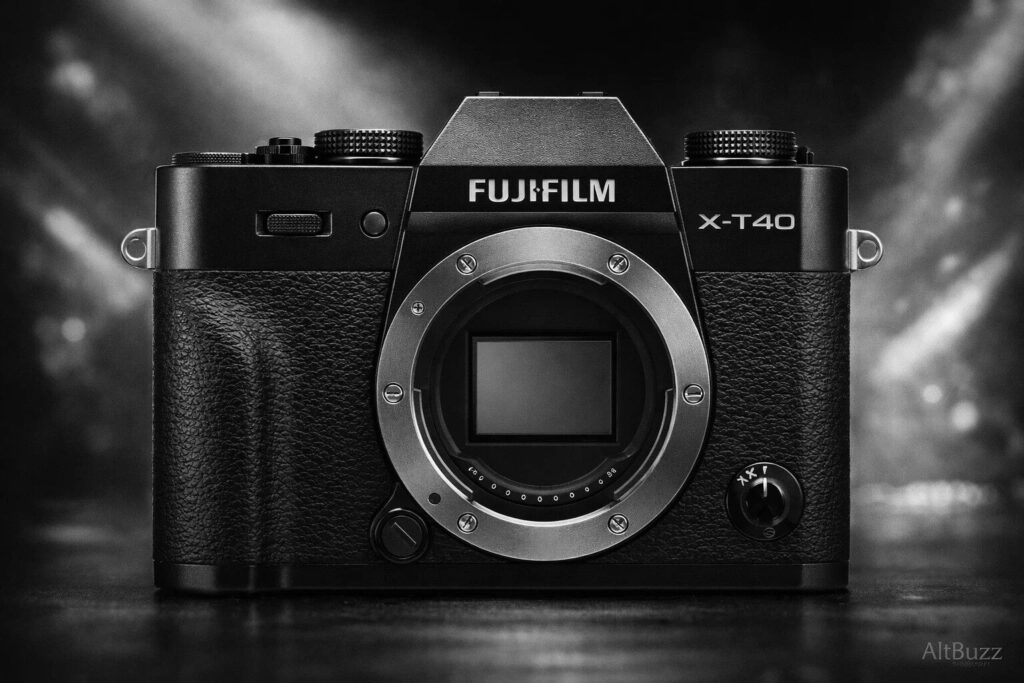
The Compact X-T Form Factor: Why It Works
The Fujifilm X-T40 is expected to maintain the compact, lightweight body dimensions that define the X-T entry line. The X-T30 II measured approximately 118 x 83 x 47mm and weighed around 383 grams with battery and card. The X-T40 is expected to stay within a few millimeters and grams of these dimensions.
That compactness is genuinely significant for the X-T40’s target users. The camera fits in a jacket pocket with a small pancake lens like the XF 27mm f2.8. It slips easily into a small travel bag alongside other daily essentials without demanding dedicated camera bag infrastructure. It does not cause fatigue during long shooting days walking through cities, markets, or natural environments.
This pocketability changes how photographers carry and use the camera. When a camera is truly pocketable, it comes along to situations where a larger camera would be left behind. The decisive moments that pocketable cameras capture would never be available to heavier, bulkier alternatives.
Why Compact Size Does Not Mean Compromised Ergonomics
Compact does not mean uncomfortable. Fujifilm has refined the grip and control layout of the X-T entry line across multiple generations. The Fujifilm X-T40’s grip is expected to provide sufficient depth for comfortable single-handed support with lenses up to moderate size.
Thumb position on the rear is expected to provide a secure resting point without requiring active gripping effort. This reduces hand fatigue during long shooting sessions. The balance with standard zoom lenses is expected to remain forward-heavy without feeling front-heavy enough to tire the wrist.
Button spacing and size are expected to accommodate comfortable operation without requiring finger repositioning between commonly accessed controls. The rear thumbstick for AF point selection, the rear command dial for exposure adjustment, and the function buttons nearest the thumb position are all expected to cluster within reach without requiring hand repositioning.
Fully Articulating Screen: The Most Important Design Change
The X-T30 II used a fixed tilting screen. It tilted upward and downward on a single axis. This was useful for basic angle adjustments but could not rotate outward for front-facing use. This limitation frustrated vloggers, self-portrait photographers, and solo content creators who needed to see themselves in frame while recording.
The Fujifilm X-T40 is expected to introduce a fully articulating touchscreen. This single design change has significant practical implications for how the camera is used across different shooting scenarios.
Vloggers hold the camera at arm’s length and talk directly into the lens. The fully articulating screen rotates forward to face the subject. Framing is confirmed visually before recording begins. The photographer knows they are in frame throughout the take.
Overhead photographers hold the camera above a subject pointing downward. The screen rotates to face downward toward the photographer. Composition and focus can be monitored without holding the camera overhead while simultaneously looking straight up.
Ground-level photographers place the camera near the ground pointing upward. The screen tilts to face the photographer at a comfortable viewing angle. Low-angle compositions become practical and comfortable rather than requiring physical contortion.
For a camera targeting young, creator-focused buyers who shoot in all of these configurations regularly, the fully articulating screen is not merely convenient. It is practically essential.
Physical Controls and the Analog Interface: Fujifilm’s Identity
Physical controls are the most distinctive characteristic of every Fujifilm X-T camera. The Fujifilm X-T40 is expected to carry these forward in full. A dedicated shutter speed dial sits on the top plate with clear engravings for each speed value. A separate ISO dial provides discrete click stops for each standard ISO value. An exposure compensation dial delivers precise EV adjustment in third-stop increments.
These physical controls serve a purpose that no software-based control system can fully replicate. They allow the photographer to configure exposure before raising the camera. They communicate camera state through touch without requiring screen activation. You feel the current shutter speed position without looking. You adjust ISO by feel alone without taking your eye from the viewfinder. This tangible, physical connection to the camera’s state keeps the photographer mentally in the scene rather than in the menus.
Furthermore, the physical dials make the learning process intuitive. Students and enthusiasts new to exposure control can see the relationship between aperture, shutter speed, and ISO physically represented in front of them. The dials make the exposure triangle concrete rather than abstract. This educational benefit is one reason so many photography teachers recommend Fujifilm cameras to students.
IBIS Arrives in the Compact X-T Body
In-body image stabilization is expected to arrive in the Fujifilm X-T40. The X-T30 II lacked IBIS entirely. The X-T5 included it. The progression suggests IBIS is the next feature to cascade down from the flagship to the compact entry model.
5-axis IBIS rated to 7 stops of correction is rumored. This is the same specification as the X-T5’s IBIS system. For a camera weighing approximately 360 grams, 7 stops of correction represents extraordinary stabilization performance relative to the body size.
IBIS benefits both still photography and video shooting directly. In still photography, slower shutter speeds become usable handheld in low light. A shutter speed of 1/15 second that would previously blur from camera shake becomes achievable cleanly with IBIS compensation. This extends usable handheld shooting into much dimmer environments.
In video mode, IBIS smooths handheld footage throughout recording. Subtle tremor from breathing and muscle fatigue becomes largely invisible. Walking shots, though not fully smooth, show significantly reduced high-frequency shake. Combined with Film Simulations applied in-camera, stabilized footage from the X-T40 could produce immediately usable social media video content without any post-production stabilization processing.
EVF Quality and the Viewing Experience
The Fujifilm X-T40’s EVF is expected to use a 2.36 million dot OLED panel. For a compact entry camera, this represents good but not exceptional resolution. The viewing experience should be clear and sufficiently detailed for confident composition and focus confirmation.
OLED technology provides true blacks rather than the grey-black of LCD panels. This improves contrast perception in the EVF view. Shadow areas in the scene appear darker and more differentiated. Highlight areas appear brighter against the deeper surrounding tones. The overall EVF image feels more vivid and three-dimensional as a result.
Magnification in the EVF is expected to provide a sufficiently large view for comfortable shooting without eyeglass users experiencing the eyecup cut-off that too-high magnification produces in compact viewfinders. Diopter adjustment range is expected to cover the prescription range needed by the majority of photographers who shoot without glasses.
Battery and Connectivity Rumors for the Fujifilm X-T40
NP-W126S Battery and Compatibility Advantages
The Fujifilm X-T40 is expected to use the NP-W126S battery. This battery powers the X-T30 II, X-S20, X-E4, and several other X-series cameras. For photographers who already own other Fujifilm cameras using this battery, the compatibility is immediately practical. Existing spare batteries work in the X-T40 without additional investment.
Battery life under standard mixed shooting conditions is expected at approximately 325 to 380 shots per charge. For casual and street photography where the camera is used thoughtfully rather than in continuous burst mode, this figure covers a substantial day of shooting with careful power management.
Power-saving habits extend shooting time meaningfully. Setting the EVF to activate only when raised to the eye rather than staying on continuously saves significant energy. Setting the screen to dim after a short period of inactivity reduces power draw during thoughtful composition pauses. With these practices and one spare battery, most photographers can cover a full shooting day without anxiety about power.
Cold Weather Considerations for the NP-W126S
The NP-W126S handles cold temperatures acceptably but not exceptionally. In sub-zero winter conditions, battery capacity reduces noticeably compared to room-temperature performance. Photographers who shoot winter landscapes, mountain environments, or cold-weather street photography should carry spare batteries and keep them in an inner jacket pocket close to body heat.
This is a genuine practical limitation. However, it applies to virtually every compact mirrorless camera at this price and size level. The battery chemistry required for exceptional cold-weather performance adds cost, weight, and size that compact entry cameras cannot accommodate without compromising their core value proposition.
USB-C Charging for Travel Convenience
USB-C charging is expected as standard in the Fujifilm X-T40. This feature eliminates the need for a dedicated proprietary battery charger in the travel kit. One USB-C cable and a compact USB-C wall adapter charge camera, smartphone, laptop, and any other USB-C device. The simplicity reduces what needs to be packed and remembered for trips.
The ability to charge from a standard power bank while on the move is especially practical for photographers who spend long days away from mains electricity. A compact 10,000 mAh power bank provides multiple full charges for the camera. Combined with a spare battery, this arrangement gives most photographers unlimited shooting endurance during a full travel day.
Wi-Fi 6 for Fast Image Transfer
Wi-Fi 6 connectivity is expected to enable significantly faster wireless image transfer from the Fujifilm X-T40 to a connected smartphone or tablet. The X-T30 II used Wi-Fi 5. The speed difference between Wi-Fi 5 and Wi-Fi 6 is meaningful when transferring the 40-megapixel RAW files that the X-T40 would produce.
Fujifilm’s XApp provides the mobile interface for wireless control and transfer. Through the app, photographers browse images stored on the camera’s card and select files to transfer to their mobile device. Selected files transfer to the phone for immediate review, social media sharing, or cloud backup. With Wi-Fi 6 speeds, transferring a selection of high-resolution files takes noticeably less time than the same operation on the X-T30 II.
Remote camera control via the XApp is also expected. The photographer can adjust exposure settings, reposition the AF point, and trigger the shutter remotely from the phone. For product photography, astrophotography, and group shots where the photographer needs to be in front of the camera, remote control via smartphone is practically essential.
Bluetooth 5.0 for Background Services
Bluetooth 5.0 maintains a persistent background connection between the Fujifilm X-T40 and paired smartphone without meaningful battery drain. This connection serves several automatic background services.
GPS location tagging happens automatically via the phone’s location hardware. Each image receives precise location coordinates in its metadata as it is captured. No manual activation required during shooting. The photographer simply shoots, and the location data is embedded automatically.
Automatic time synchronization keeps the camera’s internal clock accurate without manual adjustment. This matters for photographers who work in multiple time zones or who use the camera alongside other devices and need timestamps to match accurately for cataloguing and editing workflows.
Potential Real-World Use Cases for the Fujifilm X-T40
Street Photography: The Natural Match
Street photography is one of the most natural applications for the Fujifilm X-T40. The compact body is physically discreet on busy streets and urban environments. It does not attract attention the way larger professional cameras do. People notice and react to large cameras differently than they respond to compact, unobtrusive bodies.
The physical dial controls allow quick exposure adjustments without looking away from the scene. A moment of action in a market scene. A fleeting expression on a street corner. The OLED EVF provides a clear, bright view for confident composition in varying outdoor light conditions.
Film Simulations add a decisive aesthetic quality to street photography output that competitors cannot easily replicate. Classic Chrome produces documentary-style images with timeless character. Acros delivers sharp, grain-textured black and white that carries genuine visual weight. Nostalgic Neg produces warm, nostalgic color that feels personal and lived-in. These aesthetics emerge from the camera itself rather than requiring complex post-processing work.
Travel Photography: Maximum Quality, Minimum Weight
Travel photography consistently demands a camera that handles every situation encountered over a long day of exploration. Wide establishing shots of landscapes and architecture. Close portrait details of local people and craftspeople. Busy market scenes with fast movement. Quiet intimate moments in cafes and museums.
The Fujifilm X-T40’s combination of 40 megapixels, Film Simulations, capable AF, and compact dimensions serves all of these scenarios well from a single body. The resolution provides landscape detail for large prints and exhibition work. The AF intelligence handles people in motion reliably. The Film Simulations deliver immediate aesthetic satisfaction without hours of post-processing.
Compact size is especially important for travel. Weight and bulk accumulate relentlessly in a travel kit. Every gram saved on the camera means more capacity for other essentials or simply less physical fatigue over a long day of walking. The X-T40’s expected weight of approximately 360 grams keeps it genuinely comfortable for all-day carry.
Portrait Photography: Color Science and AF Working Together
Portrait photography benefits directly from two of the Fujifilm X-T40’s strongest expected improvements. First, Eye AF with X-Processor 5’s subject detection maintains sharp focus on the subject’s eyes throughout a session. The photographer concentrates on connection, expression, and direction rather than manually chasing focus between shots. Second, Film Simulations produce portrait color rendering with exceptional skin tone quality.
Eterna’s gentle, low-contrast rendering produces soft, flattering portraits with a cinematic quality that editorial and personal portrait clients both appreciate. Astia Soft delivers warm, accurate skin tones with controlled saturation that photograph beautifully in both natural and artificial light. Classic Chrome gives environmental portraits a documentary weight that differentiates the work clearly from standard commercial portrait output.
Together, the AF reliability and the color science make the Fujifilm X-T40 a capable portrait tool that delivers aesthetically distinguished results without requiring extensive post-processing time.
Content Creation and Vlogging
The Fujifilm X-T40 targets content creators specifically through its combination of fully articulating screen, improved video capabilities, Film Simulations in video mode, and compact size. Vloggers who want a camera that looks visually distinctive on screen, handles both wide environmental footage and tight talking-head framing, and fits in a compact travel configuration find the X-T40 a compelling proposition.
4K 60fps capability produces smooth, professional-looking footage for YouTube channels and social platforms. F-Log2 gives creators who invest time in post-production the grading latitude needed for consistent visual branding across their channel. Film Simulations provide ready-to-post footage for creators who prefer minimal post-production involvement.
The fully articulating screen solves the most practical vlogging limitation of the X-T30 II completely. Front-facing monitoring while recording to camera means the creator can confirm framing, check that they remain in focus, and monitor their own expression throughout a take without guesswork.
Possible Pros and Cons Based on Rumors
Expected Advantages of the Fujifilm X-T40
- 40.2-megapixel X-Trans CMOS 5 HR sensor rumored to arrive in the compact entry body for the first time
- X-Processor 5 expected to bring flagship-level subject and animal detection AF performance
- Full Film Simulation suite including Classic Neg, Nostalgic Neg, Eterna, and Acros expected
- 6.2K oversampled video expected for superior 4K output quality and detail
- 4K at 60fps rumored to directly fix the X-T30 II’s most significant video limitation
- F-Log2 expected for professional-grade color grading flexibility in post-production
- 5-axis IBIS up to 7 stops expected as a major new addition to the compact X-T format
- Fully articulating touchscreen rumored to replace the X-T30 II’s single-axis tilting screen
- Physical dial controls for shutter speed, ISO, and exposure compensation expected to continue fully
- 20fps electronic burst shooting expected with consistent tracking throughout sequences
- Compact body expected to remain approximately 360 grams with battery and card
- USB-C charging expected for convenient travel power management
- Wi-Fi 6 expected for faster wireless transfer of large 40-megapixel files
Possible Limitations of the Fujifilm X-T40
- No weather sealing expected, consistent with the complete X-T entry line history
- Single card slot likely, limiting redundancy for professional and event workflows
- NP-W126S battery delivers modest shot count per charge, requiring careful power management
- 40-megapixel RAW files require more storage capacity and more capable editing computers
- No vertical battery grip support expected due to the compact body architecture
- Single card slot means no simultaneous backup recording option for irreplaceable footage
- All specifications discussed here remain entirely rumor-based without any official Fujifilm confirmation
Final Thoughts on the Fujifilm X-T40
The Fujifilm X-T40 looks like it could be the most significant update in the compact X-T line’s entire history. Bringing the 40-megapixel X-Trans CMOS 5 HR sensor and X-Processor 5’s subject detection AF into the compact entry body delivers an extraordinary amount of capability at the expected price point.
The combination of Fujifilm’s Film Simulations, physical dial controls, compact dimensions, improved video performance, and now significantly upgraded resolution and autofocus creates a camera that competes on genuine experiential strengths. Not just specification numbers. Actual photographic results that look and feel different from competitors.
For photographers who love Fujifilm’s aesthetic and have been waiting for the right entry point into the X-T system, the X-T40 looks like it will deliver exactly what they hoped for. The sensor resolution. The AF intelligence. The video improvements. All in the compact, beautiful body that defines the compact X-T line.
For existing X-T30 II users, the sensor upgrade and AF improvements represent a genuinely compelling reason to consider moving up. The jump from 26 megapixels to 40 megapixels is substantial. The jump from the previous AF generation to X-Processor 5 subject detection is equally meaningful in practical daily shooting.
However, patience remains absolutely essential. Fujifilm has confirmed none of these specifications publicly. Every detail here comes from leaks and informed speculation. Wait for the official announcement. Compare the confirmed specifications carefully against everything else available at the time. Consider your actual shooting needs against the confirmed feature set.
If the Fujifilm X-T40 delivers on these rumors, it will be an exceptional camera at a genuinely compelling price. The photography community has been patient. It looks like the wait will be worth it.
Read more from Altbuzz
Read more from AltBuzz for camera rumors, leaked specs, and expert insights. AltBuzz delivers trusted and easy-to-understand photography content. Altbuzz
Stay updated with camera rumors and comparisons. AltBuzz shares latest camera content regularly. Subscribe Altbuzz