
Nikon P950 vs Canon SX70 HS: Full Comparison, Specs and Real-World Verdict
A 2000mm equivalent zoom range. That single specification defines the Nikon P950 vs Canon SX70 HS conversation before it even begins in detail. Both cameras belong to the bridge superzoom category, a segment designed specifically for photographers who need extreme telephoto reach without the enormous cost, weight, and lens-changing complexity of professional interchangeable telephoto systems. Both use small sensors to enable their remarkable zoom ranges. Both target wildlife photographers, travel shooters, birdwatchers, aviation spotters, and moon photographers who need to reach distant subjects that physical proximity simply cannot provide.
Despite sharing the superzoom category and largely similar target audiences, these two cameras make meaningfully different technical choices across sensor design, autofocus architecture, stabilization engineering, RAW file support, physical weight, and screen flexibility. These differences affect real shooting performance in distinct and sometimes decisive ways depending on what the photographer needs most from their camera.
The Nikon P950 launched in January 2020 at approximately $799. The Canon SX70 HS launched in August 2018 at approximately $549. Understanding where each camera invests its technical resources and what trade-offs each manufacturer made reveals which camera suits specific shooting priorities better across the full range of superzoom use cases.
Understanding the Superzoom Category
What Bridge Superzooms Actually Solve
Bridge superzoom cameras exist to solve one specific and well-defined problem: reaching subjects that are too physically distant to approach closely enough for standard zoom lenses to fill the frame. A professional wildlife photographer might use a 600mm f/4 prime lens weighing four kilograms and costing well over $10,000. Alternatively, they might use a 200-600mm f/5.6-6.3 zoom weighing 2.1 kilograms at over $2,000. Either solution delivers outstanding image quality but demands significant physical and financial investment.
A bridge superzoom delivers equivalent or greater maximum focal length reach in a self-contained package weighing under one kilogram at a fraction of the professional lens cost, with the obvious and honest trade-off of a smaller sensor, lower maximum aperture, and reduced image quality at the pixel level. For casual wildlife photography, backyard bird watching, aviation spotting at airshows, moon and planetary photography, and sports observation from fixed distant positions, bridge superzooms provide reach capabilities that genuinely open creative possibilities not otherwise accessible at consumer price points.
The Shared Sensor Size Reality
Both the P950 and SX70 HS use 1/2.3-inch sensors. This sensor size is significantly smaller than APS-C, Micro Four Thirds, or 1-inch sensor alternatives. The 1/2.3-inch format measures approximately 6.17 by 4.55mm. By comparison, an APS-C sensor measures approximately 23.5 by 15.6mm, capturing nearly 14 times more sensor area and proportionally more light at any given ISO setting.
Understanding this shared sensor limitation honestly before comparing these cameras avoids unrealistic quality expectations and focuses attention appropriately on where these cameras actually differ from each other. Both produce excellent results in good light at telephoto focal lengths. Both struggle in low light in ways that larger sensor cameras do not. Both produce lower dynamic range and higher noise at elevated ISOs than cameras with larger sensors. The comparison between them focuses on how well each camera maximizes what the 1/2.3-inch format can deliver within the specific constraints of the superzoom category.
Full Specifications Comparison Table
| Feature | Nikon P950 | Canon SX70 HS |
|---|---|---|
| Sensor Type | 1/2.3-inch BSI CMOS, 16MP | 1/2.3-inch CMOS, 20.3MP |
| Processor | EXPEED Firmware | DIGIC 8 |
| Zoom Range | 24-2000mm equivalent (83x optical) | 21-1365mm equivalent (65x optical) |
| Maximum Aperture | f/2.8 wide, f/6.5 at max zoom | f/3.4 wide, f/6.5 at max zoom |
| ISO Range | ISO 100 to 6400 | ISO 100 to 3200 (expandable to 6400) |
| Autofocus System | Contrast-detect with subject tracking | Dual Pixel CMOS AF |
| Stabilization | 5-axis Dual Detect Optical VR | Optical Image Stabilizer |
| Video Recording | 4K UHD 30fps, 1080p 60fps | 4K UHD 30fps, 1080p 60fps |
| RAW Support | Yes, NRW format | No, JPEG only |
| Viewfinder | 0.39-inch OLED EVF, 2.36M dots | 0.39-inch electronic viewfinder |
| LCD Screen | 3.2-inch tilting touchscreen, 921K dots | 3.0-inch fully articulating touchscreen |
| Burst Shooting | 7fps full resolution | 10fps full resolution |
| Battery | EN-EL20a, approx. 250 shots | NB-13L, approx. 325 shots |
| Storage | Single SD/SDHC/SDXC slot | Single SD/SDHC/SDXC slot |
| Connectivity | Wi-Fi, Bluetooth, GPS | Wi-Fi, Bluetooth |
| Dimensions | 137.7 x 103.3 x 126.9mm | 125.4 x 91.1 x 105.7mm |
| Weight | 1005g with battery and card | 610g with battery and card |
| Launch Price | Approx. $799 USD | Approx. $549 USD |
Zoom Range and Optical Reach Comparison
The Focal Length Difference in Real Shooting Terms
The Nikon P950 delivers 83x optical zoom spanning 24mm to 2000mm equivalent. The Canon SX70 HS delivers 65x optical zoom spanning 21mm to 1365mm equivalent. In practical telephoto shooting at maximum range, the P950 reaches approximately 47% further than the SX70 HS. This is not a minor incremental difference but a substantial compositional gap that directly affects subject fill in the frame.
For bird photography specifically, this difference is consistently meaningful. A bird that fills 60% of the frame in the P950’s maximum zoom view would appear noticeably smaller and less detailed in the SX70 HS’s maximum zoom frame under identical shooting conditions and distances. For moon photography, the P950 captures significantly more lunar surface detail and resolves crater structures and maria that appear smaller and less distinct at the SX70 HS’s maximum focal length. For aviation spotting, the P950 resolves aircraft livery, registration markings, and structural details at distances where the SX70 HS shows only a recognizable aircraft shape without fine detail.
Wide-End Comparison
The SX70 HS offers a marginally wider starting focal length of 21mm equivalent compared to the P950’s 24mm. This gives the SX70 HS a small advantage for landscape context shots, establishing environmental wildlife images that show habitat alongside subject, and wide architectural photography before zooming into telephoto range. For photographers who regularly use the wide end of their superzoom for environmental photography, this 3mm difference at the wide end provides a slight but real compositional benefit to the SX70 HS.
Aperture at All Zoom Positions
Both cameras reach f/6.5 at their respective maximum telephoto positions. This shared maximum aperture at the extreme telephoto end means both cameras require identical light levels to expose correctly when shooting at their longest focal lengths. Neither has a meaningful light-gathering advantage over the other at maximum telephoto reach, which is where both cameras spend the most time in typical wildlife and nature applications.
The P950’s advantage appears at wide and mid-zoom positions, where its f/2.8 wide-end aperture is meaningfully brighter than the SX70 HS’s f/3.4. The difference of approximately 0.7 stops at the wide end translates to either a lower ISO value, a faster shutter speed, or a combination of both in low-light conditions at shorter focal lengths. For photographers who use the wide end frequently in dawn or dusk conditions during wildlife photography, this aperture advantage provides practical benefit before reaching the telephoto range where apertures equalize.
Optical Stabilization: A Critical Superzoom Feature
Why Stabilization Matters More at Extreme Telephoto
Image stabilization is arguably more critical in superzoom cameras than in any other camera category. At 2000mm equivalent focal length, even the steadiest possible handheld technique introduces camera shake that moves the subject across multiple pixel widths between the moment of shutter release and frame completion. Without aggressive and effective stabilization, handheld telephoto shooting at extreme focal lengths produces blurry, unusable images regardless of how carefully the photographer holds the camera.
Even at 1000mm equivalent, the physics of extreme telephoto focal length amplify every micro-movement to a degree that requires substantial optical correction to overcome. Photographers who underestimate the stabilization requirement for superzoom shooting routinely return from wildlife or aviation sessions disappointed by blur that appears even in images they felt they captured steadily.
Nikon P950 Dual Detect VR System
The Nikon P950 uses a 5-axis Dual Detect Optical VR system that detects and compensates for five distinct types of camera movement simultaneously: horizontal shift, vertical shift, roll, pitch, and yaw. Standard optical image stabilization systems typically address only pitch and yaw, the two most common and largest-magnitude movements during handheld shooting. The additional correction for horizontal shift, vertical shift, and roll provides more complete compensation for the complex combination of movements that occur during real handheld telephoto photography.
The Dual Detect element adds another layer of sophistication beyond 5-axis correction. Rather than relying solely on gyroscopic sensors to detect movement, the system also reads image sensor data to verify actual image movement and cross-reference it with the gyroscope data. This dual-source calculation produces more accurate correction commands than gyroscopic data alone, particularly for slow, smooth panning movements where gyroscopes can generate overcorrection artifacts. Nikon rates the P950’s VR system at approximately 5 stops of stabilization compensation, which represents meaningful real-world improvement over standard 2 to 3-stop systems.
Canon SX70 HS Optical Image Stabilizer
The Canon SX70 HS uses Canon’s Optical Image Stabilizer system. Canon does not publish a specific stop-equivalent rating for the SX70 HS’s IS system. The system compensates primarily for pitch and yaw movements in the standard manner. Canon’s Image Stabilizer has a strong reputation for effectiveness across its lens and camera lineup generally, and the SX70 HS implementation performs well for a standard stabilization system.
In direct real-world telephoto shooting comparisons, the P950’s more sophisticated 5-axis Dual Detect VR system produces a higher keeper rate of sharp handheld images at slow shutter speeds and extreme focal lengths than the SX70 HS achieves under equivalent conditions. For bird photography at 2000mm equivalent in the soft light of early morning, where shutter speeds may need to drop below 1/1000s to maintain acceptable ISO values, the P950’s stabilization advantage translates directly into more usable frames per burst sequence.
Sensor Architecture and Image Quality
Resolution and Sensor Design
The Canon SX70 HS uses a 20.3MP front-side illuminated sensor compared to the Nikon P950’s 16MP BSI sensor. The SX70 HS’s resolution advantage provides more cropping headroom when subjects do not fill the frame even at maximum zoom, which occurs regularly in wildlife photography when birds or distant animals remain smaller than ideal despite maximum telephoto engagement. Additionally, the SX70 HS produces larger maximum resolution files for printing or intensive cropping workflows.
The P950’s 16MP BSI sensor, however, uses physically larger photosites than a 20.3MP sensor on the same 1/2.3-inch physical area. Larger photosites collect more light per pixel before noise becomes dominant, which contributes directly to cleaner high-ISO performance despite the lower overall pixel count. In practical superzoom wildlife shooting, ISO performance matters more consistently than raw resolution, because telephoto wildlife photography in realistic ambient light conditions frequently requires elevated ISO values to achieve the minimum shutter speeds necessary to freeze subject movement cleanly.
The BSI Architecture Advantage
Back-Side Illuminated architecture in the P950’s sensor positions the wiring and circuitry behind each photosite rather than in front of it, allowing more light to reach the light-sensitive area. On a 1/2.3-inch sensor where individual photosites are already physically small, this architectural efficiency improvement provides meaningful benefit in terms of both noise performance and dynamic range at elevated ISO values.
At ISO 400 and below, both cameras produce clean, detailed images where the BSI difference is largely invisible in casual comparison. Moving to ISO 800, the P950’s files show marginally cleaner noise characteristics with better retention of fine detail in feather barbs, fur texture, and distant foliage. At ISO 1600, the difference becomes more noticeable in controlled side-by-side file comparison, with the P950 maintaining better tonal gradation and less aggressive noise reduction smearing of fine textures.
RAW File Support: A Decisive Differentiator
The Nikon P950 supports RAW capture in NRW format alongside JPEG. The Canon SX70 HS captures JPEG only with absolutely no RAW format option available. For photographers who edit their images in post-processing software such as Adobe Lightroom, Capture One, or DXO PhotoLab, this difference is significant and affects real image quality outcomes.
RAW files capture the complete unprocessed sensor data with full tonal depth before any in-camera processing applies. This allows photographers to adjust white balance, exposure compensation, shadow recovery, highlight rolloff, noise reduction intensity, sharpening, and lens correction non-destructively after capture with full access to the original data. Particularly important for wildlife photography, where exposure conditions change rapidly and unpredictably, RAW capture allows recovery from imperfect exposures that JPEG would render unrestorable.
JPEG files apply all these adjustments in-camera at the moment of capture according to the camera’s own algorithms, then discard the underlying data permanently. When the in-camera exposure judgment is correct and lighting is favorable, JPEG results are excellent and require no further editing. When conditions produce challenging exposures, blown highlights from bright sky backgrounds, underexposed subjects backlit by bright environments, or high-ISO noise requiring custom noise reduction treatment, RAW files provide substantially more recovery flexibility than any JPEG workflow can offer.
For photographers who simply share images directly from camera to social media or print without computer editing, the RAW advantage is irrelevant in practice. For photographers who regularly review and refine their images on a computer screen, the P950’s RAW support provides a meaningful and consistent real-world image quality advantage over the JPEG-only SX70 HS in any shooting situation that deviates from ideal exposure conditions.
Dynamic Range Comparison
The P950’s BSI sensor combined with RAW capture capability allows photographers to extract approximately 12.0 stops of dynamic range from well-processed files. The SX70 HS’s JPEG-only output restricts practical dynamic range recovery to whatever the DIGIC 8 processor decides to preserve at the point of capture, typically producing effective in-file dynamic range of around 10 to 11 stops in JPEG format. This gap explains why P950 images from high-contrast wildlife scenes, particularly subjects with bright sky backgrounds common in bird photography, retain more detail simultaneously in both bright and dark areas of the frame.
Autofocus System Comparison
Canon SX70 HS Dual Pixel Advantage
The autofocus architecture comparison favors the Canon SX70 HS in one specific and important area. The SX70 HS uses Dual Pixel CMOS AF, Canon’s phase-detect autofocus technology that calculates focus direction from a single sensor reading rather than searching iteratively for contrast peak. This phase-detect foundation produces faster initial subject acquisition and more persistent tracking through movement, background complexity, and lighting changes than iterative contrast-detect approaches.
For wildlife photographers tracking birds in flight, the SX70 HS’s Dual Pixel AF acquires flying birds more quickly and maintains tracking lock through erratic directional changes more confidently than the P950’s contrast-detect system. The difference is most evident during the initial lock-on moment when a subject enters the frame and the camera must acquire focus from scratch, a situation that occurs repeatedly during bird photography when subjects fly in and out of the frame unpredictably.
Video Autofocus During Recording
During 4K video recording of wildlife subjects, the SX70 HS’s Dual Pixel AF maintains smooth, confident continuous tracking with minimal hunting behavior. Focus transitions between subjects or following a moving animal through varying background complexity happen without the obvious rack-focus searching that contrast-detect AF produces during video. For photographers who record wildlife video alongside stills, the SX70 HS’s video AF behavior is meaningfully smoother and more professional-looking than the P950’s.
Nikon P950 Contrast-Detect with Subject Tracking
The P950 uses contrast-detect AF augmented with subject tracking modes including a dedicated bird tracking mode that uses pattern recognition to maintain focus on bird subjects specifically. In good light with clear subject-background contrast separation, the system focuses accurately and tracks reasonably well for a contrast-detect implementation. The bird tracking mode improves tracking persistence beyond what generic contrast-detect provides, and the P950’s tracking performance in good light conditions is adequate for casual wildlife photography.
However, in lower ambient light, against backgrounds with competing contrast patterns like foliage or complex natural textures, or when tracking subjects that move unpredictably and quickly, the contrast-detect foundation shows its limitations relative to Dual Pixel phase-detect. The P950’s AF hunts more visibly in these conditions, and tracking lock breaks more easily when background complexity increases.
Tracking at Extreme Focal Lengths
At 1000mm equivalent and beyond, tracking a moving bird or aircraft across the narrow field of view requires extremely precise and responsive AF that keeps pace with movement that crosses the entire field in a fraction of a second. Both cameras face genuine challenges at extreme telephoto focal lengths with fast subjects, and neither provides the tracking reliability of a professional mirrorless camera with advanced phase-detect arrays and computational subject prediction. The SX70 HS maintains lock marginally more consistently than the P950 at these challenging focal lengths in real field conditions. The P950’s bird mode tracking recovers lock faster after temporary interruption. For photographers whose primary subjects move unpredictably in flight, the SX70 HS’s Dual Pixel AF provides a meaningful practical advantage in keeper rate per session.
Video Capabilities Comparison
4K Video Performance
Both the P950 and SX70 HS record 4K UHD at 30fps, which is a genuinely strong and practical video specification for their superzoom category. At 4K resolution with extreme telephoto engaged, both cameras capture remarkably detailed footage of distant subjects that no consumer video camera with a standard lens can approach in terms of subject reach and apparent magnification.
The P950’s 4K video benefits meaningfully from its superior Dual Detect VR stabilization system. At extreme telephoto focal lengths in video mode, the quality and consistency of stabilization becomes the primary determinant of whether footage is watchable or too shaky for comfortable viewing. The P950’s 5-axis correction produces smoother handheld telephoto video compared to the SX70 HS under equivalent ambient conditions, which translates directly into more usable video footage per session without requiring a tripod or monopod in every situation.
Slow Motion Options
Both cameras record 1080p at 60fps, enabling 2x slow-motion playback at standard 30fps timelines. Neither offers 120fps slow-motion capability, which limits the maximum slow-motion effect available to the 2x factor that 60fps provides. For wildlife documentation where slow-motion reveals wing mechanics, behavioral nuances, and environmental interaction in greater detail, 2x slow-motion provides useful supplementary material alongside standard frame rate video. Both cameras are equivalent in this specific capability.
Audio Recording
Both cameras include built-in stereo microphones without external microphone input options. The P950 benefits from slightly better microphone placement and a more effective wind noise reduction design compared to the SX70 HS in practical outdoor recording conditions, producing marginally cleaner reference audio during field use. Neither camera provides professional audio capability, and both record reference-quality audio suitable for personal documentation, wildlife sound annotation, and casual video production rather than broadcast-quality documentary work.
Screen and Viewfinder Comparison
Viewfinder Quality Comparison
The Nikon P950 uses a 2.36M-dot OLED electronic viewfinder that delivers a sharp, high-resolution view for precise subject framing at extreme focal lengths. At 2000mm equivalent focal length, seeing your subject with clarity and detail in the viewfinder before and during capture is essential for proper composition and confident tracking. The P950’s high-resolution OLED provides a comfortable and accurate viewing experience in bright outdoor wildlife photography conditions, with enough resolution to see fine subject detail in the frame before committing to capture.
The Canon SX70 HS uses an electronic viewfinder with lower resolution than the P950’s OLED panel. The SX70 HS’s viewfinder delivers functional performance but shows more visible pixelation in fine detail areas of the frame, which makes precise composition at maximum telephoto slightly less comfortable than the P950’s sharper OLED display. For casual use, both viewfinders provide adequate subject acquisition. For critical composition assessment and tracking precision at extreme focal lengths, the P950’s superior resolution creates a genuine ergonomic advantage.
Screen Articulation and Flexibility
The Canon SX70 HS includes a fully articulating touchscreen that rotates completely to face forward, tilts to all angles overhead and downward, and folds inward for protection during transport and when not in use. This full articulation suits ground-level nature photography where placing the camera at plant height or ground level and viewing the screen face-up is the only practical compositional approach. It also enables overhead photography for documenting subjects from above without raising the camera above eye level blindly.
The Nikon P950 uses a tilting touchscreen that angles upward and downward along a single tilting axis but does not rotate to face forward or provide the full angular flexibility of an articulating design. For wildlife photographers who primarily shoot from fixed upright positions using the viewfinder and occasionally tilt the screen for low-angle compositions, the P950’s tilting screen provides sufficient flexibility. For photographers who regularly use low ground-level angles, overhead compositions, or any situation requiring the screen to face away from the standard rear-facing position, the SX70 HS’s fully articulating screen provides meaningfully greater compositional freedom.
GPS and Connectivity Features
P950 Built-In GPS Value
The Nikon P950 includes built-in GPS for automatic location tagging of every captured image. For wildlife photographers who document species sightings at specific geographic coordinates, birdwatchers maintaining location-referenced life lists, naturalists building georeferenced photographic records, and travel photographers creating location-tagged archives, built-in GPS provides consistent automatic location data without any dependency on external devices.
Built-in GPS works regardless of whether a smartphone is nearby, paired, or has battery remaining. The location data embeds directly in image metadata at the moment of capture, creating an accurate and reliable geographic record that smartphone-dependent GPS solutions cannot always match in areas with poor cellular connectivity or inconsistent Bluetooth pairing.
SX70 HS GPS Dependency
The Canon SX70 HS does not include built-in GPS hardware. Location tagging on the SX70 HS requires maintaining an active Bluetooth pairing with a smartphone running the Canon Camera Connect app throughout the shooting session. This introduces a dependency on smartphone presence, battery status, and Bluetooth reliability that the P950 eliminates entirely. In remote wildlife photography locations with unreliable smartphone service or challenging Bluetooth conditions, the SX70 HS’s smartphone-dependent GPS approach is less reliable than the P950’s self-contained system.
Both cameras include Wi-Fi and Bluetooth for wireless image transfer and remote smartphone control via their respective companion apps. Transfer speeds and general app functionality are broadly comparable between the two platforms.
Weight and Physical Handling
The Weight Difference Is Significant
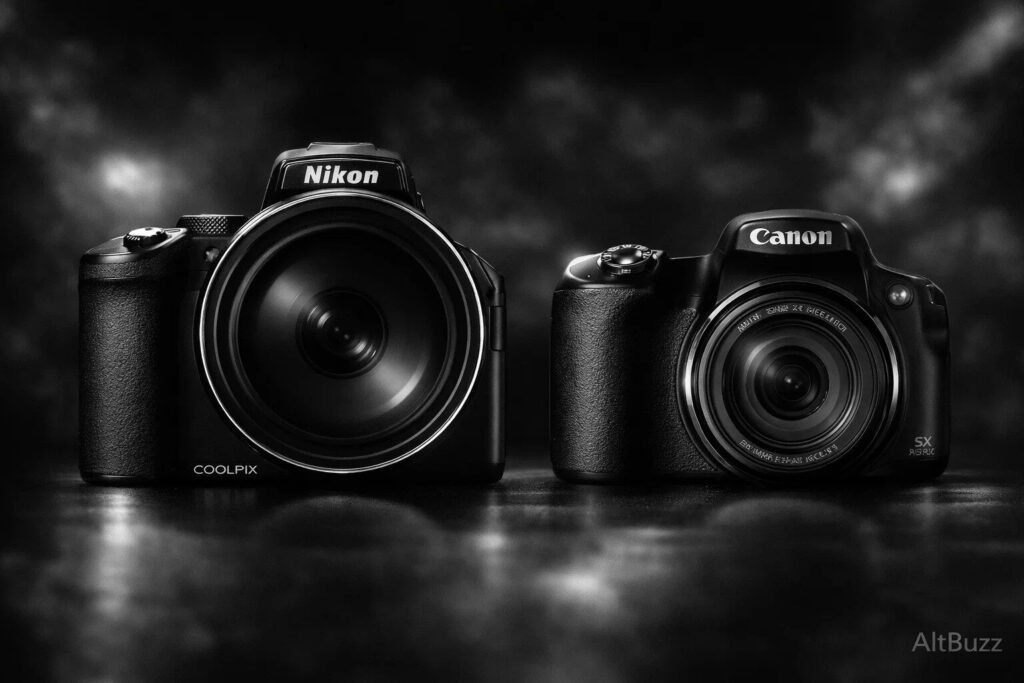
The weight comparison between these cameras deserves extended discussion because the difference is larger than any specification gap in this entire comparison. The Nikon P950 weighs 1005 grams with battery and card. The Canon SX70 HS weighs 610 grams. This 395-gram difference represents a 65% weight increase for the P950 over the SX70 HS, which is a physically substantial difference that photographers feel immediately when picking up each camera.
For photographers who carry their camera during extended wildlife walks covering several kilometers, multi-hour hiking sessions in nature reserves, and long observation periods at fixed positions, this weight difference creates genuinely different physical experiences over the course of a full day in the field. The P950 demands more consideration of carry strategy, bag choice, and neck strap versus shoulder strap decisions. The SX70 HS can be carried casually and comfortably for extended periods without the fatigue that the P950’s kilogram weight eventually induces.
Weight as a Shooting Stability Asset
Paradoxically, the P950’s heavier weight also assists in one specific shooting context. At extreme telephoto focal lengths where the camera is supported against the body, braced on a railing, or rested on a surface, the P950’s greater mass dampens small residual movements more effectively than the lighter SX70 HS. Heavier cameras resist the micro-oscillations that remain after optical stabilization correction, producing slightly steadier handheld telephoto performance in situations where the camera is partially but not fully supported.
This passive stability benefit partially offsets the P950’s carry disadvantage for shooting-position photography where the photographer remains stationary. For mobile field photography where carry comfort over distance matters significantly, the SX70 HS’s lighter weight remains a clear practical advantage throughout the session.
Battery Life Comparison
The Canon SX70 HS’s NB-13L battery delivers approximately 325 shots per charge under CIPA standards. The Nikon P950’s EN-EL20a delivers approximately 250 shots per charge. For a full day of active wildlife or bird photography, the SX70 HS’s battery advantage means fewer shooting interruptions for battery management during peak activity windows when subjects are most active and opportunities most frequent.
In practical wildlife photography, missing a shooting opportunity because the camera powered down during a battery change represents a real cost. The SX70 HS’s approximately 30% battery advantage over the P950 provides a meaningful buffer for extended active sessions. Both cameras benefit from carrying multiple spare batteries regardless, as both deliver endurance below what a full day of active telephoto shooting consumes at typical burst shooting frequencies.
Real-World Use Cases
For Bird Photography
Both cameras handle bird photography adequately in good light conditions at typical birdwatching distances. For birders who primarily observe and document garden birds, wetland species, and relatively accessible woodland birds at moderate distances, both cameras produce satisfying results. The P950’s greater reach and superior stabilization provide a consistent advantage for photographing smaller and more distant birds where the additional 635mm of maximum focal length makes a visible difference in subject fill and detail resolution.
For photographers who track birds in flight specifically, the SX70 HS’s Dual Pixel AF provides faster acquisition and more persistent tracking than the P950’s contrast-detect system. The ideal superzoom for bird photography depends on whether the photographer prioritizes maximum static reach and RAW editing capability or faster and more reliable autofocus tracking for birds in active flight.
For Aviation Photography
Aviation photography benefits most directly from maximum focal length reach and optical stabilization quality. Aircraft at airshows and airports remain at substantial distances from spectator positions, and every additional millimeter of reach directly increases the detail visible in finished images. The P950’s 2000mm maximum with superior 5-axis stabilization provides a meaningful practical advantage over the SX70 HS for aviation photography at standard observation distances.
For Moon and Celestial Photography
Moon photography represents perhaps the most direct application of maximum telephoto reach. The P950’s 2000mm equivalent captures the moon at approximately 47% larger scale than the SX70 HS’s 1365mm maximum, which translates directly into greater visible crater detail and more impressive photographic results. Combined with RAW capture capability that allows careful post-processing of fine lunar surface textures, the P950 delivers substantially better moon photography results than the SX70 HS for photographers who pursue this specific application.
For Travel and Wildlife Walks
The SX70 HS wins the travel and mobile photography application convincingly. At 610 grams, it carries comfortably on long walks and travel days without becoming a physical burden. The fully articulating screen accommodates a wide range of environmental photography angles. Dual Pixel AF handles varied subject types encountered during travel, including street scenes, wildlife, architecture, and people, with reliable and fast performance. The lower purchase price preserves budget for travel itself.
Nikon P950 vs Canon SX70 HS: Pros and Cons
Nikon P950 Strengths and Weaknesses
The P950 delivers 2000mm maximum reach that creates genuine creative possibilities for distant wildlife, moon photography, and aviation documentation that the SX70 HS simply cannot match at 1365mm. The 5-axis Dual Detect VR system produces a higher keeper rate of sharp extreme telephoto handheld images through more sophisticated 5-axis movement compensation. RAW file support provides post-processing flexibility that JPEG-only shooting cannot recover when exposure conditions are challenging or imperfect.
The superior 2.36M-dot OLED viewfinder clarity makes precise subject framing and tracking at extreme focal lengths more comfortable and accurate than the SX70 HS’s lower-resolution viewfinder display. Built-in GPS provides automatic location tagging independence from smartphone pairing requirements. The BSI sensor architecture delivers marginally cleaner high-ISO performance for the pixel count relative to the sensor size. The f/2.8 wide aperture provides a light-gathering advantage over the SX70 HS’s f/3.4 at wide to mid-zoom positions in dawn and dusk shooting conditions.
Against these strengths, the P950 weighs over one kilogram, which creates real carry fatigue during long field sessions and hiking photography. The EN-EL20a battery delivers only 250 shots per charge, requiring spare battery management more actively than the SX70 HS. The contrast-detect AF system trails the SX70 HS’s Dual Pixel phase-detect performance for tracking fast-moving subjects and video AF. The higher $799 launch price increases the financial commitment compared to the SX70 HS.
Canon SX70 HS Strengths and Weaknesses
The SX70 HS delivers Dual Pixel CMOS AF that provides faster subject acquisition and more confident tracking for in-flight birds, moving animals, and video recording than the P950’s contrast-detect system. The fully articulating screen enables ground-level, overhead, and forward-facing compositions that a tilting-only screen cannot match for environmental and creative photography angles. The significantly lighter 610-gram body reduces carry fatigue substantially during long field sessions, wildlife walks, and travel photography days. The NB-13L battery provides 325 shots per charge, extending shooting sessions between battery changes compared to the P950. The 20.3MP sensor provides more cropping headroom for subjects that do not fill the frame at maximum zoom.
The lower $549 launch price makes the SX70 HS a more accessible entry point into capable superzoom photography. DIGIC 8 processing delivers excellent JPEG output with reliable color accuracy and in-camera noise management for photographers who do not edit RAW files on a computer.
Against these strengths, the SX70 HS’s 1365mm maximum reach falls substantially short of the P950’s 2000mm for distant subject photography. The complete absence of RAW capture removes all post-processing flexibility for challenging exposures. The standard Optical Image Stabilizer trails the P950’s 5-axis Dual Detect VR in handheld extreme telephoto performance. The lower-resolution viewfinder makes precise extreme telephoto composition less comfortable than the P950’s OLED display.
Final Verdict: Nikon P950 vs Canon SX70 HS
The decision between these cameras follows directly and clearly from your primary shooting priorities.
Choose the Nikon P950 if maximum telephoto reach is your primary requirement and you photograph subjects where every additional millimeter of focal length directly improves your results, if RAW editing is a regular part of your image quality workflow and you need recovery flexibility from imperfect exposures, if superior stabilization performance at extreme telephoto focal lengths matters to your keeper rate, if built-in GPS for location tagging independence is important, and if you accept the physical weight of one kilogram as a reasonable trade-off for the capabilities it enables.
Choose the Canon SX70 HS if autofocus speed and tracking reliability for active subjects in flight or erratic movement is a priority over maximum reach, if carry weight and comfort during long field sessions is a significant consideration, if the fully articulating screen flexibility serves your shooting angles, if budget is a meaningful factor in the decision, and if JPEG-only capture satisfies your image quality workflow requirements.
Neither camera is the universally correct choice for every superzoom photographer. Both deliver remarkable telephoto capabilities far beyond what any other consumer camera category provides at comparable prices. The decision hinges specifically on whether maximum reach and RAW capability or autofocus reliability and carry comfort represents the higher priority for your most frequent and most demanding shooting applications.
Read More from AltBuzz
For superzoom camera comparisons, wildlife photography gear guides, and honest technical reviews covering every camera category at every price point, visit AltBuzz. AltBuzz makes complex camera decisions straightforward with technical depth and real-world context.
Subscribe to the AltBuzz YouTube Channel
Stay updated with the latest camera comparisons and field tests. AltBuzz covers superzoom cameras, mirrorless systems, and every major camera category with practical depth and honest analysis. Subscribe to AltBuzz on YouTube for camera content that genuinely informs your purchase decisions before you spend your money.