
Panasonic Lumix DMC-TZ10 Full Review: Specs, Performance & Verdict
The Panasonic Lumix DMC-TZ10 is a travel zoom camera that combines a 12x optical zoom with built-in GPS. Released in 2010, this compact camera targets travelers seeking versatility without carrying multiple lenses. It features a 12-megapixel sensor, 720p video recording, and a 3.0-inch LCD screen. However, GPS functionality drains battery life significantly.
Release Date and Market Position
Panasonic announced the Panasonic Lumix DMC-TZ10 in January 2010. The camera became available shortly after announcement. Known as the ZS7 in North America, it succeeded the popular TZ7/ZS3 model. Competitors included the Canon SX200 IS and Sony Cyber-shot HX5. The TZ10 positioned itself as a premium travel zoom with GPS navigation features.
Panasonic Lumix DMC-TZ10 Specifications Table
| Feature | Details |
|---|---|
| Sensor Type | 1/2.33-inch CCD |
| Resolution | 12.1 megapixels |
| Processor | Venus Engine HD II |
| ISO Range | 80-1600 (Auto extends to 6400) |
| Autofocus System | Contrast detection with face detection |
| Stabilization | Power O.I.S. (Optical Image Stabilization) |
| Video Recording | 720p at 30 fps (AVCHD Lite and Motion JPEG) |
| EVF | None |
| LCD Screen | 3.0-inch, 460,000 pixels |
| Burst Shooting | Approximately 2 fps |
| Battery | Rechargeable lithium-ion (approximately 300 shots, less with GPS) |
| Storage | SD/SDHC/SDXC |
| Connectivity | USB 2.0, HDMI output |
| Weight | 218 grams |
| Launch Price | Approximately $350-400 USD |
Sensor and Image Quality Performance
CCD Sensor Technology and Specifications
The Panasonic Lumix DMC-TZ10 uses a 12.1-megapixel 1/2.33-inch CCD sensor. This sensor size is typical for compact cameras from this era. CCD technology provides good color accuracy and smooth tonal transitions. The sensor measures approximately 6.08 x 4.56mm physically.
The Venus Engine HD II processor handles image processing duties. This second-generation processor improves speed over predecessors. Processing affects noise reduction, sharpening, and JPEG rendering. The combination produces the camera’s final output quality.
Maximum resolution reaches 4000 x 3000 pixels. This provides adequate detail for prints up to 11×14 inches. Smaller web and social media sizes look excellent. The megapixel count meets most casual photography needs.
Daylight Image Quality and Color Reproduction
Real-world image quality performs well in good lighting conditions. Colors appear natural and pleasing without oversaturation. The camera handles daylight photography admirably. Outdoor scenes render with good vibrancy and accuracy.
White balance performs reliably in typical conditions. Automatic white balance handles most situations correctly. Preset white balance modes cover common lighting types. Manual Kelvin adjustment is unavailable on this model.
The Venus Engine produces pleasing color science. Skin tones appear natural in portraits. Foliage renders with appropriate green tones. Blue skies show good saturation without clipping.
Results show good detail reproduction for the sensor size. Fine textures resolve adequately at base ISO. Sharpening levels appear appropriate without halos. Images require minimal post-processing for sharing.
Dynamic Range Limitations
The camera handles typical contrast scenes reasonably. However, smaller sensor size limits dynamic range compared to larger sensors. High-contrast situations challenge the camera’s capabilities.
Shadows block up relatively quickly in bright scenes. Highlight recovery provides limited headroom. Blown highlights show minimal detail recovery. Exposure compensation helps manage difficult lighting.
JPEG files show more limited recovery than RAW. Unfortunately, the Panasonic Lumix DMC-TZ10 lacks RAW capability. Photographers cannot access sensor data directly. This restricts post-processing flexibility significantly.
Intelligent Dynamic Range mode attempts to improve latitude. This feature brightens shadows selectively. However, results sometimes appear artificial. Use this feature judiciously in extreme lighting.
Low-Light Performance and ISO Capabilities
Low-light performance reveals the sensor’s limitations clearly. Noise becomes visible above ISO 400 quickly. Image quality remains acceptable at ISO 200-400. Beyond this range, degradation accelerates.
By ISO 800, image quality degrades noticeably. Noise reduction becomes aggressive, softening detail. Color accuracy diminishes at higher sensitivities. Fine textures blur together increasingly.
The camera extends ISO to 6400 in Auto mode. However, these extreme settings produce barely usable results. Noise overwhelms images at ISO 3200-6400. Color shifts become apparent at maximum ISOs.
Photographers should stick to ISO 400 or lower for best results. Using flash indoors often yields better quality. Tripods enable lower ISOs in static scenes. Managing ISO expectations proves essential with this camera.
Optical Performance of Leica Lens
The Leica DC Vario-Elmarit lens delivers sharp images across most of the zoom range. Center sharpness impresses even at telephoto settings. This 12x zoom covers 25-300mm equivalent focal length. The range handles diverse shooting situations.
Wide-angle performance suits landscapes and architecture. Minimal distortion appears at 25mm equivalent. Corner sharpness remains acceptable throughout the frame. The lens maintains good contrast at wide settings.
Telephoto reach extends to 300mm equivalent. This brings distant subjects closer effectively. Wildlife and sports photography become possible. However, stabilization becomes critical at these focal lengths.
Corner sharpness drops slightly at telephoto settings. This represents typical behavior for travel zoom lenses. Central sharpness remains the priority. Most users won’t notice corner softness in typical shooting.
Chromatic aberration appears occasionally in high-contrast edges. Purple fringing shows in backlit situations sometimes. However, the issue remains manageable overall. Modern software easily corrects these aberrations.
The f/3.3-4.9 maximum aperture is typical for this zoom range. However, the limited aperture restricts low-light capability. Background blur potential remains minimal. The camera prioritizes zoom range over wide apertures.
Autofocus Performance
Contrast Detection AF System
The Panasonic Lumix DMC-TZ10 employs contrast detection autofocus. This system analyzes contrast differences to achieve focus. Performance is adequate but not exceptional compared to phase detection. The system works by finding maximum contrast in the scene.
The camera lacks AF point selection. Focus area operates in multi-area or spot modes. Multi-area analyzes multiple zones automatically. Spot focusing concentrates on the center area.
Autofocus speed is acceptable for everyday photography. Well-lit scenes present no problems for the system. The camera acquires focus reasonably quickly in good conditions. However, limitations appear in challenging situations.
AF Performance in Different Lighting Conditions
The system hunts occasionally in low contrast situations. Uniform surfaces challenge the contrast detection method. Textured subjects lock focus more reliably. Adding contrast to the scene aids focusing speed.
Low-light autofocus performance slows noticeably. The camera requires more time to achieve focus in darkness. AF-assist illumination helps but has limited range. Very dark environments may prevent focus lock entirely.
Backlit situations sometimes confuse the autofocus system. The camera may focus on bright backgrounds instead. Using spot focus mode helps in these scenarios. Manual focus override becomes useful occasionally.
Face Detection Technology
Face detection technology helps significantly with people photography. The system recognizes multiple faces in the frame. Face Detection AF adjusts focus for detected faces automatically. Additionally, it optimizes exposure and flash for people.
Up to 15 faces can be detected simultaneously. The camera prioritizes the largest or closest face. Focus, exposure, and white balance optimize for the primary face. This improves portrait success rates dramatically.
Face recognition goes beyond simple detection. The system can register specific individuals’ faces. Registered faces receive priority focus and exposure. This proves useful for family photography situations.
However, face detection requires clear facial features. Profile shots may not trigger detection. Distant faces may go unrecognized. The system works best with front-facing subjects.
Intelligent Scene Detection
Intelligent Scene Detection analyzes the scene automatically. The camera selects appropriate settings from 54 pre-programmed scenes. This helps beginners achieve better results without knowledge. The system recognizes scenarios like landscapes, portraits, and macros.
Scene icons appear on screen showing detected scene types. The camera adjusts multiple parameters simultaneously. Settings include exposure, color, contrast, and saturation. Each scene type receives optimized processing.
Advanced users may find this feature limiting. Automatic selections sometimes differ from creative intent. Fortunately, the system can be disabled. Manual modes provide full control when desired.
AF Speed and Action Photography Limitations
Autofocus speed is acceptable for stationary subjects. Moderate movement tracking works reasonably well. However, action photography challenges the system significantly. Fast-moving subjects often result in missed focus.
The Panasonic Lumix DMC-TZ10 works best with stationary subjects. Slowly moving people track adequately. Children and pets present challenges for focus tracking. Sports and wildlife often exceed the camera’s capabilities.
Shutter lag exists but remains reasonable. Half-pressing the shutter pre-focuses effectively. This two-stage shutter technique improves timing. However, the camera cannot match DSLR responsiveness.
Continuous autofocus during shooting is available. However, tracking accuracy remains limited. The system struggles with erratically moving subjects. Predictable motion yields better results than random movement.
Video Capabilities
HD Video Recording Formats
Video recording reaches 720p HD resolution at 30 fps. The Panasonic Lumix DMC-TZ10 offers two recording formats: AVCHD Lite and Motion JPEG. AVCHD Lite provides better compression for longer recording times. This format suits editing on compatible software.
Motion JPEG creates larger files but offers easier editing. Most software handles Motion JPEG natively. However, storage fills quickly with this format. Choose based on editing workflow and storage capacity.
Video resolution measures 1280 x 720 pixels. This HD quality exceeded many competitors in 2010. Footage appears sharp on HD televisions. However, Full HD 1080p was already emerging.
Optical Zoom During Video Recording
One significant advantage is optical zoom during recording. The zoom operates while filming continuously. This zoom capability proves useful for travel videos. However, zoom speed is reduced to minimize motor noise.
Zoom operation still produces audible noise in recordings. The built-in microphone picks up motor sounds. Headphones reveal this limitation clearly. External microphones would help but aren’t supported.
The zoom range provides creative flexibility. Starting wide and zooming to telephoto adds production value. Travel videos benefit from this capability significantly. Few compact cameras offered this feature in 2010.
Video Autofocus and Stabilization
Face Detection AF/AE works during video capture. Focus and exposure continuously adjust for moving subjects. This feature helps maintain sharp, properly exposed footage. Face priority ensures people remain in focus.
Continuous autofocus sometimes hunts during recording. This creates distracting focus shifts in footage. Manual focus lock before recording helps. However, true manual focus isn’t available during video.
Stabilization aids handheld video shooting significantly. POWER O.I.S. reduces camera shake effectively. Videos appear smoother than unstabilized footage. However, walking motion still appears in handheld shots.
Audio Recording Quality
Audio recording is monaural through a built-in microphone. No external microphone input exists unfortunately. This limits audio quality for serious video work. Built-in microphones capture all surrounding sounds indiscriminately.
Wind noise can interfere with outdoor recordings. The microphone has no wind reduction features. Sheltering the camera helps in breezy conditions. Indoor recordings fare better acoustically.
Audio quality suits casual use and sharing online. Family events and vacation videos sound acceptable. However, professional applications require better audio. The limitation reflects the camera’s casual positioning.
Design, Build Quality, and Handling
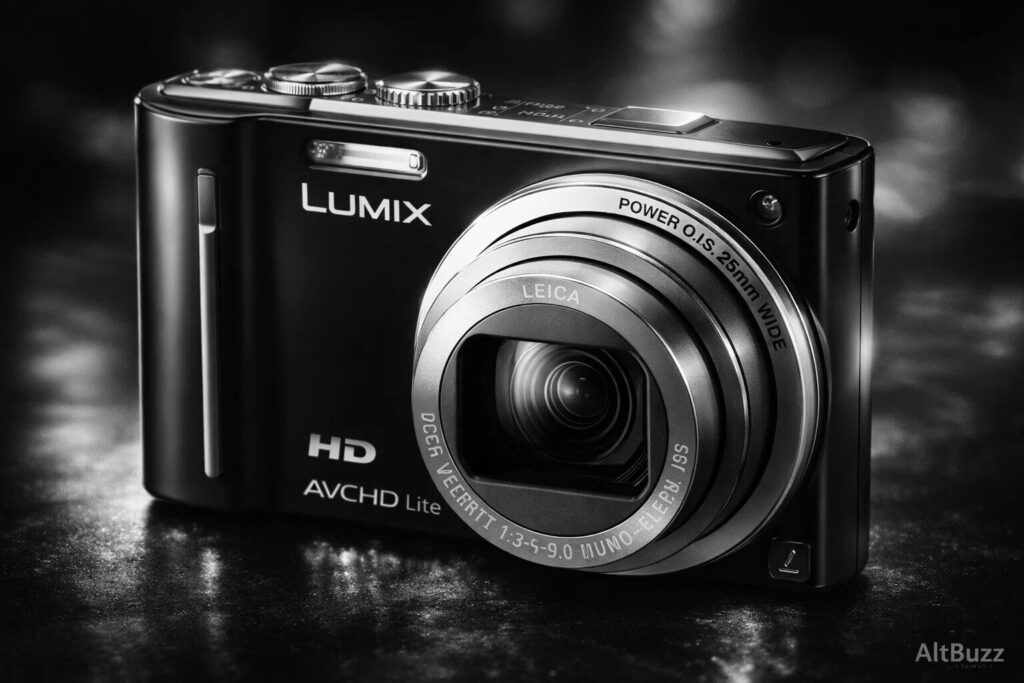
Construction and Durability
The Panasonic Lumix DMC-TZ10 features a metal body construction. The chassis uses lightweight aluminum alloy. Build quality feels solid and reassuring despite compact size. This construction withstands typical travel usage well.
The camera weighs 218 grams body only. With battery and card, weight increases moderately. This lightweight design enhances portability significantly. All-day carrying causes minimal fatigue.
Dimensions allow it to fit in larger pockets or small bags. The camera measures approximately 104 x 59 x 33mm. Truly pocketable designs require jacket or cargo pockets. Purses and small bags accommodate it easily.
However, weather sealing is completely absent. No protection exists against dust or moisture. Users must protect the camera from rain carefully. Beach environments require extra protection from sand.
Grip Design and Ergonomics
Grip design has improved over TZ7 predecessors. A vertical textured rubber strip provides secure hold. This grip enhancement aids one-handed operation. Fingers naturally find this grip area.
The index finger rests comfortably on the shutter release. Thumb position on the rear grip balances well. One-handed operation is feasible for quick shots. However, two hands provide best stability.
Zoom lever surrounds the shutter button conveniently. Thumb or finger operates the zoom easily. This placement enables quick focal length changes. The lever responds smoothly to pressure.
Small button size may challenge larger fingers. Button spacing is tight due to compact design. Some users may prefer larger cameras. However, most adapt quickly with practice.
Control Layout and Interface
Button layout offers reasonable accessibility considering size constraints. However, a dedicated play/capture switch can frustrate users. Leaving it in play mode means missing spontaneous shots. A simple button would be more intuitive.
The mode dial sits conveniently near the shutter button. Scene modes, P/A/S/M, and video mode select easily. However, the dial can rotate accidentally in bags. Lock mechanism would improve usability.
Menu navigation follows Panasonic’s typical structure. The interface responds adequately to inputs. However, menu organization could be more intuitive. Finding specific settings sometimes requires searching.
Quick Menu provides faster access to common settings. This overlay menu reduces main menu diving. ISO, white balance, and other parameters adjust quickly. This feature improves shooting efficiency.
LCD Screen Quality
The 3.0-inch LCD screen displays 460,000 pixels. This represents an upgrade from earlier 230k models. Image preview and review appear sharper. Composition judgment improves with better resolution.
Viewing angles are adequate for most situations. The screen remains visible from moderate angles. However, extreme angles show color shifts. Direct viewing provides best image representation.
Outdoor visibility could be better in bright sunlight. Glare and reflections reduce screen visibility. Shading the screen helps in very bright conditions. Indoor viewing presents no problems.
No touchscreen functionality exists on this model. All control happens through physical buttons. This traditional interface works reliably. However, touchscreens were emerging in 2010.
Battery Life and Connectivity
Battery Performance with GPS Active
Battery performance delivers approximately 300 shots per CIPA standards. However, GPS operation significantly reduces battery life substantially. Active GPS tracking drains power continuously. Battery life drops to around 200 shots with GPS enabled.
Travelers using GPS extensively should carry spare batteries. The battery indicator helps monitor remaining capacity. Conservative shooting extends battery life. Turning off GPS when unnecessary proves essential.
Cold weather further impacts battery performance. Lithium-ion batteries lose capacity in freezing temperatures. Winter travelers need extra batteries. Keeping spares warm in pockets helps.
Charging and Power Management
The rechargeable lithium-ion battery charges using the supplied charger. In-camera charging is not available on this model. This requires packing the dedicated charger when traveling. The charger is compact but still occupies luggage space.
Charging takes several hours for full recharge. Overnight charging prevents shooting interruptions. The charger accepts 110-240V worldwide. Only plug adapters are needed internationally.
Power-saving features help extend battery life. Auto power-off activates after set intervals. LCD brightness reduction conserves energy. Disabling GPS doubles shot count.
Battery availability remains good in used markets. Replacement batteries cost reasonably. Third-party options provide budget alternatives. Always verify compatibility before purchasing.
Connectivity Options
Connectivity includes USB 2.0 for file transfer. The proprietary USB cable connects to computers. File transfer speeds are adequate but not fast. Importing large video files takes time.
HDMI output allows viewing images on televisions. The mini-HDMI port connects to displays easily. This enables comfortable image review on large screens. Sharing vacation photos becomes more enjoyable.
The camera lacks wireless connectivity entirely. No Wi-Fi or Bluetooth exists. Photographers must use cable connections for all transfers. This limitation reflects 2010 technology standards.
Card reader usage speeds transfers significantly. Removing the SD card and using dedicated readers works faster. Most computers and laptops include card slots. This method bypasses USB bottlenecks.
GPS Functionality Details
GPS functionality geotags photos with location data. Latitude and longitude embed in image metadata. This proves useful for travel documentation. Remembering shooting locations becomes effortless.
However, GPS acquisition can be slow initially. The camera requires clear sky view for positioning. Tall buildings and dense forests block signals. Indoor shooting prevents GPS function entirely.
GPS data displays on playback screen. Map coordinates show for each image. Software like Lightroom displays photos on maps. This geographic organization aids photo management.
The GPS feature updates location continuously. This maintains accuracy while moving. However, continuous operation drains battery significantly. Strategic GPS use balances features and battery life.
Real-World Use Cases
Travel Photography Excellence
Travel photography represents the Panasonic Lumix DMC-TZ10’s primary strength. The 12x zoom covers wide-angle to telephoto needs comprehensively. Portability makes it easy to carry all day. One camera handles diverse travel situations.
Wide-angle capability captures expansive landscapes effectively. The 25mm equivalent includes foreground and background. Architectural interiors fit within the frame. City streets gain environmental context.
Telephoto reach brings distant subjects closer. Architectural details become accessible from ground level. Wildlife photography becomes possible from safe distances. The versatile range eliminates lens changes entirely.
GPS geotagging helps remember shooting locations years later. Looking at old travel photos reveals exact locations. This proves invaluable for future trip planning. Location-based organization simplifies photo management.
Vacation and Family Photography
Vacation photography benefits from the point-and-shoot convenience. Intelligent Auto mode simplifies camera operation completely. Family members can use the camera easily. Scene modes help achieve better results automatically.
Face Detection ensures family members appear sharp. Group photos maintain focus across multiple people. Exposure optimizes for faces automatically. Flash balancing improves indoor family shots.
The compact size doesn’t intimidate subjects. Casual photography happens more naturally. Family members forget about the camera. More authentic, candid moments emerge.
Video recording captures family memories dynamically. The 720p quality looks good on televisions. Optical zoom adds versatility to family videos. Audio quality suits casual family viewing.
Casual Video and Vlogging
Casual video recording suits family events adequately. The 720p quality meets basic viewing needs. AVCHD Lite format works with most editing software. Motion JPEG offers simpler compatibility.
Optical zoom during recording adds production value. Zooming in on speakers or subjects helps. However, zoom motor noise remains audible. Professional videography requires better audio solutions.
Stabilization helps handheld video shooting significantly. Walking shots appear smoother with O.I.S. active. However, running or fast movement still shows shake. Tripods provide best stability for stationary shots.
Point-and-Shoot Simplicity
Point-and-shoot convenience appeals to beginners strongly. Intelligent Auto mode simplifies all camera operations. The camera makes decisions automatically. Users simply compose and press the shutter.
Scene modes help achieve better results in specific situations. Portrait mode optimizes for people photography. Landscape mode enhances outdoor scenes. Macro mode enables close-up photography.
Experienced users appreciate manual control options available. P/A/S/M modes provide creative control. Aperture priority enables depth of field control. Shutter priority freezes or blurs motion creatively.
The learning curve remains gentle for new photographers. Success comes quickly with automatic modes. Confidence builds before trying manual controls. The camera grows with photographer skill development.
Pros and Cons
Pros
- Versatile 12x optical zoom (25-300mm equivalent)
- Built-in GPS for geotagging photos
- Compact and portable metal body
- Power O.I.S. image stabilization
- 720p HD video with optical zoom while recording
- Face Detection technology
- Improved 3.0-inch LCD screen
- Full manual control modes (P, A, S, M)
Cons
- GPS drains battery significantly
- Small sensor limits low-light performance
- No RAW format support
- Slow burst shooting (approximately 2 fps)
- Play/capture switch can be inconvenient
- No wireless connectivity
- Monaural audio recording only
- Autofocus struggles with fast action
Final Verdict
The Panasonic Lumix DMC-TZ10 delivers excellent versatility for travel photography. Its 12x zoom eliminates the need for lens changes. Built-in GPS adds value for travelers documenting their journeys. Image quality satisfies most casual shooting needs.
Value for money was competitive at launch. Today, the TZ10 appears in the used market at affordable prices. It represents a capable option for budget-conscious travelers. However, smartphone cameras have advanced significantly since 2010.
Who should buy this camera? Travelers seeking an all-in-one solution with GPS should consider the TZ10. Families wanting better zoom than smartphones will appreciate the versatile range. Beginners learning photography benefit from comprehensive scene modes and manual options.
Who should avoid it? Low-light photographers need larger sensors and better high-ISO performance. Action photography enthusiasts require faster autofocus systems. Videographers wanting advanced features should look elsewhere. Those prioritizing image quality over convenience should consider cameras with larger sensors.
The Panasonic Lumix DMC-TZ10 served its purpose well as a travel companion. Despite its age, it still offers practical features for casual photography. GPS functionality remains a unique selling point in the compact camera category.
Read More from AltBuzz
Read more from AltBuzz for camera reviews, detailed specs, and expert insights. AltBuzz delivers trusted and easy-to-understand photography content. Discover comprehensive guides, buying recommendations, and photographic techniques. Whether researching gear or improving skills, AltBuzz provides valuable information for photographers.
Subscribe AltBuzz YouTube Channel
Stay updated with camera reviews and comparisons. AltBuzz shares hands-on camera content regularly. Experience real-world testing and practical advice from photography experts. Subscribe here to access helpful video reviews and tutorials for photographers at all levels.