
Pentax 17 Review: A Modern Half-Frame Film Camera Worth The Hype
The Pentax 17 marks the first new film camera from Pentax in roughly two decades, and the launch generated real excitement across the analog photography community. Ricoh Imaging built this camera specifically around the half-frame format, doubling the number of shots available on a standard roll of 35mm film. Rather than simply reviving an old design, engineers combined vintage-inspired controls with genuinely modern touches like a built-in light meter and a bright optical viewfinder. This review examines every important system on the Pentax 17, from its lens design to its exposure controls, so film shooters can judge whether it belongs in their bag. Photographers curious about analog photography in a tactile, modern package will find every relevant detail covered here.
Pentax 17 Design and Build Quality
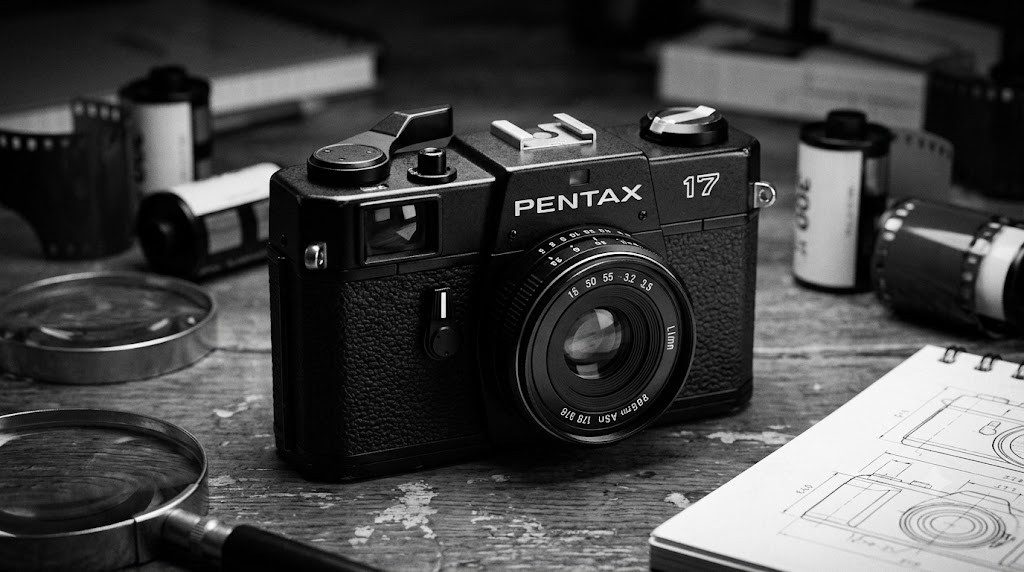
Ricoh finished the Pentax 17 in a retro-inspired shell available in either Black or Dark Silver, both built around a magnesium alloy top and base plate. The camera feels dense and reassuring in hand, avoiding the flimsy plastic feel found on many cheap point-and-shoot film cameras. A manual film advance lever sits on the top plate, shaped specifically for a comfortable finger hold after every shutter release. This small detail recreates the tactile ritual that many photographers miss when shooting purely digital cameras. Consequently, the Pentax 17 signals its analog identity the moment it lands in your hands.
Physical dials cover ISO selection, exposure mode, and focus zone, all clustered logically around the lens barrel and top plate. A note holder on the back cover accepts the torn end of a film box, letting shooters glance down and confirm exactly which film stock sits inside the camera. This small addition solves a common annoyance for photographers who load several different film types across a single week. Additionally, the compact body slips easily into a jacket pocket or small bag without adding meaningful bulk. These design choices show Ricoh understood exactly how film shooters actually use a camera day to day.
Pentax 17 Half-Frame Format Explained
The defining feature of this camera lies in its half-frame format, capturing two 17mm by 24mm images within the space normally used for one standard 35mm frame. This approach doubles the number of exposures available on any roll, turning a standard 36-exposure roll into 72 total shots. Photographers loading a 24-exposure roll instead gain 48 total images, stretching the value of every purchase considerably further. Each frame renders in a vertical orientation by default, closely matching the aspect ratio most people already associate with smartphone photography. As a result, the format feels immediately familiar to anyone raised on vertical social media content.
This half-frame approach directly addresses rising film and processing costs, since photographers effectively cut their per-shot expense in half compared to standard 35mm shooting. Beginners exploring film photography for the first time gain considerably more room to experiment and make mistakes without burning through an entire roll in one afternoon. Experienced shooters, meanwhile, may need an adjustment period since composing consistently in a vertical frame differs from decades of habit built around horizontal 35mm shooting. Scanning and processing half-frame negatives also takes labs slightly longer, since each physical frame must be split into two separate images during scanning. Despite that extra step, the overall value proposition still favors photographers shooting frequently on a budget.
Pentax 17 Lens and Optical Performance
Ricoh built the Pentax 17 around a fixed 25mm f/3.5 lens, which works out to a 37mm equivalent focal length once accounting for the half-frame format. Engineers based this design on the lens found in the 1994 Pentax Espio Mini, a compact camera still beloved among film photography enthusiasts today. Three elements arranged across three groups keep the design simple, while HD coating technology borrowed from Pentax SLR lenses helps control flare and improve contrast. This coating technology has earned strong praise across Pentax’s interchangeable lens lineup for years before appearing here. Consequently, the Pentax 17 delivers noticeably sharper, clearer images than many comparable point-and-shoot film cameras.
The leaf shutter built into this lens produces a genuinely circular aperture shape across its full range from f/3.5 to f/16. That circular quality benefits out-of-focus highlights and background blur, giving images a smoother, more pleasing rendering during bright, wide-aperture shooting. Shutter speed ranges from a brisk 1/350 of a second down to a full 4 seconds for long exposure work in dim conditions. Because the lens stays fixed rather than interchangeable, Ricoh optimized every element specifically for this exact sensor size and shooting format. That tight integration produces consistent image quality regardless of which exposure mode a photographer chooses.
Pentax 17 Focus System and Zone Focusing
Rather than relying on autofocus, the Pentax 17 uses a manual zone focusing system with six preset distances marked directly on the lens barrel. These zones range from as close as 0.25 meters out to infinity, each represented by a simple icon rather than a numeric distance marking. Photographers select the appropriate zone before raising the camera to their eye, a workflow that feels natural once learned but does require some initial practice. This approach keeps the camera mechanically simple while still delivering accurate focus across a wide range of common shooting distances. As a result, street and travel photographers can work quickly once they memorize which icon corresponds to their typical subject distance.
The optical viewfinder uses an Albada-type bright frame design, projecting a clear frame line directly into the photographer’s view of the scene. A close-up visual field compensation feature adjusts the displayed frame slightly at near focusing distances, helping maintain accurate composition even during macro-adjacent shooting. This viewfinder design traces its roots back through decades of compact camera history, proving reliable and bright even in mixed outdoor lighting conditions. Photographers moving from digital autofocus systems will need to trust their distance estimation more than they might expect initially. However, most shooters report the zone system becomes second nature within just a few rolls of practice.
Pentax 17 Exposure Controls and Metering
Ricoh built genuine creative flexibility into the Pentax 17 rather than limiting it to a single fully automatic shooting mode. A built-in light meter reads the scene and suggests exposure settings, while photographers can still select from multiple shooting modes depending on their creative goals. ISO sensitivity can be set manually across a wide range spanning 50, 100, 125, 160, 200, 400, 800, 1600, and 3200, matching whatever film stock happens to be loaded. This manual ISO selection matters significantly, since the camera has no way to read DX coding automatically from the film canister itself. Consequently, photographers must remember to update this setting every time they load a different film stock.
Beyond fully automatic exposure, the camera offers modes that let photographers dial in specific creative choices for tricky lighting situations. Slow-sync flash and other specialized modes address common challenges like backlit subjects or dim indoor environments where a simple automatic reading often struggles. A CR2 lithium battery powers the light meter, viewfinder indicators, and built-in flash unit throughout the shooting experience. This battery dependency means photographers should always carry a spare, since a dead battery disables metering and flash entirely rather than allowing fully manual backup shooting. Overall, the exposure system strikes a reasonable balance between beginner-friendly automation and creative control for more experienced shooters.
Pentax 17 Built-In Flash Performance
A built-in flash unit ships standard on the Pentax 17, expanding its usefulness into dim interiors and nighttime social situations. Flash output pairs with the camera’s exposure system to balance ambient and flash light reasonably well across typical shooting distances. Photographers shooting portraits or casual gatherings will find the flash particularly useful, since color film often benefits from a slight fill light indoors. Several reviewers specifically praised how flash shots turned out cleaner and more usable than expected for a camera at this price point. This built-in convenience removes one more piece of gear that photographers would otherwise need to carry separately.
Pentax 17 Film Economy and Cost Considerations
Rising film prices have pushed many photographers toward formats that stretch every roll further, and the Pentax 17 addresses that concern directly. Doubling the exposure count per roll effectively cuts the cost per image roughly in half compared to standard full-frame 35mm shooting. Photographers processing film through commercial labs will still pay a per-roll development fee, though that cost gets spread across twice as many resulting images. Some labs do charge slightly more for half-frame scanning, since splitting each physical frame into two images requires extra time during the scanning process. Even accounting for that modest surcharge, most photographers still come out ahead financially compared to shooting full-frame film at current prices.
Beginners exploring film photography for the first time benefit enormously from this economics, since mistakes cost far less than they would on a standard roll. Travelers can also carry fewer rolls of film while still capturing significantly more images throughout a trip. Experienced film shooters weighing a half-frame camera against a full-frame body should consider how often they shoot casually versus for specific creative projects. For high-volume casual shooting, the cost savings genuinely add up over the course of a year. For deliberate, considered image-making, some photographers may still prefer the larger negative and slower shooting pace that full-frame formats encourage.
Pentax 17 Real World Shooting Experience
Street photographers will appreciate how quickly the zone focusing system works once a shooter memorizes the common distance icons. Raising the camera, confirming the zone, and pressing the shutter takes only a moment, keeping pace with fleeting candid scenes. The manual film advance lever adds a small physical ritual after each frame, slowing the shooting pace down in a way many photographers find genuinely meditative. Because the body stays light and compact, carrying the Pentax 17 all day never produces the fatigue that heavier vintage SLR bodies often cause. These traits combine to make the camera a natural companion for travel, street, and everyday documentary shooting.
Travelers loading a single roll gain up to 72 frames, which often covers an entire day of sightseeing without needing to swap film mid-outing. The built-in flash extends usefulness into evening markets, dinners, and indoor attractions where available light often runs short. Photographers shooting family gatherings or casual social events will find the automatic exposure mode handles most situations competently without constant adjustment. Meanwhile, more deliberate shooters can switch into a specific exposure mode when a scene calls for creative control over depth of field or shutter speed. Altogether, the Pentax 17 adapts reasonably well across a wide range of everyday shooting scenarios.
Pentax 17 Film Stock Recommendations
Choosing the right film stock matters more with a fixed-lens camera like the Pentax 17, since aperture and focal length options stay locked in place. Kodak Gold 200 offers a forgiving, warm-toned option well suited to daylight shooting and casual snapshots. Ilford HP5 Plus 400 provides a versatile black-and-white choice that handles both bright outdoor scenes and dimmer indoor situations reasonably well. Photographers shooting mostly indoors or in evening light should lean toward faster film stocks around ISO 400 or 800 to keep shutter speeds usable without relying entirely on flash. Remembering to manually update the ISO dial after loading a new roll remains essential, since the Pentax 17 cannot read this information automatically from the canister.
Ricoh even sells a bundled kit pairing the Pentax 17 with rolls of Kodak Gold 200, a helpful starting point for photographers new to loading and choosing film. Beginners should experiment across a few different stocks early on to understand how each one renders skin tones, shadows, and color saturation differently. Because half-frame shooting doubles the exposure count per roll, experimenting with new film stocks costs less than it would on a standard full-frame camera. This lower barrier to experimentation makes the Pentax 17 a genuinely good learning tool for photographers building film knowledge from scratch. Over time, most shooters settle into one or two favorite stocks that match their typical lighting conditions and creative preferences.
Pentax 17 Compared To Other Film Cameras
Photographers comparing options in this space often weigh the Pentax 17 against cheaper half-frame options like the Kodak H35 or the Ilford Sprite. Those budget cameras cost a fraction of the Pentax 17’s price, though they generally skip manual exposure control and use simpler plastic lenses. The Pentax 17 instead targets photographers who want the tactile film experience alongside a genuinely sharp lens and adjustable exposure settings. Buyers considering a used full-frame classic like the Pentax K1000 or a Canon AE-1 should recognize those cameras offer interchangeable lenses that the Pentax 17 simply cannot match. Ultimately, the right choice depends on whether a photographer values compact simplicity and film economy over full manual control and lens flexibility.
Pentax 17 Learning Curve For New Film Shooters
Photographers coming straight from smartphones or digital mirrorless cameras will face a short adjustment period with the Pentax 17. Manual film advance, zone focusing, and remembering to update ISO settings all require a bit of practice before they become second nature. Most new shooters report feeling comfortable within their first roll or two, especially since the automatic exposure mode handles the trickiest calculations. Online communities dedicated to the Pentax 17 also offer plenty of tips for troubleshooting common early mistakes like forgetting to update ISO after loading new film. This gentle learning curve makes the camera approachable without stripping away the genuine tactile engagement that draws people to film in the first place.
Pentax 17 Accessories and Carrying Options
Ricoh sells a dedicated leather-style case for the Pentax 17, designed to protect the camera while still allowing quick access for spontaneous shots. A matching wrist strap ships in the box, though many photographers upgrade to a neck strap for longer shooting sessions. Spare CR2 batteries remain essential to carry, since a dead battery disables the light meter, flash, and viewfinder indicators simultaneously. Photographers who shoot frequently should also budget for a small film changing bag if they plan to load or unload rolls outside a darkroom setting. These small additions round out a complete kit for anyone planning to shoot the Pentax 17 regularly. Investing in a few of these accessories early on prevents small frustrations from interrupting an otherwise enjoyable shooting session down the road.
Pentax 17 Pros and Cons
The sharp HD-coated lens, doubled shot count per roll, and tactile manual controls stand out as the biggest strengths of this camera. Solid build quality and a genuinely useful built-in flash also deserve praise, since many competing cameras skip these details entirely. On the downside, the fixed lens and zone focusing system will feel limiting to photographers accustomed to full manual SLR control. Price also draws frequent criticism, since $500 sits well above many simpler half-frame alternatives on the market today. Weighing these factors together, the Pentax 17 earns strong marks specifically for photographers who want a premium, considered half-frame experience rather than the cheapest possible option.
Who Should Buy The Pentax 17
Photographers new to film who want a guided but genuinely capable introduction will find the Pentax 17 an excellent starting point. Social media focused shooters benefit directly from the vertical frame orientation, which matches how most platforms display images today. Travelers who want to shoot considerably more frames per roll without carrying a bag full of film canisters gain real practical value here. Experienced film photographers looking for a lightweight everyday carry camera alongside a more serious full-frame body will also appreciate what the Pentax 17 offers. However, photographers who need full manual exposure control or interchangeable lenses should look toward a classic SLR system instead.
Frequently Asked Questions About The Pentax 17
How many photos does the Pentax 17 capture per roll? The camera captures up to 72 images on a standard 36-exposure roll, or 48 images on a 24-exposure roll.
Does the Pentax 17 have autofocus? No, the camera uses a manual zone focusing system with six preset distances from 0.25 meters to infinity.
What ISO range does the Pentax 17 support? Photographers can manually select ISO 50, 100, 125, 160, 200, 400, 800, 1600, or 3200 to match their loaded film.
Does the Pentax 17 include a built-in flash? Yes, the camera includes a built-in flash powered by the same CR2 battery used for the light meter.
Final Verdict on the Pentax 17
Ricoh built the Pentax 17 as a genuinely considered modern half-frame camera rather than a simple nostalgic novelty release. The sharp HD-coated lens, doubled shot economy, and tactile manual controls combine into an experience that rewards photographers willing to learn its zone focusing system. Minor tradeoffs around price and lens flexibility feel reasonable given how thoughtfully Ricoh approached every other design decision. For photographers who want a genuinely tactile film experience without abandoning modern conveniences like a built-in light meter, the Pentax 17 deserves serious consideration. Check current pricing and availability directly through Ricoh Imaging’s official Pentax 17 product page or through B&H Photo before making a final decision.
Read More From Altbuzz
Film photography continues gaining new fans, and Altbuzz covers every notable analog release alongside our regular digital camera coverage. Head over to Altbuzz Media for more in-depth camera reviews, rumor roundups, and buying guides. Our team breaks down lens design, exposure systems, and real-world handling across both film and digital cameras. New comparisons and hands-on tests get published regularly, so bookmark the site for updates.
Subscribe To Our YouTube Channel
Watching film load, wind, and expose in real time reveals details that photos and text simply cannot capture. Subscribe to the Altbuzz YouTube channel for hands-on camera tests, lens comparisons, and first-look coverage of new releases across every camera category. New videos go live regularly, covering everything from budget point-and-shoots to professional full-frame systems. Turn on notifications so you never miss a new upload.