
The Zeiss ZX1 is the first digital camera ever made by legendary optics manufacturer Zeiss. Released in October 2020 after a two-year delay, this camera revolutionizes the photography workflow. It targets travel photographers, street shooters, and content creators seeking an all-in-one solution. The Zeiss ZX1 combines a full-frame sensor with built-in Adobe Lightroom Mobile. This unique approach eliminates the need for computers during shooting trips. After decades of producing world-class lenses for other camera manufacturers, Zeiss finally entered the camera body market. The company brought its optical expertise to create something entirely different. This isn’t just another camera with excellent glass. Rather, it represents a complete reimagining of how photographers capture, edit, and share images. The Zeiss ZX1 challenges traditional workflows by integrating professional editing software directly into the camera body. Photographers can shoot RAW files, edit them with full Lightroom capabilities, and upload finished JPEGs to social media or cloud storage. All of this happens without ever touching a computer. For certain photographers, this workflow proves revolutionary. For others, it feels like an expensive experiment.
Release Date and Market Position
Zeiss announced the ZX1 in September 2018 at Photokina in Cologne, Germany. The announcement generated tremendous buzz in the photography community. However, production delays pushed the release to October 2020. This two-year delay frustrated early adopters who had eagerly anticipated the camera. Zeiss cited software development challenges and the need to perfect the integrated Lightroom experience. Additionally, the company needed to ensure the Android-based operating system delivered sufficient performance. The camera finally became available for purchase in October 2020 through select retailers. Initially priced at $5,995, Zeiss later reduced the price to $5,400 in mid-2021. This price adjustment aimed to improve competitiveness in the premium compact market.
The camera entered the premium fixed-lens compact segment. This category includes cameras like the Leica Q2 ($5,995) and Sony RX1R II ($3,298). The Zeiss ZX1 positions itself uniquely with its integrated editing workflow. Competitors focus on traditional camera performance and portability. Meanwhile, the ZX1 emphasizes post-processing capability and workflow efficiency. The camera also competes indirectly with the Fujifilm X100V ($1,399) for street photographers. However, the price difference places them in different categories. The Zeiss ZX1 represents the company’s first foray into camera bodies after 175 years of optical manufacturing. Zeiss previously partnered with Sony to supply lenses for their cameras. The company also produces legendary lenses for Hasselblad, Rollei, and other manufacturers. This heritage creates high expectations for the ZX1’s optical quality. Zeiss positioned the camera as a lifestyle tool for photographers who value workflow over specifications. The target audience includes travel bloggers, social media influencers, documentary photographers, and creative professionals. These users prioritize immediate sharing capability over traditional camera metrics like burst speed or autofocus points.
Zeiss ZX1 Specifications Table
| Feature | Details |
|---|---|
| Sensor Type | 37.4MP Full-Frame CMOS |
| Resolution | 7728 x 4856 pixels |
| Processor | Proprietary processor |
| ISO Range | 80-51,200 |
| Autofocus System | Contrast-detect AF |
| Stabilization | None (IBIS absent) |
| Video Recording | 4K UHD 30p, 1080p 60p |
| EVF | 2.36M-dot OLED |
| LCD Screen | 4.34-inch touchscreen, 1280×720 |
| Burst Shooting | 3fps (mechanical shutter) |
| Battery | Rechargeable lithium-ion |
| Storage | 512GB internal SSD |
| Connectivity | Wi-Fi, Bluetooth, USB-C |
| Weight | 800g (1.76 lb) |
| Launch Price | $5,995 / $5,400 |
Sensor and Image Quality Performance
The Zeiss ZX1 features a 37.4-megapixel full-frame CMOS sensor measuring 35.9 x 24mm. This sensor delivers outstanding image quality with exceptional detail across the entire frame. Zeiss doesn’t manufacture the sensor themselves; instead, they sourced it from Sony. The sensor likely shares DNA with the Sony a7R II’s 42MP unit, optimized to 37.4MP. This resolution strikes a balance between detail and file size manageability. Each RAW file consumes approximately 75-80MB of storage space. With the 512GB internal SSD, photographers can store approximately 6,800 RAW images before needing to offload.
Real-world images show excellent sharpness from corner to corner. The fixed 35mm f/2 Distagon lens contributes significantly to this performance. Zeiss optimized the sensor-lens combination for maximum quality. Edge sharpness rivals the center, which is remarkable for any camera system. This uniform sharpness comes from Zeiss’s optical expertise and computational corrections. Dynamic range reaches approximately 13 stops at base ISO 80. This provides excellent latitude for recovering shadow detail and controlling highlights. Photographers can pull significant detail from underexposed areas without introducing excessive noise. Highlight rolloff appears smooth and natural, avoiding the harsh clipping common in lesser sensors.
Low-light performance impresses with clean files up to ISO 6400. At this sensitivity, images retain excellent detail with minimal visible noise. Color accuracy remains strong even as ISO increases. Between ISO 12,800 and 25,600, noise becomes visible but remains controlled with good detail retention. The grain structure appears fine and film-like rather than digital and blocky. Luminance noise predominates over color noise, which proves easier to manage in post-processing. Beyond ISO 25,600, quality degrades noticeably with significant detail loss. Extended ISOs reach 51,200, but this setting should be avoided except in emergencies. For comparison, the Sony a7R II handles high ISO slightly better due to newer processing algorithms. However, the difference isn’t dramatic enough to matter for most shooting scenarios.
Color science produces natural tones without oversaturation. Zeiss clearly aimed for accuracy over “pop” in their color rendering. Skin tones render beautifully with accurate hues across different lighting conditions. The camera handles mixed lighting well, maintaining color consistency. Blues lean slightly cyan compared to Canon’s warmer interpretation. Greens appear vibrant without crossing into unnaturalness. Reds stay saturated without blocking up. The built-in Lightroom allows users to apply various color profiles during editing. Adobe Standard, Adobe Color, Adobe Landscape, and other profiles provide different rendering options. This flexibility compensates for the neutral base profile.
The sensor pairs perfectly with the Distagon 35mm f/2 lens to create stunning images. Files exhibit superb detail retention even when heavily cropped. The 37.4MP resolution allows significant cropping while maintaining usable quality. A 50% crop still yields 18.7MP images suitable for large prints. Photographers effectively gain multiple focal lengths through cropping. However, this doesn’t replace having actual telephoto options. The lens resolves detail beautifully from f/2 through f/11. Wide open performance impresses with sharp centers and excellent corners. Stopping down to f/4 or f/5.6 delivers peak sharpness. Diffraction becomes visible at f/16, as expected with any lens. Chromatic aberration remains minimal and easily corrected in Lightroom. Vignetting appears at f/2 but corrects automatically or manually without issue. Distortion stays imperceptible thanks to optical quality and profile corrections.
Autofocus Performance
The Zeiss ZX1 uses contrast-detection autofocus, which represents older technology by 2020 standards. The system lacks phase-detection points that enable fast, predictive focusing. This decision likely stems from the camera’s development timeline beginning in 2016-2017. Back then, contrast-detect AF still appeared in many cameras. However, by the 2020 release date, most competitors had moved to hybrid systems. The autofocus system offers 315 selectable focus areas arranged across the frame. Photographers can choose from various patterns including single point, zone, and wide area. Additionally, face detection arrived with firmware version 1.4 in February 2021. This update significantly improved the camera’s portrait capabilities.
Single-point autofocus works adequately for static subjects in good lighting. The camera locks focus reasonably quickly when contrast is sufficient. However, speed lags noticeably behind modern mirrorless cameras with hybrid AF. In bright daylight with contrasty subjects, focus acquisition takes approximately 0.3-0.5 seconds. This feels sluggish compared to Sony’s 0.02-second phase-detect systems. In lower light or with low-contrast subjects, speed drops further. The camera hunts back and forth seeking contrast, sometimes requiring 1-2 seconds. This hunting becomes frustrating when trying to capture fleeting moments. Moving subjects frequently cause focus hunting and missed shots. The contrast-detect system struggles to predict subject movement. It can track slow-moving subjects with some success. However, anything moving quickly or erratically overwhelms the system.
The firmware 1.4 update added face detection, which enhanced portrait shooting significantly. The camera now recognizes faces and prioritizes them for focusing. This works well for posed portraits and environmental portraits. Eye detection locks onto subjects reasonably well in controlled situations. The system identifies eyes and maintains focus as subjects move slightly. However, it lacks the tenacity of Sony’s Real-time Eye AF or Canon’s Dual Pixel AF. In group shots, photographers can select which face receives priority. Face detection struggles in backlit conditions or when faces occupy small frame areas. Profile shots sometimes confuse the system, causing it to focus on the background. Overall, the addition of face detection improved usability considerably. It transformed the camera from portrait-unfriendly to portrait-capable.
Still, the system struggles with fast action of any kind. Sports and wildlife photography exceed this camera’s capabilities entirely. Even street photography proves challenging when subjects move unpredictably. Photographing playing children or pets requires patience and multiple attempts. The 3fps burst speed compounds the autofocus limitations. Continuous autofocus mode exists but proves unreliable. The camera often locks focus on the first frame and doesn’t update. Manual focus provides an alternative for photographers comfortable with that technique. The focus-by-wire system offers good precision with customizable focus peaking. Peaking colors include red, yellow, and white for different visibility preferences. Magnification options include 3x, 6x, and 12x for critical focusing. The large 4.34-inch touchscreen makes manual focus verification easy. However, the touchscreen’s low resolution (1280×720) limits magnified view detail.
Portrait photography requires patience and often multiple attempts to nail focus. Environmental portraits work better than tight headshots. The slower focusing gives subjects time to blink or move. Photographers accustomed to modern AF may find this frustrating. However, those coming from manual focus film cameras will feel comfortable. Street photography works if subjects aren’t moving quickly. Pre-focusing at estimated distances suits the 35mm focal length. Zone focusing techniques work well for capturing candid moments. The camera’s silent leaf shutter enables discrete shooting once focus is set. For controlled shooting scenarios, the autofocus performs acceptably. Studio portraits, product photography, and still life work fine. Landscape photography rarely challenges the AF system. Architecture and real estate photography also suit the camera well.
Video Capabilities
Video recording reaches 4K UHD (3840 x 2160) at 30fps maximum frame rate. Additionally, Full HD (1920 x 1080) extends to 60fps for smoother motion capture. The camera records video in MP4 format using H.264 compression. Bitrates remain relatively modest at approximately 100Mbps for 4K footage. This provides good quality while keeping file sizes manageable. Color sampling uses 4:2:0 chroma subsampling, which limits professional color grading flexibility. Professionals seeking maximum quality will find these specs limiting. However, content creators producing social media videos will find them adequate. The fixed 35mm focal length creates significant limitations for video work. Filmmakers cannot zoom or change perspectives without physically moving the camera. This restriction forces creative solutions or acceptance of the single field of view.
Rolling shutter appears noticeable during camera movement, especially when panning. The full-frame sensor readout isn’t particularly fast by modern standards. Quick pans create the characteristic “jello effect” as vertical lines wobble. This artifact appears less pronounced in 1080p mode due to cropped readout. Careful, deliberate camera movements minimize the issue. Avoiding whip pans and sudden movements helps maintain clean footage. Tripod work or smooth gimbal operation produces excellent results. The absence of in-body image stabilization creates shaky footage during handheld shooting. Even experienced videographers struggle to maintain steady footage without support. Digital stabilization exists but applies a significant crop to the image. The crop reduces the effective focal length advantage and image quality. Consequently, most users shoot video on tripods, gimbals, or with careful handheld technique.
However, image quality impresses when the camera stays steady on a tripod or gimbal. The 37.4MP sensor provides excellent oversampling for 4K video. Oversampling from the full sensor width creates sharp, detailed footage. Colors render naturally with good dynamic range for an 8-bit codec. Skin tones look pleasing without artificial processing. The Zeiss 35mm f/2 lens delivers superb optical quality in video mode. Edge-to-edge sharpness rivals much more expensive cinema lenses. Chromatic aberration remains minimal even in high-contrast scenes. The leaf shutter enables completely silent operation during video recording. This proves invaluable for interviews, vlogging, or documentary work. No shutter mechanism noise contaminates audio recordings. The large sensor also provides beautiful background separation even at f/2. Videographers can achieve cinematic depth of field with ease.
Audio quality proves adequate through the built-in stereo microphones. The microphones capture usable sound for casual projects and social media content. However, they pick up handling noise and wind easily. Professional productions require external microphones for clean audio. External microphones connect via a hot shoe adapter that Zeiss sells separately. The adapter provides standard 3.5mm mic input jack. Additionally, USB-C audio interfaces work with the Android operating system. This allows connection of professional microphones and recorders. Headphone monitoring also requires the hot shoe adapter or USB-C dongles. Real-time audio monitoring helps ensure clean recordings during shoots.
Log profiles are not available, which limits professional color grading capabilities. The camera outputs standard gamma curves without flat picture profiles. Advanced colorists will miss the flexibility of S-Log, V-Log, or similar options. However, the standard output looks good enough for most applications. The built-in Lightroom doesn’t support video editing, only still images. This means videographers must export footage to computers for editing. The workflow advantage disappears entirely for video work. Consequently, the Zeiss ZX1 functions as a traditional camera for video. Overall video capabilities suit casual use rather than professional production. Travel vloggers can create acceptable content with careful technique. Documentary filmmakers can capture B-roll and supplementary footage. However, dedicated video cameras or hybrid photo-video mirrorless models offer better video features. The fixed focal length alone disqualifies it for many video productions.
Design, Build Quality, and Handling
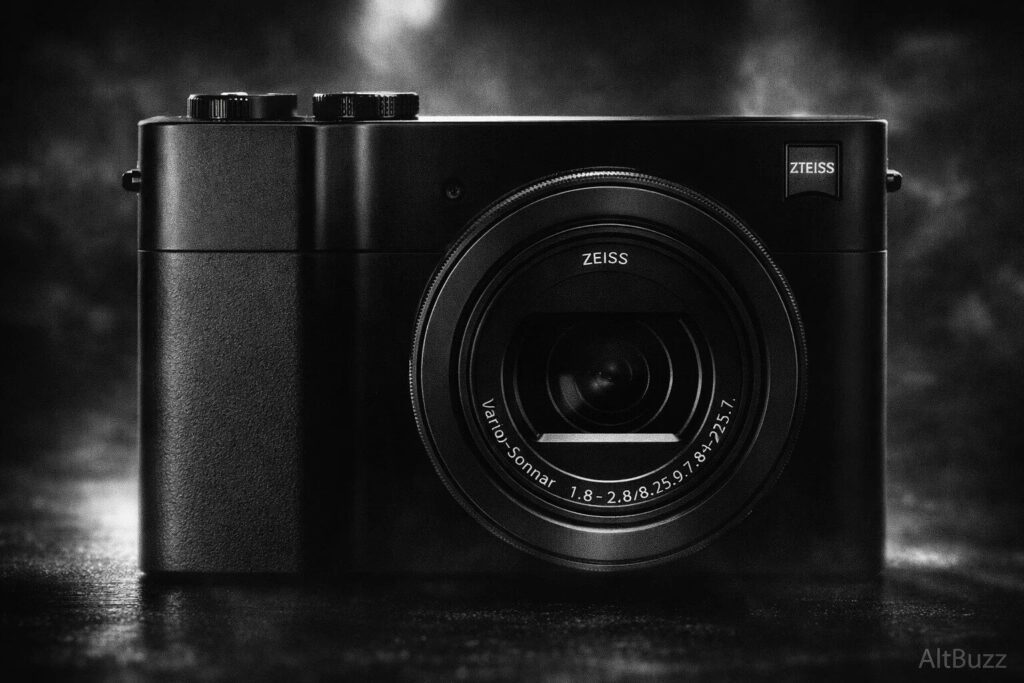
The Zeiss ZX1 features distinctive triangular design language that polarizes opinions immediately. Some photographers love the avant-garde aesthetic while others find it awkward. The camera doesn’t follow conventional design principles seen in traditional cameras. Instead, Zeiss collaborated with Italian design studio Italdesign Giugiaro. This partnership produced something entirely unique in the camera world. The angular, geometric shape creates a futuristic appearance. It looks more like a concept product than a production camera. The bent body design serves functional purposes beyond mere aesthetics. The angle creates a natural handgrip that fits comfortably in the right palm.
Aluminum construction throughout ensures premium feel and robust durability. The body is machined from solid aluminum blocks, not die-cast. This manufacturing approach provides superior strength and rigidity. Build quality reflects Zeiss’s reputation for excellence in optical instruments. Every surface, button, and joint feels precisely engineered. The camera weighs 800 grams (1.76 pounds) body-only with battery. This exceeds many compact alternatives like the Sony RX1R II at 507g. However, it remains lighter than DSLR alternatives. The substantial weight provides reassuring heft that suggests quality. Some photographers appreciate the solid feel while others find it heavy for all-day carry. Dimensions measure 155mm wide, 100mm tall, and 44mm deep at the thickest point. The triangular profile means thickness varies across the body. Despite the unique shape, it fits reasonably well in medium-sized camera bags.
The unique bent body creates an ergonomic handgrip on the right side. The angle naturally positions the shutter button under the index finger. However, the smooth aluminum surface lacks texturing or rubber coating. This makes secure grip challenging, especially with sweaty or wet hands. Photographers often worry about dropping this expensive camera. Adding a wrist strap becomes essential for security. The left side of the body remains completely flat with no protrusions. This asymmetric design looks striking but feels unbalanced initially. After adaptation, most users report comfortable handling. The large rear touchscreen creates a thumb rest of sorts. Still, ergonomics definitely take a backseat to aesthetics here.
The massive 4.34-inch touchscreen dominates the entire rear panel. This represents the largest screen ever mounted on a compact camera. The screen measures 100mm diagonal with 1280×720 pixel resolution. While physically huge, the resolution proves relatively low. Text and fine details appear slightly soft compared to higher-resolution displays. However, the large size makes the built-in Lightroom actually usable. Editing photos on this screen feels closer to tablet editing than traditional camera review. Touch responsiveness proves good with accurate finger tracking. Brightness reaches adequate levels for outdoor shooting but struggles in harsh sunlight. The screen is fixed, not articulating, which limits creative angles. Selfies and high/low angle shooting become awkward. Vloggers cannot see themselves while recording.
Physical controls include only three buttons and two dials – minimal even for a compact camera. The shutter button sits on the top right edge with good placement. One control dial encircles the shutter button for parameter adjustment. A second dial sits on the back near the thumb position. The three physical buttons handle power, playback mode, and a customizable function button. Every other function requires touchscreen interaction through the Android interface. This works smoothly when the camera is at eye level. However, shooting from the hip or at unusual angles becomes difficult. Chimping and reviewing images on the large screen feel natural. Adjusting settings mid-shoot requires thought and attention. The minimalist control layout encourages deliberate, contemplative photography. It discourages rapid shooting and constant setting changes.
Weather sealing is completely absent from the Zeiss ZX1 design. The exposed USB-C port on the side makes weather protection impossible. Additionally, the lens barrel extends when powered on without any sealing. Zeiss advises against using the camera in rain, snow, or dusty conditions. This represents a significant limitation for a $5,400 camera. Many photographers expect weather sealing at this price point. Travel photographers especially miss this protection during unpredictable weather. The beautiful aluminum finish shows fingerprints and smudges easily. Keeping the camera pristine requires frequent cleaning. However, the anodized finish resists scratches reasonably well. Small scuffs and marks develop with use but don’t compromise structural integrity.
The electronic viewfinder measures 0.48 inches diagonally with 2.36 million dots. Magnification reaches 0.7x (0.47x equivalent), which is relatively modest. The EVF provides adequate image preview and composition framing. However, it washes out completely in bright sunlight conditions. Photographers often cannot see the EVF image when shooting in harsh daylight. This forces reliance on the rear screen for composition. The large rear screen works well as a live view display. Eye relief feels comfortable even for eyeglass wearers. The EVF placement on the left side follows Leica and Fujifilm rangefinder tradition. Some photographers prefer centered EVFs but adapt quickly. Overall, the EVF performs acceptably for a camera emphasizing screen-based interaction.
Battery Life and Connectivity
Battery performance varies significantly depending on usage patterns and features utilized. Zeiss rates the battery for approximately 150 shots per charge under CIPA testing standards. However, real-world usage often yields 200-300 shots depending on shooting style. Photographers who review images frequently drain power faster. Similarly, using the built-in Lightroom for editing consumes considerable energy. The large 4.34-inch touchscreen represents the biggest power drain. Its high brightness settings and constant activation deplete the battery quickly. Screen-intensive editing sessions can drain a full battery in 2-3 hours. The Android operating system running in the background also consumes power continuously. Even in standby mode, the battery slowly depletes. Leaving the camera unused for several days results in significant battery loss.
The integrated rechargeable lithium-ion battery isn’t user-replaceable in the field. The battery compartment requires a screwdriver to access, similar to smartphones. This design choice prevents quick battery swaps during shoots. Photographers cannot carry spare batteries for extended shooting sessions. Instead, they must rely on USB-C charging from power banks. This limitation proves frustrating for professional photographers accustomed to swappable batteries. Wedding and event shooters especially miss the ability to hot-swap batteries. The camera becoming a paperweight mid-event creates anxiety. However, travel photographers who already carry power banks adapt easily.
USB-C charging enables power bank compatibility for extended shooting sessions. The USB-C port supports both charging and data transfer simultaneously. Charging from a standard USB-C power adapter takes approximately 2.5-3 hours. Fast charging isn’t supported, so higher-wattage adapters don’t reduce charging time. Power banks enable shooting while charging, though this proves awkward. The cable dangles from the camera side, interfering with handling. Most photographers charge between shooting sessions rather than during. A 20,000mAh power bank can recharge the camera 4-5 times. This extends a shooting trip to 1,000+ images before needing wall power. For travel photography, this setup works acceptably. The inability to use the camera while charging in-camera becomes problematic. Photographers must plan charging around meals, transportation, or downtime.
Wi-Fi and Bluetooth provide wireless connectivity for image transfer and camera control. The Android-based operating system offers more connectivity options than traditional cameras. Wi-Fi connects to smartphones via the Zeiss ZX1 app for iOS and Android. The app allows wireless image transfer, though connection speed varies. Transferring RAW files over Wi-Fi takes considerable time due to file sizes. JPEGs transfer much faster for quick social media sharing. The app also enables basic remote control including shutter release and parameter adjustment. Remote shooting proves useful for group photos and self-portraits. However, the app’s interface feels less polished than Sony or Canon equivalents.
Cloud backup functionality represents one of the camera’s signature features. The ZX1 can automatically back up images to Dropbox, OneDrive, and Flickr. This happens wirelessly whenever the camera connects to Wi-Fi networks. Photographers can shoot all day and return to their hotel for automatic backup. Images upload to cloud storage overnight while the camera charges. This provides automatic off-site backup without computer involvement. For traveling photographers, this feature provides tremendous peace of mind. However, uploading hundreds of RAW files requires significant Wi-Fi bandwidth. Slow hotel Wi-Fi can take hours or fail completely. Many photographers end up uploading edited JPEGs rather than full RAW files.
NAS (Network Attached Storage) backup functionality exists but proves unreliable in practice. The feature should allow direct backup to home network storage devices. However, users report frequent connection failures and incomplete transfers. Firmware updates haven’t fully resolved these issues. Many photographers gave up on NAS backup and stick with cloud services. The Android operating system should theoretically support NAS protocols. In reality, the implementation needs significant improvement. This represents one area where the ambitious feature set exceeds execution.
USB-C data transfer reaches USB 3.2 Gen 1 speeds (5 Gbps theoretical). Real-world transfer speeds reach approximately 300-400 MB/s to modern computers. This enables quick offloading of the 512GB internal storage. Transferring 6,800 RAW files takes 20-30 minutes via USB-C. However, the camera must remain powered on during transfer. Additionally, some computers don’t recognize the camera without specific drivers. Mac computers generally work plug-and-play. Windows machines sometimes require manual driver installation. The Android MTP (Media Transfer Protocol) occasionally causes compatibility issues. Transferring files directly into Lightroom requires specific import procedures. Some photographers prefer removing the SSD, but this requires disassembly. Overall, data transfer works but with occasional frustrations.
Real-World Use Cases
The Zeiss ZX1 excels particularly in travel photography scenarios where its unique workflow shines. The 512GB internal storage eliminates card swapping anxiety during extended trips. Photographers can shoot freely without worrying about running out of storage. Additionally, the built-in Lightroom enables complete photo editing in hotel rooms each evening. This workflow allows travelers to process daily shoots without carrying laptops. After editing, photographers can upload finished images directly to cloud storage or social media. The entire capture-to-publish workflow happens on the camera alone. For travel bloggers and social media influencers, this streamlines content creation dramatically. They can maintain daily posting schedules without lugging editing equipment. However, the limited battery life requires careful power management during all-day shooting.
Street photography benefits significantly from the silent leaf shutter operation. The camera makes virtually no noise when capturing images. This enables discrete shooting in public spaces without drawing attention. The 35mm focal length suits street photography perfectly as a classic reportage focal length. Photographers can work close to subjects while maintaining environmental context. However, the slow autofocus limits spontaneous shooting opportunities. Fast-moving street scenes often require pre-focusing or manual focus techniques. Zone focusing works well with the 35mm lens and f/5.6-f/8 apertures. This technique allows quick shooting without autofocus delays. The camera’s distinctive appearance sometimes attracts more attention than traditional cameras. Some street photographers prefer the anonymous look of black cameras. Still, the silent operation outweighs the visual conspicuousness for many users.
Portrait work produces beautiful results thanks to the excellent 35mm f/2 lens and quality sensor. Environmental portraits showcasing subjects in their surroundings work particularly well. The 35mm focal length provides enough context while keeping subjects prominent. Background separation at f/2 creates pleasing bokeh for subject isolation. Skin tones render naturally with accurate color and smooth gradations. The high resolution allows significant cropping for tighter compositions. However, traditional headshot portraiture feels cramped with the 35mm focal length. Photographers must work very close to subjects for tight framing. This proximity can feel invasive and create uncomfortable subject distance. Additionally, the slow autofocus requires patient subjects willing to wait for confirmation. The face and eye detection helps but doesn’t match modern mirrorless cameras. Studio portraits with controlled lighting and patient subjects work excellently.
Landscape photography suffers somewhat from the fixed 35mm focal length limitation. Wide-angle landscape photography requires much wider focal lengths like 16-24mm. Telephoto compression effects remain completely unavailable. This single focal length restricts compositional options significantly compared to interchangeable lens systems. However, the 35mm focal length works acceptably for environmental landscapes. Scenes incorporating foreground elements with background vistas compose well. The excellent image quality delivers stunning detail for large prints. Dynamic range handles challenging lighting conditions with ease. The lack of in-body stabilization necessitates tripods for long exposures. Fortunately, landscape photographers typically use tripods regardless. The High-Resolution mode (if available) would enhance landscape detail further.
Architectural photography leverages the full-frame sensor quality and excellent lens optical performance. The 35mm focal length works reasonably well for exterior architectural shots. Interior architecture becomes challenging due to insufficient width. Photographers must often back against walls to capture full room compositions. Perspective correction tools in Lightroom help manage converging verticals. The edge-to-edge sharpness produces professional results for real estate photography. However, professionals typically prefer 16-24mm focal lengths for interior work. The fixed focal length again proves limiting for comprehensive architectural documentation.
Documentary work suits the camera’s deliberate workflow and thoughtful composition encouragement. The minimalist interface reduces distraction and focuses attention on subject matter. Documentary photographers who work methodically rather than reactively appreciate this approach. The silent shutter enables discrete documentation in sensitive situations. Hospitals, courtrooms, ceremonies, and quiet events benefit from soundless operation. The built-in editing capability allows field editing for immediate story development. Photojournalists can edit and transmit images from remote locations without laptops. However, fast-breaking news events exceed the camera’s autofocus capabilities. Sports photojournalism remains completely impractical. Feature photography and slower-paced documentary work match perfectly.
Social media content creation aligns ideally with the shoot-edit-share concept that defines the ZX1. Instagram photographers can capture, edit with presets, and upload without computer involvement. The built-in Lightroom offers professional editing tools exceeding smartphone capabilities. Color grading, exposure adjustment, and selective editing create polished final images. The large screen makes editing comfortable unlike tiny camera displays. Influencers traveling light appreciate eliminating laptops from their kit. However, the high cost makes the camera impractical for casual social media users. Professional content creators justify the investment more easily. YouTube thumbnail creation, Instagram posts, and blog photography all work excellently. The workflow efficiency saves significant time during content production schedules.
Blog photography benefits from the comprehensive editing capability and immediate publishing workflow. Food bloggers can shoot, edit, and publish restaurant reviews on location. Travel bloggers maintain daily posting schedules without computer access. Lifestyle bloggers create polished content during busy schedules. The professional image quality exceeds smartphones while maintaining some portability advantages. However, the fixed focal length limits food photography somewhat. Macro photography of close-up food details isn’t possible. Nonetheless, environmental food shots and table scenes work beautifully.
Pros and Cons
Pros
- Exceptional 37.4MP image quality
- Superb Zeiss Distagon 35mm f/2 lens with edge-to-edge sharpness
- Built-in Adobe Lightroom Mobile (basic features free)
- Massive 4.34-inch high-resolution touchscreen
- 512GB internal SSD storage (approx. 6,800 RAW files)
- Silent leaf shutter operation
- Premium aluminum construction
- Unique triangular ergonomic design
- Wi-Fi, Bluetooth, and USB-C connectivity
- Cloud and NAS backup capabilities
- No memory card fumbling
- Fast USB 3.2 data transfer
Cons
- Extremely expensive at $5,400
- Slow contrast-detect autofocus
- Poor performance with moving subjects
- Only 3fps burst shooting
- No in-body image stabilization
- Moderate battery life (200-300 shots)
- No weather sealing whatsoever
- Fixed 35mm lens limits versatility
- Touchscreen interface can be frustrating
- EVF overwhelmed in bright conditions
- High-ISO performance lags competitors
- Screen too small for comfortable Lightroom editing
- Unreliable NAS backup functionality
- Cannot use external SSD for backup via USB-C
Final Verdict
The Zeiss ZX1 represents a bold experiment in camera design that simultaneously impresses and frustrates. This camera polarizes opinions more than almost any other recent release. At $5,400 (reduced from the original $5,995), it costs significantly more than comparable cameras. The Leica Q2 sits at the same $5,995 price point but offers superior autofocus, weather sealing, and traditional handling. The Sony RX1R II costs just $3,298 while providing 42MP resolution and faster autofocus. Even the Fujifilm X100V delivers excellent image quality at only $1,399 with comparable workflow limitations. From a pure specifications perspective, the ZX1 struggles to justify its premium pricing. The contrast-detect autofocus feels outdated by 2020 standards. The modest 3fps burst speed lags far behind $1,000 cameras. Battery life that barely reaches 200 shots creates constant range anxiety.
Image quality nearly matches cameras costing half as much when examined purely on sensor performance. The 37.4MP full-frame sensor produces excellent files with strong dynamic range. However, Sony cameras with similar sensors cost $1,500-$2,000 less. The Zeiss 35mm f/2 Distagon lens delivers outstanding optical performance. This lens alone might justify $1,500-$2,000 of the camera’s cost. The edge-to-edge sharpness, minimal distortion, and beautiful rendering create stunning images. Still, purchasing a $2,000 lens and $2,000 camera body separately offers more versatility. The fixed lens means photographers cannot adapt to different focal length needs. This single limitation eliminates the camera from consideration for many buyers.
The workflow advantages represent the camera’s primary unique selling proposition. Built-in Adobe Lightroom Mobile changes photography workflow fundamentally for certain users. Travel photographers can edit professionally without carrying laptops on trips. This alone saves significant weight and reduces equipment anxiety. The large 4.34-inch screen makes editing surprisingly comfortable compared to traditional cameras. However, the screen’s 1280×720 resolution limits fine detail work. Color grading and subtle adjustments work well, but critical sharpening requires larger displays. Additionally, Lightroom Mobile’s feature set doesn’t match the desktop version completely. Advanced retouching, complex masking, and certain tools remain desktop-exclusive. Photographers expecting full Lightroom capability may feel disappointed.
Value assessment proves extremely difficult and highly individual. For specific photographers with specific needs, the ZX1 delivers unique value. Travel photographers who previously carried cameras and laptops benefit tremendously. The weight savings and workflow simplification justify the cost for some. Social media influencers maintaining daily content schedules also find value. The shoot-edit-publish workflow happens entirely on one device. Documentary photographers working in remote locations appreciate the self-contained system. However, for the vast majority of photographers, better values exist elsewhere. The Sony a7R IV offers superior specs at similar pricing. The Leica Q2 provides comparable experience with better autofocus and weather sealing. The Fujifilm X100V delivers 80% of the capability at 25% of the cost.
The camera’s greatest strength is its integration of professional editing software. This distinguishes it from every competitor on the market. The 512GB internal storage provides worry-free shooting for extended periods. Approximately 6,800 RAW files fit in internal storage before offloading becomes necessary. For photographers who shoot moderately, this represents weeks or months of work. The cloud backup features provide automatic off-site protection. Images upload to Dropbox, OneDrive, or Flickr automatically over Wi-Fi. This creates redundant backup without manual intervention. Additionally, the silent leaf shutter enables discrete shooting impossible with mechanical shutters. These unique features create value that specifications alone cannot capture.
However, compromises abound throughout the camera’s design and implementation. The slow autofocus frustrates anyone accustomed to modern mirrorless cameras. Missed focus due to hunting creates lost moment anxiety. The 3fps burst speed feels glacially slow for contemporary cameras. Even smartphones often shoot faster continuous sequences. Battery life barely suffices for half-day shooting sessions. Wedding photographers, event shooters, and all-day documentarians constantly worry about power. The lack of weather sealing eliminates the camera from consideration for outdoor photography. Adventure photographers, landscape specialists, and nature shooters require weather protection. The fixed 35mm focal length, while classic, limits versatility dramatically. Wildlife, sports, and telephoto portrait photography become completely impossible.
Who Should Buy: The Zeiss ZX1 suits very specific photographer profiles. Travel photographers who previously carried cameras and laptops benefit most significantly. The integrated editing workflow justifies the cost through time and weight savings. Street photographers comfortable with 35mm focal length appreciate the silent operation. Manual focus techniques and patience overcome autofocus limitations. Content creators maintaining social media schedules find efficiency in the shoot-edit-share workflow. Zeiss enthusiasts collecting the brand’s first camera body want this historical piece. Photographers with existing camera systems seeking a lightweight travel option add useful capability. Lifestyle photographers who value workflow over specifications embrace the integrated approach. Documentary photographers working deliberately rather than reactively match the camera’s pace. Finally, photographers with sufficient budget to overlook cost-value ratios find pleasure in unique tools.
Who Should Avoid: Professional photographers needing reliability across varying conditions should skip this camera. The autofocus limitations, battery life, and lack of weather sealing create too many failure points. Action and sports shooters requiring fast autofocus find the contrast-detect system completely inadequate. Wedding and event photographers cannot risk the battery life or slow burst speeds. Videographers wanting professional features need much better stabilization and codec options. Landscape photographers requiring focal length variety miss ultra-wide and telephoto perspectives. Photographers shooting in adverse weather need comprehensive weather sealing. Anyone expecting DSLR-style handling finds the touchscreen-centric interface frustrating. Budget-conscious buyers find superior value in cameras costing $2,000-$3,000 less. Photographers wanting interchangeable lenses need traditional mirrorless systems. Finally, those seeking cutting-edge autofocus and performance specifications choose Sony, Canon, or Nikon instead.
The Zeiss ZX1 succeeds as a concept camera showcasing future possibilities in photography workflows. The integration of professional editing software represents genuinely innovative thinking. Zeiss proved that shoot-edit-share workflows can work in serious cameras. Unfortunately, execution falls short of the ambitious $5,400 price point in several critical areas. The outdated autofocus technology compromises the experience significantly. Better battery life would transform usability fundamentally. Weather sealing would expand use cases considerably. At $2,500-$3,000, this camera would represent compelling value despite limitations. At current pricing, the Leica Q2 offers superior traditional camera performance. The Sony a7R III or a7R IV provide better specifications for similar or less money. The Fujifilm X100V delivers 75-80% of the experience at $1,399. Consequently, the ZX1 remains a niche product for specific users rather than broadly recommendable.
Read More from AltBuzz
Read more from AltBuzz for camera reviews, detailed specs, and expert insights. AltBuzz delivers trusted and easy-to-understand photography content. Discover comprehensive gear reviews, hands-on testing, and expert recommendations to help you choose the perfect camera equipment for your creative vision.
Subscribe AltBuzz YouTube Channel
Stay updated with camera reviews and comparisons. AltBuzz shares hands-on camera content regularly. Watch detailed real-world tests, autofocus demonstrations, and side-by-side comparisons featuring the latest cameras and lenses. Subscribe here: 👉 Subscribe Altbuzz