
Nikon Z fc vs Fujifilm X-T30 II: Full Comparison Guide
Introduction
The Nikon Z fc and Fujifilm X-T30 II bring retro styling to modern mirrorless technology. Both cameras are already released and available in stores worldwide. This comparison helps photographers choose between these two vintage-inspired options. Enthusiasts seeking classic design with contemporary features will find this guide useful.
Retro cameras appeal to photographers who value aesthetics alongside performance. The Nikon Z fc celebrates Nikon’s FM2 heritage from the 1980s. Fujifilm continues its tradition of rangefinder-inspired designs. Both manufacturers understand that cameras serve as creative tools and fashion statements.
This guide examines every aspect from image quality to ergonomics. We’ll explore specifications, real-world performance, and value propositions. By the end, you’ll know which camera suits your needs better.
Release Date Overview
Nikon Z fc Release Date
Nikon released the Z fc in July 2021. The camera entered the market with immediate appeal to retro enthusiasts. Initial demand exceeded supply significantly. Production challenges delayed some early orders. By late 2021, availability stabilized across most regions.
The Z fc represented Nikon’s first retro-styled mirrorless camera. Market response exceeded company expectations. Photography communities praised the design execution. The camera found audiences beyond typical Nikon users.
Fujifilm X-T30 II Release Date
Fujifilm launched the X-T30 II in November 2021. This update refined the original X-T30 formula. Changes focused on software and usability improvements. Hardware remained largely identical to the predecessor.
Fujifilm positioned this camera as an enthusiast-level option. The company maintained competitive pricing despite upgrades. Global availability proved more consistent than some competitors. The X-T30 II continues selling steadily today.
Specification Comparison Table
| Feature | Nikon Z fc | Fujifilm X-T30 II |
|---|---|---|
| Sensor Type | APS-C CMOS | APS-C X-Trans CMOS 4 |
| Resolution | 20.9 MP | 26.1 MP |
| Processor | EXPEED 6 | X-Processor 4 |
| ISO Range | 100-51200 | 160-12800 (ext. 80-51200) |
| Autofocus System | 209-point hybrid AF | 2.16M-point phase detection |
| Stabilization | No IBIS | No IBIS |
| Video Recording | 4K UHD at 30p | 4K DCI at 30p |
| EVF | 2.36M-dot OLED | 2.36M-dot OLED |
| LCD Screen | 3.0″ vari-angle touchscreen | 3.0″ tilting touchscreen |
| Burst Shooting | 11 fps mechanical | 8 fps mechanical, 30 fps electronic |
| Battery | EN-EL25 (260-330 shots) | NP-W126S (380 shots) |
| Storage | Single SD UHS-I | Single SD UHS-I |
| Connectivity | Wi-Fi, Bluetooth | Wi-Fi, Bluetooth |
| Weight | 445g (body only) | 378g (body only) |
| Price at Launch | $959 (body only) | $899 (body only) |
Sensor and Image Quality: Nikon Z fc vs Fujifilm X-T30 II
Both cameras use APS-C sensors. However, the Fujifilm X-T30 II packs more resolution at 26.1 megapixels. The Nikon Z fc offers 20.9 megapixels. Fujifilm’s X-Trans sensor delivers unique color science that many photographers love. Nikon provides more traditional Bayer sensor output.
The resolution difference matters for specific uses. Large prints benefit from Fujifilm’s extra megapixels. Cropping flexibility increases with higher resolution. However, 20.9 megapixels satisfies most photography needs. Even professional work rarely demands more than this.
Fujifilm’s X-Trans color filter array eliminates the need for optical low-pass filters. This design maximizes sharpness and detail rendering. The pattern reduces moiré in most situations. Nikon’s Bayer array uses traditional RGB arrangement. Both approaches deliver excellent results.
Dynamic range performs excellently on both cameras. The X-T30 II edges slightly ahead in high-ISO performance. Fujifilm’s film simulations give instant character to images. Classic Chrome, Velvia, and Provia presets emulate legendary film stocks. Nikon’s processing produces clean, neutral files that offer flexibility in editing.
Color accuracy differs between systems. Nikon renders skin tones naturally with minimal adjustment. Fujifilm’s colors appear more vibrant and saturated by default. Portrait photographers appreciate Nikon’s approach. Landscape shooters often prefer Fujifilm’s punch.
Low-light shooting works well on both systems. The Nikon Z fc reaches ISO 51200 natively. Fujifilm extends to the same level but starts at ISO 160. Real-world noise control favors the X-T30 II marginally. Both cameras satisfy most shooting scenarios. Street photography benefits from clean high-ISO performance.
File formats include RAW and JPEG on both cameras. Nikon produces 14-bit RAW files. Fujifilm offers 14-bit compressed or uncompressed RAW. JPEG quality impresses from both manufacturers. In-camera processing reduces post-production time significantly.
Autofocus Performance Comparison
The Fujifilm X-T30 II dominates autofocus capabilities. Its 2.16 million phase-detection points cover nearly the entire frame. Face and eye detection work reliably for both humans and animals. Tracking performance impresses in various lighting conditions. The system locks onto subjects quickly and confidently.
Nikon’s 209-point hybrid system performs adequately but lags behind. Eye detection works for people but lacks animal recognition. The Z fc handles static subjects well. Moving subjects challenge the system occasionally. Low-light focusing reaches -4 EV. This capability helps in dim environments.
Subject tracking differs substantially between cameras. Fujifilm maintains focus through complex movements. The algorithm predicts subject motion effectively. Nikon’s tracking works for slower-moving subjects. Fast action stresses the system’s limitations. Sports and wildlife photography favor Fujifilm significantly.
Autofocus customization options vary between systems. Fujifilm provides extensive AF settings in menus. Users can fine-tune sensitivity and tracking behavior. Nikon offers simpler customization with fewer parameters. Beginners appreciate Nikon’s streamlined approach. Advanced users prefer Fujifilm’s control.
Face and eye detection accuracy matters for portraits. Fujifilm detects eyes even when subjects turn away. The system handles multiple faces in the frame. Nikon’s detection works well for centered subjects. Performance drops with off-center compositions. Real-world portrait work shows these differences clearly.
Video autofocus performance impacts hybrid shooters. Fujifilm tracks subjects smoothly during recording. Face detection maintains focus on moving presenters. Nikon’s video AF works but shows more hunting. Vloggers notice the difference immediately. Content creators benefit from Fujifilm’s refinement.
Real-world usability favors the Fujifilm system. Video shooters appreciate the X-T30 II’s tracking reliability. The Nikon Z fc serves portrait and street photographers better than action shooters. Each system has clear strengths depending on subject matter.
Video Capabilities Comparison
The Nikon Z fc records 4K UHD at 30fps without cropping. Full HD goes up to 120fps for slow motion. The camera lacks professional video features. No flat picture profiles come standard. This limitation restricts color grading flexibility. Overheating concerns emerge during extended recording. Summer outdoor shoots prove challenging.
Video quality looks good for casual content creation. Sharpness and detail satisfy social media requirements. YouTube creators find the specs adequate. However, professional video work demands more capabilities. The Z fc positions itself as photography-first camera.
Fujifilm X-T30 II shoots 4K DCI at 30fps with a 1.1x crop. F-Log recording enables greater post-production flexibility. Film simulations work in video mode. The camera handles longer recording sessions better. Thermal management surpasses Nikon’s implementation. However, both cameras lack in-body stabilization.
Recording limits exist on both systems. The Nikon Z fc stops at 30 minutes per clip. Fujifilm enforces similar restrictions. External recorders extend capabilities for serious videographers. Most casual users never hit these limits. Wedding and event shooters notice the constraints.
Video autofocus performance differs significantly. Fujifilm maintains smooth focus transitions. The camera avoids sudden hunting or snapping. Nikon’s AF works but shows more abrupt changes. This behavior distracts viewers in final footage. Manual focus becomes necessary for critical shots.
Audio capabilities matter for video production. Both cameras feature 3.5mm microphone inputs. External recorders improve audio quality substantially. Headphone monitoring requires adapters on both models. Professional audio demands external equipment regardless.
Content creators lean toward the Fujifilm X-T30 II. The Nikon Z fc suits casual video users. Neither camera competes with dedicated video-focused models. Hybrid shooters find more tools in the Fujifilm system. Documentary work benefits from F-Log recording. Social media content looks fine from both cameras.
Design and Build Quality
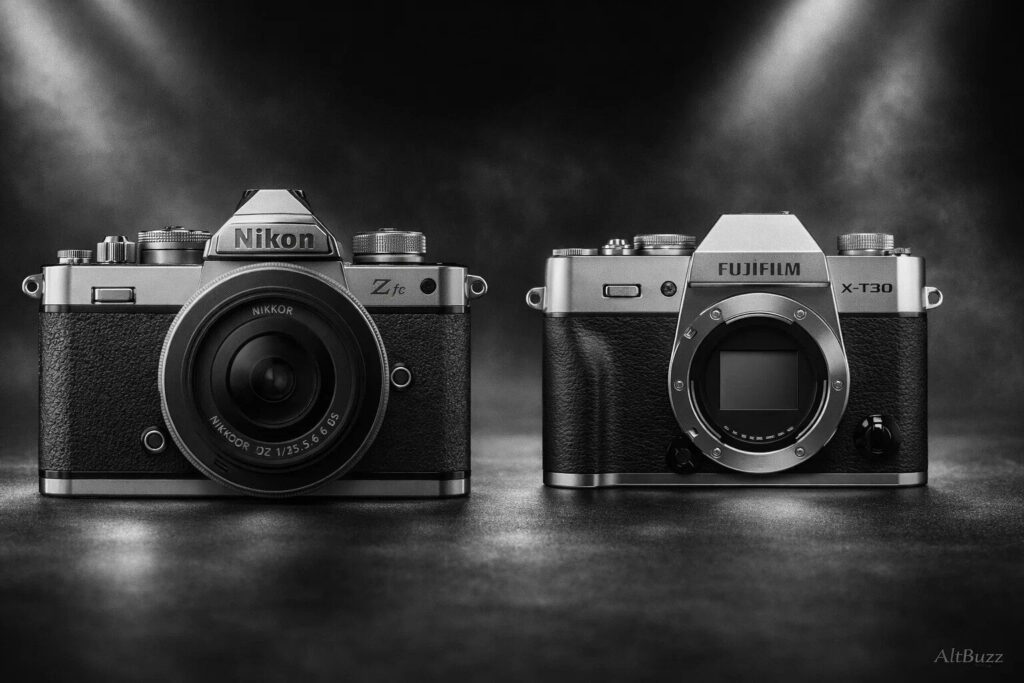
The Nikon Z fc celebrates classic FM2 styling perfectly. Dedicated dials for shutter speed, ISO, and exposure compensation sit on top. The body feels substantial and premium. Metal construction conveys quality. Weather sealing remains absent. Rain and dust pose risks to internal components.
Physical controls provide tactile satisfaction. Shutter speed dials click precisely into position. ISO dial operation requires lifting the outer ring. Exposure compensation adjusts in 1/3 stop increments. The mechanical feel enhances the shooting experience. Photographers appreciate hands-on control without menu diving.
The vari-angle screen helps with creative angles. Low and high perspectives become accessible easily. Vloggers benefit from the flipping screen. However, the mechanism adds bulk to the body. Some photographers prefer fixed screens for durability. The touchscreen interface responds accurately to inputs.
Fujifilm X-T30 II maintains the compact rangefinder-inspired design. Physical dials provide tactile control over key settings. The grip is smaller but adequate for the camera’s weight. No weather sealing exists on this model. Professional work in harsh conditions requires protection. The tilting screen works for most situations but limits flexibility.
Build quality feels solid despite plastic construction. Magnesium alloy reinforces the chassis internally. The camera withstands normal photography demands. However, professional abuse testing shows limitations. The X-T30 II targets enthusiasts rather than working pros.
Button layout differs significantly between models. Nikon places controls in familiar DSLR positions. Fujifilm adopts a more minimalist approach. Rear controls cluster logically for thumb operation. Both systems require adaptation periods for new users. Muscle memory develops after extended use.
Ergonomics favor photographers with different hand sizes. The Z fc feels better for larger hands. The substantial grip accommodates gloves comfortably. The X-T30 II disappears in smaller bags easily. Weight distribution affects handling with different lenses. Large telephoto lenses unbalance the compact X-T30 II.
Viewfinder quality matches specifications on paper. Both EVF displays show 2.36 million dots. Refresh rates reach 60fps for smooth tracking. Magnification differs slightly between models. The Nikon provides 1.02x magnification. Fujifilm offers 0.62x magnification. These numbers account for sensor size differences.
Handling and Ergonomics in Real-World Use
Street photography demands discreet, fast-handling cameras. The Nikon Z fc attracts attention with retro styling. Paradoxically, the vintage look disarms subjects. People react less defensively than to modern DSLRs. The compact size enables quick framing. Manual dials allow silent setting adjustments.
The Fujifilm X-T30 II blends into environments easily. Small size reduces intimidation factor. Street shooters value this discretion highly. Quick autofocus captures fleeting moments. The tilting screen enables waist-level composition. This technique keeps the camera below eye level.
Portrait photography benefits from different aspects. Nikon’s eye detection works reliably for people. The vari-angle screen helps with unusual angles. Studio shooters appreciate the clean files. Fujifilm’s film simulations please portrait clients immediately. The extra resolution aids detailed beauty work.
Travel photography prioritizes size and weight. The Fujifilm X-T30 II weighs just 378 grams. Long walking days feel less tiring. The Nikon Z fc adds 67 grams. This difference compounds over extended trips. Compact bags accommodate the X-T30 II more easily.
Landscape photography demands different capabilities. Both cameras lack weather sealing. Mountain conditions require protective measures. Tripod use remains essential for optimal quality. The Fujifilm’s extra resolution helps large prints. Nikon’s dynamic range captures challenging lighting.
Wedding photography presents unique challenges. No weather sealing limits backup camera use. Single SD card slots create anxiety. Professional wedding work demands redundancy. These cameras serve as secondary or casual bodies. Primary shooters need more robust options.
Battery Life and Power Management: Nikon Z fc vs Fujifilm X-T30 II
Battery performance gives Fujifilm a clear advantage. The X-T30 II delivers approximately 380 shots per charge. Nikon’s Z fc manages 260-330 shots depending on usage. Both ratings assume normal shooting patterns. Video recording drains power significantly faster. Cold weather reduces capacity on both systems.
The Nikon EN-EL25 battery appears in several Nikon cameras. This compatibility aids users with multiple bodies. However, the capacity limits all-day shooting. Wedding photographers carry multiple spares routinely. Travel shooters plan charging opportunities carefully.
Fujifilm’s NP-W126S battery serves multiple X-series cameras. The ecosystem benefits reduce costs for multi-camera users. Marathon shooting sessions require spare batteries. However, the X-T30 II lasts longer between charges. This reliability reduces anxiety during critical shoots.
Both cameras charge via USB for convenience. Power bank charging helps during travel. Portable batteries extend field time significantly. International adapters become unnecessary. USB-C would offer faster charging. Both cameras use micro-USB unfortunately.
Power-saving modes extend battery life. Screen brightness adjustments reduce consumption. EVF auto-shutoff helps conserve power. Sleep modes activate after inactivity periods. These features maximize shots per charge. Photographers customize settings based on needs.
Battery grips remain unavailable for these models. Extended shooting requires pocket management of spares. Some photographers prefer this simplicity. Others miss the convenience of battery grips. Vertical shooting ergonomics suffer without grips.
Workflow benefits remain similar for most users. Neither camera offers dual card slots. Backup options require post-shoot transfers. Cloud uploads need reliable internet connections. Professional needs exceed both cameras’ connectivity features. Enthusiasts find single slots adequate usually.
Lens Ecosystem and System Considerations
Nikon’s Z-mount system launched in 2018. Native lens selection grows steadily. The lineup covers essential focal lengths comprehensively. Professional options include fast primes and zooms. Budget choices remain limited compared to F-mount. FTZ adapter enables F-mount lens compatibility.
Third-party manufacturers support Z-mount increasingly. Sigma, Tamron, and Viltrox produce Z-mount lenses. Options expand monthly with new announcements. Prices generally undercut Nikon’s offerings. Quality varies across manufacturers and models.
Fujifilm’s X-mount matured over many years. The lens catalog includes over 40 native options. Choices span ultra-wide to super-telephoto. Film simulation compatibility makes every lens attractive. Third-party support from Sigma and Viltrox strengthens choices.
Affordable lenses favor Fujifilm’s system. Excellent primes cost $400-600 regularly. Nikon’s Z-mount primes start higher typically. Budget-conscious photographers appreciate Fujifilm’s value. Kit lenses perform well on both systems.
Specialty lenses differ between systems. Fujifilm offers unique focal lengths like 33mm f/1.4. Nikon provides traditional focal length options. Macro capabilities exist on both systems. Wildlife shooters find telephoto choices on each platform.
Lens size and weight matter for travel. Fujifilm’s lenses generally remain compact. The APS-C sensor enables smaller designs. Nikon’s Z-mount benefits from short flange distance. However, full-frame heritage influences Z-mount sizing. System weight comparisons favor Fujifilm overall.
Future-proofing concerns affect purchasing decisions. Nikon’s full-frame Z cameras share the mount. Upgrading paths remain clear and logical. Fujifilm’s APS-C commitment creates system consistency. Both manufacturers demonstrate long-term platform support.
Price and Value: Nikon Z fc vs Fujifilm X-T30 II
The Nikon Z fc launched at $959 for the body. Current market prices hover around $900-$950. Kit lens bundles add value for new shooters. The 16-50mm kit lens covers basic needs. The retro design commands a premium over technical specifications. Collectors appreciate the aesthetic investment.
Special editions appeared after launch. Heritage editions feature unique colorways. Limited production runs attract enthusiasts. Resale values remain strong for popular editions. Standard black versions depreciate normally.
Fujifilm X-T30 II debuted at $899. Prices remain similar in the current market. Kit options include 18-55mm stabilized zoom. This lens delivers excellent optical performance. The value proposition strengthens with kit purchases. Body-only pricing suits existing Fujifilm users.
Used market availability differs between cameras. Fujifilm’s longer market presence creates more listings. The X-T30 (first version) offers similar performance cheaper. Nikon Z fc listings remain scarce currently. Patient buyers find occasional deals.
Fujifilm’s lens ecosystem offers more affordable options. Excellent primes cost less than Nikon equivalents. Building a complete system costs less typically. Third-party support strengthens the value proposition. Budget constraints favor Fujifilm generally.
Nikon’s adapter strategy adds value. Existing F-mount lens owners save money. The FTZ adapter costs approximately $250. Legacy lenses gain new life on Z-mount. This compatibility benefits long-time Nikon users.
Long-term value considerations vary by user. Enthusiasts prioritizing image quality favor the X-T30 II. Design-focused photographers accept the Z fc premium. Both cameras deliver excellent results for their class. Budget considerations make them competitive choices. System commitment outweighs body price ultimately.
Software and User Interface
Menu systems differ philosophically between cameras. Nikon’s interface resembles DSLR conventions. Tabbed menus organize functions logically. The learning curve remains gentle for DSLR users. New photographers require time to navigate options. Customization capabilities satisfy most needs.
Fujifilm’s menu system emphasizes quick access. Frequently used settings appear first. The Q menu provides fast adjustments. Customization exceeds Nikon’s offerings significantly. Power users appreciate extensive options. Beginners may feel overwhelmed initially.
Firmware updates improve both cameras post-launch. Nikon addresses bugs and adds features. Fujifilm enhances autofocus performance regularly. These updates extend camera lifespans. Both manufacturers support products well.
Touchscreen implementation varies between models. Nikon’s vari-angle screen supports full touch control. Menu navigation works via touch inputs. Focus point selection happens with screen taps. Fujifilm’s tilting screen offers similar functionality. Both systems integrate touch and physical controls.
Custom button assignments provide personalization. Nikon allows function reassignment to buttons. The flexibility suits individual workflows. Fujifilm provides even more customization options. My Menu settings streamline repetitive tasks. Both cameras remember settings between sessions.
Special Features and Creative Modes
Film simulations define Fujifilm’s creative approach. Classic Chrome mimics documentary film stock. Velvia intensifies landscape colors dramatically. Acros delivers black and white contrast. These presets inspire in-camera creativity. Post-processing time decreases significantly. Photographers develop personal favorite simulations.
Nikon’s Creative Picture Controls offer similar options. Portrait mode smooths skin tones automatically. Landscape mode enhances blues and greens. Flat profile aids video color grading. These options help beginners learn processing. Advanced users typically shoot standard profiles.
Multiple exposure capabilities exist on both cameras. The Nikon Z fc blends up to 10 exposures. Creative compositions happen in-camera. Fujifilm allows similar multiple exposure shooting. Results vary based on subject matter. Experimentation reveals creative possibilities.
Interval timer photography serves time-lapse creators. Both cameras capture image sequences automatically. Nikon’s interface simplifies interval setup. Fujifilm provides similar functionality with more parameters. Post-production assembles frames into videos. Cloud movement and sunset sequences look stunning.
Panorama modes assist landscape photographers. Fujifilm stitches panoramas in-camera automatically. The feature works surprisingly well. Nikon requires post-processing panorama assembly. Third-party software handles this easily. In-camera convenience favors Fujifilm here.
Which Camera Should You Choose?
Choose the Nikon Z fc if:
- Retro design matters most to you
- You prefer Nikon’s color science and lens ecosystem
- Vari-angle screen flexibility helps your shooting style
- You shoot primarily portraits and street photography
- You own F-mount lenses and want adapter compatibility
- You value mechanical dials and tactile controls
- You’re investing in Nikon’s growing Z-mount system
- Aesthetic appeal influences your purchasing decision
Choose the Fujifilm X-T30 II if:
- Autofocus performance drives your decision
- Higher resolution benefits your workflow
- Film simulations appeal to your creative process
- You need better video features and battery life
- You want extensive third-party lens options
- You prefer a more compact, lightweight system
- You shoot action, wildlife, or fast-moving subjects
- You value technical specifications over design
Both cameras excel in different areas. The Nikon Z fc wins on style and handling. The Fujifilm X-T30 II delivers superior technical performance. Your photography needs determine the better choice. Consider lens ecosystem when deciding. Try both cameras in stores if possible. Personal preference matters significantly here.
Neither camera disappoints for its target audience. Enthusiast photographers find satisfaction with both. Professional photographers use them as secondary bodies. Travel photographers appreciate the compact sizes. Street photographers value the discrete designs.
Read More from AltBuzz
Read more from AltBuzz for camera reviews, in-depth comparisons, and detailed specs. AltBuzz delivers clear and trusted camera insights. Discover comprehensive guides that help you make informed decisions. Photography enthusiasts rely on our honest assessments. We test cameras thoroughly before publishing reviews. Our team includes working professionals with decades of experience. Trust AltBuzz for unbiased camera information.
Subscribe AltBuzz YouTube Channel
Stay updated with camera comparisons and hands-on reviews. AltBuzz covers the latest photography gear. Subscribe here: 👉 Subscribe AltBuzz