
Sony FX32 Rumors: Expected Specs, Features and Release Date
The Sony FX32 is the camera that thousands of independent filmmakers have been quietly wishing for. It is still unreleased. Sony has not officially confirmed its existence. However, the rumor community has been buzzing with leaks and informed speculation that together point to a new APS-C Cinema Line body designed to fill a very real and very frustrating gap in Sony’s product lineup.
Right now, Sony’s Cinema Line tells a mostly complete story. At the entry point sits the FX30, an APS-C camera launched in late 2022 that brought Cinema Line color science to a more accessible price tier. Above it sits the full-frame FX3, the compact cinema powerhouse that became an industry standard for run-and-gun filmmaking. And above that sits the FX6 and FX9 for broadcast and high-end production work.
But here is where things get genuinely interesting. Between the FX30 and the FX3, there is a noticeable and commercially meaningful gap. The FX30 costs around $1,500. The FX3 costs around $3,800. That is more than a $2,000 jump between two adjacent Cinema Line cameras. For professional filmmakers who have outgrown the FX30 but cannot justify a full-frame investment, or who simply prefer APS-C for its depth-of-field characteristics and lens compatibility, that gap is deeply frustrating. The Sony FX32 is widely expected to solve this exact problem.
This article covers everything the rumor community currently knows about the Sony FX32. All information presented here is based entirely on leaks, community speculation, and realistic assumptions drawn from Sony’s existing product trends, industry patterns, and competitive dynamics. Sony has not confirmed any of these details. Read this as carefully considered community analysis, not as official product information from Sony.
Expected Release Date and Market Position
Timing is everything in the camera industry. A camera announced too early loses momentum. A camera announced too late loses market share. Sony has generally been strategic about both, and the Sony FX32 rumor timeline has been narrowing with each passing month.
Based on Sony’s established product refresh cycles and the competitive pressure steadily building in the compact APS-C cinema space, most reliable sources currently place the Sony FX32 arrival in the late 2026 to early 2027 window. Some more optimistic community members hope for a mid-2026 surprise announcement, but the consensus has settled on the later end of that range.
Sony follows a relatively consistent rhythm with its Cinema Line cameras. The FX30 launched in September 2022. The FX3 came out in February 2021. Based on these patterns, the typical cadence for a follow-up APS-C Cinema body suggests late 2026 is entirely plausible. The fact that Sony launched the FX2 in mid-2025 as a 33MP full-frame Cinema Line body also provides a useful reference point. If Sony is refreshing and expanding the Cinema Line systematically, the FX32 would logically follow the FX2 in the product roadmap.
The competitive pressure argument also supports this timeline. Canon’s Cinema EOS lineup, Blackmagic’s Pocket Cinema Camera 6K Pro, and Fujifilm’s X-H2S have all made the APS-C cinema segment far more competitive than it was when the FX30 launched in 2022. Canon’s C70 in particular has won over a large number of shooters who wanted Cinema Line-level features from an APS-C body. Sony simply cannot leave this market uncontested much longer.
The expected price point for the Sony FX32 is the most discussed aspect of the camera in community forums. Most speculation settles around $1,999 to $2,499. This positioning would create a genuinely compelling middle option for buyers who find the FX30 limiting but see the FX3 as unnecessarily expensive given their APS-C lens collections. It would also give Sony a strong and direct answer to the Canon C70, the Blackmagic Pocket 6K Pro, and the Fujifilm X-H2S at a price point that many working professionals can actually budget for.
The target audience for the Sony FX32 is specific, well-defined, and currently underserved by Sony’s lineup. Solo documentary filmmakers who need Cinema Line image quality in a compact and affordable package represent the largest single group. Beyond them, corporate video producers, branded content creators, event filmmakers, news videographers, and online video journalists all fit naturally into the FX32’s expected market position. The compact form factor and APS-C sensor also make it appealing to travel filmmakers who need professional results from gear that fits inside an airline carry-on bag without drama.
Rumored Specifications Table
| Feature | Rumored Details |
|---|---|
| Sensor Type | APS-C Exmor R BSI CMOS (partially stacked, new generation) |
| Resolution | Approximately 26MP |
| Processor | BIONZ XR with dedicated AI acceleration chip |
| ISO Range | 100 to 102400 (expandable to 204800) |
| Autofocus System | AI-based Phase Detection with subject, eye, and animal tracking |
| Stabilization | 5-axis IBIS with Active Mode electronic stabilization |
| Video Recording | 6K oversampled 4K/60p, 4K/120p APS-C crop, 1080p/240p |
| EVF | 3.69M-dot OLED electronic viewfinder |
| LCD Screen | 3-inch fully articulating touchscreen |
| Burst Shooting | Up to 20fps electronic, 10fps mechanical |
| Battery | NP-FZ100 with improved thermal efficiency |
| Storage | Dual CFexpress Type A and SD UHS-II card slots |
| Connectivity | USB-C 3.2 Gen 2, Wi-Fi 6, Bluetooth 5.2, full-size HDMI |
| Weight | Approximately 580g body only |
| Expected Price | Around $1,999 to $2,499 |
Sensor and Image Quality (Rumored)
The sensor inside any cinema camera is its foundation. Everything else, the processor, the autofocus, the body design, exists to support what the sensor captures. Get the sensor right, and the rest of the camera has a chance to be great. Get it wrong, and no amount of clever engineering elsewhere can save the footage.
Leaks suggest that Sony is building the FX32 around a new 26MP APS-C Exmor R BSI CMOS sensor with a partially stacked architecture. To understand why this matters, it helps to understand what partially stacked actually means in real-world use.
A conventional BSI sensor, meaning back-side illuminated, places the readout circuitry behind the imaging layer. This positions the light-gathering surface of each pixel closest to the incoming light, which improves efficiency and reduces noise. Sony has used BSI technology in its APS-C cameras for years, and it is the architecture behind the sensor in the current FX30 and A6700.
A partially stacked design goes meaningfully further. It separates a dedicated layer of memory and readout circuitry beneath the BSI layer, connecting them through microscopic copper interconnects. This additional layer accelerates how quickly the sensor can read data from each pixel row and transfer it to the image processor. The speed increase is not marginal. It can be several times faster than conventional BSI readout.
Why does readout speed matter so much for filmmakers? Rolling shutter. This is the distortion that appears as a wobbling, tilting, or jello-like effect when the camera pans quickly, when the subject moves fast through the frame, or when shooting anything with a repetitive flash source like LED stage lighting. Rolling shutter happens because sensors read pixel rows sequentially from top to bottom. The top row and the bottom row are not captured at exactly the same instant. The faster the readout, the shorter the time difference between those rows, and the less visible the distortion becomes in the final image.
Rolling shutter in the FX30, while acceptable for many shooting situations, is a known limitation of its conventional sensor architecture. The Sony FX32 with a partially stacked sensor is expected to reduce rolling shutter substantially, producing footage that looks more like a global shutter camera in fast-motion scenarios. For handheld documentary work and action sequences, this would be a genuine quality-of-life improvement.
The 26MP resolution also provides meaningful headroom for video oversampling. When the camera captures 6K of data and downsamples to 4K, the resulting image has more detail, smoother tonal gradation, and less moiré than footage captured natively at 4K from a lower-resolution sensor. This oversampling approach is exactly how professional cinema cameras achieve their distinctly sharp yet organic visual quality.
Dual-layer transistor pixel technology is also expected in the new sensor. Sony introduced this in recent Alpha cameras with excellent results. The technology improves signal separation at the pixel level, which directly increases dynamic range and reduces noise at higher ISO values. For a Cinema Line camera used in documentary and event contexts where lighting is often mixed, uncontrolled, or simply inadequate, this additional dynamic range latitude is not just nice to have. It determines whether a shot is usable or unusable.
Sony’s S-Log3 and S-Cinetone color profiles are expected to be fully present on the FX32. S-Log3 is the professional choice for maximum grading latitude, capturing a wide logarithmic exposure curve that preserves detail in both extreme shadows and extreme highlights. S-Cinetone delivers beautiful, cinema-like color with natural skin tones and pleasing highlight rolloff right out of the camera, with minimal grading needed. Both profiles are standard across the Cinema Line, and their presence on the FX32 would immediately integrate the camera into professional multi-camera workflows.
Autofocus System (Rumored)
Sony built its reputation in the mirrorless camera market substantially on the strength of its autofocus system. For years, Sony’s Phase Detection AF has been the benchmark against which every other manufacturer’s autofocus is measured. The Sony FX32 is expected to carry the latest evolution of this technology, specifically tuned for video production workflows.
The key innovation expected in the FX32 is a dedicated AI subject recognition chip that operates independently from the main BIONZ XR imaging processor. This design approach, which Sony has already deployed in the A7 V and A1 II, offloads the computationally intensive work of scene analysis and subject classification to a specialized processor. The main BIONZ XR chip is then free to focus entirely on image processing, codec encoding, and other camera functions. The result is autofocus that is simultaneously faster, more accurate, and more power-efficient than previous generations.
The AI subject recognition is expected to identify and track humans including their eyes, faces, and full bodies. Animal recognition covers dogs, cats, and other mammals. Bird recognition with specific eye tracking for avian subjects is also expected, which matters more than it might initially seem since bird and wildlife photography and videography represent a significant and growing segment of the Sony user community. Vehicle detection covering cars, trains, motorcycles, and aircraft rounds out the subject categories.
For video production specifically, the behavior of the autofocus matters as much as its raw speed and accuracy. A cinema camera that snaps instantly to a new subject in the background when the foreground subject briefly moves away creates jarring and unprofessional footage. Sony’s cinema-tuned autofocus behavior addresses this by giving shooters granular control over how the system responds to competing subjects.
Expected video-specific AF controls include adjustable focus transition speed with multiple settings from very slow to instantaneous, focus area persistence that controls how long the camera holds focus on a lost subject before searching for alternatives, subject priority weighting that tells the camera which type of subject to prefer when multiple subjects compete for attention, and manual override capability that allows instant human intervention without disabling the tracking system entirely.
Focus tracking reliability in low light is another expected improvement. Sony’s newest AI systems use the full dynamic range of the sensor to maintain subject identification even when the ambient light drops below what the human eye can comfortably resolve. For event videographers and documentary filmmakers who regularly shoot in dark venues, backstage environments, and nighttime outdoor locations, this capability translates directly into fewer missed shots and more consistent professional results.
Video Capabilities (Expected)
Video performance is the defining purpose of the Sony FX32, and the expected capabilities represent a meaningful advancement over anything currently available at this price point from Sony or its competitors.
The headline video specification is 4K recording with 6K oversampling from the full APS-C sensor area at up to 60 frames per second. This is worth examining carefully because the details matter. Full APS-C 4K/60p means no field-of-view crop. The camera reads the entire width and height of the APS-C sensor at 6K resolution and mathematically downsamples to 4K. The visual result is footage with exceptional sharpness, fine texture detail, smooth tonal gradation, and minimal aliasing or moiré. This is the same oversampling approach used by far more expensive cinema cameras, and it is a primary reason why Cinema Line footage looks different from footage produced by comparably-priced hybrid mirrorless cameras.
Slow-motion capabilities are expected to be genuinely competitive. The Sony FX32 is widely expected to support 4K at 120 frames per second in a slightly cropped Super 35 mode. At 120fps, the footage can be played back at standard 24fps for a factor-of-five slow motion effect, or at 60fps for a factor-of-two effect with ultra-smooth motion. The cinematic applications are extensive. Falling objects, running subjects, splashing water, machinery in motion, sports moments, and emotional close-ups all benefit from high-frame-rate slow motion. At this price point, 4K/120p from a Cinema Line body would be a genuine differentiator in the market.
For extreme slow motion applications, 1080p at 240fps is also expected. This delivers footage that can be played back at approximately one-tenth of real time at 24fps. The visual quality of 1080p at 240fps from a 26MP sensor with good oversampling capabilities should be meaningfully better than what earlier APS-C cameras achieved at the same spec.
Codec options are expected to give professional shooters the flexibility they need for different workflow requirements. XAVC HS at 10-bit 4:2:2 would handle everyday professional recording efficiently. XAVC S-I All-Intra recording would provide maximum quality for high-end commercial work where editing and color grading performance in post-production are priorities. Standard XAVC S codecs would serve everyday content creation and delivery requirements without excessive storage demands.
The rumored 32-bit float audio recording capability deserves particular attention because it represents a fundamentally different approach to audio capture. Traditional audio recording sets a fixed gain level, and any sound that exceeds that level clips, distorting irretrievably. With 32-bit float recording, the camera captures a far wider dynamic range of audio information. Even if the gain is set incorrectly and a sound clips in the conventional sense, the 32-bit float file still contains enough information to recover the full undistorted audio in post-production software. For solo documentary filmmakers who are simultaneously managing a camera, a subject, and a lighting situation, this means one fewer critical parameter to monitor during a shoot. The psychological freedom that comes from knowing audio mistakes are recoverable is significant.
Heat management improvements are also widely anticipated. The FX30, despite its many strengths, has documented recording time limits in high-bitrate modes due to thermal constraints. A compact camera generating significant heat from a fast imaging pipeline and high-bitrate codec encoding faces inherent thermal challenges. The Sony FX32 is expected to address this through a combination of improved internal heat dissipation design, a slightly thicker body that creates more internal volume for thermal management, and possibly an integrated cooling fan as either a standard feature or a clip-on accessory option. Extended uninterrupted recording is not a luxury for professional filmmakers. It is a basic professional requirement.
Design and Build (Expected)
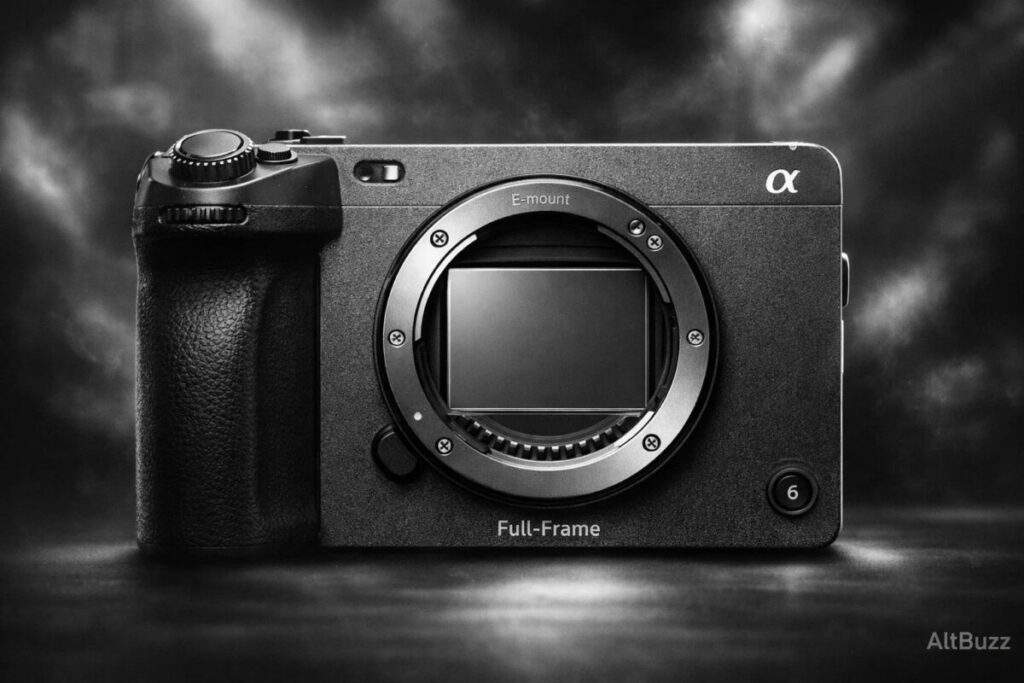
Sony’s Cinema Line has a recognizable visual identity built on compact rectangular bodies, side-mounted articulating screens, and purposeful control layouts designed for video production. The FX32 is expected to honor this identity while introducing meaningful refinements in response to real-world user feedback from FX30 shooters.
The overall form factor is expected to remain compact and portable. Sony understands that one of the FX30’s greatest strengths is its ability to be deployed without a full cinema rig in situations where a larger camera would be intrusive or impractical. The FX32 is expected to preserve this portability while adding depth where needed for improved thermal performance.
Grip design is one of the most discussed expected changes. Sony has been evolving its grip shapes across recent releases, moving toward deeper and more ergonomically contoured handles that provide a more secure feel during extended handheld shooting. The FX32 is expected to adopt this updated grip profile. For filmmakers who spend hours shooting handheld without a shoulder rig, grip depth and texture make a genuine difference in both comfort and stability. A better grip means less hand fatigue, more stable footage, and better control over camera movement.
The side-mounted fully articulating LCD screen is expected to be a standard feature, consistent with the FX30’s positioning. This screen orientation is not just a convenience feature for selfie shooting. It is an essential tool for documentary and solo production use cases. It allows the filmmaker to monitor the shot from almost any angle, including fully sideways for unconventional camera placements, from above for overhead shots, and from below for low-angle perspectives. Leaked information suggests a brighter display panel than the FX30, improving outdoor visibility in direct sunlight. A higher-resolution display is also expected, which would benefit focus peaking visualization and zebra pattern overlay accuracy.
Build quality is expected to match professional standards throughout. Magnesium alloy body construction with comprehensive dust and moisture weather sealing is widely anticipated. Professional camera tools need to perform in real conditions, including light rain, dusty outdoor environments, humid interiors, and temperature extremes. Weather sealing at this price tier sends a clear market signal about the FX32’s intended use context.
Port selection is expected to be comprehensive and purpose-built for professional video use. A full-size HDMI output for external monitoring and recording, USB-C 3.2 Gen 2 for fast data transfer and charging, a 3.5mm stereo microphone input, a dedicated headphone monitoring jack, and a multi-interface shoe for Sony XLR accessories are all expected. Some community speculation also points to the possibility of a flash sync terminal for hybrid shooters who occasionally need still photography functionality from the same body.
Battery and Connectivity (Rumored)
The NP-FZ100 battery is the expected power source for the Sony FX32. This is an important detail for the large community of existing Sony shooters who have already invested in multiple NP-FZ100 batteries and chargers. Sony’s decision to maintain battery compatibility across its professional Alpha and Cinema Line bodies represents a meaningful practical advantage over competitors who change battery systems with each new body generation.
Power efficiency improvements are expected through the BIONZ XR processor’s evolved power management architecture. Sony has achieved notably better battery life in recent cameras like the A7 V compared to their predecessors, even while increasing processing demands significantly. The FX32 should benefit from these same efficiency engineering advances.
Wireless connectivity expectations include Wi-Fi 6 for fast wireless file transfer and remote monitoring, and Bluetooth 5.2 for low-power device pairing and remote control through Sony’s Creators App. Wi-Fi 6 is particularly relevant in professional settings where multiple devices are competing for wireless spectrum. The more robust and efficient Wi-Fi 6 standard handles congested wireless environments far better than earlier specifications, which matters during live events and in busy venues.
The dual card slot configuration with CFexpress Type A and SD UHS-II support is expected and logical for this camera. CFexpress Type A cards provide the write speeds needed for sustained high-bitrate 4K All-Intra recording without dropped frames. The SD UHS-II slot provides a cost-effective backup recording option, a proxy recording destination, or a secondary storage path for less demanding recording modes. This dual-format flexibility has already proven successful across Sony’s FX lineup.
USB-C 3.2 Gen 2 capabilities would include fast wired data transfer for offloading large footage files, tethered shooting support for studio applications, and USB-C charging from compatible power banks and adapters. The ability to charge via USB-C during long shooting days without access to wall power is increasingly important for professional field production.
Real-World Use Cases
Understanding the Sony FX32’s practical value requires thinking carefully about the types of filmmakers who live in the gap between the FX30 and FX3. These are real people with real professional needs, and the FX32 is expected to serve them directly.
The independent documentary filmmaker working alone or with minimal crew is the most natural FX32 user. This person needs a camera that fits into a bag without dominating it, that can capture broadcast-quality footage in uncontrolled lighting conditions, that maintains reliable autofocus during unpredictable subject movement, and that runs long enough without overheating to capture complete scenes without interruption. The expected FX32 addresses every single one of these requirements. The Cinema Line color science ensures that the footage integrates cleanly with other professional cameras in multi-camera productions. The AI autofocus handles focus tracking so the filmmaker can direct the scene rather than micromanage the camera. The expected 4K/120p slow-motion capability means that dramatic moments can be captured at high frame rates opportunistically, without requiring prior setup or mode switching during tense shooting situations.
Corporate video producers have different but equally specific needs. Brands and agencies that produce regular video content need cameras that deliver consistently polished results without requiring large crews or extensive post-production intervention. The expected FX32 would allow a single experienced operator to walk into a conference room, a factory floor, or a product studio and produce footage that meets broadcast delivery standards. S-Cinetone’s ready-to-use color science makes this particularly practical, since it delivers professional-looking color without requiring a dedicated colorist in post.
Wedding cinematographers work under conditions that expose every weakness in a camera system. The venues are often dark and mixed in their lighting. The moments are irreplaceable. The subjects move unpredictably. And the entire production often comes down to a single shooter managing multiple cameras simultaneously. The FX32’s expected high ISO performance, reliable subject tracking, Cinema Line color rendering, and compact form factor make it an ideal primary or secondary camera for wedding filmmaking. The compact size also matters in wedding contexts because a smaller camera is less obtrusive during ceremony and intimate moments.
Travel and adventure filmmakers represent a growing and increasingly professional market segment. The rise of travel-focused documentary and branded content has created strong demand for cameras that combine professional video capabilities with portable and durable form factors. A weather-sealed APS-C Cinema Line body with IBIS stabilization, Cinema Line color, and 4K/60p oversampled recording would be a strong tool for this market. The expected NP-FZ100 battery compatibility and USB-C charging support further strengthen the travel case, since both power solutions are practical and accessible globally.
News and current affairs videographers who work in unpredictable environments and often under time pressure would also benefit from the expected FX32 capabilities. Reliable autofocus, good low-light performance, compact form factor, and professional codec support create a combination that serves breaking news and documentary news coverage extremely well.
Pros and Cons (Based on Rumors)
Expected Pros:
The Sony FX32 fills a genuine and commercially significant gap in the Cinema Line lineup with an expected price between $1,999 and $2,499. The rumored 26MP partially stacked APS-C sensor would deliver a measurable improvement in rolling shutter performance compared to the FX30, which is one of that camera’s most frequently cited practical limitations. The expected 4K/60p with full 6K oversampling brings oversampled cinema-quality 4K to this price tier for the first time in a Sony APS-C Cinema body. The anticipated 4K/120p slow-motion capability opens up genuinely cinematic high-frame-rate sequences for independent filmmakers who previously needed a much more expensive camera to achieve this. The expected 32-bit float audio recording is potentially transformative for solo documentary and event videographers. AI-powered autofocus with comprehensive subject tracking should make run-and-gun shooting more reliable and consistent than any previous Cinema Line body at this price. Full S-Log3 and S-Cinetone support integrates the FX32 immediately into professional multi-camera Cinema Line workflows. Dual CFexpress Type A and SD card slots provide both high-speed recording capability and practical backup flexibility. Weather sealing and magnesium alloy construction deliver a professional-grade durability expectation that the FX30’s build quality partially lacks. NP-FZ100 battery compatibility keeps the overall system cost manageable for existing Sony shooters.
Expected Cons:
The 1.5x APS-C crop factor compared to the full-frame FX3 will require wider lenses to achieve equivalent field-of-view coverage, which increases lens costs for shooters building a new kit specifically around the FX32. No internal RAW video recording is expected at this price tier. Sony’s Cinema Line has historically reserved RAW recording for its higher-end FX6 and above, and the FX32 is unlikely to break this pattern. Integrated active cooling may not be a standard feature, with Sony potentially offering it only as an optional clip-on accessory. The 6K oversampled 4K/60p mode may require a compromise in crop factor or recording time compared to 4K/30p, which is typical for cameras at this processing tier. Expected pricing could push above the $2,499 ceiling if Sony includes more features than currently anticipated or responds to component cost pressures. Every specification and detail presented here remains unconfirmed rumor.
Final Thoughts
The Sony FX32 is not yet official. But the need it would fill is completely undeniable. The gap between the FX30 and FX3 is felt by real filmmakers every day, and the evidence that Sony is working to close it is becoming more credible with each new leak cycle.
Sony has all the technology it needs to build the FX32 exactly as the rumor community hopes. The new partially stacked APS-C sensor platform, the AI-powered autofocus engine, the Cinema Line color science, and the BIONZ XR processing pipeline are all proven in existing Sony bodies. Putting them together in a purpose-built APS-C Cinema body at the right price is simply a matter of timing and product strategy.
Whether the Sony FX32 arrives in late 2026 or early 2027, it has the potential to become one of the most important releases in the Cinema Line’s history. It would democratize Cinema Line quality for a much wider range of working filmmakers, and that matters in an industry where great stories deserve great tools regardless of budget.
Read More from AltBuzz
Read more from Altbuzz for camera reviews, rumors, and detailed specs. AltBuzz delivers trusted and easy-to-understand photography content.
Subscribe AltBuzz YouTube Channel
Stay updated with camera reviews, rumors, and comparisons. AltBuzz shares regular camera content.