
The Fujifilm X100VI is one of the most talked-about compact cameras of 2024. It was officially released in late March 2024 and is aimed at street photographers, travel shooters, content creators, and everyday photography enthusiasts who want image quality without carrying a large system.
Fujifilm X100VI Full Review: Specs, Performance & Verdict
The Fujifilm X100VI is the sixth generation of Fujifilm’s iconic fixed-lens compact series. It brings significant upgrades over the X100V, including a new 40.2MP sensor, in-body image stabilization, and 6.2K video. However, it still keeps the classic retro design and fixed 23mm f/2 lens that fans have come to love.
In this review, we cover everything you need to know — from sensor performance to real-world shooting experience.
Release Date and Market Position
The Fujifilm X100VI was announced on February 20, 2024, and became available for purchase in late March 2024. The launch price is $1,599 USD, which is $200 more than the previous X100V.
This places it firmly in the premium compact camera segment. It competes with cameras like the Ricoh GR IIIx and Leica Q3 (though at a much lower price than the Leica). No other camera currently offers the exact combination of APS-C image quality, film simulations, hybrid viewfinder, and compact form factor at this price point.
Demand was so strong at launch that supply shortages persisted for several months. A limited-edition black model priced at $1,999 was also produced in a run of just 1,934 units.
Fujifilm X100VI Specifications Table
| Feature | Details |
|---|---|
| Sensor Type | APS-C X-Trans CMOS 5 HR (BSI) |
| Resolution | 40.2 Megapixels |
| Processor | X-Processor 5 |
| ISO Range | 125–12800 (Extended: 64–51200) |
| Autofocus System | 425-point Intelligent Hybrid AF with AI subject detection |
| Stabilization | 5-axis IBIS, up to 6.0 stops |
| Video Recording | 6.2K/30p, 4K/60p, 1080p/240p (10-bit 4:2:2 internal) |
| EVF | Advanced Hybrid Viewfinder (OVF + EVF) |
| LCD Screen | 3.0-inch tilting touchscreen |
| Burst Shooting | Up to 20fps (electronic shutter) |
| Battery | NP-W126S — ~450 shots (OVF) / ~310 shots (EVF) |
| Storage | Single UHS-I / UHS-II SD card slot |
| Connectivity | USB-C, Bluetooth 4.2, Wi-Fi (Frame.io Camera to Cloud) |
| Weight | ~521g (with battery and card) |
| Launch Price | $1,599 USD |
Sensor and Image Quality Performance
A Big Resolution Upgrade
The Fujifilm X100VI uses the same 40.2MP X-Trans BSI CMOS 5 HR sensor found in the X-H2 and X-T5. This is a major upgrade from the 26.1MP sensor in the X100V. You get 1.5x more resolution, which makes a real difference when cropping or printing large.
Real-World Image Quality
In practice, images from the X100VI are strikingly detailed. The 23mm f/2 lens resolves sharpness well across most of the frame, even at wide apertures. Colors look natural and pleasing straight from the camera.
Fujifilm’s 20 Film Simulation modes are a big reason people love this camera. The new REALA ACE mode produces neutral, life-like colors that look excellent for portraits and everyday scenes. Classic Chrome, Classic Negative, and Velvia remain popular choices for street and travel work.
Dynamic Range
Dynamic range is very good for an APS-C sensor. Highlights roll off naturally. Shadow recovery is solid, especially at base ISO. In high-contrast outdoor scenes, the X100VI holds up well without blowing out skies or losing shadow detail.
Low-Light Performance
Low light is noticeably improved over the X100V. ISO 3200 produces clean, usable images. ISO 6400 is still acceptable with some noise reduction. Beyond that, noise increases — but the X-Trans sensor’s noise pattern tends to look more film-like than digital, which many photographers actually prefer.
The combination of IBIS and the f/2 aperture also helps in dim conditions, allowing for slower shutter speeds without camera shake.
Autofocus Performance
The AF System
The Fujifilm X100VI uses a 425-point hybrid autofocus system powered by the X-Processor 5 and deep-learning AI. This is a significant step up from the X100V’s contrast-detect-only system.
Subject detection now includes: humans (face/eye), animals, birds, vehicles, motorcycles, bicycles, airplanes, trains, insects, and drones. Human detection and animal detection are separate modes, so you’ll need to switch between them manually.
Tracking Accuracy
For a compact camera, the AF tracking is surprisingly capable. In good light, it locks on quickly and maintains focus well on moving subjects. Tracking is reliable for street photography, travel, and general everyday shooting.
However, it does not compete with professional mirrorless systems in fast-action scenarios. Sports and wildlife photographers will find its tracking less consistent than cameras like the Sony A7 V or Fujifilm X-H2S. That said, the X100VI is not designed for those use cases.
Real-World Usability
In practical use, the autofocus is fast and accurate enough for most shooting situations. Face and eye detection work well in portrait sessions. Street photographers will appreciate the quick lock-on for candid moments.
Video Capabilities
Resolution and Frame Rates
The Fujifilm X100VI is the first X100 Series camera capable of recording 6.2K video. Specific options include:
- 6.2K at 30fps — highest quality, great for cropping in post
- 4K at 60fps — smooth, highly detailed
- 1080p at 240fps — useful for slow-motion footage
All modes support 10-bit 4:2:2 internal recording, which is impressive for a compact camera. This gives plenty of flexibility for color grading in post.
Log Profiles
The X100VI supports F-Log and F-Log2, giving colorists flexibility to achieve the exact look they want in post. This makes it genuinely useful for video professionals who need log footage.
Stabilization in Video
IBIS works in video mode as well. Footage from a handheld walk is smooth and usable. For vloggers and travel content creators, this is a practical improvement over older X100 models.
Audio
The camera has a 2.5mm microphone input for an external mic. There is no headphone output for monitoring. The internal microphone is serviceable for casual use, but an external mic will be needed for serious audio work.
Design, Build Quality, and Handling
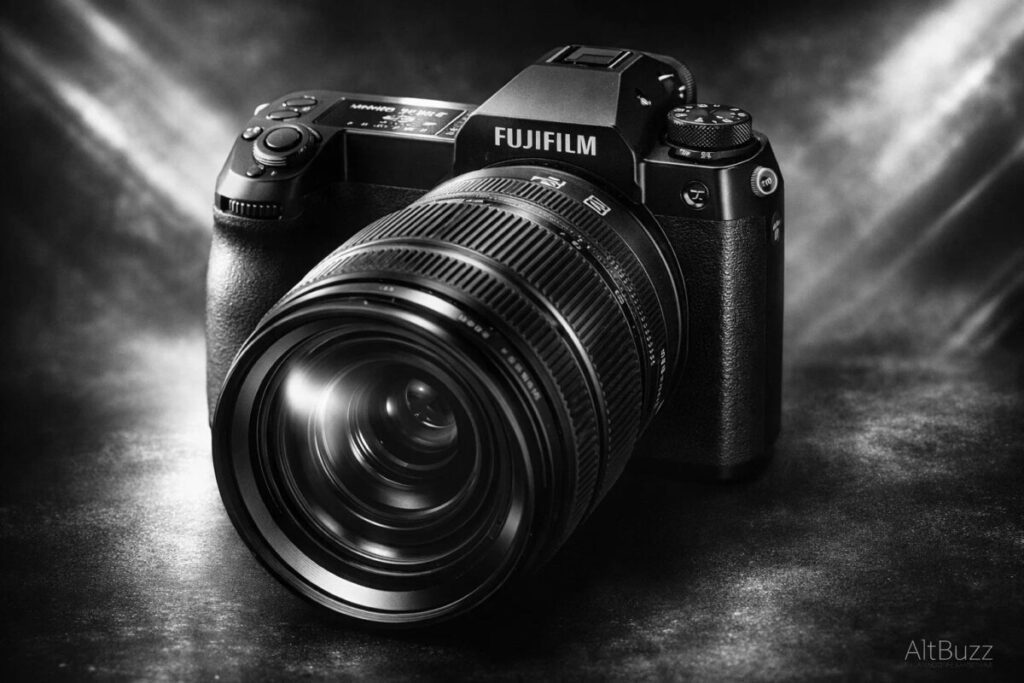
Classic Retro Aesthetic
The Fujifilm X100VI maintains the rangefinder-style design that has defined the X100 series since 2011. The top and bottom plates are aluminum. The textured leatherette grip gives the camera a premium, tactile feel.
It is available in silver/black and black colorways.
Slightly Larger Than the X100V
The X100VI is 2mm deeper and 43g heavier than the X100V. These changes are barely noticeable in hand. The camera still fits in a large jacket pocket or a small camera bag with ease.
Controls and Layout
Fujifilm kept the classic dial-based control system. You get a dedicated shutter speed dial, aperture ring on the lens, and an exposure compensation dial. This tactile approach to exposure control is one of the camera’s most beloved features.
The button layout is largely unchanged from previous models. There is a small joystick for moving the AF point. The rear touchscreen responds well to touch input.
The Hybrid Viewfinder
One of the X100VI’s most unique features is its Advanced Hybrid Viewfinder. You can switch between a real optical viewfinder (OVF) and an electronic viewfinder (EVF) at the push of a button. The OVF provides a clear, bright view with overlay information. The EVF shows you an accurate real-time preview of exposure and color.
Note: IBIS compensation drops slightly from 6.0 EV to 5.5 EV when shooting through the OVF. This is due to the camera’s inability to fully coordinate IBIS in optical mode.
Weather Sealing
The X100VI body itself is not weather-sealed on its own. However, you can add weather sealing by attaching the optional adapter ring and a filter. This is a workaround rather than a native solution, and it requires an accessory purchase.
Battery Life and Connectivity
Battery Performance
The X100VI uses Fujifilm’s NP-W126S battery. Official ratings are:
- ~450 shots using the optical viewfinder
- ~310 shots using the electronic viewfinder
In real-world use, many photographers report getting significantly more shots when using power-saving habits. USB-C charging is supported, so you can top up the battery with a power bank or laptop on the go. No external charger is included in the box.
For a full day of shooting, carrying a spare battery is recommended.
Wireless Connectivity
The X100VI includes Bluetooth 4.2 for remote control and pairing with the Fujifilm XApp. Wi-Fi is available for image transfer and remote shooting. The headline wireless feature is Frame.io Camera to Cloud integration, which allows you to wirelessly upload photos and videos directly to Adobe’s Frame.io platform. This is especially useful for professional workflows.
File transfer speeds are adequate for occasional use, but not fast enough for bulk raw file transfer.
Real-World Use Cases
Photography Use Cases
The Fujifilm X100VI excels in several shooting situations:
Street photography is where this camera shines brightest. The compact body, silent electronic shutter, and fast AF make it discreet and effective on busy streets. The fixed 35mm equivalent focal length (23mm APS-C) is a classic street photography perspective.
Travel photography is another strong suit. The X100VI’s small size means you can take it everywhere. The IBIS helps with handheld shots in churches, cafés, and other low-light interiors. The 40MP resolution gives plenty of room to crop in post.
Portrait photography is very capable. Face and eye detection works reliably. The f/2 aperture produces pleasant background separation even with a fixed lens.
Video Use Cases
For vloggers and travel filmmakers, the X100VI offers a genuine all-in-one solution. The 6.2K and 4K footage is cinematic. Film simulation modes like Eterna Cinema and Eterna Bleach Bypass look beautiful straight from the camera with minimal grading.
The built-in 4-stop ND filter is incredibly practical for video shooters. It lets you maintain proper exposure in bright outdoor conditions without overexposing.
Everyday Shooting Strengths
The X100VI is an ideal everyday carry camera. It is small enough to take everywhere but capable enough to produce professional-level results. The 1.4x and 2x digital teleconverters give some versatility, effectively simulating 49mm and 70mm focal lengths at reduced resolution.
Pros and Cons
Pros
- Excellent 40.2MP image quality with beautiful Fujifilm color science
- First X100 series camera with IBIS (up to 6.0 stops)
- 20 Film Simulation modes including new REALA ACE
- Impressive video specs: 6.2K/30p, 4K/60p, 10-bit 4:2:2
- Built-in 4-stop ND filter — very practical for video
- Unique Hybrid Viewfinder (OVF + EVF)
- Compact and lightweight for everyday carry
- Native Frame.io Camera to Cloud integration
- AI-powered subject detection autofocus
Cons
- Fixed lens — no interchangeable lens flexibility
- No native weather sealing without an accessory adapter
- Single SD card slot only
- No headphone jack for audio monitoring
- Battery life is modest — a spare is advisable
- AF subject detection requires switching between human and animal modes separately
- Higher price than the X100V ($200 increase)
- Strong initial demand caused significant supply shortages
Final Verdict
The Fujifilm X100VI is the best compact fixed-lens camera available today. It takes everything that made the X100 series iconic and adds the most-requested features: IBIS, a higher-resolution sensor, and capable video. The result is a camera that is genuinely versatile for both photographers and content creators.
At $1,599, it is not cheap. However, for what it delivers — 40MP image quality, 6.2K video, IBIS, and beautiful Fujifilm color rendering in a pocket-sized body — it represents strong value in the premium compact space.
Who should buy it:
- Street and travel photographers who want compact, high-quality stills
- Vloggers and content creators who prefer a stills-first, video-capable all-rounder
- Photographers upgrading from the X100V who want IBIS and more resolution
- Anyone who values classic design, tactile controls, and Fujifilm’s film simulations
Who should skip it:
- Photographers who need a zoom or interchangeable lens
- Action and wildlife photographers who need faster tracking AF
- Video professionals who require headphone monitoring or advanced codecs
- Budget-conscious buyers — the X100V and X-T30 II offer more value at lower prices
The Fujifilm X100VI is not a camera for everyone. However, for those who connect with its design philosophy and shooting experience, it is hard to find anything better at this size and price.
Read More from AltBuzz
Read more from AltBuzz for camera reviews, detailed specs, and expert insights. AltBuzz delivers trusted and easy-to-understand photography content.
Subscribe AltBuzz YouTube Channel
Stay updated with camera reviews and comparisons. AltBuzz shares hands-on camera content regularly.