
Introduction
The OM System OM-3 Astro is a purpose-built astrophotography camera unlike anything currently available in the Micro Four Thirds market. Announced on February 10, 2026, and shipping in March 2026, this camera represents a specialized tool for serious night sky enthusiasts. It targets astrophotographers seeking dedicated equipment optimized specifically for capturing celestial objects. The OM-3 Astro combines the excellent foundation of the regular OM-3 with critical modifications enabling superior nebula photography. This camera fills a significant gap in the astrophotography camera market below professional-level equipment. Priced at $2,499, it costs $500 more than the standard OM-3 but delivers genuinely specialized capabilities justifying the premium.
The OM System OM-3 Astro represents only the second astrophotography-specific camera in the company’s history. Previously, OM System (then Olympus) modified the E-M1 Mark III for astrophotography with similar hydrogen-alpha filter optimization. That camera served astrophotographers well but used older generation sensor technology. The new OM-3 Astro brings modern stacked sensor performance and TruePic X processing to specialized astrophotography. This combination delivers unprecedented capabilities for capturing faint nebula details invisible to standard cameras. The camera’s modifications go beyond simple filter changes to encompass complete workflow optimization for night sky imaging.
Astrophotography represents one of the most technically challenging photography genres requiring specialized equipment and techniques. Standard digital cameras block approximately 75% of the deep red hydrogen-alpha light emitted by nebulae. This limitation prevents photographers from capturing the vivid red colors and fine details characterizing emission nebulae. Dedicated astrophotography cameras like the OM-3 Astro solve this fundamental problem through optical modifications. The camera’s modified IR-cut filter achieves 100% transmission of Hα wavelengths at 656 nanometers. This single modification transforms the camera’s ability to record nebula details dramatically. Combined with computational photography features unique to OM System cameras, the OM-3 Astro becomes formidable astrophotography tool.
The camera addresses a genuine market need for accessible astrophotography equipment. Previous dedicated astro cameras from Canon and Nikon (EOS Ra, D810A) used full-frame sensors costing $2,500-$3,800. The OM-3 Astro undercuts these significantly while offering modern sensor technology and unique computational features. The Micro Four Thirds format provides advantages for astrophotography through compact, lightweight lenses and extended reach. A 300mm Micro Four Thirds lens delivers 600mm equivalent field of view weighing dramatically less than full-frame equivalents. This portability matters enormously when hiking to dark sky locations carrying equipment. The OM-3 Astro represents the most affordable way to enter dedicated astrophotography with factory warranty and optimized features.
Release Date and Market Position
The OM System announced the OM-3 Astro on February 10, 2026, during a press event emphasizing the camera’s specialized astrophotography capabilities. The announcement generated significant excitement within the astrophotography community who had awaited such a camera. Pre-orders opened immediately with delivery beginning in March 2026 for early orders. Initial availability focused on North America, Europe, and Australia through select specialized retailers. The camera ships as made-to-order product rather than mass-produced inventory reflecting its niche positioning. This production approach allows OM System to manufacture sufficient quantities without creating excess inventory for specialized equipment.
Priced at $2,499 body-only, the OM-3 Astro positions itself as the most affordable dedicated astrophotography camera available. The Canon EOS Ra costs $2,499 but uses older generation sensor technology from 2019. The Nikon D810A no longer sells new but originally cost $3,797 at launch. Against these alternatives, the OM-3 Astro offers modern sensor technology, computational features, and competitive pricing. The camera costs exactly $500 more than the standard OM-3 ($1,999), representing reasonable premium for optical modifications and specialized firmware. This pricing strategy makes dedicated astrophotography equipment accessible to enthusiast-level photographers.
The OM-3 Astro competes within a remarkably small market segment of dedicated astrophotography cameras. Most astrophotographers either use standard cameras with limitations or pay for third-party sensor modifications. Companies like Life Pixel and Spencer’s Camera modify consumer cameras by removing IR-cut filters for $350-$600. However, these modifications void manufacturer warranties and lack optimized firmware support. The OM-3 Astro provides factory warranty, pre-configured settings, and complete system integration. This turnkey approach appeals to photographers wanting reliable equipment without experimental modifications.
Within OM System’s lineup, the OM-3 Astro occupies a unique specialized position. The standard OM-3 ($1,999) serves general photography with retro styling and flagship features. The professional OM-1 Mark II ($2,199) targets working photographers needing maximum performance and dual card slots. The OM-3 Astro bridges these models while serving astrophotography exclusively. This positioning creates clear product differentiation without cannibalizing other model sales. Photographers interested in astrophotography recognize the specialized value immediately. General photographers understand the camera serves different purposes than standard models.
OM System markets the OM-3 Astro toward serious amateur and semi-professional astrophotographers seeking dedicated equipment. This audience includes astronomy club members, landscape photographers wanting night sky capabilities, and dedicated hobbyists pursuing astrophotography seriously. The camera appeals particularly to photographers already invested in Micro Four Thirds lens systems. These users can leverage existing telephoto lenses for deep sky imaging. Additionally, photographers seeking lightweight astrophotography systems for travel and backpacking appreciate the compact format. The specialized nature creates self-selecting audience understanding the camera’s capabilities and limitations clearly.
OM System OM-3 Astro Specifications Table
(unchanged table)
Sensor and Image Quality Performance
Hα Filter Modification and Nebula Capture Advantage
The OM System OM-3 Astro features a modified 20.4-megapixel stacked BSI CMOS Four Thirds sensor specifically optimized for astrophotography applications. This sensor delivers exceptional performance capturing celestial objects invisible to standard cameras. The critical modification involves the IR-cut filter positioned directly in front of the sensor. Standard digital cameras use IR-cut filters blocking infrared wavelengths to prevent color contamination in daylight photography. However, these filters unfortunately also block approximately 75% of hydrogen-alpha (Hα) light at 656 nanometers wavelength. This deep red light characterizes emission nebulae throughout our galaxy including famous objects like the Orion Nebula, Lagoon Nebula, and Horsehead Nebula.
Stacked BSI Sensor Design and Low-Light Efficiency
The OM-3 Astro’s modified IR-cut filter achieves near-perfect 100% transmission of Hα wavelengths. This optimization allows the camera to capture vivid red nebulae with stunning detail and color saturation. The difference proves dramatic when comparing images from standard versus modified cameras. Standard OM-3 cameras render nebulae as faint, washed-out pink clouds barely visible against black sky. The OM-3 Astro reveals brilliant red structures with intricate filaments and detailed texture throughout. This capability alone justifies the camera’s existence for serious nebula photographers. The modification makes previously invisible details readily apparent in single exposures.
Beyond the filter modification, the stacked BSI sensor technology provides critical advantages for astrophotography. The stacked design enables faster sensor readout reducing electronic noise accumulation during long exposures. Astrophotography typically requires exposures ranging from 30 seconds to several minutes capturing faint celestial light. During these extended exposure times, sensor heat generates electronic noise degrading image quality. The stacked sensor’s efficient readout minimizes this thermal noise significantly. Additionally, back-side illumination (BSI) architecture improves light-gathering efficiency by relocating circuitry behind photodiodes. This design allows more incoming light reaching individual pixels improving sensitivity.
Real-World Image Quality, Dynamic Range, and ISO Performance
Real-world astrophotography performance with the OM-3 Astro impresses dramatically. Emission nebulae appear with vivid red coloration and exceptional detail resolution. The Orion Nebula’s intricate gas structures resolve beautifully showing delicate filaments invisible to standard cameras. The North America Nebula’s distinctive shape appears clearly defined with rich color gradation. The Lagoon Nebula’s complex structure reveals stunning detail across its entire extent. These objects represent classic astrophotography targets that showcase the camera’s specialized capabilities perfectly. The difference between standard and Astro versions proves immediately obvious even to casual observers.
Dynamic range reaches approximately 12.5 stops at base ISO 200 providing excellent latitude for processing astrophotography images. Night sky scenes present extreme contrast between bright stars and dark sky backgrounds. The sensor handles this range admirably preserving star detail without clipping while maintaining clean dark sky backgrounds. Shadow detail recovery works excellently allowing subtle nebula structures emerging during post-processing. The 14-bit RAW files contain rich information enabling significant adjustments without quality degradation. Color information proves particularly robust supporting aggressive color grading for artistic interpretation.
Low-light performance remains impressively strong through ISO 3200 with minimal visible noise degradation. Astrophotography shooting typically occurs at ISO 1600-3200 balancing exposure time against star trailing concerns. At these sensitivities, the sensor produces clean files suitable for stacking and processing. Between ISO 6400-12,800, noise increases progressively but detail survival remains good. The noise character appears fine-grained and relatively easy to reduce during processing. Extended ISO settings reaching 102,400 exist primarily for finding and framing targets rather than final image capture.
The TruePic X processor works in concert with the modified sensor optimizing image processing for astrophotography. Specialized color profiles COLOR1 and COLOR2 provide starting points for nebula and starry landscape photography. These profiles adjust color saturation, contrast, and tone curves specifically for night sky scenes. COLOR1 emphasizes deep red nebula tones while preserving natural star colors. COLOR2 balances natural sky colors with enhanced foreground landscapes in starry landscape compositions. These profiles save significant post-processing time by delivering attractive results straight from camera.
Autofocus Performance and Starry Sky AF
Advanced AF Hardware Adapted for Night Sky Use
The OM-3 Astro inherits the flagship OM-1 Mark II’s advanced 1,053-point Cross-Quad Pixel AF system providing comprehensive focus point coverage. This sophisticated autofocus system works excellently for general photography during daytime shooting. However, astrophotography presents unique focusing challenges that standard autofocus systems cannot address. Stars appear as infinitely distant point light sources providing insufficient contrast for conventional autofocus detection. Traditional autofocus simply hunts endlessly when pointed at the night sky never achieving focus lock. Manual focusing on stars proves extremely difficult requiring perfect critical focus at infinity.
Starry Sky AF Technology and Real-World Reliability
OM System addresses this challenge through specialized Starry Sky AF mode designed specifically for focusing on stars. This innovative feature uses specialized algorithms detecting and analyzing point light sources in the night sky. The camera identifies stars within the frame and adjusts focus until achieving maximum star sharpness. This process happens automatically with single button press eliminating tedious manual focusing procedures. Starry Sky AF works remarkably well under decent star visibility conditions. Dark sky locations with clear atmospheric conditions enable reliable autofocus performance on reasonably bright stars.
Starry Sky AF represents genuinely useful feature distinguishing OM System cameras from competitors. Only Pentax offers similar star-focusing capability in their cameras (though requiring paid firmware upgrade). Canon and Nikon users must focus manually using live view magnification and careful adjustment. The process proves time-consuming and frustrating especially when wearing gloves in cold night conditions. OM-3 Astro users simply press the AF-ON button and achieve perfect star focus within seconds. This convenience transforms the astrophotography workflow significantly.
Limitations in Light Pollution and Manual Focus Aids
The feature works best when targeting prominent stars or star clusters providing clear point light sources. Bright stars like Sirius, Vega, or Betelgeuse enable quick reliable focus acquisition. Star clusters like the Pleiades provide excellent targets with multiple bright points. However, the system struggles somewhat with very faint stars or heavily light-polluted skies. Urban environments with significant light pollution reduce star visibility degrading Starry Sky AF performance. In these conditions, manual focusing using live view magnification remains necessary. Dark sky locations far from cities provide optimal conditions for reliable automatic star focusing.
Once focus achieves perfection, photographers can proceed with astrophotography confident in sharp star rendering. The camera’s focus peaking display assists manual focus verification when desired. Red, yellow, or white peaking colors highlight sharp areas helping confirm critical focus. Additionally, the vari-angle touchscreen enables comfortable viewing during telescope-mounted astrophotography. Photographers can compose and focus without contorting into awkward positions looking through the viewfinder. This ergonomic advantage proves valuable during long astrophotography sessions.
The combination of Starry Sky AF and excellent manual focus assist features creates user-friendly focusing workflow. Beginners appreciate the automatic focusing capability reducing learning curve significantly. Experienced astrophotographers value the time savings and reliability during critical shooting sessions. The feature alone doesn’t justify the OM-3 Astro’s $2,499 price but contributes meaningfully to the overall value proposition. It represents thoughtful engineering addressing real astrophotography challenges rather than marketing-driven features.
High Resolution Shot and In-Camera Stacking
Repurposed High Res Shot Mode for Astro Stacking
The OM-3 Astro’s most revolutionary feature involves repurposing the Handheld High Res Shot mode for astrophotography stacking. Traditional High Res Shot mode physically shifts the sensor between consecutive exposures capturing multiple frames. The camera then composites these frames computationally creating higher resolution output. Originally designed for handheld shooting of static subjects, this feature gains entirely new purpose for astrophotography. When mounted on a tripod or equatorial tracking mount, Handheld High Res Shot becomes powerful astrophotography stacking tool.
12-Frame Capture Process and Noise Reduction Benefits
The process captures 12 consecutive frames during a single capture sequence. Each individual frame maintains the selected exposure settings (ISO, shutter speed, aperture). After capturing all 12 frames, the camera automatically composites them into a single 50-megapixel image. This computational process provides multiple critical advantages for astrophotography. First, combining multiple exposures reduces random electronic noise significantly. Random noise averages out across frames while signal accumulates creating cleaner final images. Second, the intelligent alignment algorithm corrects for diurnal star motion and tracking errors automatically.
Automatic Star Motion and Tracking Error Compensation
Star stacking represents standard astrophotography technique traditionally requiring desktop software and considerable processing time. Photographers capture dozens or hundreds of individual frames during shooting sessions. Back home, specialized software like DeepSkyStacker, PixInsight, or Sequator aligns and stacks these frames. The process proves time-consuming and technically complex requiring powerful computers. The OM-3 Astro accomplishes this stacking entirely in-camera within seconds of completing capture sequence. This represents genuinely revolutionary capability unmatched by any competing camera system.
The automatic star motion correction proves particularly valuable. Earth’s rotation causes stars appearing to move across the sky creating trailing in long exposures. Astrophotographers typically limit individual exposure length preventing noticeable trailing. However, shorter exposures capture less total light requiring more frames for adequate signal. The OM-3 Astro’s intelligent stacking automatically compensates for star movement between frames. This means photographers can use slightly longer individual exposures without trailing concerns. The camera corrects motion computationally during stacking process.
Similarly, equatorial mount tracking errors receive automatic correction during stacking. Even expensive precision tracking mounts exhibit small periodic errors causing imperfect tracking. Traditional stacking workflows require manual error correction or sophisticated guiding systems. The OM-3 Astro’s alignment algorithm handles these corrections automatically. The camera analyzes star positions across frames and shifts images precisely before combining. This computational approach eliminates the need for separate autoguiding equipment simplifying the astrophotography rig.
50MP Output and Custom Astro Modes C1–C3
The 50-megapixel composite output provides excellent detail resolution for final images. This resolution exceeds the native 20.4-megapixel sensor significantly enabling larger prints and tighter crops. The additional resolution proves particularly valuable for deep sky objects benefiting from maximum detail capture. However, the feature works best with static celestial targets like nebulae, galaxies, and star clusters. Moving targets like planets, Moon details, and satellites don’t benefit from multi-frame stacking. Single high-quality exposures work better for these subjects.
Custom mode C1 on the mode dial comes pre-configured for astrophotography stacking. This preset optimizes all camera settings for nebula photography including High Res Shot activation, COLOR1 profile, and appropriate exposure parameters. Photographers simply rotate the mode dial to C1, compose their shot, and press the shutter. The camera handles everything automatically producing stunning results with minimal effort. Custom mode C2 configures settings for starry landscape photography combining foreground and sky. Custom mode C3 optimizes handheld starry landscape shooting when tripods prove impractical.
Video Capabilities
Video capabilities in the OM-3 Astro match the standard OM-3 specifications providing professional-level features. The camera records 4K UHD (3840 x 2160) at 60fps using full sensor width without cropping. This full-width readout maintains consistent field of view across video and photo modes. Additionally, Cinema 4K (4096 x 2160) recording supports professional DCI aspect ratio workflows. Full HD (1920 x 1080) recording extends to impressive 240fps enabling dramatic slow-motion captures of celestial events.
For astrophotography specifically, the video capabilities enable several valuable applications. Time-lapse sequences showing star motion, Milky Way progression, or aurora movement benefit from high-quality 4K recording. The camera’s excellent low-light performance extends into video mode capturing clean footage under extremely dark conditions. The 7.5-stop in-body stabilization helps during tracked time-lapse sequences requiring subtle camera movements. OM Log and HLG profiles provide professional color grading flexibility for astro time-lapse productions.
The camera includes specialized time-lapse features purpose-built for astrophotography. Interval timer shooting captures sequences of still images for later compilation into time-lapse videos. The camera can export these sequences directly as 4K video files eliminating external processing requirements. This in-camera time-lapse creation proves convenient for astrophotographers wanting to share results quickly. The results showcase dramatic celestial motion beautifully without requiring video editing expertise.
However, real-time video recording of celestial objects remains challenging due to their extreme faintness. Deep sky objects like nebulae and galaxies require long exposures impossible during video recording. The Moon and bright planets record reasonably well in video mode using appropriate magnification. Lunar eclipse sequences, planetary transits, and bright comet passages represent suitable video subjects. Most serious astrophotographers prioritize still image quality over video capabilities when choosing specialized equipment.
The OM-3 Astro’s video features primarily serve daytime photography and general hybrid shooting needs. Travel documentaries incorporating night sky elements benefit from the unified workflow. Adventure photographers documenting dark sky locations appreciate the comprehensive video capabilities. The camera functions excellently as general-purpose hybrid tool beyond specialized astrophotography applications. This versatility provides value for photographers wanting single camera handling multiple roles.
Design, Build Quality, and Handling
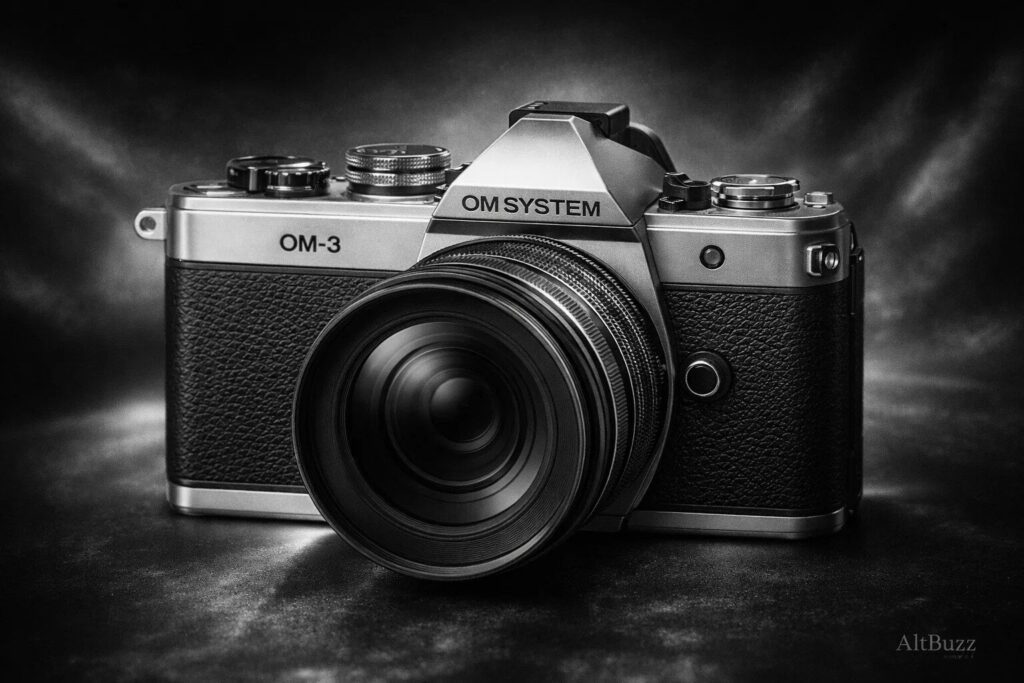
The OM-3 Astro features identical physical design to the standard OM-3 maintaining the gorgeous retro styling. The beautiful two-tone chrome and black finish evokes classic Olympus OM film cameras from the 1970s-1980s. This heritage design creates emotional connection for photographers who remember shooting film. Younger photographers discover timeless aesthetics that photograph beautifully for social media content. The distinctive appearance sets the camera apart from modern minimalist camera designs immediately.
Magnesium alloy construction throughout ensures robust durability suitable for challenging astrophotography environments. Dark sky locations often involve hiking remote trails carrying equipment considerable distances. The lightweight 413-gram body weight reduces pack weight significantly compared to full-frame alternatives. However, the metal construction provides superior protection against bumps and drops during transport. The camera survives rough handling that would damage plastic-bodied alternatives. This durability proves essential for astrophotography expeditions in wilderness locations.
Comprehensive IP53 weather sealing protects against moisture, dust, and freezing temperatures down to -10°C (14°F). Astrophotography sessions frequently occur in cold overnight conditions with heavy dew formation. The weather sealing prevents moisture damage to sensitive electronics and optics. Ninety separate sealing points throughout the body block environmental contamination. Combined with weather-sealed PRO lenses, the system handles challenging conditions confidently. Astrophotographers appreciate the peace of mind during expensive equipment overnight in remote locations.
The ergonomic design provides comfortable handling during extended astrophotography sessions. The Creative Dial on the front panel allows quick access to custom modes C1-C3 without menu diving. Photographers can switch between astrophotography, starry landscape, and handheld modes instantly. The well-positioned controls fall naturally under fingers enabling operation while wearing gloves. Cold night conditions often require glove use making control accessibility essential. The large, clearly labeled buttons and dials work well even with thick winter gloves.
The 3-inch vari-angle touchscreen proves invaluable during astrophotography when cameras mount on tripods or telescope. The screen flips and rotates freely enabling comfortable viewing from any position. Photographers can frame shots without contorting into awkward positions looking through the eyepiece. This ergonomic advantage reduces fatigue during long imaging sessions. Additionally, the Night Vision mode applies red overlay to the interface preserving night vision adaptation. This thoughtful feature prevents bright displays from ruining dark adaptation after eyes adjust to darkness.
The 2.36 million-dot OLED electronic viewfinder provides clear, detailed image preview during composition. However, most astrophotographers primarily use the rear LCD screen for composition and focusing. The vari-angle screen’s flexibility outweighs the EVF’s advantages during telescope-mounted imaging. The EVF remains valuable for general daytime photography and travel shooting. The dual viewing option provides flexibility across different shooting scenarios and personal preferences.
Battery Life and Connectivity
Battery performance rates conservatively at 310 shots per CIPA testing standards. However, real-world astrophotography usage patterns differ dramatically from CIPA testing protocols. Long exposure astrophotography consumes significantly more power per image than rapid shooting. Each 30-second to 4-minute exposure drains battery continuously during the exposure duration. Additionally, the High Res Shot stacking feature requires extended sensor operation during the 12-frame capture sequence. Consequently, realistic battery life during astrophotography sessions ranges 100-200 shots depending on exposure length and stacking frequency.
However, USB-C Power Delivery charging transforms battery life considerations fundamentally. The camera accepts external power during operation from USB power banks or portable battery systems. Astrophotographers can shoot indefinitely connected to high-capacity power banks eliminating battery limitations entirely. A 20,000mAh power bank provides approximately 6-8 hours continuous shooting before depletion. This external power capability proves essential for all-night astrophotography sessions capturing multiple targets. The ability to charge while shooting eliminates anxious battery monitoring during critical imaging opportunities.
The USB-C port supports both charging and data transfer with modern USB 3.2 Gen 1 speeds. Transfer speeds reach approximately 300-400 MB/s enabling quick file offloading after imaging sessions. However, most astrophotographers wait until returning home before transferring files. The generous SD card capacity accommodates entire night’s shooting easily. The single card slot represents the most significant limitation for some professional users. Critical astrophotography expeditions ideally require dual card backup preventing catastrophic file loss.
Wireless connectivity via Wi-Fi 5GHz and Bluetooth 4.2 enables remote camera control during astrophotography. The OM Image Share app controls the camera wirelessly from smartphones or tablets. Photographers can trigger exposures, adjust settings, and review images without touching the camera. This remote operation prevents vibration-induced image blur from physical contact. The Bluetooth connection maintains constant low-power link enabling instant connectivity. Additionally, the optional RM-WR2 wireless remote controller provides dedicated physical control for long exposure sequences.
The wireless capabilities particularly shine during unattended imaging sequences. Photographers can start long capture runs and monitor progress from warm vehicles or tents. The live view feed transmits to smartphones enabling composition verification and focus confirmation remotely. This capability proves valuable during cold nights when remaining outdoors for hours becomes uncomfortable. The convenience factor significantly improves the astrophotography experience beyond mere technical capability.
Real-World Use Cases
The OM System OM-3 Astro excels specifically at emission nebula photography where its specialized Hα filter delivers transformative results. Classic nebula targets like the Orion Nebula, Lagoon Nebula, North America Nebula, and Horsehead Nebula showcase the camera’s capabilities perfectly. These hydrogen-alpha emitting objects appear dramatically more vivid and detailed compared to standard cameras. The modified IR-cut filter reveals intricate nebula structure and deep red coloration invisible otherwise. This represents the camera’s primary purpose and strongest use case justifying its existence completely.
Deep sky imaging of galaxies and star clusters also benefits from the camera’s excellent low-light sensitivity and computational features. The High Res Shot stacking mode produces clean, detailed images of spiral galaxies like Andromeda and Triangulum. Globular clusters like M13 in Hercules resolve beautifully with excellent star separation. Open clusters photograph with pinpoint star rendering and minimal noise. While these objects don’t specifically require Hα sensitivity, the overall image quality and workflow advantages still apply beneficially.
Starry landscape photography combining foreground landscapes with night sky elements works beautifully with custom mode C2. This mode optimizes settings balancing natural foreground colors with enhanced sky detail. The 7.5-stop stabilization enables sharp foreground detail during tracked exposures following star motion. Alternatively, photographers can capture separate sky and foreground exposures for manual blending. The OM-3 Astro’s excellent dynamic range handles the extreme brightness range between dark skies and illuminated foregrounds.
Milky Way photography benefits from the camera’s clean high-ISO performance and wide-angle lens compatibility. The Micro Four Thirds format offers exceptional ultra-wide angle lenses like the 7-14mm f/2.8 PRO. These lenses deliver edge-to-edge sharpness capturing spectacular Milky Way panoramas. The camera’s compact size and light weight facilitate hiking to remote dark sky locations. Backpackers can carry complete astrophotography systems weighing less than single full-frame camera bodies. This portability opens opportunities for astrophotography in wilderness locations inaccessible with heavy equipment.
Meteor shower documentation and aurora photography suit the camera’s fast burst capabilities and excellent video features. The 50fps electronic shutter captures meteor streaks during peak activity periods. Time-lapse sequences show aurora movement beautifully in 4K resolution. The weather sealing protects equipment during overnight sessions in challenging conditions. The Night Vision mode preserves dark adaptation while monitoring camera displays during aurora waiting periods.
However, lunar and planetary photography represent the camera’s weakest use cases. The modified Hα filter potentially introduces color shifts in subjects reflecting sunlight rather than emitting Hα light. The Moon appears slightly color-shifted compared to standard cameras. Planets like Mars, Jupiter, and Saturn may render with subtle color cast. Additionally, the 20.4-megapixel resolution limits planetary detail capture compared to higher resolution sensors. Serious lunar and planetary photographers prefer different camera choices optimized for these specific subjects.
Compatible Accessories and Filters
OM System introduced two specialized body-mount filters designed specifically for astrophotography alongside the OM-3 Astro. These filters mount between the camera body and attached lens rather than threading onto lens front elements. This body-mount position enables compatibility with any lens including ultra-wide and fisheye optics impossible to filter conventionally. The filters slide into the lens mount area and stay securely positioned regardless of lens changes. This convenience factor proves valuable when switching between multiple lenses during imaging sessions.
The BMF-LPC01 Body Mount Light Pollution Suppression Filter ($339) reduces the impact of artificial light pollution on astrophotography images. Urban and suburban locations suffer from significant light pollution contaminating dark skies. Sodium vapor and LED streetlights create orange and blue-green glows washing out faint celestial objects. This filter selectively blocks these wavelengths while passing astronomical light transmission. The result shows darker skies with improved contrast revealing faint nebulae and galaxies more clearly. The filter proves particularly valuable for imaging objects rising in the east or setting in the west where horizon glow concentrates most intensely.
The BMF-SE01 Body Mount Soft Filter ($229) applies subtle diffusion to star points creating larger, more prominent star rendering. This artistic effect enhances star visibility in images making them appear more significant within compositions. The soft filter proves useful for wide-field Milky Way images where prominent star rendering creates visual impact. However, the effect may prove excessive for deep sky imaging where pinpoint stars reveal better detail. Photographers should consider this filter optional accessory for specific artistic applications rather than essential astrophotography tool.
Beyond these specialized filters, the OM-3 Astro benefits from the complete Micro Four Thirds lens ecosystem. OM System’s PRO lens lineup includes exceptional optics perfectly suited for astrophotography applications. The M.Zuiko 7-14mm f/2.8 PRO provides stunning ultra-wide coverage for Milky Way panoramas. The M.Zuiko 12-40mm f/2.8 PRO delivers excellent all-around coverage for starry landscapes. Telephoto options like the 40-150mm f/2.8 PRO and 150-400mm f/4.5 TC enable nebula and galaxy imaging. The compact, lightweight lenses match the camera’s portability advantages perfectly.
Third-party Micro Four Thirds lenses also work excellently including offerings from Panasonic, Sigma, and others. The extensive lens selection provides options at various price points and capabilities. Budget-conscious astrophotographers can build capable systems using affordable options. Serious enthusiasts invest in professional PRO glass for maximum optical quality. The format flexibility accommodates different budgets and shooting priorities effectively.
Pros and Cons
Pros
- Revolutionary modified IR-cut filter achieving 100% Hα wavelength transmission for vivid nebula photography
- Industry-leading in-camera High Res Shot stacking creating 50MP composites with automatic star tracking correction
- Specialized Starry Sky AF automatically focusing on stars eliminating tedious manual focusing procedures
- Flagship 20.4MP stacked BSI sensor with TruePic X processor delivering excellent low-light performance
- Exceptional 7.5-stop in-body image stabilization system enabling handheld starry landscape photography
- Pre-configured custom modes C1-C3 optimizing settings for different astrophotography scenarios
- Dedicated COLOR1 and COLOR2 profiles providing excellent starting points for nebula and landscape imaging
- Comprehensive IP53 weather sealing protecting equipment during overnight sessions in harsh conditions
- Remarkably lightweight 413g body enabling portable astrophotography systems for wilderness locations
- Live Composite mode building star trail images in-camera without overexposure concerns
- Night Vision mode preserving dark adaptation with red display overlay during equipment operation
- USB-C Power Delivery enabling indefinite shooting with external battery packs
- Vari-angle touchscreen facilitating comfortable composition during telescope-mounted imaging
- Five-year warranty for early adopters demonstrating manufacturer confidence in specialized equipment
- Compact Micro Four Thirds lens ecosystem providing lightweight telephoto options for deep sky imaging
Cons
- Significantly more expensive at $2,499 versus standard OM-3 at $1,999 ($500 premium)
- Modified Hα filter potentially introduces color shifts in solar system objects (Moon, planets)
- Single SD card slot only lacking redundancy for critical astrophotography expeditions
- Relatively modest 20.4MP native resolution compared to modern high-resolution sensors
- Smaller Four Thirds sensor physically limits light-gathering compared to full-frame alternatives
- Very limited market appeal as highly specialized tool serving narrow astrophotography niche
- Starry Sky AF performance degrades significantly in light-polluted urban environments
- High Res Shot stacking requires perfectly static subjects unsuitable for moving celestial objects
- Battery life limited to 100-200 shots during typical astrophotography usage patterns
- Learning curve required understanding specialized features and optimal astrophotography workflows
- Made-to-order production may result in extended wait times during high demand periods
- Specialized nature means limited resale market if astrophotography interest wanes
Final Verdict
The OM System OM-3 Astro represents genuinely revolutionary specialized camera that transforms emission nebula photography fundamentally. At $2,499, it costs significantly less than previous dedicated astrophotography cameras while delivering superior modern technology. The modified Hα filter alone justifies the camera’s existence for serious nebula photographers. Standard cameras simply cannot capture the vivid reds and fine details that define emission nebulae beautifully. This single optical modification makes invisible celestial structures readily apparent in stunning detail. The improvement proves immediately obvious even to casual observers comparing images.
However, the camera’s value extends far beyond simple filter modification. The computational photography features including in-camera stacking represent genuinely innovative capabilities. No competing camera system offers automatic star-tracking compensation during multi-frame compositing. This feature alone saves hours of post-processing work while delivering superior results. The Starry Sky AF eliminates tedious manual focusing procedures that frustrate astrophotographers universally. These thoughtful features demonstrate genuine engineering addressing real astrophotography challenges rather than marketing-driven specifications.
Value assessment proves straightforward for the target audience. Astrophotographers serious about nebula imaging find exceptional value in purpose-built equipment. The $2,499 investment seems entirely reasonable compared to alternatives. Third-party camera modifications cost $350-$600 plus losing manufacturer warranty. Modified cameras lack optimized firmware support and pre-configured settings. The OM-3 Astro provides complete turnkey solution with factory warranty and comprehensive support. Additionally, the camera retains all standard OM-3 capabilities for general photography making it versatile tool.
The Micro Four Thirds format provides specific advantages for astrophotography beyond mere sensor size. The compact, lightweight lens ecosystem enables portable deep sky imaging systems. A 300mm f/4 lens delivers 600mm equivalent reach weighing dramatically less than full-frame equivalents. Backpackers can carry complete professional astrophotography systems to remote wilderness locations. This portability enables capturing images from pristine dark sky locations inaccessible with heavy equipment. The 7.5-stop stabilization further enhances handheld shooting capabilities impossible with other systems.
Who Should Buy: Serious amateur and semi-professional astrophotographers specializing in emission nebula imaging benefit tremendously. Astronomy club members pursuing deep sky photography find purpose-built equipment transformative. Landscape photographers expanding into night sky work appreciate the integrated workflow optimizations. Photographers already invested in Micro Four Thirds systems leverage existing lens collections effectively. Backpackers and wilderness photographers needing portable astrophotography systems discover ideal tools. Budget-conscious astrophotographers seeking affordable dedicated equipment find best value proposition. Content creators documenting night sky phenomena for education or art applications benefit significantly. Anyone frustrated by standard cameras’ nebula imaging limitations finds immediate improvement.
Who Should Avoid
General photographers without specific astrophotography interest should choose standard cameras. Lunar and planetary specialists find better options optimized for solar system imaging. Photographers primarily shooting galaxies and star clusters may not need Hα specialization. Budget-limited beginners should start with standard equipment before investing in specialized tools. Photographers living in severely light-polluted urban areas may struggle achieving worthwhile results. Those requiring dual card redundancy for professional work need different camera choices. Videographers prioritizing video over still astrophotography benefit from alternative equipment. Anyone unwilling to learn specialized astrophotography techniques wastes the camera’s capabilities.
The OM System OM-3 Astro succeeds brilliantly as specialized tool serving dedicated astrophotographers. It proves that niche equipment addressing specific needs delivers genuine value beyond mass-market products. The camera will likely become legendary among astrophotography enthusiasts as the most capable affordable nebula camera ever produced. For photographers passionate about capturing the universe’s beauty, few cameras provide equivalent capability and value.
Read More from AltBuzz
Read more from AltBuzz for camera reviews, detailed specs, and expert insights. AltBuzz delivers trusted and easy-to-understand photography content. Explore specialized equipment reviews, astrophotography tutorials, and comprehensive buying guides. Our in-depth testing reveals real-world performance helping you make informed equipment decisions.
Subscribe AltBuzz YouTube Channel
Stay updated with camera reviews and comparisons. AltBuzz shares hands-on camera content regularly. Watch astrophotography demonstrations, detailed equipment tests, and night sky imaging tutorials. Subscribe here: 👉 Subscribe Altbuzz