
Introduction
The Fujifilm X-T30 III is Fujifilm’s refreshed entry-level APS-C retro mirrorless camera bringing modern capabilities to accessible pricing. Released in November 2025 and becoming widely available through January 2026, this camera represents Fujifilm’s continued commitment to film-inspired photography. It targets photographers seeking tactile, engaging camera experiences without overwhelming complexity or cost. The X-T30 III brings the 5th-gen X-Processor 5 for improved autofocus and 6K/30p video to the compact X-T lineup. Available since late November 2025, it fills the crucial entry point for the beloved X-T series. Priced at $999 body-only, it delivers exceptional value for enthusiasts seeking professional-quality tools.
The Fujifilm X-T30 series has consistently provided best-selling cameras balancing classic design against contemporary performance effectively. The original X-T30 (2019) established the series as capable enthusiast tool with excellent image quality and delightful handling. The X-T30 II (2021) refined the formula with minor improvements maintaining the winning recipe. Now the X-T30 III pushes capabilities further with latest-generation processor, enhanced autofocus, and significantly improved video specifications. These upgrades position the camera as most compelling entry-level option in Fujifilm’s extensive X-series lineup.
Fujifilm’s X-T cameras represent the company’s most successful product line embodying the brand’s philosophy beautifully. The retro SLR-inspired design with centered viewfinder hump creates instant visual recognition and emotional appeal. The physical dials controlling shutter speed, ISO, and exposure compensation encourage deliberate, thoughtful photography. This tactile interaction creates engaging shooting experience distinguishing Fujifilm cameras from competitors emphasizing electronic interfaces. The X-T30 III continues this tradition while incorporating modern conveniences appealing to contemporary photographers.
The camera addresses enthusiast needs across multiple photography genres simultaneously without professional-level pricing. Travel photographers appreciate the compact dimensions and lightweight design enabling portable systems. Street shooters value the discrete appearance and silent electronic shutter for candid work. Portrait photographers leverage Fujifilm’s legendary Film Simulations for beautiful straight-from-camera results. Content creators benefit from the enhanced video capabilities including 6.2K recording and improved stabilization. This versatility creates single camera solution handling diverse shooting scenarios without specialized equipment investments.
Release Date and Market Position
Fujifilm announced the X-T30 III on October 23, 2025, during a product launch emphasizing the camera’s film-inspired heritage and modern capabilities. The announcement generated considerable excitement within the Fujifilm community particularly among X-T series enthusiasts. Pre-orders opened immediately with shipping beginning late November 2025 just before the holiday shopping season. However, widespread availability and comprehensive reviews only materialized through January 2026 as production ramped up. This phased availability created anticipation building momentum through the critical year-end period.
Priced at $999 body-only, the X-T30 III positions competitively as most affordable SLR-styled camera in Fujifilm’s lineup. The kit with newly announced XC 13-33mm f/3.5-6.3 OIS lens costs $1,149 providing complete system for budget-conscious buyers. This pricing undercuts the X-T50 ($1,399) and X-S20 ($1,299) while delivering similar core image quality. Against competitors, the X-T30 III competes with the Sony a6400 ($898), Canon EOS R50 ($679), and Nikon Z50 ($857). Fujifilm positions the camera as premium option justifying higher cost through superior build quality, Film Simulations, and engaging tactile controls.
The camera occupies crucial entry position within Fujifilm’s carefully structured X-series lineup. Below it, only the rangefinder-styled X-M5 ($799) and fixed-lens X100VI ($1,599) exist at lower or specialized price points. Above it, the X-T50 ($1,399), X-S20 ($1,299), and flagship X-T5 ($1,699) command premium pricing for additional capabilities. The X-T30 III delivers approximately 75-80% of X-T5 flagship capability at 60% of the cost. This value proposition appeals strongly to enthusiast photographers seeking professional image quality without flagship investments.
Fujifilm markets the X-T30 III toward enthusiast photographers transitioning from smartphones or upgrading from earlier equipment. First-time digital camera buyers appreciate the AUTO mode switch lever simplifying operation while learning manual controls. Smartphone upgraders recognize the intuitive touchscreen interface while discovering tactile dial controls. Film photography veterans appreciate the familiar manual control approach and Film Simulation modes recreating analog aesthetics. Travel photographers value the compact dimensions enabling portable systems with excellent image quality. Each audience segment finds specific features addressing their particular needs and experience levels.
The camera also appeals strongly to existing Fujifilm shooters seeking affordable backup bodies or specialized tools. Wedding photographers use X-T30 III as lightweight backup to flagship X-T5 or X-H2 bodies. Travel shooters downsize from larger X-T bodies for weight-conscious trips. Parents seeking family documentation cameras discover capable tools without overwhelming complexity. The extensive Fujifilm X-mount lens ecosystem provides options across all focal lengths and budgets supporting diverse photography applications.
Fujifilm X-T30 III Specifications Table
| Feature | Details |
|---|---|
| Sensor Type | 26.1MP APS-C X-Trans CMOS 4 BSI |
| Resolution | 6240 x 4160 pixels |
| Processor | X-Processor 5 (5th generation) |
| ISO Range | 160-12,800 (expandable to 80-51,200) |
| Autofocus System | Intelligent Hybrid AF with subject detection |
| AF Points | Phase detection across entire frame |
| Stabilization | None (IBIS absent, lens-based only) |
| Video Recording | 6.2K/30p 10-bit 4:2:2, 4K/60p, 1080p/240p |
| EVF | 2.36M-dot OLED, 0.62x magnification |
| LCD Screen | 3.0-inch vari-angle touchscreen, 1.62M-dot |
| Burst Shooting | 20fps (electronic), 8fps (mechanical) |
| Film Simulations | 20 modes including Reala ACE, Nostalgic Neg. |
| Battery | NP-W126S (425 shots Economy mode) |
| Storage | Single SD/SDHC/SDXC UHS-I slot |
| Connectivity | Wi-Fi 2.4GHz, Bluetooth 4.2, USB-C |
| Weight | 378g (13.3 oz, body only) |
| Weather Sealing | None (not weather-sealed) |
| Built-in Flash | Yes, pop-up flash (GN 16’/5m) |
| Launch Price | $999 (body) / $1,149 (with XC 13-33mm f/3.5-6.3) |
Sensor and Image Quality Performance
The Fujifilm X-T30 III features the proven 26.1-megapixel X-Trans CMOS 4 BSI APS-C sensor shared across multiple X-series cameras. This sensor delivers excellent image quality that punches well above its APS-C dimensions through Fujifilm’s proprietary X-Trans color filter array. The X-Trans pattern uses unique 6×6 arrangement reducing moiré and false color without requiring optical low-pass filters. This design philosophy maintains maximum sharpness while eliminating common artifacts plaguing conventional Bayer pattern sensors. The 26.1MP resolution provides excellent detail suitable for large prints and significant cropping.
Real-world image quality impresses significantly with sharp detail rendition and Fujifilm’s legendary color science. The JPEG engine produces files straight from camera rivaling carefully processed RAW files from competitor cameras. Fujifilm’s Film Simulation modes recreate classic film stocks digitally including Provia (Standard), Velvia (Vivid), Astia (Soft), and modern additions. These simulations enable achieving desired aesthetic looks in-camera without extensive post-processing workflows. Many Fujifilm shooters prefer shooting JPEG exclusively trusting the camera’s processing over external software.
Dynamic range reaches approximately 12.5-13 stops at base ISO 160 providing excellent latitude for exposure recovery. The sensor handles challenging lighting scenarios admirably preserving detail in both shadows and highlights. Shadow detail recovery works impressively during post-processing without introducing excessive noise or banding artifacts. Highlight rolloff appears smooth and natural avoiding harsh clipping common in lesser sensors. Photographers appreciate the forgiving exposure latitude reducing pressure for perfect exposure in-camera.
Low-light performance remains impressively strong through ISO 3200 with minimal visible noise degradation. Between ISO 6400 and 12,800, noise increases progressively but detail survival remains good. The noise character appears fine-grained and relatively organic rather than digital and blocky. Extended ISO settings reach 51,200 for emergency situations though quality degrades noticeably at extreme sensitivities. For comparison, the APS-C sensor performs admirably against competitors from Sony and Canon while maintaining Fujifilm’s characteristic color rendering.
The X-Trans CMOS 4 BSI sensor provides back-side illumination improving light-gathering efficiency significantly. This design relocates circuitry behind photodiodes allowing more incoming light reaching individual pixels. The improvement translates into better low-light performance and improved dynamic range compared to conventional sensor architectures. Professional photographers report the sensor competing effectively against full-frame sensors in many scenarios when paired with excellent lenses.
Fujifilm’s color science produces the company’s signature natural yet vibrant tones requiring minimal post-processing adjustment. Skin tones render beautifully across diverse ethnicities with accurate saturation and smooth gradation. Blues and greens appear particularly impressive with rich saturation avoiding oversaturation or unnatural appearance. The color reproduction philosophy emphasizes pleasing aesthetics over scientific accuracy creating emotionally engaging images. This approach resonates strongly with photographers valuing subjective beauty over objective technical perfection.
Film Simulation Dial and Color Modes
The Fujifilm X-T30 III’s headline feature involves the dedicated Film Simulation dial positioned prominently on the camera’s top left surface. This physical control enables instant switching between Fujifilm’s 20 Film Simulation modes without menu diving. The tactile interaction creates engaging shooting experience encouraging experimentation with different looks. Photographers can match Film Simulations to subjects and scenes intuitively: Velvia for landscapes, Classic Negative for street photography, Nostalgic Neg. for portraits, and so forth.
The Film Simulation dial features three customizable positions labeled FS1, FS2, and FS3. These positions store complete “recipes” combining Film Simulation modes with custom image quality settings. Users can register preferred combinations including grain effects, color chrome adjustments, highlight/shadow tones, and sharpness levels. This recipe system enables creating personalized looks recallable instantly with simple dial rotation. The flexibility empowers creative expression while maintaining simplicity and accessibility.
Fujifilm’s 20 Film Simulation modes include classic favorites and recent additions appealing to diverse aesthetic preferences. Provia (Standard) provides neutral, balanced starting point suitable for general photography. Velvia (Vivid) delivers saturated, punchy colors perfect for landscape and nature work. Astia (Soft) produces gentle tones with subdued contrast for portrait photography. Classic Chrome creates muted, sophisticated look popular for documentary and street photography. Acros simulates classic black-and-white film with smooth tonal gradation.
Recent additions including Reala ACE and Nostalgic Neg. expand creative possibilities significantly. Reala ACE provides faithful color reproduction with natural saturation suitable for accurate representation. Nostalgic Neg. delivers high saturation with soft gradation creating dreamy, romantic aesthetic. These modern simulations demonstrate Fujifilm’s continued innovation in digital film recreation. The variety ensures photographers finding looks matching their creative vision without external editing software.
The Film Simulation dial’s physical implementation proves superior to menu-based selection dramatically. Photographers can change looks mid-shoot responding to changing light or subjects instantly. The tactile feedback and visual confirmation create confidence and engagement impossible with digital interfaces. Street photographers appreciate switching between color and black-and-white modes effortlessly. Travel shooters adapt to different environments and subjects seamlessly. This interface design embodies Fujifilm’s philosophy prioritizing engaging photography experience over pure specifications.
Autofocus Performance
The Fujifilm X-T30 III employs Fujifilm’s latest Intelligent Hybrid AF system powered by the X-Processor 5’s AI deep learning capabilities. This represents significant upgrade from the X-T30 II’s autofocus performance bringing modern subject detection algorithms. The system provides phase detection autofocus coverage across the entire frame area enabling precise focus placement anywhere in composition. The comprehensive coverage eliminates focus-and-recompose techniques reducing missed focus opportunities.
AI-powered subject detection automatically recognizes and tracks humans, animals (including birds), vehicles (cars, motorcycles, bicycles, airplanes, trains), insects, and drones. The deep learning algorithms distinguish between subject types and prioritize them accordingly. Human detection recognizes faces and eyes with good accuracy across various lighting conditions. Animal and bird detection locks onto pets and wildlife reasonably well though performance lags dedicated wildlife cameras. The automatic subject recognition simplifies operation enabling photographers focusing on composition rather than technical settings.
Face and eye detection works reliably for portrait photography ensuring critical sharpness exactly where needed. The camera identifies faces quickly and maintains eye focus throughout shooting sequences. However, the system lacks subject priority registration features found in more expensive cameras. Photographers cannot pre-register specific faces for priority tracking unlike Canon’s Register People Priority function. This limitation proves acceptable for most applications though professional portrait and wedding shooters may miss the capability.
Tracking performance proves adequate for moderate-speed subjects but struggles with extremely fast or erratic movement. Walking people, casual sports, and moderately active pets track acceptably well. However, professional sports, fast-flying birds, and racing vehicles challenge the system significantly. The X-T30 III serves enthusiast photography admirably but cannot match professional sports camera tracking performance. Photographers shooting action-intensive subjects should consider higher-end X-H2S or X-T5 models instead.
The touchscreen enables quick focus point selection by tapping desired areas directly. This proves faster than joystick navigation for dramatic focus point changes across the frame. Additionally, the camera supports traditional control methods including joystick-like focus point movement using the directional pad. The flexible control options accommodate different photographer preferences and shooting scenarios effectively. Manual focus override works smoothly with good focus peaking assistance available in multiple colors.
Autofocus speed feels adequate without being blazingly fast compared to flagship models. Lock-on time measures approximately 0.15-0.25 seconds in good light with contrasty subjects. This speed proves sufficient for most enthusiast applications including portraits, travel, and street photography. However, photographers requiring absolute fastest autofocus for critical professional work should invest in higher-tier equipment. The X-T30 III delivers excellent value balancing performance against price effectively.
Video Capabilities
Video specifications in the Fujifilm X-T30 III represent dramatic improvement over previous X-T30 models elevating the camera into serious hybrid territory. The camera records impressive 6.2K Open Gate footage at 30fps in 10-bit 4:2:2 color internally. This 6.2K capability (approximately 6240 x 4160 pixels) captures the entire sensor area providing maximum resolution and flexibility. The Open Gate recording enables extracting multiple aspect ratios during post-production including widescreen, standard, and vertical formats. Content creators producing material across multiple platforms benefit tremendously from this versatility.
Additionally, standard 4K UHD recording reaches 60fps providing smooth motion capture suitable for professional productions. The 4K oversampling from 6.2K sensor readout creates exceptionally clean footage exceeding cameras recording 4K natively. Professional videographers appreciate the high-quality 4K suitable for broadcast and commercial applications. Full HD (1920 x 1080) recording extends to 240fps enabling dramatic slow-motion effects revealing details invisible during real-time observation.
The 10-bit 4:2:2 color sampling provides professional color information supporting extensive post-production grading. This elevated bit depth prevents banding artifacts in gradients like skies and smooth surfaces. Professional colorists appreciate the grading latitude 10-bit recording provides for creating distinctive visual styles. F-Log recording mode captures flat picture profiles preserving maximum dynamic range information for post-production manipulation. This professional codec enables matching footage with other cameras and achieving consistent looks across productions.
Digital image stabilization supplements lens-based stabilization reducing camera shake during handheld recording. The electronic stabilization applies computational crop but maintains usable field of view for most applications. However, the complete absence of in-body image stabilization (IBIS) limits handheld video capability compared to stabilized competitors. Videographers shooting active content require lens-based stabilization or external gimbals for smooth results. The X-T30 III’s video performance impresses significantly but stabilization remains limitation.
Video-related features include full manual exposure control, zebra pattern warnings, and digital level display. These tools enable precise exposure management and proper composition during recording. However, the camera lacks advanced features like waveform monitors, false color overlays, and dedicated video menus. Professional videographers may miss these tools though enthusiast content creators find adequate capability. The 3.5mm microphone input enables external microphone connection for superior audio quality. However, headphone monitoring requires USB-C adapters as dedicated headphone jack is absent.
Recording time limits prove adequate for most applications though the camera lacks unlimited recording for extended takes. Battery life during video recording measures approximately 45 minutes of 6.2K/30p or 40 minutes of 4K/60p on single battery. Content creators shooting long interviews or events require multiple spare batteries. Heat management works effectively preventing overheating during normal recording sessions. Professional videographers shooting extended takes may prefer cameras with active cooling systems.
Design, Build Quality, and Handling
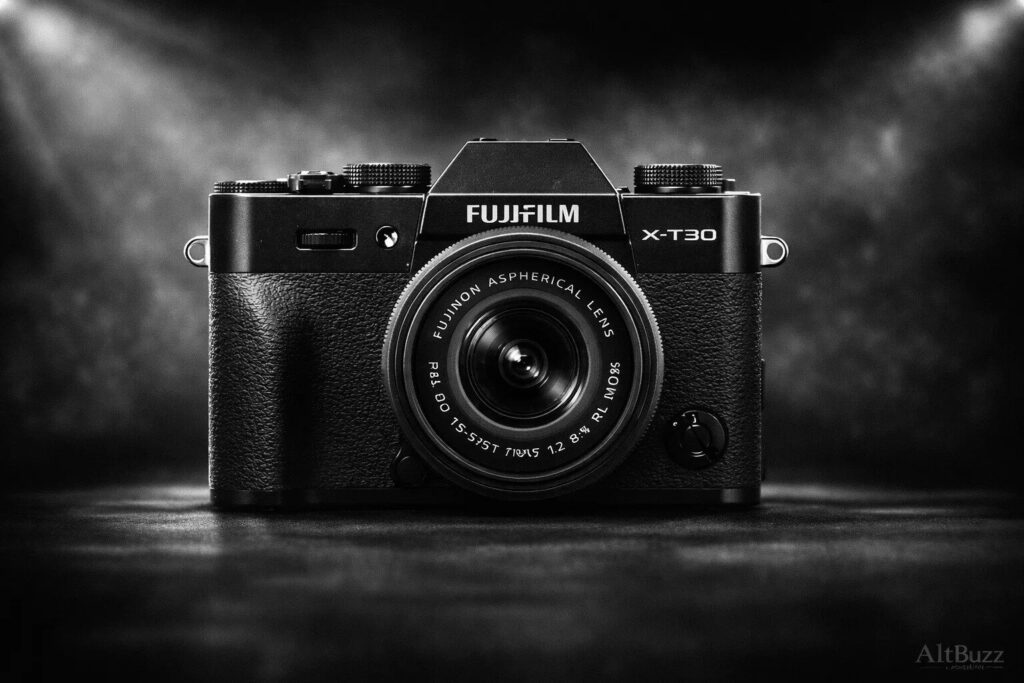
The Fujifilm X-T30 III features classic SLR-inspired design with centered viewfinder hump evoking vintage film cameras beautifully. This retro aesthetic creates instant visual appeal distinguishing the camera from modern minimalist designs immediately. Available in three color options – black, silver, and charcoal silver – the camera photographs beautifully for social media content. The two-tone designs particularly appeal to photographers appreciating heritage aesthetics. The compact dimensions measure 118.4mm x 82.8mm x 46.8mm matching the previous X-T30 II exactly maintaining beloved form factor.
At just 378 grams body-only weight, the camera ranks among lightest SLR-styled mirrorless cameras available. This exceptional portability encourages all-day carrying without fatigue reducing reluctance bringing cameras along. Travel photographers particularly appreciate the reduced pack weight enabling complete systems weighing less than single full-frame camera bodies. However, the lightweight construction uses predominantly plastic rather than magnesium alloy found in higher-tier models. The plastic body feels solid and well-assembled but lacks premium heft suggesting expensive equipment.
Importantly, the X-T30 III lacks weather sealing entirely making it vulnerable to moisture and dust contamination. Photographers shooting in challenging conditions must protect the camera carefully using rain covers or protective bags. This limitation eliminates the camera from consideration for outdoor adventure photography and professional assignments requiring reliability regardless of conditions. The absence of weather sealing represents most significant compromise distinguishing entry-level from professional equipment clearly.
Ergonomic design provides comfortable handling despite compact dimensions through thoughtful control placement. The sculpted front grip accommodates three fingers comfortably with pinky naturally curling underneath. The rear thumb rest features prominent grip texture providing secure purchase during one-handed operation. However, photographers with larger hands may find the compact size slightly cramped requiring adaptation. Most users adapt quickly appreciating the portability advantages outweighing minor ergonomic compromises.
Physical control layout emphasizes tactile interaction through dedicated dials and switches. Shutter speed and ISO dials position prominently on the top plate enabling direct parameter adjustment without menus. Exposure compensation dial provides plus/minus 3 stops adjustment visible at glance. The AUTO mode switch lever enables instant automatic operation for beginners learning manual controls. These physical controls create engaging shooting experience encouraging experimentation and learning.
The 2.36 million-dot OLED electronic viewfinder provides clear, detailed image preview with 0.62x magnification. The EVF proves adequate for composition and manual focus verification though resolution and magnification lag flagship models. Eye relief measures comfortably for eyeglass wearers without vignetting concerns. The 3.0-inch vari-angle touchscreen flips and rotates freely for high, low, and selfie angles. Screen resolution at 1.62 million dots provides sharp image review and intuitive menu navigation.
Notably, the camera includes built-in pop-up flash providing emergency lighting capability uncommon in modern mirrorless cameras. The small flash (GN 16’/5m at ISO 100) serves fill flash and emergency lighting adequately. This feature appeals to beginners appreciating self-contained lighting without external flash investments. However, serious flash photographers prefer dedicated external flashes providing superior power and flexibility. The pop-up flash represents thoughtful inclusion addressing entry-level user needs specifically.
Battery Life and Connectivity
Battery performance impresses significantly with rated 425 shots per charge when using Economy mode. This represents substantial improvement over previous models through X-Processor 5’s enhanced power efficiency. Real-world shooting often exceeds this conservative rating with photographers reporting 500-600+ shots during typical mixed usage. However, extensive video recording depletes batteries much faster requiring spare batteries for extended production sessions. The compact NP-W126S battery charges via USB-C enabling convenient power bank charging during travel.
USB-C connectivity supports both charging and data transfer with adequate speeds for most applications. Transfer speeds reach USB 2.0 standards enabling reasonable file offloading though slower than USB 3.x competitors. Most photographers find the speed acceptable for occasional transfers though professional workflows benefit from faster connections. The USB-C port location proves convenient without obstructing typical handling positions.
Wireless connectivity via 2.4GHz Wi-Fi and Bluetooth 4.2 enables smartphone connection for remote control and file transfer. The Fujifilm Camera Remote app controls the camera wirelessly with full parameter adjustment and live view preview. Remote shooting proves valuable for group photos, self-portraits, and wildlife photography from hides. Image transfer happens adequately fast for JPEG files though large RAW transfers require patience. The constant Bluetooth connection maintains low-power link for instant connectivity.
Notably, the camera supports wireless printing directly to Fujifilm’s instax Link series smartphone printers. This feature enables immediate physical prints from digital images without computer involvement. The integration appeals particularly to younger photographers appreciating instant gratification of physical prints. The printer connection supports mini, square, and wide aspect ratios providing creative flexibility. This thoughtful feature demonstrates Fujifilm’s understanding of modern photography workflows blending digital and physical mediums.
The single SD card slot uses widely available UHS-I cards rather than faster UHS-II standard found in higher-tier models. This specification proves adequate for photography and 4K video recording though 6.2K recording benefits from faster cards. Photographers shooting primarily stills find UHS-I cards perfectly sufficient and more affordable. However, the single slot lacks backup redundancy important for professional critical applications. Event and wedding photographers requiring dual card backup should consider higher-tier X-T50 or X-S20 models instead.
Real-World Use Cases
The Fujifilm X-T30 III excels particularly in travel photography scenarios where compact dimensions and lightweight design prove invaluable. The camera disappears into small bags enabling spontaneous shooting opportunities during explorations. International travelers appreciate the reduced pack weight during extended trips and flights. The excellent image quality ensures professional results despite compact form factor. The Film Simulation modes enable achieving desired aesthetics without laptop and editing software during travels.
Street photography benefits tremendously from the discrete appearance and silent electronic shutter for candid work. The retro styling appears vintage rather than expensive reducing theft concerns and subject awareness. The 20fps electronic shutter captures fleeting moments silently without drawing attention. The compact dimensions enable working intimately with subjects without intimidating bulky equipment. Street photographers report the camera encouraging shooting more frequently through reduced carrying burden.
Portrait photography produces beautiful results leveraging Fujifilm’s legendary color science and Film Simulation modes. Skin tones render naturally with pleasing saturation straight from camera without extensive retouching. The Portrait-optimized Film Simulations including Astia and Pro Neg. provide excellent starting points. Environmental portraits benefit from the compact size enabling natural subject interaction without equipment distraction. However, studio portrait photographers may miss in-body stabilization for versatile lens compatibility.
Family and lifestyle photography suits the camera’s intuitive operation and AUTO mode simplicity perfectly. Parents documenting children appreciate the reliable autofocus and fast burst rates capturing active subjects. The pop-up flash provides emergency lighting for indoor family gatherings. The vari-angle screen enables high and low angle shots of children at play. The Film Simulations create beautiful memories straight from camera without editing knowledge requirements.
Content creation for social media, blogs, and YouTube benefits from the enhanced video capabilities significantly. The 6.2K Open Gate recording enables extracting multiple aspect ratios from single takes streamlining workflow. The 10-bit 4:2:2 color provides professional quality suitable for monetized content and client work. However, content creators shooting active footage miss in-body stabilization requiring lens-based solutions or gimbals. The overall video quality rivals cameras costing significantly more.
Casual event photography including parties, gatherings, and celebrations handles admirably through the AUTO mode and pop-up flash. Beginners appreciate the simplified operation while learning manual controls progressively. The Film Simulations enable achieving professional-looking results without technical expertise. However, professional event photographers requiring dual card backup and weather sealing should choose higher-tier equipment.
Pros and Cons
Pros
- Exceptional value at $999 delivering professional image quality at entry-level pricing
- Revolutionary dedicated Film Simulation dial with customizable FS1-FS3 recipe positions
- 20 Film Simulation modes including modern Reala ACE and Nostalgic Neg.
- Latest X-Processor 5 bringing improved autofocus and enhanced battery efficiency
- Impressive 6.2K/30p Open Gate recording with 10-bit 4:2:2 color internally
- AI-powered subject detection for humans, animals, birds, vehicles, insects, drones
- Remarkably lightweight 378g body enabling portable full-featured systems
- Improved battery life rated 425 shots in Economy mode
- Classic retro SLR-inspired design with tactile physical control dials
- Built-in pop-up flash providing emergency lighting capability
- Vari-angle touchscreen enabling flexible composition angles
- Direct wireless printing to Fujifilm instax Link series printers
- USB-C charging enabling convenient power bank compatibility
- Three attractive color options: black, silver, charcoal silver
- Excellent Fujifilm color science producing beautiful straight-from-camera JPEGs
Cons
- Complete absence of in-body image stabilization limiting lens compatibility and video
- No weather sealing making camera vulnerable to moisture and dust
- Plastic body construction lacking premium magnesium alloy feel
- Single SD UHS-I card slot without backup redundancy
- Autofocus performance lags professional wildlife and sports cameras significantly
- No headphone jack requiring USB-C adapters for audio monitoring
- USB 2.0 data transfer speeds slower than modern USB 3.x standards
- Electronic viewfinder resolution and magnification lag flagship models
- Small pop-up flash provides limited power for serious flash photography
- No subject priority registration for pre-selecting specific faces
- Video recording time limited by battery capacity during intensive shooting
- Ergonomics may feel cramped for photographers with larger hands
- X-Trans sensor processing requires compatible RAW software
Final Verdict
The Fujifilm X-T30 III delivers exceptional value providing professional image quality and engaging shooting experience at remarkably accessible pricing. At $999, it costs significantly less than competing SLR-styled mirrorless cameras while offering superior Film Simulation modes and tactile controls. The dedicated Film Simulation dial alone represents revolutionary interface improvement encouraging creative experimentation. The upgraded X-Processor 5 brings modern autofocus capabilities and significantly improved video specifications previously unavailable at this price point. The combination creates genuinely compelling package difficult matching anywhere near similar cost.
Value assessment reveals the X-T30 III delivering approximately 75% of flagship X-T5 capability at 60% of the cost. For many enthusiast photographers, the performance difference doesn’t justify flagship premium pricing. The X-T30 III handles virtually all enthusiast applications admirably including travel, street, portraits, and casual family photography. Only photographers requiring professional weather sealing, dual card backup, or maximum autofocus performance need considering more expensive alternatives. The excellent image quality, engaging controls, and comprehensive feature set create reliable tool for serious photography.
The camera’s greatest strengths lie in accessibility, film-inspired workflow, and exceptional straight-from-camera JPEG quality. The dedicated Film Simulation dial transforms shooting experience making creative adjustments instantaneous and enjoyable. No competing camera provides equivalent tactile interaction and aesthetic control at similar pricing. The 6.2K video recording represents dramatic capability improvement bringing professional-quality video to entry-level pricing. The improved battery life through X-Processor 5 efficiency eliminates previous range anxiety concerns.
However, specific limitations prove frustrating depending on particular shooting requirements and experience levels. The complete absence of in-body stabilization restricts lens compatibility and handheld video capability significantly. The lack of weather sealing eliminates the camera from consideration for outdoor adventure photography and challenging conditions. The single card slot prevents professional event usage requiring backup redundancy. These limitations prove acceptable for enthusiast applications but restrict professional adoption.
Who Should Buy: Enthusiast photographers seeking engaging tactile shooting experiences find ideal tools. Travel photographers wanting compact systems with professional image quality benefit tremendously. Street shooters appreciating discrete retro styling and silent operation discover perfect equipment. Portrait photographers leveraging Fujifilm color science and Film Simulations upgrade confidently. Content creators requiring excellent video quality at accessible pricing gain comprehensive capability. Smartphone upgraders ready for intentional photography appreciate the learning-friendly AUTO mode. Fujifilm system users seeking affordable backup bodies expand capability economically. Film photography veterans transitioning digital appreciate familiar manual control approach.
Who Should Avoid: Professional photographers requiring weather sealing and dual card backup need higher-tier equipment. Sports and wildlife specialists needing advanced autofocus tracking should choose X-H2S or competitors. Videographers requiring in-body stabilization and unlimited recording benefit from alternative cameras. Photographers shooting primarily in challenging outdoor conditions need weather-sealed alternatives. Users preferring electronic interfaces over physical dials find other cameras more intuitive. Budget-limited buyers find capable alternatives at lower pricing accepting different philosophies.
The Fujifilm X-T30 III succeeds brilliantly as accessible entry point into serious photography combining heritage design with modern capabilities. It proves that engaging shooting experience and beautiful image quality matter more than pure specifications for many photographers. The camera will likely become beloved among enthusiasts as the most enjoyable sub-$1,000 camera available.
Read More from AltBuzz
Read more from AltBuzz for camera reviews, detailed specs, and expert insights. AltBuzz delivers trusted and easy-to-understand photography content. Explore Film Simulation recipes, comprehensive lens reviews, and practical photography tutorials. Our experienced team provides honest recommendations for Fujifilm shooters at all levels.
Subscribe AltBuzz YouTube Channel
Stay updated with camera reviews and comparisons. AltBuzz shares hands-on camera content regularly. Watch Film Simulation demonstrations, real-world autofocus testing, and video quality comparisons. Subscribe here: 👉 Subscribe Altbuzz