
Sony A7R V vs Canon EOS R5 Mark II: The Ultimate Photography Battle
If you are serious about photography, the Sony A7R V vs Canon EOS R5 Mark II is probably the most important comparison you can make right now. These two cameras sit at the very top of the mirrorless world. They both attract working professionals. They both cost a significant amount of money. And they both promise to deliver the absolute best image quality available today.
But they are not the same camera. They have different strengths. They serve different types of photographers. And choosing the wrong one for your needs is an expensive mistake.
This guide will walk you through every major aspect of both cameras. By the end, you will have a clear answer to the question: which one should you buy?
A Quick Look at Both Cameras
Before diving into the numbers, it helps to understand what each camera was built to do.
The Sony A7R V is Sony’s flagship high-resolution camera. It was designed for photographers who demand maximum detail in every frame. Landscape photographers, fine art shooters, architectural photographers, and studio professionals all gravitate toward it. Sony packed 61 megapixels into a full-frame body and added a dedicated AI processing chip to handle autofocus and subject recognition.
The Canon EOS R5 Mark II is Canon’s answer to the modern hybrid shooter. It targets photographers who need excellent stills and equally excellent video in a single body. Sports photographers, wildlife shooters, wedding professionals, and content creators are drawn to its combination of advanced autofocus, high burst speeds, and cinematic video quality.
Understanding this fundamental difference shapes everything else in the Sony A7R V vs Canon EOS R5 Mark II comparison.
Release Date and Market Position
Sony announced the A7R V in October 2022. It replaced the already well-respected A7R IV and introduced meaningful upgrades across the board. The new AI processing unit was the headline feature. It allowed Sony to deliver a level of autofocus tracking that the A7R IV simply could not match.
Canon released the EOS R5 Mark II in July 2024. Canon used the extra development time wisely. The R5 Mark II addressed nearly every weakness of the original R5. Overheating issues were resolved. Autofocus was dramatically improved. Burst rates were increased. Video capabilities were expanded. Canon came back swinging hard.
Both cameras are currently available and actively supported by their respective brands. Both have strong lens ecosystems. Both represent serious long-term investments.
Sony A7R V vs Canon EOS R5 Mark II Specs
| Feature | Sony A7R V | Canon EOS R5 Mark II |
|---|---|---|
| Sensor Type | Full-Frame BSI CMOS | Full-Frame BSI CMOS |
| Resolution | 61 Megapixels | 45 Megapixels |
| Image Processor | BIONZ XR + Dedicated AI Unit | DIGIC X + AI Accelerator Chip |
| Native ISO Range | 100 to 32000 | 100 to 51200 |
| Extended ISO | 50 to 102400 | 50 to 204800 |
| Autofocus System | 693-Point Phase-Detect | 1053-Point Phase-Detect |
| Subject Recognition | Human, Animal, Bird, Insect, Vehicle | People, Animal, Vehicle, Plane, Train |
| In-Body Stabilization | 8 Stops (5-Axis) | 8+ Stops (5-Axis Coordinated) |
| Mechanical Burst | 10 fps | 30 fps |
| Electronic Burst | 15 fps (compressed) | 30 fps (lossless RAW) |
| Video Resolution | 8K 25fps, 4K 60fps | 8K 60fps RAW, 4K 120fps |
| Log Profiles | S-Log2, S-Log3, HLG | Canon Log 2, Canon Log 3, HDR PQ |
| Viewfinder | 9.44M-dot OLED EVF | 5.76M-dot OLED EVF |
| Rear Screen | 3.2″ Multi-Angle Touchscreen | 3.2″ Fully Articulating Touchscreen |
| Card Slots | CFexpress Type A + SD | CFexpress Type B + SD |
| Battery | NP-FZ100 (approx. 530 shots) | LP-E6NH (approx. 490 shots) |
| Weather Sealing | Yes | Yes |
| Body Weight | 723g | 746g |
| Launch Price | USD 3,500 | USD 4,300 |
Sensor and Image Quality
Resolution Comparison
The biggest number in this comparison is resolution. The Sony A7R V offers 61 megapixels. That is one of the highest resolutions available in any full-frame mirrorless camera today. It gives you extraordinary detail. You can crop aggressively without losing sharpness. You can print at very large sizes with confidence. Every blade of grass, every brick in a wall, every strand of hair is captured with precision.
The Canon EOS R5 Mark II offers 45 megapixels. That is still an impressively high resolution. For the vast majority of professional use cases, 45MP is more than sufficient. Wedding albums, editorial spreads, commercial prints, and even large-format exhibition prints are all achievable at 45MP.
But when you need absolute maximum detail, the Sony A7R V has a clear and measurable advantage.
Dynamic Range
Sony sensors have long been praised for their dynamic range. The A7R V continues this tradition. Shadow recovery in Sony RAW files is remarkable. You can pull up deep shadows by several stops and retain clean, usable detail. Highlights hold well too. For landscape photographers who shoot challenging lighting conditions, this matters enormously.
Canon has closed the gap considerably with the R5 Mark II. The newer sensor design and improved processor deliver dynamic range that rivals Sony in many real-world scenarios. Canon shooters no longer feel like they are at a disadvantage when pushing files in post-production.
Still, Sony holds a slight edge in overall dynamic range performance, particularly in shadow recovery at base ISO.
Color Rendering
This is where photography becomes subjective. Sony produces accurate, neutral colors. They are slightly clinical but highly flexible in post. You can push Sony RAW files in virtually any color direction you choose. This makes them ideal for photographers who do extensive retouching or who need color consistency across a large number of images.
Canon’s color science has a warmer, more pleasing character straight out of camera. Skin tones in Canon files are widely regarded as among the most flattering in the industry. Many portrait and wedding photographers choose Canon cameras specifically because of how skin looks before any editing is applied.
For the Sony A7R V vs Canon EOS R5 Mark II in color rendering, Canon wins on out-of-camera appeal. Sony wins on raw flexibility. Neither is wrong.
High ISO Performance
At lower ISO values, both cameras produce extremely clean images. As you push into high ISO territory, the difference becomes more apparent.
The A7R V handles ISO 3200 to 6400 very well. Beyond ISO 12800, noise increases noticeably, which is expected given the very high pixel density of the 61MP sensor. More pixels mean smaller individual photosites, which means less light per pixel.
The R5 Mark II, with its 45MP sensor, has slightly larger photosites. This gives it a measurable advantage in high ISO performance. ISO 6400 and even ISO 12800 produce very clean results. For event photographers, wedding shooters, and photojournalists who frequently work in challenging light, this is a meaningful practical advantage.
Autofocus Performance
Sony A7R V Autofocus
Sony’s autofocus system in the A7R V is powered by a dedicated AI processing unit that works alongside the main BIONZ XR processor. This combination allows for real-time subject recognition and tracking across a wide range of subjects. Human eye detection is fast and accurate. Animal and bird tracking is impressive for a camera primarily designed for high-resolution stills.
The system covers approximately 693 phase-detect points across the sensor. Coverage is wide and transitions are smooth. For portrait photographers, event photographers, and anyone shooting moving subjects, the A7R V’s autofocus is a genuine strength.
Canon EOS R5 Mark II Autofocus
Canon’s autofocus in the R5 Mark II is, by most objective assessments, the most accurate subject-tracking system in any mirrorless camera available today. The 1053-point phase-detect system combined with the AI Accelerator chip delivers tracking that feels almost telepathic.
The camera can identify and lock onto subjects at remarkable speed. It maintains tracking through obstructions, against complex backgrounds, and at high burst rates without hesitation. For sports photographers and wildlife shooters, the R5 Mark II’s autofocus is transformative.
Head-to-Head Autofocus Verdict
For portrait sessions, studio work, and controlled environments, both cameras perform at a very high level. In fast action, wildlife, and unpredictable scenarios, the Canon EOS R5 Mark II pulls clearly ahead. The Sony A7R V vs Canon EOS R5 Mark II autofocus comparison gives the edge to Canon.
Burst Shooting Speed
This is one of the most dramatic differences in the Sony A7R V vs Canon EOS R5 Mark II specs comparison.
The Sony A7R V shoots at 10 frames per second with the mechanical shutter and 15 frames per second electronically. For a 61MP camera, those are respectable numbers. However, the file sizes at 61MP are enormous. Buffer management becomes a real consideration during extended bursts.
The Canon EOS R5 Mark II shoots at 30 frames per second with both the mechanical and electronic shutter. The electronic shutter delivers lossless RAW at 30fps, which is extraordinary. Sports and action photographers can capture sequences in incredible detail without worrying about compressed RAW artifacts.
For fast action, the Canon wins this category by a comfortable margin.
Video Capabilities
Sony A7R V Video
The A7R V is primarily a stills camera. Its video capabilities are solid but not its defining feature. It records 8K at 25fps and 4K at up to 60fps. S-Log3 provides good dynamic range for color grading. Oversampled 4K from the full sensor is sharp and detailed.
However, the A7R V lacks some of the video-specific features that dedicated hybrid cameras offer. No 4K 120fps. No advanced cinema-focused tools. It is adequate for hybrid shooters but not designed to compete in the video space.
Canon EOS R5 Mark II Video
Canon designed the R5 Mark II to be a true hybrid powerhouse. The video specifications are remarkable. Internal 8K RAW recording up to 60fps. 4K recording up to 120fps for slow-motion work. Canon Log 3 for excellent dynamic range. Improved thermal management for longer recording sessions.
For the Sony A7R V vs Canon EOS R5 Mark II for video, Canon wins decisively. The R5 Mark II is a genuine hybrid camera. The A7R V is a stills camera that can record video.
Build Quality and Ergonomics
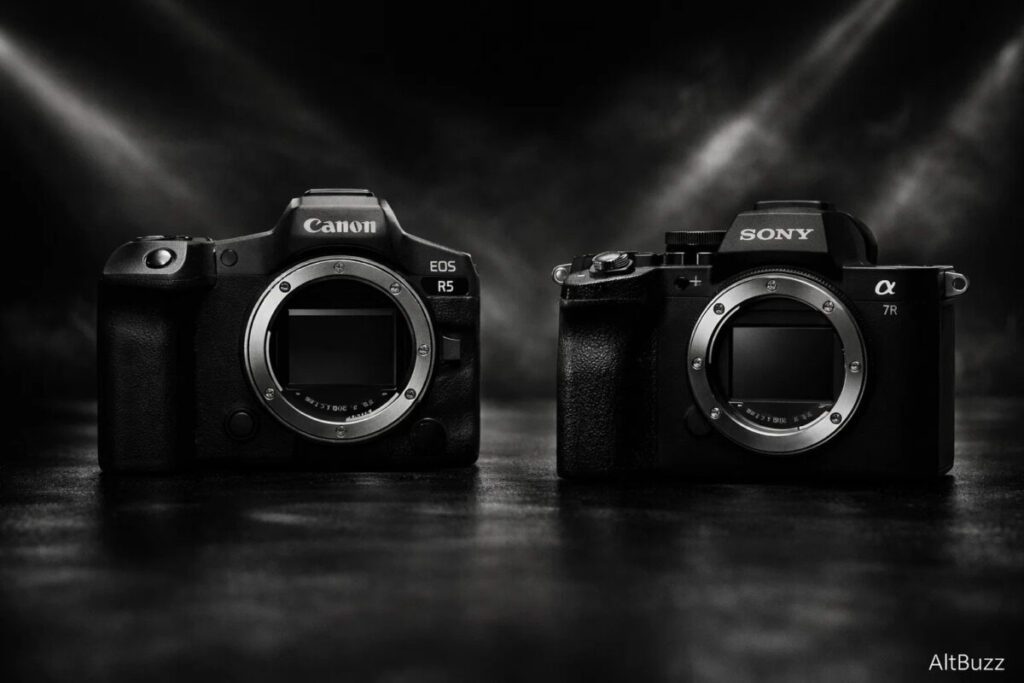
Both cameras are built to professional standards. Both feature weather sealing that can handle light rain and dust. Both use magnesium alloy construction. Both feel solid and well-assembled in hand.
The Sony A7R V introduced a redesigned grip that is more comfortable than its predecessor. The button layout was refined. The new menu system, while still complex, is far more logical than older Sony interfaces. The multi-angle tilting screen is a welcome addition for shooting at unusual angles.
The Canon EOS R5 Mark II retains the excellent ergonomics of the original R5. The grip is deep and comfortable for extended shooting sessions. The button layout is intuitive, particularly for Canon users upgrading from DSLRs or earlier mirrorless bodies. The fully articulating screen adds flexibility for both stills and video.
Both cameras feel great in hand. Canon’s grip is slightly more comfortable for photographers with larger hands. Sony’s screen articulation is useful but slightly less flexible than Canon’s fully articulating design.
Battery Life and Connectivity
The A7R V uses the NP-FZ100 battery and delivers approximately 530 shots per charge under standard testing conditions. Sony’s battery life has always been one of the weaker points of their mirrorless lineup, but 530 shots is workable for most shooting days.
The R5 Mark II uses the LP-E6NH battery and delivers approximately 490 shots per charge. Slightly lower than the Sony, though real-world performance often varies based on shooting habits, screen usage, and environmental conditions.
Both cameras support USB-C charging, which is extremely useful in the field. Both have dual card slots for backup shooting or overflow. Both support 5GHz Wi-Fi for fast wireless file transfer.
Lens Ecosystem
The Sony A7R V uses the E-mount, which has one of the largest selections of native mirrorless lenses available. Sony G Master lenses are highly regarded for their optical quality. Third-party options from Sigma, Tamron, and Zeiss add enormous variety. If lens selection matters to you, Sony’s ecosystem is one of the best in the industry.
The Canon R5 Mark II uses the RF mount. Canon RF lenses are optically exceptional. The RF 50mm f/1.2, the RF 28-70mm f/2, and the RF 100-500mm are among the finest lenses available for any system. However, the RF ecosystem is still growing and tends to be more expensive than equivalent E-mount options.
Price and Value
The Sony A7R V is available at approximately USD 3,500. For 61 megapixels, AI autofocus, and excellent dynamic range, it represents strong value for photographers who prioritize resolution above all else.
The Canon EOS R5 Mark II is available at approximately USD 4,300. The higher price reflects its hybrid capabilities, faster burst rate, and more advanced autofocus. For photographers who need everything in one body, the extra cost is justified.
Should I Buy Sony A7R V or Canon EOS R5 Mark II?
This is the central question of the Sony A7R V vs Canon EOS R5 Mark II debate. Here is a clear breakdown.
The Sony A7R V is the right choice if you:
- Shoot landscapes, architecture, fine art, or studio work
- Prioritize maximum resolution above all other features
- Work primarily with stills and do minimal video
- Are already using Sony E-mount lenses
- Want to spend slightly less money without sacrificing image quality
The Canon EOS R5 Mark II is the right choice if you:
- Shoot sports, wildlife, weddings, or events
- Need fast burst rates and reliable subject tracking
- Require high-quality video alongside professional stills
- Prefer Canon’s color science for portrait and wedding work
- Are willing to invest more for a complete hybrid solution
Is the Sony A7R V better than the Canon EOS R5 Mark II for photography?
For resolution-based photography, yes. For action, autofocus reliability, and hybrid use, no. The difference between the Sony A7R V and Canon EOS R5 Mark II comes down to specialization versus versatility. Sony specializes in maximum resolution. Canon specializes in versatility.
Pros and Cons
Sony A7R V
Strengths
- Industry-leading 61MP resolution
- Outstanding dynamic range and shadow recovery
- Excellent AI autofocus for a high-resolution camera
- Competitive pricing for its class
- Massive E-mount lens ecosystem
Weaknesses
- Lower burst rate than Canon
- Video capabilities are limited compared to hybrid cameras
- High ISO performance is behind Canon due to pixel density
- Large file sizes require significant storage and processing power
Canon EOS R5 Mark II
Strengths
- Best-in-class autofocus system
- Exceptional hybrid stills and video capability
- 30fps burst with lossless RAW
- 4K 120fps slow-motion video
- Superior high ISO performance
Weaknesses
- Higher price point
- Smaller file resolution than Sony
- RF lens ecosystem is more expensive
- Battery life is slightly lower than Sony
Final Verdict
The Sony A7R V vs Canon EOS R5 Mark II is a battle between two exceptional cameras. Neither camera is a bad choice. The difference is in what you value most.
If you are a landscape photographer, architectural shooter, or studio professional who wants the maximum possible detail in every image, the Sony A7R V is your camera. Its 61 megapixels, outstanding dynamic range, and competitive price make it the best high-resolution mirrorless camera available.
If you are a wedding photographer, sports shooter, wildlife photographer, or hybrid content creator who needs fast autofocus, high burst rates, and professional-grade video, the Canon EOS R5 Mark II is your camera. It is more expensive, but it delivers a level of versatility that the Sony cannot match.
Choose based on your work. Both cameras will serve you extremely well.
Read More from AltBuzz
Read more from Altbuzz for camera reviews, rumors, and detailed specs. AltBuzz delivers trusted and easy-to-understand photography content for photographers at every level.
Subscribe to the AltBuzz YouTube Channel
Stay updated with the latest camera reviews, rumors, and head-to-head comparisons. AltBuzz publishes regular camera content you can rely on. Subscribe Altbuzz today and stay ahead of the curve.