
iPhone 15 Pro Max vs Sony A7 V: Can a Smartphone Really Replace a Camera?
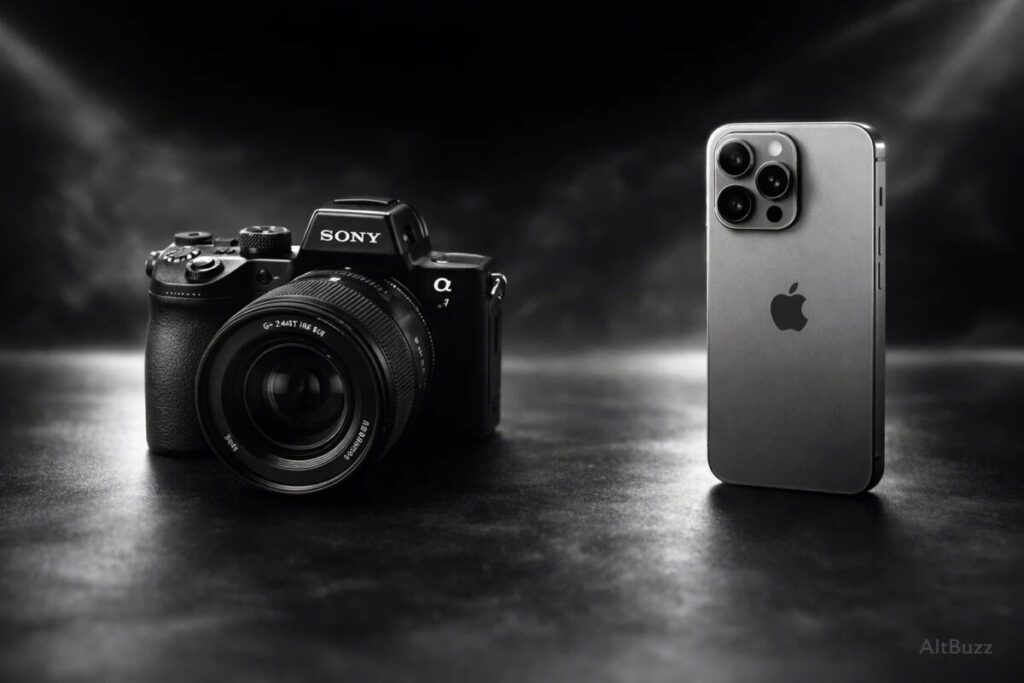
The iPhone 15 Pro Max vs Sony A7 V is the comparison that nobody would have entertained seriously just a few years ago. Today, it is a debate worth having. Apple has pushed smartphone camera technology to levels that genuinely impress professional photographers. The iPhone 15 Pro Max shoots ProRes video, records Apple Log, and produces images that are good enough for commercial use in many situations.
But here is the truth that this comparison will make very clear: a smartphone camera and a dedicated full-frame mirrorless camera are not the same thing. The Sony A7 V is in a different league. It always will be. And this article will show you exactly why, with the honesty that photographers who are serious about their craft deserve.
This is not a comparison designed to validate the idea that your phone is enough. This is a comparison designed to show you what you are giving up when you choose convenience over capability.
Understanding What These Devices Were Built to Do
The iPhone 15 Pro Max is the world’s most advanced smartphone. Photography is one of its many functions. It is designed to let everyone capture good-looking photos and video in any situation, with minimal effort and maximum convenience. Apple’s engineering is remarkable. The computational photography systems are sophisticated. The results can be genuinely impressive.
The Sony A7 V is a dedicated full-frame mirrorless camera built for photographers who have chosen image-making as a serious pursuit. It is designed to give creative professionals the tools they need to produce images that cannot be created any other way. Every element of its design, from the sensor size to the lens mount to the autofocus system, serves the single goal of producing the highest-quality images possible.
These two devices share the word “camera” only loosely. Understanding their fundamental purposes is the starting point for understanding the iPhone 15 Pro Max vs Sony A7 V comparison.
Release Date and Market Context
Apple announced the iPhone 15 Pro Max in September 2023 alongside the full iPhone 15 lineup. The Pro Max represented Apple’s most ambitious effort yet to close the gap with dedicated cameras. Apple Log and ProRes were the headline features for photography enthusiasts. For a general audience, the 5x optical zoom and improved portrait mode were the talking points.
Sony revealed the A7 V in late 2024 as the successor to the well-respected A7 IV. The A7 V brought a refined AI autofocus system, improved sensor performance, updated video specifications, and enhanced in-body stabilization. It continues Sony’s position as one of the most trusted names in professional full-frame mirrorless photography.
One of these devices exists to make everyone feel like a photographer. The other exists to make photographers feel fully equipped for any challenge.
iPhone 15 Pro Max vs Sony A7 V: Full Specifications
| Feature | iPhone 15 Pro Max | Sony A7 V |
|---|---|---|
| Device Type | Smartphone | Full-Frame Mirrorless Camera |
| Main Camera Sensor | 48MP (1/1.28-inch sensor) | Approx. 33MP Full-Frame BSI CMOS |
| Sensor Size | 1/1.28 inch | Full-Frame 35mm |
| Aperture (Main Lens) | f/2.8 (fixed, non-adjustable) | Adjustable (depends on lens) |
| Lens System | Three fixed lenses | Interchangeable (Sony E-mount) |
| Optical Zoom | 5x (120mm equivalent) | Unlimited via lens selection |
| ISO Range | Automatic (up to ~6400 main) | 100 to 51200 (ext. 50 to 204800) |
| Autofocus | Apple AI-based phase-detect | AI Phase-Detect with Subject Recognition |
| In-Body Stabilization | Sensor-Shift OIS | 7-stop 5-Axis IBIS |
| Video | 4K 60fps, ProRes, Apple Log | 4K 60fps, 4K 120fps (Super35 crop) |
| Log Format | Apple Log | S-Log2, S-Log3 |
| RAW File Support | ProRAW (computational) | Uncompressed / Lossless RAW |
| File Flexibility | Limited (Apple ecosystem-friendly) | Full RAW flexibility |
| Rear Display | 6.7-inch OLED touchscreen | 3-inch tilting LCD |
| EVF | No | Yes (high-resolution OLED) |
| Depth-of-Field Control | Simulated (computational) | Natural (optical, lens-dependent) |
| External Flash/Lighting Support | Limited | Full (via hot shoe and accessories) |
| Weight | 221g | Approx. 514g (body only, no lens) |
| Battery | All-day estimated use | Approx. 580 shots per charge |
| Price | Approx. USD 1,199 | Approx. USD 3,299 (body only) |
Sensor Size: Why Physics Still Wins
This is the most important section of the entire iPhone 15 Pro Max vs Sony A7 V comparison. It is the section that explains, fundamentally and irrefutably, why a dedicated camera like the Sony A7 V produces superior images.
The iPhone 15 Pro Max uses a sensor measuring approximately 1/1.28 inches. The Sony A7 V uses a full-frame sensor measuring 36mm by 24mm. The surface area difference between these two sensors is enormous. The full-frame sensor in the Sony is approximately 30 times larger than the sensor in the iPhone.
This matters because light is the raw material of photography. A larger sensor collects more light per unit of time. More light means better signal. More signal means less noise. Less noise means cleaner images at higher ISO values. Better light collection also means more natural tonal gradation, richer shadows, and more detailed highlights.
No amount of software processing can fully compensate for this fundamental physical difference. Apple has built extraordinary computational photography systems that maximize what the iPhone sensor can do. The results are impressive for the sensor size. But the Sony A7 V is capturing far more actual optical information in every frame.
This is not a criticism of Apple’s engineering. It is a statement of physical reality. And it is the core reason why the Sony A7 V produces images that the iPhone 15 Pro Max simply cannot replicate.
Image Quality Comparison
Resolution and Detail
The iPhone 15 Pro Max main camera captures 48 megapixels. It is worth noting that this resolution is achieved through a process called pixel binning in most shooting modes, combining multiple pixels to create a cleaner final image. The resulting detail is good, particularly in good lighting.
The Sony A7 V produces approximately 33 megapixels of full-frame resolution. Each pixel receives significantly more light than each pixel in the iPhone sensor, because the individual photosites on a full-frame sensor are much larger despite the iPhone having more total pixels.
The practical result is that Sony A7 V images contain more genuinely usable detail. They withstand aggressive cropping far better. They resolve fine textures, subtle tones, and distant subjects with a clarity that iPhone images cannot match, particularly when the comparison is made at high levels of magnification or in challenging lighting.
Dynamic Range
Dynamic range is one of the clearest indicators of sensor capability. The Sony A7 V delivers exceptional dynamic range from its full-frame sensor. RAW files from the A7 V allow extensive shadow recovery and highlight protection. Photographers who shoot landscapes, architectural interiors, or any high-contrast scene will immediately notice the advantage.
The iPhone 15 Pro Max uses Smart HDR and computational processing to generate impressive dynamic range from its smaller sensor. Results in JPEG and HEIC formats are genuinely good. However, Apple ProRAW files, while more flexible than standard iPhone photos, do not offer anywhere near the post-processing latitude of Sony A7 V RAW files.
In a side-by-side comparison of high-contrast scenes processed by experienced retouchers, the A7 V files consistently reveal more shadow detail and more recoverable highlight information. This difference becomes dramatic when shooting in difficult natural light conditions.
Low Light Photography
Low-light performance is perhaps the single biggest gap between the iPhone 15 Pro Max and the Sony A7 V. And the gap is very large.
The iPhone uses Night Mode, a multi-frame long-exposure computational technique that stacks multiple frames to reduce noise. The results are impressive for casual use. In good hands, Night Mode iPhone photos look clean on a screen and even in small prints.
However, the Sony A7 V at ISO 6400 captures images with more natural noise characteristics, better color accuracy in shadow regions, and more genuine detail than the iPhone achieves through computational stacking. At ISO 12800 and above, the Sony A7 V continues to produce usable, professional images. At those same light levels, iPhone images begin to show significant degradation in texture and color accuracy, even with Night Mode engaged.
For photographers who work at events, in theaters, in restaurants, at night, or in any environment where light is limited, the Sony A7 V is not just better than the iPhone 15 Pro Max. It is categorically more capable. This is not a gap that can be closed by software updates or new computational techniques. It is a sensor physics gap.
Depth of Field and Background Separation
This area of comparison is where the iPhone’s limitations become most visually apparent. Natural, optically-produced background blur from a large-aperture lens on a full-frame camera is one of the most visually compelling qualities of professional photography. It is also one of the hardest things for a smartphone to imitate convincingly.
Apple’s Portrait Mode uses computational analysis to separate the subject from the background and apply simulated blur. In ideal conditions, with cooperative subjects and clear depth differentiation, it works reasonably well. But edge rendering is often soft or slightly artificial. Hair, fabric edges, and subjects that overlap with the background often show the telltale signs of digital processing.
The Sony A7 V with a 50mm f/1.4 or 85mm f/1.8 lens produces background blur that is optically natural. The bokeh circles are organic. Edge separation is precise. The subject stands out from the background in a way that simply looks different from any computational simulation.
For portrait photographers, this distinction alone is worth the investment in a dedicated camera.
Autofocus Comparison
iPhone 15 Pro Max Autofocus
Apple’s autofocus in the iPhone 15 Pro Max is fast, reliable, and well-tuned for casual and even semi-professional photography. Face detection and subject tracking work effectively across the three cameras. For everyday shooting, events, and social content, the iPhone autofocus is fully adequate.
Where it begins to show limitations is in fast action, low contrast scenarios, and situations that demand precise, consistent subject tracking over extended periods.
Sony A7 V Autofocus
Sony’s AI autofocus system in the A7 V represents the current state of the art in dedicated camera autofocus. The subject recognition covers humans (including eye detection), animals, birds, insects, vehicles, trains, and aircraft. Tracking is persistent and intelligent. The camera maintains lock even when subjects move behind partial obstructions, turn away, or change speed dramatically.
For wildlife photographers, sports photographers, event photographers, and anyone who regularly captures fast or unpredictable subjects, the Sony A7 V’s autofocus is not just better than the iPhone’s. It is genuinely transformative for the quality and consistency of results.
The real-time eye detection on the A7 V works in conditions where the iPhone would struggle to identify a subject at all. The practical benefit is a dramatically higher percentage of sharp, properly focused frames from any given shooting session.
Video Comparison: iPhone 15 Pro Max vs Sony A7 V
iPhone 15 Pro Max Video
Apple made significant strides in video capability with the iPhone 15 Pro Max. ProRes recording to an external SSD via USB-C is a genuinely professional feature. Apple Log gives video editors a flexible grade starting point. The built-in Action mode provides impressive stabilization for handheld footage.
Filmmakers including noted directors have used iPhone cameras for creative projects. That speaks to the genuine capability of the device. For social media content, YouTube videos, short-form storytelling, and even some commercial work, the iPhone 15 Pro Max produces beautiful video.
Sony A7 V Video
The Sony A7 V records 4K at up to 60fps with 10-bit S-Log3, oversampled from the full sensor. The 7-stop in-body stabilization produces steady footage even handheld. Slow-motion recording at 4K 120fps (in a Super 35 crop mode) opens creative possibilities for high-frame-rate content.
The full-frame sensor gives A7 V video a cinematic quality, depth of field, and tonal richness that the iPhone simply cannot replicate. Sony’s S-Log3 footage, when properly exposed and graded, produces cinematic results that hold up at professional production standards.
For commercial video production, narrative filmmaking, or any project where the final product needs to look undeniably professional, the Sony A7 V is the stronger choice. The iPhone 15 Pro Max vs Sony A7 V for video comparison is much closer than most people expect in casual situations. But when professional standards apply, the Sony A7 V is the right tool.
Lens Flexibility and Creative Control
This is one of the most significant practical differences between the two devices. The iPhone 15 Pro Max has three fixed lenses: a main wide lens, an ultrawide lens, and a 5x telephoto. You cannot change them. You cannot choose your depth of field independent of focal length. You cannot use a tilt-shift lens for architectural work, a macro lens for close-up photography, or a 400mm telephoto for wildlife.
The Sony A7 V accepts any lens in the E-mount ecosystem. Wide primes, standard zooms, telephoto zooms, macro lenses, fisheyes, tilt-shifts, and anamorphic lenses are all available. This creative flexibility is not a minor convenience. It is the difference between a camera that adapts to your subject and a camera that requires your subject to adapt to it.
Wildlife photographers need telephoto reach that no smartphone provides. Macro photographers need magnification ratios achievable only with dedicated macro lenses. Architectural photographers need tilt-shift control. In every one of these cases, the Sony A7 V is not just better than the iPhone. It is the only option that actually works.
Stabilization Comparison
The iPhone 15 Pro Max uses sensor-shift optical image stabilization on its main camera and software-based stabilization for video. Action mode adds additional aggressive stabilization for moving video. Results are impressive for a smartphone.
The Sony A7 V features a 7-stop 5-axis in-body image stabilization system. This works with any lens, including manual lenses with no electronic communication. The coordination between in-body stabilization and optically stabilized lenses produces footage stability and still image sharpness at slow shutter speeds that the iPhone cannot approach.
For photographers who regularly shoot at 1/30 of a second or slower, the Sony A7 V’s IBIS is a significant practical advantage that produces a measurable improvement in sharp frame yield.
Design, Portability, and Convenience
Here is where the iPhone 15 Pro Max earns genuine credit. It weighs 221 grams. It fits in your pocket. You have it with you every single day without any extra thought or preparation. The best photograph you never took because you left your camera at home is worth nothing. In this sense, the iPhone 15 Pro Max is an extremely capable camera that is infinitely more accessible.
The Sony A7 V weighs approximately 514 grams without a lens. A typical walk-around lens adds another 300 to 600 grams. You need a bag. You need to think about carrying it. You need to decide in advance that you are going out to photograph.
This convenience gap is real. It matters. And for casual shooters, it is the reason a smartphone is often the more sensible choice. But for working photographers, the discipline of carrying a camera is simply part of the job. And when they arrive at their subject with a Sony A7 V in hand, the results justify every gram of what they chose to carry.
Battery Life and Connectivity
The iPhone 15 Pro Max delivers a full day of typical use on a single charge. For casual shooting, it will last from morning to night without concern. Apple’s ecosystem integration means photos go automatically to iCloud, can be shared instantly, and are immediately accessible across all Apple devices.
The Sony A7 V delivers approximately 580 shots per charge. For event photographers who shoot several hundred frames in a session, one or two batteries per day are standard practice. USB-C charging means you can top up the battery from a power bank in the field. Wi-Fi transfer and a companion smartphone app allow wireless sharing, though not with the seamless ease of the iPhone ecosystem.
The iPhone wins on connectivity and convenience. The Sony wins on camera-specific battery management for professional shooting days.
Price Comparison
The iPhone 15 Pro Max starts at approximately USD 1,199 for the base storage configuration. For a device that serves as your phone, computer, map, communication tool, and camera, that price is reasonable.
The Sony A7 V body costs approximately USD 3,299. Add a versatile zoom lens and you are looking at USD 4,500 to USD 5,000 or more to build a complete shooting kit. That is a significant investment.
However, this price comparison deserves context. You are already spending money on a smartphone regardless of your camera choices. The iPhone’s camera capability is bundled with a device you need anyway. The Sony A7 V is an additional, specialized investment in your craft.
For hobby photographers and casual content creators, the iPhone 15 Pro Max’s camera at its included price is extraordinary value. For professional photographers, the Sony A7 V is a professional tool whose cost is justified by the quality of output it enables and the income that output can generate.
Which One Should You Actually Choose?
Should I Buy iPhone 15 Pro Max or Sony A7 V?
This question has a more nuanced answer than most comparisons, so let us be honest about what each device is actually suited for.
The iPhone 15 Pro Max is a better choice if:
- Photography is a secondary activity for you
- You primarily share content on social media and digital platforms
- Portability and always-having-a-camera-available are your top priorities
- You shoot spontaneous, everyday moments more than planned photographic sessions
- Your budget does not allow for a separate camera system
The Sony A7 V is the stronger choice if:
- Photography is a serious hobby or your profession
- You need maximum image quality for client work, exhibitions, or large-format printing
- You regularly shoot in challenging light conditions
- Creative control over depth of field, lens selection, and exposure matters to you
- You are willing to invest in a camera system that will genuinely elevate your work
Is the Sony A7 V Better Than the iPhone 15 Pro Max for Photography?
Yes. Unequivocally. The Sony A7 V is better than the iPhone 15 Pro Max for photography in every technical dimension that defines image quality. Sensor size, dynamic range, low-light performance, lens flexibility, depth-of-field control, RAW file latitude, and stabilization all favor the Sony A7 V. The iPhone 15 Pro Max is an impressive device with a capable camera. The Sony A7 V is a professional imaging tool designed to produce images at the highest possible standard.
The Honest Truth About Smartphones and Cameras
The narrative that smartphones are replacing dedicated cameras is popular and partially true for the mass market. Casual photographers do not need a dedicated camera anymore. The iPhone 15 Pro Max is genuinely good enough for most everyday needs.
But professional photographers, serious hobbyists, and anyone who has experienced the creative freedom of a full-frame camera with interchangeable lenses knows that smartphones and dedicated cameras are not on a path to convergence. They serve different needs. They produce different results. And the difference between the iPhone 15 Pro Max and the Sony A7 V, despite being smaller than it was a decade ago, remains very significant in real-world professional use.
What You Are Giving Up When You Choose a Smartphone
When you shoot exclusively with an iPhone 15 Pro Max instead of the Sony A7 V, you are giving up:
- The organic background separation of a large aperture lens on a full-frame sensor
- The shadow recovery and highlight protection of a full-frame RAW file
- The lens flexibility to choose the exact focal length and depth of field for each shot
- The low-light capability that makes ISO 6400 and above genuinely usable
- The tactile, deliberate experience of photography as a craft
These are not trivial sacrifices. They represent the difference between documenting what happened and creating a photograph.
Pros and Cons
iPhone 15 Pro Max
Strengths
- Always in your pocket, always available
- Excellent computational photography for everyday use
- ProRes and Apple Log for serious video work
- Seamless ecosystem integration for sharing and backup
- Price includes full smartphone functionality
Weaknesses
- Tiny sensor severely limits low-light capability
- No interchangeable lenses
- Fixed aperture with no optical depth-of-field control
- ProRAW files have limited post-processing latitude
- Background blur is computationally simulated, not optically natural
Sony A7 V
Strengths
- Full-frame sensor delivers professional-grade image quality
- Outstanding low-light performance at high ISO
- Interchangeable lens system for unlimited creative options
- Exceptional RAW file latitude for post-processing
- Natural, optically produced depth of field and background separation
- AI autofocus with real-time subject tracking
- 7-stop in-body stabilization
Weaknesses
- Requires a bag and deliberate preparation to carry
- Body-only cost plus lenses represents a significant investment
- Larger and heavier than any smartphone
- Sharing workflow is less seamless than Apple ecosystem integration
Final Verdict
The iPhone 15 Pro Max vs Sony A7 V comparison has a clear winner in photographic terms. The Sony A7 V wins. It is not particularly close when real-world image quality, creative control, and professional capability are the measures.
The iPhone 15 Pro Max is an extraordinary smartphone that happens to include a very good camera. For the target audience of most iPhone users, it is more than sufficient. It captures memories beautifully. It produces content that looks great on social media and digital screens.
But the Sony A7 V is not competing for the same audience. It exists for photographers who understand that image quality matters deeply. Who know that the difference between a computationally-generated bokeh and a real optically-produced one is visible and meaningful. Who need to deliver images for professional clients who expect the best.
If you are reading this comparison because you are wondering whether a smartphone can replace a dedicated camera for your photography work, the answer is almost certainly no. The Sony A7 V is worth every dollar you invest in it. The images it produces, the creative control it offers, and the professional output it enables place it in an entirely different category from any smartphone camera in existence today.
Carry your iPhone for daily life. Carry your Sony A7 V when photography is the purpose. The results will speak for themselves every single time.
Read More from AltBuzz
Read more from Altbuzz for camera reviews, rumors, and detailed specs. AltBuzz delivers trusted and easy-to-understand photography content for creators who take image quality seriously.
Subscribe to the AltBuzz YouTube Channel
Stay updated with real-world camera tests, comparisons, and photography content. AltBuzz publishes honest, in-depth content for photographers and filmmakers. Subscribe Altbuzz and see the difference that the right camera really makes.