
Sony FX3 vs Canon EOS C70: Which Cinema Camera Wins for Filmmakers?
Choosing between the Sony FX3 vs Canon EOS C70 is one of the most meaningful decisions a working filmmaker can make. These two compact cinema cameras dominate conversations in documentary production, commercial video, solo filmmaking, and narrative indie work. They are both small. They are both powerful. They both cost a serious amount of money. And they both attract extremely dedicated user bases.
But beneath the surface, they are fundamentally different tools built for somewhat different filmmaking philosophies. Picking the wrong one for your style of work will cost you more than money. It will cost you time on set, flexibility in post-production, and potentially opportunities when a project demands something your camera cannot deliver.
This comprehensive breakdown will take you through everything that matters, from sensor technology and codec performance to ergonomics, audio, and long-term value.
Background: Why These Two Cameras?
The Sony FX3 was Sony’s attempt to bring Cinema Line quality into a body that mirrorless photographers already loved. Before the FX3, Sony’s cinema cameras felt foreign to photographers coming from the A7 series. The FX3 changed that. It used the same E-mount, the same battery, and the same familiar form factor, but it added cinema-grade features including dual base ISO, full-time timecode, and a quad-blimp microphone mount.
The Canon EOS C70 was Canon’s attempt to miniaturize the Cinema EOS experience without sacrificing the professional tools that Cinema EOS cameras are known for. Built-in ND filters, dual XLR inputs, Cinema EOS codec, and the RF mount combined in a body small enough for gimbal work and run-and-gun documentary shooting.
Both cameras succeeded. Both became industry favorites almost immediately. The Sony FX3 vs Canon EOS C70 comparison has been one of the most discussed topics in professional video circles ever since.
Release Date and Positioning
Canon released the EOS C70 in November 2020. At the time, it was a bold statement from Canon: Cinema EOS quality in a compact, accessible form factor. It targeted the growing market of solo filmmakers, small-crew productions, and hybrid shooters who needed cinematic output without a full cinema rig.
Sony announced the FX3 in February 2021, just a few months after Canon. Sony was clearly watching the market and responded with a camera that leveraged its strengths: full-frame imaging, world-class autofocus, and a familiar mirrorless body.
Both cameras positioned themselves as premium tools for serious video creators who need more than a mirrorless camera but cannot justify the size and cost of a traditional cinema camera.
Sony FX3 vs Canon EOS C70: Full Specifications
| Feature | Sony FX3 | Canon EOS C70 |
|---|---|---|
| Sensor | 12.1MP Full-Frame BSI CMOS | Super 35 DGO Sensor |
| Sensor Size | Full-Frame (35mm) | Super 35 (approx. APS-C) |
| DGO Technology | No | Yes (Dual Gain Output) |
| Main Processor | BIONZ XR | DIGIC DV 7 |
| Dual Native ISO | 800 and 12800 | 800 and 4000 |
| Extended ISO | 80 to 102400 | 100 to 102400 |
| Autofocus System | Phase-Detect with Real-Time Tracking | Dual Pixel CMOS AF II |
| Subject Tracking | Human, Animal, Vehicle | Human, Animal, Vehicle |
| In-Body Stabilization | 5-Axis Active (with lens) | 5-Axis IS Combination |
| Maximum Resolution | 4K 120fps (Super35 Crop) | 4K 120fps (Super35) |
| Internal RAW Recording | No | No (via HDMI to Atomos) |
| Main Codec | XAVC S-I (All-Intra), XAVC HS | XF-AVC (All-Intra, Long GOP) |
| Log Format | S-Log2, S-Log3 | Canon Log 2, Canon Log 3 |
| Built-In ND Filter | No | Yes (2 to 10 Stops, Variable) |
| Audio Inputs | 4-Channel via MI Shoe Adapter | Dual XLR Built-In + 3.5mm |
| Viewfinder | Not included (external) | Not included (external) |
| Rear Display | 3-inch Tilting Touchscreen | 3.5-inch Rotating Touchscreen |
| Lens Mount | Sony E-Mount | Canon RF Mount |
| Battery | NP-FZ100 | BP-A30 or BP-A60 |
| Recording Media | CFexpress Type A or SD | CFexpress Type B or SD |
| Body Weight | 715g | 1,030g |
| Launch Price | Approximately USD 3,900 | Approximately USD 5,499 |
Sensor Technology and Image Quality
Full-Frame vs Super 35
The sensor size difference is the most foundational distinction in the Sony FX3 vs Canon EOS C70 debate. The FX3 uses a full-frame sensor. The C70 uses a Super 35 sensor. Neither is objectively better. They produce genuinely different looks.
Full-frame, as found in the FX3, provides a wider field of view for any given lens. A 35mm lens on the FX3 behaves like a 35mm lens. This gives you more creative flexibility with wide-angle shooting and makes wide lenses more practical in tight spaces. Full-frame also produces shallower depth of field at equivalent framing compared to Super 35, which creates the cinematic shallow-focus look that many filmmakers pursue.
Super 35, as used in the C70, is the traditional cinema sensor standard. Most Hollywood cinema lenses are designed with Super 35 in mind. The field of view crop (approximately 1.5x on the C70) means your lenses provide a slightly tighter frame. Many cinematographers prefer Super 35 because it aligns with traditional cinema optics and production workflows.
Canon’s DGO Technology
The biggest technological advantage the C70 holds over the FX3 is its Dual Gain Output sensor. DGO is not a software trick. It is a hardware-level innovation that reads each pixel simultaneously at two different gain levels. One reading captures highlight detail. The other captures shadow detail. The camera combines both readings into a single image with up to 16 stops of dynamic range.
In practice, this means the C70 handles extremely high-contrast lighting situations with remarkable grace. Interiors lit by windows, outdoor scenes with deep shadows and bright skies, and mixed-lighting environments all benefit from this technology. The DGO sensor is one of the most impressive pieces of imaging technology in any camera at this price point.
The Sony FX3 does not have anything equivalent to DGO. Its dynamic range is excellent for a mirrorless sensor but measurably behind the C70 in high-contrast situations.
Dual Native ISO
Both cameras use dual native ISO, which is a significant advantage over standard mirrorless cameras for video work.
The FX3 has native ISO settings at 800 and 12800. Switching between these two settings gives you a clean signal at both low-light and very low-light conditions. The FX3’s high ISO performance is genuinely exceptional, largely because of the full-frame sensor’s large photosites.
The C70 has native ISO settings at 800 and 4000. The lower second native ISO reflects the Super 35 sensor’s smaller photosites compared to full-frame. However, Canon’s image processing and DGO technology mean that noise in C70 footage is natural-looking and easy to manage in post-production.
For extreme low-light scenarios, the FX3’s full-frame sensor and higher second native ISO give it a genuine advantage.
Autofocus in Real Filmmaking Situations
Sony FX3 Autofocus
Sony built the FX3 with the same autofocus engine found in its professional mirrorless cameras. Real-time eye detection, face tracking, and subject recognition all work in video mode. For interview-based documentary work, the FX3’s autofocus is outstanding. You can set it to track a subject and trust that the camera will hold focus through head movements, partial obstructions, and changing distances.
For solo filmmakers who shoot themselves frequently, this is transformative. The FX3 can reliably track your face during self-filmed content, freeing you from worrying about focus pulls.
Canon EOS C70 Autofocus
Canon’s Dual Pixel CMOS AF II is the gold standard for smooth, cinematic autofocus in video. Where Sony’s autofocus can sometimes feel reactive and slightly mechanical in its transitions, Canon’s autofocus moves with a naturalness that feels intentional. The focus transitions are gradual, deliberate, and aesthetically pleasing.
For narrative filmmakers who want autofocus to feel like a skilled focus puller rather than a machine, the C70 is the stronger choice. Subject recognition is reliable, and the system handles complex scenes without unwanted hunting or snapping.
The Practical Difference
Both systems are excellent. The practical difference is character. Sony’s autofocus is faster and more aggressive, which is ideal for documentary and run-and-gun work. Canon’s autofocus is smoother and more cinematic, which is ideal for narrative, commercial, and creative video work.
Video Recording: Codecs, Formats, and Practical Quality
Sony FX3 Recording Options
The FX3 records in Sony’s XAVC S-I format, which is an all-intra codec. This means each frame is independently compressed, making it much easier to work with in editing software. It also records in XAVC HS, which uses HEVC compression for more efficient storage.
S-Log3 is the primary log profile for the FX3. It delivers an extensive dynamic range in a highly gradable format. Colorists familiar with Sony’s S-Log3 workflow will feel at home immediately.
The FX3 does not record internal RAW. RAW output is available via HDMI to an external recorder like an Atomos Shogun, which adds cost and complexity to your rig.
Canon EOS C70 Recording Options
The C70 uses Canon’s XF-AVC codec. This is the same codec used in Canon’s much more expensive Cinema EOS cameras. It is a highly respected professional format with strong support in post-production workflows worldwide. All-intra recording at high bitrates gives colorists exceptional latitude in grading.
Canon Log 2 and Canon Log 3 both offer wide dynamic range. Canon Log 3 is particularly popular for its flexibility and usable exposure latitude. The C70 also supports RAW output via HDMI to an Atomos Shogun 7.
4K 120fps Slow Motion
Both cameras can record 4K at 120 frames per second. This capability requires a Super 35 crop on the FX3, which changes the field of view of your lenses. The C70, already using a Super 35 sensor, records 4K 120fps without any additional crop. This is a meaningful practical advantage for the C70 when slow-motion shooting is a regular part of your workflow.
Built-In ND Filters: A Game-Changing Feature
This section alone may decide the Sony FX3 vs Canon EOS C70 debate for many filmmakers.
The Canon EOS C70 has a built-in variable ND filter covering 2 to 10 stops. You can control it directly from the camera body. No screw-on filters. No matte box. No reaching for a filter wrench in the middle of a shot. You simply dial in the exposure you want and the camera handles the rest.
For documentary filmmakers who move between indoor and outdoor environments frequently, this feature is enormously valuable. When your subject walks from a dimly lit corridor into bright sunlight, you adjust the ND with a single control and keep rolling.
The Sony FX3 has no built-in ND filter. To manage exposure, you need external filters. This adds cost, adds time to lens changes, and adds complexity to your kit. Experienced cinematographers often build external ND solutions into their FX3 rigs, but it is an additional expense and inconvenience.
For run-and-gun, documentary, and event filmmakers, the C70’s built-in ND filter is arguably its single most valuable practical feature.
Audio Capabilities
Sony FX3 Audio
The FX3 includes a 3.5mm microphone input and four-channel audio recording via Sony’s Multi Interface Shoe. However, to connect professional XLR microphones, you need the XLR-K3M adapter or the larger XLR-K3M accessory. This is an additional purchase and adds to the size of your rig.
Canon EOS C70 Audio
The C70 includes two built-in XLR inputs directly on the camera body, plus a 3.5mm input. You can connect professional microphones directly without any adapters. Four-channel audio recording is standard. For productions that rely on professional audio, the C70’s built-in XLR inputs remove a significant layer of complication.
In professional productions where audio quality and reliability are critical, the C70’s built-in XLR capability is a decisive advantage.
Design, Build, and Ergonomics
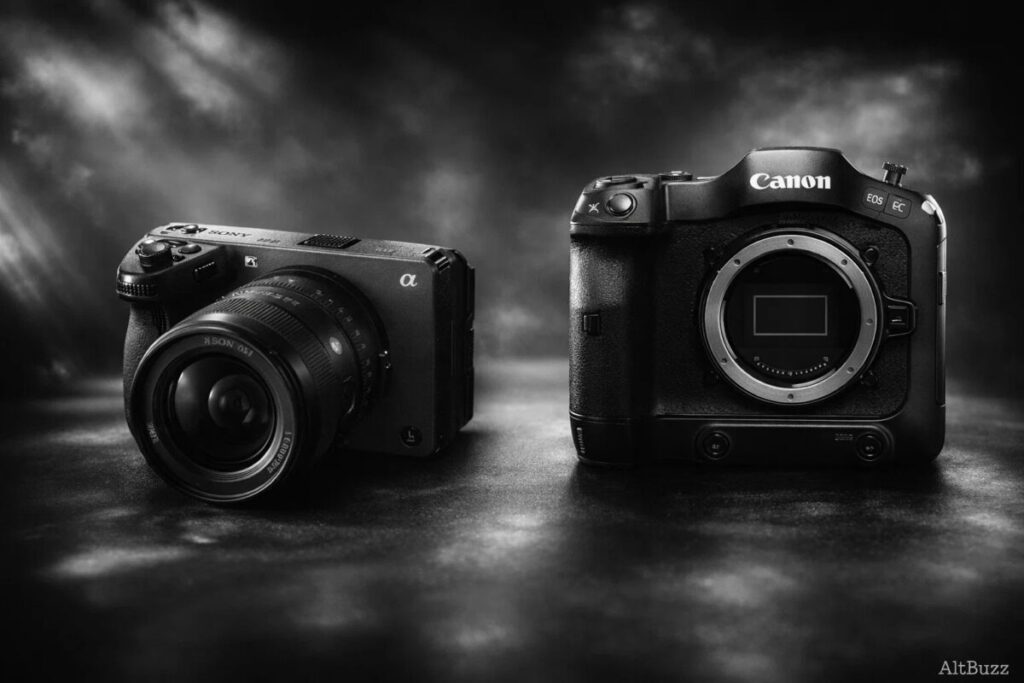
The Sony FX3 is remarkably compact and lightweight at approximately 715g. It is essentially a mirrorless camera body with cinema-specific features. This makes it ideal for gimbal mounting, where every gram counts. It also makes it easy to carry in a small bag and deploy quickly in unpredictable shooting situations.
The Canon EOS C70 weighs approximately 1,030g without a lens, which is notably heavier than the FX3. However, much of that extra weight comes from features: the built-in ND filter mechanism, the XLR inputs, the larger battery system, and the more robust control layout. The C70’s controls are arranged more like a traditional cinema camera, with dedicated dials and buttons for commonly adjusted video parameters.
For gimbal work and extreme mobility, the Sony FX3 is the more practical choice. For productions where a dedicated video operator is managing the camera and professional controls are important, the Canon EOS C70’s ergonomics are superior.
Battery Life and Power Management
The FX3 uses the NP-FZ100 battery, the same battery found in Sony’s mirrorless cameras. Run time is moderate, and you will need multiple batteries for a full shooting day. The bright side is that NP-FZ100 batteries are widely available and relatively affordable.
The C70 uses Canon’s BP-A series batteries. The BP-A30 offers a standard runtime. The BP-A60, a larger battery option, significantly extends shooting time and is a practical choice for documentary productions. The BP-A60 does add weight but provides the power endurance for full-day shoots without interruption.
Both cameras support USB-C power delivery for charging and powering the camera during extended shoots.
Lens Ecosystems
The FX3 uses the Sony E-mount. This is one of the largest and most mature lens ecosystems in mirrorless photography. Native E-mount cinema and photo lenses from Sony, Sigma, Tamron, and Zeiss give filmmakers an enormous range of options at various price points. Adapting Canon EF, Nikon F, and other lenses to the E-mount is also very practical.
The C70 uses the Canon RF mount. RF glass is optically extraordinary. Canon’s RF lenses are widely regarded as some of the finest optics available. However, the RF ecosystem is younger and tends to be priced at a premium. Filmmakers with existing Canon EF glass can use the EF-EOS R adapter, which maintains full electronic communication.
Price Comparison and Overall Value
The Sony FX3 is available at approximately USD 3,900. For a full-frame cinema camera with dual native ISO, professional codecs, and world-class autofocus, it represents genuine value in the cinema camera market.
The Canon EOS C70 launched at approximately USD 5,499. The higher price reflects its built-in ND filters, XLR inputs, professional codec structure, and DGO sensor technology. For productions where those features are essential, the C70’s price is entirely justified.
The price difference of approximately USD 1,600 is significant. However, when you factor in the cost of external ND filters and XLR adapters needed for the FX3, the real-world cost gap narrows considerably.
Which Camera Should You Choose?
Should I Buy Sony FX3 or Canon EOS C70?
Choose the Sony FX3 if you:
- Need a lightweight, compact body for gimbal or aerial work
- Prioritize full-frame sensor look and extreme low-light performance
- Shoot a lot of solo self-filmed content requiring reliable autofocus
- Are already invested in the Sony E-mount ecosystem
- Work within a tighter budget
Choose the Canon EOS C70 if you:
- Frequently shoot in changing light and need built-in ND filters
- Need professional XLR audio without adapters
- Value the smoothest possible autofocus for cinematic work
- Want Cinema EOS codec quality and grading flexibility
- Shoot regular slow-motion content at 4K 120fps without sensor crop
Is the Sony FX3 Better Than the Canon EOS C70 for Cinema?
For pure low-light performance and portability, the FX3 is technically superior. For professional production workflow features, dynamic range at standard ISO, and practical on-set convenience, the C70 has meaningful advantages. The difference between the Sony FX3 and Canon EOS C70 is not about one being better overall. It is about which camera fits your specific way of working.
Pros and Cons Summary
Sony FX3
Strengths
- Full-frame sensor with exceptional low-light performance
- Very compact and lightweight body
- Excellent autofocus for documentary and solo work
- Wide selection of E-mount lenses
- Lower price point
Weaknesses
- No built-in ND filter
- XLR audio requires an adapter
- Smaller battery with shorter run time
- No DGO technology for high-contrast scenes
Canon EOS C70
Strengths
- Built-in variable ND filter (2 to 10 stops)
- DGO sensor with outstanding dynamic range
- Dual built-in XLR inputs
- Cinema EOS codec and color science
- Smooth, cinematic autofocus character
Weaknesses
- Higher price
- Heavier and bulkier body
- Super 35 sensor means no full-frame look
- Lower second native ISO compared to FX3
Final Verdict
The Sony FX3 vs Canon EOS C70 debate does not have a single winner. It has two winners for two different types of filmmakers.
The Sony FX3 is the ideal choice for solo creators, documentary shooters, and hybrid operators who need a powerful, lightweight cinema camera with excellent autofocus and full-frame image quality.
The Canon EOS C70 is the ideal choice for professional productions, documentary crews with higher production values, and cinematographers who need built-in ND, XLR audio, and Cinema EOS quality in a compact form factor.
Both cameras will make your work look exceptional. Invest in whichever one fits your workflow. You will not regret either choice.
Read More from AltBuzz
Read more from Altbuzz for camera reviews, rumors, and detailed specs. AltBuzz delivers trusted and easy-to-understand photography content for filmmakers at every level.
Subscribe to the AltBuzz YouTube Channel
Stay updated with the latest cinema camera reviews, comparisons, and filmmaker tips. AltBuzz publishes reliable, in-depth content for serious video creators. Subscribe Altbuzz and grow your knowledge with every upload.