
Hasselblad X2D 100C Review: When 100 Megapixels Meets Medium Format Genius
Introduction: A Camera Built for One Purpose Only
Some cameras try to do everything. The Hasselblad X2D 100C does not.
It shoots no video. Also, it does not track sprinting athletes, does not compete on burst speed or price. Instead, it concentrates every ounce of engineering into a single objective: producing the finest still images a portable camera has ever made.
That is a bold claim from a brand with an equally bold history. Hasselblad cameras flew aboard Apollo 11 and captured the first photographs taken on the surface of the Moon. The brand defined medium format photography across decades of commercial, portrait, and fine art work. Yet by the mid-2010s, the company faced serious financial strain in a market dominated by mirrorless full-frame innovation.
Then came the X1D in 2016. A compact medium format mirrorless body sparked a genuine revival. The X1D II followed, building on that foundation carefully. Now the X2D 100C arrives as the most complete, capable, and technically ambitious camera Hasselblad has produced in its modern era.
The X2D 100C delivers stunning, massive RAW files, is plenty fast enough, and remains compact enough to feel like shooting with a DSLR. But it remains a Hasselblad: at $8,200 plus another $4,000 or so for a lens, it is not an affordable camera for amateurs. For the right kind of photographer, however, the X2D delivers. gogemio
This review covers every technical layer of the X2D 100C. The sensor, dynamic range, autofocus, IBIS, storage, color science, lens system, ergonomics, and real-world shooting behavior all receive thorough attention. By the end, you will know exactly what this camera offers, where it genuinely excels, and where it still falls short.
If you are also evaluating fixed-lens alternatives, our Leica Q3 full technical review covers 60MP full-frame performance in a compact 28mm body. Both cameras serve serious photographers, but they take very different approaches to image quality.
Who the Hasselblad X2D 100C Is Built For
Before examining specifications, it helps to understand the photographer this camera serves.
The X2D 100C targets working professionals whose craft demands the absolute ceiling of image quality. Landscape photographers printing at mural scale benefit directly from 100MP output. Commercial photographers whose clients license images at maximum resolution find the file quality decisive. Fine art photographers for whom tonal depth and color accuracy define their work gain a genuine advantage here.
The camera is aimed at professional studio and landscape photographers for whom image quality is often the sole consideration. It is a stills-only camera: no video, no high-speed burst, no hint of hybrid use. Instead, it offers resolution, dynamic range, and color depth unmatched by any full-frame camera. Andydavison
Understanding this context matters before comparing specifications across camera categories. The X2D 100C is not trying to replace a Sony A1 or a Canon EOS R3. It occupies a different category entirely, one where the image is everything and speed is secondary.
Body and Build Quality: Scandinavian Engineering in Every Detail
Materials and Construction
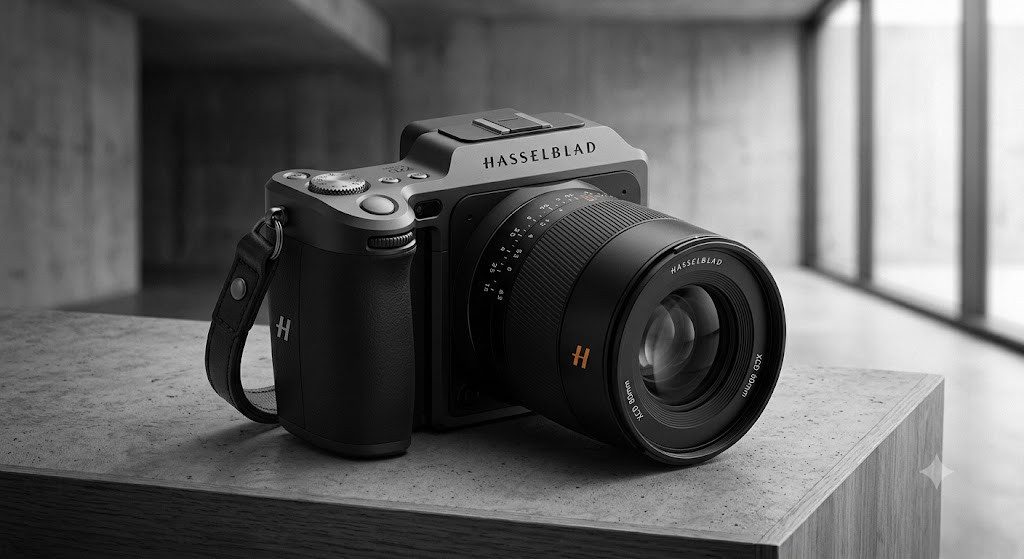
The X2D 100C is designed in a new dark grey tone body of machined aluminum. adorama
The machined aluminum construction gives the X2D 100C a solidity that plastic-bodied cameras cannot replicate. Every panel, every control surface, and every port cover communicates precision manufacturing. The dark grey finish is subtle and professional without drawing attention in the field.
The body measures 148.5 x 106 x 75mm and weighs approximately 895g without a lens. That weight feels appropriate given the sensor size and internal hardware. It sits well in the hand during extended shooting sessions without causing fatigue.
The grip is deep and secure, the weight distribution is intentional, and long sessions do not become the ordeal typical of less well-designed large-format cameras. Andydavison
Control Design Philosophy
Hasselblad follows a minimalist control philosophy rooted in the brand’s Scandinavian heritage. The X2D 100C carries no superfluous buttons or buried submenu systems. Each physical control serves a direct, obvious function.
The top plate features a secondary LCD display showing current camera settings at a glance. This means you never need to raise the camera to your eye or wake the rear screen just to check your exposure settings.
There is also a 1.08-inch top display for showing off the current camera settings, as well as a 3.6-inch 2.36MP tilting touchscreen display on the back serving as the main interaction point for the Hasselblad User Interface. adorama
The Hasselblad User Interface presents settings in clean, logically organized menus. You will not spend time hunting through nested submenus for basic functions. The overall software experience matches the hardware quality in a way that does not always happen with premium camera brands.
Ports and Connectivity
Ports include one USB-C and one CFExpress Type-B slot. Digital Photography Review
The minimal port selection is intentional. Hasselblad keeps the layout clean and protected behind magnetically latching doors. USB-C handles data transfer, tethered shooting, and charging. The CFexpress Type B slot supplements the internal SSD for photographers who want card-based redundancy in the field.
Wi-Fi connectivity uses a dual-band 2.4GHz and 5GHz system. This pairs with the Phocus Mobile 2 application on iOS and iPadOS for wireless image transfer and remote control from a tablet or phone.
The Sensor: 100MP BSI-CMOS on a Medium Format Stage
Physical Sensor Size and What It Means
The light-sensitive area on X System medium-format image sensors measures 43.8 x 32.9mm, approximately 70% larger than full-frame. This larger size provides a higher resolution and larger light collection area, resulting in richer details. Wikipedia
That 70% size advantage over full-frame is the foundation of everything the X2D 100C delivers. A larger sensor captures more light per unit area. It produces larger photosites even at the same pixel count. This creates the characteristic medium format rendering that full-frame cameras simply cannot replicate, regardless of how many megapixels they claim.
The sensor at the heart of the X2D 100C is a 100MP backside-illuminated CMOS sensor measuring 43.8mm x 33mm, which Hasselblad claims offers up to 15 stops of dynamic range through its 16-bit color depth. adorama
The 4:3 aspect ratio of the medium format sensor produces image dimensions of 11,656 x 8,742 pixels. That 4:3 ratio more closely resembles the classical proportions of medium format film than the 3:2 ratio used by most full-frame cameras. Many photographers find those proportions naturally suit portrait, still life, and architectural subjects.
BSI Architecture and Its Practical Benefits
BSI, or Back-Side Illuminated, sensor architecture positions the photodiodes at the front of the sensor structure facing incoming light directly. The wiring and transistors move behind the photodiodes rather than partially blocking them. Each photosite therefore collects more light per unit area than conventional front-illuminated designs allow.
The practical results show in high-ISO performance, readout speed, and dynamic range. The X2D 100C benefits from these architectural advantages at a sensor size where individual photodiodes are considerably larger than those found in full-frame cameras.
Resolution and File Sizes
The sensor produces images measuring 11,656 x 8,742 pixels. RAW files from this camera exceed 200 megabytes per image. Even fine JPEGs measure between 60 and 80 megabytes depending on the scene. gogemio
These file sizes carry genuine workflow implications. A full day of shooting produces hundreds of gigabytes of data. Post-processing requires a capable computer with adequate RAM. The 1TB internal SSD addresses storage anxiety at the capture stage, which removes the need to carry multiple memory cards for most assignments.
Dynamic Range: 15 Stops and What That Number Really Does
Understanding 15 Stops
Dynamic range measures the gap between the darkest shadow a sensor can capture with visible detail and the brightest highlight before clipping to pure white. Each stop doubles the light level represented. Fifteen stops means the sensor handles a luminance ratio of approximately 32,000:1 between its darkest and brightest extremes.
Dynamic range is absolutely extraordinary. While shooting high-contrast scenes, highlights retained detail while deep shadows could be lifted several stops without either color shift or noise. LensesPro
In practical shooting terms, this means you can expose for a bright sky in a landscape and still recover detail from deep foreground shadows in post. Backlit portraits retain both facial detail and highlight graduation in a single frame. Architecture interiors with bright windows and dark rooms photograph cleanly without HDR bracketing workflows.
16-Bit Color Depth
Over 281 trillion colors are represented with the 16-bit color depth. Wikipedia
The jump from 14-bit to 16-bit color depth proves significant for photographers who push files hard during editing. More bit depth means smoother tonal gradations across the entire tonal scale. It means less banding when you stretch shadows or compress highlights in post. Most importantly, the file holds together through heavy editing without showing the digital artifacts that reveal aggressive processing.
Most full-frame cameras record 14-bit raw files. The X2D 100C’s 16-bit output gives it a measurable advantage in post-production flexibility, particularly for large-format printing where tonal smoothness matters at high magnifications.
Real-World Dynamic Range Performance
The X2D 100C boasts an extra stop of dynamic range compared to its predecessor and a lower base ISO than its main 100MP competitor from Fujifilm. 5050 Travelog
That extra stop sounds modest on a specification sheet. In practice, one additional stop of recoverable highlight range changes how you approach difficult lighting situations. Instead of reaching for a graduated neutral density filter for every bright sky, you can trust the raw file to hold the detail you need.
In-Body Image Stabilization: A Medium Format First
Why IBIS Matters in This Format
Medium format cameras historically demanded tripods for serious work. The combination of large sensors, heavy bodies, and high resolution meant that even minor camera shake produced visible softness at pixel-level inspection. Handheld medium format photography was a compromise, not a choice.
Hasselblad independently developed its own IBIS for the X2D 100C in order to meet the stringent requirements for stabilizing a 100MP sensor. adorama
The engineering challenge here is significant. Stabilizing a physically larger sensor requires the IBIS mechanism to move a heavier mass across larger distances. Conventional IBIS systems designed for full-frame sensors cannot simply be scaled up for medium format use.
5-Axis 7-Stop Stabilization
The X2D 100C is equipped with an in-house-developed IBIS system that is currently the most compact in the industry for medium format cameras. It can detect camera movements down to 0.1-pixel precision. Wikipedia
Five-axis stabilization compensates for all five categories of camera movement. Pitch and yaw rotation, X and Y axis translation, and roll rotation all receive individual correction. This comprehensive approach handles the full range of hand tremor and body movement during freehand shooting.
The five-axis seven-stop IBIS system compensates for five different types of camera shake when shooting stills and substantially reduces motion blur at slower shutter speeds. Amateur Photographer
Seven stops of compensation means you can theoretically shoot sharp handheld images at shutter speeds eight times slower than the reciprocal rule baseline for your lens focal length. For landscape photographers, that changes everything about how and when they can shoot.
IBIS in Practice
The practical impact of this stabilization transforms the X2D 100C’s usefulness across shooting environments. Landscape photographers no longer need to carry tripods for all ambient light work. Interior architectural photographers can hand-hold shots in dim rooms. Travel photographers can work through varied lighting conditions without the weight and setup time of support equipment.
The IBIS makes handheld shooting at low ISOs not just possible but genuinely practical. LensesPro
Shooting at ISO 64 or ISO 100 with IBIS-assisted handheld capture produces cleaner files than shooting at ISO 800 or 1600 from a tripod would on a lesser camera. The stabilization system allows you to keep ISO values low, which preserves the maximum dynamic range and tonal depth the sensor produces.
Autofocus System: Phase Detection Comes to Hasselblad
The Technology Behind the Upgrade
The X1D series relied on contrast-detection autofocus. The X2D 100C introduced phase-detection autofocus to the X System, which represented a fundamental change in how the camera acquires focus.
The updated autofocus system uses 294 Phase Detection Autofocus zones to detect and lock onto subjects. adorama
Phase-detect pixels embedded in the sensor measure the directional offset between light rays entering from different angles. This allows the camera to calculate both how much the lens needs to move and in which direction, without the hunting behavior that defines contrast-detection systems. The result is faster initial focus acquisition and more confident lock-on performance across the frame.
Autofocus Speed
The X2D 100C features a faster processor and autofocus system that combine to make this Hasselblad’s most versatile camera in every way. This is a camera that can resolve twice as much detail as the X1D II yet is twice as quick. B&H Photo Video
The processor upgrade from the X1D II plays an important role here. Faster AF processing means the camera spends less time calculating and more time ready to shoot. For medium format photography, which traditionally demanded slow workflows, this speed improvement changes the camera’s practical usability across a broader range of subjects.
Where Autofocus Works Well
Single-shot AF for static and slow-moving subjects performs reliably in good light. Portraits in studio environments, landscape details, product photography, and still life work all fall comfortably within the system’s confident capabilities.
The phase-detect coverage across 294 zones gives reasonable frame coverage for off-center subject placement. You do not need to focus and recompose for most portrait and still life compositions.
Where Autofocus Struggles
Autofocus still struggles on the X2D 100C, and the camera remains unsuited to action photography in the way that mainstream full-frame and crop-sensor cameras can be. B&H Photo Video
Continuous autofocus tracking for moving subjects remains a genuine limitation. The X2D 100C is not a wildlife camera, a sports camera, or a photojournalism camera. Photographers who regularly track fast, erratic motion will find the system frustrating in those specific scenarios.
If AF tracking is a priority in your work, our premium compact camera buying guide for 2026 covers which systems handle moving subjects most reliably at different price points.
Storage: 1TB Internal SSD Plus CFexpress
The Built-In SSD
The X2D 100C features a built-in 1TB SSD with a write speed up to 2,370MB/s and a read speed up to 2,850MB/s. Although ample storage is built-in, additional space can be added using the CFexpress Type B card slot. Digital Photography Review
A 1TB SSD built into a camera body is genuinely novel. At 200MB per raw file, 1TB holds approximately 5,000 full-resolution raw images before requiring offload. Most photographers will complete multiple full shooting days before needing to transfer files to a computer.
Built-in 1TB SSD storage lets you store roughly 4,600 RAW photos or 13,800 JPEGs. The high-speed storage capabilities let you shoot 16-bit RAW images over a sustained time period in Continuous Drive mode. Amateur Photographer
The write speed of 2,370MB/s means the internal SSD never becomes a bottleneck during sustained shooting. Even continuous drive at full raw resolution does not overwhelm the storage system during typical capture sequences.
CFexpress Type B Slot
The external CFexpress Type B slot supplements the internal SSD effectively. You can direct images to the card, the SSD, or both simultaneously for in-camera backup. Photographers who require redundancy for commercial assignments can record to both storage locations at once without any workflow compromise.
CFexpress Type B cards deliver speeds that match the internal SSD when using quality media. This means the external slot provides genuine high-speed performance rather than a slower secondary fallback option.
Electronic Viewfinder: 5.76M Dots at 1.0x Magnification
The X2D 100C features a 0.5-inch OLED electronic viewfinder with a resolution of 5.76M dots, 1.0x magnification, and a 60fps refresh rate. adorama
A 1.0x magnification EVF means the subject through the viewfinder appears at true life size rather than reduced. This is a distinctive quality that changes how you compose and observe a scene. It feels more like looking through a window than through a camera viewfinder.
The 5.76M-dot OLED panel renders fine detail with clarity that matches the X2D 100C’s resolution ambitions. When reviewing focus in a magnified view, the EVF shows enough detail to make critical sharpness judgments with confidence. For photographers coming from full-frame bodies with smaller finders, this viewfinder quality is genuinely impressive.
The 60fps refresh rate is not the highest available in the mirrorless category. However, for the deliberate, considered shooting style the X2D 100C encourages, 60fps proves smooth enough in practice. The camera is not being used to track erratic motion, so the refresh rate limitation rarely becomes apparent during typical use.
The Tilting Rear Screen: Practical Design for Multiple Shooting Positions
The 3.6-inch, 2.36M-dot tilting rear touchscreen has firm stops at 40 degrees and 70 degrees to the body and suits image composition and low-angle shooting. Amateur Photographer
The tilting screen addresses one of the most practical limitations of the X1D II, which had a fixed rear display. Low-angle landscape compositions, waist-level street shooting, and overhead crowd shots all become accessible through the tilting mechanism. You no longer need to press your face to the ground for close-perspective landscape captures.
The 2.36M-dot resolution renders raw and JPEG review images with enough clarity to evaluate focus and exposure confidently. The touchscreen interface handles menu navigation, focus point selection, and image review through accurate, lag-free touch response.
One important note: the original X2D 100C’s screen was partially obscured by the EVF housing when tilted in certain positions. Hasselblad addressed this in the X2D II 100C with a revised mechanism that pulls out away from the body before tilting.
Hasselblad Natural Colour Solution: What HNCS Actually Does
The Color Science Philosophy
Every camera manufacturer processes color differently. Some chase saturation and vibrancy. Others aim for accuracy with neutral rendering. Hasselblad’s approach through HNCS sits in a different category entirely.
The Hasselblad Natural Colour Solution optimises colors to appear as authentically as the eye perceives them. Captured without any presets, artistic visions effortlessly come to life. Wikipedia
HNCS is not a set of picture profiles or creative looks. It is a foundational color management philosophy applied at the sensor characterization, white balance calibration, and raw processing stages simultaneously. The goal is perceptual accuracy rather than stylistic enhancement.
What HNCS Produces in Practice
The X2D 100C continues to produce images with stunning tonal depth, true-to-life skin tones, and that elusive, three-dimensional Hasselblad look. Files are 16-bit, recording over 280 trillion colors. Detail rendition is exceptional, achieving amazing skin tones, textures, and micro-contrast. The color balance is neutral yet rich, avoiding the overly punchy saturation common in smaller formats. LensesPro
The three-dimensional quality that Hasselblad photographers describe is real, though difficult to define precisely in words. It combines the medium format rendering of depth and spatial relationships, the tonal smoothness of 16-bit files, the accurate midtone graduation of HNCS processing, and the micro-contrast produced by high-quality XCD lenses working together.
Portrait photographers find HNCS skin tone reproduction particularly compelling. Colors render without the orange push common in heavily processed JPEG files from other manufacturers. Complexion details, subtle variations in skin tone, and the transition between light and shadow across facial features all show with natural accuracy.
HNCS vs. Color Profiles
Most cameras offer color profiles named Standard, Vivid, Portrait, and Landscape. The X2D 100C does not work this way. HNCS provides a single, consistent color foundation that reflects the world as it actually appears. This approach demands more deliberate post-processing decisions but rewards photographers who want precise, predictable color output across all their work.
XCD Lens System: Leaf Shutters and Optical Excellence
The Lens Library
The XCD system spans focal lengths from ultra-wide to moderate telephoto, with each lens purpose-built for the medium format sensor.
The Hasselblad XCD lens lineup is exceptional. The rendering is exquisite, with smooth, creamy bokeh and edge-to-edge sharpness even at wide apertures. Photography Blog
The XCD 55mm f/2.5 V serves as the standard lens for the system, equivalent to roughly 43mm on full frame. The XCD 90mm f/2.5 V produces beautiful portrait compression and subject separation. The wider XCD 21mm, 28mm, and 38mm options cover architectural and landscape focal lengths effectively.
The Leaf Shutter Advantage
The leaf shutter is built into the lens structure. Its most significant advantage is achieving flash sync at all speeds up to 1/2,000s. This helps capture fast-moving subjects when flash is used and aids wide-aperture portraits in strong outdoor lighting. Cameras with focal-plane shutters limit flash sync to 1/125s or 1/250s, restricting creative options. The leaf shutter also generates significantly reduced vibration when triggered. B&H Photo Video
Flash sync at all shutter speeds is a professional-grade capability with immediate practical value. A studio photographer can balance strobe output against ambient light at 1/2,000s, essentially eliminating ambient influence entirely. Portrait photographers can shoot at f/2.5 with fill flash in bright sunlight without overexposing, since the leaf shutter allows high-speed sync natively.
The leaf shutter lenses, available up to 1/2,000s, are a secret weapon for studio photographers needing to overpower the sun with flash. Photography Blog
The reduced shutter vibration matters for critical sharpness at medium shutter speeds. The X2D 100C produces sharp files at all shutter speeds without vibration-induced softness affecting the 100MP output.
Lens Cost Considerations
The XCD lenses, with their leaf-shutter designs, tend to be more expensive and often slower than lenses in the rival Fujifilm system. Wikipedia
A typical XCD prime lens costs between $3,500 and $5,000. The leaf shutter mechanism inside each lens adds manufacturing complexity and cost compared to conventional lens designs. Building a multi-lens X System kit requires substantial investment beyond the camera body price. This is not a criticism unique to Hasselblad, as medium format lens systems across all manufacturers command premium pricing reflecting genuine engineering quality.
Burst Rate and Continuous Shooting
The X2D 100C shoots at a maximum rate of 3.3 frames per second. Digital Photography Review
That figure is modest by full-frame mirrorless standards. The Sony A9 III shoots at 120fps. Even entry-level mirrorless cameras typically exceed 10fps. For the X2D 100C’s target applications, however, 3.3fps is genuinely sufficient in practice.
Landscape photographers shoot single frames deliberately. Studio photographers capture deliberate sequences with time between each. Portrait photographers look for decisive expressions rather than rapid motor-drive bursts. The 3FR raw file format records each 100MP capture as a full 16-bit file, and the internal SSD’s write speed handles sustained capture at 3.3fps without buffer limitations during typical shooting sequences.
ISO Range: Native 64 Through ISO 25,600
Utilizing a 100-megapixel medium format BSI CMOS sensor with a native ISO of 64, the X2D 100C captures life in vivid color and exquisite detail. Wikipedia
The native ISO 64 base sensitivity reflects the medium format sensor’s light-gathering advantage. A lower base ISO means the sensor produces its cleanest, most detailed files at a sensitivity level that suits the controlled shooting environments where the X2D 100C excels.
At ISO 400 and below, files are essentially noise-free at pixel-level inspection. ISO 800 introduces very faint luminance noise that remains invisible at print sizes below 40×50 inches, ISO 1600 remains usable for most professional outputs, ISO 3200 and beyond trades noise for light-gathering necessity, but the 16-bit depth helps enormously when applying noise reduction in post.
The size advantage of medium format photodiodes means noise at ISO 25,600 on the X2D 100C often compares favorably to noise at ISO 6400 on smaller-format cameras shooting the same scene.
Hasselblad X2D 100C vs. The Competition
X2D 100C vs. Fujifilm GFX100S
The Fujifilm GFX100S is the X2D 100C’s most direct competitor. Both cameras use 100MP medium format BSI-CMOS sensors. Both target professional landscape, portrait, and commercial photographers at serious price points.
For lab data comparison, the X2D 100C was tested against the GFX100S as its main 100MP medium format rival. 5050 Travelog
The X2D 100C advantages include superior IBIS performance at 7 stops versus the GFX100S’s 6 stops, a higher-resolution EVF at 5.76M dots versus 3.69M dots, a lower base ISO at 64 versus 100, the internal 1TB SSD storage that the GFX100S lacks, and the leaf shutter flash sync capability built into every XCD lens.
The GFX100S advantages include a wider, more affordable lens selection. Fujifilm has built the GFX lens ecosystem across more focal lengths and more aperture options than the Hasselblad XCD lineup currently covers. GFX lenses are generally less expensive than equivalent XCD glass. For photographers building a multi-lens kit on a tighter budget, this difference is meaningful.
X2D 100C vs. Sony A7R V
The Sony A7R V offers 61MP on a full-frame BSI-CMOS sensor with class-leading autofocus, excellent IBIS, and a competitive price around $3,500. Many photographers wonder whether the X2D 100C justifies its much higher cost.
Because you no longer have to go medium format to get high resolution, the comparison of how medium format cameras stack up against the 61MP full-frame Sony A7R IV forms a natural part of evaluating the X2D 100C. 5050 Travelog
The X2D 100C wins on raw resolution (100MP vs 61MP), sensor surface area, dynamic range, color depth (16-bit vs 14-bit), and the tonal rendering qualities that medium format sensor size produces. The A7R V wins on autofocus capability, burst rate, video features, lens ecosystem breadth, portability, and price.
For photographers who print large or license at maximum resolution, the X2D 100C produces files the A7R V cannot match regardless of settings. For photographers who need speed, tracking, video, or flexibility across many shooting situations, the A7R V makes more practical sense.
Real-World Shooting Performance
Landscape Photography
This is the X2D 100C’s home territory. The 100MP sensor resolves fine detail across enormous prints with clarity that smaller sensors cannot approach. The 15-stop dynamic range handles sunrise and sunset contrast without graduated filters in many situations. The 7-stop IBIS allows handheld work at dawn and dusk without tripod setup time eating into golden hour minutes.
The low base ISO 64 means you use the camera at its cleanest, most detailed operating point for most outdoor natural light work. The leaf shutter produces no mirror vibration to compromise sharpness at the medium shutter speeds common in landscape photography.
Studio and Commercial Photography
The leaf shutter flash sync at all speeds is a decisive advantage in studio environments. Combined with the accurate HNCS color science, the X2D 100C produces commercial files with the color accuracy that digital asset management workflows and brand color standards demand from professional suppliers.
100MP resolution allows extreme cropping in post-production without losing printable quality. A tight crop from a wide composition still delivers 30 to 40MP of output. This flexibility reduces the number of setups required during commercial shoots, saving both time and client budget.
Portrait Photography
HNCS skin tone reproduction is genuinely exceptional across different complexions and ethnicities. Colors render with natural accuracy without the color casts that affect less carefully calibrated camera systems.
The shallow depth of field characteristics of medium format at typical portrait distances create background separation and three-dimensional rendering that full-frame cameras approach but do not precisely match. Portrait photographers who have experienced both formats consistently describe this quality difference as the primary reason they invest in medium format.
Architecture and Interiors
The tilting screen assists with low-angle and elevated compositions without awkward camera positioning. High dynamic range in interior spaces with bright windows becomes manageable through the 15-stop sensor rather than requiring HDR bracketing workflows.
The 11,656 x 8,742 pixel files allow substantial perspective correction in post-production without losing usable resolution after cropping the corrected image. Architectural photographers printing at 60 inches and beyond will appreciate the headroom this resolution provides.
Known Limitations: Honest Assessments Before You Buy
Battery Life Is the Biggest Practical Concern
Battery life is disappointing, measuring approximately 200 frames per charge during testing. Digital Photography Review
200 frames is genuinely low for professional work. Purchase at least two additional batteries with the camera. Better yet, purchase three or four if your work involves extended field shooting without access to charging. Fast charging via USB-C Power Delivery helps between sessions, but active battery management becomes part of your daily workflow.
No Video at All
The X2D 100C records no video. Not 4K, not 1080p, not even low-quality footage for reference purposes. This is a deliberate design decision rather than an oversight.
It is a stills-only camera: no video, no high-speed burst, no hint of hybrid use. Andydavison
For photographers who need occasional video capability alongside stills, the X2D 100C requires a second camera body for that purpose. This is not a dealbreaker for the target audience, but it does limit versatility compared to full-frame mirrorless options that handle both formats.
Autofocus Tracking Remains Limited
Phase-detect AF represents a meaningful improvement over the X1D II’s contrast-detect system. Continuous tracking and moving subject AF still fall short of full-frame mirrorless performance, however. The X2D 100C is not the right tool for children at a birthday party, sports events, wildlife in motion, or any subject that moves quickly and unpredictably.
Lens Selection Gaps at Telephoto Focal Lengths
There are no native lens options for telephoto shooters in the current XCD lineup. B&H Photo Video
The XCD system currently lacks a dedicated telephoto lens beyond moderate focal lengths. Wildlife photographers, sports photographers, and anyone who regularly works at 200mm and beyond cannot currently build a complete telephoto kit within the native XCD system. Adapter solutions exist for longer focal lengths using legacy glass, but these workarounds sacrifice some of the XCD system’s native advantages.
Phocus and Phocus Mobile 2: The Software Ecosystem
Hasselblad provides Phocus as its dedicated raw processing software for desktop use and Phocus Mobile 2 for iOS workflow.
Phocus handles Hasselblad’s 3FR raw format with full HNCS color processing, offering adjustments calibrated specifically for the sensor’s color characteristics. The software provides tethered shooting control, allowing photographers to capture directly to a connected computer with immediate full-resolution preview.
A 2.4/5GHz high-speed Wi-Fi connection enables faster and more stable transmission. Linking the X2D 100C with an iPad or iPhone via Wi-Fi transmits full-size JPEG and RAW images using Phocus Mobile 2, enabling editing and output of high-quality RAW images that fully utilize HNCS capabilities. Digital Photography Review
Adobe Lightroom Classic and Capture One also support the X2D 100C’s 3FR files natively. Photographers already invested in those ecosystems can process X2D files without adopting Phocus, though Hasselblad’s own software arguably realizes the HNCS color science most accurately and consistently.
Quick-Reference Specifications
Sensor: 100MP BSI-CMOS Medium Format, 43.8 x 32.9mm
Pixel Count: 11,656 x 8,742
Color Depth: 16-bit, 281 trillion colors
Dynamic Range: Up to 15 stops
Native ISO: 64
ISO Range: 64 to 25,600
IBIS: 5-axis, 7-stop compensation
Autofocus: 294-point Phase Detection Hybrid AF
Burst Rate: 3.3fps
Shutter: Leaf shutter in lens, up to 1/4,000s mechanical, 1/6,000s electronic
Flash Sync: All shutter speeds
EVF: 0.5-inch OLED, 5.76M dots, 1.0x magnification, 60fps
Rear Screen: 3.6-inch tilting touchscreen, 2.36M dots
Internal Storage: 1TB SSD (read 2,850MB/s, write 2,370MB/s)
External Storage: CFexpress Type B
Video: None
Connectivity: USB-C, CFexpress Type B, Wi-Fi 802.11ax dual-band
Body Material: Machined aluminum
Weight: 895g body only
Dimensions: 148.5 x 106 x 75mm
Price: $8,200 body only
Final Verdict: The Ceiling of Portable Medium Format Photography
The Hasselblad X2D 100C is not trying to be the most versatile camera available. It is trying to be the best camera for photographers who care about nothing except the image.
On those terms, it succeeds completely.
The 100MP BSI-CMOS sensor delivers resolution, dynamic range, and color depth that no full-frame camera matches. The HNCS color science produces files with a three-dimensional quality and tonal richness that set the standard for the category. The 7-stop IBIS makes the camera genuinely usable in a much wider range of conditions than any previous medium format body. The 1TB built-in SSD solves the storage anxiety that hampered earlier Hasselblad shooting experiences.
The limitations are real. Battery life demands careful management. The absence of video rules out hybrid workflows. Continuous autofocus tracking falls behind full-frame competitors. The lens selection leaves telephoto focal lengths underserved.
The X2D 100C’s strengths operate in a tier above competition, though. No full-frame camera produces files with the spatial rendering, tonal depth, and color accuracy of a well-exposed 100MP medium format raw file. That quality gap is measurable and visible at the output sizes where professional photographers deliver their work.
For medium format, the X2D could just be our new favorite camera. B&H Photo Video
For landscape photographers, commercial photographers, portrait photographers, and fine art photographers who have reached the ceiling of full-frame image quality and are ready to invest in the next level, the Hasselblad X2D 100C delivers exactly what it promises.
Frequently Asked Questions
Does the Hasselblad X2D 100C shoot video?
No. The X2D 100C records no video in any format. It is a dedicated stills camera by design.
What lenses work on the X2D 100C?
The X2D 100C supports Hasselblad XCD lenses with built-in leaf shutter, HC and HCD lenses via the XH adapter, and V System and XPan lenses via the XV or XPan adapters. Leica Camera
How does the internal SSD work in the field?
The 1TB internal SSD works exactly like a fast memory card embedded in the body. Images write directly to it during capture. You offload via USB-C connection to a computer or transfer wirelessly to an iPad using Phocus Mobile 2.
Is the X2D 100C weather sealed?
The X2D 100C body has dust and weather resistance suited to typical professional outdoor shooting conditions. Hasselblad does not publish a specific IP rating. The machined aluminum construction and sealed port covers provide meaningful environmental protection.
How does the X2D 100C compare to the newer X2D II 100C?
The X2D II 100C increases phase-detect points from 294 to 425, adds LiDAR distance sensing, delivers 10 stops of IBIS versus 7, introduces continuous autofocus with subject detection, and includes an HDR workflow. It also launches at a lower price than the original X2D 100C. If purchasing new, the X2D II 100C represents the more capable current option at a reduced price point. The Leica X2
Read More from Altbuzz
This review is part of our June 2026 premium camera deep-dive series. We are covering the most significant camera releases and announcements hitting the market right now, from medium format to compact full-frame.
If you are comparing options before making a purchase decision, our Leica Q3 full technical review breaks down the 60MP fixed-lens alternative at a different price point. Photographers weighing medium format against high-resolution full-frame will also find our Hasselblad X2D 100C vs. Sony A7R V comparison guide useful for a direct side-by-side breakdown. For buyers still narrowing down categories before committing to a system, the premium camera buyer’s guide for 2026 walks through every major option across sensor formats, price tiers, and shooting styles.
Stay updated on every Hasselblad announcement and medium format development at altbuzzmedia.com. For community analysis and ongoing gear discussion, the Hasselblad community on DPReview remains one of the most active and technically informed forums for X System photographers.
Watch on the Altbuzz YouTube Channel
Full video reviews, sensor comparisons, and hands-on field tests for both the Hasselblad X2D 100C and the full June 2026 camera series are available on the Altbuzz YouTube channel @AltBuzzMedia.
Video coverage includes real-world shooting tests across landscape, portrait, and studio environments, direct file comparisons against the Fujifilm GFX100S and Sony A7R V, and a complete walkthrough of the HNCS color workflow from capture through to final export. Subscribe to get notified when the X2D II 100C video review goes live, along with our ongoing coverage of medium format developments through the rest of 2026.