
Leica SL3-P: The New Full-Frame Camera That Fills Leica’s Missing Middle Ground
The Leica SL3-P officially arrived on June 25, 2026, and it closes a gap that Leica shooters have talked about for years. Sitting neatly between the 60-megapixel SL3 and the 24-megapixel SL3-S, this new camera gives photographers a resolution option that finally makes sense for everyday professional work. Leica calls it the most advanced full-frame camera the company has ever built, and the spec sheet backs up that claim.
This article breaks down everything worth knowing about the Leica SL3-P. We will cover the sensor, the new autofocus system, video capability, build quality, and pricing. We will also look at how this camera compares against its own SL siblings and against rivals from Sony and Panasonic. By the end, you will know exactly who this camera serves best and whether it deserves a spot in your bag.
What Is the Leica SL3-P and Why It Fills a Real Gap
Leica has offered two clear choices inside its SL lineup for a while now. The SL3 delivers enormous 60-megapixel files for studio and landscape work, while the SL3-S trades resolution for speed with a leaner 24-megapixel sensor built for events and video. Many photographers found themselves stuck between the two, needing more detail than the SL3-S offers without wanting to manage the massive files that come from the SL3.
The Leica SL3-P solves that problem directly. According to B&H Photo, the SL3-P arrives as the most advanced full-frame camera in Leica’s history, introducing cinema-level video alongside a resolution point built specifically for working professionals. The name itself hints at its purpose, with the P standing for photography, since Leica has deliberately positioned this model as a stills-first tool rather than a full hybrid workhorse.
Built on the Panasonic S1RII Platform
The SL3-P borrows its core sensor technology from the Panasonic Lumix S1RII, a partnership that has become common practice within the L-Mount alliance. This is not the first time Leica has leaned on Panasonic engineering either, since the Leica D-Lux 8 followed a similar path by building on the Panasonic Lumix LX100 II platform. Sharing sensor development allows Leica to focus its own engineering resources on build quality, color science, and the overall user experience that defines the brand.
A Camera Aimed at Studio, Portrait, and Event Photographers
Leica designed the SL3-P with a specific audience in mind. Portrait, fashion, architecture, and advertising photographers all benefit from a resolution point that delivers serious detail without slowing down a busy editing workflow. Wedding and event photographers also stand to benefit from the improved autofocus system, which addresses one of the most consistent criticisms Leica has faced compared to Sony, Canon, and Nikon over the years.
Leica SL3-P Sensor and Image Quality
The sensor sits at the heart of what makes the SL3-P such an interesting release, and Leica has packed in genuinely impressive numbers.
A 44 Megapixel Sweet Spot
The SL3-P uses a 44.3-megapixel BSI full-frame sensor, positioned deliberately between the SL3 and the SL3-S. This resolution gives photographers enough detail for large format prints and aggressive post-production cropping, all without the heavy file sizes that can slow down a demanding delivery schedule. For working professionals juggling tight deadlines, that balance matters just as much as raw resolution numbers.
Dynamic Range and ISO Performance
Leica rates the SL3-P at up to 14 stops of dynamic range, a figure that puts it firmly in competition with the best full-frame sensors currently available. The ISO range stretches from 50 all the way to 200,000, giving photographers serious flexibility across everything from bright studio lighting to dim reception halls during an evening event. According to PR Newswire, this wide range ensures high image quality even in genuinely challenging lighting conditions.
Multishot Mode for Extreme Resolution
For photographers who occasionally need even more detail, the SL3-P includes a Multishot mode capable of producing images up to 176 megapixels. This feature works by combining multiple exposures into a single composite image, a technique useful for product photography, fine art reproduction, and any situation where maximum detail matters more than shooting speed.
Sensor Readout Speed
Leaked details reported by Camera Decision ahead of the official launch suggested the SL3-P would feature the fastest sensor readout of any Leica camera yet, reportedly 156 percent faster than the SL3-S. Faster readout reduces rolling shutter distortion during fast motion and burst shooting, a meaningful upgrade for photographers working with moving subjects.
Leica SL3-P Autofocus: Closing the Gap With Competitors
Autofocus has long been a sore point for Leica shooters who compare the brand against Sony, Canon, and Nikon. The SL3-P appears designed specifically to address that criticism head-on.
A New Hybrid Autofocus System
The SL3-P introduces a hybrid autofocus system that combines three separate technologies. Phase detection, depth mapping through object detection, and contrast detection all work together across 819 autofocus points. This tripartite approach allows the camera to draw on the strengths of each method depending on the shooting situation, resulting in faster acquisition and more reliable tracking during dynamic scenes.
Smart Subject Recognition
Machine learning algorithms power the subject recognition system built into this new autofocus setup. This allows the SL3-P to identify and track subjects more intelligently than previous Leica cameras, a genuine benefit for wedding photographers, corporate event shooters, and anyone photographing moving portrait sessions where a missed focus point means a missed moment entirely.
Real World Impact for Working Photographers
For photographers who have avoided Leica specifically due to autofocus concerns, the SL3-P represents a serious attempt to close that gap. Faster acquisition speed and improved tracking during unpredictable situations make this camera a legitimate option for professional work that previous SL models could not confidently handle, particularly in fast paced event environments.
Leica SL3-P Video Capabilities
While Leica positioned the SL3-P primarily as a stills camera, the video specifications still impress on their own merit.
8K Recording and Professional Video Tools
The SL3-P records 8.1K Open Gate footage in a 3:2 format at up to 30 frames per second, alongside HDMI RAW 8K Open Gate output. It also supports 5.9K recording at up to 60 frames per second and 4K at 120 frames per second for smooth slow motion footage. Apple ProRes recording tops out at 5.8K, giving video professionals a genuinely capable codec option straight out of the camera.
Leica Pure and Leica Cine Color Profiles
Two dedicated in-camera LUTs, named Leica Pure and Leica Cine, give videographers immediate access to the L-Log color space without needing extensive external grading. A redesigned Video Profile menu, alongside tools like HDMI RAW output and False Color monitoring, rounds out a video toolkit that Leica has never offered at this level before on any previous SL camera.
Where Video Takes a Back Seat
Despite these impressive numbers, Leica has been clear that the SL3-P is not meant to replace a dedicated video camera. Photographers who need extensive hybrid workflows should still look toward the SL3 or SL3-S, since Leica intentionally focused the SL3-P around still photography performance first, with video capability serving as a strong secondary feature rather than the primary selling point.
Leica SL3-P Build Quality and Design
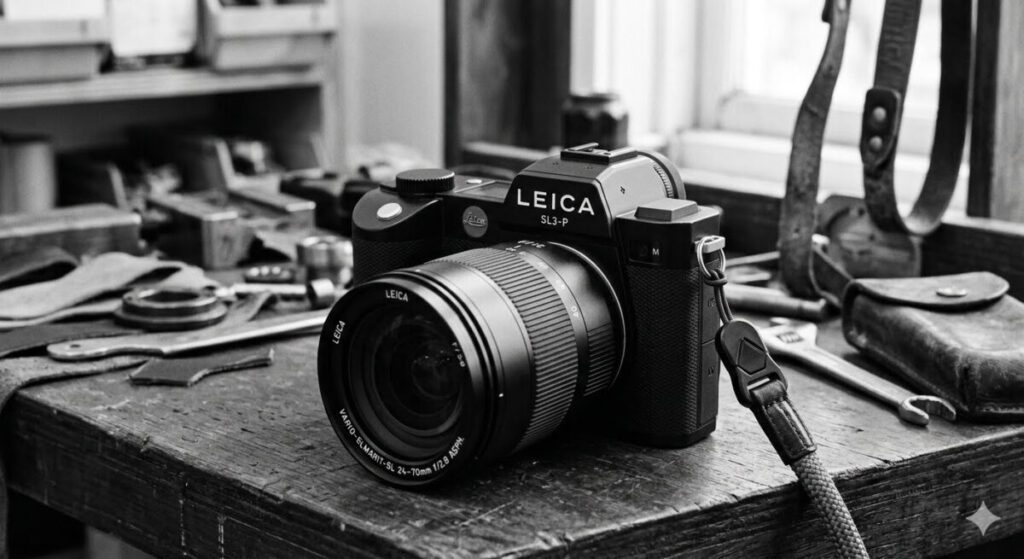
Leica’s reputation rests heavily on build quality, and the SL3-P continues that tradition with a few notable design choices.
German-Made Full Metal Construction
The SL3-P features a full metal chassis, designed and manufactured in Germany. This construction approach reflects Leica’s long standing commitment to durability, giving professional photographers confidence that the camera can withstand the daily wear of serious commercial work over many years of use.
IP54 Weather Sealing
The camera carries an IP54 dust and splash resistance rating, supported by Aqua Dura coatings on external lens elements. This level of protection makes the SL3-P suitable for unpredictable outdoor shooting conditions, an important consideration for photographers who regularly work outside a controlled studio environment.
A Minimalist Design Without the Red Dot
In a distinctive design choice, the SL3-P ships without Leica’s traditional red dot logo. Large letters spelling LEICA appear across the top plate instead, giving the camera a more discreet presence. This design decision suits documentary and photojournalistic work particularly well, where a recognizable red logo can sometimes draw unwanted attention during sensitive shooting situations.
Interface and Usability
The user interface separates photo and video modes using a clear color code, with red representing photo mode and yellow representing video mode. The high resolution tilting screen automatically adjusts its display based on camera orientation, keeping information legible whether shooting horizontally or vertically. Leica delivers ongoing firmware updates through the Leica FOTOS App, ensuring the camera continues improving well after its initial release.
Leica SL3-P Pricing and Launch Kits
Pricing sits firmly within Leica’s premium territory, though the SL3-P does offer some flexibility through bundled kit options.
Body Only and Kit Pricing
The Leica SL3-P retails for 6,690 dollars as a standalone body. Leica also offers three launch kits designed to bundle the camera with new lens options. The SL3-P 28 to 70 Vario Kit costs 7,790 dollars, the SL3-P 24 to 70 Vario Kit costs 8,390 dollars, and the SL3-P 24 to 70 and 70 to 200 Vario Kit costs 10,995 dollars for photographers who want both zoom ranges covered from day one.
New SL Lens Additions
Alongside the camera body, Leica introduced two new prime lenses built for the SL system. The Summilux-SL 50mm f/1.4 ASPH retails for 4,950 dollars, while the APO-Macro-Elmarit-SL 100mm f/2.8 costs 2,700 dollars. Both lenses become available worldwide by the end of 2026, giving SL3-P owners additional options as they build out their kit over time.
The Leica SL3-P and the L-Mount Alliance
Leica does not build the SL3-P in complete isolation. The camera exists within a broader ecosystem that shapes both its capabilities and its long-term value for buyers.
What the L-Mount Alliance Means for SL3-P Owners
The L-Mount alliance brings together Leica, Panasonic, and Sigma under a shared lens mount standard, giving SL3-P owners access to a far wider lens selection than Leica glass alone could ever provide. Sigma in particular has released dozens of L-Mount lenses at prices well below Leica’s own lineup, making the SL3-P more approachable for photographers who want Leica’s body and sensor performance without committing entirely to Leica-branded optics for every focal length.
Why Shared Sensor Technology Benefits Buyers
Building the SL3-P around the Panasonic S1RII platform brings real advantages beyond cost savings during development. Shared sensor technology across the alliance means firmware improvements and processing advances discovered on one brand’s camera can sometimes inform future updates across the ecosystem. Photographers benefit indirectly from research and development that spans three manufacturers instead of just one, even though each brand still delivers its own distinct user experience and design philosophy.
Real World Use Cases for the Leica SL3-P
Specifications matter, but understanding how the SL3-P performs across different professional scenarios helps clarify whether this camera fits an actual working photographer’s needs.
Studio Portrait and Fashion Sessions
Studio photographers benefit enormously from the 44-megapixel resolution paired with 14 stops of dynamic range. Skin tones render with exceptional detail, and the extended dynamic range gives retouchers genuine flexibility when adjusting shadows and highlights during post-production. The Multishot mode adds further value for fashion clients who occasionally need ultra-high-resolution files for large format campaign prints.
Wedding Day Coverage
Wedding photographers face constantly changing lighting conditions across a single day, from bright outdoor ceremonies to dim reception halls lit by candlelight. The SL3-P’s wide ISO range, stretching up to 200,000, gives photographers confidence that low light moments will not compromise a wedding gallery’s overall quality. Combined with the new hybrid autofocus system, the camera should track a first dance or a ring exchange with far more reliability than earlier SL models managed.
Architectural and Commercial Work
Architecture and interior photographers often shoot in challenging mixed lighting, combining natural window light with artificial interior sources. The SL3-P’s dynamic range handles these tricky lighting scenarios well, preserving detail across bright windows and shadowed interior corners within a single exposure. According to Digital Camera World, this kind of balanced sensor performance has become increasingly important as commercial clients demand faster turnaround times without sacrificing image quality.
Leica SL3-P vs the Rest of the SL Family
Understanding exactly where the SL3-P fits requires comparing it directly against its closest siblings.
SL3-P vs Leica SL3
The standard SL3 offers a substantially higher 60-megapixel sensor, appealing to photographers who genuinely need maximum resolution for large scale prints or extreme cropping flexibility. The SL3-P trades some of that resolution for faster file handling and a more balanced everyday workflow, making it the more practical choice for photographers who deliver images quickly and consistently rather than occasionally producing massive gallery prints.
SL3-P vs Leica SL3-S
The SL3-S remains the more video-centric option within the family, built around a 24-megapixel sensor optimized for speed and hybrid shooting. The SL3-P clearly outresolves the SL3-S while still improving on its autofocus performance, positioning itself as the more well-rounded stills option for photographers who occasionally shoot video but prioritize photography above all else.
Leica SL3-P vs Competitors: Sony and Panasonic
Beyond its own SL lineup, the SL3-P faces real competition from established rivals in the full-frame mirrorless space.
Comparing Against the Panasonic Lumix S1RII
Since the SL3-P shares its core sensor platform with the Panasonic Lumix S1RII, the comparison naturally centers on price and brand experience rather than raw specifications. Panasonic’s own body typically sells for a fraction of Leica’s asking price, meaning photographers pay a significant premium for Leica’s build quality, color science, and overall user interface polish. Whether that premium feels justified depends heavily on how much a photographer values the broader Leica ownership experience.
Comparing Against Sony’s High Resolution Options
Sony continues to dominate the professional mirrorless market with cameras like the A7R V, which offers even higher resolution alongside a mature autofocus system built over many product generations. The SL3-P cannot match Sony’s autofocus track record purely on paper, though its new hybrid system represents Leica’s most serious effort yet to close that gap. Photographers deeply invested in the Sony ecosystem may not find enough reason to switch, but those drawn to Leica’s design philosophy now have a genuinely more competitive tool to consider.
Who Should Buy the Leica SL3-P
The SL3-P makes the most sense for a specific type of photographer rather than every Leica shooter across the board.
Ideal for Studio and Portrait Professionals
Portrait, fashion, and advertising photographers stand to benefit most directly from the SL3-P’s resolution and dynamic range balance. The 44-megapixel sensor delivers enough detail for demanding client deliveries without creating the storage and editing burden that comes from constantly working with 60-megapixel files.
A Strong Option for Wedding and Event Shooters
The improved autofocus system makes the SL3-P a legitimate option for wedding and event photography, a genre that previous Leica SL cameras struggled to fully support due to slower focus tracking. Photographers who need reliable subject tracking during fast moving, unpredictable moments now have real reason to consider Leica alongside more established autofocus leaders.
Perhaps Not the Right Fit for Video-First Creators
Despite genuinely impressive video specifications, creators who prioritize video work above stills photography should still look toward the SL3 or SL3-S instead. Leica built the SL3-P around a photography-first philosophy, and while the video toolkit performs well, it exists as a secondary feature rather than the camera’s primary purpose.
Frequently Asked Questions About the Leica SL3-P
When did the Leica SL3-P officially launch?
Leica officially announced and released the SL3-P on June 25, 2026, alongside two new SL prime lenses.
How much does the Leica SL3-P cost?
The body-only price is 6,690 dollars. Leica also offers bundled kits ranging from 7,790 dollars to 10,995 dollars, depending on which lenses are included.
Does the Leica SL3-P shoot 8K video?
Yes. The SL3-P records 8.1K Open Gate footage at up to 30 frames per second, alongside strong support for 5.9K, 4K120, and Apple ProRes recording.
Is the Leica SL3-P better than the SL3?
Better depends on the photographer’s priorities. The SL3 offers higher 60-megapixel resolution, while the SL3-P offers a more balanced file size alongside improved autofocus performance, making it the more practical everyday choice for many working professionals.
What lens mount does the Leica SL3-P use?
The SL3-P uses the L-Mount, giving photographers access to lenses from Leica, Panasonic, and Sigma through the shared L-Mount alliance.
Final Thoughts on the Leica SL3-P
The Leica SL3-P arrives as a genuinely thoughtful addition to the SL lineup, filling a resolution gap that photographers have wanted addressed for a long time. A 44-megapixel sensor, a completely new hybrid autofocus system, and surprisingly capable 8K video all come together in a camera built specifically around real professional workflows. The IP54 weather sealing and full metal German construction only reinforce Leica’s continued commitment to durability alongside performance.
At 6,690 dollars, the SL3-P remains a serious investment, positioned squarely within Leica’s premium territory. For photographers already living inside the Leica ecosystem, or those considering a first step into it, this camera offers one of the most balanced propositions the brand has released in years.
Read More from Altbuzz
For more 2026 full-frame camera coverage, check our Leica SL3 versus SL3-S comparison, our Sony A7R V review, and our best L-Mount lenses buying guide for additional context on this growing camera system.
Follow every Leica SL3-P update and full-frame camera launch at altbuzzmedia.com. For dedicated Leica rumor and release tracking, follow Leica Rumors at leicarumors.com.
Subscribe to Altbuzz YouTube Channel
Full hands-on impressions of the Leica SL3-P, side-by-side comparisons against the SL3 and SL3-S, and ongoing full-frame mirrorless coverage are live on the Altbuzz YouTube channel @AltBuzzMedia. Subscribe now for weekly camera reviews and gear analysis through the rest of 2026.