
Fujifilm X100VI Review: Is This the Camera Everyone Says It Is?
The Fujifilm X100VI became a genuine cultural moment the day it launched. Photographers lined up for hours. Waitlists stretched past a year in some regions. Resale prices climbed well above the original sticker price.
That kind of hype usually signals a marketing win, not a technical one. This review looks past the noise. It breaks down what the X100VI actually does well, where it genuinely struggles, and whether it earns its reputation as one of the best compact cameras released in years.
We tested the specs, cross-checked real-world reports, and pulled together everything a buyer actually needs before spending real money. Let’s get into it.
Fujifilm X100VI at a Glance
Fujifilm released the X100VI in February 2024 at a launch price of 1,599 dollars. That price includes the fixed lens, since this camera never accepts interchangeable glass. The body ships in classic black or a silver and black two-tone finish that echoes older rangefinder cameras.
At its core sits a 40.2 megapixel X-Trans CMOS 5 HR sensor paired with Fujifilm’s X-Processor 5 chip. That combination nearly doubles the resolution of the outgoing X100V. The camera weighs 521 grams with a battery and card installed, keeping it genuinely pocketable for a premium compact.
This generation finally adds two features fans requested for years. In-body image stabilization now ships standard, rated up to 6 stops. Weather sealing also arrives for the first time on the body itself, though the lens still needs an accessory ring and filter for full protection.
Design and Build Quality
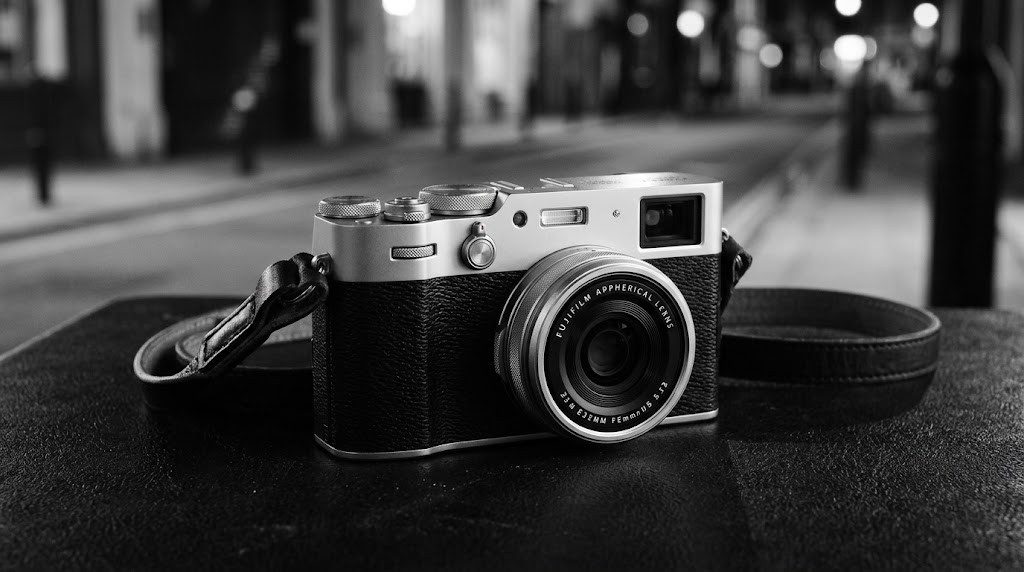
The Retro Body and Manual Dials
Fujifilm did not touch the X100VI’s exterior design in any meaningful way. The body reuses the same chassis as the X100V, measuring 128.0 by 74.8 by 55.3 millimeters. Physical dials still control shutter speed, exposure compensation, and aperture directly on the lens ring.
That mechanical control layout remains the camera’s biggest personality trait. Photographers can adjust exposure without opening a single menu. The tactile clicks feel deliberate and satisfying, closer to a film camera than a modern digital body.
Weather Sealing Reality Check
Fujifilm added body-level weather sealing for the first time in this series. The company has not published a formal IP rating, but confirms resistance to splashes and light dust exposure. Real-world testers report the body handling coastal spray and occasional rain without issue.
The catch involves the lens itself. Full weather resistance still requires screwing on an adapter ring and protective filter, a setup that adds noticeable bulk to an otherwise compact package. Buyers who want true sealed protection need to budget for that extra accessory.
Handling and Grip
The X100VI ships without a substantial front grip, staying true to its rangefinder-inspired design. Long-term users often recommend a wrist or neck strap rather than pure hand-holding, since the smooth body offers little to hold onto during a full day of shooting.
This tradeoff feels intentional rather than accidental. Fujifilm prioritized a slim silhouette over ergonomic bulk, which suits photographers who value discretion over a confident one-handed grip.
Sensor and Image Quality
The 40 Megapixel X-Trans Sensor
The jump to 40.2 megapixels represents the biggest technical change in this generation. That resolution gives photographers far more room to crop, which matters enormously on a camera with a single fixed focal length. A tighter crop effectively becomes your zoom lens.
Reviewers consistently praise the level of fine detail this sensor captures, especially in good light. The X-Trans color filter array also continues Fujifilm’s reputation for producing pleasing skin tones and rich color straight out of camera.
Dynamic Range and Low Light Behavior
Low light performance improved noticeably compared to the X100V, according to multiple independent reviewers. Noise stays more controlled at higher ISO settings, and the extra resolution does not come at the cost of usable dynamic range in typical shooting conditions.
The lens itself is not the sharpest optic paired with a 40 megapixel sensor. Some reviewers note it falls short of dedicated prime lenses on larger interchangeable systems. Most photographers still find the output more than sufficient, since the X100VI trades ultimate sharpness for character and portability.
Film Simulations and Color Science
Fujifilm ships the X100VI with 20 Film Simulation modes, including the newer REALA ACE profile. These presets let photographers achieve a finished look directly in camera, cutting down on editing time significantly.
This feature genuinely shapes how people use the camera day to day. Many buyers specifically choose the X100VI because these simulations produce satisfying results without opening editing software, turning the shooting process itself into the creative endpoint.
Autofocus Performance
Subject Detection Explained
The X-Processor 5 brings genuine autofocus improvements over the X100V. The system now detects people, animals, birds, cars, motorcycles, bicycles, airplanes, trains, and insects through dedicated subject tracking modes. This puts the X100 series closer to Fujifilm’s more advanced X-T5 and X-H2 bodies.
Reviewers describe tracking performance as reliable for walking subjects moving toward, across, and away from the frame. Zone autofocus and low-contrast scenes show the clearest improvement compared to the previous generation.
Where Autofocus Still Struggles
The fixed lens contains a slower focus motor than Fujifilm’s dedicated prime lenses built for interchangeable systems. This throttles overall autofocus speed compared to bodies like the X-T5, even though they share the same processor and sensor technology.
Eye detection and general subject detection also sit in separate menu modes rather than working together automatically. Photographers need to manually switch between them depending on the scene, which adds a small workflow friction point that competitors have already solved.
The Fixed 23mm f/2 Lens
Focal Length and Shooting Character
The lens delivers a 35mm equivalent field of view at a maximum aperture of f/2. That focal length sits in a sweet spot for street, travel, and documentary photography, wide enough to capture context while staying tight enough for intentional composition.
This single-lens approach forces a specific way of shooting. Photographers cannot zoom or swap glass mid-session, which many reviewers describe as creatively freeing rather than limiting. The constraint pushes shooters to move their feet and compose more deliberately.
The Built-In ND Filter Advantage
A 4-stop internal neutral density filter ships built into the camera, a feature rarely found on compact cameras at this price. It lets photographers shoot wide open at f/2 in bright daylight without blowing out highlights, a common problem on fixed-aperture compacts.
This feature also matters for video shooters who want cinematic shallow depth of field in outdoor conditions. Without an internal ND, achieving that same look would require carrying separate filters and swapping them constantly.
In-Body Image Stabilization
Fujifilm finally added IBIS to the X100 series with this generation, rated up to 6 stops of correction. This marks a genuine milestone for the lineup, since every previous model relied entirely on steady hands and fast shutter speeds in dim conditions.
The stabilization system works alongside the higher resolution sensor to meaningfully improve handheld shooting confidence, especially in low light or during slower shutter speed video work. Reviewers note this pairing feels like a real generational leap rather than a minor spec bump.
Viewfinder and Screen
The Hybrid Optical Electronic Finder
The X100VI keeps Fujifilm’s signature hybrid viewfinder, letting photographers switch between a true optical view with digital overlays and a full electronic preview. The optical mode delivers that classic rangefinder feeling, showing the world as it actually looks rather than a processed digital feed.
Many photographers actually favor the electronic mode day to day, since it previews exposure, film simulation, and focus confirmation directly in the frame. The optical mode remains available for shooters who specifically want that traditional viewing experience.
Rear LCD Limitations
The rear screen tilts vertically but does not flip forward to face the shooter. That single-axis design creates a real limitation for anyone hoping to use the X100VI for solo vlogging or face-to-camera video content.
Fujifilm clearly built this camera around stills-first shooting rather than video-first workflows. Buyers specifically chasing a flip screen for content creation should look elsewhere in Fujifilm’s own lineup instead.
Video Capabilities
Resolution, Codecs, and Color Profiles
The X100VI records up to 6.2K at 30fps, an unusually high resolution for a compact camera in this category. It also offers 4K at up to 60fps, along with 10-bit 4:2:2 color depth and F-Log2 support for photographers who want to color grade footage in post-production.
This spec sheet genuinely surprises reviewers given the camera’s compact, photography-focused design. The video quality holds up well for casual and even semi-professional use, particularly when paired with the built-in ND filter for controlling exposure outdoors.
Why This Stays a Photo-First Camera
Despite the strong video specs, most reviewers agree the X100VI functions as a stills camera that happens to shoot excellent video, not the other way around. The lack of a flip screen and the single card slot both point toward a photography-first design philosophy.
Buyers who need dedicated vlogging features should consider Fujifilm’s X-M5 instead, which offers a flip-out screen and better thermal management at a lower price point.
Battery Life and Storage
Real-World Battery Performance
Fujifilm rates the X100VI at approximately 310 shots using the electronic viewfinder, or 450 shots using the optical finder, per CIPA testing standards. Real-world users often report noticeably higher numbers, sometimes reaching 600 to 700 shots per charge when Wi-Fi and Bluetooth stay disabled.
The added IBIS system and higher resolution sensor both draw more power than the outgoing X100V. Multiple reviewers specifically recommend carrying a spare battery for long shooting days, especially if video recording enters the mix.
Storage and Charging
The camera includes a single SD card slot limited to UHS-I speeds, which caps maximum write performance compared to faster UHS-II cards used on other Fujifilm bodies. This mainly matters for buffer clearing during fast burst shooting or high-bitrate video recording.
USB-C charging comes standard, letting photographers top up the battery from a power bank or laptop while traveling. This convenience helps offset the camera’s otherwise average battery endurance.
Burst Shooting and Buffer Performance
The X100VI shoots at 11fps using its mechanical shutter, with buffer space for roughly 17 uncompressed RAW frames before slowing down. Switching to the electronic shutter pushes burst speed to 13fps, with JPEG buffer capacity jumping to around 37 frames.
Clearing a full buffer after an extended burst can take several seconds, during which the camera partially locks up. This rarely matters for street or travel photography, where shooters rarely fire off sustained bursts. It becomes a real limitation for anyone attempting fast-paced event or action photography with this camera.
Price and Real-World Availability
Launch Price vs Street Reality
Fujifilm launched the X100VI at 1,599 dollars for the body, which already includes the fixed lens. That price positions it above most APS-C compact rivals but well below full-frame alternatives like the Leica Q3.
Actual market prices have told a different story since launch. Sustained demand pushed resale and grey-market prices well above MSRP for extended periods, with some listings appearing at 2,000 dollars or more depending on availability and region.
The Hype Factor Explained
Social media exposure turned the X100VI into more than just a camera. Viral posts and street photography trends pushed demand far beyond what Fujifilm’s production could initially supply, creating genuine scarcity in the first year after launch.
Buyers should approach this pricing situation with discipline. Paying a significant premium over retail rewards scalping behavior and rarely reflects the camera’s actual value once supply normalizes. Waiting for retail stock or a fair used price remains the smarter path for most buyers.
Fujifilm X100VI vs Fujifilm X100V
The X100V remains available at a lower price point and still delivers Fujifilm’s beloved color science and handling. It lacks IBIS entirely and uses an older processor, which noticeably limits autofocus speed and subject tracking compared to the newer model.
Buyers on a tighter budget who do not need the newest autofocus tricks or in-body stabilization can save real money by choosing the X100V instead. Anyone prioritizing low light confidence, video quality, or tracking performance should pay the premium for the X100VI.
Fujifilm X100VI vs Ricoh GR IIIx
The Ricoh GR IIIx competes directly on size, offering an even smaller, genuinely pocketable body with a similar 40mm equivalent field of view. It lacks a built-in viewfinder entirely, forcing photographers to compose using the rear screen or an optional hot-shoe finder.
The X100VI pulls ahead in autofocus speed, battery endurance, and Fujifilm’s signature film simulations. Shooters who prioritize absolute discretion and pocket size over viewfinder comfort may still prefer the Ricoh, but most buyers find the X100VI more versatile for extended shooting days.
Fujifilm X100VI vs Leica Q3
The Leica Q3 brings a full-frame sensor and Leica’s renowned lens quality into a similarly styled fixed-lens compact, but at a dramatically higher price point. It targets buyers who prioritize ultimate image quality and brand prestige over value.
The X100VI cannot match the Q3’s full-frame image quality or lens sharpness. It does deliver roughly 80 percent of that experience at a fraction of the cost, which explains why most enthusiast photographers choose the Fujifilm over the Leica for everyday carry.
Who Should Buy the Fujifilm X100VI
Street photographers, travel shooters, and documentary photographers make up the core audience for this camera. Anyone who values a single, deliberate focal length paired with genuinely excellent color science will likely find the X100VI a joy to carry every day.
Content creators who focus purely on photography, rather than video-first vlogging, also fit this camera well. The built-in film simulations and hybrid viewfinder combination reward photographers who want a finished look straight out of camera.
Who Should Skip the Fujifilm X100VI
Photographers who need lens flexibility should look elsewhere entirely, since this camera never accepts interchangeable glass. Wildlife, sports, and long-telephoto shooters will find the fixed 35mm equivalent lens fundamentally limiting no matter how good the sensor performs.
Vloggers and solo video creators should also consider other options. The lack of a flip screen and average battery life both work against dedicated video workflows, even though the underlying video specs look genuinely strong on paper.
Pros and Cons Summary
What works well:
- The 40.2 megapixel sensor delivers excellent detail and real cropping flexibility
- In-body stabilization up to 6 stops meaningfully improves handheld shooting
- The built-in 4-stop ND filter adds real creative control in bright light
- Twenty film simulation modes produce satisfying results straight out of camera
- The hybrid viewfinder offers genuine flexibility between optical and electronic shooting
What holds it back:
- Autofocus still trails behind Fujifilm’s own interchangeable lens bodies
- Battery life stays average and demands a spare for long shooting days
- The rear screen does not flip forward, limiting solo video use
- Full weather sealing requires an extra accessory ring and filter
- Sustained demand has kept real-world prices well above the official MSRP
Frequently Asked Questions
Is the Fujifilm X100VI worth the money? For street, travel, and documentary photographers who value a single deliberate focal length and Fujifilm’s color science, yes. Buyers chasing pure specs-per-dollar value will find better options elsewhere.
What is the difference between the X100VI and the X100V? The X100VI adds in-body image stabilization, body-level weather sealing, a higher resolution 40.2 megapixel sensor, and improved autofocus through the newer X-Processor 5.
Does the Fujifilm X100VI have a good autofocus system? It represents a real improvement over the X100V, with reliable subject tracking for people and several object categories. It still trails behind Fujifilm’s own interchangeable lens bodies due to the fixed lens motor.
How long does the Fujifilm X100VI battery last? Fujifilm rates it at 310 shots using the electronic viewfinder or 450 shots using the optical finder. Real-world users often report higher numbers with Wi-Fi and Bluetooth disabled.
Can the Fujifilm X100VI shoot good video? Yes. It records up to 6.2K at 30fps with 10-bit color and F-Log2 support, though the lack of a flip screen makes it better suited to photography-first shooters than dedicated vloggers.
Is the Fujifilm X100VI weather sealed? The body itself resists splashes and light dust. Full weather sealing for the lens requires an additional adapter ring and protective filter sold separately.
Why is the Fujifilm X100VI so hard to find in stock? Viral social media attention pushed demand well beyond Fujifilm’s initial production capacity, leading to long waitlists and inflated resale prices in the first year after launch.
What is the Fujifilm X100VI’s lens equivalent focal length? The fixed 23mm f/2 lens delivers a 35mm equivalent field of view, a popular focal length for street and documentary photography.
Does the Fujifilm X100VI have interchangeable lenses? No. The lens is permanently fixed to the body, which is a core part of this camera’s design philosophy and shooting experience.
Should I buy the Fujifilm X100VI or the Ricoh GR IIIx? Choose the X100VI if you want a built-in viewfinder, stronger autofocus, and Fujifilm’s film simulations. Choose the GR IIIx if absolute pocket size and discretion matter more than those features.
Final Verdict
The Fujifilm X100VI mostly earns its reputation. It combines genuinely excellent image quality, real autofocus improvements, and Fujifilm’s beloved color science into a compact body that photographers actually want to carry every day. The addition of in-body stabilization and weather sealing finally addresses two long-standing complaints about this camera line.
The honest weaknesses remain real too. Autofocus still trails Fujifilm’s interchangeable lens bodies. Battery life stays merely average. And market hype has pushed real-world prices well beyond what this camera should reasonably cost. Buy it at retail or a fair used price, and the X100VI delivers one of the most satisfying shooting experiences available in a compact camera today.
Want more in-depth camera reviews like this? Visit Alt Buzz for the latest camera reviews, comparisons, and buying guides covering every major brand.
Prefer video breakdowns instead of reading? Subscribe to the Alt Buzz YouTube channel for hands-on camera coverage, real-world testing, and gear comparisons published every week.