
Fujifilm X100VI Review: Is This Compact Camera Worth the Hype?
This Fujifilm X100VI review tackles a camera that photographers wanted long before it arrived. The X100 series has built a loyal following over more than a decade, and the sixth generation pushes the formula further than any model before it. Fujifilm packed a 40.2MP sensor, in-body stabilization, and modern autofocus into a pocketable body with a fixed lens and a hybrid viewfinder. Demand surged after launch, and shortages followed, which turned a camera into a cultural moment.
So does the X100VI live up to the excitement? We break down the design, image quality, film simulations, autofocus, stabilization, video, battery life, accessories, and price. We also compare it with its main rivals, offer setup tips, and explain who should buy it. Along the way, we point out the weaknesses, because no camera suits everyone.
Fujifilm X100VI at a Glance
Here are the key specifications before we go deeper.
- Sensor: 40.2MP APS-C X-Trans CMOS 5 HR (back-illuminated)
- Processor: X-Processor 5
- Lens: Fixed 23mm f/2 Fujinon (about 35mm full-frame equivalent)
- Stabilization: 5-axis in-body, rated up to 6 stops
- Viewfinder: Hybrid optical and electronic, 3.69 million-dot EVF
- Screen: 3-inch tilting touchscreen
- Video: 6.2K at 30p, 4K at 60p, Full HD at 240p, 10-bit F-Log2
- Film simulations: 20 modes, including REALA ACE
- Card slot: One SD slot (UHS-I)
- Battery: NP-W126S, rated around 450 shots
- Built-in ND filter: 4 stops
- Weight: Roughly 520 to 530 grams with battery and card
- Launch price: $1,599 in the United States
Check current availability and pricing on the Fujifilm X Series website, because street prices have varied since launch.
A Short History of the Fujifilm X100 Series
To understand the X100VI, you need to know where it comes from. Fujifilm introduced the original X100 in 2011, and it surprised the industry. At a time when most enthusiast cameras chased bigger zoom ranges and more buttons, Fujifilm chose a fixed lens, a retro body, and a clever hybrid viewfinder. That bet worked. Photographers fell for the idea of a single focal length and a more intentional way of shooting.
Over the next decade, Fujifilm refined the formula. Each generation improved the sensor, the autofocus, the lens, or the handling. The X100V arrived about four years before the X100VI and became a modern classic, with a redesigned lens and a tilting screen. Then social media and street photography trends pushed the camera into the spotlight, and demand grew far beyond what Fujifilm expected.
The X100VI builds on that legacy. It keeps the familiar design, but it upgrades the internals in ways that matter. The camera feels like a natural evolution rather than a risky reinvention.
Design and Build Quality
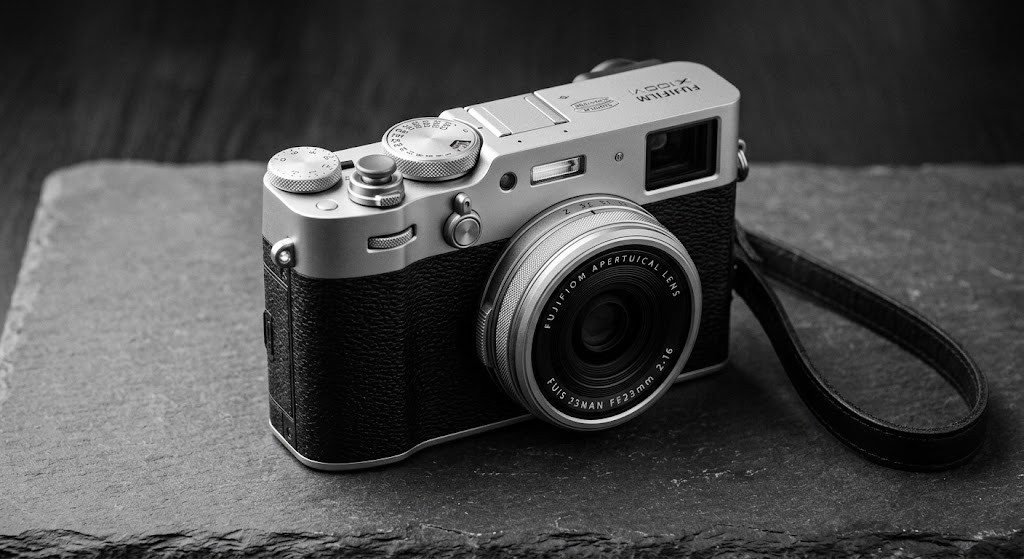
The X100VI looks and feels like a classic rangefinder. Fujifilm kept the same compact dimensions as the X100V, and the camera weighs only slightly more. It slips into a jacket pocket or a small bag without effort, so you can carry it everywhere.
Retro Dials and Tactile Controls
Dedicated dials on the top plate control shutter speed, ISO, and exposure compensation. Around the lens, a physical aperture ring clicks through its stops. This layout lets you set your exposure without opening a menu. You feel the camera respond under your fingers, and that feedback shapes how you shoot.
A front lever switches between the optical and electronic viewfinder, and a small joystick moves your focus point. Fujifilm also refined the menu and quick settings, which helps you reach common options faster. The company clearly improved the controls instead of reinventing them.
The Hybrid Viewfinder
The hybrid viewfinder remains the signature feature of the X100 line. In optical mode, you look through a bright window with frame lines, so you can watch action outside the frame. In electronic mode, you get a sharp 3.69 million-dot view with exposure preview. You can even display a small electronic window inside the optical view to check focus.
Few cameras offer this experience. Street photographers love it because it keeps them connected to the scene. It also adds charm to every outing, and many owners say it makes them shoot more.
Weather Resistance Needs Accessories
The X100VI does not offer full weather sealing by itself. Fujifilm says you can improve protection by adding an adapter ring and a protective filter. Those accessories cost extra, and they change the look of the lens. If you shoot often in rain or dust, plan for that expense.
Build and Handling
The body uses a metal construction, so it feels solid without feeling heavy. The grip is modest, which keeps the camera slim. Photographers with large hands may want a small grip add-on or a leather case. For casual walks and long travel days, though, handling feels natural.
Color Options and Finish
Fujifilm offers the X100VI in black and silver. The silver version looks more classic, while the black version looks stealthier on the street. Both finishes show wear over time, and some owners like that patina. Choose the color that fits your style, since performance stays identical.
Image Quality and Sensor Performance
Image quality marks the biggest leap from the previous model. The 40.2MP sensor offers about 1.5 times the resolution of the X100V, and the back-illuminated design helps it collect light efficiently.
Resolution and Detail
The sensor resolves fine textures beautifully. Fabric patterns, architectural details, and landscape elements all show strong clarity. High resolution also gives you flexibility to crop. A single 35mm-equivalent frame can become a tighter composition in post without losing much detail.
That flexibility matters on a fixed-lens camera. You cannot zoom, so you can recompose later. Many street photographers shoot wide, then crop to find the strongest framing.
The Lens
The 23mm f/2 lens remains compact and sharp. Fujifilm kept the same optical design as the X100V, which already earned praise for its character. Some photographers noticed that the lens looks a little soft in the corners at wide apertures when paired with a 40MP sensor. Stopping down to f/4 or f/5.6 improves that behavior. For most everyday use, though, the lens performs well.
A leaf shutter inside the lens also lets you use flash at fast shutter speeds. That helps with daylight fill flash portraits, a favorite technique among street and event photographers. It also keeps shutter noise very quiet, which suits discreet shooting.
Color Science
Fujifilm’s color science attracts many photographers to the brand. Skin tones look natural, greens stay rich without turning neon, and blues keep a pleasing depth. The camera produces JPEG files that often need little editing, and RAW files give you room for serious adjustments.
High ISO Performance
At higher ISO values, the X100VI performs well for an APS-C camera. Noise stays controlled through typical evening and indoor situations. Combined with stabilization, the camera copes admirably in dim light. Extremely high ISO values will show grain, but many photographers enjoy that film-like texture.
Dynamic Range
The sensor gives you good latitude to recover shadows and protect highlights. Fujifilm also offers dynamic range settings that help in contrasty scenes. A bright sky above a shaded street, for example, becomes easier to balance. Shoot RAW when you want maximum flexibility.
Film Simulations: The Heart of the Fujifilm Experience
Film simulations deserve their own section, because they define why many people choose Fujifilm. The X100VI includes 20 modes, and each one recreates the look of a classic film stock or a creative style.
The Most Popular Modes
- Provia (Standard): A balanced, natural look for everyday shooting
- Velvia (Vivid): Rich, saturated colors for landscapes and travel
- Astia (Soft): Gentle tones that flatter portraits
- Classic Chrome: Muted, cinematic color with a documentary mood
- Classic Negative: A bold, nostalgic look with strong contrast
- Eterna: A soft, film-like style borrowed from cinema
- Acros: A beloved black-and-white mode with smooth tonality
REALA ACE
Fujifilm added a new mode called REALA ACE. It aims for faithful color with crisp contrast, and it suits photographers who want accurate results without heavy styling. Many users treat it as a dependable everyday option.
Grain, Color Chrome, and Custom Recipes
Beyond the basic modes, you can adjust grain effect, color chrome effect, highlight tone, shadow tone, and more. Photographers often save combinations as custom presets. Online communities share these recipes widely, so you can experiment freely and find a look that fits your style.
This workflow saves time. You shoot, you see a finished look, and you share. Many owners say they edit far less than they did with other cameras.
In-Body Image Stabilization
IBIS is the headline addition. Fujifilm rates the five-axis system at up to 6 stops of compensation, and the company fit it without increasing the camera’s size. This feature changes how you shoot in low light.
You can now handhold slower shutter speeds with confidence. An evening street scene, a dim restaurant, or a museum interior becomes far easier to capture sharply. Stabilization also benefits video, giving smoother handheld footage.
Working with the ND Filter
The built-in 4-stop ND filter pairs nicely with stabilization. In bright daylight, you can open the aperture to f/2 for shallow depth of field. You can also slow the shutter for motion blur in water or crowds. Both tricks used to require extra filters, and now they live inside the camera.
Autofocus Performance
The X100VI uses Fujifilm’s newer autofocus technology, borrowed from higher-end X Series cameras. It recognizes people, animals, birds, vehicles, and more. Eye detection works smoothly for portraits, and tracking holds a moving subject far better than the X100V did.
Real-World Autofocus
For street photography, travel, and family moments, the system performs reliably. It locks quickly in good light, and it handles most everyday scenes without trouble. Low light and fast action challenge it a little more, but it stays usable.
Do not expect the speed of a dedicated sports camera. The fixed 35mm-equivalent lens also limits subject distance for wildlife and sports. The X100VI shines at close-to-medium range instead.
Zone Focusing and Manual Focus
Many street photographers prefer zone focusing, which means setting a distance in advance and shooting without refocusing. The X100VI supports this method with a distance scale and a focus ring. Manual focus also helps in tricky light. You can use focus peaking or the small electronic window in the optical viewfinder to confirm sharpness.
Burst Shooting and Speed
The X100VI offers fast burst options, especially with the electronic shutter. You can shoot quick sequences of street moments or family action without feeling limited. The buffer handles moderate bursts well, although large 40MP RAW files fill it faster than smaller files would. Because specifications vary by shooting mode, check Fujifilm’s official specification page before you publish exact frame rates in your own copy.
Keep in mind that electronic shutter shooting can introduce rolling shutter with fast motion. For most casual photography, you will not notice. For quick panning or sports, the mechanical leaf shutter gives a safer result.
Video Features
Video quality gets a major upgrade over the previous model. The X100VI now works as a capable hybrid camera.
Resolution and Frame Rates
The camera records 6.2K video at up to 30p, which produces detailed footage that you can crop or downscale. It also records 4K at 60p for smoother motion, and Full HD at up to 240p for dramatic slow motion.
Color and Workflow
Ten-bit internal recording with F-Log2 gives you serious color grading flexibility. That level of dynamic range used to belong to more expensive cameras. The X100VI also supports Frame.io Camera to Cloud, which lets you upload footage directly for fast editing workflows.
Stabilization for Video
IBIS makes handheld video far smoother. Walking shots, casual interviews, and travel clips look more stable than footage from the previous model. Pair the camera with a small gimbal or grip for even better results.
Who Video Suits
Travel vloggers, casual creators, and photographers who shoot occasional clips will enjoy the video tools. The fixed lens limits creative framing, though, and the tilting screen does not flip fully forward for vlogging. Serious filmmakers will prefer interchangeable lens bodies.
Viewfinder, Screen, and Battery
Screen
The 3-inch touchscreen tilts upward and downward, which helps with waist-level shooting and high-angle shots. It folds neatly against the body when you do not need it. Because it tilts only vertically, it does not suit selfies or side-angle framing.
Battery Life
The NP-W126S battery delivers about 450 shots per CIPA testing, which is acceptable for a compact camera. Many reviewers still call the battery a weak point, because the sensor and stabilization draw power. Carry at least one spare for travel days. USB charging helps you top up from a power bank.
Storage
The camera offers a single SD slot that supports UHS-I speeds only. For 40MP RAW files and high-bitrate video, that limit feels a little dated. Choose a fast, reliable UHS-I card, and offload files regularly.
Connectivity and Sharing
The X100VI supports Bluetooth and Wi-Fi, so you can send photos to your phone quickly. Fujifilm’s companion app handles transfers and remote control. That convenience supports the shoot-and-share workflow that many owners love.
Shooting Different Subjects With the X100VI
A fixed 35mm-equivalent lens may sound limiting, but it covers a surprising range of work. Here is how photographers typically use it.
Street Photography
The X100VI feels designed for the street. The quiet leaf shutter, discreet size, and optical viewfinder help you stay unobtrusive. The wide view encourages you to move close and engage with your surroundings.
Travel Photography
Travel demands light gear, and the X100VI delivers. You carry one small camera, so you can walk all day without fatigue. Landscapes, architecture, food, and portraits all fit within the lens’s natural view.
Portraits
At f/2, the lens produces pleasing separation for environmental portraits. Eye detection helps keep faces sharp, and film simulations flatter skin tones. You will not get the compressed look of a longer lens, but you gain a sense of context and intimacy.
Landscapes
High resolution and stabilization help landscape shooters. Stop down for depth of field, mount a small tripod, and capture rich detail. The ND filter also supports long exposures of water or clouds.
Everyday Life and Family
Many owners simply use the X100VI as a daily camera. It captures family gatherings, birthdays, and weekend outings with beautiful color. Because it looks charming and non-threatening, people often relax in front of it.
Setup Tips for New Owners
Good settings help you enjoy the camera sooner. Treat the following suggestions as a starting point, then adjust to your taste.
- Choose a film simulation you like. Start with Classic Chrome or REALA ACE, then experiment.
- Use Auto ISO with a sensible limit. Set a minimum shutter speed, so the camera protects you from blur.
- Try aperture priority. Set the aperture ring, then let the camera pick the shutter speed.
- Shoot RAW plus JPEG. You keep editing flexibility while still enjoying ready-to-share files.
- Customize the function buttons. Assign the controls you use most, such as the ND filter or the focus mode.
- Learn the electronic window in the optical viewfinder. It helps you check focus without leaving the optical view.
- Update the firmware. Fujifilm often improves performance and features through updates.
Fujifilm X100VI vs Rivals
Several compact cameras compete for the same buyers. Here is a quick comparison.
| Camera | Strength | Weakness |
|---|---|---|
| Fujifilm X100VI | Hybrid viewfinder, film simulations, IBIS | Fixed lens, availability |
| Ricoh GR IIIx | Pocketable size, discreet look | No viewfinder, older sensor tech |
| Leica Q3 | Full-frame sensor, premium build | Far higher price |
| Fujifilm X-T50 | Interchangeable lenses, similar sensor | Larger kit, less compact |
| Sony RX100 VII | Zoom lens, speedy autofocus | Small sensor |
You can compare official specifications on the Fujifilm X Series site, the Leica Camera website, and the Ricoh Imaging site.
X100VI vs X100V
The X100VI improves on the X100V with a higher-resolution sensor, a faster processor, in-body stabilization, and stronger video features. Both share the same lens and design philosophy. If you find a used X100V at a bargain price, it remains a wonderful camera. If you want the best performance, the X100VI justifies the upgrade.
X100VI vs Ricoh GR IIIx
The Ricoh GR IIIx fits into a pocket even more easily, and its discreet look suits candid photography. However, it lacks a built-in viewfinder and stabilization of the same caliber. The X100VI offers a more complete shooting experience, while the Ricoh offers extreme portability.
X100VI vs Leica Q3
The Leica Q3 uses a full-frame sensor and a premium build, and it costs far more. It serves photographers who want a luxury compact camera. The X100VI offers a much more accessible price with a similarly charming experience. For most buyers, the Fujifilm delivers better value.
X100VI vs Interchangeable Lens Cameras
A camera like the Fujifilm X-T50 gives you more flexibility, because you can swap lenses. The X100VI, by contrast, gives you simplicity. You carry one camera, one lens, and one clear vision. Many photographers find that limit liberating.
Fujifilm X100VI Pros and Cons
Pros
- Gorgeous retro design with tactile controls
- 40.2MP sensor with strong detail and color
- Compact in-body stabilization up to 6 stops
- Unique hybrid optical and electronic viewfinder
- Excellent film simulations for ready-to-share JPEGs
- Capable 6.2K video with F-Log2
- Quiet leaf shutter and built-in ND filter
Cons
- Fixed lens limits flexibility
- Weather resistance requires accessories
- Single UHS-I card slot
- Battery life feels modest
- Tilting screen does not suit vlogging
- Limited stock and high demand have affected pricing
Common Complaints and How to Handle Them
No camera avoids criticism. Here are the most common concerns and some practical responses.
- “The lens feels soft at f/2.” Stop down slightly when you need maximum sharpness. Many photographers enjoy the gentle rendering at wide apertures.
- “The battery drains quickly.” Carry spares and keep the screen off when possible.
- “I cannot find one in stock.” Join retailer waiting lists and check official channels regularly.
- “I need weather protection.” Add the adapter ring and protective filter, or carry a small rain cover.
- “I want a longer focal length.” Use the digital crop modes or the optional teleconversion lens.
Who Should Buy the Fujifilm X100VI?
Buy the X100VI If You Love Simplicity
Street photographers, travelers, documentary shooters, and everyday enthusiasts will find the X100VI a joy. It encourages you to move, observe, and react. Its small size makes it easy to carry anywhere, so you will actually bring it along.
Buy the X100VI If You Want Great JPEGs
Photographers who dislike long editing sessions will appreciate Fujifilm’s film simulations. You can shoot, share, and move on. That workflow suits busy creators and casual hobbyists alike.
Skip the X100VI If You Need Versatility
Wildlife, sports, and studio professionals need interchangeable lenses and bigger buffers. Vloggers who need a fully articulating screen should also look elsewhere. The X100VI excels at focus and simplicity, not at covering every possible job.
Consider Alternatives If Budget Is Tight
If you cannot find the camera at a fair price, a used X100V or an interchangeable lens Fujifilm body offers excellent value. Patience often saves money.
Useful Accessories
A few accessories improve the X100VI experience:
- Wide and tele conversion lenses: These change the 35mm-equivalent field of view to roughly 28mm or 50mm.
- Adapter ring and protective filter: These add weather resistance and lens protection.
- Lens hood: This reduces flare and adds a little extra protection.
- Leather case or small grip: These improve handling comfort.
- Spare NP-W126S batteries: These extend shooting time.
- UHS-I SD cards: Choose reliable brands for stable performance.
- Small travel tripod: This helps with landscapes and long exposures.
Find official accessories on the Fujifilm X Series website.
Fujifilm X100VI Price and Value
The X100VI launched at $1,599 in the United States and began shipping in March 2024. Demand outpaced supply, so many buyers faced waiting lists and inflated resale prices. Availability and prices vary by region and retailer, so check current listings at B&H Photo and Adorama before you buy.
At the official price, the camera offers excellent value, since it combines high resolution, stabilization, and strong video in one compact package. At inflated prices, the value drops, and alternatives like a used X100V or an X-T50 become more appealing. Never overpay out of panic.
Smart Buying Tips
- Buy from authorized retailers to protect your warranty.
- Avoid unusually cheap listings that look too good to be true.
- Compare prices across several stores before you commit.
- Check return policies, and inspect the camera on arrival.
- Join stock alerts instead of paying a large markup.
The Altbuzz Verdict on the Fujifilm X100VI
At Altbuzz, we judge cameras by one question: does this camera help you make better pictures and enjoy the process? The Fujifilm X100VI answers with a confident yes. It rewards you for slowing down, and it delivers beautiful files without demanding long editing sessions.
Here is our score breakdown, shared as our opinion:
- Design and handling: 9 out of 10
- Image quality: 9 out of 10
- Autofocus: 8 out of 10
- Video: 8 out of 10
- Battery and practicality: 7 out of 10
- Value (at official price): 8.5 out of 10
- Overall: 8.5 out of 10
The X100VI will not replace a full camera system, and it does not try to. Altbuzz recommends it to anyone who wants a compact, joyful camera for everyday life, as long as you can buy it at a fair price.
Fujifilm X100VI FAQ
Is the Fujifilm X100VI worth buying?
Yes, if you value simplicity, image quality, and design. Pay close attention to price, since high demand has affected availability.
Does the Fujifilm X100VI have image stabilization?
Yes. It uses a five-axis in-body system rated at up to 6 stops.
Is the Fujifilm X100VI weather sealed?
Not by itself. You can add an adapter ring and a protective filter to improve weather resistance.
Can you change the lens on the Fujifilm X100VI?
No. The lens is fixed, but optional conversion lenses change the field of view.
How good is the X100VI for video?
It records 6.2K at 30p, 4K at 60p, and 10-bit F-Log2, which suits casual and hybrid creators. Heavy filmmaking calls for a different camera.
What memory card does the X100VI use?
It uses a single SD card slot with UHS-I speeds.
How long does the X100VI battery last?
The NP-W126S battery is rated around 450 shots, though real results vary. Carry a spare for long outings.
Does the X100VI have a built-in ND filter?
Yes. It includes a 4-stop ND filter, which helps in bright light.
How many film simulations does the X100VI have?
It offers 20 film simulation modes, including the new REALA ACE.
Should I buy the X100VI or the X100V?
Buy the X100VI for the newer sensor, stabilization, and video upgrades. Consider a used X100V if you want to save money.
Is the X100VI good for beginners?
Yes, with a small caveat. The tactile dials teach exposure basics, and the auto modes keep things simple. The price and fixed lens may feel limiting for a first camera, though.
Final Thoughts on the Fujifilm X100VI
The Fujifilm X100VI delivers what photographers hoped for: more resolution, better stabilization, smarter autofocus, and the same irresistible charm. It keeps the soul of the X100 series while adding modern power. A few compromises, such as a fixed lens and a single card slot, remain, yet they rarely spoil the experience.
If you want a camera that invites you outside and rewards every walk with a great photo, the X100VI belongs on your shortlist. Pick it up at a fair price, set your dials, and start shooting.
Read More from Altbuzz
Explore more camera news, reviews, and buying guides on Altbuzz:
- Nikon Zf Review: Is This Retro Full-Frame Camera Worth Buying?
- Nikon Z9 II: Rumored Specs, Price and Release Date
- Top 5 Rumored Fujifilm Cameras for 2026
- 10 Best Mirrorless Cameras in 2026, Ranked
Subscribe to Altbuzz YouTube Channel
Love honest camera reviews, rumor breakdowns, and buying advice? Subscribe to the Altbuzz YouTube channel for fresh videos on Fujifilm, Nikon, Sony, Canon, Leica, and more. Hit the bell icon so you never miss a camera review.