
Nikon Zf Review: Is This Retro Full-Frame Camera Worth Buying?
This Nikon Zf review answers a simple question: can a camera that looks like a 1980s film body still satisfy a modern photographer? Nikon built the Zf around a 24.5MP full-frame sensor, a powerful EXPEED 7 processor, and the same family of autofocus tools found in its flagship bodies. It then wrapped that technology in a case inspired by the classic Nikon FM2. The result feels like a love letter to film photography, with the performance of a current mirrorless camera inside.
We cover everything that matters to a buyer: design, image quality, autofocus, stabilization, video, battery life, price, and competition. We also tell you who should buy the Zf and who should look elsewhere. Reviews often flatter their subject, so we point out the weak spots too.
Nikon Zf at a Glance
Here are the key specifications before we go deeper.
- Sensor: 24.5MP full-frame (FX) BSI CMOS
- Processor: EXPEED 7
- Stabilization: 5-axis in-body, rated up to 8 stops
- Autofocus: 273-point phase detection with subject detection and 3D tracking
- Burst: Up to 14 fps with the mechanical shutter, plus a 30 fps JPEG mode with pre-capture
- Video: 4K at 30p from full-width oversampling, 4K at 60p with a crop, 10-bit N-Log
- Viewfinder: 3.69 million-dot EVF
- Screen: 3.2-inch vari-angle touchscreen
- Cards: One SD (UHS-II) slot and one microSD (UHS-I) slot
- Battery: EN-EL15c, rated around 360 to 380 shots per charge
- Launch price: About $1,999.95 in the United States
Check current pricing and availability on the Nikon USA website, because street prices change often.
Design and Build Quality
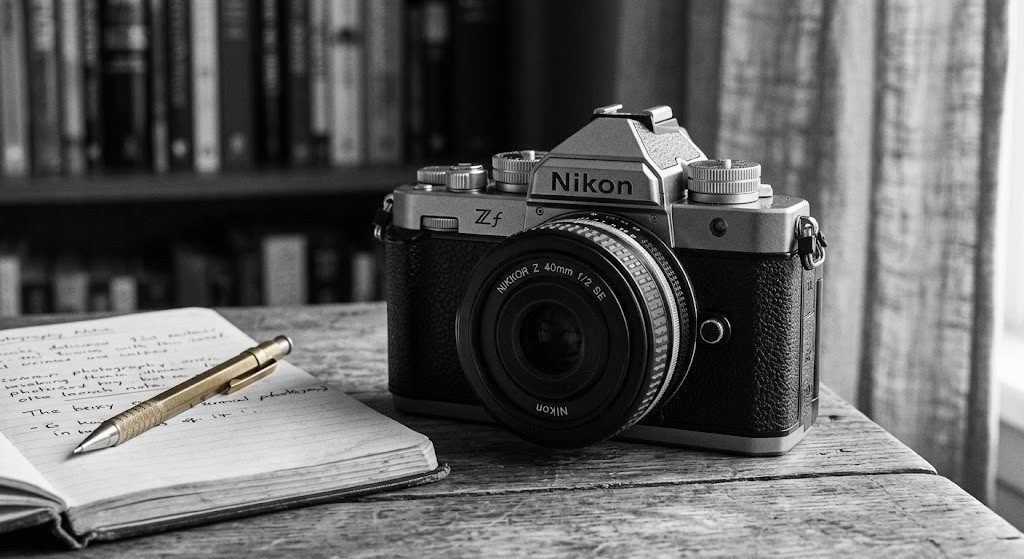
Design defines the Nikon Zf. Most cameras chase function first, but Nikon chased feeling here. The Zf invites you to pick it up, turn a dial, and shoot.
Retro Looks and Physical Dials
Nikon placed dedicated dials on top of the camera for shutter speed, ISO, and exposure compensation. A locking shutter speed dial gives you that old-school click, and a matching lens like the NIKKOR Z 40mm f/2 SE completes the vintage look. A small lever also switches the camera into a dedicated black-and-white mode, which suits street photographers who want to see the scene in monochrome while they compose.
These controls change how you shoot. You glance at the top plate and know your settings without waking a screen. Photographers who grew up on film will feel at home instantly, and newer shooters often find the tactile approach refreshing.
Handling and Ergonomics
Style comes with trade-offs. The body weighs about 710 grams with battery and card, so it feels dense in the hand. The grip is shallow compared with a modern DSLR-style body, so heavy lenses can feel awkward over long sessions. Many owners add a third-party grip or a leather half case to fix this. Small hands usually manage fine, while large hands may want an accessory.
The Hidden microSD Slot
Nikon placed the second card slot inside the battery compartment, and it accepts microSD cards rather than full-size SD. Nikon did this to keep the body compact. Photographers who rely on dual full-size cards may find the setup less convenient, and microSD cards also offer slower write speeds.
Weather Sealing and Durability
The Zf uses a metal body with weather sealing. It handles light rain and dusty conditions better than most retro-styled cameras. Even so, treat it with some care. Its mix of metal and leather-style coverings looks beautiful but invites wear if you toss it around.
Image Quality and Sensor Performance
The 24.5MP BSI sensor produces excellent stills. Twenty-four megapixels remains a sweet spot for many photographers. Files stay manageable, noise stays low, and you still have room to crop.
Sharpness and Detail
The sensor lacks a traditional low-pass filter, which helps fine detail look crisp. Paired with Nikon’s Z-mount lenses, the Zf delivers clean, sharp images. Portraits show natural skin tones, landscapes keep rich texture, and street scenes look lively without heavy editing.
High ISO and Dynamic Range
Backside illumination helps the sensor gather light efficiently. As a result, the Zf performs well in dim conditions, such as evening events, indoor portraits, and city streets at night. You can raise ISO with confidence, and the files respond well to editing. Dynamic range also sits in the strong range for a camera at this price, giving you room to recover shadows and protect highlights.
Pixel Shift for 96MP Files
The Zf includes a pixel shift mode that combines up to 32 frames into a single high-resolution 96MP image. This feature suits still life, architecture, and product work on a tripod. Moving subjects can create artifacts, so use it only for static scenes. Even so, it adds real value to a camera in this class.
Autofocus Performance
Nikon gave the Zf a modern autofocus system. It uses 273 phase-detect points and recognizes people, animals, and vehicles. Eye detection works smoothly for portraits, and tracking locks onto subjects reliably.
3D Tracking Returns
The Zf brings back 3D Tracking, a mode Nikon popularized in its DSLRs. You place the focus point on a subject, then the camera follows it around the frame. Some shooters love this method for unpredictable action, while others prefer subject detection. The Zf lets you choose.
Real-World Limits
The Zf does not match the autofocus depth of Nikon’s flagship bodies, and it does not aim to. Fast sports and erratic wildlife challenge it more than they challenge a Z8 or Z9. For portraits, street photography, travel, and events, though, the system performs with confidence. Choose a different camera if you shoot fast action every weekend.
In-Body Image Stabilization
Nikon rates the Zf’s five-axis stabilization at up to 8 stops under CIPA testing. Real-world results vary, but most reviewers agree the system works very well. Nikon also links the stabilization to the active autofocus point, which helps keep your subject sharp.
In practice, you can handhold slower shutter speeds in low light. A dim café interior, a church, or an evening street scene becomes much easier to shoot without a tripod. Stabilization also benefits video, giving smoother handheld footage.
Burst Shooting and Speed
The Zf shoots up to 14 fps with its mechanical shutter. RAW shooting runs slightly slower than JPEG, and the buffer handles long bursts well. Nikon also added a JPEG-only 30 fps mode that works from a video stream and supports pre-capture, similar to the feature in Nikon’s pro bodies.
That 30 fps mode helps with unpredictable moments, such as a child’s laugh or a bird taking off. Remember, it records JPEG only, so you give up RAW flexibility. Overall, the Zf offers plenty of speed for everyday work. It will not replace a dedicated sports camera, but it does not need to.
Video Features
The Zf works as a capable hybrid camera. Nikon built in the tools that content creators ask for most.
Resolution and Frame Rates
You get 4K video at up to 30p using the full width of the sensor with oversampling, which produces sharp, detailed footage. For 4K at 60p, the camera crops into a DX area, so you lose some field of view. Full HD supports up to 120p for slow motion.
Color and Codecs
The Zf records 10-bit H.265 and supports N-Log for flexible color grading. Videographers who like to grade footage will appreciate this. A vari-angle screen helps vloggers frame themselves, and the stabilization smooths walking shots.
Who Video Suits
Casual creators, travel vloggers, and photographers who shoot occasional video will enjoy the Zf. Serious filmmakers may want features like full-width 4K 60p or longer recording headroom, which cost more on newer bodies. Check thermal performance in your own use, and consider a small cage or external recorder if you plan heavy video work.
Viewfinder, Screen, and Battery Life
Electronic Viewfinder
The 3.69 million-dot EVF looks clear and natural. It shows a bright, detailed view, and the magnification feels comfortable for eyeglass wearers. Compared with higher-end bodies, it lacks some refinement, but most photographers will not complain.
Vari-Angle Touchscreen
The 3.2-inch rear screen flips out to the side and rotates. That helps with low-angle shots, high-angle shots, and selfies. You can tuck it in against the body to protect the glass, which also preserves the retro look.
Battery Performance
The Zf uses the EN-EL15c battery, which Nikon rates around 360 to 380 shots per charge depending on the viewing method. Real-world performance often runs higher with careful use, but a spare battery remains a wise purchase. The camera charges over USB, which makes travel easier.
Nikon Zf vs Rivals
Several strong cameras compete in this price range. Here is a quick comparison.
| Camera | Strength | Weakness |
|---|---|---|
| Nikon Zf | Style, tactile dials, 8-stop IBIS | Small grip, microSD slot |
| Sony A7 IV | Lens choice, hybrid versatility | Less tactile handling |
| Canon EOS R6 II | Fast autofocus, strong video | Plainer design |
| Panasonic Lumix S5 II | Video features, phase-detect AF | Larger body |
| Nikon Z6 II | Dual cards, ergonomics | Older tech |
Visit the Sony Electronics, Canon USA, and Nikon USA sites for official specifications.
Zf vs Z6 II
The Zf improves on the Z6 II with a newer processor, stronger stabilization, and better subject detection. However, the Z6 II offers dual full-size card slots and a more conventional grip. Choose the Zf for style and newer tech, and choose the Z6 II for practicality and savings.
Zf vs Z6III
The Z6III arrived later with a partially stacked sensor and stronger video features. It costs more, and it looks modern rather than retro. If you want the best Nikon video in this class, look at the Z6III. If you want character and a simpler photography focus, the Zf stays appealing.
Nikon Zf Pros and Cons
Pros
- Beautiful retro design with satisfying physical dials
- Excellent 24.5MP image quality in low light
- Class-leading 8-stop stabilization
- Reliable subject detection and 3D Tracking
- 96MP pixel shift mode
- Vari-angle screen and 10-bit video
Cons
- Shallow grip and a heavy-feeling body
- Second card slot uses microSD and sits in the battery bay
- 4K at 60p comes with a crop
- Battery life is modest
- Autofocus does not match Nikon’s flagship bodies
Who Should Buy the Nikon Zf?
Buy the Zf If You Love Photography as an Experience
Street photographers, travelers, portrait shooters, and enthusiasts will love the Zf. It rewards slow, intentional shooting, and it looks great on a shoulder strap. If you enjoy dials and clicks, the camera will bring joy to every outing.
Skip the Zf If You Shoot Fast Action or Heavy Video
Sports and wildlife photographers should look at faster, more robust bodies. Professional videographers should also consider newer hybrid cameras with fuller 4K 60p support and better cooling. The Zf can do both jobs, but other cameras do them better.
Best Lenses for the Nikon Zf
Lens choice shapes the Zf experience. Nikon’s Z-mount lineup offers many options.
- NIKKOR Z 40mm f/2 SE: The classic design match, compact and sharp
- NIKKOR Z 28mm f/2.8 SE: A small wide-angle for street work
- NIKKOR Z 24-70mm f/4 S: A versatile and compact kit zoom
- NIKKOR Z 50mm f/1.8 S: A superb portrait lens with beautiful rendering
You can also adapt older F-mount lenses with the FTZ II adapter. Browse official lenses on the Nikon USA site.
Nikon Zf Price and Value
The Zf launched at around $1,999.95 in the United States, which put it in direct competition with other full-frame hybrids. Prices vary by region and retailer, and sales appear regularly. You can compare current offers at B&H Photo and Adorama.
Value depends on what you want. If you simply want the cheapest full-frame image quality, you can find lower-priced options. If you want character, stabilization, and a camera you enjoy using, the Zf offers strong value.
The Altbuzz Verdict on the Nikon Zf
At Altbuzz, we judge cameras by one question: does this camera help you make better pictures and enjoy the process? The Nikon Zf answers yes for a specific type of photographer. It combines strong image quality, excellent stabilization, and a design that inspires you to go out and shoot.
Here is our score breakdown, shared as our opinion:
- Design and handling: 8.5 out of 10
- Image quality: 9 out of 10
- Autofocus: 8 out of 10
- Video: 7.5 out of 10
- Battery and practicality: 7 out of 10
- Overall: 8.2 out of 10
The Zf will not suit everyone, and that is fine. It excels at what it sets out to do. If you value feel as much as specs, Altbuzz recommends the Zf without hesitation.
Nikon Zf FAQ
Is the Nikon Zf good for beginners?
Yes, with a small caveat. The physical dials teach exposure basics nicely, and the auto modes keep things easy. The price may feel high for a first camera, though.
Does the Nikon Zf have in-body stabilization?
Yes. It uses a five-axis system rated at up to 8 stops under CIPA testing.
Is the Nikon Zf good for video?
It handles casual and hybrid video well, with 10-bit recording and N-Log. For heavy professional video, newer cameras offer more.
What memory cards does the Nikon Zf use?
It has one SD (UHS-II) slot and one microSD (UHS-I) slot.
How long does the Nikon Zf battery last?
Nikon rates the EN-EL15c at roughly 360 to 380 shots per charge, depending on how you frame. Carry a spare for long days.
Can I use old Nikon lenses on the Zf?
Yes. The FTZ II adapter lets you mount F-mount lenses, with varying levels of autofocus compatibility.
Is the Nikon Zf worth buying?
For photographers who want style, strong stills, and a rewarding shooting experience, yes. Fast sports shooters and heavy video users should look elsewhere.
Final Thoughts on the Nikon Zf
The Nikon Zf proves that nostalgia and technology can share one body. It delivers dependable image quality, remarkable stabilization, and a tactile design that makes photography feel personal again. Its few weaknesses, such as the small grip and microSD slot, rarely ruin the experience.
If you want a full-frame camera that you actually look forward to carrying, the Zf deserves a spot on your shortlist. Pair it with a compact prime, take it for a walk, and let the dials do the talking.
Read More from Altbuzz
Explore more camera news, rumors, and buying guides on Altbuzz:
- Nikon Z9 II: Rumored Specs, Price and Release Date
- Top 5 Rumored Fujifilm Cameras for 2026
- Sony A7R VI: Rumored Specs and Release Date
- 10 Best Mirrorless Cameras in 2026, Ranked
Subscribe to Altbuzz YouTube Channel
Love honest camera reviews, rumor breakdowns, and buying advice? Subscribe to the Altbuzz YouTube channel for fresh videos on Nikon, Sony, Canon, Fujifilm, Leica, and more. Hit the bell icon so you never miss a camera review.