
Sony RX10 V Review: The Bridge Camera King Returns
Bridge cameras looked like a dying category. Phones ate the casual end. Mirrorless bodies with long lenses ate the serious end. Then Sony brought back its flagship superzoom after a nine year gap, and the whole segment suddenly feels relevant again.
The Sony RX10 V arrived in July 2026 as the direct successor to the RX10 IV, a camera that held the title of best bridge camera on the market for almost a decade without a real challenger. That is an unusually long reign in the camera industry. This review breaks down whether the new model actually earns its spot at the top, or whether nine years of waiting deserved a bigger leap forward.
We pulled together specs, hands-on testing reports, and direct comparisons against the outgoing model to give you a complete picture before you spend real money. Let’s get into it.
Sony RX10 V at a Glance
Sony announced the RX10 V on July 9, 2026, priced at 2,299 dollars for the body. That price includes the fixed lens, since bridge cameras never accept interchangeable glass. The camera became available almost immediately after announcement, a fast turnaround compared to many flagship launches.
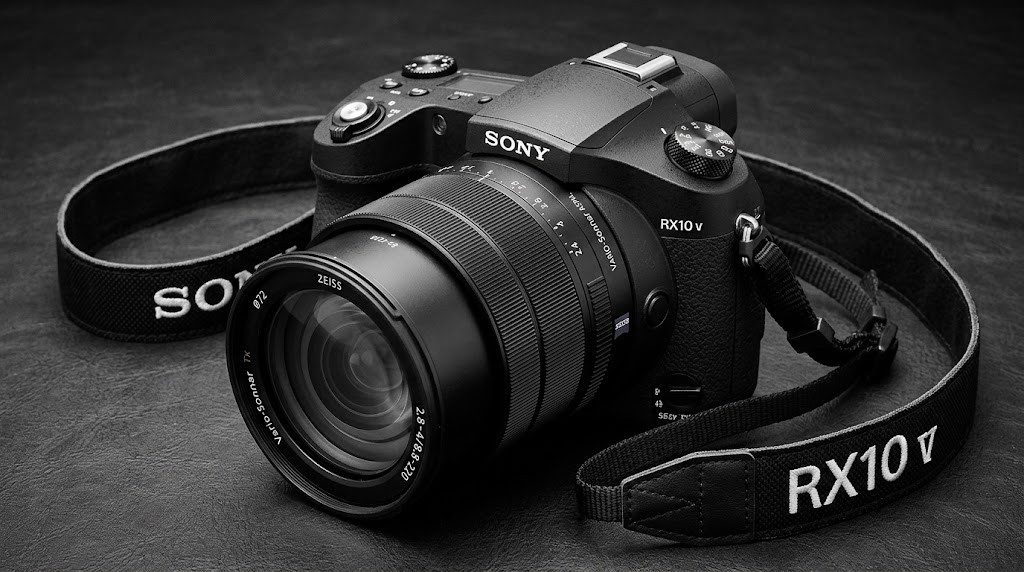
At its core sits the same 20.1 megapixel 1-inch stacked BSI CMOS sensor used in the RX10 IV, paired with a ZEISS Vario-Sonnar T* 24-600mm equivalent lens at a bright F2.4-4.0 aperture. That combination delivers a 25x optical zoom range in a single body, covering everything from wide landscapes to distant wildlife without ever swapping lenses.
Sony kept the core imaging hardware unchanged but rebuilt nearly everything around it. The new Bionz XR processor with an integrated AI chip drives faster autofocus, quicker burst shooting, and improved video specs. Ergonomics also borrow heavily from Sony’s Alpha mirrorless lineup, giving this bridge camera a genuinely modern feel.
Design and Build Quality
The Alpha-Inspired Control Layout
Sony reshaped the RX10 V’s top plate significantly compared to its predecessor. Extra exposure dials now sit alongside the shutter button, with one dial lockable to prevent accidental changes. The shooting mode dial moved to the right side of the body, taking the place once occupied by a small top LCD screen.
Long-time RX10 IV owners will need a short adjustment period here. The new layout feels closer to a modern Alpha camera than the older Cyber-shot-style design, which most reviewers consider a genuine improvement despite the learning curve.
A New Grip and Bigger Battery
The RX10 V ships with a redesigned, more comfortable grip shape. That larger grip exists partly to house Sony’s bigger NP-FZ100 battery, the same cell used across the Alpha mirrorless range. This single change delivers one of the most significant real-world upgrades in the entire camera.
Reviewers consistently praise how much better the camera feels in hand during long shooting sessions. The added bulk stays modest, and the ergonomic payoff clearly outweighs the minor size increase for anyone shooting for extended periods.
What Sony Removed
Not every design change moves in a positive direction. Sony dropped the built-in flash entirely from the RX10 V, though a hot shoe remains available for external flash units. The top LCD screen also disappeared, replaced by the relocated mode dial.
These omissions genuinely frustrate some reviewers who relied on quick flash access or a glanceable top display. Buyers upgrading from the RX10 IV should factor in this tradeoff before assuming the newer model strictly improves on every front.
The Viewfinder and Rear Screen
A Genuinely Upgraded EVF
The electronic viewfinder receives one of the most dramatic upgrades on the entire camera. Sony fitted a larger 0.5-inch Quad-VGA OLED panel with 3.68 million dots and 0.78x magnification, a substantial jump over the RX10 IV’s smaller 0.39-inch, 2.36 million dot unit.
Reviewers describe the difference as immediately noticeable. The larger, sharper viewfinder makes tracking fast-moving subjects considerably easier, which matters enormously on a camera built with wildlife and sports photography in mind.
The Rear Touchscreen
The rear display keeps its familiar 3-inch tilting design but gains a modest resolution bump to 1.62 million dots. Touch functionality improves noticeably over the outgoing model, and a new vertical display mode adds welcome flexibility for shooting in portrait orientation.
This screen will not surprise anyone already familiar with Sony’s recent camera lineup, but the added polish keeps it competitive against rivals launching in the same price bracket.
Autofocus and Burst Performance
Sony’s Latest AI-Powered Subject Detection
The RX10 V borrows its Bionz XR processor and AI chipset directly from Sony’s current Alpha mirrorless cameras. That shared hardware brings genuinely advanced subject recognition to a bridge camera for the first time, with dedicated detection modes for people, animals, birds, insects, cars, trains, and airplanes.
Hands-on testers specifically praised bird detection performance during real wildlife shoots. Autofocus tracking stayed reliable even when birds appeared small within the frame, a scenario that typically challenges cameras in this price category.
Burst Shooting Without Blackout
Continuous shooting speed jumps from the RX10 IV’s 24fps to 30fps using the electronic shutter, with zero viewfinder blackout even at the fastest setting. The mechanical shutter tops out at a more modest 10fps, which most reviewers found perfectly adequate for typical shooting scenarios.
A speed boost feature, borrowed from Sony’s professional cameras, lets photographers hold a custom button to temporarily jump from a moderate burst rate up to the full 30fps only when the action intensifies. This approach helps manage file counts without sacrificing the ability to capture decisive moments.
Where Autofocus Still Needs Care
Busy scenes with multiple faces, such as crowded events or group photography, occasionally challenge the RX10 V’s subject detection system. Reviewers found that narrowing the autofocus area helps the camera lock onto the intended subject rather than drifting toward background faces.
This limitation feels minor compared to the overall autofocus improvements, but it is worth knowing before relying on fully automatic subject selection in chaotic shooting environments.
Image Quality
The Same Sensor, Smarter Processing
The RX10 V uses the identical 20.1 megapixel 1-inch stacked sensor found in the nine-year-old RX10 IV. Resolution and raw image quality have not changed at the hardware level, which some buyers may find underwhelming given the long gap between generations.
The real improvements come from processing rather than raw specs. Sony’s newer chipset delivers noticeably better color accuracy and a higher percentage of correctly focused shots, which matters just as much as sensor resolution in practical, everyday shooting.
Sharpness Across the Zoom Range
Reviewers consistently praise how sharp images look throughout the entire 24-600mm zoom range, particularly given how far that focal range stretches. The bright F2.4-4.0 aperture also helps in lower light and allows for genuine background blur at the telephoto end of the lens.
Detail does soften somewhat in low light conditions, particularly past ISO 5000, where noise becomes noticeably more visible. This remains a reasonable limitation given the 1-inch sensor’s physical size compared to larger APS-C or full-frame alternatives.
Macro Capability
The lens focuses as close as 3 centimeters at the wide 24mm end, and down to 72 centimeters at full 600mm telephoto, delivering a maximum magnification of 0.49x. That combination gives the RX10 V genuine macro versatility alongside its wildlife and landscape capabilities.
Sample shots from reviewers show the camera capturing surprisingly detailed close-ups of insects and small subjects, adding real flexibility beyond the headline superzoom feature.
Video Capabilities
Higher Frame Rates Across the Board
Video specs receive a meaningful boost over the RX10 IV. The new model records full-width 4K at up to 60fps, compared to the previous model’s 30fps ceiling, and adds a cropped 4K120 mode for slow motion work. Full HD footage still tops out at 240fps for extreme slow motion.
These upgrades put the RX10 V in a genuinely competitive position for hybrid shooters who want strong video alongside stills capability, something the RX10 IV struggled to offer by comparison.
Professional Color Tools
Sony added its popular S-Cinetone and S-Log3 color profiles to the RX10 V, along with support for importing up to 16 custom LUTs. These tools give video shooters real flexibility in post-production color grading, a feature set previously reserved for Sony’s more video-focused cameras.
A dedicated tally lamp, improved audio workflow options, and in-camera time-lapse recording round out the video-focused additions, making this bridge camera considerably more capable for content creators than its predecessor ever was.
Battery Life and Connectivity
A Genuinely Massive Battery Improvement
Sony switched the RX10 V to its larger NP-FZ100 battery, the same cell used across the Alpha mirrorless lineup. Rated battery life jumps to approximately 630 shots per charge, compared to just 400 shots on the outgoing RX10 IV, a roughly 50 percent improvement.
This single upgrade transforms the day-to-day shooting experience. Reviewers who previously carried multiple spare batteries for the RX10 IV report far less anxiety about running out of power during long wildlife or travel shooting days.
Modern Ports and Wireless Features
A USB-C port finally arrives on this generation, enabling faster file transfer and convenient on-the-go charging from a power bank. This addition alone likely explains part of why Sony discontinued the RX10 IV, since that older model never received USB-C support required under newer regulations in some markets.
Wireless connectivity includes 5GHz Wi-Fi alongside 4K30 live streaming support, and the Sony Creators’ App handles remote control, file transfer, and firmware updates from a connected smartphone.
Weather Resistance and Durability
The RX10 V carries dust and moisture resistant sealing throughout its body, though Sony stops short of guaranteeing full waterproof protection. This level of sealing suits typical outdoor shooting conditions like light rain, dusty trails, or humid environments common in wildlife photography.
Reviewers who tested the camera across multiple outdoor sessions, including bird photography trips and travel shooting in varied weather, reported no issues with the sealing holding up under normal use.
Storage and File Handling
A Single Fast Card Slot
The RX10 V includes one SDXC card slot rated for UHS-II speeds, an upgrade over the slower storage supported by the RX10 IV. That faster interface matters directly for buffer clearing during extended 30fps bursts and for writing high-bitrate 4K60 footage without dropped frames.
Some enthusiasts may wish for a second card slot as backup, a feature increasingly common on higher-end mirrorless bodies. For a bridge camera in this category, a single fast slot remains a reasonable and expected tradeoff given the body size.
Burst File Organization
Sony improved how the camera groups continuous shooting sequences during playback, making it noticeably easier to scroll through a long burst and pick out the sharpest frames. This small workflow detail matters more than it sounds during a busy wildlife session that generates hundreds of frames in seconds.
Reviewers specifically called out this organizational improvement as a quiet but genuinely useful upgrade, one that saves real time during editing after a long day of shooting fast-moving subjects.
Price and Value Consideration
A Significant Jump From the RX10 IV
The RX10 IV launched back in 2017 at 1,699 to 1,800 dollars depending on region. The RX10 V now costs 2,299 dollars, a substantial increase that partly reflects nearly a decade of inflation and partly reflects the meaningfully upgraded processor, viewfinder, and battery inside.
This price positions the RX10 V well above most competing bridge cameras, though direct rivals with comparable image quality and build remain scarce. Buyers should view this camera as a premium, specialist tool rather than a casual point-and-shoot purchase.
What Else That Money Could Buy
Photographers already invested in Sony’s mirrorless ecosystem might consider the Sony FE 400-800mm F6.3-8 G OSS lens instead, which costs similarly to the RX10 V and delivers sharper results when paired with a full-frame body like the A7R V. That setup sacrifices portability and versatility for outright image quality.
Buyers prioritizing raw zoom range over ultimate image quality might look toward the Nikon Coolpix P1100, which offers a staggering 125x optical zoom at roughly half the RX10 V’s price. That camera’s much smaller sensor produces noticeably softer images, making it a different tool built for a different priority.
Sony RX10 V vs Sony RX10 IV
The core imaging hardware stays remarkably consistent between generations. Both cameras share the same 20.1 megapixel 1-inch stacked sensor and the same 24-600mm F2.4-4.0 ZEISS lens, meaning raw resolution and optical quality have not fundamentally changed.
Nearly everything surrounding that core hardware improved meaningfully. The new processor delivers faster, smarter autofocus. The viewfinder jumped to a larger, sharper panel. Battery life grew by half. Burst speed climbed from 24fps to 30fps with zero blackout. Owners of a well-functioning RX10 IV may not need to upgrade immediately, but anyone buying fresh should choose the newer model without hesitation.
Sony RX10 V vs Nikon Coolpix P1100
The Coolpix P1100 wins decisively on raw zoom range, stretching to an extraordinary 125x optical zoom covering a 25-3000mm equivalent focal length. That range dwarfs the RX10 V’s already impressive 25x zoom, and it costs roughly half as much.
The tradeoff involves image quality and overall refinement. The P1100’s much smaller sensor produces noticeably softer, noisier images compared to the RX10 V’s larger 1-inch sensor. Buyers chasing outright reach on a tighter budget may prefer the Nikon, while anyone prioritizing image quality alongside strong zoom range should choose the Sony instead.
Who Should Buy the Sony RX10 V
Enthusiast wildlife and bird photographers who want serious reach without carrying a full mirrorless body and separate telephoto lens make up the ideal audience for this camera. The combination of a bright, versatile lens and genuinely capable autofocus makes it a compelling all-in-one solution for exactly this use case.
Travel photographers who want to pack a single capable camera instead of multiple lenses will also find real value here. The RX10 V covers landscapes, portraits, macro subjects, and distant wildlife without a single lens change, which matters enormously when packing light for extended trips.
Who Should Skip the Sony RX10 V
Current RX10 IV owners who remain happy with their existing camera have little urgent reason to upgrade, given that the core sensor and lens remain unchanged between generations. The improvements, while real, mostly affect handling and speed rather than fundamental image quality.
Photographers who already own a Sony mirrorless body should seriously consider a dedicated telephoto lens instead. A setup like the A7R V paired with Sony’s 400-800mm lens delivers noticeably sharper results, even though it costs more overall and sacrifices the RX10 V’s compact, all-in-one convenience.
Pros and Cons Summary
What works well:
- A perfectly balanced combination of image quality and genuine 25x zoom versatility
- The latest processor and AI autofocus meaningfully improve wildlife and action photography
- A 50 percent battery life boost removes a major daily frustration from the previous model
- The upgraded viewfinder and new AF joystick both improve real-world handling significantly
- Strong video specs, including 4K60 and professional color profiles, add genuine hybrid appeal
What holds it back:
- A steep 2,299 dollar price tag places it well above most bridge camera alternatives
- The built-in flash and top LCD screen have both been removed compared to the previous model
- Lens zoom speed feels slightly sluggish during fast-paced shooting situations
- The sensor and lens remain identical to the nine-year-old predecessor
- Busy scenes with many faces can occasionally confuse the subject detection system
Frequently Asked Questions
Is the Sony RX10 V worth the price? For enthusiast wildlife, bird, and travel photographers who want serious zoom reach in a single body, yes. Buyers expecting a dramatic sensor or lens upgrade after nine years may find the price harder to justify.
What is different between the RX10 V and the RX10 IV? The RX10 V adds a newer Bionz XR processor with AI autofocus, a much larger and sharper viewfinder, a 50 percent battery life boost, faster burst shooting with no blackout, and USB-C connectivity. The core sensor and lens stay the same.
Does the Sony RX10 V have good autofocus for wildlife photography? Yes. Reviewers specifically praised its bird and animal detection performance, describing the tracking as reliably sticky even with small subjects in the frame.
How long does the Sony RX10 V battery last? Sony rates the camera at approximately 630 shots per charge using the NP-FZ100 battery, a significant improvement over the RX10 IV’s 400 shot rating.
Can the Sony RX10 V shoot good video? Yes. It records 4K at up to 60fps without cropping, offers a 4K120 cropped mode, and includes professional color tools like S-Log3 and S-Cinetone alongside custom LUT support.
Does the Sony RX10 V have a built-in flash? No. Sony removed the built-in flash on this generation, though a hot shoe remains available for external flash accessories.
Is the Sony RX10 V weather sealed? The body carries dust and moisture resistant sealing, though Sony does not guarantee full waterproof protection.
How does the Sony RX10 V compare to the Nikon Coolpix P1100? The Nikon offers a much longer 125x zoom at roughly half the price, but its smaller sensor produces noticeably softer images. The RX10 V trades some reach for meaningfully better image quality.
Does the Sony RX10 V accept interchangeable lenses? No. Like all bridge cameras, the lens is permanently fixed to the body as part of its core design.
Should I upgrade from the RX10 IV to the RX10 V? If your current RX10 IV works well, the upgrade is not urgent, since the sensor and lens have not changed. Buyers purchasing fresh, or those frustrated by the RX10 IV’s autofocus, viewfinder, or battery life, should choose the newer model.
Final Verdict
The Sony RX10 V earns its return after a nine year wait. It keeps the winning core formula that made the RX10 IV the best bridge camera on the market, then wraps that formula in a genuinely modern processor, a dramatically improved viewfinder, a much larger battery, and Sony’s latest autofocus intelligence. Wildlife and travel photographers who want serious zoom reach without carrying multiple lenses will find real value here.
The honest tradeoffs remain real too. The price climbed substantially, the built-in flash and top LCD both disappeared, and the core sensor and lens have not moved forward in nearly a decade. Buyers should view this as a thoughtful, well-executed refinement rather than a full reinvention. For the specific audience it targets, it remains the best all-in-one superzoom camera available today.
Want more in-depth camera reviews like this? Visit Alt Buzz for the latest camera reviews, comparisons, and buying guides covering every major brand.
Prefer video breakdowns instead of reading? Subscribe to the Alt Buzz YouTube channel for hands-on camera coverage, real-world testing, and gear comparisons published every week.