
Sony RX10 V vs Sony RX10 IV: Is the Upgrade Worth It?
Nine years is a long time to wait for a new camera. That is exactly how long Sony made bridge camera fans wait between the RX10 IV and its successor. The RX10 IV spent nearly a decade as the undisputed best all-in-one superzoom camera on the market, largely because nobody, including Sony, bothered to challenge it.
Now the RX10 V exists, and current RX10 IV owners face a real question. Does this new model justify spending 2,299 dollars on an upgrade, or does the old camera still hold up well enough to skip this generation entirely? This comparison breaks down exactly what changed, what stayed the same, and who actually benefits from upgrading.
We pulled together specs, hands-on testing notes, and direct side-by-side comparisons to give you a clear answer. Let’s get into it.
Quick Overview: What Actually Changed
The Core Hardware Stayed the Same
Both cameras share the identical 20.1 megapixel 1-inch stacked BSI CMOS sensor. Both use the same ZEISS Vario-Sonnar T* 24-600mm equivalent lens at a bright F2.4-4.0 aperture, delivering the same 25x optical zoom range that defines this camera line.
This matters enormously for anyone expecting a fundamentally sharper or higher resolution camera. Raw optical image quality has not moved forward in nine years. Sony chose to refine everything surrounding that hardware instead of replacing it.
Everything Else Got Rebuilt
The RX10 V swaps in Sony’s newer Bionz XR processor paired with a dedicated AI chip, the same combination found in current Alpha mirrorless bodies. That upgrade touches nearly every part of the shooting experience, from autofocus intelligence to burst speed to video specifications.
Ergonomics, the viewfinder, the battery, and the port selection all received meaningful updates too. Think of this generation as a full chassis and electronics overhaul built around an already excellent lens and sensor combination.
Sensor and Image Quality Compared
Identical Resolution and Optics
Both cameras capture 20.1 megapixel stills through the same physical lens and sensor combination. Pixel-level sharpness, dynamic range ceiling, and optical characteristics remain essentially unchanged between generations, since nothing in the actual light path was redesigned.
Photographers hoping for a resolution bump or a physically larger sensor will not find one here. Sony clearly decided the existing 1-inch sensor and lens combination still competes well enough not to warrant replacement.
Smarter Processing Changes the Results
Despite identical hardware, real-world image quality still improved. The RX10 V’s newer processor delivers noticeably better color accuracy according to hands-on reviewers, along with a higher percentage of correctly focused, keeper-worthy shots thanks to smarter autofocus.
This distinction matters practically even if it does not show up on a spec sheet. A camera that nails focus more consistently effectively produces better usable images, even when the underlying sensor resolution never changed.
Autofocus: The Biggest Real-World Difference
RX10 IV’s Autofocus Now Shows Its Age
The RX10 IV originally impressed reviewers with solid autofocus for its era, including basic subject tracking. Nine years later, that system feels noticeably behind current standards, lacking the specific subject categories and AI-driven intelligence found in Sony’s newer cameras.
Photographers who have used more recent Sony bodies will immediately notice the gap when picking up an RX10 IV today, particularly when tracking erratic or fast-moving wildlife subjects.
RX10 V Brings Real AI Subject Detection
The RX10 V inherits its autofocus system directly from Sony’s current Alpha lineup, adding dedicated detection modes for people, animals, birds, insects, cars, trains, and airplanes. Reviewers specifically praised how reliably the camera tracked birds in flight, even when subjects appeared small within the frame.
This upgrade alone represents the single most significant practical improvement between generations. Anyone who regularly photographs wildlife, sports, or moving subjects will feel this difference immediately during real shooting sessions.
Burst Shooting Speed Compared
RX10 IV Tops Out at 24fps
The RX10 IV offered a respectable 24fps burst rate using its electronic shutter for its time, a genuinely fast speed when it launched back in 2017. That speed still holds up reasonably well today for casual action shooting.
Buffer depth and shot-to-shot consistency on the older model reflect its age, however, and the camera lacks the newer speed boost button feature that lets shooters jump between burst rates on demand.
RX10 V Pushes to 30fps With Zero Blackout
The newer model increases maximum burst speed to 30fps using the electronic shutter, with no viewfinder blackout even at that top speed. A speed boost button also lets photographers hold a moderate burst rate normally, then jump to the maximum speed only when the action intensifies.
This combination genuinely changes how photographers shoot fast action. Continuous visual feedback during a burst, paired with on-demand speed control, gives the RX10 V a real edge for capturing decisive, fleeting moments.
Viewfinder and Screen Differences
RX10 IV’s Smaller, Dimmer Finder
The RX10 IV shipped with a 0.39-inch electronic viewfinder carrying 2.36 million dots. That spec felt competitive at launch but reads as noticeably modest compared to viewfinders found on current cameras across every price bracket.
Photographers using the RX10 IV today often describe the finder as functional but uninspiring, particularly when tracking fast subjects where a sharper, larger view makes a real difference.
RX10 V’s Dramatically Upgraded EVF
Sony fitted the RX10 V with a substantially larger 0.5-inch Quad-VGA OLED panel, boasting 3.68 million dots and 0.78x magnification. Reviewers describe the jump as immediately obvious the moment you look through it, transforming how confidently you can track a moving subject.
This single component upgrade ranks among the most noticeable differences between the two generations during actual hands-on use, right alongside the autofocus improvements.
Rear Screen: A Smaller Gap
Both cameras use a 3-inch tilting touchscreen, though the RX10 V gains a modest resolution bump to 1.62 million dots along with improved touch responsiveness. A new vertical display mode also arrives exclusively on the newer model.
This particular upgrade feels far less dramatic than the viewfinder change, representing a nice refinement rather than a transformative improvement.
Battery Life: A Genuinely Massive Upgrade
RX10 IV’s Modest Battery Life
The RX10 IV relies on Sony’s smaller NP-FZ50 battery, officially rated for approximately 400 shots per charge. Many owners report needing to carry multiple spare batteries for any serious full-day shooting session, particularly when using the viewfinder heavily.
This limitation frustrated wildlife and travel photographers especially, since long observation periods between shots still drain the battery steadily even without constant shutter presses.
RX10 V’s 50 Percent Improvement
The newer model switches to the larger NP-FZ100 battery already used across Sony’s Alpha mirrorless range, pushing rated battery life up to approximately 630 shots per charge. That represents a roughly 50 percent improvement over the outgoing model.
Reviewers who tested both cameras back to back specifically called out this change as one of the most welcome quality-of-life improvements, removing a genuine source of anxiety during extended shooting days.
Design and Ergonomics Compared
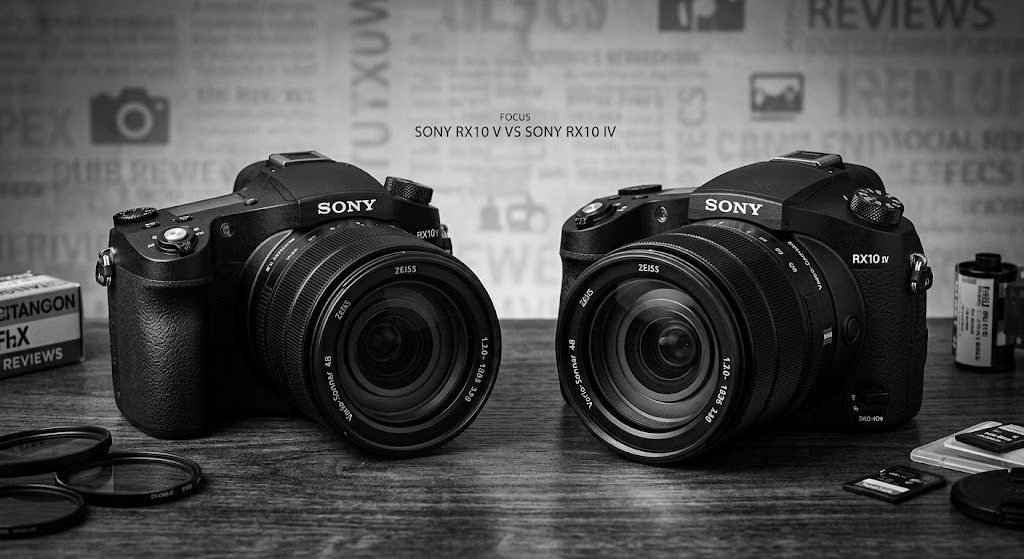
RX10 IV’s Compact, Cyber-shot Feel
The RX10 IV carries design language closer to Sony’s older Cyber-shot compact cameras, with a smaller grip and a more basic top plate layout including a small top LCD screen and built-in flash.
This layout feels perfectly usable but noticeably dated next to Sony’s current camera lineup, particularly for photographers already accustomed to the control schemes found on modern Alpha bodies.
RX10 V’s Alpha-Style Overhaul
The RX10 V borrows control layout cues directly from Sony’s mirrorless cameras, adding extra exposure dials, a genuinely useful AF joystick for manual focus point selection, and a larger, more comfortable grip shaped around the bigger battery inside.
Reviewers who used both cameras extensively particularly praised the added joystick, describing it as something they wished the RX10 IV had included from the start, especially for precise wildlife autofocus point placement.
What Got Removed Along the Way
Sony’s redesign was not purely additive. The RX10 V drops the built-in flash entirely, keeping only a hot shoe for external units. The top LCD screen also disappeared, replaced by the relocated shooting mode dial in that same physical space.
Photographers who relied on quick built-in flash access or a glanceable top display should weigh this tradeoff carefully. It represents a genuine step back in specific situations, even as the overall control layout improves.
Video Specifications Compared
RX10 IV’s Modest Video Ceiling
The RX10 IV caps out at 4K recording limited to 30fps, a fine specification for 2017 but clearly dated against current video-capable cameras. Slow motion options and color grading tools also stayed fairly basic on this generation.
Video-focused buyers today would find the RX10 IV noticeably limiting compared to what modern hybrid cameras now offer as standard, even within the same bridge camera category.
RX10 V’s Meaningful Video Upgrade
The newer model records full-width 4K at up to 60fps, adds a cropped 4K120 mode for genuine slow motion work, and introduces professional color tools including S-Cinetone, S-Log3, and support for 16 custom LUTs. A dedicated tally lamp and improved audio workflow round out the package.
This upgrade transforms the RX10 V into a genuinely capable hybrid camera, closing much of the gap that previously made the RX10 line feel like a stills-only proposition.
Connectivity and Ports
RX10 IV’s Aging Port Selection
The RX10 IV notably lacks a USB-C port, relying on older connection standards for charging and file transfer. This omission became a real liability over time, particularly as USB-C became a legal requirement for new electronics in some markets.
Many industry observers point to this missing port as a likely factor in why Sony eventually discontinued the RX10 IV rather than continuing to sell it indefinitely alongside the newer model.
RX10 V’s Modern Connection Standards
USB-C arrives standard on the RX10 V, enabling faster file transfers and convenient charging from any USB-C power source, including portable power banks while traveling. Wireless connectivity also improves with 5GHz Wi-Fi support and 4K30 live streaming capability through the Sony Creators’ App.
These additions feel less exciting than autofocus or battery improvements, but they meaningfully modernize the day-to-day usability of the camera for anyone managing files on the go.
Price Comparison
What the RX10 IV Cost at Launch
Sony originally launched the RX10 IV in 2017 at approximately 1,699 to 1,800 dollars depending on region. Nine years later, that pricing looks genuinely reasonable in hindsight, especially considering how long the camera remained the class leader without a direct challenger.
Used and remaining new stock of the RX10 IV can sometimes be found at a meaningful discount compared to the new model, making it a reasonable budget option for buyers who do not need every feature the RX10 V adds.
What the RX10 V Costs Today
The RX10 V launched at 2,299 dollars, a substantial jump that reflects both nearly a decade of inflation and the genuinely upgraded processor, viewfinder, and battery inside. This pricing positions the newer camera as a clear premium purchase within an already premium camera category.
Buyers should view the price difference as paying specifically for autofocus intelligence, viewfinder quality, and battery life rather than for any change in core image quality, since the sensor and lens remain identical between both models.
Side-by-Side Specification Comparison
| Feature | Sony RX10 IV | Sony RX10 V |
|---|---|---|
| Sensor | 20.1MP 1-inch stacked CMOS | 20.1MP 1-inch stacked CMOS |
| Lens | 24-600mm F2.4-4.0, 25x zoom | 24-600mm F2.4-4.0, 25x zoom |
| Processor | Bionz X | Bionz XR plus AI chip |
| Burst Shooting | 24fps electronic | 30fps electronic, zero blackout |
| Autofocus | Basic subject tracking | AI subject detection, multiple categories |
| Viewfinder | 0.39-inch, 2.36m dots | 0.5-inch, 3.68m dots |
| Rear Screen | 3-inch tilt, lower resolution | 3-inch tilt, 1.62m dots, vertical mode |
| Battery | NP-FZ50, approx. 400 shots | NP-FZ100, approx. 630 shots |
| Built-In Flash | Yes | No, hot shoe only |
| Top LCD | Yes | No, replaced by mode dial |
| USB Port | Micro USB | USB-C |
| Video | 4K up to 30fps | 4K up to 60fps, 4K120 cropped |
| Launch Price | 1,699 to 1,800 dollars (2017) | 2,299 dollars (2026) |
Who Should Upgrade to the RX10 V
Wildlife and bird photographers who regularly shoot fast, unpredictable subjects will feel the biggest benefit from upgrading. The combination of AI-driven autofocus, a larger viewfinder, and zero-blackout 30fps burst shooting directly addresses the exact scenarios where the RX10 IV starts to show its age.
Photographers who shoot long days away from a charging outlet, or who regularly run low on battery with the RX10 IV, will also find real, immediate value in the roughly 50 percent battery life improvement alone.
Hybrid shooters who want strong video alongside stills capability should also lean toward the newer model, given the substantial jump in frame rates and the addition of professional color grading tools.
Who Can Stick With the RX10 IV
Casual and travel photographers who mainly shoot landscapes, portraits, and everyday scenes may not notice much practical difference between the two cameras, since the core sensor and lens produce essentially identical image quality in typical daylight conditions.
Budget-conscious buyers who can find a well-maintained used RX10 IV at a significant discount should seriously consider that option instead, particularly if fast autofocus tracking and extended battery life are not top priorities for their typical shooting style.
Anyone who already owns a functioning RX10 IV and feels satisfied with its performance has little urgent reason to upgrade, since the fundamental image quality has not changed at all between generations.
Frequently Asked Questions
Is the Sony RX10 V a big upgrade over the RX10 IV? In terms of autofocus, viewfinder quality, burst speed, and battery life, yes, the improvements are substantial. In terms of raw sensor resolution and lens sharpness, the two cameras remain essentially identical.
Do the RX10 IV and RX10 V use the same lens? Yes. Both cameras share the identical ZEISS Vario-Sonnar T* 24-600mm F2.4-4.0 lens with the same 25x optical zoom range.
Which camera has better autofocus, the RX10 IV or RX10 V? The RX10 V offers significantly more advanced autofocus, with AI-driven subject detection across multiple categories including birds, animals, and vehicles, borrowed directly from Sony’s current Alpha mirrorless lineup.
How much better is the battery life on the RX10 V? The RX10 V rates for approximately 630 shots per charge, compared to 400 shots on the RX10 IV, an improvement of roughly 50 percent thanks to the larger NP-FZ100 battery.
Does the RX10 V have a built-in flash like the RX10 IV? No. Sony removed the built-in flash on the RX10 V, keeping only a hot shoe for external flash units, while the RX10 IV retained its built-in flash.
Is the RX10 IV still worth buying today? For casual and travel photographers on a budget who do not need the latest autofocus or video specs, a discounted RX10 IV can still deliver strong image quality thanks to its unchanged sensor and lens.
What video improvements does the RX10 V offer over the RX10 IV? The RX10 V records full-width 4K at up to 60fps and adds a cropped 4K120 slow motion mode, compared to the RX10 IV’s 4K30 ceiling, along with professional color tools like S-Log3 and custom LUT support.
Why did Sony wait nine years between the RX10 IV and RX10 V? Sony has not officially explained the gap, though the RX10 IV’s continued strong sales and lack of direct competition likely reduced urgency for a successor until now.
Does the RX10 V have a better viewfinder than the RX10 IV? Yes, significantly. The RX10 V uses a larger 0.5-inch, 3.68 million dot panel compared to the RX10 IV’s smaller 0.39-inch, 2.36 million dot unit.
Should I sell my RX10 IV to buy the RX10 V? Only if you specifically need faster autofocus, longer battery life, or improved video specs for your shooting style. If your RX10 IV already meets your needs, the core image quality has not changed enough to justify an immediate upgrade.
Final Verdict
The Sony RX10 V represents a smart, focused upgrade rather than a full reinvention. Sony correctly identified that the RX10 IV’s sensor and lens combination still competed well nine years later, so the company poured its engineering effort into everything surrounding that hardware instead. The result is a camera that autofocuses smarter, shoots faster without blackout, sees through a dramatically better viewfinder, and lasts far longer on a single charge.
Whether that upgrade is worth 2,299 dollars depends entirely on how you shoot. Wildlife photographers chasing fast, unpredictable subjects will feel every one of these improvements immediately. Casual shooters who mainly capture landscapes and everyday scenes may find their existing RX10 IV, or a discounted used model, perfectly adequate for years to come.
Want more in-depth camera comparisons like this? Visit Alt Buzz for the latest camera reviews, comparisons, and buying guides covering every major brand.
Prefer video breakdowns instead of reading? Subscribe to the Alt Buzz YouTube channel for hands-on camera coverage, real-world testing, and gear comparisons published every week.